The Fountain (2006)

2008 #37
Darren Aronofsky | 93 mins | DVD | 12 / PG-13

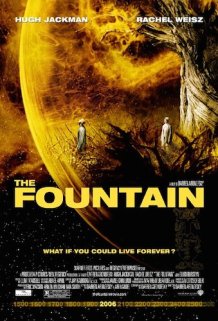
The FountainThe Fountain was one of the more critically divisive films of recent years, eliciting genuine “love it or hate it” reviews all round. I find myself leaning more towards the former. While I can’t claim to fully understand (let alone explain) much of what it means, and while I usually dislike things that can pretentiously be described as “film as poetry” (or similar), there’s something in the qualities of The Fountain that engaged me.

For one thing it looks gorgeous. While the whole film is beautifully shot, it’s hard not to single out the future segments, in which Aronofsky chose to create space with “micro-photography of chemical reactions” rather than the usual CGI. However it was achieved, the important thing is it looks great. Clint Mansell’s score is equally beautiful, both dramatically exciting and romantically tender — sometimes at the same time. Performance-wise, Hugh Jackman is undoubtedly at the centre and is as likeable as ever. It’s only the present-day segments where he really has much to do, in the arguably-clichéd story of a scientist so desperate to find a cure for his wife’s disease he misses out on spending time with her. Rachel Weisz is good as ever as the wife, even if her American accent is occasionally distracting.

Meanwhile, the past segments are essentially an historical adventure movie with some of the plot scenes cut, and the future segments offer near-2001 levels of silent obscurity. By a similar token, the film has an apparently ambiguous finale that, unusually, I’m quite happy to let wash over me. I’m sure there are multiple conclusions a viewer can reach for what it’s ‘about’ — the eternity of love, the repetition of life, or simply a sci-fi/fantasy quest for immortality — but I find myself happy to accept that it may mean one, all, or none of those things and just leave it be. It’s an odd way to feel at the end of a film — not caring about what it meant, but in a good way.

I can only apologise that, a bit like the film, this review is relatively brief, a tad dreamy, and somewhat inconclusive. I can see why some dislike this film, and I think I’d normally be one of them, but in this case something about it captured me. I look forward to seeing it again and, maybe, getting a better idea what it was.

4 out of 5

Hulk (2003)

2008 #36
Ang Lee | 132 mins | DVD | 12 / PG-13

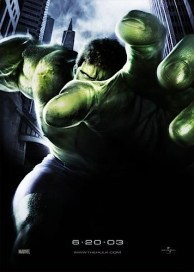
HulkWith the Edward Norton-starring (and -penned), Louis Leterrier-directed sequel/re-imagining of the Hulk coming this summer, I decided it was finally time to watch Ang Lee’s much derided 2003 attempt at bringing Marvel’s green monster-hero-thing to the big screen. Much like the lead character — in a Jekyll & Hyde-style, he’s mild-mannered scientist Bruce Banner by day, but the big green monstrous Hulk when angry — this is very much a film of two vastly different sides.

Indeed, the most striking thing about Lee’s interpretation of the Hulk is what a mish-mash of styles it is. On the one hand, it wants to be a drama/thriller, focussed on father-child issues and military cover-ups. On the other, it has comic book action sequences and a bizarre editing style inspired by comics — a compilation of unusual techniques that look like a Media Studies teacher’s wet dream. Not even Spider-Man was that kooky. In the end, it just means the cutting style feel out of place, firstly because for much of the film (at least the first 45 minutes) it’s the only reminder of the film’s comic roots, but especially because Lee’s use of the tricksy techniques is inconsistent — sometimes confusingly overused, sometimes apparently forgotten. Other technical elements also detract. Danny Elfman’s score is blandly uninspired, a carbon copy of his work on similar films. Worst of all is the CGI Hulk — it looks like they used an action figure he’s so plasticky. It gets by OK in early appearances, swathed in moody shadows, but in the glaring desert sunlight he doesn’t stand a chance.

The big, destructive sequences starring the Hulk himself are too little too late. There’s nothing wrong with sneaking drama into blockbusters, but this feels like a blockbuster snuck into a drama. There are fights because there have to be, not because anyone involved in making the film seems to want them. They’re badly placed thanks to the plot structure and the film’s pace topples under their weight. Even the climax wants to be a battle of wills between father and son, but turns into a nonsensical messy CGI splurge. That said, the dramatic moments don’t fare much better. Usually so watchable, Eric Bana can do little with the material offered here. The rest of the cast don’t suffer as much, and there are times when it almost works, but neither the dramatic nor blockbuster sides fully function in themselves, and certainly not when slammed together.

Hulk is not a film anyone could love — even the weakest comic adaptations usually have their fans — and, for a film aimed at a devoted fan base, this is perhaps its biggest flaw. Equally, it retains too much of the superhero genre for anyone to consider admiring it as a purely dramatic film. Hopefully Hulk-fan Norton’s film can marry the two halves better… or if not, at least create some cool destruction-filled action.

2 out of 5

I Am Legend (2007)

2008 #35
Francis Lawrence | 96 mins | DVD | 15 / PG-13

This review contains major spoilers.

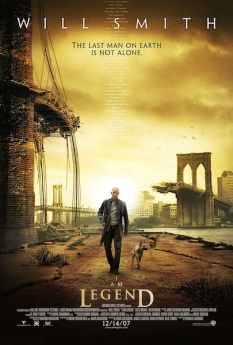
I Am LegendWill Smith stars in this adaptation of Richard Matheson’s classic sci-fi novel from the director of Constantine. The latter is a film I personally enjoyed (and which features a relatively early appearance of the currently prolific Shia LaBeouf) but received some mixed reactions on the whole. By a broadly similar token, I Am Legend has received a fair share of negative reviews, though my opinion is a little more divided.

Things go very well for the first half. It’s nicely paced, concentrating on a depiction of one man’s loneliness taken to the extreme. The script, and Smith’s acting, handle the material well. The deserted and destroyed New York looks as stunning as the trailers promised, while the CGI animals that roam it are as good as any. The flashbacks that punctuate the film are well executed too, drip-feeding clues to what happened while maintaining some mysteries of their own. There are some other good sequences: Neville’s exploration of a pitch-black Dark Seeker-infested building is tense, and the death of his pet dog — his one remaining companion — is moving, even if it was given away in the trailer. That scene is effectively played and shot, showing only Neville’s face as he is forced to euthanize the diseased animal by suffocation.

Sadly, this is where things begin to go down hill. The Dark Seekers — the film’s vampires/zombies/whatever — are crafted with pretty good CGI, but they’re still not life-like enough to work. If it were a mindless blockbuster they would’ve been more at home, but as it’s managed to be an effective drama they feel entirely out of place. It’s true that real actors couldn’t have managed the physical feats the creatures are made to pull off, but do they really need to do those things? I suspect not. The film also leaves several holes in the Dark Seeker’s actions — for example, they copy Neville’s trap, a move apparently beyond their intelligence, but the film neglects to explore why or how they did this.

Instead it moves on to the arrival of some more survivors. Quite where they came from, or how they got into the supposedly isolated Manhattan, is another inadequately explained set of circumstances. After they arrive, the film’s climax comes out of nowhere. It’s as if the screenwriters ran out of ways to keep things going so just bunged on a big climactic action sequence. And what happens in it is pretty silly too, especially Neville’s self sacrifice — why not get in the Magic Safe Hole too and then chuck the grenade out? Perhaps he just has a death wish by that point. It would seem most of the audience did. There’s also a pathetic epilogue, and an even worse final line that attempts to make sense of the title.

I Am Legend is something of a disappointment. The considered and effective first half gives way to an increasingly nonsensical second, marred by numerous flaws that stack up til a near-laughable conclusion comes from nowhere. I’ve been told that the ‘alternate theatrical cut’, with a handful of additional scenes and a new ending, is marginally more effective. I’m sure I’ll watch it someday and share my thoughts. For now, I Am Legend’s two halves of differing quality just leave it in the middle of the road.

3 out of 5

I Am Legend is on Watch tonight, Saturday 11th October 2014, at 9pm. It’s on again on Tuesday, when I’ll (re-)share my thoughts on the so-called “Alternate Theatrical Version”.

What May has been

Ah May! The start of summer! Not that I like summer, personally, as I’m rather adverse to all that heat. But it’s been miserable weather for the most part so far, so I’m all the happier.

As is my film viewing, it must be said. Happier, that is, not miserable. The second year of 100 Films got off to an entirely ignominious start, but May has seen something of a turnaround — 41% of all the new films I’ve seen this year have been in the last 31 days. I’m actually behind with reviews, having seen up to #37 (but only posted to #34). As I catch up you can look forward to my thoughts on The Fountain, Hulk and I Am Legend. Along with Transformers, they make for an appropriately blockbustery selection just as 2008’s season kicks off.

Nonetheless, I still have 63 new films to see ’til I reach my target. Such a feat may only require just over 2 films per week, but as I’ve barely topped 1.5 on average so far it’s all to play for. At this point last year I only had 45 films to go, but I still managed to see 74 more before the end of December — that bodes well at least…

Transformers (2007)

2008 #34
Michael Bay | 138 mins | DVD | 12 / PG-13

TransformersAs I’m sure you know, Transformers is a live action adaptation of the ’80s cartoon inspired by a toy line, which managed to become the highest grossing non-sequel of 2007 (though, of course, it’s still very much part of a franchise. But taking that into account places it 5th, which doesn’t sound as impressive. If anyone’s interested, the highest-grossing non-franchise movie was Ratatouille… though you could argue that’s basically in the Pixar franchise, so the honour would then slide to I Am Legend… which you could argue is in the Will Smith franchise, but that would be pushing it).

Firstly, I have to admit that I’m inadvertently something of a Michael Bay fan; or, at least, a fan of his films. He’s hardly the world’s greatest director — certainly not in an award-winning sense — but his movies set out to be big and fun and, more often than not, they achieve it. I always think I’ve seen very few of them, but I’ve actually been fairly comprehensive: Bad Boys and, especially, The Rock are both entertaining action flicks; Armageddon I half-watched once and it seemed a bit crap; the only bits of Pearl Harbor I’ve happened across have been even more laughable than reviews led me to believe; Bad Boys II was overlong and overrated, but had its moments; conversely, The Island was cruelly slated — I could write a whole review of my thoughts on that, but this isn’t the place. So I’ve actually taken in all of his films (one way or another), bar this latest — another huge-budgeted, action-packed, CGI-heavy extravaganza. Same old same old?

Not quite. Thanks to its kid-friendly basis, and in spite of much slaughter and gags about masturbation, Transformers is probably Bay’s most family-friendly offering. That said, it’s still very much a Boys’ Film, packed with soldiers, fights, explosions, and female characters who are either hot teens with a surprising knowledge of mechanics or hot twenty-somethings with a surprising knowledge of computers. Or comedy mothers. But most of all, there’s a serious technology fetish — the film nearly bursts with so many cars, planes, guns, army vehicles… Of course, if there’s one film where a tech fetish is acceptable, it has to be one about giant robots who can reshape themselves into everyday items. In these moments the CGI is frequently astounding, as thousands of parts move and rearrange to change a plane/car/hi-fi into a robot being. It happens so fast that, unbelievably, it’s rarely even the focus of the scene. It’s also mostly photo-real, though it becomes hard to judge just how real because the physical impossibility means the viewer reasons it has to be CGI. That doesn’t stand in the way of the achievement though, and how the effects team lost out to The Golden Compass at the Oscars is beyond me (to be fair, I haven’t seen that Pullman adaptation, but the CGI looked decidedly under-impressive in the trailers).

It’s not all so good. The music is indistinguishable from that in every other Bay film, which means it usually serves its purpose but is beginning to sound a tad tired. The opening is a little dry, with too much focus on faceless soldiers and not enough on the infinitely more entertaining story of Sam Witwicky, who’s played with charm by Shia LaBeouf, rising (risen?) star du jour. Once the Autobots (they’re the good robots) turn up en masse halfway through the film really hits its stride, suddenly becoming funny, exciting, and even stirring on occasion. The finale’s a bit of a muddle however, with no clear idea of which robot is which and who’s fighting who, or what the strategy/point actually is. It’s disappointingly anticlimactic in some respects, especially the duel between Optimus Prime (head Autobot) and Megatron (head Decepticon — they’re the bad robots), which amounts to little more than a couple of clashes. Why can no one seem to manage a good final battle these days? Megatron is underused in the film as a whole, only coming to life very late on and affording Hugo Weaving about five lines. It seems a waste.

Despite these flaws, I really enjoyed Transformers, certainly more than I expected to. It may be clichéd in places, with too much of a tech fetish, shallow female characters, too many faceless soldiers, bouts of weak dialogue, a muddled climax… But it’s still fun, with enough likeable moments and characters to carry it through. Hopefully they can focus in on what worked — or, at least, maintain the same level of quality — in next year’s sequel.

4 out of 5

Throne of Blood (1957)

aka Kumonosu jô

2008 #33
Akira Kurosawa | 105 mins | DVD | PG or 12

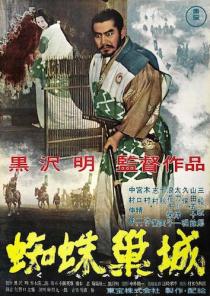
Throne of BloodKurosawa moves Macbeth from Scotland to 16th Century Japan in this retelling of Shakespeare’s infamous Scottish Play. I’ve heard this described as a loose adaptation — perhaps those reviewers have never read the play. Kurosawa sticks very closely to the structure of Shakespeare’s version of the story (though based on real events, Shakespeare changed key details), often choosing to adapt it scene-for-scene. It works well in the new setting, with some of the themes — honour, respect, betrayal — perhaps becoming more understandable when placed in samurai culture. Kurosawa changes other elements too — character names are understandably localised, there’s only one witch, there’s no version of the famous “Is this a dagger which I see before me?” monologue, and so on. It’s not all omissions however, as Kurosawa adds imagery and symbolism of his own. Again this helps to place the story in its new context, but also covers the loss of Shakespeare’s original language (a major sticking point for some critics).

Beyond the Shakespearean similarities (or lack of), there’s much to see in Throne of Blood — literally, thanks to the atmospheric cinematography. Most of the exteriors are doused in fog, and while this is sometimes over-done (an extended sequence of Washizu and Miki riding in and out of it goes on too long) it also makes for some amazing moments, such as when the trees of Cobweb Forest drift menacingly forward. The interior of the forest is suitably oppressive and scary too, the perfect location for encountering a witch. Kurosawa was inspired by Japanese Noh theatre in his construction of the film, so there are a lot of longer shots that allow the characters to be blocked as if on stage. It’s not overly theatrical, thankfully, and works suitably.

Cinematic techniques are not entirely abandoned however. The most memorable is the banquet scene, in which Washizu sees Miki’s ghost: we see Miki’s empty seat, the camera tracks forward to a shocked Washizu, then back to reveal the ghost of Miki sat at his place, before tracking and panning around the room to follow Mifune’s brilliant performance. It’s an infinitely more effective reveal than any amount of jiggery pokery with dissolves or CGI could provide. Similarly, Washizu’s iconic death scene — in which hundreds of arrows puncture him and the surrounding walls — is impressively achieved (using real arrows), including one seamless shot when an arrow pierces his neck.

Macbeth is my favourite Shakespeare play — it’s a great story, with great themes, imagery and language. Throne of Blood obviously loses some of this, but it doesn’t matter in the slightest — Kurosawa has constructed an excellent and well-conceived retelling with a few of his own flourishes.

5 out of 5

A note on the classification: the UK DVD from the BFI is rated PG, classified in 1991. A few months after the DVD’s release in 2001, the film was re-submitted to the BBFC and received a 12. Quite way the rating was raised isn’t explained, and copies of the DVD still bear a PG on the cover.

Indiana Jones and the Kingdom of the Crystal Skull (2008)

2008 #32
Steven Spielberg | 122 mins | cinema | 12A / PG-13

This review contains major spoilers.
For a spoiler-free view, see my initial thoughts.

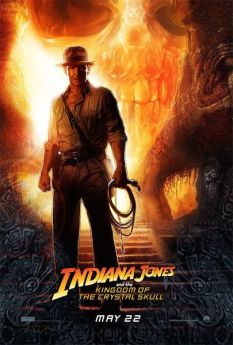
Indiana Jones and the Kingdom of the Crystal SkullI’ve grown up with Indiana Jones around. Not in the way Harry Knowles may have (apparently if you weren’t old enough to see the original trilogy in the cinema, at precisely the right age, then this film isn’t for you), but they’ve always been there. I was so young when I first saw Last Crusade (on video) that, even though it can only have been two years old at most, it was a film that had Always Existed as far as I was concerned (much like Ghostbusters and Back to the Future, or so many other ’80s movies that I love). I remember directing a recreation of Last Crusade in the playground (with me as Indy, of course, and one of my best friends hating me for days because he’d been Brody and I’d melted him at the end, my 6-year-old memory having confused the character with Donovan); loving Young Indiana Jones whenever they showed it on BBC Two; visiting the absolutely fantastic stunt show at DisneyWorld Florida; churning through a couple of the tie-in novels (carefully selected from the gift shop based on their blurbs); having the Raiders poster on my door for at least a decade; running around with my Indy hat and Nazi cap gun (wow, we must’ve bought a lot in that gift shop); wishing there were action figures for me to play with (and appropriating an Alan Grant from Jurassic Park for the task, because he had a vaguely similar hat)… There are many more Indy memories locked away in my head, but I think those examples will more than suffice.

And so, about 17 years or so since I first encountered Dr Henry Jones Jr, I finally get to see him in the cinema. I don’t think I’m one to be easily suckered in by that thrill factor, however. I wasn’t one of the people who came out of Phantom Menace extolling it’s virtues only to later realise how disappointing it was; heck, I came out of Two Towers not with the feeling that after a whole year (wow!) of waiting Lord of the Rings was back and wasn’t it great — I thought it dragged for at least the first half and found Helm’s Deep somehow anticlimactic. I say this in defence of the fact that I enjoyed Crystal Skull and think it’s a good film, an opinion that seems oddly rare at the minute. I suspect this will change with time.

That’s not to say the film isn’t flawed, mind. The opening’s a bit slow for my liking, there are few lines that are as funny or as quotable as in the other films, and some moments push things a bit too far — I’m thinking specifically of Indy escaping a nuclear test in a lead-lined fridge. It’s not as bad as Bond surfing the wave from a melting ice shelf in Die Another Day, but it’s not really in-keeping either. Another oft-cited problem is the amount of material the film awards to some of its starry cast members. Actors of the calibre of John Hurt, Jim Broadbent and… well, most people say Ray Winstone, but I think he’s overrated as an actor… still, they don’t get a great deal to do. The problem here is that they’re John Hurt, Jim Broadbent and Ray Winstone — replace them with unknowns and far fewer people would whinge about the size and point of their roles. Quite why an actor like John Hurt would accept such a small, almost one-note role (while there may be more depth to the character, it’s all revealed in Mutt’s memories rather than Hurt’s performance) is a different issue, but he does play the part well.

The rest of the cast fare better: Shia LaBeouf continues to be a star on the rise, here blessed with a teen rebel who isn’t also incredibly irritating. Mutt has a heart, and we don’t have to suffer a two-hour ‘emotional journey’ to find it. He pairs well with Harrison Ford too, and one can see why George Lucas suggests a future for the franchise that emulates the father-son dynamic from Last Crusade. That said, Ford gets his best partner in Karen Allen’s Marion. She was always the best ‘Indy girl’, and while her return may be as surprising as Indy wearing that hat and carrying a whip (not just because we’ve seen her in all the trailers, but who else is it going to be when Mutt first mentions a Marion in the diner?) she plays a vital role in injecting some verbal humour and banter into proceedings. The only other noteworthy female cast member is Cate Blanchett as a villainous Russian psychic (maybe). She’s clearly having bags of fun with the part, and is rewarded primarily with a death scene that is pleasingly in line with those in the rest of the series. This is another moment some reviewers have whined about, saying we’ve seen it before, but personally I’d’ve been disappointed with anything less from an Indy film.

Of course, this is all without really mentioning the man himself. Make no mistake, Harrison Ford is still Indiana Jones. The hair may be grey, the face covered in more lines, but the attitude and humour is still there. This is an older Indy, of course — he’s not only aged nearly two decades since we last encountered him, he’s also lived through the Second World War. The snippets of dialogue that explain what he’s been up to since we last saw him are all very nice for fans too, I think, but are pleasingly not dwelt upon for too long — this is a film that will work just fine for anyone who somehow hasn’t seen the first three. Ford can still hold his own in the action stakes too, running, swinging and punching his way through a variety of thrilling sequences. The screenplay could have used his age as a crutch, leaving him with some comedy running away while the much younger Mutt got stuck in; this isn’t the case, and that’s great.

As for those action sequences, they’re a lot of fun. The best by far is an extended chase through the jungle, including a fantastically conceived sword fight on the back of two moving vehicles. There’s a good deal of silliness in it — Mutt’s Tarzan-like vine swinging, or Marion’s use of a handily-placed tree to get their car into a river — but this is a franchise explicitly inspired by the B-movie thrills of the ’30s, ’40s and ’50s, in which context these things are more than acceptable. It’s a little daft, but it’s all such fun that if you’re worrying about the realism you’re not entering into the spirit of things. More disappointing is some lacklustre CGI, which is used far more often than Spielberg might have liked us to believe. There’s also a bit with some large ants that may be a little too close to the use of beetles in The Mummy, but as that’s basically an Indiana Jones rip-off it seems only fair to return the favour.

Finally, there’s the MacGuffin: the eponymous Crystal Skull (the “Kingdom of the” prefix isn’t really needed). It’s alien, as long-rumoured, which has undoubtedly angered some fans. Personally, I don’t find it any sillier than the Ark of the Covenant or the Holy Grail, equally unreal items (in fact, less real — maybe the aliens are too likely to be true for some viewers?) with equally fantastical powers. It also fits with the mid-50s setting, post-Roswell and heading into the Space Race. The design of the aliens and their saucer is pleasingly retro, though obviously achieved with CGI, and it does tie to theories that ancient monuments and civilisations had contact with aliens (again, true or not, they’re no worse than the religious artefacts of the other films). Like everything else about the film, the MacGuffin may not be quite as good as the equivalent elements in Raiders and Last Crusade, but it pushes close enough.

Speaking of which, it’s worth quickly mentioning the UK rating. For some reason, Crystal Skull is a 12A while Raiders and Last Crusade are both only PG. I swear there’s nothing worse in this film than those; in fact, I’m sure there’s nothing here that’s as likely to be traumatising for youngsters as Donovan melting at the end of the third film. I expect it says more about our variable rating system than it does about the films themselves, but in the unlikely event anyone reading this is wondering about its suitability for a younger audience, there’s my thoughts.

As I mentioned earlier, reaction to the film, both from critics and the general viewing audience, has been somewhat mixed. It seems plenty of fans have left their rose-tinted glasses with their DVD box set and viewed Crystal Skull with the all-too-critical eye of one who isn’t aware they don said goggles to watch the older films. Crystal Skull is a suitable return to the Indiana Jones series — full of fun and excitement, and a good chance to be reacquainted with old friends. It can’t beat Raiders because that came first, automatically embedding itself as the best in the minds of many; and it can’t beat Last Crusade, partly because it lacks the wonderful dynamic between Harrison Ford and Sean Connery, and partly because I just love that film. But, crucially, it is in the same league as them, and that’s fine by me.

4 out of 5

My initial reactions to Kingdom of the Crystal Skull can be read here.

Iron Man (2008)

2008 #31
Jon Favreau | 126 mins | cinema | 12A / PG-13

This review contains spoilers.

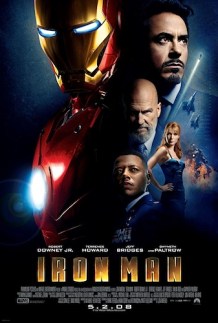
Iron Man“Iron Man, Iron Man, does whatever an iron can. Flattens clothes, nice and smooth; burns a hole if he doesn’t move. Look out! Here comes the Iron Man!”
OK, maybe not…

Irritating ‘humorous’ review intros aside, Iron Man has never been at the forefront of my comics experience. X-Men and Batman, yes yes yes; a few of Alan Moore’s, of course; a solid stab at getting through Preacher; occasional diversions into Spider-Man or Ghost Rider… But never Iron Man (or a slew of others, but they don’t have a surprisingly successful movie currently in cinemas). Whilst he’s obviously a popular character with fans, the film’s phenomenal success — both financially and critically — has rather taken me by surprise, and consequently dragged me to the cinema for the first time in over 10 months.

Tony Stark is, perhaps, Marvel’s answer to Bruce Wayne: the billionaire playboy CEO of a huge technology company who uses his technological know-how to become a superhero in the wake of personal tragedy — but in Stark’s case the company is an amoral weapons manufacturer and the playboy lifestyle isn’t just a front. What this means for the viewer is that, in the title role, Robert Downey Jr gets to shine. He has all the best lines and comedic moments (of which there are plenty) and a couple of cool action bits too (of which there are few). As he’s the hero this would seem just, but you only have to look at earlier entries in the Batman franchise to see how the hero can be sidelined for the villain. Elsewhere in the cast, Gwyneth Paltrow brings humanity to proceedings as the improbably named Pepper Potts, whose biggest flaw is that the filmmakers refuse to have anyone make a joke about her name. Not even one! Jeff Bridges gives a suitably dastardly performance as the eventual villain, but the plot woefully underuses him.

Because this is an origin story, you see, and sadly falls into most of the typical origin story traps: the ‘major’ villain exists only to provide a final act punch-up while the rest of the film explores how Ordinary Man (or Ordinary Rich Man in this case) gained Super Powers (or Built Super Suit) and went on to Save Mankind (or Save Some Foreigners, but I’ll leave deeper debates over the film’s dubious international perspective to others). It used to be the case that superheroes arrived on the screen ready to go — look at Burton’s original Batman, for example — but since the genre’s ’00s revival it’s all about the origins. What this typically means is a decent-enough first film that serves only to introduce the characters for the sake of a fully-formed second entry. One can only hope this will be the case with Iron Man.

The primary exception to this rule is Batman Begins, which succeeds because it’s less about the origin story and more an exploration of Batman’s psychology in general, something only vaguely alluded to in preceding efforts. Where Iron Man falters on this score is in completing Stark’s move from uncaring weapons manufacturer to socially conscious hero relatively early on, from which point he spends ages building his suit and battling, not an evil villain, but off-screen corporate machinations. The final fight, when it arrives, lacks punch (literally) and is over too soon. The amount of time, depth and humour awarded to the characters is to be applauded, but it comes at the expense of some excitement. At least it makes a change, as it’s thoroughly unusual to find the balance skewed that way.

To touch on an exceedingly minor element, the fan-pleasing post-credits scene with Samuel L. Jackson as Nick Fury is quite disappointing. While it’s cool to see Jackson as Fury, and a nice lead for the now-confirmed Avengers movie (which will come after Iron Man 2, so you have to wonder why the scene is at the end of this film), it’s too brief. When Fury informs Stark he’s not the only superhero in the world it provides a mixed reaction: on the one hand, we’re all too aware that from the Marvel Universe we’ve had three X-Mens, three Spider-Mans, a Daredevil, an Elektra, a Hulk (and soon another), a Punisher, and even a Ghost Rider — if they all take place in the same filmic universe then Stark ought to have noticed at least a couple of them on the news! And if they’re not in the same universe, one wonders if the cast of The Avengers movie will be padded with second-string heroes who barely warrant their own film. But that’s a debate for another review (one in three years’ time, in fact).

This may all sound a tad harsh on Iron Man, but when a film receives near unrelenting praise from most quarters it’s hard not to spy the faults when coming to it late. What it most resembles is a great TV pilot: at the end you enjoyed what you just saw, but your thoughts lie with what’s to come — “that’s the setup, now what will they do?” Hopefully Iron Man 2, due in two years, can take the many positive elements and run with them.

4 out of 5

Indy 4: Initial Thoughts (no spoilers)

Indiana Jones and the Kingdom of the Crystal SkullI couldn’t make it to the local midnight showing of Indiana Jones and the Kingdom of the Crystal Skull, so instead I plumped for the next one on the largest local screen (which is also the cheapest student rate locally — hurrah!) A whole 11 hours extra waiting…

The film has now been out in the UK for just over 14 hours, and goodness knows how long elsewhere, not to mention last Sunday’s premiere at Cannes, so the ‘net is already packed with thousands of opinions and full-bodied reviews (almost 3,000 people have already rated it on IMDb, unsurprisingly placing it in the Top 250). Hundreds of thousands more will follow in the ensuing hours, days, weeks and years — I’m sure discussion of Indy isn’t going away soon. Nonetheless, I’m throwing out my thoughts onto my little plot of webspace, just in case anyone cares. I’ll post a proper review another time, but these are a quick handful of reactions having finished the film less than an hour ago. They are, as the title notes, spoiler-free.

From the first shot it’s clear that a playful, entertaining spirit will pervade the film. It’s a bit of a slow open after that, but once it kicks into gear it’s excitement all the way. There are several exciting sequences, most notably the much-trailed jungle chase, so there’s no disappointment there. It also has the best idea for a sword fight since Pirates of the Caribbean 2. The MacGuffin is decent enough — not as iconic as the Ark or the Holy Grail, perhaps, but it more than serves its purpose. There are fewer quotable lines than you might hope, but the dialogue is still witty. It’s occasionally a bit silly too, but most of it’s in-keeping with the near-B-movie spirit of the franchise.

Indy’s age is playfully acknowledged, but it doesn’t become an excuse — he still gets plenty of action and drives the story. There are nice references to his earlier adventures (including the TV series) and what he’s been doing for the last 20 years. Most fans will appreciate that, I think. One might argue (and some reviews have) that a few actors are underused in their supporting roles, but this is Ford’s film and they’re no worse than, say, Sallah in Raiders and Last Crusade — I doubt they cast John Hurt, for example, and then wrote him a relatively small part. As with the opening image, Spielberg ends the film with another playful beat aimed primarily at fans.

To rank Crystal Skull in relation to the original trilogy, it’s the third best — but that’s behind Raiders, a certified classic, and Last Crusade, one of the first films I ever saw and which I love dearly. Aside from those, it stands head and shoulders above many other action/adventure films. Will it hold up as well as Raiders has in 27 years’ time? Who can say. But right now, it’s damn fine entertainment.

A proper review of Kingdom of the Crystal Skull will appear as #32 in the next few days, following my review of Iron Man.

Sweeney Todd: The Demon Barber of Fleet Street (2007)

2008 #30
Tim Burton | 112 mins | DVD | 18 / R

Sweeney ToddTim Burton and Johnny Depp collaborate for the sixth time (as the DVD’s blurb is so keen to point out) for a film adaptation of Stephen Sondheim’s musical adaptation of the classic tale of the titular barber who slaughters instead of shaves and sells the resultant meat to all of London in the pies of his accomplice, Mrs Lovett.

As with 2005’s Charlie and the Chocolate Factory, the announcement of Burton as director of Sweeney Todd was one of those “well, of course” moments, despite the vastly different audiences. And with Burton come Depp and Helena Bonham Carter, naturally. But whereas the eventual product of Charlie resulted in a “that’s that done then” feeling of the inevitable, Sweeney is more of an unknown quantity for me — I’m familiar with the basic story, of course, but not this particular version. It’s a dark tale, but told here in a heavily stylised manner — no gritty realism to be found (for that try the Ray Winstone TV movie), but instead there’s bold and striking performances, design, direction, and storytelling. One is tempted to call it “theatrical”, but the direction is anything but and the actors do much more than project for the benefit of the back row. It’s anti-naturalistic in all elements, which suits both the ghoulish and musical subject matters perfectly, but is consequently not to everyone’s taste.

As for the musical elements, Sweeney is done in an operatic style — the majority of dialogue is sung and the story is almost entirely told through these songs, rather than having a couple of numbers peppered throughout (quite how they managed to edit a trailer that was both comprehensible and light on song is near miraculous). Anyone who’s seen an Andrew Lloyd Webber production will be familiar with this way of doing things. Personally, I find it a more immersive style — everyone’s singing from the word go, not disconcertingly launching into song a little way in. The cast’s voices may not be perfect (and I’m far from a knowledgeable judge), but they do the job more than adequately. Rough moments almost add to the film’s style, and the cast’s acting abilities more than make up for them anyway. One casting oddity is Anthony Head, who turns up for a sole inconsequential line. He may not be a regular film actor, but surely he’s bigger (and certainly better) than a glorified extra? He’s not even listed in the end credits. I smell deleted scenes… (A bit of IMDb reading reveals I’m right. Sadly, these aren’t included on the DVD.)

The other striking element of Sweeney Todd is its look. London here is a dingy monochrome metropolis, interrupted only by fanciful fairytale-coloured fantasies like the song By the Sea, and, of course, gallons of vibrant spurting blood. Wisely held off until relatively late in the film, when the blood comes it is all the more shocking. And from that point it flows like wine — or, more accurately, squirts like a stamped-on ketchup bottle — in perfectly judged amounts: it gushes far more than you’d normally see but, because Burton never pushes it to the mad excess that Tarantino did in Kill Bill, it remains on the disturbing side of believable. The stylised theatricality of it almost makes you question the high classifications, but the underlying morals and sheer bloody volume ultimately justify them.

Yet there’s something missing from Sweeney Todd. I can’t work out what it is — perhaps the numerous numbers Burton cut or trimmed have unbalanced proceedings slightly, in some frustratingly ephemeral way? — but despite all this praise and only vague criticisms, I’m certain it’s a four-star film. A very solid four, to be sure, but it doesn’t achieve enough to pass higher.

4 out of 5

Sweeney Todd: The Demon Barber of Fleet Street is on Channel 4 tonight, Saturday 9th August 2014, at 11:10pm.