Superhero Movie (2008)

2008 #52
Craig Mazin | 85 mins | in-flight | 12A / PG-13
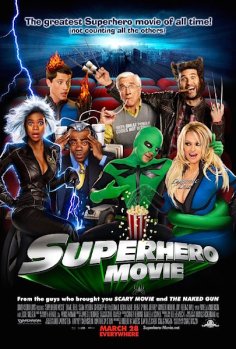
Superhero MovieYears ago, I saw Scary Movie. I don’t really know what I thought of it anymore, but I never expected I’d find myself watching another entry in the critically-derided …Movie series. But then I found myself on a plane, half asleep and with a choice of films I’d mostly rather watch on a decent-sized screen, and decided that maybe Superhero Movie wouldn’t be so bad after all…

As anyone who saw a trailer will have guessed, Superhero Movie is mainly a spoof of Spider-Man… a film that is now six years old. Unfortunately, this means that most of the best jokes have already been done in numerous other sketch-length spoofs, amongst them one at the MTV Movie Awards and one during Comic Relief 2005. The latter even did the green costume thing, though the hero was ‘Spider-Plant Man’ rather than the (less funny) Dragonfly employed here. Superhero Movie takes all this sketchery to the next level, however, crafting its story simply by reworking the first Spider-Man film almost scene by scene, inserting jokes (and, more often, ‘jokes’) where it can — which is about once per scene.

There are also asides that spoof X-Men, Fantastic Four and Batman, but they barely warrant a mention. They’re certainly not any funnier. In fact, the climax is the only wholly original plot point — or, at least, plot point not directly lifted from Spider-Man, as it may well come from some other comic source. This incessant copying makes the film feel like an over-extended sketch, and so it becomes clear that something like Mystery Men, with its genuinely original plot, makes for a much better superhero comedy movie.

As for the gags themselves, they’re childish, lewd, offensive (“isn’t Stephen Hawking funny!”), too specific to American culture, too topical (they’ll be dated within six months), already dated (“isn’t the Windows paperclip annoying!”), too obvious… It’s very much a movie made for now, not for posterity. Actually, to be fair, it’s very much a movie made for six years ago. In this respect I suppose it’s just like the rest of the …Movie series, which I’ve always felt looked like cheap TV specials owing to their specificity and, well, rubbishness. Still, believe it or not, some bits are actually amusing. Or amusing enough while they’re on. Perhaps I was just laughing out of desperation. I certainly can’t remember any of the jokes now.

Intriguingly (a word I use loosely here), there are a bunch of deleted scenes and gags during the end credits — not bloopers, but genuine deleted bits. It’s a mystery as to why these aren’t either in the film itself or relegated to DVD extras — it’s not like running time is an issue, and clearly pacing isn’t. In fact, some of the deletions are much funnier than gags that were left in. They’re probably the only reason to keep watching Superhero Movie to the end, though they’re not reason enough to start it in the first place.

2 out of 5

Superhero Movie featured on my list of The Five Worst Films I Saw in 2008, which can be read in full here.

The Golden Compass (2007)

2008 #51
Chris Weitz | 113 mins | Blu-ray | PG / PG-13

The Golden CompassThis adaptation of the first novel in Philip Pullman’s His Dark Materals trilogy (known as Northern Lights in the UK, but adopting the US title for the film — unlike Sorcerer’s Stone, it’s actually more appropriate) received quite the critical drubbing on its cinematic release, and wasn’t a huge success at the US box office either, which has cast doubt on the prospects of the following two instalments ever being produced. Which is a shame, because this is actually a fine family fantasy film.

The requisite elements are present and correct: a well-realised alternate world, engaging heroes, slightly camp villains, mysterious items, mysterious backstories, a globe-trotting quest, talking non-human characters, a couple of action sequences and casual doses of spectacle. The latter was something that worried me going into the film, in fact, as the CGI looked dreadful in the trailer. When it won the Oscar I really couldn’t understand how, but now having seen the film — and in high definition to boot — it was, to my surprise, mostly exemplary. There are weak patches, of course (Mrs Coulter’s monkey being the main one), but the majority is either appropriately realistic or in a suitable style enough that it didn’t matter. “Don’t judge a book by it’s cover,” as they say; or indeed a film by its trailer.

Another key sticking point for me was the discarding of the books’ religious elements, which is far too atheistical for most Americans (not that I’ve actually read the books yet, but I always enjoy a good bit of Christian baiting). The filmmakers have found an appropriate way around this however: there’s a subtext, blatant to the intelligent viewer, which carries such views. It will like whoosh over the heads of those who would’ve been offended by it, which is surely the point. Nonetheless, the lack of commercial success suggests that the stir it had already caused served to cement it as “the anti-Christian film” in too many people’s minds. Or perhaps it was merely that too few had heard of the books? Or there’s always those variable reviews…

Leading the cast as Lyra, Dakota Blue Richard’s accent seems forced and occasionally grates, but really speaking she’s pretty good (pun retrospectively intended). The rest of the cast make a good account of themselves, though the likes of Daniel Craig, Derek Jacobi and Christopher Lee were clearly cast in readiness for the intended sequels. Ian McKellen is as good value as ever and the rest of the voice-only actors offer able support. Nicole Kidman never really gets the chance to unleash her full evil potential however.

In fact, therein lies probably the film’s primary weakness. While Golden Compass does work in its own right, it’s as much Part One of a trilogy as Fellowship of the Ring: at the end you feel curiously fulfilled, even though there’s clearly a lot of tale left to tell. I can only hope that the muted success it achieved is enough to get the continuing and concluding parts made, though that seems increasingly, disappointingly, unlikely.

4 out of 5

Two-thirds done

With August now behind us, 2008 is two-thirds complete. And so, as I missed halfway, now seems like a moderately appropriate time to reflect on how well my aim of watching 100 new films is going in 2008.

By this point in 2007 I had made it to 98 films, which makes my current tally of 60 look a little lacklustre (reviews for ten of which are still in the works). At least it’s a nice round number. Still, there’s 17 weeks of the year to go — that means I need to average 2.4 films per week, or 10 per month, from here out. Considering my averages to this point are 1.7 and 7.5 respectively, it’s still all to play for.

I would say the summer blockbuster season has given me a hand though: at the end of the year’s first third I’d only made it to 22 films (averages: 1.3 per week, 5.5 per month), but, since Iron Man dragged me to the cinema for the first time in nearly a year, I’ve visited the big screen a total of eight times — not exactly a mind-blowing number, but at 8% of my aim (obviously) it’s not wholly insignificant.

Here’s a few more largely-pointless statistics to round out this post: as well as those eight cinema trips, I’ve seen 39 films on DVD, six via downloads, four on TV, and even one on VHS. There’s also been my first two films on Blu-ray, and one each for the new additions of IMAX and “in-flight”.

I’ve seen five alternate cuts (three of which warranted proper numbering) but just one short. Of all the features I saw, 16 ran over two hours (two made it past the three-hour mark!) and 15 didn’t even make it to 90 minutes! Films are often accused of having spiraling running times these days, but that’s clearly not the case for much of my viewing. I’m reviewing films from across the history of film, of course, but 10 of those 15 were produced in the last decade.

I’ve seen eight feature films that the BBFC awarded a U certificate, 20 that require some PG, 16 that warranted a 12 or 12A, 12 that pushed things to a 15, and just four of those naughty 18s. Two were unrated.

I did a statistics post earlier this year, for 100 days. Back then, I hadn’t seen any films from the ’70s, ’60s, ’50s, or before 1939. While I’ve still not managed anything from the ’70s or before 1939, I have at least seen two from the ’60s and four from the ’50s. As well as that, I’ve watched three films from the ’30s, five each from the ’40s and ’80s, and six from the ’90s. The 2000s still sit proudly atop the pile however, with a grand total of 37.

Three directors have managed to squeeze more than one film into the total so far — namely Kenneth Branagh, Alfred Hitchcock and Akira Kurosawa, each with two films. (Francis Lawrence and Christopher Nolan don’t really count as they appear twice thanks to alternate versions of the same films.)

Finally, I’ve handed out ratings right across the board. Animated Sherlock Holmes mystery The Baskerville Curse grabbed only my second-ever single-star rating, while seven films merely managed a lowly 2 stars. Ten films are theoretically average with 3, while the majority (30) made it up to 4. A total of 12 films so far this year have touched the giddy heights of 5 stars (not counting The Dark Knight twice). All of this leaves my average score for first-view films at 3.75 — as ever, I’m either largely watching good films or am just fairly generous with my scores.

That’s all for now. Back to actually watching films then… or maybe even getting round to reviewing them…

100 Films on a Cover

Empire, not content with conducting a ludicrously huge reader poll to find the 500 greatest films ever made, have also roped in 150 (as yet unnamed) “key directors and producers” and “the world’s most influential film critics” to have their say.

And Empire, not content with conducting a ludicrously huge reader poll and gathering the opinion of key directors, producers and critics to find the 500 greatest films ever made, have gone and created a “magazine milestone” — 100 different covers for the issue featuring the list! In fact, it’s 101, with the 101st being a subscriber-only cover that’s currently secret. I’m currently quite glad that Empire’s the only magazine I’ve bothered to keep up my subscription to.

I’m a bit of a collector and hoarder, but even I’m not mad enough to fork out £150 to get all 100 covers. That said, at just £1.50 an issue it’s a pretty reasonable deal, all things considered, and certainly better than the one Total Film offered when they did their 21 different Bond covers a short while back. Nonetheless, I’ll surely try to get my hands on a few different ones, and here’s my current pick of the bunch — mainly, films I love that have especially cool covers, but also some that just look good.

Click to enlarge.

Hamlet (1996)

2008 #50
Kenneth Branagh | 232 mins | DVD | PG / PG-13

Hamlet (1996)Following his success with Henry V and Much Ado About Nothing, Kenneth Branagh tackled arguably Shakespeare’s most revered play, Hamlet. And he didn’t do it by half. It’s the first ever full-text screen adaptation, which means it clocks in just shy of four hours; he unusually shot it on 70mm film, which means it looks gorgeous; and, while he grabbed the title role himself, he assembled around him a ludicrously star-packed cast from both sides of the pond — in alphabetical order, there’s Richard Attenborough, Brian Blessed, Richard Briers, Julie Christie, Billy Crystal, Judi Dench, Gerard Depardieu, Nicholas Farrell, John Gielgud, Rosemary Harris, Charlton Heston, Derek Jacobi, Jack Lemmon, John Mills, Jimi Mistry, Rufus Sewell, Timothy Spall, Don Warrington, Robin Williams and Kate Winslet — not to mention several other recognisable faces. Even Ken Dodd’s in there!

But, with impressive statistics and name-dropping put to one side, what of the film itself? Well, it’s a bit of a slog, especially for someone unfamiliar with the text. While there is much to keep the viewer engaged, the high level of attention required can make it a little wearing; certainly, I took the intermission as a chance to split the film over two nights. Amusingly, the second half uses the original text to provide a sort of “Previously on Hamlet“, which was very useful 24 hours later. None of this is the fault of Branagh or his cast, who do their utmost to make the text legible for newbies — for example, there are cutaways to events that are described but not shown by Shakespeare, which, among other things, help establish who Fortinbras is (Rufus Sewell, as it turns out) before he finally turns up later on.

That said, some of the performances are a bit mixed. Branagh is a good director and not a bad actor, but his Shakespearean performances are variations on a theme rather than fully delineated characters. While there a new facets on display here thanks to the complexity of the character, there are also many elements that are eerily reminiscent of his Henry V and Benedick. The Americans among the cast seem to be on best behaviour and generally cope surprisingly well, while Julie Christie achieves an above average amount of fully legible dialogue. Perhaps the biggest casting surprise is Judi Dench, appearing in what is barely a cameo — one wonders if the film-career-boosting effects of a certain spy franchise would have changed that.

The best thing about this version, however, is how it looks. Much credit to cinematographer Alex Thomson for using the larger 70mm format to its full, loading every frame with vibrant colours and packing detail into even the quietest moments. Not every frame is a work of art — there is, after all, a story to be told — but there’s more than enough eye candy to go round. Also, a nod to the editing (the work of Neil Farrell), which makes good use of long takes — many of them full of camera moves — but also sharply edited sequences, such as the all-important play. The fast cuts make for a joyously tense scene in a way only cinema can provide, which I suppose is rather ironic during a ‘play within a play’.

For fans of Shakespeare, I suspect Branagh’s Hamlet is a wonderful experience, finally bringing the complete text to the screen and executing it all so well. For us mere mortals, it’s a beautifully shot and engagingly performed film, that I’m sure would benefit from a greater understanding of the text.

4 out of 5

Brideshead Revisited (2008)

2008 #49
Julian Jarrold | 133 mins | cinema | 12A / PG-13

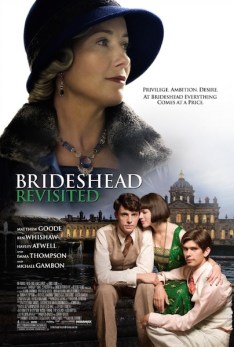
Brideshead RevisitedI’ve not seen the miniseries and I’ve not read the book, but I do know that both are considerably longer than Jarrold’s two-and-a-quarter hours film. So why does it feel so slow? Perhaps it’s the pair of opening flashforwards (easier to refer to them as that than to the majority of the film as one great big flashback), an overused technique these days that here serves no purpose whatsoever: there’s no additional insight on events that follow (or, rather, precede) by placing these snippets at the start, and there’s no new perspective on the snippets when we reach them chronologically (except that, second time round, we actually know who the characters are). It’s the most niggling fault in a film that, like my just-reviewed WALL-E, is of two halves.

The first is very good. It’s entertainingly written and performed, firmly in the tradition of the ‘heritage’ films and TV series that Britain churned out through the ’80s and ’90s — it’s the natural successor to the work of Merchant-Ivory, who of course produced the tonally-similar (at least at first) A Room With a View, which makes this all seem very appropriate. As Sebastian, Ben Whishaw is, perhaps unsurprisingly, the best of the three leads. When he’s off screen you miss him, and the point at which Sebastian leaves the story is arguably when things go off the boil. As Charles, Matthew Goode by and large holds his own — handy really, as he is definitely the centre of the film. Emma Thompson is as you’d expect her to be, which is to say she’s pretty good but ultimately it’s all rather familiar from her other performances.

The second half is where the film falls apart. The focus shifts from Charles and Sebastian’s friendship/possible homosexuality, to Charles and Julia’s love affair. The latter seems to come from nowhere and never takes off, consequently making it hard to accept the lengths they’re prepared to stretch to in order to make it work when they’re finally reunited years later. The plot slowly slides into darker and bleaker territory, needlessly dragging small characters back into proceedings to kill them off and finally pushing towards an Atonement-esque World War II epilogue. Some or all of this is obviously derived from the source, but considering the praise garnered by the novel and miniseries I presume it’s made to work there. Here it doesn’t.

An hour-and-a-half in I couldn’t understand what story there was left to tell, and I continued to be bemused by the sudden import of Charles and Julia’s relationship as the next hour dragged by. It’s a shame, because Brideshead starts out so promisingly and enjoyably, but once it begins to slide it never recovers.

3 out of 5

WALL-E (2008)

2008 #48
Andrew Stanton | 98 mins | cinema | U / G

“Pixar films” seem to have become a bit of a genre unto themselves — yes, they fit into “animation” (always dubious as a genre), “family” (almost as bad), “comedy”, and occasionally a few others, but, much as the Bond films have their own rules and expectations outside the “action” and “spy thriller” conventions, the work of Pixar always achieves special and particular attention. WALL-E subverts some of these expectations (it’s not a buddy comedy, mainly) and has received huge amounts of praise — “consequently”, some might add. It is indeed a very good film, but you’ll surely have heard all that elsewhere; instead, I’m going to draw attention to a couple of things that bothered me.
Most of these issues can be attributed to the fact that WALL-E is a film of two halves. They’re not exactly poorly linked, as elements from each feed into the other, but they are notably different. The first presents a realistically-rendered future Earth, deserted by humans (who are nonetheless represented on hologram screens by live-action actors) and now only inhabited by insects and a trash-collecting robot called WALL-E. Silent but for R2D2-like bleeps, WALL-E quickly endears himself to the audience through his actions. He’s cute, funny and likable, and the early scenes cement him in the audience’s sympathies, which is certainly handy for later. When EVE — a futuristic, iPod-alike ‘female’ robot — turns up, the film becomes a sweet love story, as WALL-E tries to instill the human-like emotions he’s developed into the cold new robot. A very funny and surprisingly touching love story, this is the film’s better half.

The second travels out into space, taking us to meet cartoon humans on a cartoony spaceship. It jars painfully with the realism that pervades the Earth-bound scenes, and the continued use of real actors in holograms highlights the cartoonish style of the future humans. There’s nothing wrong with a cartoon style, I hasten to add — certainly, it works better in films like The Incredibles and Ratatouille than the attempts at realism do in the Toy Story films — but it’s the contrast that’s uncomfortable. The story itself also takes a weak turn here: it becomes a light kiddy-adventure runaround, which is fun and still has flashes of humour and heart, but is nowhere near as daring or as effective as the first half. This is where the sympathies engaged earlier become important, because it’s the audience’s affection for WALL-E that provides most of the genuine quality in this half.

If I were to broadly characterise the two halves, I’d say the first is everything you’d hoped for after the advance hype, while the second is something you could have feared. It’s not bad — it’s still a superior light kiddy-adventure runaround, with exciting-enough sequences and a largely interesting (if unoriginal and preachy) plot — but it’s not as groundbreaking or engaging as the first half. Worst of all is when the cartoon humans land on the realistic Earth, however — it brings to mind films like Who Framed Roger Rabbit, where cartoon characters are placed in the real world. In this instance, that’s not a positive comparison.

WALL-E is a good film. The bits that work do so perfectly, keeping the overall quality high, and the weaker sections are ultimately only poor by comparison. If the whole film were like the second half I’d probably merrily accept it as a cartoon runaround but, coming after that beautiful beginning, it only served to gradually erode the fifth star from my rating. It’s a shame, in that respect. On the other hand, this is still one of Pixar’s very best films — I’d certainly rate it above the even-more-over-praised Ratatouille, and probably slot it close behind The Incredibles or Toy Story 2 at the top of the scale. Being pipped by films of that level — and then only just — is nothing to be ashamed of.

4 out of 5

The Dark Knight: The IMAX Experience (2008)

2008 #48a
Christopher Nolan | 152 mins | IMAX | 12A / PG-13

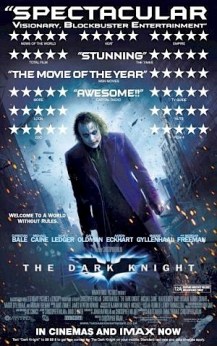
The Dark Knight: The IMAX ExperienceOne of the joys of spending five weeks of this summer in New York is that I have the opportunity to see anything that’s out in the US before the UK early. I haven’t entirely used this to my advantage (no trip to Hellboy II, for example, which has almost left theatres here but is still a few weeks off at home), but I have been to the much-anticipated new Batman movie, The Dark Knight… twice. Unlike in the UK, I have relatively easy access to an IMAX here, and, as any good Bat-fan will know, this means I was not only able to see TDK one week early, but also on the screen it (or, at least, parts of it) were specially shot for. Of course, despite the film virtually being on loop at Manhattan’s sole IMAX screen, the high demand for tickets means I had to wait til the second Saturday to see it writ so large — and even then I was fairly lucky, as some showings sold out inside of two hours.

As I’ve reviewed the film before, and my feelings on it have barely changed with a second viewing just one week later, it seems sensible to focus on the IMAX aspect. For those who somehow missed the news, The Dark Knight is the first Hollywood blockbuster to be specially shot for IMAX — not all of it, but six key sequences… or so they say. From what I could tell, while some whole sequences were indeed shot on IMAX film, often it was used just for bits of scenes, or now and then for the more dramatic establishing shots. For example, every aerial shot in the film — and, as those who’ve seen it will know, there are a fair few — appears to have been shot with IMAX cameras. The choice of sequences to shoot on IMAX is also intriguing. Some reviewers asserted it was “obvious” scenes were IMAXed even on a 35mm print, but I think they might be in for a surprise. Yes, the bank robbery opening, the car chase, and elements of the climax all receive the IMAX treatment, but elsewhere smaller scale action sequences and even some dramatic scenes are awarded the vision-filling honour.

It all looks stunning, of course: the resolution is visibly increased whenever the IMAX film kicks in (the rest of the film, blown-up from 35mm, is blurry and grainy by comparison but still doesn’t come out too badly) and the added size and scope of the format serve to underline the scenes for which it’s employed. While most of them are worthy, if sometimes unexpected, there are times when one wonders if scenes were picked just to make up the numbers with something not especially challenging. That said, it’s always nice to see, so one can’t complain too much. I didn’t find IMAX to be an especially viewer-friendly format for a two-and-a-half-hour feature though — it’s designed to fill your vision, an aim it achieves admirably, but when trying to watch a regular movie it entails an unusual amount of head turning, as well as trying very hard to notice everything right into the depths of your peripheral vision. It was certainly an experience, as the advertising subtitle suggests, but it won’t be for everyone and I’m not sure I’d bother again without some notable incentive (such as the one Dark Knight offers — none of these new-fangled 3D films have been interesting enough to tempt me yet). In some respects, what interests me most is what debates and opinions the use of IMAX will provoke about the film’s correct aspect ratio when it comes to DVD/Blu-ray time. I don’t care to predict what people will say, but I suspect it will be amusing to observe.

One final note: watching this just one week after I first saw it in a normal cinema (one week & one hour, to be exact!), it seemed to me that the odd shot was trimmed slightly or actually missing. Quite why this would be I don’t know, and it may just be my memory playing tricks, especially as the running time listed on the BBFC is actually slightly longer for the IMAX version (as seems to be standard, from a quick look at a few other IMAXed films — I’m sure someone knows why). The differences — if indeed there are any — are minor, but I felt I should mention it.

There’s no questioning The Dark Knight‘s brilliance in its own right, in my mind — it may be questionable whether it’s the Best Film Ever (surprisingly, it still sits at #1 on the IMDb Top 250), but at the same time I genuinely enjoyed this more than any other film I’ve seen from that top ten (and probably beyond). Whatever size screen you see it on, this film is an amazing experience — but some of it was shot especially for IMAX and those bits do look spectacular on the extra-huge screen. If you have the chance, this is really how Dark Knight should be seen — especially as it’s always possible that you won’t have the chance again.

5 out of 5

As if two reviews wasn’t enough, I shared more of my thoughts on The Dark Knight (this time when considered next to Batman Begins) here.

On the off chance anyone’s wondering what happened to #48, it’s WALL-E and the review’s on its way. But I’ve been sat on this one for a week (and not got round to the WALL-E one for over a week!), so I thought I’d just get on and post this, sequence be damned.

Presto (2008)

2008 #47b
Doug Sweetland | 5 mins | cinema | U / G

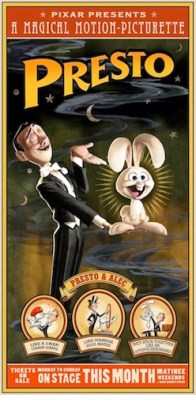
PrestoThe last Pixar film I bothered to head to the cinema for was 1999’s Toy Story 2, back in the days before “it’s made by Pixar” was reason enough to see a film (remember those times? They seem so long ago…) Their only other releases had been the first Toy Story (my enjoyment of which being the motivation to see the sequel) and the unappealing A Bug’s Life. Since then I haven’t had enough desire to expend the effort — or the money — to catch any of their films on the big screen. I explain this because, I’m reliably informed, all Pixar films are preceded by a short while in cinemas… but, because I’ve only seen most of them on DVD, I forgot this, so was initially surprised to see a caged rabbit when I was expecting an adorable little robot.

This rabbit, it turns out, is called Alec, and he’s a bit of a bastard. I think we’re supposed to root for him, and I’m sure kids (and many adults too) will, but while his owner (the titular magician) isn’t especially nice to our starring bunny (the plot is concerned with Alec trying to get a carrot that Presto won’t give him, yet), Presto doesn’t treat Alec quite as badly as Alec treats Presto. On the other hand, the overload of OTT physical violence is all in the name of humour, so that’s OK. It’s not as satirically extreme as The SimpsonsItchy & Scratchy though, which will ironically lead some to declare it promotes violence as comical. But then such ludicrousness is political correctness for you — in fact, Presto‘s brand of violence is very funny indeed. Completely dialogue free, it quickly becomes a breakneck feast of visual, mostly slapstick, humour. It may be violent, but it’s also highly witty, marvelously inventive, and wholly entertaining… even if the hero is morally dubious. But then, Roadrunner was a total wanker and he always won.

You can’t judge shorts on the same level as features, because they’re a different form — that’s why I don’t include them in the main numbering on this blog, and why I once felt the need to go on about that. So while awarding Presto a full five stars doesn’t mean it’s likely to be vying with The Dark Knight or… well, The Dark Knight… for my Film of the Year, it is thoroughly deserved. It’s a perfectly entertaining piece of short comedy, and it’s great that Pixar continues to facilitate wide exposure for such work.

5 out of 5

I Am Legend: Alternate Theatrical Version (2007/2008)

2008 #47a
Francis Lawrence | 104 mins | Blu-ray | 15

This review contains spoilers.

I Am Legend: Alternate Theatrical VersionI only watched the theatrical version of I Am Legend earlier this year (it’s #35), but, for reasons I won’t elaborate on for once, I’ve found myself watching this alternate version already.

Most of the comments in my original review still apply, as this cut only has minimal differences: there are a couple of very short new scenes in the third act, which were presumably excised because they primarily feed into the different ending, the main attraction of this version. Personally, I prefer it. The whole butterfly thing is too God-messagey, recalling the weakest elements of Signs, but if one can put that aside then the new content fits in much better with several threads that develop in the rest of the film (in both versions — in the original cut they’re just ignored). It feels like this was the intended conclusion but, for whatever reason, someone decided it needed changing. Perhaps it wasn’t explosive enough; or, indeed, conclusive enough, as it dispenses with the safe-haven epilogue and its pathetic attempt at justifying the title — another pleasurable loss as far as I’m concerned.

One other element I’ve reconsidered thanks to this repeat viewing are the CGI humans. They’re good enough in and of themselves, and would make more than passable foes in another action film, but here they ruin the ambiance that’s so carefully built up before their first appearance. Yes, the CGI lions are also clearly fake, but with limited methods to create such scenes they seem more acceptable. The arrival of the Dark Seekers, on the other hand, barges the film from thoughtful sci-fi drama into horror action blockbuster stylistically, in a way that using real actors simply wouldn’t. The not-real Dark Seekers may have superhuman jumping abilities, but the film doesn’t need those either, and could easily have crafted a similarly action-packed climax with real performers.

I Am Legend is still as middle-of-the-road as before, with very little to choose between the two versions. However, thanks to a less irritating final few minutes, this version just has the edge — if you ever intend to watch I Am Legend, be it a repeat viewing or your first, I recommend you plump for the alternate cut.

3 out of 5

The theatrical version of I Am Legend is on Watch tonight, Tuesday 14th October 2014, at 10pm.