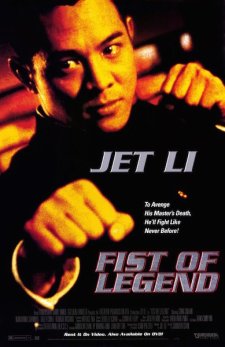
Fist of Legend (1994)

aka Jing wu ying xiong

2008 #77
Gordon Chan | 99 mins | TV | 18 / R

Fist of LegendI found myself watching Fist of Legend unintentionally following this year’s Children in Need appeal. The significance of this piece of trivia is that I watched it on TV, which means I had to watch it dubbed. Apparently, “it is regarded as one of the best martial arts films of all time, and almost universally viewed as Jet Li’s best” (thank you Wikipedia), but the dub does its utmost to obscure this.

Putting the audio aside (for the moment), the film has a lot to recommend it — primarily, the fights. At 2am, after seven hours of near-solid TV watching, it was these that drew me in. I’m no expert on martial arts, but I do like a good fight (on film) and Fist of Legend serves up plenty of those. In fact, there’s approximately one every five minutes, an impressively high ratio that consciously — and very pleasingly — fulfills what you want from this kind of film. This quantity doesn’t seem to have damaged quality either: all are generally impressive, but there are some particularly good ideas floating about too, such as a long fight where both participants are blindfolded.

There’s a plot too, which includes a few surprisingly surprising twists and an interesting undercurrent of Japanese/Chinese racial tensions thanks to the setting (1937, during a Japanese occupation of Shanghai). This adds an extra level to what could otherwise be a stock revenge plot.

So, that just leaves the soundtrack. The English audio is at least as bad as you’d imagine, and a reminder — if one were needed — about why dubbing foreign language films is so hated. Whatever the qualities of the film itself, the clichéd dub script and flat voiceover performances, awkwardly delivered to fit the actor’s mouth movements, make the film look cheap and poorly done. On the bright side, the main villain has an amusingly gravelly “I am playing a villain!” voice.

If you can look past the rubbish dub (which I should imagine is even easier on DVD, what with turning it off), Fist of Legend is very enjoyable. However, with the action being the primary source of pleasure, those who don’t like martial arts movies may want to imagine a lower score.

4 out of 5

The Cable Guy (1996)

2008 #79
Ben Stiller | 88 mins | download | 12 / PG-13

The Cable GuyThe best thing I have to say about The Cable Guy is that the opening titles were very well done.

The second-best thing I have to say is that a subplot featuring director Ben Stiller as a faded-child-star twin-killer is very neatly integrated into the film, seeming utterly pointless until it has a near-vital role in the climax. That’s a pleasing piece of writing/editing right there. Unfortunately, the point this seems to be aiming at — that TV rules our life too much, that we’re too addicted to it, etc etc — is not only old hat, but also rendered meaningless in this instance by the lack of impact: TV goes off for the night, and one guy picks up a book. Oh, wow. And to top it off, thanks to an unnecessary final beat, it seems Jim Carrey’s titular character hasn’t actually learnt the lesson we thought he had.

Incidentally, The Cable Guy is a comedy, though at times it seems to wish you’d forget that so it could be a psychological stalker thriller. Perhaps that’s what it had wanted to be — for one thing, there are surprisingly accurate predictions for the future of telecommunications, although their coming true may simply have killed another joke (“play Mortal Kombat with a friend in Vietnam!”) — until someone realised the idea was too silly to be taken completely seriously. How funny you find the end product will depend on whether you like the style of comedy Carrey employed in the early & mid-’90s, and whether you can stomach pointless asides that don’t do anything for the plot (final act freaky nightmare, step forward). There’s little else to engage interest — Matthew Broderick’s pseudo-protagonist is, perhaps, too nice and too eager to please, and the go-nowhere romantic subplot — his main action aside from being Carrey’s straight man — has all the depth and shape of something from a cookie cutter.

More fun than the jokes, actually, is playing Spot The Pre-Fame Comedy Star. Eyes open for young-looking turns from (in ease-of-identification order) Jack Black, Ben Stiller, Owen Wilson, Janeane Garofalo, and Kyle Gass. And Eric Roberts randomly shows his face too, not that that’s relevant to anything.

The Cable Guy is rated 12, or PG-13 in the US, which may also be the last ages you’d enjoy it at.

2 out of 5

In case anyone’s wondering what’s happened to #77 & #78… Despite spending 23 months carefully posting reviews in order (well, the first two months are actually a bit of a muddle), it’s now December and I’m a few behind, so I’ve decided to throw numerical sequence to the wind and just post reviews as & when I get round to completing them. The main reason for this is to help drive things forward so that I can actually end 2008’s posting by December 31st, rather than having it drag on into 2009 and overlap with Year 3. I’m sure no one will really mind. Or care.

Eternal laziness of the dreamless blogger

11 months down, 1 to go… 81 films down — it should’ve been at least 92.

It’s fair to say 100 Films hasn’t gone quite as smoothly this year as it did last, where I made it to 100 by the start of September and meandered on to a final total of 129. Rather than being in the luxurious position of just watching as much as I like to see how far I can get, I have 31 days to see 19 more films to even hit my basic target.

“Oops.”

I could reel off a list of excuses — the effort I’ve tried to put into writing much longer reviews, having an undergraduate degree to complete, starting work on a postgraduate degree, actually getting a job over the summer… but there’s also plain old laziness — yeah, isn’t watching a film such a lot of effort?

…no?

Of course, as the old adage favoured by so many teachers goes, “you’ve only let yourself down.” (I may be paraphrasing for effect.)

Still, 31 days! And 19 of them holiday-days! The end is in sight, and I might still make it.

Though, don’t be surprised if the reviews get shorter — it would be nice to complete 2008 within 2008 after all — and, if I do well, I may even get the final lists (see here and here for last year’s) online for December 31st.

Hey, a blogger can dream.

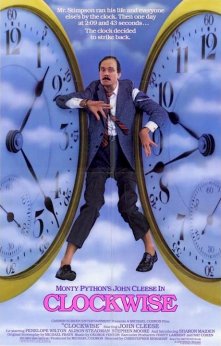
Clockwise (1986)

2008 #76
Christopher Morahan | 92 mins | DVD | PG / PG

ClockwiseClockwise, so I’m told, was written after John Cleese (who, I should point out, isn’t credited as the writer) attended Robert McKee’s famous screenwriting seminar. What this means for your average viewer is that Clockwise is expertly constructed. More importantly, it’s also very funny.

The first 15 minutes are a little dubious, but it soon becomes apparent that some of McKee’s principles are being followed (if you’re aware of them, of course) as this opening serves to establish the everyday life of Cleese’s character, headmaster Brian Stimpson. The point of this soon becomes apparent: when everything goes to hell over the next hour-and-a-quarter, the viewer can fully appreciate the impact on Stimpson’s existence. And all go wrong it does, in a manner that’s rather reminiscent of Fawlty Towers — not in the sense that Cleese is repeating himself, but rather that you could replace Stimpson with Basil Fawlty and merrily carry on along much the same path; though, I hasten to add (to this over-punctuated sentence) that Stimpson is not a clone of Fawlty, but he is prone to ending up in similar accident-and-misunderstanding-based farcical situations.

I imagine that Clockwise is less well known than it deserves because it is so very British. The humour — largely based around issues of punctuality, politeness, and social custom — is particularly British, as are the countryside settings and the finale set at a public school conference. And, in the first instance, everything goes so spectacularly wrong thanks to our wonderful language’s multiple meanings for the word “right”. From this point Cleese & co escalate the hopelessness of the situation beautifully (and very much in keeping with McKee’s ideas of good structure), gradually crafting more absurd events and dragging in more and more characters, most of whom come together in that finale. This final section perhaps goes on too long, with a rather inconclusive ending, and it lays on the anti-public school gags with a trowel — though that suits me just fine.

Some have argued that Clockwise is more like a series of sketches than a cohesive whole, but all the independent scenes are connected by a common goal, meaning very few (if any) feel genuinely out of place or inelegantly shoved in. The calm pauses between the comic scenes also allow it to remain hilariously funny so consistently — an all-out assault of comedy, no matter how good, can become rather wearing. Again, this ebb-and-flow is something the filmmakers may well have picked up from McKee.

While you could probably use Clockwise as a mini masterclass in applying some of Robert McKee’s structural principles, that’s thankfully not the be-all of it. Very funny once it gets going, this is one that fans of Fawlty Towers will likely especially enjoy — and, really, who with a sense of humour isn’t a Fawlty Towers fan?

4 out of 5

Sherlock Holmes and the Secret Weapon (1943)

2008 #75
Roy William Neill | 66 mins | DVD | PG

The name’s Holmes, Sherlock Holmes, as Universal’s loose adaptations of Britain’s Greatest Detective deliver a low-key proto-Bond, 22 years before Goldfinger applied the same tricks to Britain’s Greatest Spy.

“How so?”, you might ask. Well, Holmes has been employed as a spy for His Majesty’s Government; it begins with an ‘end of the previous adventure’ almost-action sequence that would undoubtedly take place before the opening credits now; there’s a war-winning weapon at stake; a bit of globetrotting (albeit just from Switzerland to London); some double-crossing and side-switching; even a surprisingly nasty torture sequence; a nice race-against-time final act; and an equally-matched villain, with a secret lair, who has devised a clever death for our hero. So the lair is just a house with soundproofing and unbreakable glass, but that’s not a bad effort — I don’t think there are many volcanoes to hollow out in the London area. It may be Bond on a World War Two London scale, but the feeling is there.

I discussed the controversy (for a modern audience, at least) of this updated setting in my last Holmes review, and it’s even more abundant here — seeing Baker Street as a victim of the Blitz, and 221B surrounded by sandbags, is very odd indeed — but at least it employs several elements from a variety of Conan Doyle’s plots, and it’s not unreasonable to assume that, given his skills of deduction and disguise, Holmes would’ve been employed as a spy had he been ‘alive’ during the war. In fact, Holmes actually does some detecting this time, whereas in Voice of Terror he seemed to meander around a bit, and employs several disguises, even if some of them are about as much cop as one of those glasses-nose-and-moustache masks. Of course, it would help the mystery if its solution wasn’t revealed before Tobel (the inventor of the titular war-winning weapon) was even kidnapped, but you can’t have everything.

What lets the film down more is Lionel Atwill as a weak Moriarty, supposedly the film’s grand villain. It’s not all his fault — for one example of poor writing, Holmes deduces the final code after an accidental clue from Watson, while Moriarty gets it by clumsily spilling water over a copy, hardly displaying great powers of deduction — but he doesn’t compare to the scheming, cunning Moriarty we saw played by George Zucco in The Adventures of Sherlock Holmes. On the plus side, the ease with each Moriarty outwitted Holmes in that earlier outing made our hero look a bit ridiculous, whereas here Holmes gets to outwit his nemesis a couple of times, including a particularly nice denouement.

As with Voice of Terror, I enjoyed a lot of Secret Weapon in spite of its distinct un-Holmes-ness — it’s another pacey, exciting World War Two spy thriller. It’s better than its immediate predecessor on the whole, though a spot of miscasting nearly persuaded me to remove another star.

4 out of 5

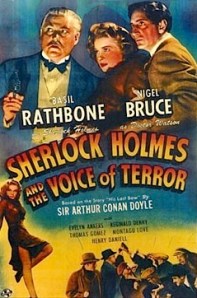
Sherlock Holmes and the Voice of Terror (1942)

2008 #74
John Rawlins | 63 mins | DVD | U

Despite the success of their two Sherlock Holmes films (The Hound of the Baskervilles and The Adventures of Sherlock Holmes, both 1939), Fox decided the character was outdated and resolved not to make any more. Universal clearly disagreed, and the popular pairing of Basil Rathbone and Nigel Bruce reprised their roles three years later for this, the first of twelve Holmes films the studio would make with the duo in just five years.

There’s more change afoot than just the logo at the start, however, as Holmes and Watson are dragged from their typical Victorian setting to London in the midst of World War Two. For a modern audience, who definitively associate Holmes with the Victorian era, this move seems virtually incomprehensible and sacrilegious; but Conan Doyle’s original Holmes stories take him as far as the start of World War One, so bringing the character another 28 years forward is little worse than, say, relocating the 1980 novel The Bourne Identity to 2002. Nonetheless, the filmmakers were aware of the problem even at the time, choosing to open the film with a title card that asserts Holmes to be “immortal… ageless, invincible and unchanging” in the hope that audiences would accept a then-present-day setting.

Whether the setting bothers you or not, the story itself might. The basic concept is a nice idea for a war-set spy-thriller, but not really for a Sherlock Holmes mystery. There are plenty of audience-pleasing applications of his ‘impossible’ deduction skills, such as the moment when Holmes concludes someone dislikes him based on the depth of footprints left in a carpet (never mind that the character huffily ignored Holmes when he came in), but the main plot involves a minimal use of these abilities. It’s also loaded with implausible elements — why would the Nazis waste bombs on empty fields (to disguise one plane going a different route) when they could have used them on genuine targets? Why are recordings shipped to Germany and broadcast back, rather than just broadcast from England? Worst of all, what’s going on with Rathbone’s haircut? The final twist is either genius or ludicrous, I’m not sure which; and the misguided reference to Holmes’ deerstalker (he’s promised not to wear it — why?) is, well, misguided.

It’s not all bad. As mentioned, the basic storyline is a good one, providing decent entertainment once it gets going; Holmes gets plenty of amusing lines, which manage to provide more genuine laughs than Watson’s incompetence; and there’s some lovely shadow-drenched photography — though the film’s even more drenched in patriotism, to the point of propaganda at times.

The consensus seems to be against me, but by the end I was quite enjoying Voice of Terror. It may be a Sherlock Holmes film in name only, but taken instead as a cheap spy thriller it makes for passable entertainment.

3 out of 5

Quantum of Solace (2008)

2008 #73
Marc Forster | 106 mins | cinema | 12A / PG-13

This review contains spoilers.
For a spoiler-free view, see my initial thoughts.

Quantum of SolaceQuantum of Solace is to Casino Royale what Tomorrow Never Dies was to GoldenEye: it’s the second film of a new Bond, tasked with revitalising a flagging franchise (this time creatively rather than monetarily); it’s been promoted as shorter (though by 38 minutes, not TND’s mere 11) and more action-packed; and it’s got to follow a huge success, both critically (94% on Rotten Tomatoes) and commercially ($588m worldwide). It’s a tall order — one many believe TND failed to live up to (personally, I’ve always liked it). Does QoS do any better?

Well, it’s certainly action-packed. Bond hurtles from budget-blowing sequence to budget-blowing sequence with alarming fervour, the camera literally struggling to keep up. It’s this zoomed-in, over-cut, handheld style that most grates with me during these sequences. I quite like it in the Bourne films — it’s part of their style; it fits — but I was incredibly glad to not find it in Casino Royale, and therefore disappointed to see it showing up here. Compare Royale’s early free running chase to the early rooftop one in QoS and you’ll quickly see not only which is better staged, but which is better shot. There are some good moments action-wise — for every disappointing boat or plane battle there’s an effective duel (swinging from scaffolding) or a destructive car chase — but I do wish someone would put the camera on a tripod. The frequency of such sequences, plus an abundance of other common action/spy movie tropes (a rogue agent, shadowy organisations, moles — in fact, trust has never been more of an issue), suggest that this is very much the Action Movie on director Marc Forster’s increasingly eclectic CV. His true strengths show up elsewhere however, as the most memorable parts of the film aren’t the headache-inducing punch-ups, but any scene that involved Bond and M or Bond and Mathis.

The acting, you see, is of a high standard, certainly above the requirements of the genre. While Craig may be lumbered with a very focussed, almost one-note Bond, the flashes of drama and dark humour allow him the odd chance to stretch. He may not get the variety that Casino Royale offered in this department, but he does enough with what’s there. Never more so than in the scenes with Giancarlo Giannini’s Mathis — the action pauses for breath when Bond seeks him out, and we’re treated to some of the film’s very best bits. Some fans wondered how the character could be brought back after Casino Royale, and the trick is to transform his role: what was previously a minor part designed to facilitate the plot here becomes one of unique significance, an injection of emotion and humour that makes his unfortunate death the film’s most heartbreaking moment — in fact, I might go so far as to argue it’s the saddest moment in a Bond film since the end of On Her Majesty’s Secret Service. It’s these scenes that allow Forster’s dramatic directorial abilities to come to the fore, confirming that this is where his true talent lies.

Best of all is Dame Judi Dench, unsurprisingly excellent as ever. She’s aided considerably by M having a much bigger part this time out — not in an obvious The World Is Not Enough-style “have her kidnapped” kind of way, but just by giving her a lot more to do as James’ boss. In the old days the boss sending an agent out into the field and not hearing from him again until the mission was over may have made sense, but in our world of easy telecommunication it would be ridiculous if M wasn’t closely monitoring and commanding Bond every step of the way. So she does, and it’s great for the viewer to be treated to so much of Dench and her relationship with Craig. Not only that, but M has a spot of governmental and inter-agency politics to deal with too, increasing her role still further. If they retain any element of QoS for Bond 23, I hope it’s this.

As for the other Bond girls, Olga Kurylenko is fine but unmemorable, perhaps most significant for being the only major Bond girl who doesn’t sleep with our hero. (Incidentally, this is the third action film in two years in which Kurylenko plays a major part and doesn’t sleep with the hero. That’s quite a niche to be carving.) Back-up girl Gemma Arterton is disappointingly underused, existing primarily for the sake of being another girl in an otherwise masculine film. Her Goldfinger-tribute death, a nice nod in a franchise that has almost entirely excised its past, is an effective touch in and of itself (aficionados will surely note that, this time, there’s no conveniently-placed cushion), but considering the substance at stake turns out to be water rather than oil, it’s either Quantum playing some misplaced guessing game or an ill-considered plot hole. More annoying is her name, however. I don’t care that she’s named Strawberry Fields — it’s either an appropriately silly Bond girl name or, in this day and age, depressingly believable — but much is made of her first name going unrevealed, only to be rewarded with no pay-off. It’s not revealed on screen (only in the end credits), and Bond doesn’t even have an (admittedly clichéd) “I never even knew her first name” line on finding her body. Only a minor misstep, to be sure, but a nagging one.

As the scheming villain-by-proxy, Dominic Greene, Mathieu Amalric feels underused. He’s not as non-present as some Bond villains (The Spy Who Loved Me comes to mind, where Bond shares all of three lines with his nemesis before shooting him), but there’s a definite sense that the military coup/water hoarding storyline is a perfunctory element around Bond’s hunt for the men behind Vesper, in the process establishing Quantum so they can be dealt with in a later film. While I like having a Big Bad Organisation to cross over the films, much as SPECTRE did in the early days, the downside to their first real appearance here is that this particular scheme — a coup in a relatively inconsequential country, it must be said — is a bit lightweight for such a powerful, important organisation. This, plus Greene being more of a civil servant-type figure than an evil megalomaniac, leaves the climax feeling rather anticlimactic, lacking both the grandeur of the old Bond and the emotional weight of Casino Royale (as if a sinking building wasn’t quite grand!) It’s been touted in interviews that Greene’s fighting style is that of “a man who can’t fight”, but that’s no reasonable excuse for his final duel with Bond being so brief. Try harder next time.

Which, it seems, has been the closing impression of QoS for many fans. In this vein, placing the famous gunbarrel at the film’s close is surely highly symbolic, in the same way that saving the equally famous theme music for the end of Casino Royale was: Bond has now completed his evolution, excised his Vesper-demons, and is now the character we all know. Where at the start of the film he merrily kills everyone he comes across, at the end, face to face with the man mostly directly responsible for Vesper’s suicide, who he’s spent most of the film tracking down, he questions him before handing him over to MI6. For all those who dislike QoS’s style, this closing gunbarrel is hopefully an indication that, come 2011, the Bond they know will be back.

So does QoS do any better than Tomorrow Never Dies? Critically, yes, actually — although it’s received mixed reviews, they’ve been positive overall. At the box office, very much so, including the franchise’s best-ever US opening weekend (in this case topping the widely-disliked Die Another Day, something Casino Royale didn’t even manage). As for me, the opinion that opened my initial thoughts on the film still stands: it’s not as good as Casino Royale, but that was a far above average piece of entertainment. QoS isn’t a great Bond film, and it certainly doesn’t have the cross-fandom appeal that Brosnan at his best managed — and it certainly does have more than its fair share of detractors — but it’s a solid entry in the series. When the preceding instalment was possibly the best the franchise has produced in its 46-year history, that can make things seem worse than they are.

4 out of 5

My initial thoughts also offer additional comments on the level of humour, the title sequence, and more.

Casino Royale (2006)

2008 #72a
Martin Campbell | 139 mins | DVD | 12 / PG-13

Casino RoyaleI’ve seen Casino Royale four times in the two years since its release (twice on opening weekend, in fact), which is an unusually high number of viewings for me. Normally I’ll see a film once and, even if I really like it, might not bother again for years; even films I’d name among my most-favourites fall into this category.

The reason I share this upsettingly trivial bit of information about my film watching habits is because, after two years and four viewings, I don’t really have much to say about Casino Royale. It’s a damn fine Bond film, returning to Fleming and resetting the character without losing anything truly essential about the franchise. The action sequences are great because they’re not only exciting but also drive the plot forward and reveal character — when Bond runs through the wall at the building site is a prime example of this.

In Daniel Craig and Eva Green the franchise has probably the best two leads it’s ever had, in terms of acting ability, and they put it to good use. There are many more pitch-perfect things about this film — not least making a poker game engrossing — and, yes, a few flaws, though for me they’re so minor as to not matter; but I don’t feel the need to expound on them a great deal because the film really speaks for itself. And, looking at the UK box office and DVD/Blu-ray sales, I’m not sure there’s anyone who hasn’t seen it.

In summary, Casino Royale is possibly the best Bond film of all time — though when you have a series that has encompassed so many disparate styles (directly compare From Russia With Love to Moonraker and one might even struggle to believe they’re from the same series), it makes for an incredibly hard selection to pick a sole winner from. Still, this one’s up there with the very best, not just of Bond but of action-spy-thrillers in general.

Now, I just wonder what happened next…

5 out of 5

The Invasion (2007)

2008 #72
Oliver Hirschbiegel | 99 mins | download | 15 / PG-13

The InvasionThe Invasion is a modern thriller aimed at a mainstream audience, which naturally means it begins at the end. Is there a reason for this? As is too often the case these days, no. The only explanation I could come up with is that such an opening suggests there’ll eventually be some some actual scares in this sci-fi/horror, and so is designed to help the viewer persevere through the distinctly lacking film that follows.
Things go sharply down hill from the lacklustre opening ending opening: Jeremy Northam accidentally stabs himself with an Evil Alien Parasite Thing in a blatant genre convention that seems to have moved from the “necessary to get on with the plot” to the “badly obvious cliché”. The order of scenes that follow seems to be a random mess — for example, Nicole Kidman’s kid, Olly, begins to have nightmares again; a few scenes later, his dad (Northam, now taken over by the Evil Alien Parasite Thing) phones wanting to see him after a long absence; a few scenes later, Kidman tells a friend that Olly’s nightmares restarted after he was told he was going to see his dad. This is not an isolated example.

Much of the dialogue is on the level of bad exposition, but, to rub salt in the wound, it explains things we’ve already been shown. Normally reliable actors turn in flat performances with such an awkward script, which ponderously works its way through a plot that’s far too slow-moving considering how obvious it is. We know it’s an Evil Alien Parasite Thing within the opening minutes and even a passing familiarity with the genre will let you know how things are going to end up (as if opening with the ending didn’t give you a hint), but we’re still treated to near-endless scenes of our luckily-immune heroes trying to work out why everyone else is behaving oddly. It takes a full 36 minutes for Kidman to finally realise what we’ve all known from the start, but just in case you’ve missed the bleeding obvious there’s a pile of handy flashbacks. More to the point, how come only two people in the entire world (the other being Daniel Craig) have noticed what’s going on? The possessed have all the subtlety of a Jeremy Clarkson joke, walking around in a permanent mechanical daze.

A lot of articles have noted that the studio disliked how the film ended and so brought in other writers and director(s) to re-shoot the final act, aiming to bolster the action. Thank goodness they did, because it’s at this point that there’s finally something worth watching. The aliens’ dominance is a near-inevitable and obvious eventuality from very early on, and so structurally speaking should have been reached sooner. Unfortunately, when it does arrive, the weak early scenes mean we don’t care about the characters, so while some of the more action-packed scenes are well staged they have little genuine impact. Some good moments sneak through though, like a couple’s very public suicide, or… No, that was the only one I noted.

In this structural imbalance The Invasion is reminiscent of I Am Legend: a ponderous dramatic first half turns into an all-action assault as the only uninfected people are relentlessly pursued by the infected majority. In an inversion of the disappointing (but not dreadful) Will Smith vehicle, The Invasion‘s first half is dire while the second at least has some excitement and jeopardy. In Legend it was a shame that they couldn’t keep the first half running for the rest of the film; here you’re glad the studio intervened and forced some actual events on the film. It would be quite interesting to see how it was all meant to turn out originally, but I doubt it would be entertaining in the slightest.

Once it’s all over there’s a truly dreadful info-dump that explains what happened next. Besides making you cringe and wonder how a piece of exposition so blatant could ever have been greenlit, all it achieves is the delivery of a killer blow — not by blatantly stating the film’s subtext (which it does — not so ‘sub’ then), but with what that subtext actually is: when humanity is taken over by aliens, war stops; ergo, war is what makes us human. Lovely.

2 out of 5

The Invasion featured on my list of The Five Worst Films I Saw in 2008, which can be read in full here.

St. Trinian’s (2007)

2008 #71
Oliver Parker & Barnaby Thompson | 97 mins | download | 12

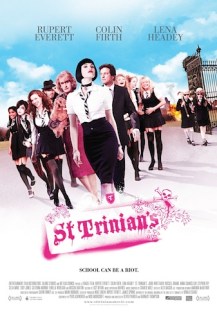
St. Trinian'sI really didn’t think I was going to like St. Trinian’s. It seemed to be aimed squarely at teens whose quality barometer is fixed at Girls Aloud being the best music artists of all time and aren’t old enough to have seen There’s Something About Mary. Certainly, some of the film lives up to these expectations, but other bits are surprisingly good.

For one thing, it has a pleasantly wicked sense of humour, which must be pushing that 12 certificate on moral grounds — 10-year-olds producing black market vodka, for just one example. There’s a number of good, brief, visual gags too, such as the RE department having a Practical Study of the Easter Story with a girl strung up like Jesus on the cross (Christian bating is always funny). On the other hand, it merrily includes some ancient gags too — a dog shags someone’s leg! Hilarity! But then again, it makes no bones about being aimed at a relatively young audience, and for them this probably seems wonderfully fresh and naughty. Thankfully it’s not all down on this level — it has an even better line in Colin Firth spoofing than the Bridget Jones movies, and while some of these references may fly over the heads of that intended audience, they should at least keep any adult viewers amused. My personal favourite was the two 10-year-old girls who keep quoting famous movie lines. Simple, but effective.

A fair number of people seem to have considered the moral vacancy of St. Trinian’s’ style of comedy a bad thing, claiming impressionable girls will copy the characters’ actions or at least be influenced by their anarchic attitude. Not likely, I say — the school is such a fantasy-mess that I think even the very young would struggle to believe it as a potential reality. In fact, I’d go so far as to say that most of it is relatively harmless fun — if only some of The Youth Of Today would copy this lot rather than getting stupidly drunk, pregnant as soon as they’re able, and knifing each other every evening, then we might not be in the state we’re in. But anyway…

Through any weak patches, affairs are buoyed by a rather wonderful cast. The likes of Colin Firth and Rupert Everett are clearly having a ball, the young (though most not as young as their characters) cast all do a good job, with Gemma Arterton standing out in particular, and anything featuring Stephen Fry is at least worth a look. Yes, he’s only playing himself (literally) on a version of University Challenge that no doubt owes something to QI (even if it is just Fry hosting), but luckily he’s given a smidgen more to do than just read out cue cards. In spite of which names may be above the title or which characters get introduced first, it’s decidedly an ensemble piece — every time you think a lead is emerging another takes centre stage. In that respect it might be seen as a bit messy, but each one gets a decent enough through-line.

Incidentally, it’s incredibly British — not just in its setting and style, but also the very current cultural references — which might explain why it still hasn’t had a US release. It wouldn’t look out of place premiering on TV, probably at Christmas considering the scale of it, and I wouldn’t be surprised if the budget had been TV-sized. It’s also got a posh girl played by that girl who plays a posh girl in everything on TV (namely, Lucy Punch). That doesn’t really signify much, but my God she’s done well out of playing essentially the same role in numerous productions.

Despite my preconceptions when starting out, which were all supported by the opening few minutes, I ultimately found St. Trinian’s quite enjoyable. It’s far from perfect, and every time I began to truly warm to it — I even found myself laughing at a final beat for the leg-shagging dog cribbed from a decade-old comedy (I believe I already mentioned it…) — there was another recycled or immature joke to make me despair. In spite of that, the overall impression was adequate enough.

3 out of 5