Rebecca (1940)

2008 #10
Alfred Hitchcock | 125 mins | download | PG
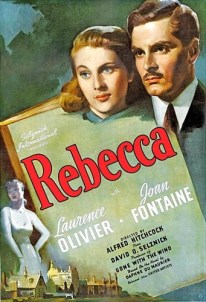
This review could be seen to contain some spoilers.

RebeccaI must confess that I don’t think I’ve come to Rebecca under the best circumstances for judging it as a film in its own right. As with last week’s Great Expectations, Rebecca is on my current University module, which means I arrive at it having just read both Daphne du Maurier’s original novel and, the afternoon before viewing, a detailed and very interesting account of the film’s genesis and production from Hitchcock and Selznick: The Rich and Strange Collaboration of Alfred Hitchcock and David O. Selznick in Hollywood (nothing like a snappy title, eh?) by Leonard J. Leff. Such reading conspires to lead me into direct comparisons with the novel (which, as with most adaptations, are ultimately unfavourable due to things having to be cut), as well as a preoccupation with what was going on during production.

But, trying to put such distracting things aside, Rebecca has a great many good points. The cast, for one thing, are perfect. There were serious doubts about Joan Fontaine as the lead, but she is spot-on as the shy, almost childish, Mrs de Winter. Laurence Olivier is equally effective as Maxim, and Judith Anderson’s Mrs Danvers is suitably scary, if significantly younger than I imagined. The production’s technical aspects are also highly admirable: while the early Monte Carlo scenes may be nothing especially exciting, the plot whizzes past and we soon find ourselves at the infamous Manderley, all large halls, fog-filled grounds, dramatic lighting and big camera moves. Especially of note is Maxim’s confession — a long chunk of dialogue in the novel, it would have been all too easy to just use a flashback, but Hitchcock instead employs a camera move across the empty room to suggest the narrated action.

Further comparisons with the novel are inevitable, of course. The film skips nothing of importance, condensing events effectively so that the plot moves at a decent pace. Some events, such as the fancy dress ball and following ship wreck, are even made more dramatic by combining them. Some choices are thoroughly bizarre though: the novel is well known for its first person narrative, something the film attempts to retain by featuring Mrs de Winter in every scene… until the end when, in a deviation from the novel, she remains at Manderley while we follow Maxim and co. to London for some final twists. This does lead to a dramatic reunion upon Maxim’s return to Manderley, but I’m not convinced such a brief moment was worth the modifications.

As expected, viewing in such close proximity to the novel also forces comparisons that aren’t especially warranted — for example, the film loses much of the characterisation of Mrs de Winter by unsurprisingly finding no way to adapt her frequent flights of fancy and imagination. But then, one can always read the novel for those things (and I’d recommend it — get past the famous but dull opening and it often rattles along), and so, judged purely on its own merits, there is a considerable amount to recommend in Rebecca.

5 out of 5

The Hound of the Baskervilles (1939)

2008 #9
Sidney Lanfield | 77 mins | DVD | PG

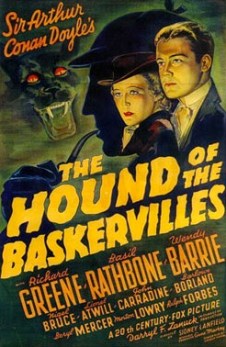
The Hound of the BaskervillesArguably the definitive screen interpretation of Sherlock Holmes and Dr Watson, played by Basil Rathbone and Nigel Bruce, appear for the very first time here, in what would become the first in a series of 14 pictures starring the pair. (Incidentally, this will be the first in an irregular set of reviews of that series. I have the rather lovely Optimum box set, you see, and so shall slowly work my way through it. Though as I’ve already owned it for several years and only just started watching it (as with so many DVDs), I have no idea how long it will be before I finish.)
I’ll start by laying my cards on the table: The Hound of the Baskervilles is a vastly overrated Holmes tale, and one that has been unduly adapted at least 15 other times (that from a quick search of IMDb). As far as I can tell its popularity is primarily due to the circumstances around its original publication (it was the first Holmes story in nearly a decade, following his death in The Final Problem). Holmes is absent for much of the story, which plods along fairly uneventfully (or, at least, inconsequentially) until a slightly dubious climax involving a centuries-old portrait. Naturally, all of these flaws carry over into any faithful adaptation, and this certainly is one.

One of the novel’s strong points is its occasional Gothic styling, and this is something the film version does very well. Dartmoor looks fantastic, like something Tim Burton would have created were he working in the ’30s. It’s clearly a set, but it’s dramatic and moody and completely effective. After the dull and poorly-designed interior scenes in London, it’s fantastic when the film finally moves down into Devon and things… well, don’t exactly get going, but at least there’s something to look at! As with the novel the plot meanders by, diverted by an escaped convict and an entirely pointless (in this version at least) seance, until that painting-based resolution. All is not lost, however, as a particularly vicious-seeming attack by the hound livens things up considerably.

Rathbone is underused as Holmes, which is a shame as he immediately makes the part his own. Bruce isn’t as bungling and comedic as he would later become, though the signs are already beginning to show. And the infamous final line — “Oh Watson, the needle!” — is actually a huge anticlimax if you haven’t seen it before, an entirely pointless, meaningless and misplaced addition.

I feel like I’ve come down a little harshly on Hound of the Baskervilles, mainly thanks to a general unfavourable opinion of the source material. There are many better Holmes stories, often ignored thanks to the fame of this particular one. The following 13 films may be even less faithful adaptations than this, but I’m looking forward to their fun and frivolity, which will hopefully top Baskervilles. The moor really is fantastic though.

3 out of 5

Great Expectations (1998)

2008 #8
Alfonso Cuarón | 111 mins | download | 15 / R

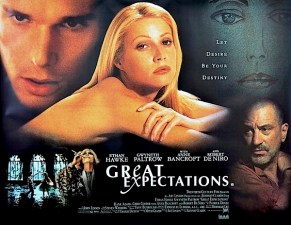
Great ExpectationsAfter re-enjoying the classic David Lean version of Great Expectations (which I reviewed in 2007) last week as part of my adaptations module, it’s now the turn of this American-set re-imagining. Despite a generally-held negative opinion toward this version, I found it to be more of a mixed bag.
Its main problem is that it can’t escape its roots. Not a fault in an adaptation, you might think, but in the case of one so radical as this it is a flaw: you’re left comparing and contrasting it with Dickens’ novel and Lean’s film, rather than appreciating it as a film or narrative in its own right. It comes across more as an academic exercise in turning a British Victorian novel into a modern American movie than a believable tale that works in isolation. Indeed, many of the changes appear to be designed purely to help distance it: the changed character names, the focus on the love story, and so on. Yet it directly recreates many scenes from the novel, and it obviously retains its title, despite there being no reference to that in the film itself.

Another product of this re-imagining is an unremitting sexualisation of everything. When Pip — sorry, Finn’s — hand is placed on Ms Havisham — sorry, Ms Dismoor’s — chest his first guess is that it’s her “boob” rather than her heart; when 10-year-old Estella kisses Pip — Finn, even — it now comes with added tongues; Finn — Pip — Finn! — draws now, and what he draws are nudes of Estella; and then they have sex too; and there are undoubtedly other examples that have since slipped my mind. This was pre Y Tu Mamá También, of course, where perhaps Cuaron exorcised this sexual preoccupations — they’re certainly not so evident in Children of Men or (unsurprisingly) his Harry Potter. His penchant for long takes, as seen constantly to great effect throughout Children of Men, also put in the odd pleasing appearance here.

By the end, it’s tricky to know what to make of this Great Expectations. It’s nicely faithful for a modern version, and yet that forbids it from striking out as its own work — it’s a fairly basic romantic film, bookended with some bizarre American Gothic trappings. I think it must stand as neither a success nor a failure, but as an interesting curio in the canon of Dickens adaptations.

3 out of 5

That picture was the only one I could find in high enough quality to make a banner image. Honest.

The BAFTAs 2008

British film’s big night has been and gone. I won’t offer a comprehensive list of winners, or even many thoughts on them — such things are easily found elsewhere — but I will instead offer my thoughts on one of the few ceremonies this year to be presented in full (well, relatively speaking), and the only film awards ceremony that receives a terrestrial television airing in the UK.

The first thought that comes to mind is, “oh dear”. Anyone would think the writers’ strike was affecting the UK too, if this was the evidence they had to go on. Jonathan Ross’s jokes were few and far between, and rarely gained much reaction from his audience. To be fair to Ross, Stephen Fry had a good deal of excellent material when he used to host the BAFTAs and he was often met with silence too… but not as often, and it tended to be the silence of “that went over the heads of the yanks in the audience” rather than of “it wasn’t that funny…”

I like Ross as a presenter, generally speaking — I enjoy his Friday night show, and while I rarely catch his radio show (I’m rather lax about listening to anything on the radio) I enjoy that even more; and I liked Film 2000-whatever, because I often find I agree with his views and have some broadly similar tastes. But he’s no BAFTA host. He’s just not funny enough… oddly, because his work at the Comedy Awards is usually hilariously good.

The opening, with a troop of 300-style Spartans, was by far the most interesting bit. It all seemed quite incongruous for an awards show, but through this it suggested a show with some flair and excitement. Sadly it just remained incongruous, with nothing else even vaguely close amongst the endless troop of fairly famous people reading poorly from an autocue. Even that Spartan-packed opening was flawed, missing out on the apparently obvious joke of having someone enter and yell, “THIS. IS. BAFTA!”, which would’ve been a far stronger opening than… whatever Jonathan Ross said. I can’t remember now…

It’s a shame we couldn’t make a better fist of it for a year when more eyes than ever were on the BAFTAs, thanks to the faltering performance of US awards shows under the strike. A new host would help. Eddie Izzard, maybe — he got laughs. So did Ricky Gervais, not that he’d do it. But when even Hugh Laurie can’t bridge the cultural divide of British and American humour, you have to wonder if the host is doomed to failure from the start. At least the awards themselves threw up some surprises, with enough nods to the American films (and a consequent shunning of British talent) to keep them interested — I do wonder if the BAFTAs pander to trying to gain an American audience too much, but one could probably debate that for hours.

There’s one thing we do better though: fewer awards, and we don’t even screen them all. It makes for a much less tiring experience.

Calendar Girls (2003)

2008 #6
Nigel Cole | 103 mins | DVD | 12 / PG-13

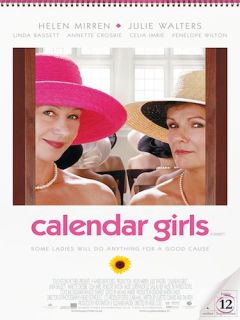
Calendar GirlsHelen Mirren and Julie Walters lead a cast of recognisable British actresses in this popular comedy drama about the true story of a group of Women’s Institute members who posed nude for a charity calendar. The film could so easily have been quite a lowly, cheap TV movie effort, what with its apparently farcical premise, worthy cause and older characters. But instead the filmmakers have crafted a movie that is both utterly hilarious and deeply moving — even for this younger male viewer.

Balancing comedy and drama, and making both work, is quite a feat — as someone once said, most comedy-dramas are so called because they’re neither very funny nor very dramatic — so it’s always impressive to see it pulled off so well. It’s surprisingly fast-paced, the central story supported by a number of well-chosen subplots that help shed light on the motivations of the women, making them more than just some older ladies who decided to strip off. Penelope Wilton is especially worthy of mention, as the downtrodden housewife who uncovers her husband’s affair. Of all the supporting cast she gets probably the largest role, even if it would seem to be the least heralded, and does an excellent job with it.

When I sat down to watch Calendar Girls I was expecting a pleasant bit of fluff that would make a lazy afternoon pass by amiably enough, even if it made an hour-and-three-quarters feel like two-and-a-quarter. I was surprised on most fronts: funnier, pacier, more dramatic, and more affecting than I had any reason to expect. Recommended, especially if you didn’t think it was for you.

4 out of 5

A dismal January

This new year of film watching has hardly got off to an auspicious start, with only five new films seen in January. For those who haven’t already done the maths, that rate sees me just reaching 60 by the end of the year — a tad short of 100!

But I have new resolve… sort of… and a list. Lists always help. That is, in this case, a list of things in my DVD collection I would especially like to get round to watching. Some of those may well pop up soon. Plus I’ve just started a new film module, which should mean a slew of unseen films… well, one a week at any rate… except the first is Great Expectations, which I saw last year!

Oh well…

The Mirror Crack’d (1980)

2008 #5
Guy Hamilton | 105 mins | TV | PG

The Mirror Crack'dA star-studded cast and the director of Battle of Britain, Goldfinger and three other Bond films can’t raise this adaptation of an Agatha Christie Miss Marple mystery far above the level of an ’80s TV movie.

There are some good lines, and it’s a Christie so obviously the fundamental story is good, but the direction is flat and lacks suspense, half the cast phone in their performances, and Angela Lansbury, lumbered with a sprained ankle and premature aging, seems to be in a dry run for Murder, She Wrote. The lack of involvement by the main character is something I always find problematic with Marple stories, even when the actress involved has the necessary twinkle. Edward Fox is her match as the detective who actually does most of the detecting for once (but is still robbed of the final revelation, of course).

The best bit, which I’ll just take a moment to highlight, is the opening. It’s a black & white murder mystery, the scene of the final revelation… and the print burns up just before the killer is revealed. The film cuts to a village hall, where the film was being screened and the projector’s just died. Miss Marple proceeds to explain what will happen to everyone, based on what she’s deduced from the film so far. A man at the back who’s seen it confirms she’s right. Much better than my summary makes it sound, this is by far the film’s highlight, one of the few whole scenes that rises above the pervading flaws.

Despite a few commendable elements, this is a good tale that’s not told as well as it could be.

2 out of 5

Churchill: The Hollywood Years (2004)

2008 #4
Peter Richardson | 84 mins | TV | 15

Churchill: The Hollywood YearsWhat if the Americans made a movie of Winston Churchill’s life, prone as they are to re-write World War 2 history to show they won it all by themselves?

This is ostensibly the premise of this spoof from some of the team behind Channel 4’s The Comic Strip. I say ostensibly, because the film is bookended (for padding, I suspect) with scenes that suggest that the real Churchill was an American GI, and the British simply re-wrote history using a somewhat chubby actor called Roy Bubbles. Sadly, the joke was funnier when it was riffing on those US historical re-writes.

The problem with killing that joke is, it’s the best one the film’s got. It’s also just about suitable for a five-minute comedy sketch, or, at a stretch, a series of sketches. The strategy for drawing this out to movie-length seems to have involved those bookends, as well as bunging some outtakes at the end and including a bunch of ridiculous, irritating, and unfunny subplots with Hitler and his entourage. It’s a shame to see the talents of actors such as Antony Sher and Miranda Richardson frittered away on such material.

This is all being a tad harsh, because Churchill actually has its fair share of amusing moments. The supporting cast of British TV comedians are mostly very good, Neve Campbell’s posh English accent (usually such a stumbling block for Americans-as-Brits) is as good as anything a British actress could have delivered, and Christian Slater and Romany Malco make for a likeable pairing. But, again, most of the best bits are of sketch length, and so wind up spread out among the padding.

In that respect it’s quite a shame, because there’s a good idea, good potential, and some good laughs in here.

2 out of 5

Easy Riders, Raging Bulls (2003)

2008 #3
Kenneth Bowser | 113 mins | DVD | 15

Easy Riders, Raging BullsDocumentary, based on the best-selling acclaimed book by Peter Biskind, about the decade in Hollywood between the death and effective re-birth of the studio system.

It’s a broad story, with many threads, which means this film has a tendency to sprawl all over the place as it attempts to take an overview of it in chronological order. Consequently it’s short on great insight, but does provide an overview of what went on in this period — that is, the story of how Hollywood made the transition from the old studio system to the era of the blockbuster (a method which still more or less exists), via a brief period where directors truly had auteur-level control.

There are numerous interesting interviewees to help the story along, all of them people who were actually there, who lived through it and helped create it. This makes for a refreshing change, as most documentaries of this ilk seem to be full of film historians and journalists. Of course, there are many big names notable by their absence, so when the film makes its rambling way onto the likes of Scorsese and Spielberg that familiar sense of historic detachment does begin to creep in.

All told, it gives a good overview of the shape of what happened in this period, and how Hollywood became what we know today. Anyone after deeper explorations (of the period, the people, or the films themselves) will want to look elsewhere. I suspect the book may be a good place to start.

3 out of 5

Dark City (1998)

2008 #2
Alex Proyas | 97 mins | DVD | 15 / R

Reposted today in memory of the great Roger Ebert, this was a film he championed and, as you’ll soon see, I adored.

Dark CityA little while ago I wrote about not falling in love with new films any more. Well, put bluntly, here’s one.

Dark City is probably the most underrated film I’ve ever seen. It is, to my mind, absolutely brilliant. It’s an intelligent and engaging neo-noir thriller with wonderful sci-fi twists. The imagery is fantastic — the film is beautifully designed and shot in a wonderfully stylised and highly effective manner. The sets and effects are breathtaking — not showy like so many blockbusters, but utterly effective and impressive. The script and story are complex (though never too much) and interesting, allowing you to piece together the mystery of just what is going on. To my mind, it’s much more effective than the whole “what is the real world” thing of The Matrix.

Incidentally, on that subject, if you’ve seen all of that particular trilogy you may find some bits of Dark City eerily familiar — to say which would spoil things, but many are so obvious you don’t have to be a film buff to spot them. Either both universes are based on similar philosophical ideas, or the Wachowskis just ripped this off (in case you hadn’t noticed, it predates The Matrix by a year, and many of the most recognisable elements are in the sequels anyway). Considering there hasn’t been a lawsuit (to my knowledge), I’ll guess it’s the former. But Dark City does it all better: there are no rambling, incomprehensible speeches and it doesn’t batter you around the head with philosophical claptrap when all you want is the story to move forward.

The film’s single major flaw is the studio-imposed opening narration, which gives away far too many plot twists — honest to God, if you ever watch this, mute it during the New Line logo and don’t turn the sound back on til the first close-up of Kiefer Sutherland’s fob watch. If you don’t, you’ll find most of the mystery of the plot ruined, as this narration shockingly gives away most of the answers. (There are rumours of a director’s cut, 15 minutes longer and without that narration, slated for release back in 2006. Maybe this year it’ll turn up as a “10th Anniversary Edition”.)

I could witter on for pages about how much I’ve fallen for Dark City. It’s a superb movie, massively underrated, that I hope I haven’t over-hyped for any reader who wants to seek it out. But please, if you do, heed my warning about muting the opening narration — it really is worth it.

5 out of 5

Dark City placed 3rd on my list of The Ten Best Films I Saw For the First Time in 2008, which can be read in full here.