Henry V (1989)

2008 #29
Kenneth Branagh | 132 mins | DVD | PG / PG-13
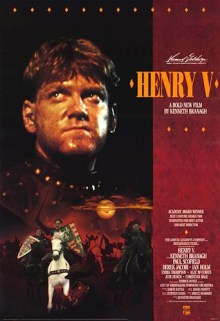
Henry V (1989)Once more unto the breach, dear friends, as I delve into a second version of Henry V in as many (viewing) days. (I dread to think how many reviews of this film began with a similar quote-based pun.) Inevitably, having watched them so close together, this is as much a comment on the relative merits of Branagh’s and Olivier’s interpretations of Henry V as it is a review of Branagh’s film in its own right.

Branagh’s version opens with almost a direct homage to Olivier’s, though with an important difference. Olivier opened with the Chorus’ narration on a stage ; Branagh opens with the Chorus’ narration on a film set. Rather than wasting half an hour with this conceit (as Olivier did), Branagh pushes into the ‘reality’ of the story before another actor has even entered. And his reality is much more real. The film looks as if it’s lit by candles and daylight, the castles and tavern are rough and dark, the battlefields muddy and grimy; everyone gets dirty and bloodied by the fights. On the whole it’s a grittier and more realistic version. Yet there’s room for more than that. The story still seems concluded at the Battle of Agincourt, but the proposal scene no longer feels tacked on. In fact it’s now laugh-out-loud hilarious, with Branagh and Emma Thompson demonstrating the undeniable chemistry that would help make Much Ado About Nothing so good a few years later. Unlike Olivier’s fluffy limp to the credits, this is an entertaining round-off to the plot.

The fact I’d never seen a version of Henry V before Olivier’s ostensibly gives Branagh’s the benefit of a better understanding on my part. Practically, it matters little that I saw Olivier’s first, as the more modern and film-friendly performances in Branagh’s version mean that, while Olivier’s allowed me to broadly follow the majority of what was happening, Branagh’s gives more access to the nuances of both plot and character. He’s aided in the latter by the inclusion of scenes deemed inappropriate for a World War 2 propaganda film: in one, Henry and co confront three traitors; in another, he hangs an old friend in order to make an example. Other scenes are played differently too, so that Branagh’s Henry is a more complex and morally debatable figure, unlike Olivier’s bright-eyed hero. Whatever your opinions on the two actors on the whole, these changes make for a better character and therefore a better film.

It would be remiss not to mention the rest of the cast. Brian Blessed is positively restrained as Exeter, one of Henry’s key associates — you’d never imagine he could turn in such a performance if you’d only seen his recent go at hosting Have I Got News For You. Paul Schofield, as the aging French King, and Michael Maloney, as the contemptible Dauphin, help flesh out the French side more than Olivier’s version managed, as does Christopher Ravenscroft’s Mountjoy, the French herald who all but switches his allegiance. The English ranks are swelled by Bilbo Baggins, Hagrid, and the current incarnations of ‘M’ and Batman (don’t worry, the French have Miss Marple); not to mention the recognisable faces of Richard Briers, Danny Webb, Simon Shepherd and John Sessions (and no doubt others I’ve accidentally missed). Of course, a starry and recognisable cast does not necessarily a good film make, but this is a dependable lot and there are good performances all round — even if Ian Holm’s Welsh accent is somewhat dubious (though it’s a lunar leap on from the one in Olivier’s version).

And deserving of a paragraph unto himself is Derek Jacobi’s masterful Chorus, who, with just a handful of narrational lines and a big black coat, is somehow one of the coolest characters I’ve seen of late.

There’s no contest here for me. Olivier’s version is an over-stylised, propaganda-inspired, outdated version of Shakespeare, whereas Branagh’s is a comprehensible, realistic, textured and, perhaps most importantly, genuinely enjoyable interpretation.

4 out of 5

Henry V (1944)

2008 #28
Laurence Olivier | 131 mins | VHS | U

Henry V (1944)Or The Chronicle History of King Henry the Fift with His Battell Fought at Agincourt in France, as the title card (and therefore IMDb) would have it.

The works of Shakespeare tend to be a love-it-or-hate-it experience for most people, often based on one’s social class and/or experiences at school (obviously not exclusively). Just to be awkward, I’m going to say I have mixed feelings about his plays: on the one hand, I consistently enjoy Macbeth and find Much Ado About Nothing a diverting enough rom-com; on the other, I was bored by Richard III, even when played by Sir Ian McKellen, and never got on with A Midsummer Night’s Dream (to pick just two examples for each side). I imagine most people have their likes and dislikes of course, but I often feel I fall between the the dislike Normal people have for Shakespeare and the love that Cultured people have for him.

This may seem beside the point, but it does lead to Olivier’s Henry V. Simply put, I didn’t much care for it. It failed to engage me, and I’d put this down to Olivier’s infamous staging (literally) of it. The first half hour is a recreation of the play’s first performance in 1600, complete with fluffed sound cues and heckles from the crowd. The goings-on backstage and performer/crowd interactions heavily distract from the actual text being performed, as much as anything because they’re more entertaining. Then, cued by one of the Chorus’s lines, the film moves to showing the story in ‘reality’ — except this is a reality made of painted scenery, primary-coloured landscapes, and cardboard fairy castles. It’s a deliberate effect, designed to emulate pre-Renaissance painting, but it didn’t work for me — it’s over-stylised and distracting, and if you’re not familiar with the play (as I wasn’t) getting distracted is a problem. The concept of transition from performance to reality has potential (as would the idea of presenting the whole thing on stage with crowd interactions, actually, considering I missed them when they went), but I personally feel Olivier executed it poorly. For one thing, it spends too long bedding in the feel of the stage performance before it gets round to the shift to reality.

Stylised productions can work, and excellently, but here the direction and acting are sometimes as flat as the castles. Actors arbitrarily shout some lines, hush others, and put in emphasis of dubious relevance — it’s like Shakespeare-by-numbers, the sort of production that reveres the text so much it doesn’t bother to think about it. It hampers any understanding of what they’re saying, especially for newcomers. Perhaps more fairly, the performance style is incredibly stagey. My degree-related reading suggests this is one of the earliest proper Shakespeare films (previous adaptations being silent or even less complete), so perhaps the idea of a more subdued, screen-acting style had yet to permeate such productions. Things do pick up as the film goes on: the battles are effective, and the proposal scene is more comfortably performed than the pre-war politics. That said, the story seems to be over once Agincourt is won, so by modern structural standards the hasty single-scene romance that follows feels pointlessly tacked on.

Olivier’s Henry V has received plenty of praise in its time, as well as derision, largely for its conception as World War 2 propaganda. The latter is hard to ignore, with grand speeches delivered in a way reminiscent of Churchill’s and scenes removed so that Henry’s character becomes unquestionably good — both aspects that are distinctly less relevant to today’s more complex, war-dubious world. Even leaving the propaganda aside, the performances are outdated, the design several stylised steps too far, and on the whole the production failed to engage or hold my interest. However good it may once have seemed, I think this version has had its day.

2 out of 5

Next I’ll be reviewing Kenneth Branagh’s all-star 1989 version of Henry V, here.

Vantage Point (2008)

2008 #27
Pete Travis | 86 mins | download | 12A / PG-13

Vantage Point is nothing like Rashomon.

I don’t imagine you’ve missed the endless comparisons — every review seems to have them, IMDb’s single-line plot description mentions it, the film itself certainly pretends to be like it, and I imagine even the pitch to the studio went, “well, it’s like this Japanese film…”. But, in fact, it’s nothing like it, and here’s why: Rashomon is about four people who tell completely different versions of the same events, some or all of which are therefore untrue; Vantage Point repeatedly shows the same events from different angles, revealing a sliver of new information each time. There are no lies and no real misdirection; none of the characters interpret what they see, we’re just shown it from where they were standing. Nonetheless, it’s a potentially interesting way to construct a thriller, but Vantage Point doesn’t exploit the concept’s full potential.

And then, halfway through, it gives up on it.

At first it seems like the filmmakers have simply lumped the gang of terrorists together as one character for the purpose of their perspective, an example of typically uninsightful American action-thriller ideology. But it soon becomes clear that, instead of continuing the perspective-shifting high concept of the first half, the rest of the story is going to play out like a normal thriller. And suddenly it’s a lot more entertaining, freed of pointless repetition and an irritating tendency to stop each story at an appropriately cliffhanging moment. If only the whole film had been constructed this way! Yes, it would have lost out on the odd mystery and some revelations wouldn’t have been so spread out, but continually retelling the story to pull this off seems a cheap trick anyway. Not that it matters, as most of the twists are blatantly obvious, and possibly the biggest of all was blown in the trailer — and is glossed over in the film as if they expected you to have seen it there.

Of course, the already slim running time would be reduced to the length of an American TV episode if they edited it chronologically, because there are plentiful repeated shots of speeches, explosions and crowds running, as well as the over-egged ‘rewind’ sequence each time the chronology is reset, a trick that’s as pandered to an inattentive brain-dead audience as ever you’ve seen. Another reason for employing this disjointed wannabe-Rashomon style is that the timelines probably don’t add up: some characters seem to squeeze an awful lot into a couple of minutes before their plot has to sync with someone else’s, while others presumably stand around doing nothing now and then.

Ultimately it’s the much-reported attempt to be ‘Rashomon-like’ that really scuppered Vantage Point for me. It only manages the multiple perspectives trick until halfway through, and even then it’s not especially well executed. The style has clearly been foisted upon it to mask a story that isn’t that original — the plot is a bit like half a season of 24 on speed — but it could have made passable enough entertainment for 90 minutes, especially as there are a couple of half decent action sequences. As a straightforward thriller it might not have been a great deal better, but it would have been less disappointing.

3 out of 5

L.A. Confidential (1997)

2008 #26
Curtis Hanson | 132 mins | DVD | 18 / R

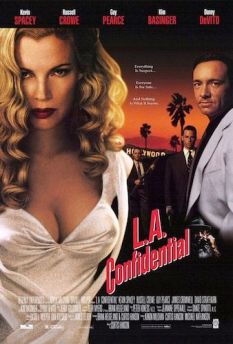
L.A. ConfidentialOnce again I’m watching an adaptation shortly after plowing through the source novel, a situation that has so far proved awkward for giving films a fair assessment. L.A. Confidential is an especially tricky one: how does a 480-page, densely written, intricately plotted crime novel, spanning seven years and “no fewer than four and perhaps as many as a dozen major crimes”, translate into a two-and-a-quarter-hour film? With more than a few surprises, as it turns out, because the apparently minor changes near the film’s start turn out to be the proverbial pebble in a pond: their ripples spread so far that, by the second half, not even a reader who can remember the many details of the novel’s complex plot will know for sure what’s coming.

This isn’t necessarily a bad thing. If screenwriters Hanson and Brian Helgeland had tried to squeeze in everything the movie would have been rushed even at three hours. Instead they’ve excised several unnecessary subplots and trimmed others to the bare minimum. Most impressively, they’ve picked apart several of the multitudinous plot threads and completely restructured them. It’s an incredible feat of adaptation. The downside is that some great strands are lost. Ed Exley’s father plays a huge role in the novel but is completely absent here; Inez Soto, the victim of a brutal gang rape, is reduced from a key supporting character to a couple of lines. Another connected loss is some characterisation. Jack Vincennes and Exley lose the most, though Bud White’s development is tied too closely to the main storyline. That said, the characters are still mostly there, painted quickly and precisely; they may lack some of the depth and complexity the novel can offer, but that’s an almost unavoidable difference between a film and a long, well-written novel. To make a good film such sacrifices are necessary — even though it’s been simplified, the novel’s complex plot is still a long way from becoming straightforward.

What impressed me most about L.A. Confidential is that, despite spending huge chunks of the film pondering what they’d cut and changed, I still enjoyed it immensely. Even while distracted with thoughts of the novel, its differences and its relative merits, I could still enjoy the fantastic filmmaking. The casting is perfect, especially Spacey, Pearce and Crowe (perhaps the last most of all, considering his penchant for real life violence). For once it really is as if the roles were written for them, making it easy to forget that Pearce and Crowe were virtually unknown at the time. They’re supported by a cracking screenplay (which I think I’ve praised plenty already) and beautiful direction, which manages to evoke the period without being shot like a period film — Hanson has stated that he aimed to make it period-accurate but shoot it like a modern thriller, and he’s succeeded. There may be one or two imperfections (the music felt a little repetitive to me, for example), but they’re slight and it seems churlish to pick on them in any depth.

I look forward to watching L.A. Confidential again without the novel hanging over my head. I’ve made my comparisons now, and my memory’s weak enough that, by the time I get round to watching it again (perhaps when the long-rumoured special edition re-release turns up), I’ll have forgotten enough of the novel’s specifics to not be bothered by them. I expect I’ll enjoy it even more then. It’s an excellent achievement, both as an adaptation and a film in its own right. You can’t say fairer than that.

5 out of 5

The Baskerville Curse (1983)

2008 #25
Eddy Graham | 67 mins | DVD | U / G

The Baskerville CursePeter O’Toole is Sherlock Holmes (well, his voice) once again in this animated Conan Doyle adaptation from the ’80s (see also my reviews of two others, The Sign of Four and A Study in Scarlet). Of course, this is an adaptation of that perennially popular Holmes story, The Hound of the Baskervilles, and as such O’Toole barely features. A shame, as he’s the only half decent thing in this mess.

As I’ve previously expressed, The Hound of the Baskervilles is not my favourite Holmes story, though it has its moments and there have been some enjoyable screen versions. Unfortunately, this pointlessly renamed offering retains all of the original’s faults but loses most of the best bits, despite wasting time on train journeys, telegram writing and pointless flashbacks to things we saw just minutes earlier. The animation is poor, even for a production of this level, with dire character design and a total lack of atmosphere (it opens with jolly music over views of primary-coloured countryside!) There are further flaws, but there’s no point wasting any more time going through them. I can only hope that the final entry in this series, The Valley of Fear, will be closer in quality to the other two instalments.

In retrospect, I’m certain I underrated the 1939 adaptation of The Hound of the Baskervilles. I’m equally certain that I shall have no such regrets over this lame attempt.

1 out of 5

The Baskerville Curse featured on my list of The Five Worst Films I Saw in 2008, which can be read in full here.

Rashomon (1950)

2008 #24
Akira Kurosawa | 88 mins | DVD | 12 / PG-13

RashomonOne has to wonder if Dr. Gregory House was exposed to Rashomon at a young age. House’s universal truth — “everyone lies” — is also the conclusion of Kurosawa’s much-lauded film, in which four witnesses tell different versions of the events surrounding a samurai’s murder.

The “Rashomon” of the title is one of two gates to Kyoto, built in 789 and in disrepair and disrepute by the film’s 12th Century setting, but thanks to this film the word has come to signify a narrative that retells the same event from multiple perspectives. Mentioning it seems unavoidable when writing about a film (or episode of TV, or novel, or…) with such a structure, as reviews of recent thriller Vantage Point would attest. However, most similar tales aren’t quite as radical as this ‘original’ (which is based on two short stories by Ryunosuke Akutagawa), in which the four tales differ wildly.

Justifiably, much has been written about Rashomon, both critically and analytically. As such I’m not going to dig too deeply here, but instead just highlight a couple of reasons why it’s so acclaimed. For one, it looks great. Kazuo Miyagawa’s cinematography is exemplary, producing gorgeous rain at the gate, wonderful shadows in the forest, and employing numerous inventive shots and moves, always effective rather than showy. Fumio Hayasaka’s music underscores proceedings beautifully, coming into its own during long dialogue-free sequences. The performances are also accomplished, especially Toshiro Mifune as laughing bandit Tajomaru, but also Masayuki Mori’s largely silent turn as the murdered samurai, and Fumiko Honma’s chillingly freaky medium.

As I said, there’s much more that could be (and has been) written about Rashomon — I’ve not even touched on the intricacies of the plot, the presentation of the courthouse scenes, the significance of the fights, and so on. Certain viewers might be put off by the subtitles, the black and white photography, the film’s age, and its occasional ‘arthouse’-ness — and, I confess, I’m one of the first people to get fed up with films like Tati’s Play Time or Ozu’s Tokyo Story — but, for me, Rashomon was an incredibly enjoyable first encounter with Kurosawa.

5 out of 5

Rashomon placed 5th on my list of The Ten Best Films I Saw For the First Time in 2008, which can be read in full here.

Sunshine (2007)

2008 #23
Danny Boyle | 103 mins | DVD | 15 / R

This review contains minor spoilers.

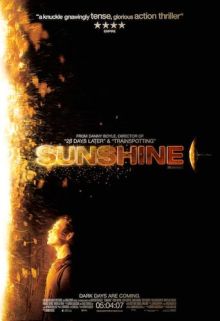
SunshineAfter branching out into the genres of horror (with 28 Days Later…) and ‘family’ (with Millions), Danny Boyle turns his hand to sci-fi with this effort, which tells the story of a spaceship in the apparently not-too-distant (but, clearly, distant enough) future transporting an improbably large nuclear bomb to restart our dying sun.
Sunshine is what some would call “grown-up science fiction”, often more concerned with the crew’s moral dilemmas than thrilling action set pieces or dazzling CGI. Luckily, though, the former aren’t too pretentious and both of the latter are still present. Similarly, the fact that it’s a British rather than American film is apparent early on: there’s an international crew (the Captain is even Foreign! Shocking!), there’s no time wasted on the melodrama of what life is like back on Earth, and the plot slow burns, carefully depicting the crew’s day-to-day relationships and tasks before, inevitably, It All Goes Wrong. The crew notice their failed predecessor floating nearby and have to decide whether to continue on their present course or divert to meet the other craft. I’m sure anyone can guess which option they choose. The ensuing slow slide from relatively minor problems to increasingly major ones fills most of the running time and, like every aspect of the film, is very well executed.

One stumbling block is that, in many ways, it’s territory that’s been trod before. Boyle and screenwriter Alex Garland mix in elements of Alien, 2001: A Space Odyssey, Armageddon, and no doubt several other spaceship-based movies. To their credit, it doesn’t feel like a total rip-off, but the influences are apparent. I was also reminded of the BBC miniseries Space Odyssey: Voyage to the Planets, though I doubt that was a huge influence! (It is quite good though, so you never know…)

Most reviews of Sunshine primarily criticise a shift in quality for the third act. It’s hard to disagree on this, as the film moves from a realistic(ish) Apollo 13-esque space mission movie into slasher horror territory. It almost works, though does feel a little like they were desperate for either a multiplex-pleasing round-off or anything that would carry the film through the last 30 minutes. The real let down is the final sequence, a logic-vacant confusingly-shot finale that consequently feels a tad disappointing.

Yet it’s not bad enough to make too large a dent in the film’s overall quality. The first hour may be better than the final half hour, but it’s all still good enough to pass. Ultimately, the weak ending’s only impact may be in knocking one star off the final score — though, without an alternate final act to compare it to (obviously), it’s hard to be certain it’s even that bad.

4 out of 5

Sunshine placed 10th on my list of The Ten Best Films I Saw For the First Time in 2008, which can be read in full here.

Sunset Blvd. (1950)

(aka Sunset Boulevard, of course. See here if you’re really interested.)

2008 #22
Billy Wilder | 106 mins | DVD | PG

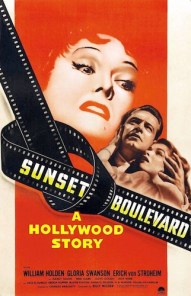
Sunset BoulevardSunset Blvd. may not be the first movie about the movies, but for the amount of controversy it caused and the impact it’s had it may as well have been. It’s certainly a well respected film — I’m sure I could cite any number of Greatest Films Ever lists it’s turned up on, but everyone always disagrees about those.* Nonetheless, any film with such acclaim attached to it also has more than its fair share of expectation, with anything less than total brilliance liable to falter.
And, to my expectation-laden eyes, falter it does — not fatally, by any means, but enough to damage my opinion. William Holden makes for an effective enough lead, his dialogue and narration peppered with memorable quotes and observations. Gloria Swanson is fantastic as the deluded, pitiable faded star, especially when she sinks to her lowest in the final scenes. The opening is iconic for good reason, the final shot equally glorious, both meaningful and creepy. But the plot has a tendency to meander in the middle, sometimes latching on to half-introduced ideas and characters to vaguely examine another facet of the industry. It certainly has a lot to say about the workings of Hollywood during the studio system and, viewing it 58 years on, what has or hasn’t changed since.

It’s by no means a bad film, just occasionally puzzling when its huge acclaim contrasts with the flaws I perceived. As such, it’s tempting to say Sunset Blvd. is overrated. But really that would be a slightly sensational way of saying I’m not entirely sure what to make of it. One day I’m likely to see it again with better-informed eyes, but for now…

4 out of 5

* Incidentally, while I’m mentioning Greatest Films polls, I’ve just discovered The 1,000 Greatest Films, a list that compiles 1,604 different lists to create a ‘definitive’ one. Sunset Blvd. placed 31st on the 2007 update.

Notorious (1946)

2008 #21
Alfred Hitchcock | 101 mins | TV | U

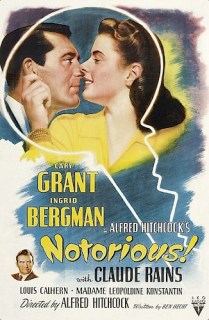
NotoriousCary Grant, Ingrid Bergman and Claude Rains star in Alfred Hitchcock’s 7th best film (according to the ever-changing IMDb Top 250, where it currently resides at #108). Grant is Devlin, an American spymaster who recruits a Nazi spy’s daughter, Alicia Huberman (Bergman), to infiltrate a group of Nazis in Brazil, via her old acquaintance Sebastian (Rains).

Initially the film focuses on the will-they-won’t-they relationship between Devlin and Alicia. A lesser film would have happily made this last the duration, but Notorious moves on to the question of how far an undercover agent should go in the line of duty. Once it has an answer for that it’s on to what the Nazis are actually plotting, and beyond that to the effects of the spy being uncovered. It’s not that the film is restless or doesn’t deal with any of these threads in depth — indeed, my implication that it drops each to move on to the next is disingenuous, as they overlap and weave around each other — but it doesn’t over-analyse or stretch them out interminably. It’s all the better for it.

The second half is where Notorious really comes into its own. Detailing the relationships and situations in the first half is time well spent to set up the second, which contains a brilliant sequence at a society party and a wonderfully tense climax. Hitchcock’s direction shines here, with swooping crane shots and dramatic close-ups — who’d’ve thought a cup of coffee could be so menacing? The villains’ plans may be under-explained, but no matter, because the focus is on how they’re uncovered rather than how they’re prevented. All in, it makes for a highly effective and entertaining spy thriller with a not insignificant dash of romance.

5 out of 5

Notorious placed 7th on my list of The Ten Best Films I Saw For the First Time in 2008, which can be read in full here.

Double Indemnity (1944)

2008 #20
Billy Wilder | 108 mins | download | PG

This review could be seen to contain some spoilers.

Double IndemnityDouble Indemnity is perhaps the archetypal film noir — unsurprising, really, when you have Raymond Chandler co-adapting a novel by James M. Cain. Present and correct are the femme fatale, dry-witted lead man, voice-over narration, shadowy photography, murder, cover-ups, investigations, twists… The difference to films such as The Big Sleep is that the hero is the villain: our narrator, insurance salesman Walter Neff, conspires with Phyllis Dietrichson to murder her wealthy husband for the payout from an accident insurance policy — the double indemnity clause of the title. Neff even has the perfect plan… but, perhaps, too perfect…

Once again I’m viewing this in the context of its source novel (see previous such reviews), and it makes for a very faithful retelling of Cain’s novel. Some of the subplots are sadly lost, not only for time but probably for reasons of taste (Wilder struggled to get the film made in the first place, as the ostensible heroes are both murders and adulterers), some of the names are changed (maybe there was something objectionable about “Huff” and “Nirdlinger”?), and the ending is modified, perhaps with an eye to partially redeeming Neff. In some ways the film’s variant finale is more in keeping, especially for the character of Keyes, but I expect the merits of both versions could be debated. Chandler’s influence as screenwriter is clear in the dialogue. Many lines and exchanges ring with his unmistakable style, which is generally much wittier than that found in the novel.

The real feat of Double Indemnity The Film is that none of these changes jar too much, leaving us with that rare thing: a film that changes the original, but leaves both as excellent pieces of work.

5 out of 5