

Travis Knight | 114 mins | Blu-ray (UHD) | 16:9 | USA & China / English | PG / PG-13
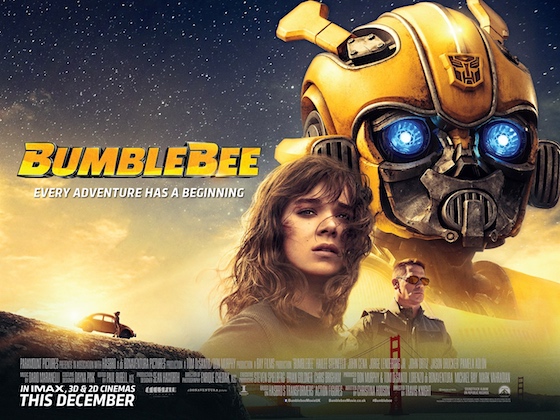
The live-action Transformers movies, eh? Seemingly hated by everyone, critics and fans alike, and yet combined the first five grossed almost $4.4 billion at the global box office. Nonetheless, with the fifth one being the lowest grossing so far, and Michael Bay finally making good on his oft-repeated desire to leave the series’ director’s chair, someone clearly felt it was time for a change. That brings us to Bumblebee, a spin-off (it’s focused around the de facto second-in-command Transformer) cum prequel (it’s set in the ’80s, explaining some events that occurred before the 2007 movie) cum soft reboot (with redesigned characters and nothing that explicitly ties it to the Bay films, this could be the start of a whole new continuity). Did fans finally get what they want? Well, maybe, but it obviously didn’t work for the wider audience: the film took $468 million worldwide, which is good in itself but still represents almost a $140 million drop from the previous film. And it didn’t work for me, either: Bumblebee isn’t necessarily any better than the best of the Bay-era films, it’s just middling in different ways.
The film begins much like Man of Steel: launching us into a conflict between aliens on a distant planet. I criticised that film for throwing us into the deep end with a bunch of hard-sci-fi mumbo-jumbo, and I find similar fault here. I guess the point is to get an Epic Action Sequence up front (unlike Man of Steel, where it’s political arguing, here it’s a full-blown battle) and to show off the new-look old-style Transformers, which have been modelled more on their appearance in the ’80s cartoon series. But it does nothing to dispel the notion that this is nothing like the Bay films — it’s just another frenzy of metal-on-metal and garbled mythology. Then Bumblebee, who’s mainly identifiable as “the yellow Transformer”, gets sent off to Earth, where he accidentally winds up in a scrap with some military types. More action, but with a slight change of pace.
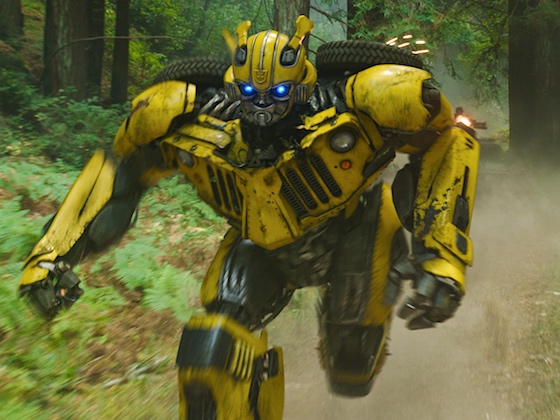
Only after all this has gone down do we finally get to the supposed point of the movie. We’re introduced to Charlie (Hailee Steinfeld), a teenager in 1980s California who likes listening to 1980s music and wearing 1980s clothes and doing other 1980s things because this is set in the 1980s. She’s down on her luck for various reasons, but what she really wants is a car. She finds one in a boat scrapyard (totally logical), but that turns out to be Bumblebee in disguise, and suddenly she has a giant robot for a best friend. But Captain Military Man (John Cena — I have no idea what his character name was. I could look it up, but this was more amusing), who Bumblebee fought with in that second action sequence, is on the hunt for our big yellow friend, and so are some Decepticons (the bad robots).
The “a girl and her robot” angle is what the film was sold on, combined with the ’80s setting to suggest a throwback to movies of that era, like E.T. and so on. I quite like it as a concept — it’s certainly a change of pace from the increasingly overblown city-destroying world-saving antics of the earlier films — but it’s the execution that disappointed me. It takes too long to get it up and running. Even after the palaver I’ve already described, it spins its wheels on Charlie getting Bumblebee started, on comedic interludes with her family, on establishing a wannabe-love-interest for her (a guy who both works opposite her at a fairground and is her next door neighbour, yet apparently she’s never even noticed. Incidentally, I can’t remember his name either). There’s altogether too much time spent on the military and Decepticons hunting ‘Bee, too, especially considering it amounts to little that’s meaningful. I mean, specifically two Decepticons turn up on Earth, and they’re therefore the film’s primary villains, but I can’t remember their names either. Their personalities amount to “the one who plans” and “the one who just wants to shoot everything”.
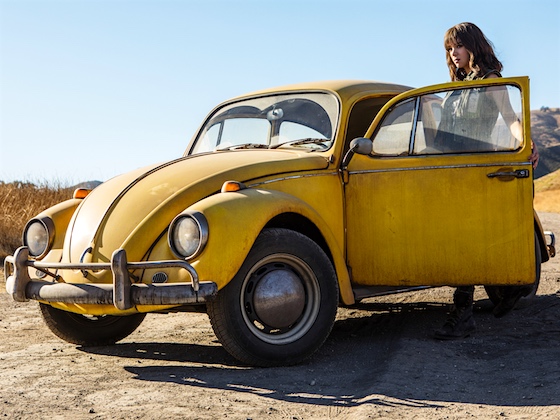
But after nearly an hour of this faff, the film gets good, with Charlie and Neighbour Boy getting up to some enjoyable ’80s kids’ movie-style antics with their friendly giant robot. But oh, then it’s time for the climax, so it’s back to explosions and indistinguishable chunks of metal hitting each other.
This is why it’s frustrating to me, because for a brief bit of time in the middle you see what I think this movie really wanted to be, and what I really wanted it to be, before it descends back into Bayhem-with-calmer-editing. Incoming director Travis Knight (whose only previous credit is the exceptional Kubo and the Two Strings) handles individual sequences well, suggesting he was a canny hire, but the film’s problem is bigger than that. The wonky pace and structure devotes time in the wrong places, leading to underdeveloped character beats (the big payoff for Charlie’s emotional subplot actually made me laugh out loud, which was not the intended effect) and taking too long to get to where it wants to be — just as it’s getting good, it has to dart off into a finale that doesn’t have enough impact, because we’re not really invested in the villains either.
Talking of what the movie “should’ve been”, a word on the certification. Bumblebee was originally given a 12A by the BBFC, just like every other modern blockbuster, but there was some kerfuffle in Australia that led to it being cut down under, and it seems that version was tamer enough to get a PG in the UK, so that’s the one that was released here (and, I think, everywhere outside the US). It loses about six seconds of injury and violence, apparently. There was a time earlier this century when anything below PG-13 was a bad thing, because they thought teens/adults would write the film off as being kids’ fare. Maybe that’s changed. Maybe it just doesn’t apply in the UK. Maybe they thought being a PG wouldn’t put grownups off (as an adult, who looks at the certificate, especially for the sixth movie in a well-established franchise?) but would allow more kids in. Who knows. It is what it is. I’m not sure it’s worth caring about.

Also, another thing about differing releases: I wish they’d put it out on 3D Blu-ray somewhere, so that I could’ve bought that version. As noted at the start, I watched the 4K UHD disc, and the (upscaled) picture was fine but not spectacular (aside from one or two bits, and the usual benefits of HDR), but there were whole chunks I feel would’ve benefited from 3D. The Bay movies certainly did. I know those of us who enjoy the format are more in the minority than ever, but it seems that interest remains in some markets (looking at other titles that didn’t get a 3D release in the US and UK but did elsewhere, countries like Germany, Italy, Japan, and India seem to be among the lucky ones), so I don’t know why this hasn’t turned up in any of them.
Anyway. If Bumblebee managed its structure and pace better it’d be a lot more fun. I feel like, even with just the material that made it to the final cut, you could do a radical re-edit and turn it into a much better movie — ditch the Cybertron crap, cut way back on the baddies hunting for ‘Bee, get the relationship between Charlie and ‘Bee up and running faster, then focus on their teenage hijinks. Instead, someone thought it would be neat to bookend the film’s heart with a bunch of Bay-esque whooshbangery, and it gets in the way.

Bumblebee is released on DVD and Blu-ray (regular and 4K UHD flavours) in the UK today.




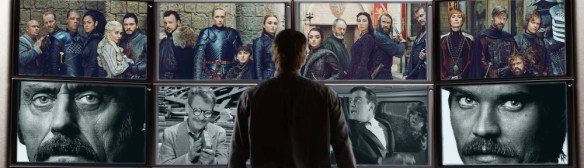
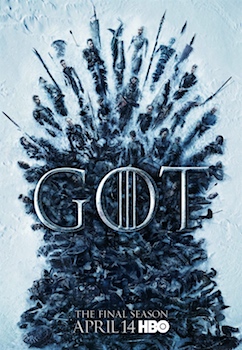 Almost two years ago, just hours after Game of Thrones’ seventh season finale aired,
 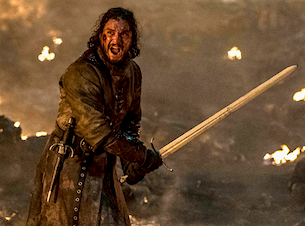 Content-wise, the episode was one long battle — the longest ever in film or TV history, apparently. More isn’t always more, mind. While I didn’t find it boring or drawn-out, it also wasn’t perfect. The battle tactics left a lot to be desired, something spotted by lay-viewers, never mind the “how it should’ve been done” articles by professional military tacticians that followed the broadcast. And the way things played out, a lot more deaths were warranted. Quite a few key characters did fall, and even more faceless masses, but the way it was staged made it a miracle that so many people escaped unscathed. There are three episodes left — you need characters to fuel the story, and major characters left to be sacrificed later too — but that doesn’t mean you have to stage it so everyone effects an improbable escape. There’s a balance to be found between “it looks like they’re all about to die” and “it seems literally impossible everyone would’ve survived those last-minute odds”. But hey, this isn’t the first time the show has succumbed to this, and there was a lot else to like: lots of effective individual sequences within the battle, great callbacks to previous lines and events, some heroic sacrifices, and a perfect ending. (I’m really not going to talk about some dickheads’ reaction to that.)
 It’s frustrating because I liked the tone of the episode overall — as I said, the return to human conflict and schemes; also a lot of the individual scenes between characters and so on. But it needs more room to breathe. It’s especially galling after the exceptionally spacious
 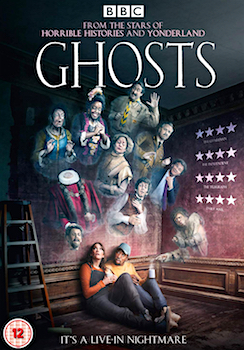 This new sitcom from the writing and performing troupe behind the original TV iteration of Horrible Histories and the Sky One fantasy comedy Yonderland is pitched as a more adult-focused series, but it’s not exactly 18-rated stuff, just a little cheekier than they might’ve done before. Anyway, it’s about a young couple who inherit a crumbling old mansion, which is home to the ghosts of various people who’ve died there down the centuries. As the couple attempt to make a life for themselves and restore the place on a budget of nothing, the ghosts cause various issues, while also having problems of their own — turns out being dead isn’t the end of your emotional woes. I wouldn’t say Ghosts is the most hilarious sitcom you’ve ever seen, but it has a definite charm. It also surprises with genuine emotion, particularly in the third episode, where we learn about the death and family of one of the more recent ghosts.
 I’ve never seen Columbo before, and despite this being the first episode (er, kind of — I believe it was preceded by two other pilots) this isn’t the start of me watching it regularly. No, I watched this for one simple reason: the director was a certain Mr Steven Spielberg, in his pre-movie days when he directed a handful of TV episodes. Unsurprisingly, such an early work contains little about its style that screams “Spielberg”, but it’s still a classily staged production, with a lot more going for its visuals than the point-and-shoot style we associate with old TV. The story’s not a bad one either, about a crime novelist who murders his co-writer following the methodology from an unused plot. He thinks he’s a clever bugger who’s got away with it easily, but Columbo seems to see through him right from the start. Well, I’m not sure dumping the corpse on your own front lawn is the best way to go about claiming “it wasn’t me.”
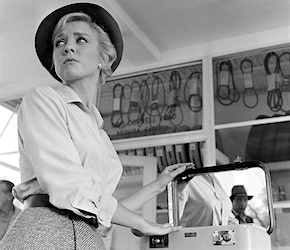 First up, season one’s The Hitch-Hiker is another Twilight Zone tale where we can’t be sure if the protagonist is experiencing paranoia or the supernatural — undoubtedly a recurring theme for the series, almost to the point where it’s less a “theme” more just a fact of its format. Anyway, this particular reiteration is effectively unnerving, with a scenario that’s relatable — you can just imagine how it would feel if you kept seeing the same hitchhiker by the side of the road, always somehow ahead of you, always staring at you with a despondent look… it gives me chills just thinking about it. Director Alvin Ganzer gets good mileage out of that element too, creating some effective shocks. Aside from that the execution isn’t top notch though, with Rod Serling seeming to have taken too much inspiration from the original radio play (by Lucille Fletcher) in his inclusion of some over-explanatory narration. The trademark twist ending is both altogether guessable for the savvy viewer, but also doesn’t really explain a whole lot.
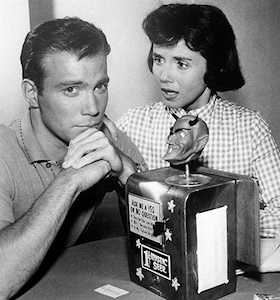 I was more taken with Nick of Time, written by the reliably superb Richard Matheson. Starring William Shatner as a superstitious honeymooner, it’s a neat little tale about a cheap fortune telling machine that might actually predict the future. As well as a genre tale about the perils such a machine might pose, it’s really about superstition and belief in fate vs. self determination — a strong moral life lesson bundled in a quirky supernatural fable. That’s Twilight Zone at its best, really. Similarly, season five’s Living Doll is another of the series’ most genuinely unnerving episodes. Telly Savalas stars as a man whose own insecurities make him paranoid and abusive towards his wife and stepdaughter. When the kid gets a new talking doll, it begins to taunt and threaten him, but only when no one else is around to hear. Again, it’s very creepy, but has a point to make beyond that.
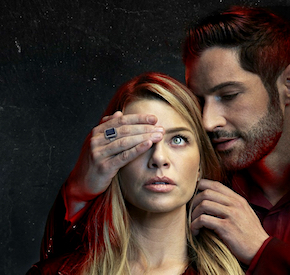 This fortnight, I have mostly been missing the fourth season of Lucifer, which just returned as a Netflix exclusive. I’ve not watched season three yet, though, so that’ll be a little while off. I’ve also successfully managed to avoid any spoilers about Line of Duty’s recently-concluded series (touch wood). I’ve got a plan to binge it in a few weeks’ time (so, not in my next TV roundup, but should be the one after) — hopefully nothing will blow its secrets between now and then!



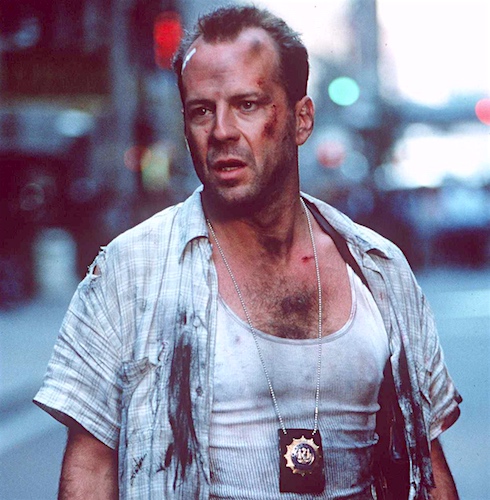






 Favourite Film of the Month













 100Films.co.uk