Unknown's avatar

About badblokebob

Aiming to watch at least 100 films in a year. Hence why I called my blog that. http://100films.co.uk

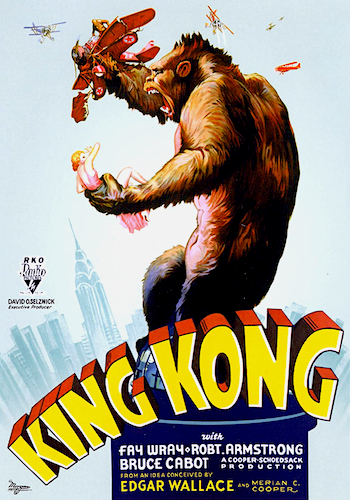
King Kong (1933)

The 100 Films Guide to…

King Kong

A Monster of Creation’s Dawn
Breaks Loose in Our World Today!

Country: USA
Language: English
Runtime: 100 minutes
BBFC: A (1933) | PG (1985)

Original Release: 2nd March 1933 (New York City, USA)
UK Release: 17th April 1933 (London)
Budget: $672,254.75
Worldwide Gross: $5.3 million

Stars
Fay Wray (Doctor X, Mystery of the Wax Museum)
Robert Armstrong (The Most Dangerous Game, Mighty Joe Young)
Bruce Cabot (Fallen Angel, Diamonds Are Forever)

Directors
Merian C. Cooper (The Four Feathers, The Last Days of Pompeii)
Ernest B. Schoedsack (The Most Dangerous Game, Mighty Joe Young)

Screenwriters
James Creelman (The Most Dangerous Game, The Last Days of Pompeii)
Ruth Rose (She, Mighty Joe Young)

From an idea by
Merian C. Cooper (Roar of the Dragon, Mighty Joe Young)
Edgar Wallace (The Squeaker, The Hound of the Baskervilles)


The Story
Adventurous filmmaker Carl Denham and crew travel to an uncharted tropical island in search of the subject for his next picture. There, they encounter a gigantic ape — Kong — who takes a shine to the movie’s pretty young star…

Our Hero
Ann Darrow is a down-on-her-luck gal in New York City, when successful movie producer Carl Denham plucks her to star in his next movie — which involves going on a long boat voyage to a mysterious uncharted island, where she’ll make a big new friend…

Our Villain
People might point to Kong — he is a giant monster who kidnaps the heroine and kills a bunch of people, after all — but I think we all know the real villain is Carl Denham, the risk-taking heath-and-safety-averse movie producer turned theatrical impresario, whose exploitative whims ultimately lead to death and destruction.

Best Supporting Character
He may be a stop-motion puppet made of metal and rubber and fur, but animator Willis O’Brien injects so much life and personality into Kong that he is, unquestionably, the real star of the show.

Memorable Quote
“It wasn’t the airplanes. It was beauty killed the beast.” — Carl Denham

Memorable Scene
King Kong is full of great moments, but the most famous has to be the climax: having wreaked havoc across New York City, Kong scales the Empire State Building with Ann in hand, deposits her at the top, and fights for his life as a fleet of biplanes swarm around. It’s not going to end well…

Truly Special Effect
I’ve already mentioned Willis O’Brien’s animation of Kong, but his skill goes far beyond that: there are all manner of beasties on Kong’s island, brought thrillingly to life by O’Brien and his team. These stop-motion effects are obviously of their time, but the way they’re integrated with the live action is frequently impressive, and any technical limitations certainly didn’t lead them to skimp on the action — you might think Kong would only appear sparingly, but the big guy gets tonnes of screen time.

Making of
King Kong was made before the enforcement of the Production Code, but its 1938 re-release was after. To comply, multiple scenes were removed (perhaps most famously, one where Kong peels off Ann’s clothes). They weren’t restored until the ’70s. But one scene was deleted even earlier: the so-called “spider pit” sequence, in which the sailors Kong tips off a log are attacked and killed by a bunch of creatures. When included in a preview screening, audience members were so disturbed that they either left or were so focused on what they’d just seen it disrupted the rest of the film. Consequently, the sequence was removed before the film’s general release, and is probably lost forever. But it remains a kind of Holy Grail of deleted scenes, and so during production of the 2005 remake, Peter Jackson and Weta set about recreating the original spider pit scene, just as a fun side project. The end result (included on subsequent Blu-ray releases of the ’33 film) is nice ‘n’ all, but what’s really incredible is the half-hour making-of devoted to its creation. The amount of time, effort, and skill that Jackson & co put into creating such a short sequence — something they themselves describe as “just a bit of fun” — is phenomenal.

Next time…
King Kong was such a hit that a sequel was raced out the same year. Produced on a vastly reduced budget and in just six months to get it into theatres for Christmas, The Son of Kong was not a success. But the iconicity of Kong has ensured he’s survived long-term. In the ’60s, he was licensed to Japanese studio Toho so they could pit him against their own giant monster in King Kong vs. Godzilla, and in 1967 they produced a Kong-only followup, King Kong Escapes. In 1976, a big Hollywood remake of the original updated events to a contemporary setting. Although it wasn’t a success, sequel King Kong Lives eventually followed ten years later. There was another remake in 1998: a direct-to-video animated musical titled The Mighty Kong (no, really). Also in the late ’90s, a small-time horror director from New Zealand nearly produced another remake, but the project didn’t come together. One billion-dollar-grossing, Oscar-winning, genre-defining, medium-revolutionising fantasy trilogy later, Peter Jackson was finally allowed to realise his dream, helming an epic reimagining that this time retained the original film’s 1930s setting. Various other animated films, TV series, comic books, games, theme park rides, and the like have featured Kong down the decades. Most recently, he’s once again been inducted into a shared universe with Godzilla, getting a wholly rebooted origin in Kong: Skull Island before facing off against the giant lizard in Godzilla vs. Kong. Given the latter’s current box office success, more films will surely follow.

Verdict

Beauty and the Beast is reimagined as a monster movie in this iconic classic. Obviously some of it has aged (not just the effects, but some broadly racist attitudes around Pacific islanders and the ship’s Chinese cook), although its pre-Code roots allow it some unexpected liberties (from gruesome deaths to an unmistakable sexuality around Fay Wray — all within PG levels, but still). Take all that in your stride, and King Kong absolutely holds up as an adrenaline-fuelled spectacle.

Godzilla: King of the Monsters (2019)

2020 #38
Michael Dougherty | 132 mins | Blu-ray (3D) | 2.40:1 | USA, Japan, Canada & Mexico / English | 12 / PG-13

Godzilla: King of the Monsters

Five years on from the events of Godzilla, the world is very much aware of the existence of Titans, gigantic prehistoric creatures — or, if you prefer, monsters. These creatures are studied and, where possible, contained by the secretive organisation known as Monarch, and one of their scientists, Dr. Emma Russell (Vera Farmiga), has developed a device capable of attracting Titans and altering their behaviour. When Emma and her daughter Madison (Millie Bobby Brown) are kidnapped by a group of terrorists, Madison’s father and former Monarch employee Mark (Kyle Chandler) is re-recruited by Monarch to help track them, before the terrorists can unleash the Titans to wreak havoc on mankind.

As well as a direct followup to the 2014 reboot of the Godzilla franchise, King of the Monsters is the third film in Legendary’s “MonsterVerse”. The in-between entry was 2017’s Kong: Skull Island, whose 1970s setting kinda leaves it adrift and standalone from the rest of the present-day-set films in this shared universe (although, following the Marvel template, Kong did have a post-credit scene designed to vaguely tee-up King of the Monsters). That said, it does have a role to play tonally. Whereas Gareth Edwards’ Godzilla was a fairly strait-laced, serious take on the concept of a giant lizard attacking mankind, Jordan Vogt-Roberts’ Skull Island took a more pulpy approach to the movie, playing like a monster B-movie with a modern spectacular effects budget.

Here, Michael Dougherty’s offering feels like a combination of those two previous MonsterVerse films. As a direct sequel to Godzilla, it brings in plot threads and a couple of supporting characters from that movie (namely Ken Watanabe and Sally Hawkins as a pair of Monarch scientists, given more prominent roles here). It also adopts the dark visual style of Edwards’ movie, eschewing the colourfulness that was part of Vogt-Roberts’ contribution. But what Dougherty does retain is that pulpiness in the storyline. I mean, Godzilla showed us a world where the real-life (more or less) military had to scramble to find a way to respond to a giant lizard suddenly appearing.

Puny humans

Conversely, in King of the Monsters we find a government organisation that maintains multiple huge facilities around the world to research and contain a variety of giant beasties (one of whom is an alien, by-the-way), and a terrorist organisation that’s well organised and financed enough to break into several of those facilities and set about freeing the Titans. And that’s without mentioning a side quest into a vast sunken kingdom. If you wanted more of the real world Edwards gave us in the first film, sorry, you’re shit out of luck; but if you’re into some of the craziness that other kaiju movies have doled out down the decades, here we go!

And, in some respects, that makes this the first MonsterVerse movie that truly feels like it’s in a shared universe of monsters. Sure, the previous films had monster antagonists — MUTOs in Godzilla, Scullcrawlers in Kong — but, frankly, they were kinda generic nasties to give our hero-monsters something to fight. In King of the Monsters, we finally get to see some of the big-name stars from Godzilla’s rogue gallery; namely: inventively-named giant moth Mothra, pterodactyl-like Rodan, and the baddest of them all, three-headed dragon Ghidorah. Okay, we haven’t been introduced to these creatures in previous movies, so it’s not technically a team-up / versus movie in that sense, but you can still feel these are headline-bout-worthy characters in a way the franchise’s previous villains just weren’t. Obviously there’s still no doubt about who the ultimate victor of these monster punch-ups is going to be (clue’s in the title), but the brawls are meatier and more impactful.

I imagine that’s even more true for long-time kaiju fans, who’ll have a much greater familiarity with the ‘supporting’ monsters. Indeed, there’s a sense in which King of the Monsters has been made expressly for those fans, because it’s absolutely loaded with nods and references to the older films. I’ve not seen many classic Godzilla movies, so my knowledge of what was being referenced was second-hand at best — though one I’ll make room to highlight is composer Bear McCreary’s new realisation of Akira Ifukube’s classic Godzilla theme. It’s epic and awesome; a real hair-raiser when it kicks in.

There can be only one

Unfortunately, the parade of callbacks seems to have been a major problem for some viewers. Fans who got the references regard them as either hollow fan service or a pointless remix of past glories, while normal folk found it all a bit confusing and weird — because God forbid any blockbuster try to do stuff from outside your normal well-worn expectations. Clearly, these monster flicks aren’t for everyone. Even among those who like them, you don’t have to read many viewer’s rankings before you’ll have seen every possible iteration of which film is better than which, often accompanied by bafflement that anyone could hold an opposing view. It’s like an inadvertent case study for the fact that different people want different things. So it seems none of these movies please everyone, although personally I like the idea that each film is its own thing to some degree; that you might not love every film in the MonsterVerse, but hopefully one of them will hit the sweet spot for you. The MCU cookie-cutter format may be reassuring, but there’s delight in variety too.

There’s certainly plenty of variety here. The MonsterVerse could’ve gone down the route of wheeling out these storied foes one by one, eking the franchise out across Godzilla vs. Mothra, Godzilla vs. Rodan, Godzilla vs. Ghidorah… Instead, we get them in one Titan-sized hit. If you’re in the mood for gigantic creatures thwacking each other, there’s something wholly satisfying about that.

4 out of 5

Godzilla (1954)

aka Gojira

2019 #71
Ishirô Honda | 96 mins | Blu-ray | 1.37:1 | Japan / Japanese | PG

Godzilla

Before its current re-fashioning as a major US-produced blockbuster franchise, the rep of the Godzilla movies was more-or-less cheesy B-movie SF with cheap-n-cheerful “man in a suit” special effects. (I expect die-hard fans would disagree, but to outsiders looking in, I feel that’s fairly accurate.) But that certainly wasn’t how things started with the first movie. Indeed, this first movie was nominated for Best Picture at Japan’s answer to the Oscars, only losing to Seven Samurai. There’s no shame for any film in losing to Seven Samurai. It was also a pricey affair: the most expensive Japanese film ever made up to that point, costing almost a million dollars — ten times the average budget for a Japanese feature at the time.

But, more than just the blockbuster entertainment of its day, Godzilla is a serious-minded work. A giant monster stomping on cities — or, if you prefer, a man in a rubber suit stomping on models — may have soon become fodder for the kind of movie fans who enjoy pulp entertainment, but, in its original incarnation, it’s an analogy for the terror of the nuclear bomb. Released just nine years after the bombings of Hiroshima and Nagasaki, it’s one of the first films to deal with that scar on the Japanese national psyche. And lest you think this is something pretentious critics have projected onto the film after the fact, the movie itself draws the connection, with one character — a young woman, no less, as if to remind us of the recency of those events — commenting that she only narrowly escaped the bombings. A big part of why Godzilla still works as a film today, almost 70 years later, is because everyone involved is playing it straight, and the clear messages about the folly of mankind interfering with nature, and the futility of weapons, are powerful.

That’s not to say it’s perfect. Subplots get in the way, like a love triangle that manages to waste screen time while not really having any significant impact on the viewer. (Reportedly, a flashback scene that would have helped explain the connection between two of the participants was deleted because it slowed down the film. The romance is slow enough as it is, but you never know, maybe that extra clarity would have helped.) Conversely, some of the moral conundrums raised by the story are barely touched on. One of the main characters is a scientist who thinks mankind should study Godzilla rather than try to kill it, but other than him stating that fact and consistently looking miserable, the film doesn’t really do anything more to engage with his argument.

Good God

As for the stomping monster action, viewed with a modern eye the effects are of course a mixed bag (the miniature vehicles look like something you’d find in a toy shop, for example), but make some allowances and they’re still pretty darn effective. An underwater sequence that mixes footage of real divers with “dry for wet” shots of Godzilla and lead characters remains mostly convincing. Godzilla may have lost Best Picture to Seven Samurai, but it did win the award for special effects, and that’s one thing it does have over Kurosawa’s film, at least. I don’t know if those same awards had one for music, but if so I guess Akira Ifukube’s score wasn’t even nominated. It would’ve deserved it for the main theme alone, though, which has since become iconic for good reason.

The Godzilla franchise has come a long way and changed a good deal across the seven decades since this film’s release. It’s not a series, nor a genre, that’s to everyone’s taste (just look at the wide spread of reactions to the recent US movies, including the fact even people who broadly like them can’t vaguely agree on which order to rank them in). But this original, at least, stands tall as an example of how a movie that some might seek to dismiss as facile genre fare can actually be about a whole lot more.

4 out of 5


For 50 years, you couldn’t actually see Godzilla in the West — not exactly. Instead, you’d watch…

Godzilla, King of the Monsters!
(1956)

2019 #82
Terry Morse & Ishiro Honda | 81 mins | Blu-ray | 1.37:1 | Japan & USA / English | PG

Godzilla, King of the Monsters!

In an era where the original cut is king (to the extent that, say, a major studio might hand a director $70 million to complete his cut of a not-particularly-successful movie just so they can release it on a streaming service), it seems wild to remember that, until 2004 — a full five decades after Godzilla‘s premiere release — this re-edited, bastardised version was the only one available to Western audiences.

With a runtime 15 minutes shorter than the Japanese cut, you might think King of the Monsters was just an abridgement. But they went at it more thoroughly than that back in the ’50s; in fact, almost 40 minutes of footage was cut, and the disparity is covered by newly-filmed scenes starring Raymond Burr as Steve, an American journalist. These new scenes don’t just place Burr’s character around the existing action, but work to make him the (human) star of the movie.

The end result is actually fairly close to the original story-wise, just now there’s an American journalist hanging around the fringes. At first he’s often to be found at the back of a crowd or the edge of a room, observing events, but they get bolder as the film goes on, integrating him with some of the main characters, either by repurposing and rearranging original footage or shooting Burr with doubles whose faces we never see. It’s not a perfect match, but for a quickly-produced low-budget effort in the 1950s, it’s surprisingly well achieved. This is partly thanks to the choice of director for the new scenes. Terry Morse had 30 years of experience as an editor and director of low-budget films, and it was felt someone with that kind of background would be well-placed to maintain the continuity needed to make it seem like Burr was part of the original production.

Raymond Burr, sir

Morse also makes some interesting decisions about how to adapt the existing footage. Although all of the ‘Japanese’ characters speak perfect English with American accents in the new bits, a lot of the Japanese dialogue in Ishiro Honda’s scenes is left undubbed, and it’s never subtitled either. Instead, the film trusts us to infer what’s happening, or informs us via someone translating for Steve, or his voiceover narration. It feels like quite a mature way to handle a multi-lingual production. Unfortunately, any such maturity doesn’t extend across the board: when abridging the original, they removed or neutered much of its commentary about mankind’s destructive nature, thereby turning a powerful allegory into a simple monster movie.

To my surprise, Godzilla, King of the Monsters is not a complete disaster. There’s a fair bit of the original movie left, and the American inserts aren’t unremittingly terrible, which they certainly could have been. If this was the only version of the film available, I’d probably give it a solid 3 stars. But it isn’t the only version anymore, so the question becomes: why watch it nowadays? It neuters some of what was great about the Japanese cut, and it’s inherently a bastardisation — so, other than curiosity value (or, for older fans, nostalgia), there’s no reason to bother with this. Stick to the real one.

2 out of 5

The Titanic Monthly Review of March 2021

Nothing to do with the ship, everything to do with the two titans (aka kaiju) duking it out on disappointingly small screens right now.


#54 Jesus Shows You the Way to the Highway (2019)
#55 David Byrne’s American Utopia (2020)
#56 Dead Man’s Eyes (1944)
#57 Crocodile Dundee in Los Angeles (2001)
#58 Con Air (1997)
#59 Wild Target (2010)
#60 Bright Young Things (2003)
#61 Carol (2015)
#62 Gambit (2012)
#63 We Bought a Zoo (2011)
#64 10 Things I Hate About You (1999)
#65 Holiday Affair (1949)
#66 The Catcher Was a Spy (2018)
#67 Truly Madly Deeply (1990)
#68 Vivacious Lady (1938)
#69 The Prom (2020)
#70 Bachelor Knight (1947), aka The Bachelor and the Bobby-Soxer
#71 Midnight in Paris (2011)
#72 Aguirre, Wrath of God (1972), aka Aguirre, der Zorn Gottes
#73 Godzilla vs. Kong (2021)
David Byrne's American Utopia

Carol

Godzilla vs. Kong

.


  • I watched 20 new feature films in March.
  • That’s the first time since 2016 that my first three months of a year have all topped 20. Then, it lasted until April — we’ll see if that feat is duplicated next month.
  • Nonetheless, it’s March’s lowest tally since 2017, although it still surpasses the March average (previously 15.5, now 15.8).
  • It’s also the lowest tally of 2021 so far, falling short of the year’s average to date (previously 26.5, now 24.3) and of the rolling average of the last 12 months (previously 23.9, now 23.3).
  • Still, I passed the halfway point of my modified goal (120 films in a year) on 13th March, the earliest ever (beating 2016).
  • And this is the furthest I’ve ever reached by the end of March, beating a previous best of #67 (which was also in 2016).
  • This month’s Blindspot film: Werner Herzog’s first significant feature film, Aguirre, Wrath of God. Also the first Herzog film I’ve ever seen, believe it or not (well, I did watch the start of Fitzcarraldo once, but it literally sent me to sleep).
  • From last month’s “failures” I watched The Catcher Was a Spy, David Byrne’s American Utopia, and Jesus Shows You the Way to the Highway.


The 70th Monthly Arbitrary Awards

Favourite Film of the Month
I always find concert films a little weird. Just sitting watching people play music — what? (Can you tell I don’t go to gigs? I have done, and I find them weird too.) So, I’m never quite sure what to expect — I guess, at best, some music I like that I am paying weirdly too much attention to. But there’s somehow more than that to David Byrne’s American Utopia — even though it is, fundamentally, people playing music. But it felt almost like a profound experience, and I’m (clearly) still processing that.

Least Favourite Film of the Month
As it started, I thought Netflix musical The Prom might defy all the negatives I’d heard and turn out to be perfectly decent. But its earlier scenes and numbers are the best bit — it goes on too long, the quality drops, and by the end, well, I didn’t hate it, but there was plenty of room for improvement.

Best Callback of the Month
Look, I don’t want to spoil Godzilla vs. Kong for anyone (especially as it’s only out in the UK today, and it costs £16 so I presume hardly anyone will be paying for it), but it contains a fun reference to an (in)famous moment from 1962’s King Kong vs. Godzilla (so famous that I’m very aware of it even though I’ve never seen the ’62 film) that left a big grin on my face. Here’s the original moment in gif form, just as a primer for whenever you watch GvK

“Eat your greens!”

Post Opportunity I’m Most Annoyed to Have Missed of the Month
Other than when I’m dumping old unreviewed films in roundup posts, I always feel like it’s nice to be able to tie a review in to something. It feels less like it’s just being tossed out into the ether if it’s at least somehow connected to something current. The past couple of years, I’ve got very good at missing these opportunities, and it always irks me. Most recently, a new documentary about Terry Gilliam’s The Man Who Killed Don Quixote, titled He Dreams of Giants, was released in the UK last Monday — but I got the chance to see it last September, and watched Don Quixote and the previous (un)making-of doc about Gilliam’s film, Lost in La Mancha, also. I intended to post them together as a triple review to mark the occasion, but didn’t find time to write them up. So now they’ll languish in my backlog, probably to also be dumped in a 100-Week Roundup in mid-2022. Bother.

The Audience Award for Most-Viewed New Post of the Month
None of this month’s new posts seem to have particularly piqued the interest of my readership and/or the general public who stumble across this blog. The most seen was 100-Week Roundup XXVI, with its reviews of Paperman and Waltz with Bashir, but it was in a lowly 82nd place overall. Roundup XXVII was right behind it, too.


This month, I continued to rewatch films, while also continuing to slowly slip behind on my target. There’s always time to catch up, though — if I ever get round to watching a trilogy or something, I’ll shoot along. And with the Indiana Jones films just announced for 4K, it’s long overdue that I actually watch my Blu-ray set…

#7 The Sound of Music (1965)
#8 Casablanca (1942)
#9 Runaway Jury (2003)

The Sound of Music and Casablanca were both films I haven’t watched in about 15 years, which I feel like is a pretty standard kind of revisit time for me — long enough that I begin to think “I should really rewatch that”, plus half-a-decade-or-so of not quite getting round to said rewatch (for example: I’ve owned Casablanca on Blu-ray since 2014). Brief thoughts on both (here and here, respectively) on Letterboxd.

It’s been even longer since I saw Runaway Jury. It’s not the kind of film I necessarily thought I’d ever rewatch — it’s good, I liked it, but not really exceptional — but sometimes you just get an itch. It was worthwhile, because I do love this kind of stuff: just a solid, well-played thriller. I guess it’s the province of TV rather than movies now, but there’s something to be said for wrapping it all up in one 120-minute hit rather than dragging it out for eight-to-thirteen hours.


The big news this month was the long-awaited release of Zack Snyder’s Justice League — direct to Sky Cinema / Now on this side of the pond, limiting most (legal) viewers to a relatively low quality stream. But hey, at least it was available as part of a subscription package rather than having to fork out £16 to rent one single film. Other “would’ve been in cinemas under normal circumstances” flicks that went down that route included Ammonite, Judas and the Black Messiah, The Little Things, Locked Down, Raya and the Last Dragon, and Tom and Jerry, and that’s why I’ve not seen any of them. Justice League, on the other hand, I just haven’t made room for its four-hour running time yet.

Other big streaming debuts this month included Coming 2 America, once slated for a cinema release but now an Amazon Original. I presume they paid a pretty penny for the privilege, given how mercilessly they were pushing it on their homepage. I’ve heard it’s quite good, which can’t also be said for their other debuts, The War with Grandpa and Made in Italy. Elsewhere, Netflix had Jennifer Garner vehicle Yes Day, while Apple TV+ offered the Russo brothers’ attempt to prove they can do more than MCU flicks, Cherry. I won’t be racing to watch either.

Also out to buy or rent this month, but at a more normal price point, was the Russian remake of The Raid, cannily titled Russian Raid; another DC flick, Wonder Woman 1984 (no 3D release in the UK (but there is one overseas) means no purchase from me); and a belated release for Richard Linklater’s Where’d You Go, Bernadette. Plus, straddling the two price points, documentary Stray, about street dogs in Istanbul. Sounds like the kind of thing that would be ripe for misery and depression for a dog lover like myself, but apparently it isn’t at all, so I’ll give that a shot when it’s a bit cheaper.

Dozens more films made my watchlist across all the streamers this month (between regular subscriptions, discounted ones, and free services, I’m currently keeping an eye on six different services), but not a huge amount that merit special mention here. Well, maybe Train to Busan Presents: Peninsula, which I blind bought on Blu-ray, haven’t watched yet, and is now streaming on Amazon Prime. Oh well. And, talking of Korean thrillers, iPlayer magicked up one I hadn’t heard of — The Gangster, the Cop, the Devil — that sounds up my street. Or that I really should catch Wild Tales before it leaves All 4 again. Or the fact that between Amazon and iPlayer I could catch up on two different versions of A Star Is Born (1937 and 1954, respectively), which would just leave the 1976 one. Or that Disney+ adding Star to their lineup is causing a dilemma for my viewing of the Die Hard films I’ve never seen: they have all the sequels in 4K, so now I have to choose between watching the Blu-rays I own and paid for, or plump for streaming in lovely UHD. I find this choice easy when it’s DVD vs HD streaming (the latter almost always looks noticeably better), but I find that sometimes a poor/mediocre UHD version (especially if they’ve been over-aggressive with the HDR, for example) is actually worse than the Blu-ray. Frankly, I probably won’t get round to watching any of them before I cancel my D+ subscription, so it’s a bit of a moot point.

We end, as always, with my insatiable habit of buying things on disc — always the true failures here, because it’s all stuff I’ve actively spent money on. Once again, sales tempted me — it feels like some label or another is always running one these days, usually several at once. So, I picked up piles from Indicator (90° in the Shade, The Odessa File, The St. Valentine’s Day Massacre, The System, and Town on Trial), Network (Deadlier Than the Male, Some Girls Do, the 1928 Moulin Rouge, and Things to Come), HMV’s Premium Collection (kinda-noir Possessed and the 1932 Scarface), and a couple from the Criterion twofer that’s currently on (The Awful Truth and the 1936 Show Boat). I definitely intend to get more from the latter before the offer ends, but my wishlist is long (I could easily spend a couple of hundred quid on that alone). Plus, Arrow currently have a sale going too. Eesh. I also dropped a couple of quid each on The Amazing Spider-Man and its sequel in 3D — I’m not a massive fan of those films, but they were actually shot in 3D and I’d like to see them in that form. I also nabbed The Meg in 3D for dirt cheap, but that one I thought that was a lot of fun.

And there were brand-new releases, too, all of them blind buys: animes Children of the Sea and Children Who Chase Lost Voices (aka Journey to Agartha); Fanny Lye Deliver’d, with an extended cut in 4K; the Lucky Stars trilogy of Jackie Chan / Sammo Hung action-comedies; and Russian horror Viy. As ever, my taste is nothing if not eclectic.


Later than usual, the Oscars are here (at almost the end of the month). So far I’ve seen precisely none of this year’s Best Picture nominees — let’s see how much that changes in the next four-and-a-half weeks…

Eighth Grade (2018)

2019 #148
Bo Burnham | 94 mins | digital (HD) | 1.85:1 | USA / English | 15 / R

Eighth Grade

I confess to never having heard of Bo Burnham before the buzz generated by this, his debut film as writer-director. According to his Wikipedia page, he started out as a YouTuber, turned that into a standup career, and from there has been a musician, actor, screenwriter, and poet — plus, with this, film director. It’s the kind of trajectory that challenges your perception of what being a YouTuber is good for. Of course, other “content creators” have jumped beyond the confines of the video streaming site before, but generally to eye-rolling effect for any of us old enough to be outside the sway of popular youth culture. But Burnham bucks that trend too, because in Eighth Grade he’s produced a mini masterpiece of distilling the teenage experience.

The film introduces us to the life of Kayla (a star-making performance by Elsie Fisher), a 13-year-old girl so shy and insecure that she doesn’t seem to have any friends at school, but who still spends most of her time engaged in typical modern teenage activities: glued to her phone scrolling through social media, and posting her own content that no one anyone actually views. (At this point we’ve all been there, right?) The videos she posts online are perky and optimistic, presenting a front of having her life together. In reality, Kayla’s middle school experience has been miserably lonely, and as it comes to an end she hopes for a better time in high school. (If the American high school movies we’ve all seen are anything to go by, her chances can’t be good…)

In some respects, Eighth Grade is wholly focused on showing us the present day. The specifics of what it depicts are very much “modern American teenager”, with pool parties, active shooter drills, living through social media, their eyes glued to phones, etc; even the plot-prompting transition from middle to high school isn’t necessarily relevant to those of us outside the US education system. But if you look past the modern milieu to the fundamental feelings underneath, they’re universal and speak across the generations. This is the most truthful movie about what it’s actually like to be a teenager I think I’ve ever seen. It really captures the uncomfortableness of being a not-popular teen, both for good (well done Burnham & co, you conveyed your point) or ill (it can be as squirm-inducing as living the real thing). And if you watch it and think “eh, I don’t remember my teenage years being like this”, I’m afraid to inform you that you were quite possibly one of those kids making life a bit awkward for the rest of us. Sorry.

Kayla

Much like bullies, indie movies often revel in taking nice people and kicking them down, because, hey, life’s shit and that’s probably what’s gonna happen. Without spoiling where the story goes, it makes a welcome change to see a film where realism isn’t abandoned (Kayla’s life doesn’t become plain-sailing) but in which the nice, sweet, quiet character nonetheless sees their life improve, rather than believe things are gonna get better only to have their expectations crushed. Well, there’s a certain degree in which the optimistic hopefulness of being a tween is contrasted with the crushing reality of being a teenager, but there’s a positive message along the lines of “these things shall pass” that I think remains good advice to many people struggling with a particular time in their life.

Talking of specific times in one’s life (this is a tenuous transition, I admit), the certifications handed to Eighth Grade (at least in the UK and US) are a bit daft. To clarify for the benefit of those of us on the outside, the US’s 8th grade is for 13- to 14-year-olds; the equivalent of Year 9 in England (other UK and Anglosphere countries may vary). So it’s somewhat amusing that a film explicitly titled Eighth Grade is officially limited to over-15s in the UK and over-17s in the US (I know R is a little looser than that, but you get what I mean). You feel that the certifiers are, not for the first time, somewhat out of step when it comes to the realities of kids’ life experiences. I doubt that’s a major problem (I’m sure plenty of people don’t stick rigidly to the ratings), but it is, perhaps, a stark reminder that things like the boundaries of film certificates require constant review and revision if they want to remain relevant.

Something that I think will remain relevant is Eighth Grade. As I said, it already transcends its depiction of current teenage lifestyles, so it stands to reason that, as time goes on, while it will cease to accurately reflect the specifics of young people’s lives, it will continue to encapsulate how it feels to be that age.

5 out of 5

Eighth Grade placed 9th on my list of the Best Films I Saw in 2019.

The Man Who Reviewed Some Films

There are a lot of films about a man who did something — already on this blog I’ve written about men who invented Christmas, sued God, and, um, laughed. But I noticed I have many other reviews pending about such apparently-noteworthy fellas, so I’ve rounded most of them up into this one handy location.

Some of these men knew stuff; some shot somebody; one just had a nap… but they’re all men who had a movie named after them. They are:

  • The Man Who Knew Infinity (2015)
  • The Man Who Knew Too Much (1956)
  • The Man Who Shot Liberty Valance (1962)
  • The Man Who Sleeps (1974)


    The Man Who Knew Infinity
    (2015)

    2019 #65
    Matthew Brown | 109 mins | digital (HD) | 2.39:1 | UK & USA / English | 12 / PG-13

    The Man Who Knew Infinity

    Srinivasa Ramanujan (Dev Patel) is a man of boundless intelligence that even the poverty of his home in India cannot crush. His skill for mathematics attracts the attention of noted British professor G.H. Hardy (Jeremy Irons), who invites him to develop his computations at Trinity College, Cambridge. Ramanujan finds that his largely-intuitive mathematical theories clash with stringent academic requirements, just as his cultural values are challenged by the prejudices of 1910s Britain. With Ramanujan’s health in decline, the two men join in a mutual struggle that would define him as one of India’s greatest scholars. — adapted from IMDb

    Writer-director Matthew Brown takes this interesting true story and turns it into an ironically by-the-numbers biopic. Even with reliable actors like Patel and Irons headlining, there are some surprisingly stuff performances, and the film struggles to truly convey the genius or importance of the maths involved. Instead, it’s just lots of characters saying “OMG look at this stuff he thought up” and other characters saying “nah mate, it’s wrong” (except in the vernacular of 1910s Cambridge, of course). Alongside that, it doesn’t have many places to go with the story or characters, so it comes to feel repetitive as it goes round and round over the same points. Even the start of World War I has no genuine impact on events, factoring into the film only because that’s when these events actually happened, so Brown seems to feel it must be mentioned. Indeed, a lot of the film feels beholden to fact in this way, though I’m sure it must be doing the usual biopic thing of bending the truth.

    3 out of 5

    The Man Who Knew Too Much
    (1956)

    2019 #84
    Alfred Hitchcock | 120 mins | Blu-ray | 1.85:1 | USA / English | PG / PG

    The Man Who Knew Too Much

    Dr. Ben McKenna (James Stewart), his wife Jo (Doris Day), and their eight-year-old son Hank are on vacation in Morocco when they witness the public murder of a mysterious man who, before he dies, manages to reveal to Ben details of an assassination about to take place in London. The plotters kidnap Hank to keep the McKennas silent, so Ben and Jo return to London to take matters into their own hands. — adapted from IMDb

    Famously, this is the time Hitchcock remade himself: he’d previously filmed The Man Who Knew Too Much in 1934 while he was still working in Britain. Later, he’d compare the two by calling the original “the work of a talented amateur” while the remake “was made by a professional”, although he reportedly preferred the earlier version precisely because it wasn’t so polished.

    Undoubtedly, the 1956 Man Who Knew Too Much is not top-tier Hitchcock, but that doesn’t mean it’s without joys. Jimmy Stewart and Doris Day are perfectly cast as an ‘everyman’ American couple who accidentally get embroiled in international espionage, and Hitch could make such thrills work with his eyes closed. He’s also on top form during a sequence in the Albert Hall, a stunning set piece that lasts 12 minutes without a single word of dialogue, in which Hitch has the balls to just keep going through an entire piece of music, allowing the tension to almost build itself as he cuts around the room; even when Stewart finally turns up, we still don’t need exposition — we know exactly what’s happening.

    Although a key part of the film’s conclusion, it’s not the actual finale, which is a shame because the following plan to rescue Hank is a bit daft. And, when you think about it, the villains’ plot doesn’t make a whole lot of sense either. It’s stuff like that which gets in the way of The Man Who Knew Too Much being among Hitch’s very best work, but it remains a fine suspense thriller.

    4 out of 5

    The Man Who Shot Liberty Valance
    (1962)

    2020 #66
    John Ford | 118 mins | digital (HD) | 16:9 | USA / English | U

    The Man Who Shot Liberty Valance

    When US Senator Ransom Stoddard (James Stewart) returns to the town of Shinbone to attend the funeral of his friend Tom Doniphon (John Wayne), a young reporter persuades him to tell the story of why he’s there. Flashback to a quarter-century-or-so earlier, when Ransom, a newly-qualified lawyer (still played, unconvincingly, by 53-year-old Stewart), arrived in Shinbone with a plan to bring law to the West. After Ransom receives a beating from local heavy Liberty Valance (Lee Marvin), he recuperates at the Ericsons’ restaurant, where he takes a job in their kitchen to repay their kindness. He develops an affection for their daughter, Hallie (Vera Miles), who’s also being wooed by young rancher Doniphon (still Wayne, also in his early 50s — it seems there was a good deal of movie star vanity in this casting). With local law enforcement refusing to do anything about Valance’s violent oppressive tactics, Ransom eventually takes it upon himself to face the villain down…

    Despite the violent promise of the title, Liberty Valance is very much a dramatic western rather than an action-packed one. Just shooting Valance isn’t the characters’ first recourse; indeed, the film on the whole is interested in the clash between the moral values of the old West and incoming modernity, and how the old ways can persist even as new ones come into force. That older Ransom is a senator is not incidental: a major part of the plot concerns Shinbone (or, rather, wherever it is) applying for statehood, and Ransom and Valance both standing to be a representative.

    All of which is fine, but unfortunately the dramatic focus seems to have resulted in the film being rather slow-going at times. The main plot is fine, but the telling could’ve been tighter — there’s a lot of stuff about Ransom washing dishes and teaching everyone to read and write. It establishes his place in town, sure, but it takes forever getting there. At the other end, Valance is actually shot a full 25 minutes before the end. There’s story to wrap up and twists to reveal, but it takes its sweet time doing it. None of which is distracting as the age-related issue I already referred to. I was genuinely puzzled why everyone kept talking about how young Ransom was, when Stewart patently isn’t, until I realised it was an example of good ol’ Hollywood vanity, where someone thought a star in his 50s could get away with playing a guy in his 20s.

    Despite that, however, Stewart and Wayne remain powerful screen presences, and the commentary on the changing face of the West — indeed, of the country as a whole — is indicative of a direction the genre continues to explore to this day (it’s what the whole of Deadwood is about, at its core).

    4 out of 5

    The Man Who Sleeps
    (1974)

    aka Un homme qui dort

    2020 #203
    Bernard Queysanne | 78 mins | digital (SD) | 4:3 | France & Tunisia / French

    The Man Who Sleeps

    When I watched this, it was ranked as one of the greatest films of all time by Letterboxd users. I did not feel the same — rather than Un homme qui dort, I found it more like Un homme qui t’endort. (That’s a joke I’m so pleased with, I’ve now used it four times.)

    At first it plays like a stereotype of French art house cinema: shot in black & white, it’s about a disaffected student, told with introspective voiceover narration, which philosophises at the level of a pretentious undergraduate, and nothing actually happens. But then I began to feel that, actually, it does a pretty good job of capturing how I’ve felt often in my life; especially back when I too was a pretentious undergraduate. But that feeling didn’t last much more than quarter-of-an-hour — and as the film is an hour and a quarter, that became a problem. As I slogged on through it, the interminable narration became repetitive; the musings less relatable. Just because warped minds exist doesn’t mean it’s worth our while to spend 78 minutes in their thoughts.

    The Man Who Sleeps is the kind of film that thinks it’s profound, but is actually pretentious. That may gel with the worldview of its undergrad subject, but, just as you wouldn’t want to listen to a real-life undergrad’s philosophising for over an hour, I don’t want to endure the same from a fictional one either. I guess it’s apt that a film titled “the man who sleeps” would be a good cure for insomnia.

    2 out of 5

    The Man Who Sleeps featured on my list of The Worst Films I Saw in 2020.

  • The 100-Week Roundup XXVIII

    The 100-Week Roundup covers films I still haven’t reviewed 100 weeks after watching them. Sometimes these are short ‘proper’ reviews; sometimes they’re only quick thoughts, or even just the notes I made while viewing.

    This week’s selection includes a few more films from April 2019

  • Early Man (2018)
  • Amour (2012)
  • Ralph Breaks the Internet (2018)


    Early Man
    (2018)

    2019 #56
    Nick Park | 89 mins | digital (HD) | 1.85:1 | UK, France & USA / English | PG / PG

    Early Man

    Only the third feature film directed by Wallace & Gromit creator Nick Park, Early Man is about a prehistoric tribe who invented football (aka soccer) and must defend their home from a more advanced civilisation by playing a winner-takes-all footie match.

    So, despite the Stone/Bronze Age setting, this is a sports movie — and with that in mind, the plot is as rote as they come. And, if you hadn’t guessed yet, the period setting is less historically accurate than Game of Thrones (at least Thrones is inspired by things that really happened). Plus, there are plenty of bizarre choices — like, if the story’s set in Britain, why is Tom Hiddleston doing a weird Generic European accent? But, for all that, this is an Aardman production, and so there’s tonnes of pleasure to be found in incidental details; the asides and background jokes and grace notes that frequently raise a full-blown laugh, or at the very least a warm smile.

    There’s also something to be said for the film being quite delightfully Brit-centric. When so many productions aim to be bland enough to appeal to a global audience, Park and co haven’t shied away from including an array of gags that are like to only be caught by Brits and/or footie fans. For example, there’s a reveal of the backstory of the tribe and their relationship to the sport that’s an obvious riff on England’s relationship to international football, and I don’t know how apparent that would be to overseas viewers; or characters with names like Goona and Asbo. Not that such things should turn off the uninitiated, however. For pun lovers alone there’s plenty of material, not to mention general quirkiness. I could try to explain what goes on with the duck, but it’s better I leave it for you to discover.

    Early Man isn’t Aardman’s strongest production, but their productions have a base-level charm that’s high enough to keep it ticking over, with the occasional inspired flourish to boot.

    3 out of 5

    Amour
    (2012)

    2019 #59
    Michael Haneke | 127 mins | digital (HD) | 1.85:1 | Austria, France & Germany / French & English | 12 / PG-13

    Amour

    German director Michaell Haneke may be much acclaimed by the arthouse crowd, but I’m not a huge fan of his previous works that I’ve seen (1997’s Funny Games and 2005’s Hidden — it seems I gave the latter four stars, which is not how I remember it). Palme d’Or, Oscar, and BAFTA winner Amour is the exception, however, even while some of its more arty asides hold it back somewhat.

    It’s the story of an ageing couple, Georges and Anne. When Anne has a stroke, Georges is left caring for her as her health continues to decline. In its depiction of this relationship — the strains placed on it and how it survives them — Amour is a truthful, affecting, and deeply moving character drama. Most of the major events (diagnoses, tests, a second stroke) happen off screen, with the film more concerned with day-to-day realities, but that’s part of where its power lies. It’s not so much about the big drama, more the reality of coping.

    But in between this powerful material, there’s random art house shenanigans, like a pigeon wandering into the apartment before Georges shoos it out, or a montage of impressionist paintings. Why do we see these things? I’ve not the foggiest. I guess Haneke had a purpose in mind, but goodness knows what it was — although, as he said in one interview, “consider the pigeon just a pigeon. You can interpret it any way you want. I wouldn’t describe it as a symbol. I have problems with symbols, because they always mean something specific. I don’t know what the pigeon means,” so maybe not. When combined with an overall slow pace, this resulted in the film becoming a bit of a slog for me, which was a real shame. The bits that are good — that are insightful and impactful and emotional — are so good, but, for me, those longueurs get in the way.

    4 out of 5

    Ralph Breaks the Internet
    (2018)

    2019 #62
    Rich Moore & Phil Johnston | 112 mins | digital (UHD) | 2.39:1 | USA / English | PG / PG

    Ralph Breaks the Internet

    The sequel to Wreck-It Ralph is indeed called Ralph Breaks the Internet, when Ralph Wrecks the Internet was right there. Although, if they wanted to be truly accurate, a better titled would’ve been Corporate Synergy: The Movie.

    The plot sees Ralph and his chum Vanellope heading out into the internet to fix the arcade game they live in. That includes an extended sequence set ‘inside’ the Oh My Disney website — originally the Disney Infinity game, but that got cancelled during production so had to be changed. I think that rather indicates the mindset and motives behind this movie: $ advertising $ . Most famously, it includes a sequence where Vanellope encounters the Disney princesses. It’s quite a funny sequence, somewhat undermined by the “no one can understand Merida (because she speaks Scottish)” gag. Imagine if they’d tried that with Tiana or Pocahontas or Moana and their accent/dialect…

    When it’s not being a big advert for its production company, Ralph Breaks the Internet seems to think it’s a clever satire of the online world. It does references and stuff, but doesn’t develop them enough to be genuine commentary — for example, Ralph finds ‘the comment section’ and it’s depressing, and then someone tells him “the first rule of the internet is never read the comments”, and… that’s it. It’s stating a widely-accepted truism as if it’s some kind of revelation or point unto itself. This extends right to the climax, which sees our heroes fighting with a giant virus born of toxic masculinity, an idea that’s somewhere between timely and fucking ridiculous (how does toxic masculinity inherently create a computer virus?)

    Other problems include a pile of plot holes and inconsistencies (such as when Vanellope does or doesn’t use her glitching ability, among others); that it’s a structural mess (the plot bounces from place to place just so it can even get started, then major motivating goals are dismissed and moved on from), which leads to it being needlessly long (surely kids’ animations are best around the 90-minute mark). Also, frankly, I don’t particularly like the characters or the style of humour they create. That’s only worsened when you shoehorn in blatant advertising, half-witted satire, and muddled messages.

    The best Disney canon movies are timeless. Heck, some of the worst ones are, too. But Ralph 2 is so about the ‘right now’ of when it was made, it’s probably already dated today, just a couple of years later, never mind how it’ll hold up in a couple of decades.

    2 out of 5

  • The Purge: Anarchy (2014)

    2019 #57
    James DeMonaco | 104 mins | digital (HD) | 2.39:1 | USA & France / English | 15 / R

    The Purge: Anarchy

    For those unfamiliar with the Purge franchise, they’re set in a near-future America where the law is suspended for one night a year — Purge Night — allowing the citizens to ‘purge’ their criminal impulses by committing any crime they like. Because this is America, said crimes invariably involve violence and murder. As a premise, it used to seem a little ridiculous and implausible — the kind of thing you might dream up only to think through and realise it would never work — but we live in a world where Donald Trump can be elected president, get nothing done while constantly and obviously lying about things, escape charges for crimes he blatantly committed, and still be worshipped by his followers as the only thing that can make America “great” again. So, yeah, maybe the Purge could come to pass nowadays, why the fuck not?

    The first film was a contained horror/thriller about one well-to-do family whose home comes under assault from a gang of Purge participants on the night in question. This first sequel ditches most of the Horror genre trappings to instead emulate ’70s B-actioners, in the vein of stuff like Assault on Precinct 13 or The Warriors, and it’s all the better for it.

    This time, the narrative opens up to a wider world. We’re introduced to a trio of storylines, spread around a city, which quite quickly stumble into each other and result in their protagonists teaming up, fighting their way across a hostile city (like The Warriors), trying to survive the night (like Precinct 13 — see, my comparisons aren’t just random). It reminded me a little of the early episodes of a season of 24, when it cuts around multiple disconnected characters who inevitably come into contact. (It strikes me that the best way to do a Purge TV show would be to nick 24’s real-time conceit to cover the entirety of Purge Night. I’ve no idea if the actual Purge TV show attempted anything like that.)
    Gonna get purged

    It can’t be understated how good it is that Anarchy does something different with the franchise’s basic premise. Sure, it has the same problem with the underlying concept as the first film (all crime is legal, but for some reason the only crime anyone commits is murder), but the story it tells, the environs it’s in, are completely different. Even the satirical, allegorical, political stuff (hardly the films’ forte) is more potent this time. It’s still only tangentially touched upon, but more effectively and meaningfully handled than in the first film.

    There’s also the sense that they’re trying to build a franchise now. In the first film, the whole Purge backstory was really just a backdrop/excuse for the low-budget home invasion action of the plot, but here there are more hints at what’s going on in the wider world politically. That includes the introduction of an anti-Purge movement, although it’s factored in as barely even a subplot, to the extent you feel it had to be intended as setup for future movies. In this respect it reminds me of what the Saw films used to do: tell a standalone story, but always provide a little piece of the puzzle to an ongoing narrative that was designed to run and run. When it works, as it does in Anarchy, you leave the film satisfied that you’ve had a whole story, but also ready for the next jigsaw piece (Saw-related pun very much intended). It’s quite a TV-esque way of building an ongoing narrative, the way they used to do it before everything became “an eight-hour movie”, but, hey, the media boundaries are thoroughly blurred in both directions now; and it’s better than a blatant cliffhanger that leaves the story unresolved if a sequel never happens.

    In this instance, a sequel did happen; several of them, in fact, with a final instalment due later this year. I quite liked the original Purge (not to be confused with The First Purge, which is the fourth film), but I enjoyed Anarchy a lot, so they’ve got me on the hook now, even if (based on what I’ve seen online) the quality of future sequels tails off.

    4 out of 5

    The series’ third film, The Purge: Election Year, is on Channel 4 tonight at 12:10am.

    The 100-Week Roundup XXVII

    The 100-Week Roundup covers films I still haven’t reviewed 100 weeks after watching them. Sometimes these are short ‘proper’ reviews; sometimes they’re only quick thoughts, or even just the notes I made while viewing.

    This week’s selection includes the first reviews to be rounded up from April 2019

  • The Howling (1981)
  • The Gold Rush (1925)
  • A Good Year (2006)


    The Howling
    (1981)

    2019 #50
    Joe Dante | 87 mins | TV | 1.85:1 | USA / English | 18 / R

    The Howling

    After a near-fatal encounter with a serial killer, television newswoman Karen White becomes emotionally disturbed and loses her memory. On doctor’s orders she’s sent to the Colony, a secluded retreat where the creepy residents may not be what they seem… — adapted from IMDb

    Released the same year as John Landis’s An American Werewolf in London, I think it’s fair to say The Howling has been overshadowed by its UK-set counterpart, which has left a more enduring mark on the werewolf subgenre. But it would be a shame to ignore director Joe Dante’s effort entirely, because it’s a strong movie with its own pleasures — where American Werewolf is mostly quite comical, The Howling is more of a straight-faced horror movie.

    Indeed, at the start it feels more like a ’70s thriller than a campy horror — a Network-esque newsroom drama crossed with a seedy serial killer flick, in which the handheld neon-lit photography of nighttime ‘mean streets’ reminded me of something like The Killing of a Chinese Bookie. When the plot heads out into the countryside, the sub-Hammer antics feel a bit low-rent by comparison; but once the proper werewolf action kicks off, it picks up again. Special makeup maestro Rick Baker may have abandoned this project for American Werewolf, but the special effects feature sterling work nonetheless, including a couple of superb transformations. Hurrah for practical effects.

    There’s room for improvement here — it needs a more cohesive, thorough, better paced screenplay (after an effective opening, it takes time to get going again, but then the climax is a bit rushed) — but the bits that work are so good that The Howling still ends up as a great werewolf movie.

    4 out of 5

    The Gold Rush
    (1925)

    2019 #52
    Charles Chaplin | 95 mins | DVD | 4:3 | USA / silent | U

    The Gold Rush

    Charlie Chaplin’s The Gold Rush exists in two versions: the 1925 original, and a 1942 re-release for which Chaplin cut whole scenes, trimmed others, and reinserted some outtakes and alternate shots, plus adding a synced soundtrack that included voiceover narration by him. The re-release is the ‘official’ version according to Chaplin’s estate (on the 2-disc DVD I own, the ’42 version is by itself on disc 1, with the ’25 version among the special features on disc 2), but from what I read it seems most people regard the ’25 original as the superior version, so that’s the one I chose to watch.

    As with the other Chaplins I’ve seen, it’s an episodic series of skits with a linking theme — this time, his Little Tramp character is prospecting for gold in the Klondike. It’s an interesting mix of the expected slapstick humour with something that’s more… not serious, exactly (although a subplot about a wanted criminal who murders a couple of lawmen is a bit incongruous), but there are sequences that aim at distinctly different emotions, like pathos (not unfamiliar when it comes to the Little Tramp), or overt thrills, including a cliff-edge climax.

    Then there’s the ostensibly happy ending, in which our hero gets the girl. That’d be the girl who stood him up, who doesn’t really care for him, who got railroaded into posing with him and kissing him… but gets with him right after she learnt he’s now a multimillionaire. Are we sure that’s a happy ending?

    4 out of 5

    The Gold Rush was viewed as part of What Do You Mean You Haven’t Seen…? 2019.

    A Good Year
    (2006)

    2019 #54
    Ridley Scott | 113 mins | TV | 2.35:1 | UK & USA / English & French | 12 / PG-13

    A Good Year

    Ridley Scott, the acclaimed director perhaps destined to be best remembered for sci-fi classics like Alien and Blade Runner, and actor Russell Crowe, who made his name with hard-man roles in films like Romper Stomper and L.A. Confidential, have collaborated multiple times. Together they’ve created action-filled historical epics like Gladiator and Robin Hood, and contemporary thrillers like American Gangster and Body of Lies. But in amongst all that they made… this, an oddity on both man’s filmography: a gentle romantic dramedy about a London banker who inherits a vineyard in Provence and learns to love a simpler life.

    Ridley Scott directing a sunny romcom sounds like a daft idea, doesn’t it? Well, turns out it’s not only daft, it’s quite bad. Apparently Scott conceived the story, and everything (apart from scenes in London) was shot within eight minutes of his home in Provence. In some hands that might lead to a very personal story, but I don’t think that’s the case here. I once read someone argue that the entertainment an artist enjoys consuming isn’t necessarily the same as what they’re good at creating, and this seems like a case in point. The storyline and atmosphere may’ve been inspired by Scott’s love for the region he’s made his home, but it doesn’t match his skills as a filmmaker very well at all.

    It’s as inappropriately directed as you’d expect, with moments of almost slapstick comedy that feel decades out of date, and other parts that are shot and scored more like a thriller than a breezy comedy-drama. In front of the camera, Russell Crowe does his best to be Hugh Grant, and he could be worse, but it does make you appreciate how good Hugh Grant was at being Hugh Grant. His love interest is Marion Cotillard, playing a character whose name sounds like “Fanny Chanel” — one character responds to being told that with “ooh la la”, which might be the most succinct “British person’s view of the French” dialogue exchange ever written.

    Much as Crowe’s continued exposure to the region and its people slowly charms him, so did I gradually warm to the film. When Scott isn’t trying too hard it has a certain laidback good humour, with the bonus of beautiful scenery and beautiful women, so that it becomes not unpleasant to watch. If that sounds like damning with faint praise… well, it is. A Good Year is not a good film, but it is, ultimately, a mostly pleasant one.

    3 out of 5

  • The 100-Week Roundup XXVI

    The 100-Week Roundup covers films I still haven’t reviewed 100 weeks after watching them. Sometimes these are short ‘proper’ reviews; sometimes they’re only quick thoughts, or even just the notes I made while viewing.

    This week’s selection, the final two films from March 2019, includes a pair of awards-worthy short animations — the first won an Oscar, the second was nominated for one. I was going to include more films in this week’s roundup (effectively bundle two weeks into one), but it felt like a disservice to this pair.

  • Paperman (2012)
  • Waltz with Bashir (2008)


    Paperman
    (2012)

    2019 #48a
    John Kahrs | 7 mins | Blu-ray (3D) | 1.85:1 | USA / silent | U / G

    Paperman

    This Disney short was originally released alongside Wreck-It Ralph (and can now be found on that film’s Blu-ray; as well as on Disney+, I presume) and, as I recall, attracted a lot of praise at the time, primarily for its visual style. That was an innovation in creating 2D-looking animation via a 3D system — so it seems a bit daft that I watched it in 3D. I have to wonder if the added visual dimension highlights the underlying 3D animation, because it’s quite obviously been created in 3D with a 2D style over the top.

    That said, it look gorgeous, however you cut it. There’s an inherent beauty in how it’s executed, while the chosen black-and-white style emphasises the apparent setting (’40s New York) and also gives it a timeless quality. The 2D/3D combination works well, giving it the fluidity and dynamism of CG animation, but with a certain roughness — a hand-made-ness — that comes from 2D cel animation. Of course, that’s artificial, injected via design choices (like scruffy outlines on the characters), but it feels authentic.

    As for the actual story, it’s a charming little romantic number involving paper aeroplanes… until those sheets of folded paper become sentient and omniscient, at which point it lost me with its silliness. But as an exercise in style: lovely.

    4 out of 5

    Waltz with Bashir
    (2008)

    aka Vals Im Bashir

    2019 #49
    Ari Folman | 87 mins | TV | 16:9 | Israel, France, Germany, USA, Finland, Switzerland, Belgium & Australia / Hebrew, Arabic, German & English | 18 / R

    Waltz with Bashir

    One night at a bar, an old friend tells director Ari Folman about a recurring nightmare in which he is chased by vicious dogs. They conclude that there’s a connection to their Israeli Army service in the first Lebanon War of 1982. Ari can’t remember that period of his life, so he meets and interviews old friends and veterans, hoping to discover the truth about that time and reconstruct his own memories of the conflict. — adapted from IMDb

    This search for the truth has led Waltz with Bashir to be labelled an “animated documentary”, which sounds like an odd idea, almost oxymoronic — you can tell a true story with animation, of course, but can you document something? Well, yes. Rather than talking heads, what animation allows is the visualisation of the narrators’ memories and dreams alike, and means we can flow between them, too. On a practical level, it allows the film to stage scenes that would be impossible in live-action without a huge budget, meaning it doesn’t have to compromise on the stories it tells. More thematically, having a shared style between ‘reality’ and ‘dream’, plus the distancing effect of it being drawn, not ‘real’ — of being unequivocally created, not just filmed — helps to underscore larger points about the reliability (or otherwise) of memory. The dreams are connected to the memories; are the memories a kind of dream?

    Given the time period being remembered, of course the film is about war and how that affects the mind of its participants, but it’s also memory in general, I think. You’d think such extreme, unique experiences would be unforgettable, and yet the workings of the mind and memory aren’t that straightforward. One strand I found particularly fascinating was the way people are haunted by the suffering of animals in the conflict, perhaps more so than by the human-related atrocities they saw. Is this just a coincidence of the people Folman spoken to? Is it a particular interest of Folman himself? Or is it a genuine phenomenon? I don’t know the answer, but (outside of, say, War Horse) I don’t remember it being such a clear thread in a war-related film or documentary before.

    I’ve seen people say they couldn’t connect with Waltz with Bashir because they didn’t know the history of the period well enough. Conversely, I felt that was part of why the film was so effective: not really knowing what was going on or what was being referred to, I was discovering it as the character did. Some parts along the way could perhaps have used further clarity or explanation for those of us entirely unfamiliar with the conflict, but there’s enough information disclosed to be going on with. I found the film’s ending to be powerful beyond words, and part of what makes it so shocking and impactful is not knowing about it, of learning about it for the first time with the characters.

    5 out of 5