

Alfonso Cuarón | 111 mins | download | 15 / R
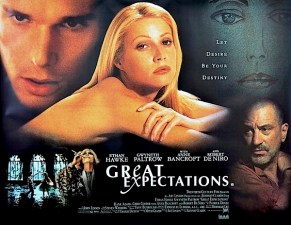 After re-enjoying the classic David Lean version of Great Expectations (which I reviewed in 2007) last week as part of my adaptations module, it’s now the turn of this American-set re-imagining. Despite a generally-held negative opinion toward this version, I found it to be more of a mixed bag.
Its main problem is that it can’t escape its roots. Not a fault in an adaptation, you might think, but in the case of one so radical as this it is a flaw: you’re left comparing and contrasting it with Dickens’ novel and Lean’s film, rather than appreciating it as a film or narrative in its own right. It comes across more as an academic exercise in turning a British Victorian novel into a modern American movie than a believable tale that works in isolation. Indeed, many of the changes appear to be designed purely to help distance it: the changed character names, the focus on the love story, and so on. Yet it directly recreates many scenes from the novel, and it obviously retains its title, despite there being no reference to that in the film itself.
Another product of this re-imagining is an unremitting sexualisation of everything. When Pip — sorry, Finn’s — hand is placed on Ms Havisham — sorry, Ms Dismoor’s — chest his first guess is that it’s her “boob” rather than her heart; when 10-year-old Estella kisses Pip — Finn, even — it now comes with added tongues; Finn — Pip — Finn! — draws now, and what he draws are nudes of Estella; and then they have sex too; and there are undoubtedly other examples that have since slipped my mind. This was pre Y Tu Mamá También, of course, where perhaps Cuaron exorcised this sexual preoccupations — they’re certainly not so evident in Children of Men or (unsurprisingly) his Harry Potter. His penchant for long takes, as seen constantly to great effect throughout Children of Men, also put in the odd pleasing appearance here.
By the end, it’s tricky to know what to make of this Great Expectations. It’s nicely faithful for a modern version, and yet that forbids it from striking out as its own work — it’s a fairly basic romantic film, bookended with some bizarre American Gothic trappings. I think it must stand as neither a success nor a failure, but as an interesting curio in the canon of Dickens adaptations.

That picture was the only one I could find in high enough quality to make a banner image. Honest.
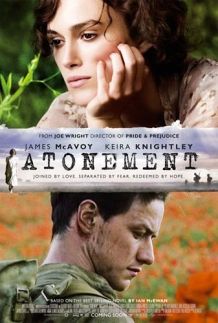 “The Most Nominated Film of the Year” proudly proclaims a sticker on the cover of Atonement’s newly released DVD. Well, not quite: according to
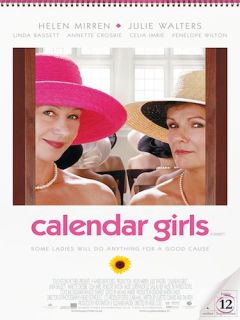 Helen Mirren and Julie Walters lead a cast of recognisable British actresses in this popular comedy drama about the true story of a group of Women’s Institute members who posed nude for a charity calendar. The film could so easily have been quite a lowly, cheap TV movie effort, what with its apparently farcical premise, worthy cause and older characters. But instead the filmmakers have crafted a movie that is both utterly hilarious and deeply moving — even for this younger male viewer.
 A star-studded cast and the director of
 What if the Americans made a movie of Winston Churchill’s life, prone as they are to re-write World War 2 history to show they won it all by themselves?
 Documentary, based on the best-selling acclaimed book by Peter Biskind, about the decade in Hollywood between the death and effective re-birth of the studio system.
 A
A  And so 2008 begins with one of last summer’s biggest hits: the long-awaited big screen debut of America’s most well-known family. I’m not a big
  100Films.co.uk