

Randall Wallace | 132 mins | download | 12 / PG-13
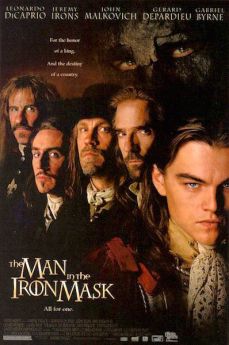 From the off it’s clear that The Man in the Iron Mask is not going to go well. It’s an adaptation of a tale of the Three Musketeers, so naturally is set in historical Paris… where everyone has a different accent and very few of them are French. It is, to be blunt, a horrid mishmash — much like the whole film.
Wordy political intrigue tries to coexist with broad comedy which is squashed against swashbuckling adventure. The latter two could co-exist, but the film feels like it wants to be the former and so suffers for it. The comedy jars too much to be effective, while instances of unintentional comedy unfortunately provoke more frequent laughs. It should at least be able to swash buckles effectively — these are the Three Musketeers after all — but entirely fails to achieve this until the climax. The plot, semi-faithfully adapted from one of Alexandre Dumas’ original novels, offers a level of complexity to which the film clearly aspires, but the adaptation and acting struggle to match it.
The majority of performances are marred by overacting — John Malkovich, especially, is woefully miscast, while Leonardo DiCaprio doesn’t appear to give a particularly good performance as either Louis or Philippe. In DiCaprio’s defence I suspect this is actually the script’s fault, because he manages to clearly differentiate the two when they are silent or pretending to be the other — it’s when they open their mouths that it all goes wrong. Gérard Depardieu is fine as the comic relief, though that relief is tonally misplaced, while Gabriel Byrne makes an interesting d’Artagnan — there’s nothing at all wrong with him, and yet he doesn’t feel quite right. Which leaves just Jeremy Irons among the main cast. He fares the best of the lot, even getting the occasional scene or speech that is genuinely quite good, though it’s clear he is far better than the material. To be fair, the same is also true of everyone else.
For all this, The Man in the Iron Mask is more disappointing then bad. The Bastille-set climax is occasionally brilliant and never less than entertaining, delivering on the film’s swashbuckling promise in a copious fashion. Throughout, there’s the occasional good scene — or even just a decent line of dialogue — and you can briefly understand what inspired such quality actors to sign on.
Something went wrong somewhere though, and the obvious culprit must be writer/director Randall Wallace. The story’s good, but that’s Dumas’, while the adaptation’s weak — and that’s Wallace’s. The actor’s are good, but battle the poor script — and that, obviously, is Wallace’s. They don’t seem to have been given any significant direction, they’re not helped by an uneven tone, and even the cinematography falls short, failing to make the spectacular locations and costumes look suitably beautiful on screen — and we know who’s ultimately in charge of all that too.
The Man in the Iron Mask desperately wants to be better than it is — it’s a great tale, packed with politics and swashbuckling, and this particular version has the high calibre cast to pull it off. But both are left floundering by a writer/director who isn’t up to either task — poor dialogue, a gyratingly uneven tone and lacklustre direction abound. A missed opportunity, and all the more disappointing for it.

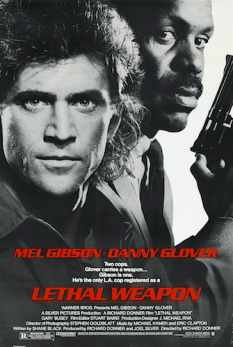 Lethal Weapon comes from another era — an era in which R-rated films were still allowed to be blockbusters. One only needs to look at the classifications attached to the most recent instalments of formerly-R-rated ’80s franchises — primarily,
  Ed Zwick seems to like war. More accurately, Zwick likes making films about war, but clearly isn’t a fan of the act itself. Since gaining attention with multi Oscar-winner Glory, about the first black regiment during the American Civil War, he’s directed a number of films concerned with wars and those that fight them:
 One of the great things about doing 100 Films in a Year has been the number of firsts it’s either led me to or just been there to document: my first time watching films on
  When Andrei Tarkovsky adapted Stanislaw Lem’s thoughtful science fiction novel
 The Wraith of Cobble Hill is a perfect example for this debate as its modern, urban story seems to clash with the cartoonish style employed to bring it to the screen. There are no flights of fantasy, few implausible shots, nothing that couldn’t be achieved in live action even on a low budget. Ultimately the only reason for it being animated is, why shouldn’t it be? Personally, I’m not convinced it works; at the very least, it distracted me enough to consider it.
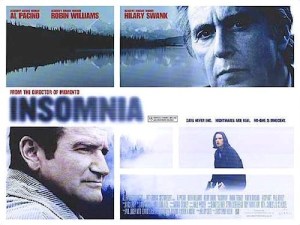 Between becoming a Geek God with
  In Bruges has gathered quite a bit of indie-level praise and acclaim, culminating in wider recognition at the Oscars and other awards ceremonies at the start of this year. For those like me, finally getting round to seeing it in the wake of all this, it comes with quite a burden of expectation on its shoulders. Can it possibly be the modern classic many make it out to be? I mean, it is set in, y’know, Bruges…
 100Films.co.uk