2010 #36
Scott Wiper | 109 mins | TV | 18 / R
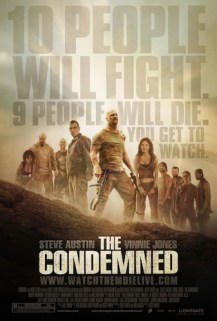 The Condemned is an old-fashioned-ish action movie, produced by WWE Films — i.e. the people behind all the wrestling claptrap. I should very much like to point out that I don’t care one jot about WWE or any other form of wrestling, real or faked. So why watch this? Because it’s got nothing to do with WWE itself aside from one (or more, I don’t know) former wrestlers acting in it.
The plot, essentially, concerns a bunch of hardened murderers being purchased from the death rows of various third world prisons and dumped on an island where they will fight to the death, broadcast live on the Internet for the enjoyment of paying customers worldwide. Yes, it’s Battle Royale with a sort-of-moralistic twist — “heck, if these guys are gonna be executed anyway, they may as well do it to each other for our entertainment, right?”
So, it sounds trashy; it sounds pitched in that kind of you-can-almost-believe-it-would-happen-for-real ballpark that might provoke debate; though it also sounds like we’re going to be told this is all actually quite moral and acceptable (watching people die? Yay!), and we’ll perhaps need to switch off from the plot because, really, it’s just an excuse for a good fight.
Well, that’s not quite so — and I’ll pick on the people who nonetheless insist this is brainless in a bit — because The Condemned is surprisingly good. It starts well, and one keeps expecting it to degenerate into rubbish, but it never quite does. This is partly due to lowered expectations, true, and I’m not claiming it’s a piece of philosophical art — it’s still essentially a straight-up action movie — but there’s more to the story and its inherent issues than one has any reason to expect.
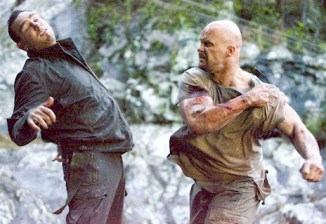 Indeed, in places it’s even satirical. Largely, though, the plot flatly commentates on society’s preoccupation with violent entertainment. Ironically, this is criticising not only organisations like WWE, who produced the film, but the genre of the film itself. It’s difficult to tell if director/co-writer Scott Wiper and his fellow filmmakers are aware of this irony/self-criticism, but if we give them the benefit of the doubt it becomes a nice layer.
Technically it’s not a remake of Battle Royale (there’s no credit to that effect at any rate), but the plot shares a shocking number of similarities: a group of people relegated to an island for a fight to the death with only one survivor, watched by millions of paying customers, with explosive bracelets that kill them if they don’t comply. OK, so The Condemned is a webcast and the bracelets are on the ankles not necks, but those are hardly huge leaps. Though it lacks originality, the use of death row criminals rather than innocent schoolchildren lends The Condemned both a more realist edge (you can’t really imagine the situation in Battle Royale ever happening, whereas The Condemned’s scenario is almost plausible) and a different social commentary — if these people are going to die anyway, why not let them fight it out for mass entertainment?
The film could choose a simplistic moral path; indeed, as it’s a WWE-produced action movie, one more or less expects it to fall on the side that, yes, this is actually quite a good idea. Fortunately, however, it doesn’t, and while the opinions may ultimately be explicit, with clear cut good and bad guys, it at least develops them to this point rather than starting out that way. In this respect, one might argue it has stronger, more dimensional characters than even some other well-respected action movies.
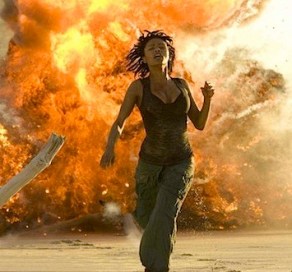 The same can be said of the action. With ten people, nine of whom will die, it could just be a series of fights where the designated Good One emerges victorious. And yes, there are a couple of fights of this nature, but as Things Go Wrong the realistically sick side of the ‘game’ is revealed: one female is cut up and presumably raped, all streamed live, while another is tortured before eventually being burned alive. It’s disgusting but, crucially, the film agrees that it is. That might sound obvious, but one suspects certain entries in the torture porn genre would disagree. That it draws you in to the brainless action movie mindset — fights! deaths! yay! — before twisting it with a dose of nasty reality suggests a greater degree of thought to both its structure and social message than one might expect. Maybe this is only a serendipitous side effect of the story path the writers chose, but even if it was an accident the success of it is still present.
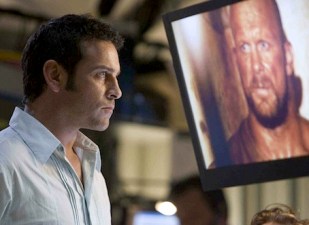
Events are kept rolling with a couple of different plot threads. When so many films of every genre are padded to make a decent length these days, it’s refreshing to find one that has good reasons to be as long as it is (and still below two hours, note). Perhaps there are a couple too many convicts to dispatch early on, but that’s a minor over-extension. Subplots with the FBI and a girlfriend add different perspectives alongside the twin-pronged thrusts of action on the island. The viewer is never allowed to forget that events are being watched — the goings-on in the producers’ camp are given as much time and attention, even during the action scenes, as anything going on in the jungle. Thematically, this is as much about voyeurism as death-dealing.
 Something that amuses me is how many reviews call this “a brainless action movie” and make assertions like “the dialogue only serves to get from one action scene to the next”. Now, I’m not going to argue that The Condemned is actually some essayistic polemic on the evils of the media or modern violence-obsessed culture, but it has more to think about than the majority of action movies — meaning it’s neither brainless nor devoid of importance between action scenes. Perhaps you can enjoy this solely as a series of action scenes, but I have to wonder if those who do didn’t so much turn their brain off as have it removed (assuming there was one there in the first place) — the commentary on voyeurism and violence isn’t subtle and therefore certainly not accidental, so quite how it can be missed is beyond me.
Perhaps I’m overrating The Condemned here — it’s still a WWE-produced action movie and a Battle Royale rip-off, after all. But it has both competence in its direction, acting and action (you don’t have to go as low as a Uwe Boll film to find weaker efforts than this), and some level of thought in its script. I’ve seen a lot worse, and avoided a lot, lot worse — see Five’s movie schedule for examples of both. By contrast, The Condemned is a masterpiece; and at worst, it’s a lot better than it has any right to be.


 Ah, Rambo. Rambo Rambo Rambo. The only Rambo film I’ve seen is Son of Rambow. And, it turns out, the only Sylvester Stallone film I’ve seen is Judge Dredd. (He had an uncredited cameo in Men in Black, apparently, but I don’t think that counts.) Quite how this has happened (or, rather, hasn’t happened) I don’t know. Anyway, with the Rambo series apparently over, it’s as good a time as any to begin catching up.
 Stallone is perfect for the character: suitably calm and ‘everyman’ at the beginning; muscular and mostly silent as the trained assassin; and even an actor capable of pulling off the final breakdown, when the horrors of war spill over. It’s difficult to imagine most muscle-men action stars pulling off Rambo’s closing speech. Throughout, Rambo’s PTSD is made obvious without being overdone: brief flashbacks suggest all the horror we need to know, topped by his final outburst. Rambo isn’t the beast, the men who made him that way are, along with those he did it for who fail to appreciate what he’s been through.
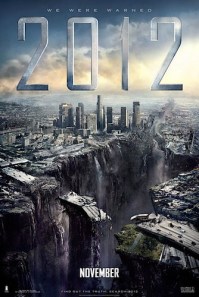 It’s the end of the world, and Roland Emmerich feels fine. The “master of disaster (movies)”, as I’m sure someone (probably himself) has labelled him, here attempts the biggest disaster of them all — as I said, it’s the end of the world.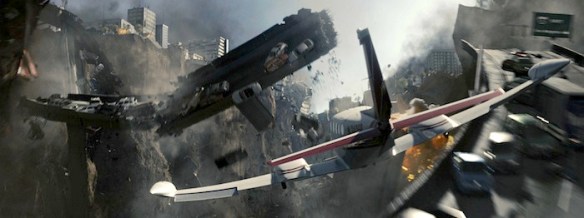
 as the US President, but a couple of the cast members hold the screen well enough.
 On the other hand, you do get more or less what you’d expect from the film. No one’s going into this thinking they’re getting a deep character piece — it’s great big spectacle all the way, and while it’s not the greatest big spectacle ever, it delivers something close enough to prevent it being the ultimate disaster of a movie — but it’s not the ultimate disaster movie either.
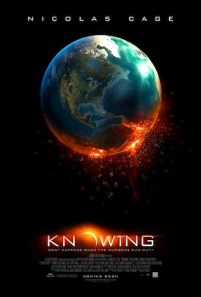 Not many people seem to like Knowing. Quit the opposite, in fact. I must confess, I’m not really sure why. I can read their reasons, of course, but I still thought it was a decent film. Solidly entertaining even, I’d say.
 those numbers down, and other such technical queries, but that seems like needless nitpicking.
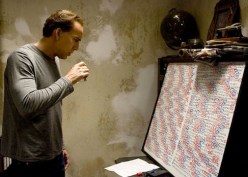 I will accept, however, that the very last shot is arguably a step too far and a little cheesy.
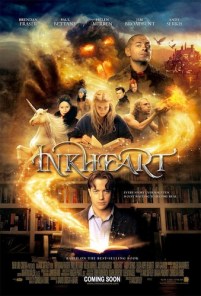 Shot in late 2006, originally scheduled for release in December 2007, ultimately pushed back twice and finally hit cinemas December 2008… what’s wrong with Inkheart?
 A side effect of not establishing the central concept’s rules is that the film doesn’t play with it enough. What, if anything, happens if you just change the words while reading? How is it determined what comes out of the book, what goes in, and can these be influenced? What happens if two Silvertongues read the same text at once? There are other things it would be interesting to see, but those require a more detailed description of some of the few rules that can be discerned so I won’t trouble you with them now.
 While everyone else is straightforward, predictable and/or pantomime, Dustfinger is torn back and forth between helping the heroes, his inherent selfishness, his fear of returning home, and his desire to see his family again. Brendan Fraser, the ostensible lead, is as adequate as ever but outshone by almost everyone else, not least Eliza Hope Bennett. She’s a minor find as Meggie (who I rather suspect is the main character in the book, but here is trumped by ‘star’ power), displaying more believability than most young teenage leads manage in films like this.
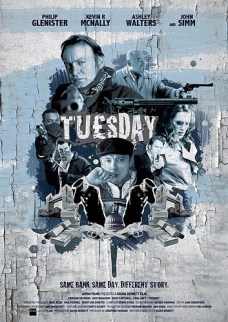 Tu£sday is a low-budget crime thriller, in which several groups of people all try to rob the same bank on the same day — hence the clever title. Unfortunately, the concept is much more interesting than the film writer/director Sacha Bennett has forced it into.
 As the film barely scrapes up to a theatrical running time, there’s a suspicion that the final re-run genuinely was left untouched to keep the length up.
 Unfortunately, it doesn’t go as all-out for the decade as
 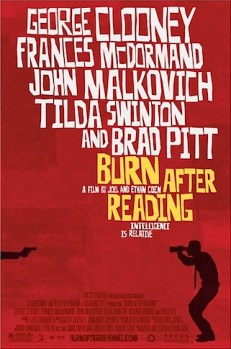 Ah, the Coen Brothers! Those indie-mainstream praise-magnets that I’ve never particularly got on with. But then, perhaps I was just too young and under-read (or, rather, under-viewed) to get
 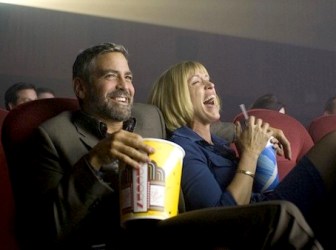 For the characters in the film, it’s a confusing mess of a situation they find themselves embroiled in — no one has the full picture, and most don’t properly comprehend the bit they do see. For the viewer, it’s a fun bit of nothing. Things have changed by the end, certainly — most notably, several people are dead — but the events that got us there are pretty quickly forgotten.
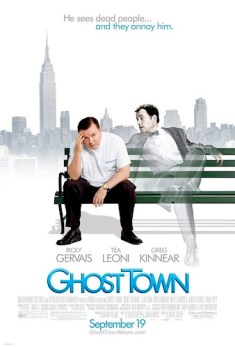 Before I come to write a review, I tend to check out the sort of scores it’s received at a few different sites. This isn’t to help form my opinion, but actually just a side effect of the fact I go to places to rate the films myself. What one usually encounters is some degree of discrepancy, be it as little as half a mark or as large as several. As you may have guessed, Ghost Town is going to prove the exception: on
 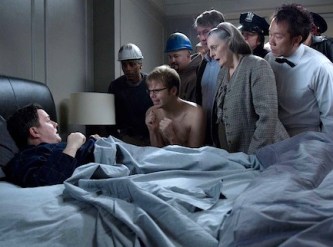 The high-concept at the film’s centre — that Ricky Gervais sees dead people and doesn’t want to — is neat enough. It largely sticks to its rules, it manages a few moments of humour, it doesn’t get too repetitive, it often plays the most obvious card (someone thinks Ricky’s talking to them when he’s actually talking to a ghost! Oh, my sides.) And Gervais, as you’re no doubt aware, plays himself. He doesn’t do characters but variations on a theme, and while this means he’ll never be a good actor per se, he can fulfil such characters very competently.
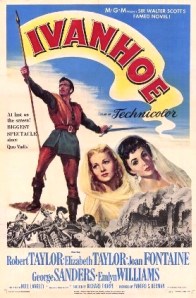 Ivanhoe is the kind of film they don’t often make any more, a pure swashbuckling romp. And when they do make them they tend to muck it up with over-complicated mythology-obsessed sequels — yes
 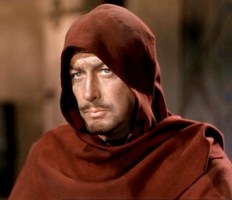 Though the final duel that ultimately follows can’t quite live up to this in terms of sheer scale and excitement, it impressively holds its own as a climactic action sequence.
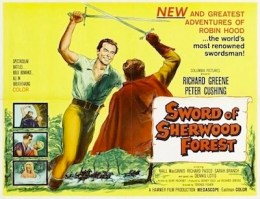 Hammer didn’t just make horror movies, y’know. I’m sure many film fans know this, but the phrase “Hammer Horror” is so ubiquitous that I expect most people think that was the company’s name and all they produced.
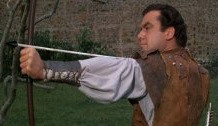 It doesn’t all tie together fully. For example, one assumes the town of Bortrey was going to be the site of Newark’s castle, as that’s the only apparent reason why he’d be annoyed at the Archbishop for stopping the Sheriff acquiring it. But then Bortrey is burnt down, and with little reaction or comment from any character. And the opening plot point — a man escaping the Sheriff with a mysterious symbol — is never fully explained. Was he a co-conspirator? Was he aiming to warn the Archbishop? If the latter, where did he get the symbol? Maybe I missed a scene that explained all this.
 The cast are adequate, even if Richard Greene’s no Errol Flynn and Peter Cushing’s no Alan Rickman (here at least). Terence Fisher’s direction is rather flat a lot of the time, though a few scenery shots, riding sequences and fights bring out a bit more dynamism.
 100Films.co.uk