Unknown's avatar

About badblokebob

Aiming to watch at least 100 films in a year. Hence why I called my blog that. http://100films.co.uk

Mass (2021)

Fran Kranz | 107 mins | digital (HD) | 2.00:1 + 2.66:1 | USA / English | 12 / PG-13

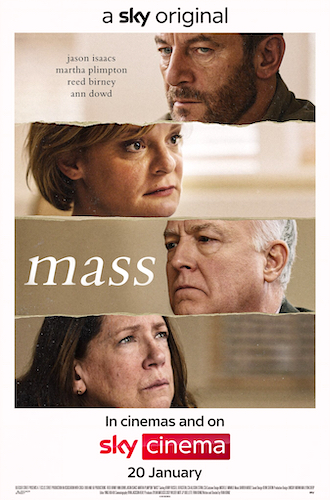
Mass

The fact Mass been relegated to the status of a “Sky Original” in the UK might mislead you (not all their “original” acquisitions are bad, but the first few were dregs that distributors clearly didn’t want to send to cinemas and neither Netflix nor Amazon had any interest in, and they’ve not done much to turn that reputation around). This, however, is a blisteringly emotional gut-punch that definitely merits your time.

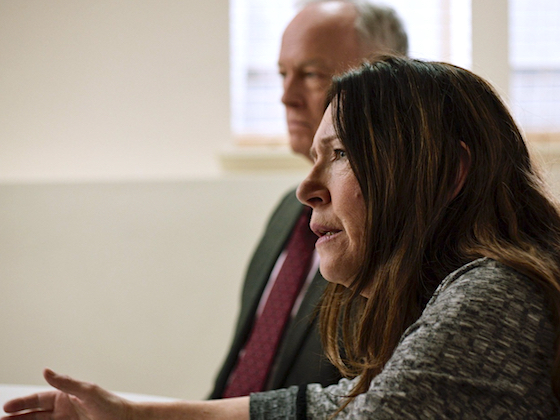
The more one says of the plot, the more it spoils the film’s revelations — it’s a compelling watch however much you know, but the less the better, to allow some of the shocking moments to land at their most impactful. Suffice to say, it’s about two couples (Jason Isaacs and Martha Plimpton on one side, Ann Dowd and Reed Birney on the other) sitting down to talk. Yes, it’s mostly a four-hander, taking place in one room in real time, in which people talk to one another. That setup has led to accusations of staginess, because some people think that “a few characters sat in one room talking” automatically equals “like a play”. It’s more complicated than that, and Mass is a good example as to why. On screen, we have access to greater intimacy and subtly — the cast don’t need to project so the back row of the gods can hear; there are closeups to really see what the characters are feeling when they’re not speaking; and so on. In a literal sense, you could stage this script, but it wouldn’t have the same effect.

Powerful performances

It’s written and directed by actor Fran Kranz in his directorial debut, and it’s a real achievement. For a film that is literally about sitting down and expressing emotions, it’s remarkably subtle, especially coming from a first-timer. He also doesn’t seek to explain every little detail. So much of what has gone on prior to this meeting is only hinted at, which is partly realistic (no character explains things they all know just for our sake), but it also keeps the film focused on the true human emotions. And in that respect, it would’ve been so easy to give in to histrionics, especially when the subject matter is so explosive, but Kranz and his cast keep it reined in. All four of the leads are phenomenal, each in different ways, and it’s a shame that the film didn’t have the support of a bigger, savvier distributor to give it an awards season push — they should all four be in the conversation for every gong going, but there’s not an Oscar nomination between them, and only Dowd was recognised by BAFTA. A pity.

Kranz’s one real flourish is a pronounced change in aspect ratio about halfway through. It comes at a key moment in the narrative, so clearly it’s meant to be significant, but I can’t quite work out how. Regular readers will know I normally love a film that plays with aspect ratios, but here it just seems like a distraction. It’s a minor misstep in a film full of bold moves that pay off. For example, it’s brave to risk undercutting the drama with the almost-comedic ordinariness of bookend scenes in which, at the start, the meeting room is prepared and, at the end, everyone leaves. It would’ve been easy to fade to black after the last big emotional moment in the room, but the return to everyday mundanity is, I think, part of the point.

BAFTA nominee Ann Dowd

Mass has flown under the radar somewhat, especially without the bonus of a clear presence in awards season. That’s a shame, because it’s a fine work that merits exposure. It’s not an easy watch — it’s liable to wring out your emotions — but, with that, it’s ultimately cathartic. A potent experience.

5 out of 5

Mass is the 9th film in my 100 Films in a Year Challenge 2022. It placed 5th on my list of The Best Films I Saw in 2022.

Meat Loaf: In Search of Paradise (2007)

Bruce David Klein | 88 mins | DVD | 16:9 | USA / English

Meat Loaf: In Search of Paradise

The singer Meat Loaf was very protective of his creative process, and apparently this documentary was the first time he’d allowed cameras behind the scenes to document it. Certainly, he’s frequently uncomfortable with or begrudging of their presence, although he seems to get used to them over time, allowing us some rare insights.

The film follows Meat and his band as they prepare for and commence a mammoth 18-month world tour following the release of Bat Out of Hell III. Despite the lengthy schedule, a DVD recording of the concert is scheduled for just a few gigs in. It’s never mentioned who was responsible for booking that, but it clearly causes added stress for everyone: rather than allowing the show to become refined and polished over a long series of gigs, it’s got to be good enough to be documented almost as soon as it starts. No one here is ever pretentious enough to refer to the recording as an “historical record”, but that’s what it will be. This is the first tour in which Meat will perform songs from the entire Bat Out of Hell trilogy, and the gig that’s recorded for DVD is the one that will endure as the record of this tour. It’s got to be right.

Perhaps the biggest obstacle is the fact that Meat Loaf is never satisfied. At one point, Meat’s mate Dennis Quaid is in town and pops by to watch that evening’s gig. Afterwards, he describes it as “an incredible show”. “It wasn’t one of my favourites, but thank you,” replies Meat. So Dennis asks, “how many times are they your favourite?” “Never,” Meat answers, “I hate ’em all… I’m waiting for the perfect show.” Of course, the perfect show never comes, and so Meat never feels it’s gone as well as it could have; he’s always apologising to fans that it won’t live up to expectations. But it’s not that the tour is genuinely coming up short — the band are happy; the crowds are certainly entertained — it’s just something in Meat Loaf’s character. He pushes himself so hard — too hard, given how exhausted it makes him, to the point he physically collapses after most shows. Whether you like his music or not, this film leaves you in no doubt about his dedication to his craft; to trying to give his fans exactly what they want.

Looks like paradise to me

That desire comes to a particular head in one of the film’s major subplots: the show is generally well reviewed in the press, but every critic takes issue with the staging of Paradise by the Dashboard Light, a number about teenage sex in which 59-year-old Meat duets with 28-year-old Aspen Miller — who looks a lot younger, especially in her skimpy cheerleader outfit. Frankly, I reckon the critics were at least partly jealous that Aspen Miller wasn’t writhing all over them, but maybe that’s just giving away something about me… Anyway, the number should be one of the highlights (as guitarist Kasim Sulton says, he’s been touring with Meat for decades and they’ve never done a show without it), but the criticisms are a cause of irritation backstage. Importantly, Miller doesn’t share the critics’ concerns; indeed, she seems to find it frustrating that they’re dismissive of her part in the performance, writing her off as a victim of it, when she’s an adult involved in the planning of what is a fully-choreographed routine. But the criticisms get to Meat even more — it’s not meant to be a song about a handsy old man attempting to assault a young girl, after all — and so various fixes are attempted to improve the song’s reception. It’s like a case study in revising a work while it’s already in performance, and shows that these tours don’t go out on the road locked and unchangeable — or, at least, they don’t when Meat Loaf is involved.

The film’s final line is given to Meat Loaf himself. As he walks away after that all-important gig filmed for the DVD, he repeats several times: “I tried.” That’s his attitude in summation: he never thought it was good enough, but he always gave it his all.

4 out of 5

Meat Loaf: In Search of Paradise is the 10th film in my 100 Films in a Year Challenge 2022.

Archive 5, Vol.3

I have a backlog of 437 unreviewed feature films from my 2018 to 2021 viewing. This is where I give those films their day, five at a time, selected by a random number generator.

Today, everything from silent comedies to afterlife comedies to toy-licence-based adventure comedies (a burgeoning genre we’re sure to see more of in years to come). Plus a revisionist Arthurian legend for good measure.

This week’s Archive 5 are…

  • Guinevere (1994)
  • The Kid (1921/1972)
  • Defending Your Life (1991)
  • The LEGO Movie 2: The Second Part (2019)
  • Sherlock Jr. (1924)


    Guinevere

    (1994)

    Jud Taylor | 91 mins | digital (SD) | 4:3 | USA & Lithuania / English

    Guinevere

    This Lifetime TV movie is like an American Renaissance faire cosplay version of Arthurian legend. Its attempt at a feminist take on the famed stories is interesting, but deserves better writing, filmmaking, and accents.

    Most of Guinevere’s flaws come from its low-rent made-for-US-TV-in-the-’90s roots (the mediocre direction; the tacky music score), but that’s also its biggest asset, because when and for whom it was made means it was shot on film, which gives it a certain gloss (even when downgraded to SD) that taped or digital productions simply lack.

    Story-wise, the love triangle stuff from legend is there, but given a YA spin — it’s practically Arthurian Twilight. Are you Team Arthur or Team Jacob? The feminist bent is not subtle either, which, given changes in attitudes over the past few decades, makes you wonder if it’s ripe for a re-adaptation (it’s based on a trilogy of novels with magnificently florid titles like Child of the Northern Spring and Queen of the Summer Stars).

    You see, despite everything, I didn’t hate it. Maybe I should — it’s not good, by any means — but I liked what it was trying to do, even while it didn’t do it well (at all). It’s a concept someone should definitely take another run at.

    2 out of 5

    Guinevere was #209 in my 100 Films in a Year Challenge 2020.


    The Kid

    (1921/1972)

    Charlie Chaplin | 50 mins | DVD | 4:3 | USA / silent | U

    The Kid

    Charlie Chaplin’s first feature-length work as star and director sees his Tramp character caring for an abandoned child (Jackie Coogan). I say “feature length”, but when you combine a re-edit Chaplin performed in 1972 with PAL speedup, it runs just 50 minutes. I’ve gotta say, I appreciated that. I’ve felt some of Chaplin’s other films have gone on a bit, whereas this didn’t outstay its welcome. That said, I did feel the Dreamland sequence near the end was filler. That aside, it’s quite a nice film. Coogan is particularly effective — he has just the right look for the role, and was obviously very good at imitation and/or taking direction.

    Regarding the length, the original 1921 release was 68 minutes, but for a 1972 reissue Chaplin cut some footage, appears to have sped up the frame rate of the rest, and added a score and some sound effects too. It’s only this cut that gets released on disc nowadays (often with the excised footage included as deleted scenes). The original cut clearly still exists, and yet everyone just seems to overlook it — it’s only if you bother to read up on the film that you discover what most people are watching and reviewing as “a 1921 film” is actually a 50-years-later director’s cut. Imagine if we all just ignored, say, Blade Runner’s original version and just treated The Final Cut as— oh, wait. Never mind.

    4 out of 5

    The Kid was #60 in my 100 Films in a Year Challenge 2020.


    Defending Your Life

    (1991)

    Albert Brooks | 111 mins | Blu-ray | 1.85:1 | USA / English | PG / PG

    Defending Your Life

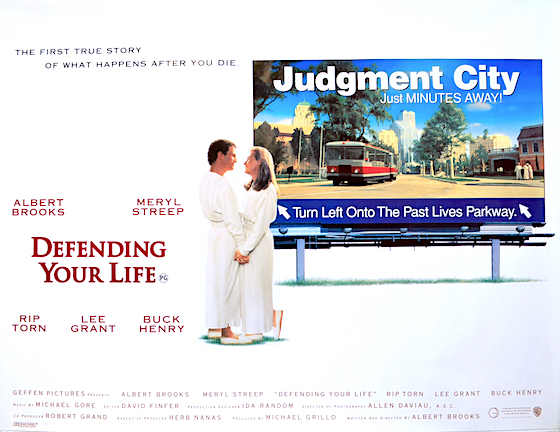
    Writer-director Albert Brooks stars as a loner advertising exec who dies and finds himself in a bureaucratic afterlife where he has to prove that he overcame his fears. While he awaits his trial, he finally meets the love of his (after)life, Julia (Meryl Streep).

    For a film that’s literally about life and death, Defending Your Life is rather gentle. Like, it’s rarely laugh-out-loud funny, but it’s often slightly amusing. And it’s unhurried, too: its 111 minutes aren’t tedious by any means, but it doesn’t rush anywhere. A fun side effect of this is how casual its world-building is. This is a very specific vision of the afterlife, an entire world with its own rules, and while that’s all explained, it’s not laid out in minute detail like a how-to guide. I feel like this is something movies used to happily do but has been eroded by the need for everything to be over-explained and -analysed.

    I liked Defending Your Life a good deal (I’ve picked up a couple more of Brooks’s films on Blu-ray off the back of it), and part of that is certainly its laidback style. Nonetheless, perhaps if it were snappier — quicker witted and paced — it might be a better-remembered film, comparable to something roughly contemporaneous like Groundhog Day.

    4 out of 5

    Defending Your Life was #113 in my 100 Films in a Year Challenge 2021.


    The LEGO Movie 2:
    The Second Part

    (2019)

    Mike Mitchell | 107 mins | Blu-ray (3D) | 2.40:1 | USA, Denmark, Norway & Australia / English | U / PG

    The LEGO Movie 2

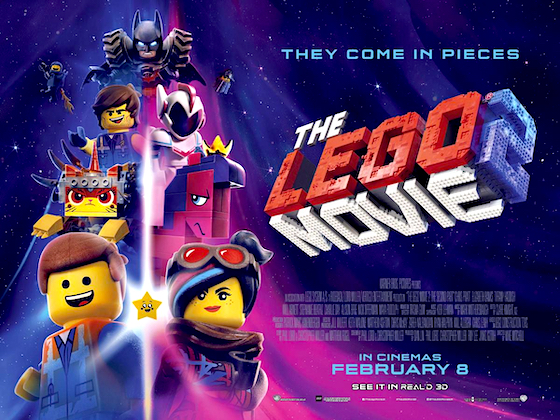
    After the surprise success of The LEGO Movie, naturally a sequel had to follow. Unfortunately, it’s altogether less surprising, because it’s that old fashioned sequel thing: a less-good do-over of the first movie.

    The Second Part feels less focused than its predecessor. It still has a positive message (about not needing to grow up, and about playing together, or something), but it takes a while to get to it, rather than baking it into the entire experience. Maybe that’s intellectualising things a bit — this is a family-friendly adventure-comedy starring toys, after all. But still, the overall journey doesn’t feel as exciting or fun. There are fun little bits on the way, but, moment to moment, it lacks the spark of the first one.

    For a specific example, take the breakout hit of the first film, the irritating song Everything Is Awesome. That angle has been doubled down on, with multiple attempts at emulating the “irritating but kinda loveable” song formula; but while these numbers are annoying while they last, they don’t have the irrepressible catchiness of the first film’s signature achievement — a mixed blessing, to be sure (at least they won’t be stuck in your head afterwards). The end credits are accompanied by a song that jokes about the credits being the best part… but, in this case, the credits kinda are the best part.

    3 out of 5

    The LEGO Movie 2: The Second Part was #33 in my 100 Films in a Year Challenge 2020.


    Sherlock Jr.

    (1924)

    Buster Keaton | 45 mins | Blu-ray | 1.33:1 | USA / silent | U

    Sherlock Jr

    Apparently there are ever-raging arguments within the silent film fan community about who was the best comedian of the era. Charlie Chaplin’s got the most widespread recognition, but Buster Keaton and Harold Lloyd have their advocates, of course, and I guess there are probably people shouting in favour of smaller names too. I didn’t think I’d ever pick a ‘side’ in these debates — I’m certainly not about to go seeking them out and wading in — and, fundamentally, I do hold with the notion that the greats are all great and so why not appreciate them all? — but, from what I’ve seen thus far, I’m finding Keaton’s work more consistently enjoyable than Chaplin’s. Sherlock Jr. is my favourite of his that I’ve seen so far.

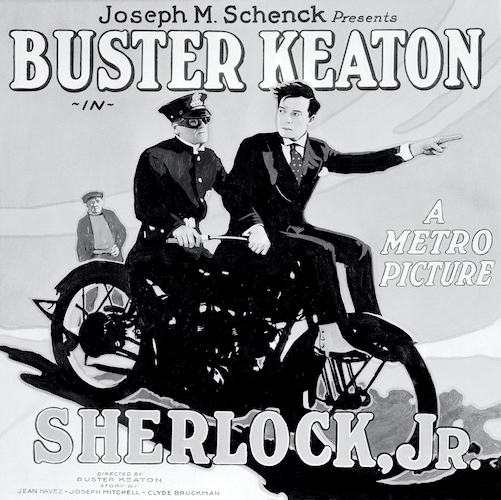
    Keaton plays a film projectionist who’s studying to be a detective on the side. When he’s framed for the theft of a watch, his apparent guilt doesn’t give him much chance to put his skills to the test. But when he falls asleep during a movie, he steps inside it and becomes the world’s greatest detective. And when I say “steps inside”, I mean it in the most literal sense possible: the projectionist walks through the screen and into the movie, and is suddenly subject to its whims — for example, he’s confounded whenever it cuts to a new location. The sequence is both thoroughly entertaining and technically faultless — and I say that viewing it nearly 100 years after it was made, after all the advances in technique and effects we’ve had in that time. Reportedly, the film’s cameraman, Byron Houck, went as far as using surveying equipment to ensure the camera was positioned correctly so the transitions were seamless. The effort paid off.

    The same is true in several other incredible sequences, like a billiards game filled with trick shots, which Keaton rehearsed for four months with a pool expert and then took five days to film. Or a motorbike chase with more I-can’t-believe-he-just-did-that death-defying stunts than one of Tom Cruise’s impossible missions. The technical skill is faultless and, even if you’re not wowed by how they pulled it off, the sequences are immensely entertaining in their own right. Maybe it’s just personal taste, but this is why I have a preference for Keaton: his skits are more ingenious, better paced, and backed up with impressive stunt work. When you mix those daredevil antics with genuine movie magic, as he does here, you get a majestic, unforgettable farce.

    5 out of 5

    Sherlock Jr. was #102 in my 100 Films in a Year Challenge 2019. It was viewed as part of What Do You Mean You Haven’t Seen…? 2019. It placed 3rd on my list of The Best Films I Saw in 2019.


  • January’s Failures

    Oo-ooh, wouldja look at this? After three years as just part of my monthly review, Failures has gone and got its own dedicated post! Well, it was getting ridiculously long to be just a part of something else. There’s just so much stuff to see every month, and so much of it I don’t see…

    We begin, as ever, with the big screen, where there’s something of a sense of things being back to normal, at least in terms of what’s being released. I think the closest to what could conceivably be called a blockbuster this month was the new Scream, while the rest of the UK release schedule was filled with belated bows for things like Licorice Pizza, Belfast, and Nightmare Alley. Let’s be honest, they’re not things that would tempt me out to the cinema in the best of days (I’ll wait for an at-home option), never mind in Covid times.

    I’m not alone in such thoughts, of course, and so the streamers continue to trot stuff out to capture our fleeting interest, though there weren’t any particularly big guns this month, unless I missed something. I think Netflix’s biggest offering was Robert Harris adaptation Munich: The Edge of War, as well as a UK debut for Chloë Grace Moretz sci-fi Mother/Android. Moretz used to be on track to be a genuine movie star, but nowadays I feel like I only see her turn up in direct-to-streaming stuff no one seems to know is coming — like, out of nowhere, there’ll be a new film starring her on Netflix or Amazon now and then. I don’t know if that’s a deliberate career choice or a case of reduced options…

    Meanwhile, over at Prime Video, there was George Clooney’s latest directorial effort, The Tender Bar, starring Ben Affleck, and acquired fourquel Hotel Transylvania: Transformania. I watched the first of those last year and thought it was moderately likeable, so maybe I’ll get to the fourth one day. There’s also Copshop, which I think they’re billing as a Premiere rather than an Original, or something? I can’t remember, and I can’t be bothered to load it up right now just to check. I guess it’s the difference between “stuff we own and will always be here” and “stuff we’ve bought exclusive rights to for a bit”. Sky’s ‘originals’ always feel like they’re in a similar limbo. This month those included Save the Cinema, which looks like a pleasant ‘little Britain’ kind of film, and Naked Singularity, which is apparently a heist movie starring John Boyega, Olivia Cooke, Bill Skarsgard. Again, having heard no one mention it doesn’t exactly suggest it’s worth one’s time.

    As usual with Sky, more interesting were their other premieres — the likes of Pig, A Quiet Place Part II, The Paper Tigers, and No Sudden Move. That last one’s actually been on there since October, but somehow I’d missed that it was a new Steven Soderbergh film. I need to catch up on his stuff. They also had Nobody, which I’ve seen and really should’ve reviewed, and Supernova, which I bought on disc and really should’ve seen and reviewed. Over on Prime, there was Demonic — which catches my attention purely because it’s the latest from Neill Blomkamp, a director who’s star has faded to the point where this got very little attention during its cinema window — and, eh, a bunch of older stuff. If I listed everything I deemed worthy of bunging on my watchlist, we’d be here forever.

    Netflix’s catalogue offerings all felt like hand-me-downs: The Gentlemen, after it was on Prime for yonks last year; and Dolittle, after it had been on iPlayer all over Christmas. Talking of iPlayer, they offered The Souvenir (which used to be on MUBI) and Mary Queen of Scots (which used to be on, er, Netflix). But, hey, at least you expect a free TV-schedule-derived streamer to be a relatively-late-to-the-game kinda place for these things. Still, iPlayer does a decent job nowadays, what with also offering the likes of The Sisters Brothers, sci-fi Little Joe, Lady Macbeth, and Personal Shopper. Plus, you’re more likely to find older classics there than pretty much anywhere else, which this month included In the Heat of the Night and a bunch of war films. You can find some similarly interesting stuff on Channel 4’s catchup — the main thing I want to try to catch from last month is Topsy-Turvy, which hasn’t been on UK TV for a ridiculously long time. It’s quite long though, and C4 does force adverts on you, so I can see myself failing at that again in February.

    I’m still subscribed to MUBI, though considering they add a film a day and this month I’ve only long-listed three to mention, and the only one I’m going to bother to mention is Céline Sciamma’s debut, Water Lilies, I do wonder if I should be. (There’s a bunch of stuff on there I keep meaning to catch up on, though.) As for Disney+, they seem to mainly be focusing on series right now, but did offer Marvel’s Eternals weeks before its disc release. Seems to be the way things are going.

    And talking of discs releases, yeah, I still bought dozens of the things. No such thing as a post-Christmas slump for me. Brand-spanking-new releases included the 4K discs of Edgar Wright’s Last Night in Soho and Ridley Scott’s The Last Duellast month I mooted that I should watch the latter on Disney+ before committing to buying it. Obviously, that didn’t happen. Hope I like it! Of course, most of my purchases are blind-buys anyway — I did exactly the same with Donnie Yen action-thriller Raging Fire. Exactly the same, because it was also a Zavvi-exclusive Steelbook that’s the UK’s only 4K release. Other new releases included more Asian action in Eureka’s double-bill of Warriors Two and The Prodigal Son; the mystery of a missing hammer in a nudist camp in Patrick; and importing the 4K of Blood for Dracula, aka Andy Warhol’s Dracula, to go with last month’s import of the 4K of Flesh for Frankenstein, aka Andy Warhol’s Frankenstein.

    You’d think January sales might account for much disc purchasing this month, but not really. I nabbed Blade in 4K when it was randomly cheap on Amazon the other week; and I think silent drama Piccadilly was slightly reduced when I picked it up — but that’s about it. Although I did get the limited edition of anime In This Corner of the World for a steal. Places like HMV are still selling it for £20, but there’s a guy on eBay who has it for a fiver. Seemed worth a punt, and it paid off. Otherwise, there were a couple of things that came out late last year and I didn’t get for Christmas (the BFI’s release of the original Invasion of the Body Snatchers, and StudioCanal’s 4K disc of Tinker Tailor Soldier Spy), and a semi-random US order. I almost order in ‘bulk’ from the US these days, to average out the cost of shipping. There’s always stuff I want to pad out an order, anyhow. This one was provoked by a Criterion sale (from which I only got High Sierra and Hitchcock’s The Lodger in the end), plus the new release of Gambit (the Michael Caine / Shirley MacLaine one) and some more new releases that are still in the post. I used it as a chance to also get Kiss Me Kate (in 3D) and Vincent Price I Am Legend adaptation The Last Man on Earth.

    Finally, I also bought the animated Transformers movie — fully known as The Transformers: The Movie, of course — on 4K. But does that really count as a failure when I consciously bought it to watch “sometime this year” as part of WDYMYHS? Something to mull over ’til next month…

    The All-New Monthly Review of January 2022

    I’ve already lied to you, dear reader. I say that because much of this monthly review is going to seem familiar — “All-New” it is not. “Partially new”, that would be the truth: there are new graphics, and a revised focus in some sections, both to fit in with the blog’s new identity.

    Despite that, I’ve stuck with the “all-new” moniker to reflect The All-New 100 Films in a Year Challenge, my progress with which is now the primary focus of these monthly updates… although you can still find links to all my reviews; and the Arbies survive, now in their 80th month, still drawing from everything I watched.

    Well, we’ll see how it goes. On which note, on it goes…


    This month’s viewing towards my yearly challenge

    #1 Carry On Spying (1964) — Decades #1
    #2 Gosford Park (2001) — Rewatches #1
    #3 Penny Serenade (1941) — Decades #2
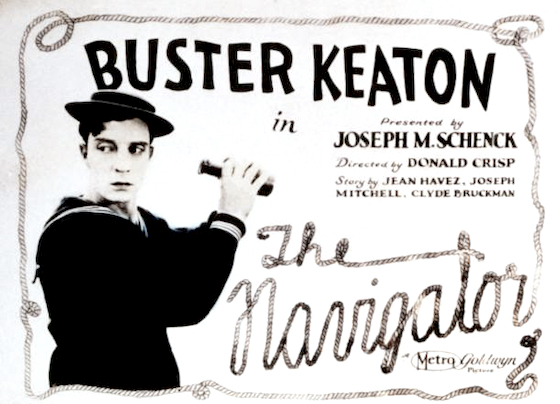
    #4 The Navigator (1924) — Decades #3
    #5 Flight of the Navigator (1986) — WDYMYHS #1
    #6 In the Line of Fire (1993) — Decades #4
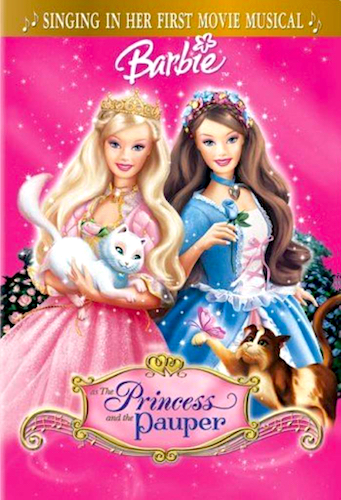
    #7 Barbie as The Princess and the Pauper (2004) — Decades #5
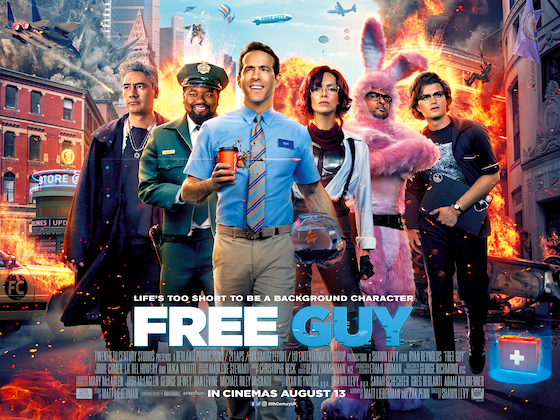
    #8 Free Guy (2021) — Decades #6
    #9 Mass (2021) — New Films #1
    #10 Meat Loaf: In Search of Paradise (2007) — DVDs #1
    #11 Voyage of Time: An IMAX Documentary (2016) — Decades #7
    #12 L’avventura (1960) — Blindspot #1


    • I watched 11 feature films I’d never seen before in January.
    • All of them counted towards my 100 Films in a Year Challenge, along with one rewatch.
    • As you may or may have inferred from that, this means I effectively have two counts running now: my 100 Films Challenge, and how many new films I’ve seen. The former may be the official thing going on nowadays, but a decade-and-a-half habit is hard to break, so on my ‘new film’ count goes. As I said up top, it’s the Challenge that’s the focus of these posts now, but I’ll still be including titbits about my overall new film viewing. And come the end of the year, it’s the overall new viewing that will continue to fuel things like my Top 10 and the statistics post.
    • So, to the Challenge. As the year gets underway, most — in fact, everything — I watch counts. I don’t expect that to be the case as we go forward.
    • For example: I’m not surprised to see the Decades category filling up fastest, because it’s so easy to complete. Slots are filled by any film that (a) isn’t better off counted towards another category, and (b) isn’t from a decade already ticked off — and, as the year begins, none are ticked off (obv). With 7 out of 12, Decades is already 58% complete. As for the remainder, the 1910s might require a special effort (I don’t watch many films that old without explicitly setting out to), but I imagine the others will take care of themselves in short order.
    • Just in case it needs stating for anyone: yes, Mass is “a 2021 movie” thanks to its festival screenings (the US and Canadian releases were also last year), but it didn’t come out in the UK until 20th January, which makes it a 2022 (i.e. new) movie for me.
    • This month’s Blindspot film was L’avventura, which I’ve been putting off including on the list (or watching in any other way) for years. I haven’t particularly enjoyed other classics of mid-20th-century Italian cinema, like Bicycle Thieves or , so I feared this would be the same. And that’s part of the motivation for watching it first: ripping off the plaster. Well, it was a somewhat pleasant surprise. More when I review it soon.
    • This month’s WDYMYHS film was Flight of the Navigator, which I watched on Prime Video. The danger of putting titles from streamers on a “movies I must watch this year” list is that at some point, possibly without warning, they could disappear from that streamer. But that also makes them an easy choice for where to start. This year there are only two across all 24 films from Blindspot and WDYMYHS, and they’re both on the latter list — I imagine the other will be next month’s pick.
    • I didn’t watch anything from last month’s “failures”. And as for this month’s failures: I’ve finally decided to spin the feature off into its own post. Look for that in the next day or two.


    The 80th Monthly Arbitrary Awards

    Favourite Film of the Month
    Although my viewing numbers this month were more than solid (getting to 100 films in a year at a steady pace — something the new challenge is partially intended to enforce — requires an average of 8.3 films a month), the level of quality was more middling. One film did stand out, though: Mass, a chamber piece that puts you through the emotional wringer, powered by a quartet of awards-worthy performances.

    Least Favourite Film of the Month
    Conversely, the month’s middling quality means it’s also hard to pick a worst film. By a nose, I’m going to say Voyage of Time, because I didn’t get as much out of it as I might’ve hoped. Plus, MUBI’s pathetic attempt at streaming in 4K (a feature they’d specifically pushed in the film’s advertising) got on my wick.

    Best Navigator of the Month
    The navigator in The Navigator is actually the name of the boat; and even if it weren’t, Buster Keaton is pretty poor at navigating it. The navigator in Flight of the Navigator is the kid who bonds with the spaceship, and while he’s ostensibly in charge, I think the spacecraft actually does most of the work. But in Barbie as The Princess and the Pauper, Barbie manages to ride into the forest and go straight to the exact hidden cabin where her doppelgänger is being held captive. Impressive navigation, Barbie.

    Biggest Mystery of the Month
    Whodunnit in Gosford Park? What happened to Anna in L’avventura? How did David lose eight years in Flight of the Navigator? Can they catch the assassin in In the Line of Fire? What are the villains up to in Carry On Spying? Can Meat Loaf put on a gig that makes him happy in In Search of Paradise? No, the biggest mystery of the month is: what the feck is Brad Pitt on about in the Voyage of Time narration?!

    The Audience Award for Most-Viewed New Post of the Month
    No break-out successes this month — the victor is down in 30th place overall, behind a slew of archive TV columns — but it was a close-run thing nonetheless, with two posts tied for second place, just two hits behind the winner. Said winner was, somewhat appropriately, The Best of 2021. And now it’s the best of (January) 2022, too. Hurrah.


    Every review posted this month, including new titles and the Archive 5


    It’s 100 Films’ 15th birthday (just two months after launching! Is this what being a time traveller feels like?)

    I had been thinking I’d mark the occasion with a revised version of 100 Favourites, as that’s five years old, but those things take literally years to put together (well, the first one did), and while I had been considering it for years, it’s been overtaken by the relaunch. Maybe in 2023.

    Other than that, erm, things continue much the same…

    Archive 5, Vol.2

    I have a backlog of 442 unreviewed feature films from my 2018 to 2021 viewing. This is where I give those films their day, five at a time, selected by a random number generator.

    Today: musical comedies from ’41 and ’51; murder mysteries from ’33 and ’73; and an animated film that changed the Oscars.

    This week’s Archive 5 are…

  • Royal Wedding (1951)
  • A Study in Scarlet (1933)
  • Chicken Run (2000)
  • The Last of Sheila (1973)
  • Road to Zanzibar (1941)


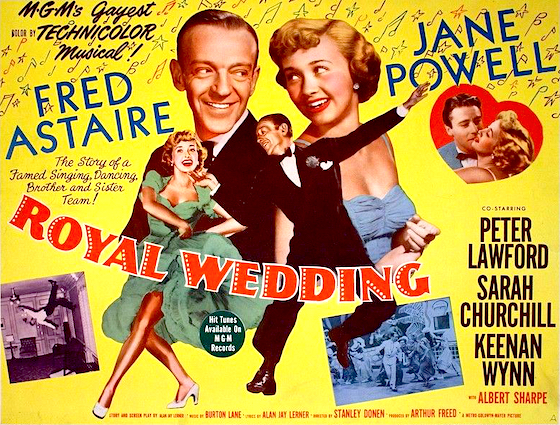
    Royal Wedding

    (1951)

    aka Wedding Bells

    Stanley Donen | 93 mins | digital (SD) | 4:3 | USA / English | U

    Royal Wedding

    Cynically, I assumed this US production was designed as a cash-in to a news event, most likely the wedding of Princess Elizabeth (i.e. the Queen) and Philip. Although those are indeed the eponymous nuptials, they actually took place several years earlier, in 1947; and in the UK, for its initial release the film was retitled Wedding Bells so audiences wouldn’t think it was a documentary about the real event. So much for my modern cynicism.

    The actual plot is semi-biographical, inspired by the real-life dance partnership of the film’s star, Fred Astaire, and his sister Adele, and who she went on to marry. Here the sister is played by Jane Powell (almost 30 years Astaire’s younger) as the duo take their successful Broadway show across the ocean to London in time for the royal wedding. Such window dressing aside, the plot that unfurls is run-of-the-mill, with both siblings finding themselves in romantic entanglements, and the songs are unmemorable too. The object of Astaire’s affection is played by Sarah Churchill, daughter of Winston Churchill, which adds a bit of fun trivia, at least.

    There is one noteworthy highlight: a set piece in which Astaire dances up the walls and across the ceiling of his hotel room, an effect that’s achieved seamlessly — there’s no wobble or what have you to give away the trickery, and Astaire’s choreography helps hide the behind-the-scenes technique too. There are one or two other neat bits if you’re a fan of dance-y musicals, but, on the whole, this is a thoroughly middle-of-the-road Astaire musical — not bad, just no more than adequate.

    3 out of 5

    Royal Wedding was #180 in my 100 Films in a Year Challenge 2021.


    A Study in Scarlet

    (1933)

    Edwin L. Marin | 72 mins | Blu-ray | 1.33:1 | USA / English | U

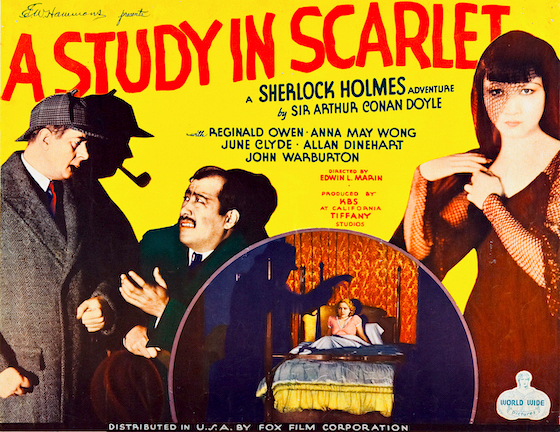
    A Study in Scarlet

    For some reason, cinema has a long history of taking the titles of original Sherlock Holmes stories but then producing an entirely new plot underneath. A Study in Scarlet — the very first of Sir Arthur Conan Doyle’s Holmes works — seems to be a particularly afflicted tale. It features the first meeting of Holmes and his roommate / sidekick / chronicler, Dr Watson, but I think there are two adaptations that actually show this — and, ironically, neither of them are actually called A Study in Scarlet (one is the debut episode of Sherlock, A Study in Pink, and the other is the first episode of the Russian series The Adventures of Sherlock Holmes and Dr. Watson, which is called Acquaintance). According to IMDb, “the Conan Doyle estate quoted the producers a price for the rights to the title and a considerably higher price to use the original story” — perhaps they did that all the time, hence my observed phenomena.

    Obviously, this ‘poverty row’ effort is one such example of title/story mismatch: this so-called adaptation stars Sherlock Holmes and Dr Watson… and that’s where similarities to the novel end. The pair don’t even live at 221b Baker Street — for no apparent reason, it’s been changed to 221a. Did the filmmakers just misremember one of the most famous addresses in literature? Having only paid for the rights to the title, the producers hired director Robert Florey (the Marx Brothers’ The Cocoanuts; Murders in the Rue Morgue) to write a new story, and actor Reginald Owen — who stars as Holmes — wrote the dialogue. Owen hoped this would be the first in a series of Holmes films starring himself. It wasn’t.

    Physically, Owen isn’t anyone’s ideal image of Holmes, but his actual performance is adequate. Much the same can be said of the whole film: it’s an entertaining-enough 70-minute crime romp, with enough incident to create a brisk pace, and a use of the rhyme Ten Little Indians that makes you wonder if Agatha Christie saw this movie before she published And Then There Were None six years later (or is it just a coincidence? The audio commentators spend a good deal of time chewing it over). Given second billing behind Owen is bona fide Chinese-American movie star Anna May Wong, even though she has relatively little screen time. She makes her mark, though, with a role that doesn’t simply conform to racial stereotypes (possibly an unintended side effect of her late casting rather than genuine progressivism by the filmmakers, but sometimes you gotta take what you can get).

    This particular Study in Scarlet is a long way from being a definitive Sherlock Holmes movie, but for fans of ’30s detective flicks, it’s nonetheless a likeable little adventure.

    3 out of 5

    A Study in Scarlet was #206 in my 100 Films in a Year Challenge 2021.


    Chicken Run

    (2000)

    Peter Lord & Nick Park | 84 mins | digital (HD) | 16:9 | UK, USA & France / English | U / G

    Chicken Run

    I’ve always enjoyed Aardman’s work. I grew up watching the Wallace & Gromit shorts on TV, and have seen all of their feature output — except their first. I’m not sure why it’s taken me 20 years to get round to Chicken Run. I guess when it was originally released I had grown out of “kid’s movies” but not yet grown back into them; but since then, to be honest, something about it never particularly appealed to me. It certainly has its fans: it’s still the highest grossing stop motion film ever; there was a push to get it an Oscar Best Picture nomination, the failure of which led to the creation of a category it could’ve won, Best Animated Feature (trust the Academy to shut the door after the horse had bolted); and when Netflix recently announced a sequel, there was much pleasure on social media.

    So, finally getting round to it, would I discover what I’d been missing all along? Unfortunately, no. I thought it was fine. In no way did I dislike it, but nor did it charm me in the way of my favourite Aardman productions. It’s rather dark for U-rated film — it doesn’t mince its words or imagery about the fact the chickens are being killed — and that contributes to some particularly effective sequences, like when our heroes end up inside the pie machine, or a suitably exciting climactic action sequence. There are some reliably decent gags along the way, too.

    I’m sure I’ll watch the sequel. Maybe I’ll like it more. But, I confess, the fact they’ve now announced a new Wallace & Gromit movie for the year after does have me even more excited.

    3 out of 5

    Chicken Run was #148 in my 100 Films in a Year Challenge 2020.


    The Last of Sheila

    (1973)

    Herbert Ross | 120 mins | digital (SD) | 1.85:1 | USA / English | 15* / PG

    The Last of Sheila

    I’d never even heard of this before Rian Johnson mentioned it as an inspiration for Knives Out 2. Co-written by Anthony Perkins (yes, Norman Bates from Psycho) and Stephen Sondheim (yes, the famous musical composer), The Last of Sheila is a murder mystery firmly in the Agatha Christie mould — despite the writers’ pedigree, there are no significant horror elements (even the deaths are, at worst, on the PG/12 borderline) and certainly no song-and-dance numbers (excepting a magnificently inappropriate song over the end credits, sung by Bette Midler). Apparently Perkins and Sondheim used to host elaborate scavenger hunts for their friends in the late ’60s and early ’70s, and they adapted them into a screenplay at the suggestion of a guest, Herbert Ross, who produced and directed the film (seems only fair).

    Further inspiration came from their professional lives and acquaintances, because the potential victims and suspects are all actresses, agents, and the like, gathered for a Mediterranean cruise aboard a producer’s yacht. He proposes they play a game about secrets and gossip — but clearly one of the secrets in play is too big, because someone winds up murdered. A well-constructed mystery is unfurled throughout the film, although its execution is a little variable: a fun, very Christie-esque first half gives way to long talky scenes in the second, as characters stand around and explain the plot to each other. But when that plot is as good as this — with some nice surprises, plus motives dark enough to give it a little edge — it feels churlish to object too strongly.

    4 out of 5

    The Last of Sheila was #186 in my 100 Films in a Year Challenge 2021.

    * IMDb says it was given a 15 on video, but the BBFC say it hasn’t been rated since 1973, when it got an AA. The BBFC site is crap nowadays; IMDb will accept any old junk users submit. You decide. ^


    Road to Zanzibar

    (1941)

    Victor Schertzinger | 87 mins | DVD | 1.33:1 | USA / English | PG

    Road to Zanzibar

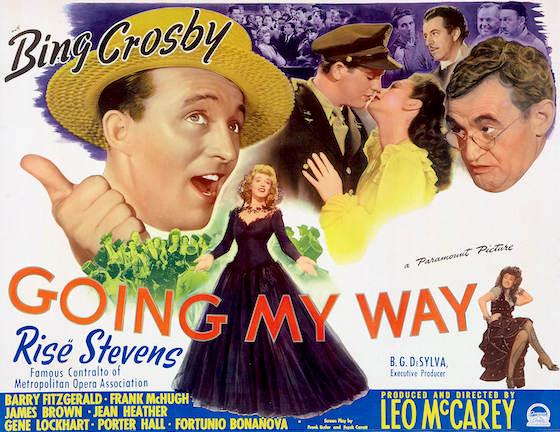
    The second in what became the Road To… series — though it was never intended as such. What ended up becoming Road to Zanzibar was initially an original feature, first offered to Fred MacMurray (this before his roles in the likes of Double Indemnity and The Apartment) and George Burns (an actor I’m not particularly familiar with). After they rejected it, apparently someone at Paramount remembered Road to Singapore had done relatively well, and that Bob Hope and Bing Crosby seemed like a good pairing, and so they were offered it.

    As I wrote in my last review of a Road To film (which was over 11 years ago?! Jesus…), if you’ve seen one Road To film then you’ve a fair idea what to expect from any other — essentially, a suitably daft bit of fluff and fun. This one’s a bit thin — on plot, on gags, on everything — but it skates by on the charm of Bob and Bing, joined, as ever, by Dorothy Lamour. The only serious problem is the same as Singapore: dated depictions of African stereotypes. It kind of gets away with it by being a spoof of “African adventure”-type movies, but maybe that’s me being kind with hindsight. Either way, the bit where the tribe’s African dialogue is subtitled with contemporary American vernacular is one of the film’s more amusing gags.

    3 out of 5

    Road to Zanzibar was #110 in my 100 Films in a Year Challenge 2019.


  • 2022 | Weeks 1–3

    Here we go — finally, and somewhat later than anticipated (it’s been a slow start to the year, viewing-wise) — the new review format for 2022!

    …which you’ll have already seen in Archive 5, of course; and is fundamentally similar to what I was doing before in roundups and what-have-you; and which I’ve already ‘broken’, because my review of Flight of the Navigator came out so long that I posted it alone.

    But still, the intention is this is now my regular review format, popping up every week or two (or three) to review everything in a more timely fashion than I have for many, many years. We’ll see how it goes — I feel like I need to relearn how to write short pieces, because longer reviews feel like they should get their own posts, and that’s happened to pieces intended for every one of these roundups so far this year.


    Anyway — to kick things off for 2022, a film with a broadly appropriate title. Because, despite (deliberately misleading) hints to the contrary, I’m carrying on. Get it? Carrying on watching. And “spying” is a synonym of “watching”, right? (Look, there aren’t any Carry On films with more apposite titles, okay?)

    These weeks’ films are…

  • Carry On Spying (1964)
  • Penny Serenade (1941)
  • The Navigator (1924)
  • In the Line of Fire (1993)
  • Barbie as The Princess and the Pauper (2004)
  • Free Guy (2021)


    Carry On Spying

    (1964)

    Gerald Thomas | 84 mins | digital (SD) | 16:9 | UK / English | U

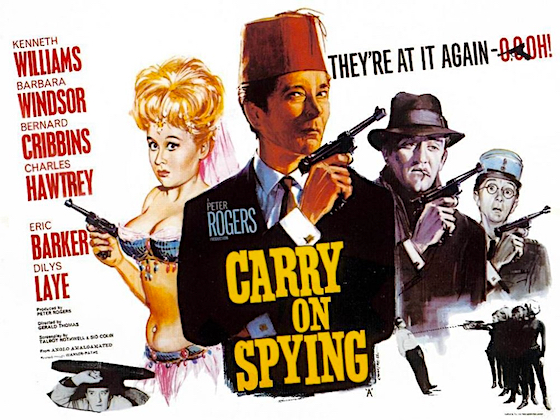
    Carry On Spying

    Believe it or not, I’ve never actually seen a Carry On film before. Maybe that’s not so surprising these days. They were once such a part of British culture that they produced 30 of the things, but I think they were seen as “a bit old fashioned” even before I was born, and by 2022’s standards… oof. But, lest you get the wrong end of the stick (oo-er, etc), this isn’t me intending to finally dive into all of them. Rather, as well as its timely title, I chose to watch Carry On Spying primarily because it’s a James Bond spoof — the first, I believe, seeing as it was released in July 1964, when the Bond series only encompassed Dr. No and From Russia with Love (Goldfinger would follow a couple of months later).

    With Bond not yet even properly into its initial phenomenon phase (the first two films were hits, but it was the next two that skyrocketed its popularity), you might think Spying came too soon, and would be disadvantaged by being produced before the famous Bond formula was fully in place. Instead, it sets its spoofing sights a little wider, including an extended riff on The Third Man. I couldn’t tell you everything it’s drawing on, but its third-act villain’s lair — all sleek metal corridors and little road-train thingies and jump-suited identikit henchpeople — appears to be a take-off of You Only Live Twice, some three years before that film even came out. So I can only presume Spying’s point of reference there is something else, which I can’t quite remember; some other spy fiction that was already doing stuff the Bond franchise would still be pulling off years later. That doesn’t reflect too positively on YOLT, when you think of it, although Bond’s cultural dominance and longevity has come to ensure it’s the one that’s remembered for pioneering all this stuff.

    I don’t know how many Carry On films were genre spoofs, but the series’ reputation is more for smut and innuendo. There’s pleasantly little of that here — some, for sure, mostly based around Barbara Windsor (of course) as a trainee agent; but while it’s all fundamentally juvenile, it’s not as ceaselessly ribald as I was expecting. Satisfyingly, it remains primarily focused on its chosen genre. In that respect, I’ve definitely seen worse spoofs.

    3 out of 5

    Carry On Spying is the 1st film in my 100 Films in a Year Challenge 2022.


    Penny Serenade

    (1941)

    George Stevens | 120 mins | digital (HD) | 4:3 | USA / English | U

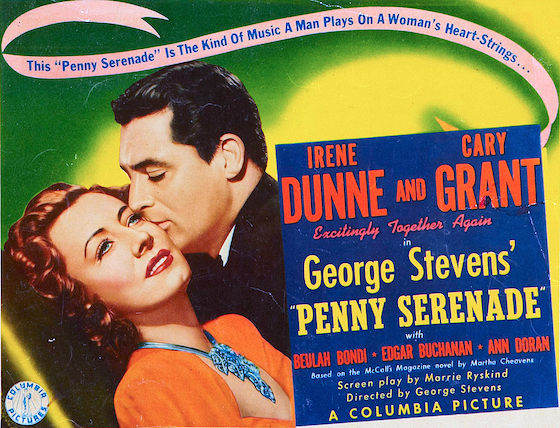
    Penny Serenade

    This is the third and final film to pair up stars Irene Dunne and Cary Grant as a married couple (I’ve watched all their collaborations within the past couple of years, but not posted reviews of the first two yet. I thought it was within the last year, but turns out I watched my first in May 2020. These strange days have really messed with my sense of the passage of time!) But where their first two films were screwball romcoms, this is undoubtedly a melodrama, following a couple as they meet, marry, and attempt to start a family.

    Dunne and Grant both make a fair fist of the serious stuff — Grant, in particular, gives an uncommonly sensitive performance at times — although they can’t resist slipping back into a spot of almost-slapstick given half a chance, with various individual sequences playing more like one of their comedies. Those scenes stand at odds with the film’s overall narrative and tone, which goes for full-on weepy. Indeed, if anything, I thought it was overdone, in particular an ending that throws in sudden tragedy followed so quickly by a pat happy ending that it feels almost distasteful.

    The film’s hook is that it begins with Dunne planning to leave, before she discovers a book of records that, as she plays them, take her back through their relationship. Different songs provoking specific memories is a neat narrative device on paper, but doesn’t really come across on screen. Aside from the first track, and maybe a later burst of Happy Birthday (although that could be almost any birthday, surely), the songs don’t seem to have any special relevance to the memories they supposedly call forth. It doesn’t help that, to modern ears, they all sound kinda samey. Plus, that the songs lead everything to unfurl in chronological order, with every major beat of their life story accounted for, is certainly convenient.

    If you can look past such artifice, and just want to revel in an old-fashioned bit of heart-tugging, Penny Serenade is fit to make you shed a tear. Personally, I’d rather the headline duo had given us another bout of screwball tomfoolery.

    3 out of 5

    Penny Serenade is the 3rd film in my 100 Films in a Year Challenge 2022.


    The Navigator

    (1924)

    Donald Crisp & Buster Keaton | 66 mins | Blu-ray | 1.33:1 | USA / silent | U

    The Navigator

    This is my fourth Buster Keaton feature now (I’ve only previously reviewed The General, but Sherlock Jr made it into my 2019 top 3), and he’s established himself as my favourite of the major silent comedians (I rarely enjoy Chaplin’s films as much as I feel I should; and, in fairness to Harold Lloyd, I’ve only seen one of his so far, which I liked a lot). The Navigator was the biggest hit of his career, though is probably my least favourite of his I’ve seen so far — though I don’t want to damn it with false criticism, because it’s still a brisk and entertaining comedy.

    Keaton stars as a spoiled rich kid whose marriage proposal is rejected. He’d already booked the honeymoon tickets, so sets off by himself; but, due to several points of confusion, he ends up adrift at sea on a decommissioned ship, empty but for one other passenger: his would-be fiancée (Kathryn McGuire). It’s up to this pair of brats to get along and survive while they hope for rescue. (Rescue does not come quickly. Considering McGuire’s father is a successful shipping magnate who’s aware of what’s happened, you’d think he’d send a vessel after them; but then, he might have his own problems, owing to a bunch of foreign spies who… look, it’s best not to overthink the logistics and plausibility of the plot.)

    Although Keaton gets the lion’s share of the gags, as well he might, for a stretch in the middle he and McGuire form an effective double act. The two rich kids being hilariously useless at household basics, like making coffee or opening a tin of food, is well observed; a flash-forward to their automated solutions is also fun. While Keaton still gets to show off by himself — particularly in an elaborate underwater diving sequence, naturally saved for the final act — McGuire makes the most of the material she’s given.

    The only outright demerit to the film is that the finale hasn’t aged particularly well: the ship finally drifts near land, but it’s an island with a village-full of black natives, at which McGuire immediately exclaims “cannibals!” That she’s sort of proven right when they start attacking the ship is… well, maybe not even worse, but at least just as bad. Still, by 1920s standards, maybe we can take comfort in the fact that it’s only casual racism…

    More than that, the reason I say it’s my least favourite Keaton so far is simply that it doesn’t have as many comedic highs as his very best work. Nonetheless, his genius regularly shines through in moments and even whole sequences, and there are a couple of individual gags that are all-timers.

    4 out of 5

    The Navigator is the 4th film in my 100 Films in a Year Challenge 2022.


    In the Line of Fire

    (1993)

    Wolfgang Petersen | 129 mins | digital (HD) | 2.39:1 | USA / English | 15 / R

    In the Line of Fire

    Clint Eastwood is a Secret Service agent who failed to stop the JFK assassination, now taunted by John Malkovich’s mysterious wannabe-assassin and his threats to kill the current President. It’s a fundamentally strong idea for a thriller, and works especially well by having the villain constantly phoning the hero for little chats. Malkovich’s always makes for a first-rate antagonist, and his slightly loony personality clashes well with Eastwood’s stoic, dry-witted, old-fashioned tough guy. There are a couple of chase scenes and shoot-outs here and there, but, rather than any elaborate physical action, it’s the verbal sparring that represents the film’s highlights.

    On the downside, the pace is a little on the slow side (perhaps matched to the “too old for this shit” age of Eastwood’s hero — in real life, he’d be a whole decade past the mandatory retirement age) and there are one too many clichés as important plot points (don’t get too attached to the partner who’s always talking about his wife and kids). Plus, there’s a wholly unnecessary romance between 62-year-old Clint and 39-year-old Rene Russo — the film doesn’t need it, even if there wasn’t that age gap. It leads to an (almost) sex scene that’s worthy of the Naked Gun films, which is amusing but tonally misplaced.

    They used to make this kind of political thriller on the regular back in the ’90s, one of those bread-and-butter genres for grownups that have fallen by the wayside in favour of hyper-budgeted kids’-movie spectacle that men of allegedly adult age flock to nowadays. In the Line of Fire may not truly stand out among its brethren of the era, but I do wish they still made ’em like this.

    4 out of 5

    In the Line of Fire is the 6th film in my 100 Films in a Year Challenge 2022.


    Barbie as
    The Princess and the Pauper

    (2004)

    William Lau | 85 mins | digital (SD) | 16:9 | USA & Canada / English | U

    Barbie as The Princess and the Pauper

    One of the many film lists I have my eye on completing is Letterboxd 100: Animation, which lists the highest-rated animated feature films on the site (with a few caveats). There are over 40 titles left that I’ve not seen, and I could’ve chosen to watch almost any of them… but I chose the Barbie one. Well, not the Barbie one, because there are actually two Barbie titles on the list. And that’s not some temporary fluke: they’ve been on there for quite a while now. This merited investigation.

    As you’ve no doubt gathered from the title, this particular Barbie film is a reimagining of Mark Twain’s The Prince and the Pauper. A fairytale-esque story, about a princess, done as a musical? Yep, this is very much a wannabe Disney, but without the production values of that major studio: the computer animation here looks more like a PS2 cutscene. But hiding beneath the cheap animation is a halfway decent musical fairytale. Take the second musical number, How Can I Refuse, for example: it’s every inch in the mould of a “Disney villain’s song”, but is better than some genuine examples, and comes complete with a dance routine by the antagonist and his two henchman. This film has ambition, I’ll give it that.

    Other songs vary in quality. When the eponymous duo first meet, there’s an unintentionally hilarious number in which they sing about how similar they are, the indentured servant and the pampered royal. If you say so, girls. A later track is a typical “you be you” song, but sung to a pet cat who behaves like a dog. That’s a level of barminess I can get on board with.

    I would never have dreamed of watching this if it weren’t on the Letterboxd animation list. Now, I wouldn’t exactly say I’m glad I watched it, but I enjoyed it more than I thought I would — even if sometimes that was due to laughing at it rather than with it.

    3 out of 5

    Barbie as The Princess and the Pauper is the 7th film in my 100 Films Challenge 2022.


    Free Guy

    (2021)

    Shawn Levy | 115 mins | digital (HD) | 2.39:1 | USA / English | 12 / PG-13

    Free Guy

    Ryan Reynolds plays his role again as Guy, a bank worker in city riddled with crime and superheroics. But, it turns out, Guy isn’t real — he’s an NPC in a computer game, programmed to do the same thing over and over and basically be ignored by the real-world players. Until, that is, he spots the woman of his dreams (Jodie Comer) and his programming breaks as Guy becomes self-aware.

    The basic concept sounds like a fun, fresh, and timely idea, right? Video games have never been more popular, AI is ever-improving, and there’s room for both gags and action in the core idea — that’s the winning Marvel formula, right there. Unfortunately, the execution is as if someone found a way to make a new movie by collaging others. Free Guy is just The LEGO Movie + The Truman Show + Wreck-It Ralph + Ready Player One + the PG-13 version of Deadpool 2 — not put in a blender, but cut up and stuck back together side-by-side, with snippets of Groundhog Day, Fortnite, and multiple Disney-owned properties scattered in for good measure.

    That last aspect, the Disney references, has been singled out for particular derision on social media. The film was initially produced by 20th Century Fox, but ended up a Disney title after the buyout, which allows a bunch of stuff they own to pop up in the movie. I know we’re supposed to find this infinitely depressing — a sad reminder that Disney are on course to own all culture, and that’s a bad thing — and it is bad, of course… but the bit with Captain America’s shield still made me laugh. Sorry, not sorry. Yeah, you can be miserable about this stuff, because obviously the total homogenisation of all American media under The Walt Disney Company is not worth that a couple of meta gags; but the homogenisation of all American media under The Walt Disney Company is happening anyway, so we may as well enjoy the gags we get along the way.

    Whether you have that kind of attitude or not will probably dictate how much you enjoy Free Guy. Its originality is surface deep, at best, and at every second it will call to mind some other film that already did the same thing. But, allowing for that, it’s still a fairly entertaining couple of hours of action-comedy.

    3 out of 5

    Free Guy is the 8th film in my 100 Films in a Year Challenge 2022.


  • Flight of the Navigator (1986)

    Randal Kleiser | 90 mins | digital (HD) | 16:9 | USA / English | U / PG

    Flight of the Navigator

    I’ve written before (several times, I think) about how a lot of my childhood movie viewing involved catching up on the family-friendly blockbuster hits of the ’80s. But some stuff slipped through the net — or maybe didn’t slip through, but so totally failed to lodge itself in my memory that I don’t remember I ever saw it. We’ll never know which is the case. Either way, Flight of the Navigator is the latest title to fit that bill. It’s not bad, but I might’ve liked it more if I’d seen it as a kid.

    The film is split more or less into two halves. It begins in 1978, when 12-year-old David (Joey Cramer) goes into the woods near his Florida, knocks himself out, and returns home later that evening only to find it’s now 1986. Obviously, doctors can’t explain how he hasn’t aged a day in the eight years he’s been missing. Meanwhile, NASA encounter a spaceship near those woods. Could the two be connected? Maybe it’d be a more interesting film if they weren’t…

    Anyway, both end up at a NASA research facility, and with the ship calling out to David, he manages to sneak out with the help of an intern (an early screen appearance by a young Sarah Jessica Parker, surprisingly cute and likeable) and flies off in the ship (voiced by Paul Reubens, credited as “Paul Mall” to obscure his involvement, for whatever reason). Their adventures make up about the second half of the film. Not that they’re really “adventures” — it’s mostly David hanging out with the ship, doing some silly stuff while failing to navigate home. There are some nice moments here, but some cringey ones too.

    Davey phone home

    The standout aspect is the design of the ship, both inside and out, which is well-realised onscreen. Obviously these days it would be achieved with swishy CGI, but the film’s mix of models, practical sets, and early digital effects is done well for its time. Things like the highly-reflective inside of the ship are all the more impressive knowing they couldn’t just shoot whatever they wanted then digitally remove the crew. And the fact that they couldn’t just magic up anything they wanted for the exterior shots, either, makes the effects more restrained and pointed in how and when they’re deployed, which overall is to the story’s benefit.

    Sadly, the same can’t be said of Alan Silvestri’s score, which is badly dated from the opening cue onwards, never recovering. However, you could do a great “how music changes tone” demo with some parts. For example, when David escapes NASA in the ship, it’s shot with a lot of drama — thick chains breaking, lights crashing down, people running in fear — but Silvestri scores it with an E.T.-esque “isn’t this magical” type of cue. If you were to replace it with a dramatic, exciting, or even scary track, it would certainly work, but with an entirely different feel. It’s possibly deliberate that the music and visuals here sit so at odds, the contrast being exactly what they were going for; though, considering the rest of the film is formally straightforward, I can’t say I’m convinced.

    Altogether, I think Flight of the Navigator may have been entertaining for preteens in the ’80s and ’90s, but surely anyone older could only love it because of nostalgia from watching it at that age; and it’s probably a bit slow-paced for today’s youth. It looks like they’re planning a remake (it’s been in the works since 2009, but last September was announced for Disney+), and, honestly, for once maybe that’s a good idea: there’s potential in this concept that’s unrealised by this version. Whether a direct-to-streaming movie will handle it better, who knows, but it’s worth a shot.

    3 out of 5

    Flight of the Navigator is the 5th film in my 100 Films in a Year Challenge 2022. It was viewed as part of “What Do You Mean You Haven’t Seen…?” 2022.

    American Animals (2018)

    Bart Layton | 117 mins | digital (HD) | 2.39:1 | UK & USA / English | 15 / R

    American Animals

    I don’t want this to turn into a rant about IMDb — there’s a time and a place for those, certainly, but what’s meant to be a short review of one film is not one of them — but the way they’ve devalued the documentary in recent years is not also depressing but also inaccurate. Because anything that has the genre Documentary is now marked as “(documentary)” on someone’s filmography, and therefore IMDb, and/or its contributors, are reluctant to use it about anything that isn’t 100% a documentary. Something like, say, American Animals.

    To be clear: American Animals is unquestionably a documentary. It tells a true story, about some students who plan to rob a library of its rare books. It features interviews with the real people involved, both the students and others. But it’s mostly told via reenactments starring actors, several of them fairly recognisable faces. The real people appear as talking heads scattered throughout, particularly at key moments. So, it’s also unquestionably a hybrid of documentary and fiction. On the surface, it can look a lot like any fictionalised adaptation of a true story; but it’s hidebound to be more accurate than those often are, because it’s also got all these interviews. IMDb isn’t built for nuance such as this.

    Prior planning prevents piss-poor performance... possibly

    The film’s director, Bart Layton, previously made widely-praised definitely-a-documentary The Imposter. In my review of that, I described his style as “flashy” and “over-eager”, wondering if “perhaps he better belongs in fiction filmmaking? Perhaps that’s where he wants to go in future”. Here, I guess he’s moving to bridge that divide; but the blurred line means that, when the film says “here’s the real [person X]”, you kind of question it. Especially as, if a crime was committed, how come they’re interviewing the criminals?

    That latter thought contributes to a genuine tension and suspense throughout the film. How far will this plot go? Do they even actually attempt it? One of the guys keeps saying, “I expected there to be something to stop us”, and you think maybe something will stop them… but the fact this film exists, and there’s all the chat about how the boys let their parents down and whatever, shows something happened. (No spoilers!) Yet it’s also surprisingly funny, like a bit where we’re shown the “Ocean’s Eleven version” of the robbery, complete with Elvis song on the soundtrack.

    Some have criticised these kinds of flights of fancy, or the whole hybrid form, for inviting us to sympathise with these guys rather than condemn their actions. I think there’s room for both. The film seeks to explore what led these pretty normal guys to do such a thing, and (to an extent) how it has affected them since. I think you can both disapprove of what they did and seek to sympathise with them — to understand how it happened is not to condone it.

    4 out of 5

    American Animals was #107 in my 100 Films in a Year Challenge 2020.
    It is streaming on All 4 until 10th February.

    Archive 5, Vol.1

    Part of the impetus behind this new era of 100 Films was to solve ‘problems’ like my repeated failure to post reviews. Hopefully my plan for regular groups of capsule-sized reviews will solve that going forward. But this has been an issue for a while, and that’s led to a huge backlog of unreviewed films from 2019 to 2021 — it totals a ridiculous 449 feature films (counting shorts too, it goes over 500). Rather than abandon those to the mists of time, I present a new weekly (more or less — let’s not overcommit myself) series: Archive 5.

    Essentially, it’s the same format as new viewing: each post is a collection of short reviews; but here they’re five titles plucked at random from my archive of unreviewed films (and I’ve used a random number generator, so it’s genuinely unmethodical). If I can keep this up weekly, it will take me just under two years to clear the backlog — which means I could still be reviewing stuff from 2019 in 2023. Hahaha… haha… ha… ugh.

    With that in mind, there’s no need for further ado. This week’s Archive 5 are…

  • Never Too Young to Die (1986)
  • Bachelor Knight (1947)
  • Little Women (2019)
  • Aniara (2018)
  • Who’s Afraid of Virginia Woolf? (1966)

    (I Care a Lot was originally intended to be part of this post, but then the review turned out a little long, so I spun it off by itself. That’s the kind of thing I’ll probably keep doing, too.)


    Never Too Young to Die

    (1986)

    Gil Bettman | 97 mins | digital (HD) | 1.85:1 | USA / English | 18 / R

    Never Too Young to Die

    If you dropped A View to a Kill, Rocky Horror, WarGames, and Mad Max 2 into a blender, the end result might be Never Too Young to Die. And if that sounds like a ludicrous, unpalatable mash-up… yep, that’s Never Too Young to Die.

    This direct-to-video action-adventure stars a pre-Full House John Stamos as Lance Stargrove, a teenage gymnast whose dad is a secret agent (played by George Lazenby — aged 47 at the time, but looking at least 20 years older). When daddy is killed, Lance teams up with his partner (singer turned actress Vanity) to go after the culprit: gang leader and wannabe terrorist Velvet Von Ragnar (Gene Simmons (yes, from Kiss), chewing scenery as if he’s not been fed for months).

    If you’ve never heard of this film… well, neither had I, until a Cracked article suggesting comical substitutes for Covid-delayed blockbusters. But what really convinced me to watch it is that it has The Greatest Trailer Ever Made. If you set out to make a spoof ’80s trailer, I’m not convinced you’d be able to beat that. Unfortunately, neither can the film as a whole. It’s fun at times (the boob-biting final fight, or a scene where Stamos tries to distract himself from Vanity’s sexuality by… eating multiple apples), but it’s not quite camp or daft enough to really earn a place as a cult classic.

    I’ll say this for it, though: rewatching that trailer has made me really want to watch the film again…

    3 out of 5

    Never Too Young to Die was #70 in my 100 Films in a Year Challenge 2020.


    Bachelor Knight

    (1947)

    aka The Bachelor and the Bobby-Soxer

    Irving Reis | 91 mins | digital (SD) | 4:3 | USA / English | U

    Bachelor Knight

    If you ever need to name an obscure Oscar winner for some reason, you could do worse than Bachelor Knight — or, to give it its even-dumber-sounding original title, The Bachelor and the Bobby-Soxer. Yes, this won the Oscar for Best Original Screenplay (the other nominees aren’t the greatest field you’ve ever seen, but altogether they’re either better-remembered or were considered good enough to nominate for other gongs that evening, so quite how this took the prize, I don’t know).

    The plot also stretches credibility: after high schooler Susan (Shirley Temple) becomes infatuated with artist Richard Nugent (Cary Grant), she sneaks into his place to model for him, much to the disapproval of her older sister Margaret (Myrna Loy), who also happens to be a judge; and when Nugent ends up in her court room, she sentences him to date Susan until her infatuation inevitably wears itself out. I know things are different in the US, and also in the past, but did/do judges there really have the power to hand out any crazy made-up sentences they like?

    On the bright side, the film moves sprightly through its plot. Perhaps that’s because it takes a whole 40 minutes to get through the basic setup, even while running at a pace, means there’s less screen time left to dwell on all that follows. Not that some individual bits don’t go on a tad, like a picnic sequence; but others work very well, like a scene in a nightclub that is a nicely-written bit of escalating farce.

    It’s not the best work of anyone involved, but Bachelor Knight belies its iffy title (both of them) to be a likeable-enough 90 minutes of screwball comedy.

    3 out of 5

    Bachelor Knight was #70 in my 100 Films in a Year Challenge 2021.


    Little Women

    (2019)

    Greta Gerwig | 135 mins | cinema | 1.85:1 | USA / English | U / PG

    Little Women

    Writer-director Greta Gerwig’s adaptation of Louisa May Alcott’s beloved novel was greeted in some quarters by questions of if it was necessary: it’s the sixth big-screen version of Alcott’s book, and came just two years after a major new BBC adaptation. Well, I don’t know if it was ‘necessary’ or not, but Gerwig’s version is definitely a very good film.

    A key point that marks it out from other adaptations is that Gerwig has restructured the story: instead of playing out in a straightforward chronological fashion, it flashes back and forth in the sisters’ lives, starting with them as young women in 1868, with Jo in New York and Amy in Paris, before mixing in events from their childhood, seven years earlier, when the four sisters lived together in Massachusetts. This might seem like a rejig for the sake of differentiation, but Gerwig uses it to create interesting juxtapositions or to reframe plot points. For one example (spoilers follow, if you’re not familiar with the story), I felt it made Laurie and Amy’s relationship less creepy. Told chronologically, they first meet when he’s a young man and she’s a child, and he only moves his affection to her after Jo’s rejected him and Amy’s grown up. In Gerwig’s version, we first meet them together in Paris, and they seem more destined for each other, with a genuine spark between them as individuals, rather than a nagging sense of “if I can’t have one sister, this other will do”. It’s only later we learn the full backstory of Laurie and Jo — and, for that matter, of Jo and Amy — which, yeah, is obviously still a bit creepy, when you think about it.

    Whichever way you cut it, Gerwig seems to really get to the heart of the meaning in the story and characters, as well as giving it a lightly feminist polish (misogynists would probably consider it Terribly Feminist and Evilly Revisionist, if they watched it, which I don’t imagine they would). A star-studded cast ensure the whole thing is well acted, and it’s beautifully shot by cinematographer Yorick Le Saux. Questions about ‘necessariness’ are particularly irrelevant when the work is this good.

    5 out of 5

    Little Women was #4 in my 100 Films in a Year Challenge 2020.


    Aniara

    (2018)

    Pella Kågerman & Hugo Lilja | 106 mins | digital (HD) | 2.35:1 | Sweden & Denmark / Swedish & English | 18 / R

    Aniara

    A sci-fi movie based on, somewhat oddly, a 1950s Swedish poem, Aniara is about a spaceship transporting migrators from Earth to Mars that accidentally veers off course and heads irretrievably into deep space. Rather than the kind of action-adventure this might provoke if it were a Hollywood production, Aniara follows how the passengers and crew attempt to cope with their new lives.

    It’s a premise interesting enough that you feel it could fuel a TV series — how this mass of people, forced together by accident and terrible circumstance, comes to function (or not) as a society. Or maybe the remake of Battlestar Galactica already nailed that kinda thing. Either way, here it’s condensed into about 100 minutes; and because it has such a long-term view of what it wants to pack in, there are some surprisingly large time jumps (by the half-hour mark we’ve already reached Year 3). It takes some odd detours when it does that (society completely breaks down into weirdo cults… then a probe that might allow them to return home is discovered, at which point everything goes back to normal), but overall it has a pretty clear thesis about humanity and how we cope with things — “not well”, fundamentally.

    The final act kind of rushes a similar point, skipping ahead (several times) to how things are even worse without really tracking the descent. Maybe that’s why I liked the idea of a series version so much: to fill in all those blanks. But I don’t want to take this criticism too much to heart. If anything, the fact I wanted more detail is a compliment. It’s not the film bungling developments and me searching for justification, but rather that I’d be interested in seeing the themes and characters explored in even more detail. As it stands, Aniara is an epic-scale story told well in a somewhat condensed fashion.

    5 out of 5

    Aniara was #65 in my 100 Films in a Year Challenge 2020. It placed 21st on my list of The Best Films I Saw in 2020.


    Who’s Afraid of Virginia Woolf?

    (1966)

    Mike Nichols | 131 mins | Blu-ray | 1.85:1 | USA / English | 12

    Who's Afraid of Virginia Woolf?

    When a middle-aged college professor (Richard Burton) and his wife (Elizabeth Taylor) have his new young colleague (George Segal) and wife (Sandy Dennis) around for drinks one evening, the occasion soon degenerates into a verbal slanging match between the elder couple, the younger inescapably caught in the middle.

    And as the film takes place in almost-real-time, in just a couple of locations, it feels like we’re trapped with them. With a running time north of two hours, the film’s drunken sardonicism almost becomes an endurance test, particularly when it goes on a bit too long in the middle. But it’s carried through by some magnificent performances. Everyone talks about Taylor — just 33 at the time, she wasn’t sure she could play the part of a bitter 52-year-old, but she’s excellent — or they talk about Taylor and Burton — similarly, he wasn’t sure he could play a beaten-down failure of a man, having been used to taking dashing heroic roles — but Sandy Dennis is great too, and deserved her Oscar. Of the four actors, its George Segal who draws the short straw, not really getting the material to truly stand toe-to-toe with the other three (he still got an Oscar nom, though).

    Director Mike Nichols insisted the film be shot in black & white, which helps it to pull off Taylor’s ageing makeup, but was also intended to stop it seeming too ‘literal’ and instead give an abstract quality. That fits the material, because the characters, events, and revelations are all pretty odd; the way it plays out pretty strange. Plus, the pitch-black darkness of the night fits the film’s themes. Cinematographer Haskell Wexler does a superb (indeed, Oscar-winning) job, the photography looking more striking than you might expect, or even need, for such an actor-focused character piece.

    A whole featurette on the film’s disc release discusses how it was “too shocking for its time”, mainly because of the language used (the fact the film was made relatively unedited set a ball rolling that, just a couple of years later, saw the Production Code replaced by the modern MPAA classification system). While such concerns are no longer really relevant (once-controversial terms like “screw” and “goddamn” are hardly “fuck”, are they?), that the film is still powerful shows it was never truly about what was said, but who said it and how they said it. I don’t mean to say that it would still be offensive today, but rather that it still packs an emotive punch.

    5 out of 5

    Who’s Afraid of Virginia Woolf? was #22 in my 100 Films in a Year Challenge 2021.