Unknown's avatar

About badblokebob

Aiming to watch at least 100 films in a year. Hence why I called my blog that. http://100films.co.uk

March’s Failures

A quieter month in theory means more failures… but, who am I kidding, there are always tonnes of these. I’d probably have to watch ten times as many films to leave this column blank.

The most noteworthy oversight this month is undoubtedly The Batman. I’m a fan of the character anyway, and now they’ve made a version that sounds even more up my street — it’s regularly been compared to films like Se7en, my favourite movie ever. But life has conspired against me, and so I’ve not yet found a time to see it on the big screen. I still might, though I’ve already got the 4K Blu-ray on preorder anyway. That wasn’t the only new film at the cinema this month, although the likes of The Nan Movie and Morbius haven’t received the strongest notices. The new Michael Bay effort, Ambulance, sounds somewhat promising, though definitely something I’ll leave ’til streaming.

Even before that, the list of movies I’ve left to streaming that have now turned up on streaming is beginning to grow. It was a relatively strong month for Sky Cinema (which has ailed a bit over the last couple of years, between a dearth of new theatrical releases and distributors wanting to snaffle exclusivity for their own streamers), adding the likes of Fast & Furious 9, Reminiscence, Malignant, and Don’t Breathe 2; plus M. Night Shyamalan’s latest, Old, although I already own that on an (unwatched, natch) 4K disc. Sky are also the UK-exclusive home for Liam Neeson’s latest action trash, Blacklight, upending my previously-expressed notion that he had some kind of Amazon Prime exclusivity deal going on.

Talking of streaming premieres and Amazon Prime, the best they could offer this month was Deep Water, the Ben Affleck / Ana de Armas erotic thriller that’s had some kind of behind-the-scenes woes I haven’t bothered to follow. On the other hand, they’re also the streaming home for acclaimed Princess Diana biopic Spencer. You win some, you lose some. Netflix’s brand-new offerings were somewhat short on widely-discussed titles (no Oscar noms or headline-grabbing production issues here), but looked like a stronger slate overall. I’ve heard good things about Ryan Reynolds-starring sci-fi The Adam Project; post-apocalyptic Swedish thriller Black Crab seemed to shoot up their viewing chart; Nightride is billed as a “real-time crime thriller”, which sounds up my street; and I also spotted The Pirates: The Last Royal Treasure, which looks like a Korean Pirates of the Caribbean. If it lives up to that vibe, which I got from its trailer, then it could be fun. Also not to be overlooked is Boiling Point, another real-time thriller — set in, er, a restaurant kitchen at Christmas — that I’ve heard is very good.

But for all that, the biggest streaming premiere of the month was surely the new Pixar on Disney+, Turning Red. If we ignore the empty-headed ‘controversy’ it generated (essentially, some middle-aged white men struggling with a story that wasn’t about a middle-aged white man), it’s meant to be very good — but I’m way behind on my Disney / Pixar viewing, so it just has to go on the list with Luca, Raya, Encanto, and probably a few others. In a very different mode, they were also the UK home for Fresh, a film which everyone has been talking about while trying to avoid the ‘surprise reveal’. If it’s not about cannibalism, the marketing has done a good job misdirecting my expectations. If it is about cannibalism, I’m not sure why everyone’s pretending it’s such a big secret. Maybe they’re just overly optimistic about what can be kept a surprise these days (the poster’s a dismembered hand packaged like a supermarket steak, c’mon!) Sticking with the big D, they also belatedly (it came out in the US back in January) debuted a belated (the last one was six years ago) continuation for the Ice Age franchise with The Ice Age Adventures of Buck Wild; plus, streaming debuts for Guillermo del Toro’s Nightmare Alley; Jessica Chastain’s Oscar winner, The Eyes of Tammy Faye; and the second pandemic-delayed Kenneth Branagh Poirot mystery, Death on the Nile — it slipped in there on the 30th, just in time to make this the second month in a row I’ve mentioned it (after its theatrical debut just last month). I’m inclined to jump straight to buying it on disc, to go with its predecessor (which I enjoyed), and that’s out in April — so it may end up mentioned in my failures three months on the trot. Or maybe I’ll actually watch it — stranger things have happened.

Once the home to deep cuts from the arthouse archive, MUBI increasingly have dibs on new arthouse (read: foreign) hits, at least in the UK. This month that boiled down to the streaming premiere of Cannes winner Titane, but they’ve got a big couple of months ahead, with Oscar nominees Drive My Car and The Worst Person in the World likely to feature in future editions of this column. All 4 do the same kind of thing later and freer, albeit with ads, recently including Bacurau, Rita, Sue and Bob Too (both their viewing windows now expired, unfortunately), Her Smell, and Ninjababy. There wasn’t so much noteworthy on the BBC iPlayer this month, although they’ve got back a couple of films I’ve been meaning to get round to for years, like If Beale Street Could Talk and Molly’s Game. I’m also going to mention La Belle Époque, which appeared on there just days after I posted my 5-star review, and is still available.

As always, we end with the place my disposable income goes to die: Blu-ray purchases… although the list doesn’t look so long this month. Indeed, day-one purchases were relatively thin on the ground: I picked up The Matrix Resurrections, because I loved it (and, er, didn’t pay for it first time round…), plus I imported Nightmare Alley on 4K (no UK release seems forthcoming, not even a retailer-exclusive Steelbook), and at the same time nabbed the new 4K release of The Sword and the Sorcerer — never seen it, no idea if I’ll like it, but I do sometimes enjoy a bit of ’80s-style Fantasy, so it’s the kind of thing that’s worth a punt to me. Rounding out my US order was a film I didn’t even know existed until Warner Archive put it out recently, the 1948 adaptation of The Three Musketeers, with a starry cast that includes Gene Kelly, Lana Turner, Angela Lansbury, and Vincent Price. Other new releases of older titles that I’ve never included Hong Kong take on Nikita, Black Cat, and Eureka’s latest classic martial arts title, Odd Couple. And then, of course, there were sales and offers: my 4K collection continues to bulge out with Halloween Kills and Venom: Let There Be Carnage from a chart 2-for-whatever; and a bunny-themed double (sort of) in a Disney 2-for-whatever, with Jojo Rabbit and Who Framed Roger Rabbit. A UK Criterion 2-for-whatever brought me Investigation of a Citizen Above Suspicion and Topsy-Turvy (I used to love Gilbert and Sullivan’s work as a kid, but I haven’t listened to or seen any of it for ages). Finally-finally, a couple of limited editions I bought belatedly at near-as-damn-it full price before they disappeared forever: the HMV-exclusive edition of Almost Famous (it has both cuts in 4K, which the cheaper regular UK release does not) and Arrow’s Yokai Monsters set — the standard edition of which is already out, at a higher price point than the limited edition. What is the world coming to…

The Slapping Monthly Review of March 2022

In my last post, a little over three weeks ago, I wrote that it had been “a hectic time, both at work and in my personal life, these past few weeks.” Well, that didn’t really let up, hence the extended period of radio silence here. Hopefully that is now behind me, however, and both posting and film watching can return to the decent pace I’d established in the first two months of the year.

If it doesn’t, maybe I need a jolly good slap… or not, eh?

Alright, that’s what amounts to “topical satire” for now. Let’s get on with how March’s film viewing went…


This month’s viewing towards my yearly challenge

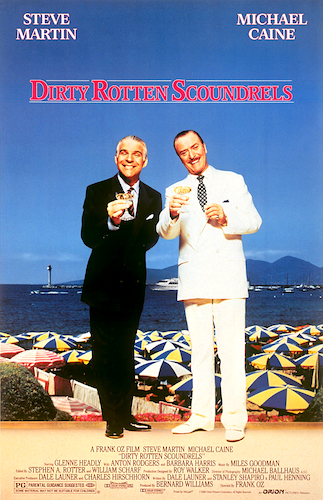
#21 Dirty Rotten Scoundrels (1988) — Decades #10
#22 West Side Story (1961) — Rewatch #3
#23 Cobra (1986) — WDYMYHS #3
#24 Django & Django (2021) — New Film #3
#25 A Man Escaped (1956) — Blindspot #3


  • I watched nine feature films I’d never seen before in March.
  • Four of them counted towards my 100 Films in a Year Challenge, along with one rewatch.
  • That means I end the month bang on target: we’re a quarter of the way through the year, and I’m a quarter of the way to #100.
  • My overall viewing is going less well, failing to reach ten new films in a month for the first time since November. (You can see all my latest viewing, both Challenge-related and not, on my Recently Watched page.)
  • That said, while it didn’t reach the magic double figures, it’s not that far short of 2022’s other months: the year’s monthly average only drops from 12 to 11.
  • That said, in the world of viewing averages, a whole film drop is moderately large. For comparison, the rolling average of the last 12 months dropped by 0.9 films (from 14.8 to 13.9), and the all-time average for March by just 0.46 (from 15.79 to 15.33).
  • For the third month in a row, my “2022 film” is a 2021 film that didn’t get a UK release until 2022. This should’ve been the month to buck that trend, with The Batman, but unfortunately I haven’t had a chance to get to the cinema.
  • This month’s Blindspot film was Robert Bresson’s World War 2 prison drama A Man Escaped — or, to fully translate its original French title, One Condemned to Death Escaped, or, The Wind Blows Where It Wants. Classy.
  • This month’s WDYMYHS film was ’80s Sly Stallone actioner Cobra. That doesn’t have an intelligent-sounding extended title. Or much intelligence on the whole, really. It’s kinda fun, though.
  • From last month’s “failures” I watched The King’s Man.


The 82nd Monthly Arbitrary Awards

Favourite Film of the Month
I watched both versions of West Side Story this month, and, heretical as it may sound, I think I thought Spielberg’s was better. (As a rewatch, the original isn’t eligible for this award anyway). Not only that, but Spielberg’s pure cinematic skill sees it stand out easily from the rest of the month’s viewing.

Least Favourite Film of the Month
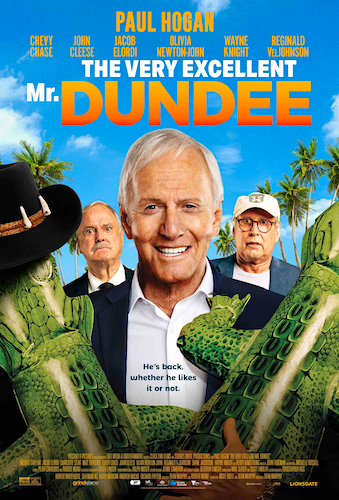
I actually quite enjoyed The Very Excellent Mr. Dundee — certainly more than most other people seem to have — but there’s also no doubt it was the weakest film I saw this month.

Film You’d Most Like to Hang Out In of the Month
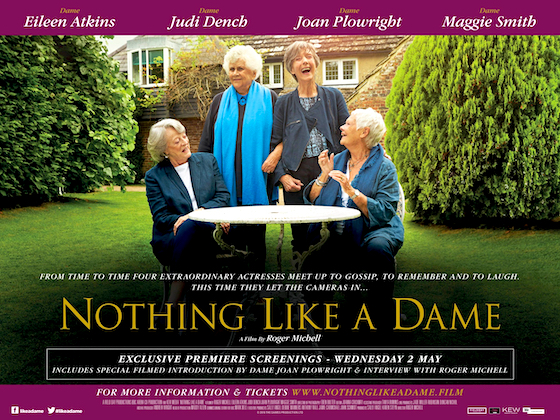
Who wouldn’t want to spend time nattering with the grandes dames of British theatre and cinema in Nothing Like a Dame? Not only would you get fabulous anecdotes, but they seem like a right giggle.

Film You’d Least Like to Hang Out In of the Month
No one said life in a Nazi prison would be fun, and A Man Escaped certainly bears that out.

The Audience Award for Most-Viewed New Post of the Month
Just three posts to choose from, last month, and the victor of those was 2022 Weeks 7–8. Of the other two, my ‘failures’ proved more popular than my general monthly review for the second month running. Could just be the appeal of the title, I suppose.


Every review posted this month, including new titles and the Archive 5


The much-discussed Spider-Man: No Way Home finally hits disc next week, so I’ll see if it has any surprises left for me (I don’t think I’ve been totally spoiled, but it’s been impossible to avoid certain big stories). Also, hopefully I’ll also finally see The Batman, one way or another. And also some films that don’t involve men dressing up as critters to fight evil.

2022 | Weeks 7–8

It’s been a hectic time, both at work and in my personal life, these past few weeks. I’ve managed to carve out a small amount of time for some film watching (though not as much as I’d like), but little for film reviewing — hence why there’s not been an Archive 5 for a fortnight, and why this update comes over two weeks after the period it covers.

But better late than never, and the only way to get back on track is to get on, so…

  • Shot in the Dark (1933)
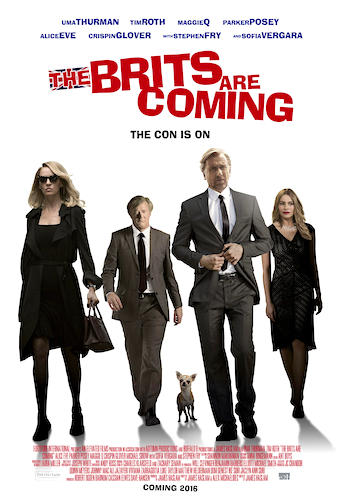
  • The Brits Are Coming (2018), aka The Con Is On
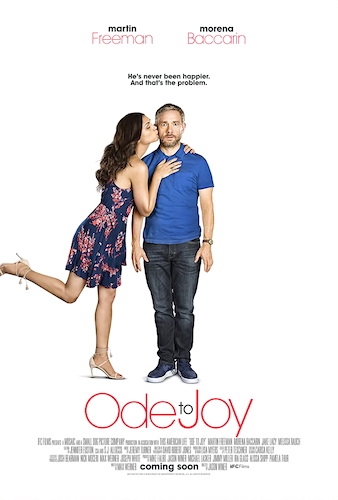
  • Ode to Joy (2019)
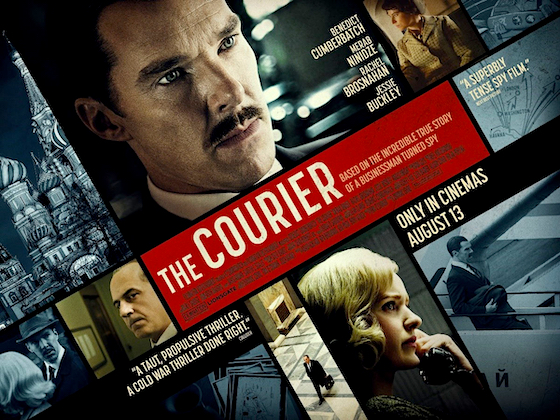
  • The Courier (2020)
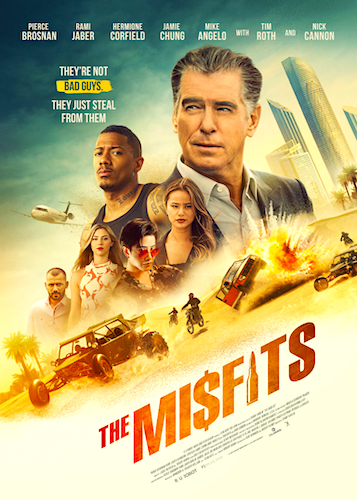
  • The Misfits (2021)


    Shot in the Dark

    (1933)

    George Pearson | 52 mins | digital (SD) | 4:3 | UK / English

    Shot in the Dark

    The works of Agatha Christie and G.K. Chesterton are casually evoked in this ‘quota quickie’ murder mystery, adapted from a novel by H. Fowler Mear, a screenwriter whose Wikipedia entry describes him as “competent but uninspired”. (FYI, the film is often listed as A Shot in the Dark online, I presume due to confusion with a couple of slightly later films that go by that title. As the title card makes plain, there’s no A here.)

    When a wealthy old man dies of a gunshot, it’s ruled a suicide; but when the family gather to listen to the will he recorded, the deceased claims he must have been murdered. Before he can make any further accusations from beyond the grave, the record goes missing. Fortunately, the local vicar (O.B. Clarence) happens to be passing at the time, and sticks his nose in — to find both the record and the murderer.

    There’s nothing particularly special about the mystery that unfolds. As a detective, the vicar is a cut-price Father Brown knockoff; a weak caricature of the Sherlock Holmes type: every time he interviews someone, he seems to already know everything they’re going to tell him, if not more. It’s quite fun that almost everyone confesses to the murder at one time or another, only to turn out to not actually be responsible, but I have trouble crediting that as a deliberate gag — it’s not emphasised enough for that to be the case. When the actual culprit is eventually revealed, how and why the crime was committed isn’t properly explained. This is the kind of film that doesn’t see the value in wasting valuable screen time on things like “motive” and “plausible opportunity” and “plot twists” when it can offer dark & stormy nights and people storing poison next to medicine and secret passageways. Indeed, when they find a secret room, it turns out to have its own secret room — that’s the kind of work we’re dealing with here.

    All in all, it’s not <i<bad for a quick little murder mystery, but it’s not strictly good either. It scrapes a 3 by the skin of its teeth.

    3 out of 5

    Shot in the Dark is the 16th film in my 100 Films in a Year Challenge 2022.


    The Brits Are Coming

    (2018)

    aka The Con Is On

    James Haslam | 91 mins | digital (HD) | 2.35:1 | UK & USA / English | 15 / R

    The Brits Are Coming

    Uma Thurman and Tim Roth star as a couple of British crooks who accidentally gamble away a pile of cash belonging to a crime lord (Maggie Q), so flee to LA to steal the expensive new engagement ring of his ex (Alice Eve).

    As a crime-comedy caper, you feel like this must have read funny — how else to explain such a starry cast in such a cheap-feeling production? Assuming that’s the case, something definitely got lost between page and screen: almost everything about The Brits Are Coming seems as if it should work, and yet almost none of it does. The occasional moment lands, amid a barrage of F-words so unnecessary you wonder if the film was in some kind of competition to use as many as possible. You sense the cast might’ve been having fun, at least, though supporting appearances from the likes of Stephen Fry and Crispin Glover do little to elevate the material.

    1 out of 5


    Ode to Joy

    (2019)

    Jason Winer | 97 mins | digital (HD) | 2.35:1 | USA / English | 12 / R

    Ode to Joy

    Charlie (Martin Freeman) has cataplexy, a rare neurological condition that means if he feels a strong emotion — in his case, happiness — he passes out. Unfortunately for Charlie, he seems to be a bit of a softy: even just seeing someone with their baby or cute dog on the street is liable to make him wobbly. So Charlie lives an uneventful life, working in a library (what better place for calm?) and never doing anything particularly interesting. Certainly never dating. But then one day he defuses a situation involving Francesca (Morena Baccarin), who takes a shine to him; and of course he’s interested in her, because, duh, it’s Morena Baccarin. Can Charlie manage to be happy… but not too happy?

    If it all sounds a tad far-fetched, you should know that it’s inspired by a true story (there’s even a writing credit acknowledging the journalist behind the original piece). Nonetheless, the fictionalised version could easily have turned the premise into something ridiculous, but a solid screenplay and great cast ensure it stays balanced on just the right comedy-drama line. Freeman is perfect casting for “man who would like to be happy but must keep himself miserable”, playing to strengths he’s displayed ever since his breakthrough role in The Office. As his love interest, Baccarin could probably have got away with just looking pretty, but there’s more zest to her character than that. Among the supporting cast, The Big Bang Theory alum Melissa Rauch is particularly hilarious as Francesca’s ‘boring’ friend who Charlie ends up dating instead. She’s the closest thing the film has to an outright “comedy character”, but the screenplay and Rauch’s performance manage to round her out.

    Ode to Joy could’ve coasted on easy (if probably repetitive) gags derived from Charlie’s condition, or it could’ve more-or-less ignored it as simply a hook for a bog-standard romcom. Instead, it’s something a bit more thoughtful, exploring what it really means to be “happy”, as well as where and how we find happiness. Not to mention that age-old question, what’s the point in living if you don’t feel alive?

    4 out of 5


    The Courier

    (2020)

    Dominic Cooke | 112 mins | digital (UHD) | 2.39:1 | UK & USA / English & Russian | 12 / PG-13

    The Courier

    A fascinating true story that I wasn’t the slightest bit aware of, The Courier stars Benedict Cumberbatch as nondescript businessman Greville Wynne, who was recruited during the Cold War by MI6 and the CIA to travel to Russia and collect information offered by an asset in Soviet military intelligence, Colonel Oleg Penkovsky (Merab Ninidze), at that time the highest-ranked Soviet to leak intelligence to the West. Definitely sounds like spy novel stuff, but, as I said, it’s all true (well, except for the bits tweaked for dramatic licence, obv).

    As regular readers will no doubt have inferred from my reviews of James Bond, John le Carré adaptations, and other similar fare, I love a bit of Cold War espionage. Normally that’s of the fictional variety — I guess most of the true stories aren’t quite as exciting, or remain too classified — but there’s nothing quite like knowing the events you’re witnessing actually took place. That said, the events depicted here fall under the latter category, as they’re officially still classified. Screenwriter Tom O’Connor reportedly pieced the narrative together from various sources, which I imagine helps make this as close to the truth as we’re likely to get, for now at least.

    Either way, it’s a suitably thrilling tale, powered by two superb lead performances from Cumberbatch — initially reluctant and floundering, but increasingly self-assured and moralistic — and Ninidze — controlled and honourable, but with an emotional undercurrent. Strong supporting turns, too, from the likes of Jessie Buckley and Rachel Brosnahan, don’t let us forget the very human cost of the spy games, especially if things should turn sour…

    By the end, you definitely feel that the actions of Wynne and Penkovsky should be better known. Perhaps the need for keeping official secrets has stymied that — although (without wishing to spoil what happens) some events did make news at the time, and this isn’t the first drama or documentary to cover the case — but The Courier stands as a valiant effort to bring their tale to a wider audience.

    4 out of 5


    The Misfits

    (2021)

    Renny Harlin | 95 mins | digital (HD) | 2.39:1 | USA, UAE & Finland / English | 15 / R

    The Misfits

    If you thought Michael Bay’s 6 Underground was bad, The Misfits is here to show you what a properly poor “former crooks do good deeds from the shadows” action movie looks like.

    The eponymous ‘Misfits’ are a small group of international Robin Hoods, preying on the rich and selfish for the benefit of the poor and helpless. Their latest job is to steal the gold reserves of a terrorist organisation, which are kept safe in a prison owned by Warner Schultz (Tim Roth, slumming it again), so they recruit his nemesis: thief and multi-time Schultz prison escapee Richard Pace (Pierce Brosnan, only half succeeding to reconjure the roguish charm he deployed decades ago in similarly-themed films like The Thomas Crown Affair).

    Despite the involvement of a couple of big-ish names in front of the camera and a former blockbuster director behind it (Renny Harlin, whose credits included Die Hard 2 and Cliffhanger before a couple of flops relegated him to rental-shelf-filler fare), The Misfits looks like it was made for £3.50 and a favour from the Abu Dhabi tourist board (the city appears glamorous and expensive, unlike anything else about the film).

    The screenplay feels like it was generated by an AI fed on every low-rent heist movie from the last 30 years. It’s not just clichés, but the way it drifts along with a “this is the sort of thing that happens in this sort of movie” logic, not particularly caring if it makes objective sense. The construction is sloppy, too. For example, a ton of time is devoted upfront to introducing the ‘Misfits’, only for most of them to be 2D one-trick pies (a thief, a fighter, an explosives expert, etc) who are supporting characters in what is really Brosnan’s film. I thought it was going to be a case of bait-and-switch marketing — make the famous actor prominent on the poster, only for his role to be little more than an extended cameo when the film is really about these other guys — but no, he’s genuinely the lead, it’s just the film is weirdly built. And that’s before we get onto the centrepiece heist itself, where the inevitable twists and reveals are either too clearly telegraphed, or simply pulled out of thin air (the gold isn’t there, it’s here! Except it’s not here, it’s there! But it’s not there, it’s here!)

    If you are exceptionally forgiving, The Misfits has vague merit as entertainment, but it’s a very hollow kind of fun. If you’re in the mood for the particular joys of a heist movie, and you can’t think of or get hold of another one at that minute, it would probably scratch the itch.

    2 out of 5

    The Misfits is the 18th film in my 100 Films in a Year Challenge 2022.

  • February’s Failures

    Once upon a time, I never thought I’d be mentioning a Jackass film on this blog, but the release of revival movie Jackass Forever caused me to seek out the first two in the series, and I do intend to watch the rest eventually. Not going to the cinema for it, though. Or, indeed, anything else this month. Fare like Moonfall and Uncharted is very much in the “wait for streaming” camp for me — I’ll surely watch them both eventually, and it may even turn out I enjoy them, but they’ll wait. I did enjoy Branagh’s Murder on the Orient Express, so I was tempted by Death on the Nile, but, honestly, I’m still not sold on the whole “living with Covid” thing, so it’s going to take more than that to persuade me out to the cinema. Other things — like animations Belle and Flee — had more limited releases and I don’t even know if they came near me.

    The return of the big screen doesn’t mean the streamers have let up on originals, although their quality continues to be variable. I’ve heard good things about Steven Soderbergh’s latest, Kimi, which went straight to Sky Cinema here in the UK, emulating it’s “direct to HBO Max” release Stateside. But their other originals — school shooting thriller The Desperate Hours and language-barrier romcom Book of Love — have received lesser notices. Netflix, on the other hand, could boast Jean-Pierre Jeunet’s first film in almost a decade, Bigbug, and yet I’ve seen precisely one tweet mentioning it. Their latest reincarnation of Texas Chainsaw Massacre, on the other hand, did seem to generate chatter, but little of it positive. And the less said about Madea and Mrs Brown teaming up for A Madea Homecoming, the better.

    In that middle ground of “cinema releases coming quickly to streaming”, MUBI continue to rule with the likes of Céline Sciamma’s Petite Maman and Icelandic folk horror Lamb, although Disney+ come close with Kingsman prequel The King’s Man and Wes Anderson’s The French Dispatch. On a slightly slower track, Sky Cinema also had a pretty strong showing of stuff this month, mainly in the horror realm. We’re talking Freaky, The Forever Purge (I’ve got a couple of others left before I get to that, personally), Ben Wheatley’s In the Earth, and Escape Room: Tournament of Champions (I quite enjoyed the first, so I’ll give it a chance). Also, not a horror but it looks horrific: Space Jam: A New Legacy. And quirky British true story comedy Dream Horse, which looks worth it just for the international cast’s attempts at the Welsh accent.

    As usual, Amazon Prime, BBC iPlayer, and All 4 produced plenty of stuff from deeper in the archive that I’m happy to fill out my watchlist with while clearly being in no rush to get round to. Normally I’d include Netflix in that list, but I’ve not jotted down much on my shortlist this month; though MUBI had an uncommonly good showing, the standout being Jiro Dreams of Sushi right at the end of the month. Others of particular interest included The Passion of the Christ (I feel I really should’ve seen that by now), the 1950s version of Around the World in 80 Days, Ripley adaptation The American Friend, and Memento, which I haven’t revisited in many a year. I own it on DVD, but, naturally, it’s in HD on iPlayer.

    Finally, the inexorable growth of my Blu-ray collection continued unabated, with a mix of new releases and sale pickups. Although I watched Ghostbusters: Afterlife in February, I picked it up in the series’ Ultimate Collection box set, meaning I now have 4K copies of Ghostbusters and Ghostbusters II on my watchlist. And that’s not all from the rewatch back catalogue, because HMV’s rolling offer of half-price UHD discs also allowed me to nab La La Land, Branagh’s Murder on the Orient Express, the original Scream, and The Shawshank Redemption — a rare film that I love (or like a lot, at least) but never upgraded to Blu-ray, so jumping from DVD straight to 4K feels like some kind of victory.

    There were new releases in 4K too, of course, most prominently Dune: Part One (how I wish it said that on the spine — it inevitably won’t match the sequel), which I imported from France so I also have it in 3D, and The King’s Man. Could’ve just watched that on Disney+, or at least given it a go there first, but as I own the first two it was inevitable I’d buy it, so I just got on with it. And, as we all know, discs are better than streaming anyway. I also took a punt on adult fantasy animation The Spine of Night in 4K, imported from the US alongside a new edition of Candyman III: Day of the Dead — it’s meant to be a rubbish film, but it completes my Candyman collection. Unfortunately, it’s also a somewhat rubbish disc, with noticeably weaker picture quality compared to a German release from a while back. Still, lots of special features. If I actually like it when I watch it, maybe I’ll treat myself to the German disc too. Based on everyone else’s opinion, that seems unlikely.

    UK labels continue to rollout martial arts classics — I feel like something must have changed in the licensing of these, because we got hardly any a few years ago, while now there’s at least a couple every month from 8 Films or Eureka, and now Arrow getting in on the game too. Anyway, this month’s releases included The Flag of Iron and Legendary Weapons of China from 88 Films, and Skinny Tiger and Fatty Dragon from Eureka, who also released silent epic The Indian Tomb on their Masters of Cinema line. They’d previously released Fritz Lang’s 1950s remake on DVD, which went OOP just before their release of the silent one came out. I presume that’s just a funny coincidence. And last but very much not least on the new release pile, Mark Cousins’ The Story of Film: A New Generation. Long-time readers will surely remember how much I loved his series The Story of Film: An Odyssey, so I’ve been eagerly awaiting this sequel. Now I’ve just got to make room for its near-three-hour running time.

    I’ve ummed and ahhed for years about upgrading my Charlie Chaplin box set to the Blu-ray version, especially as there have been a couple now, and the extra features vary, and the picture quality isn’t always the best. But Amazon cut it to such a low price this month, I decided just to give in — so that’s 11 features, a mix of ones I’ve seen and ones I haven’t. They may not be the very best available, but they’re a lot better than my DVD copies (which I can hang onto for the missing extras, because I’ll never make much reselling them anyway), and a lot cheaper than buying the films individually — which I can always do if I particularly love any of them. Criterion have put most of them out in the US, and are about to start bringing them to the UK, so we’ll see as they go along. Talking of box sets I’d overlooked but was tempted into by sales (it might not sound like a common problem, but it is for me), Indicator tempted me to grab their four-film John Ford at Columbia set this month; and because that wasn’t expensive enough to qualify for free postage, I also delved into their 5-for-whatever offer, picking up Eyes of Laura Mars, Modern Romance, Night Tide, See No Evil, and Time Without Pity. Their releases are so well-done, and their picks often so obscure but intriguing, that it’s easy to just keep buying them. Now, I just need to make the effort to actually watch more of them, too.

    Looking at that (not-so-)little lot, it’s easy to see why my bank account felt severely depleted by the end of the month. Maybe in March I’ll finally resist the lure of sales… but there’s always all those exciting new releases… Oh, I’m damned.

    The Comparatively Calm Monthly Review of February 2022

    For a moment, set aside your fears of World War III and/or anticipation for The Batman (whichever is taking up more of your mental capacity right now; possibly both) and journey with me back, back, back to a time when military invasion was just a threat and Batman reactions were still embargoed — i.e. last month.


    This month’s viewing towards my yearly challenge

    #13 She’s Gotta Have It (1986) — WDYMYHS #2
    #14 The Hobbit (1977) — Decades #8
    #15 Jackass Number Two (2006) — Series Progression #1
    #16 Shot in the Dark (1933) — Decades #9
    #17 A Room with a View (1985) — Rewatches #2
    #18 The Misfits (2021) — New Films #2
    #19 Tintin and the Temple of the Sun (1969) — DVDs #2
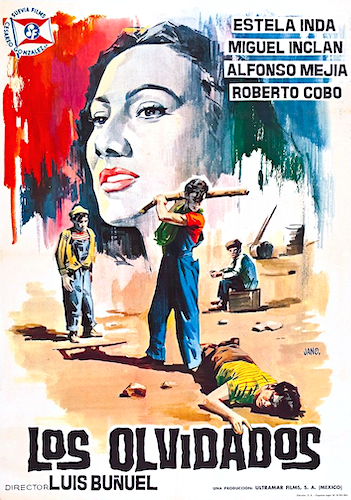
    #20 Los Olvidados (1950) — Blindspot #2


    • I watched 13 feature films I’d never seen before in February.
    • Seven of them counted towards my 100 Films in a Year Challenge, along with one rewatch.
    • As with last month’s ‘new film’, The Misfits is originally a 2021 release; but, best I can tell, its UK debut only came this month (as a direct-to-Prime Amazon Exclusive), so it counts as a 2022 release for the purposes of the Challenge.
    • Another oddity of my new rules kicked in this month. When I watched the first Jackass movie, it didn’t count for anything (the only place it could’ve qualified was Decades for the 2000s, but that had been taken); but then I watched the first sequel, and now that does count, as Series Progression. My scrupulous planning ahead for rare eventualities does pay off, see.
    • All the great films from the 1930s that I haven’t seen and could’ve watched to count towards my Decades tally, and instead I’ve filled the slot with a 52-minute “quota quickie” murder mystery. And, frankly, I don’t regret it in the slightest.
    • This month’s Blindspot film was Luis Buñuel’s ‘true story’ of children in poverty in mid-century Mexico, Los Olvidados, aka The Young and the Damned. That English-language title does kinda sum it up.
    • This month’s WDYMYHS film was Spike Lee’s pro debut, She’s Gotta Have It, which (as discussed last month) completes the films for which I was reliant on streaming. That’s one less thing to worry about.
    • Away from the Challenge, 13 beats January’s 11 to be 2022’s de facto best month in those stakes.
    • But it’s not a huge number, so falls short of most stats I keep an eye on: February’s all-time performance (the best is 27); the February average (previously 14.2, now 14.1); and the average of the last 12 months (previously 16.0, now 14.8).
    • My “failures” section may have been spun off onto its own dedicated post this year, but that hasn’t affected how many I actually watch: this month, I didn’t catch up with any of last month’s failures.


    The 81st Monthly Arbitrary Awards

    Favourite Film of the Month
    Its nostalgia-driven style may have enraged some critics and cineastes, but (anecdotally, at least) it seems to have worked gangbusters for regular folk — and, for once, I’m counting myself among the latter. There were certainly ‘worthier’ films among this month’s viewing, but nothing so all-around entertaining as Ghostbusters: Afterlife.

    Least Favourite Film of the Month
    A few to choose from this month — it’s felt like an underwhelming start to the year, I must say, with the poor and (mostly) mediocre films outweighing the good stuff. Anyway, the nadir has to be The Brits Are Coming, known in the US (and therefore most places online) as The Con Is On. It promises a stylish crime caper with an all-star cast. It delivers an amateurish-feeling wannabe-comedy that makes you wonder how come this cast were that desperate for work.

    Most Compromised Viewing Experience of the Month

    Nowadays, we’re used to ultra-faithful HD presentations that do their utmost to present films in their original cuts and original aspect ratio with original colour grading and original audio, to faithfully replicate the filmmakers’ intended vision. But not everything has been granted such treatment, like my DVD copy of Tintin and the Temple of the Sun — or, as the revised title card would have it, courtesy of some Windows MovieMaker-level text animation, The Seven Crystal Balls & Prisoners of the Sun. At least the rest of the opening titles are intact, which apparently wasn’t the case on VHS. The tape also cut two musical numbers, though the DVD only restores one. Despite most of the film being dubbed into English — with no original French audio option offered — the song wasn’t dubbed; but nor is it subtitled, so goodness knows what it was about. It’s bookended by some weird digital edits, suggesting more footage was cut, or possibly lost. And talking of audio, serves me right for choosing the remixed 5.1 track, which occasionally misses random sound effects and music cues. All of that without mentioning the strange digital artefacts that pop up now and then. Far from ideal… but also, as far as I’m aware, the only English-friendly version available (I doubt they fixed any of these problems for the iTunes release).

    Moment That’s a Great Visual But Impossible to Adequately Describe in Writing of the Month
    There’s a bungee jump stunt in Jackass Number Two that isn’t one of their most elaborate or dangerous, and certainly is a long way from being their grossest, but nonetheless ends in a moment of hilarity that, literally, has to be seen. I could try to describe exactly what occurs in the split-second, but it would take many words to convey accurately and still wouldn’t do justice to seeing it happen in a fraction of a second. It’s not even their funniest or most audacious thing, it’s just… gravity. Nature always wins.

    The Audience Award for Most-Viewed New Post of the Month

    Despite my return to (relatively) regular posting this year, February is my lowest month for traffic since… well, since as far back as the WordPress stats page shows (October 2019). Oh well. And despite many of my posts containing multiple different films to pique readers’ interest(s), it was actually a single-film review that came out on top for new posts: Ghostbusters: Afterlife.


    Every review posted this month, including new titles and the Archive 5


    Assuming we don’t all get nuked by a frustrated Russian, next month begins with The Batman, which got rave reviews when its embargo lifted yesterday, and ends with the Oscars, which can’t seem to do anything right this year. Hopefully, I’ll see them both.

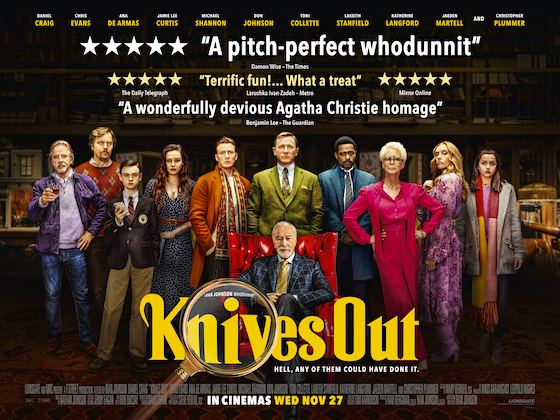
    Knives Out (2019)

    2020 #55
    Rian Johnson | 130 mins | Blu-ray (UHD) | 1.85:1 | USA / English | 12 / PG-13

    Knives Out

    After creating the widely beloved and totally uncontroversial Star Wars instalment The Last Jedi, writer-director used his newfound filmmaking cachet to quickly launch a passion project that he’d been working on since after his debut feature, Brick: a whodunnit murder mystery in the Agatha Christie mould, a genre of which Johnson is a lifelong fan.

    The story revolves around crime novelist Harlan Thrombey (Christopher Plummer) and his family of hangers-on, played by an all-star cast (including the likes of Jamie Lee Curtis, Michael Shannon, Chris Evans, Toni Collette, and Don Johnson). When Harlan dies, seemingly by suicide, freelance detective Benoit Blanc (Daniel Craig) has reason to suspect foul play, and teams up with Harlan’s nurse, Marta (Ana de Armas), to find out which of the family members dunnit.

    Knives Out is clearly built like a Christie story, though perhaps with a touch more satire and humour. That’s not to say it’s an outright comedy (though I’ve tagged it as one, because it’s often amusing), but this is a heightened world we’re in; it’s the real world, but filtered through the lens of a genre. And rather than follow the familiar formula of a Poirot- or Marple-type case, the film is like one of Christie’s other novels; one of the ones where the broad shape is the same, but there’s some twist or variant in how it’s told. Here, it’s that the detective isn’t actually our POV character, and at times we know a lot more than him (or, at least, different stuff to him). That leads to some effective twists that I won’t spoil, but which certainly keep you thinking and on your toes. I made a prediction as to the true solution before the halfway mark, and it turned out to be wrong, so that was fun (I don’t mean to boast, but plenty of murder mysteries are thoroughly guessable).

    The name's Blanc, Benoit Blanc

    That said, I wasn’t a million miles off with my guess, but that also doesn’t matter. As I noted in my summation of the film for my 2020 top ten, it’s not so important who actually dunnit when it’s so much fun spending time with the outrageous suspects and Craig’s implausibly-accented detective. That means it achieves something many mystery-based films miss: it’s highly rewatchable, because knowing the outcome isn’t the be-all and end-all. And yet, to achieve that, it doesn’t sell out the mystery entirely — I say “it barely matters who dunnit”, but it’s still an engaging riddle on first viewing.

    Knives Out was a notable success, eventually leading Netflix to pay a frankly ludicrous sum for two sequels. I’m glad there’ll be followups, because more mysteries in this vein promises more fun, but it’s a shame that what could’ve been a non-superhero non-action-based big-screen franchise has been nipped in the bud by the streamer. I expect that was literally their goal (and why they paid so very, very much money), but that’s a whole other debate.

    5 out of 5

    The UK network TV premiere of Knives Out is on Channel 4 tonight at 9pm. It placed 13th on my list of The Best Films I Saw in 2020.

    Netflix’s currently-untitled sequel is due for release later this year.

    Archive 5, Vol.5

    I have a backlog of 427 unreviewed feature films from my 2018 to 2021 viewing. This is where I give those films their day, five at a time, selected by a random number generator.

    Today, melancholic Frenchmen, screwball Americans, and royal Africans are followed by a superhero team-up and a lesson on the evils of social media.

    This week’s Archive 5 are…

  • La Belle Époque (2019)
  • The Awful Truth (1937)
  • Coming to America (1988)
  • Scooby-Doo! & Batman: The Brave and the Bold (2018)
  • The Social Dilemma (2020)


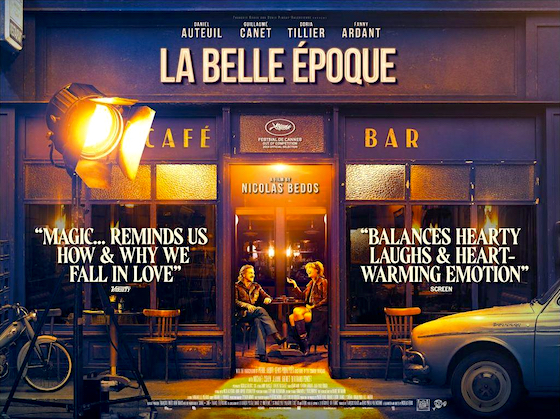
    La Belle Époque

    (2019)

    Nicolas Bedos | 115 mins | cinema | 2.35:1 | France / French | 15 / R

    La Belle Époque

    Sixtysomething Victor (Daniel Auteuil) is officially a grumpy old man, and his marriage is on the rocks because of it. To cheer him up, his son buys him an experience with his friend’s company, who stage bespoke historical reenactments as a form of time travel. When Victor’s wife finally has enough and throws him out, he uses his experience to revisit 1974, when they first met and fell in love.

    To oversimplify things, it’s kind of like Groundhog Day by way of Charlie Kaufman: the immersive theatrical experience recalls Synechdoche, New York (in a superficial way, I guess), and Victor’s desire to live it over and over again is, well, obvious. Except he’s not stuck there, but choosing it. It’s a mix of nostalgia and melancholy, because, of course, he’s not actually reliving that day, however much he comes to believe in it.

    Advance reviews led me to believe La Belle Époque would be little more than a pleasant diversion, but there’s a lot more to it than that. It clearly has something to say as regards the power of nostalgia and the need to live in the present. But, deep thoughts aside, it’s also a charmingly romantic film — sharply witty, unexpectedly beautiful in places, and genuinely emotional by the end. It’s a shame that it seems to have had half-hearted distribution outside of France (perhaps the fault of it being acquired by Disney, I suspect with an English-language remake in mind, rather than a ‘proper’ distributor of foreign fare who would’ve shown it more love) because I think it deserves, and would reward, a wide audience.

    5 out of 5

    La Belle Époque was #140 in my 100 Films in a Year Challenge 2019. It placed 7th on my list of The 15 Best Films of 2019.


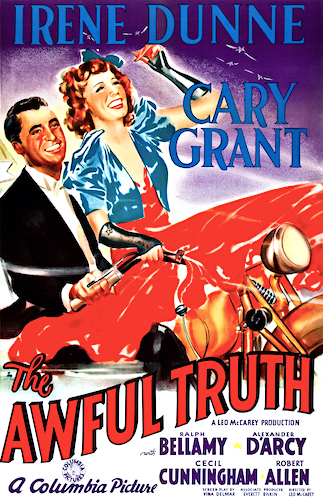
    The Awful Truth

    (1937)

    Leo McCarey | 91 mins | Blu-ray | 1.37:1 | USA / English | U

    The Awful Truth

    When Leo McCarey received his Best Director Oscar for this film, he said that he got it for the wrong film — a clear reference to his fondness for Make Way for Tomorrow, which he made the same year. I’m not wholly sure I agree with him, although Tomorrow’s is clearly the ‘worthier’ picture — but that doesn’t always mean better.

    The Awful Truth was the first of three screen pairings of Irene Dunne and Cary Grant, and the film that refined the latter’s famous screen persona. Here, the duo play a married couple who begin to divorce, only to then interfere with each other’s further romances. When it’s on form, the film is up there with the best of its subgenre: a sparkling screwball comedy with glorious dialogue, a pair of splendid lead performances, and a magnificent dog. Unfortunately, it goes on a mite too long and begins to lose steam in the final act. While that might hold the film back from perfection (and so open the door to the idea that Make Way for Tomorrow is somehow superior), the magnificence of what comes before means it’s still a must-see for fans of this style of comedy.

    4 out of 5

    The Awful Truth was #95 in my 100 Films in a Year Challenge 2021.


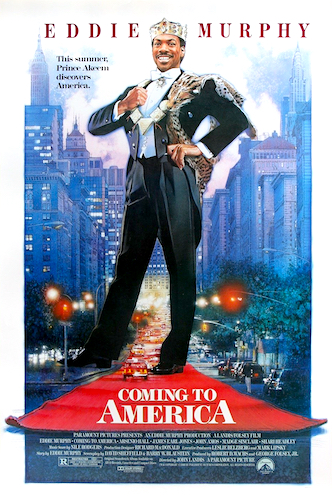
    Coming to America

    (1988)

    John Landis | 117 mins | digital (HD) | 16:9 | USA / English | 15 / R

    Coming to America

    Eddie Murphy plays a pampered but bored African prince, who dodges an arranged marriage to travel to America and find a bride. With that plot and the fact it was made a few decades ago, I was half expecting Coming to America to have aged badly. If nothing else, it seemed primed to base its humour around cringe-inducing culture-clash awkwardness — not necessarily an invalid kind of comedy, but not one I personally enjoy.

    As it turns out, it’s nothing of the sort. In fact, it’s actually rather sweet and kind-hearted, with just enough lewdness to give it a kick rather than make it eye-rollingly vulgar (I’m sure it would only take a couple of minor trims to get that 15/R rating down to a 12/PG-13). Some have criticised it for being too slow — including director John Landis, who asked Paramount if he could re-edit it for the Blu-ray release (they refused) — but I thought it was quite well paced. It doesn’t move at whipcrack speed, but it doesn’t need to. All in all, it holds up well enough that I can see why they decided to produce a belated sequel (which is still on my watchlist).

    4 out of 5

    Coming to America was #28 in my 100 Films in a Year Challenge 2021.


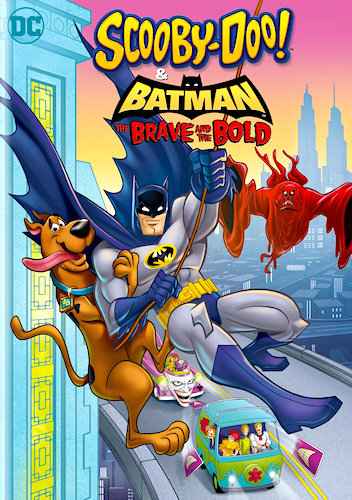
    Scooby-Doo! & Batman:
    The Brave and the Bold

    (2018)

    Jake Castorena | 75 mins | digital (HD) | 1.78:1 | USA / English | PG

    Scooby-Doo! & Batman: The Brave and the Bold

    There are an awful lot of Batman movies nowadays (58 and counting, according to my Letterboxd list), but I thought I was at least aware of them all. Turns out not, because I hadn’t even heard of this one until I happened to see someone log it on Letterboxd several years after its release. (It’s a direct-to-video production that they didn’t bother to release on Blu-ray, so that’ll be a big part of why it slipped under my radar.)

    A plot description is pretty unnecessary here: the title tells you all you need to know. The reason it’s a particularly unwieldy one is because Scooby-Doo and friends team-up with, specifically, the Batman from animated series Batman: The Brave and the Bold. I watched a selection of episodes from that show a few years ago and, frankly, didn’t enjoy most of them (although a couple are excellent: Mayhem of the Music Meister is so good I watched it twice in as many days, which regular readers will know is very unlike me), so I didn’t have high hopes for this movie either.

    At least it’s an appropriate iteration of Batman to crossover with Scooby-Doo, because (a) the whole point of the show was team-ups, with every episode seeing Batman join forces with a different DC hero (the subtitle is derived from a classic DC team-up comic), and (b) the overall tone of the show was camp and comical, which chimes well with Scooby-Doo. In fact, despite Scooby-Doo getting top billing, the film is really a feature-length episode of Batman: The Brave and the Bold guest starring Mystery Inc, rather than the other way round. I mean, it’s set in Gotham City, stuffed with appearances and cameos by other DC characters, and (most of all) it uses The Brave and the Bold’s animation style, even featuring a version of the series’ title sequence and theme music — with a Scooby makeover, of course. Nonetheless, it also adopts plenty of the tropes of a Scooby-Doo story, like the unmasking at the end.

    Thanks to all that, it’s everything you’d expect from “Scooby-Doo meets Batman” — they leave nothing on the table, right down to having Scooby actually say, “Holy Scooby-Dooby-Doo, Batman!” And would you have it any other way? It’s a daft concept, mashing these two cheesy franchises together — there’s no point trying to be above it. By embracing what it is, it delivers what you’d expect as well as could be imagined. For that, I quite enjoyed it on the whole. And so I would say that, if the basic idea of it doesn’t interest you, give it a miss; but if you think it sounds potentially appealing, you should definitely watch it.

    3 out of 5

    Scooby-Doo! & Batman: The Brave and the Bold was #105 in my 100 Films in a Year Challenge 2020.


    The Social Dilemma

    (2020)

    Jeff Orlowski | 94 mins | digital (UHD) | 16:9 | USA / English | 12 / PG-13

    The Social Dilemma

    One of those Netflix documentaries that everyone seems to be talking about for a while but then forgets just as quickly, The Social Dilemma is essentially about how dangerous social media is, as told to us by the people who created it. Not the Mark Zuckerberg of the world, obviously — they’re still raking in far too much cash to want to dissuade us from using their products — but various other developers and whatnot who’ve been involved over the years.

    Naturally, the main reaction to all this information is: “OMG, I totally need to change all my social media habits!” And do people? Not as far as I’ve seen. As one contributor in the doc comments, “knowing what was going on behind the curtain, I still wasn’t able to control my usage. So that’s a little scary.” Eesh. We’re doomed.

    4 out of 5

    The Social Dilemma was #20 in my 100 Films in a Year Challenge 2021.


  • 2022 | Weeks 4–6

    It’s been a busy start to the year… at my day job, which has had the knock-on effect of lower film viewing than has been the case in recent years. (I say that, but as February passes its midpoint, I’ve actually watched slightly more films than I had at the same point in 2020; but the last time I was lower than that was right back in 2014, so…)

    As well as work, there’s the psychology of my new reviewing practices. These regular up-to-date roundups have taken me right back to the days when I used to review everything in order, and how not being caught-up on my reviews made me not want to watch anything more. I’m getting those same kinds of twinges now. I need to try to use them to my advantage — take the time to read more books or something.

    Anyway, enough about me — let’s have some film reviews…

  • Voyage of Time: An IMAX Documentary (2016)
  • L’avventura (1960)
  • She’s Gotta Have It (1986)
  • Don’t Look Up (2021)
  • Jackass: The Movie (2002)
  • Jackass Number Two (2006)


    Voyage of Time

    (2016)

    aka Voyage of Time: An IMAX Documentary / Voyage of Time: The IMAX Experience

    Terrence Malick | 46 mins | digital (UHD) | 1.90:1 | USA / English | NR / G

    Voyage of Time: An IMAX Documentary

    Calling a film “a visual poem” sounds either clichéd or pretentious, or both, but how else to accurately describe this work by Terrence Malick? It’s labelled “a documentary”, because only because it’s not strictly fiction — if you come looking for the kind of education you’d get from something narrated by David Attenborough or Brian Cox, say, then I think you’d leave disappointed.

    No, film-as-poetry is the most appropriate way to attempt to engage with Voyage of Time; and, as with so much written poetry, your personal tolerance for and interest in it will vary. That’s how I found it, anyway: like most poetry, I felt I should appreciate it, but really was glad it was quite short. (The non-IMAX version of the film, subtitled Life’s Journey, runs about twice as long.) There’s some stunning photography, of everything from the birth of the universe to prehistoric vistas (presumably shot in remote modern-day locales rather than computer-generated), and Brad Pitt occasionally whispers some abstrusely meaningful ponderings over the top. As much as the pretty pictures are a draw, you can also find gorgeous nature photography in a BBC Attenborough documentary, and you’ll learn something at the same time.

    The IMAX version of the film has been streaming on MUBI since the end of last year, and they definitely sold it on the visual experience, boasting about offering it in 4K. I found the quality to be variable, with the stream unable to keep its end up for the whole running time, sometimes sinking to sub-1080p levels, becoming blocky and compressed. This is why physical media remains the best, when possible.

    3 out of 5

    Voyage of Time: An IMAX Documentary is the 11th film in my 100 Films in a Year Challenge 2022.


    L’avventura

    (1960)

    aka The Adventure

    Michelangelo Antonioni | 143 mins | digital (HD) | 1.85:1 | Italy & France / Italian, English & Greek | PG

    L'avventura

    I don’t have a great track record for enjoying acclaimed classic Italian cinema (neither Bicycle Thieves nor were to my taste, for example), so I’ve put off watching L’avventura for years, expecting I wouldn’t get on with it. But, inevitably, I had to face it someday… and, as it turned out, I really liked it… for a while…

    The film begins with Claudia (Monica Vitti) and her wealthy friend Anna (Lea Massari) meeting up with the latter’s wealthy boyfriend, Sandro (Gabriele Ferzetti), to go for a cruise on the yacht of some other wealthy friends. When they dock on a small island, Anna goes missing. The party scour the island, but there’s no sign of her. Police and divers arrive, but no luck. Reports suggest maybe she boarded another boat; possibly she was kidnapped. The wealthy friends quickly drift back to their lives, but Claudia and Sandro keep searching, following scant clues. Soon they too begin to get distracted — by each other.

    I don’t think it’s a spoiler to say that L’avventura starts out looking like a missing-person mystery only to get sidetracked into being a kind of romantic drama. I certainly knew that going in; and it’s probably beneficial to know it, spoiler or not, so as to manage your expectations of the film appropriately. Anyone expecting a Christie-style hunt through clues and suspects until the truth is unearthed will come away severely disappointed. No, this is the Mystery genre reimagined through an arthouse lens: it’s inconclusive, more interested in the characters than the hunt they’re on, and notoriously slow paced.

    With that in mind, I was surprised by how effective I found the mystery part of the movie. It’s not a whistle-stop action-adventure, but it’s not significantly slower than your average murder mystery, and accusations of it being uneventful seem misplaced — if I were expecting it to unfold like a regular mystery, there’d be plenty of places to look out for clues. It’s as the film shifts more towards Claudia and Sandro’s burgeoning romance that it begins to drag. The pair start just hanging around places as tourists, at which it does begin to seem like nothing’s happening and so what’s the point? The conceit of them falling for each other when they’re meant to be searching for someone they mutually care about is a good storyline, but I wasn’t convinced by how it played out. There doesn’t seem to be any time when they’re actually falling in love, they just suddenly are. Maybe I’m missing some point there. Or maybe it’s beside the point. Until I can work that one out, I’m going to have to chalk this up as half great, half A Shame.

    4 out of 5

    L’avventura is the 12th film in my 100 Films in a Year Challenge 2022. It was viewed as part of Blindspot 2022.


    She’s Gotta Have It

    (1986)

    Spike Lee | 84 mins | digital (UHD) | 1.66:1 | USA / English | 18 / R

    She's Gotta Have It

    Spike Lee’s post-student debut concerns twentysomething Brooklynite Nora Darling (Tracy Camilla Johns), who’s openly dating three men: upright ‘nice guy’ Jamie (Tommy Redmond Hicks), preening model Greer (John Canada Terrell), and streetwise Mars (Lee himself). And let’s not be coy (because the film certainly isn’t): she’s not just dating them, she’s sleeping with them all. The story of this love ‘square’ is partially narrated to camera by its four participants, as well as some of Nora’s other friends and acquaintances.

    It’s kinda crazy to think that the American indies were making sexually frank films like this and sex, lies and videotape in the late ’80s (a precursor, no doubt, to the wave of ‘real sex’ movies in the early ’00s), while nowadays we regularly get young people on Twitter arguing that no movie ever needs to have a sex scene, ever. So while I’m tempted to describe the film’s views on promiscuity as “then-modern”, perhaps just “modern” will still suffice — it’s certainly taken most (arguably all) of the intervening decades to get rid of the double standard for men and women as regards having multiple partners. That said, what has perhaps changed is our idea of what counts as “sexually explicit”. The film was obviously quite shocking back in its day, with the MPAA insisting on cuts before they’d give it an R (the unrated “director’s cut” had a Criterion LaserDisc release, but hasn’t surfaced anywhere else since), but you’ll see more nudity, more thrusting and moaning, on certain TV shows nowadays.

    Sexual stereotypes are not the only ones Lee sought to subvert here, as he also attempts to combat stereotypical depictions of African-Americans on screen — note the prominent message in the end credits that “this film contains are no jerri curls!!! and no drugs!!!” (punctuation as seen on screen). It extends beyond those basic signifiers; for example, how Nora’s three lovers are such different personalities. Partly that makes sense for the plot — that different sides of Nora’s personality like different types of guy — but also it shows different ideas of male Blackness; that The Black Guy is not just one thing. The jazzy score is another definite contrast to what you’d expect from a Hip Young Black Movie in the ’80s. Maybe that’s just Lee’s personal preference, but maybe it’s another conscious subversion of expectations.

    Lee’s politics are clear and forthright, but his filmmaking still needed some work. A lot of the film looks great, mostly shot in high-contrast black-and-white (plus one striking, ultra-saturated colour sequence), but some of the editing and performances could use refinement. Rough round the edges though it may be, She’s Gotta Have It is so clearly the calling card of a talented and individual voice with something brand-new to say that those rough edges are almost more of a feature than a bug.

    4 out of 5

    She’s Gotta Have It is the 13th film in my 100 Films in a Year Challenge 2022. It was viewed as part of “What Do You Mean You Haven’t Seen…?” 2022.


    Don’t Look Up

    (2021)

    Adam McKay | 138 mins | digital (UHD) | 2.39:1 | USA / English | 15 / R

    Don't Look Up

    Oscar statue2022 Academy Awards
    4 nominations

    Nominated: Best Picture, Best Original Screenplay, Best Editing, Best Original Score.

    Having targeted those responsible for the 2008 financial crash in The Big Short, and Dick Cheney and his responsibility for everything bad that’s happened in the last few decades in Vice, writer-director Adam McKay now turns his satirical attention to a fictional scenario, basically so he can have a go at anyone and everyone he feels like. The plot concerns a giant asteroid headed for Earth; an extinction-level event just 6½ months away. But, despite a handful of scientists trying to warn everyone, nobody seems in a great rush to do anything about it. It’s all an allegory for America’s carefree attitude to climate change, see.

    Really, this is a film I should be fully onboard with. It’s setting its sights on vacuous mainstream culture and Trumpian politics, after all. The problem is, these targets are low-hanging fruit, and — somewhat ironically, given its title — Don’t Look Up is satisfied with only plucking those lowest branches. Repeatedly. Unhurriedly. When they said the comet was 6½ months away, I didn’t expect the rest of the film to feel like it was covering that in real-time. It needed a better editor, or perhaps a studio who exerted a bit more quality control than Netflix’s famed “do what you want, we’ll just release it” approach. There are funny moments, certainly, but they’re literally few and far between when the pace is languid and the satire so broad, simplistic, and repetitious. Indeed, the most laugh-inducing stuff has nothing to do with the satire at all, just funny bits of business along the way (the best is a running gag about a general and snacks, which keeps cropping up unexpectedly).

    And for a film that’s entire thesis is being critical of American attitudes, it’s (again) ironic that it depicts this global crisis as so America-centric. Sure, there are cutaways to people watching events in other parts of the world, and a couple of belated nods to the idea that other countries might have their own thoughts on this impending disaster, but that’s all they are — sops and nods. “If America’s not going to fix this, no one can,” says the film. Ah, fuck off.

    2 out of 5


    Jackass: The Movie

    (2002)

    Jeff Tremaine | 85 mins | digital (SD) | 16:9 | USA / English | 18 / R

    Jackass: The Movie

    Jackass never appealed to me. I was a 14-year-old boy when it started, surely the franchise’s target audience; but I was an intelligent 14-year-old boy, so I was above it. Sorry, not sorry. But with everyone going on about the new movie, and reevaluating the whole franchise as some kind of essential classic of Cinema, I thought it was finally time to see for myself.

    For those not au fait with the series, it’s about a bunch of men who clearly aren’t old enough to know better performing stunts and pranks that no one in their right mind should ever want to do anyway. They’re frequently designed to induce pain. They’re often trying to be as crude or gross as possible. Some may make you feel ill just by watching them. And yet others are almost on the level of wholesome fun… albeit “wholesome fun” where you know participants will come away with bruises, at the very least.

    Almost everything the guys get up to is “dumb” — that’s kinda the point — and yet… It borders on “educational” when, for example, lead troublemaker Johnny Knoxville submits to being shot by “less lethal” riot control ammunition. The plan was for him to be shot in the chest, but the guys who make the stuff say if it hits his heart it could kill him, so they revise it to him being shot in the abdomen. Whereas most of the other stunts are followed by cutaways to the rest of the crew in hysterics, here the shocked silence of their reaction is telling. Or how about the kinda-feminism of a segment called “Ass Kicked by a Girl”, in which one of the gang enters the ring against a world champion female kickboxer. There’s no “haha, I can take her easily ’cause she’s a girl” posturing: the guy knows he’s about to get his ass handed to him. There’s some kind of respect for women in that, anyway, which you might not expect given the rest of the laddish antics.

    Taken as ‘a movie’, it’s rather formless — I suspect the TV show was exactly the same, just shorter — but the rapid-fire, standalone-stunt style does mean that no sketch hangs around too long. Some are literally seconds. But there’s not even a sense of escalation, say — it’s not like they save the largest or most outlandish stunt for the end (although there’s a post-credit scene that seems like it was probably the film’s most expensive single sequence). In some respects it doesn’t matter (who cares about the structure of a Jackass movie?), but in others, it’s what keeps it at the level of “feature-length special” rather than true Movie.

    But, ultimately, the important thing is this: some of it is funny. Reader, I laughed.

    3 out of 5


    Jackass Number Two

    (2006)

    Jeff Tremaine | 88 mins | digital (HD) | 16:9 | USA / English | 18 / R

    Jackass Number Two

    Even Jackass isn’t immune from the law of diminishing returns: after three seasons on TV plus a movie, this second big-screen outing feels kinda uninspired, like they’ve used up all their truly great ideas and are mostly running on fumes. That said, there are some good sequences — a variety of rodeo-based stunts with real live bulls are among the highlights — but other pranks feel reheated, or are just underwhelming; things you suspect would have been rejected in favour of better material before.

    In that sense it almost feels like it was rushed out to capitalise on success, but there’s a gap of four years, the TV show had ended, and they hadn’t necessarily intended to do any more — surely the only reason to return, then, was fresh ideas? Or, perhaps, being given the budget to do things they couldn’t before. That might be the case, because some of the material does feel like it’s got too much money and/or time behind it. I say “too much” because I think Jackass works best when it has a rough, cheap, “made at home” vibe. The finale here — a big “old Hollywood”-style musical number, with stunts mixed in — feels particularly out of place. Obviously it’s all a big joke, but the glossy, clearly-expensive visuals don’t feel of the right style.

    Plus, at various points you can feel some of the cast are getting genuinely fed up with this shit. Maybe they’d been doing it for too long by this point (I say there was a years-long gap, but some had been involved in spinoff projects). Whatever the reason, it serves to undermine the fun somewhat. One of the reasons you can enjoy these fools doing life-threatening stunts is because they’re volunteering for it and they seem to be having fun, however much they’re getting hurt or disgusted. But if they’re not enjoying it, aren’t we just watching people be tortured for our entertainment? It almost tips it from being stupid-but-funny into exploitative bullying. And we shouldn’t be having to think about anything that deep during a Jackass movie.

    As I’ve given both films 3 stars, let’s be clear: I’d definitely rate the sequel lower than the first movie, just not a whole star lower — it doesn’t merit being pulled down to a 2, while the first doesn’t merit a retrospective bump up to 4. If this kind of tomfoolery tickles you, there’s still plenty of entertainment to be had in Number Two, it’s just (mostly) not their finest output — which I guess is kinda apt, given the title.

    3 out of 5

    Jackass Number Two is the 15th film in my 100 Films in a Year Challenge 2022.


  • Archive 5, Vol.4

    I have a backlog of 432 unreviewed feature films from my 2018 to 2021 viewing. This is where I give those films their day, five at a time, selected by a random number generator.

    Today: singing vicars, grumpy gamers, very nice Kazakhs, and deleted actors.

    This week’s Archive 5 are…

  • Going My Way (1944)
  • The Bells of St. Mary’s (1945)
  • Zero Charisma (2013)
  • Borat (2006)
  • The Thin Red Line (1998)


    Going My Way

    (1944)

    Leo McCarey | 126 mins | digital (HD) | 1.33:1 | USA / English | U

    Going My Way

    The Oscars, eh? Every year film fans pay them a load of attention, and every year we seem to be disappointed with the outcome. But this isn’t some new phenomenon: Going My Way hails from the 1940s, but is perhaps the definitive example of a film that managed to sweep the Oscars (it won seven awards from ten nominations) against a bunch of films that have endured to much greater acclaim (films it competed against included Double Indemnity, Laura, Lifeboat, Gaslight, and Meet Me in St. Louis. I think we can agree those are all better-remembered on the whole).

    None of which is to say it’s a bad film. It’s a gently-paced series of vignettes, almost like a collection of short stories, springing from young priest Father O’Malley (Bing Crosby) arriving to take charge of a struggling New York City parish. His modern ways clash with the old-fashioned values of the incumbent Father Fitzgibbon (Barry Fitzgerald), but his worldly knowledge allows him to connect with some of the parish’s disaffected inhabitants. Despite the religious setting, it doesn’t lean too heavily on the wonders of Christianity (you know I’d be the first to rip into it if it did). Overall, it’s perfectly pleasant; an easy afternoon’s viewing.

    Incidentally (and here’s a good bit of trivia that might come in handy for a quiz someday), it was the first Oscar Best Picture winner to have a sequel: The Bells of St. Mary’s, released the very next year… and also the very next review in this roundup…

    3 out of 5

    Going My Way was #93 in my 100 Films in a Year Challenge 2021.


    The Bells of St. Mary’s

    (1945)

    Leo McCary | 126 mins | TV (SD) | 4:3 | USA / English | U

    The Bells of St. Mary's

    This followup to Going My Way was not only the first sequel to an Oscar Best Picture winner, but was also the first sequel to be nominated for the Best Picture Oscar.

    Bing Crosby returns as Father O’Malley, sent to a new locale, ready to solve another series of subplots at a struggling religious institution, this time butting heads (sort of — it’s never as dramatic as that makes it sound) with Ingrid Bergman’s head nun. Like the first one, it’s really a bundle of subplots for Bing to ‘solve’. The low-stakes problems and amiable tone between the two leads, even when they’re disagreeing, makes for a gentle and relaxing kind of film. I’d give it the edge over its Oscar-winning predecessor, thanks primarily to Bergman’s performance, but neither film is likely to set anyone’s world alight.

    As well as their Oscar success, the films were the highest grossing at the US box office for 1945 and ’46, respectively, another first for a film ‘series’. And yet, with six decades distance, they’re little more than also-rans; nicely obscure trivia answers to “films that won/were nominated for Best Picture”. Maybe there’s a lesson in that for anyone obsessed with the current cultural zeitgeist.

    3 out of 5

    The Bells of St. Mary’s was #187 in my 100 Films in a Year Challenge 2021.


    Zero Charisma

    (2013)

    Katie Graham & Andrew Matthews | 88 mins | digital (HD) | 16:9 | USA / English

    Zero Charisma

    I’d nickname this Portrait of a Manbaby on Fire. The manbaby in question is Scott (Sam Eidson), a stereotypical alpha-nerd: he has a neckbeard; he wears black T-shirts that feature elaborate depictions of grim reapers and the like; he lives with his grandma; he paints miniature fantasy figurines; he’s the Game Master of a role-playing group, which he rules with an iron fist. But when into-geeky-stuff hipster Miles (Garrett Graham) joins the group and everyone really likes him, Scott finds his position threatened, and he’s not happy about it.

    As much as geek/nerd culture has transitioned into the mainstream over the past couple of decades, there’s still stuff that remains the preserve of the hardcore; the truly nerdy. That culture clash is part of what Zero Charisma is about, of course, with Scott’s true old-fashioned kind of nerdishness clashing with Miles’s new-school cool. But it’s also a character study of the former. Scott may seem a stereotype — like The Simpsons’ Comic Book Guy rendered in live-action — but I’d wager anyone who’s moved in nerdish circles has known someone at least a bit like him. Stereotypes are stereotypes for a reason. The film exposes and examines those to often amusing effect. Some have said it exaggerates these things, but I don’t think it’s particularly guilty of that. Maybe it generalises them, and lumps all the worst characteristics of the extremely nerdy together into one character, but that doesn’t make it inaccurate, just broad.

    My only real problem was the ending. There’s a scene where everything comes to a head — a climax, if you will — but, in the wake of that, I felt it lacked adequate resolution. Has Scott learnt anything from this experience? Is he a changed man? Maybe a little, but not completely. To be fair, that’s a realistic character arc, because whose personality changes overnight after a single revelation? And yet it also doesn’t feel like the filmmakers quite know how they want to leave things. If they’d been going for a “change takes time and is incremental, but Scott’s started on that road” kinda message, I would have approved. Instead, the film tries to have its cake and eat it by showing Scott as better on the surface, but then secretly GMing a game where he still behaves like an asshole. Maybe it’s trying to say we can never truly change, however much our flaws are highlighted to us, which would be a pretty glum way to end an otherwise likeable comedy.

    3 out of 5

    Zero Charisma was #109 in my 100 Films in a Year Challenge 2020.


    Borat

    (2006)

    aka Borat: Cultural Learnings of America for Make Benefit Glorious Nation of Kazakhstan

    Larry Charles | 84 mins | digital (HD) | 16:9 | USA & UK / English | 15 / R

    Borat

    Ali G’s Sacha Baron Cohen adopts the persona of a Kazakh journalist to ostensibly interview Americans about their culture, but, unbeknownst to them, he’s of course really looking to expose their ludicrous views (you just know that, ten years later, a lot of these people voted for Trump) and take the piss out of them for our entertainment.

    As with most sketch-based comedy, the end result is a mixed bag. Sometimes it’s very funny; other times, it’s just being gross for the sake of it, like in a naked fight between Borat and his portly producer. A few bits don’t quite land — sometimes you can feel Baron Cohen’s not getting the response he wanted out of his target — and, even though he’s taking the piss out of people who deserve it, it sometimes gets a bit uncomfortable (though that might just be my English reserve/politeness kicking in and making me cringe). Most of the sketches are quite short, which is nice — they generally don’t outstay their welcome, and, if one isn’t working, you can be assured another will be along shortly.

    3 out of 5

    Borat was #220 in my 100 Films in a Year Challenge 2020.


    The Thin Red Line

    (1998)

    Terrence Malick | 171 mins | Blu-ray | 2.35:1 | USA / English | 15 / R

    The Thin Red Line

    An extensive cast of famous actors and recognisable faces star as a battalion of soldiers who spend 2 hours and 51 minutes taking one (1) hill in Terrence Malick’s very Terrence-Malick-y World War 2 movie. I mean, this is a movie about a battle in which the first shots aren’t fired until past the 45 minute mark, but there are plenty of shots showing the minutiae of nature. And there’s a lot of discussion about how there isn’t enough water.

    None of which is necessarily a problem — indeed, there are plenty of people who think this is a great movie, and I’m glad for them. But for everyone who loves it, there’s someone who’d call it “pretentious and self-indulgent, despite gun battles and lush cinematography.” I find myself somewhat stuck in the middle. I mean, if you were expecting a normal combat movie from Terrence Malick, more fool you. And it’s unquestionably beautifully shot — so many gorgeous visuals, but also effective camerawork and editing to convey, say, the chaos of battle. But I also found it to be bitty and episodic. Well, calling them “episodes” might be kind — they’re scenes; sometimes less than scenes; just moments, or even shots. It’s like a really long deleted scenes package pretending to be a movie.

    Of course, the behind-the-scenes stories sort of support that reading. The first cut clocked in at five hours. It took two editors and thirteen months of post-production to get it to a manageable size. Hans Zimmer composed over four hours of music, but only for a few bits of his work made it into the final cut. Billy Bob Thornton recorded narration for the entire film; the released cut has eight different narrators, but none of Thornton’s work is in there. Many actors thought they had significant roles, but found their performances reduced to little more than cameos. Most famously, Adrien Brody thought he was playing the lead role, only to discover at the premiere that he’s in just a couple of shots, and doesn’t even speak until over halfway through (and then it’s just a brief voiceover). And then there are the actors whose work was left on the cutting room floor: Bill Pullman, Gary Oldman, Lukas Haas, Viggo Mortensen, Martin Sheen, Jason Patric, Mickey Rourke… This movie has more great actors whose performances were deleted entirely than most movies have in their entire cast!

    All of which suggests a movie that should be universally recognised as a disaster. That it isn’t — quite the opposite — is testament to something. Maybe someday I’ll rewatch it and find out what.

    3 out of 5

    The Thin Red Line was #77 in my 100 Films in a Year Challenge 2020. It was viewed as an additional film for Blindspot 2020 after I failed to watch it for WDYMYHS 2019.


  • Ghostbusters: Afterlife (2021)

    Jason Reitman | 124 mins | Blu-ray (UHD) | 2.40:1 | USA & Canada / English | 12 / PG-13

    Ghostbusters: Afterlife

    Among the many, many discussions provoked by the last Ghostbusters movie was the notion of the 1984 original as “a comedy”. In short, people who consider themselves Very Clever were keen to point out that the ’84 film is, in fact, “a comedy”, and not whatever they thought some of its fans thought it was — a serious fantasy-horror film, I guess. But, as I see it, it’s the people insisting the original is “a comedy” who are actually the ones missing the point. It may star a bunch of SNL alumni, and it’s got a few gags, and if definitely doesn’t take itself seriously, but it’s not just a comedy — it’s a fantasy-adventure-horror-comedy. Those other three genres are just as important to the film’s style and tone — and to people’s love for the film — as the funny bits.

    I bring all this up because I think it has coloured reactions to Afterlife, a film which isn’t just the franchise’s fourth movie, but is very much a direct sequel to its first. Said reaction has been mixed, with some criticising it as a soulless exercise in nostalgia; a reaction and over-correction to the outright-comedy of the 2016 reboot, which was unpopular in some corners for daring to star women. That’s a dumbass criticism which, in the eyes of some, tars anyone who dislikes that movie — which is unfortunate, because a lot of perfectly rational people didn’t like it simply because it wasn’t very good (personally, I thought it was middling). On the flip side, a lot of people have found Afterlife very enjoyable — and I’m one of them. One of the reasons I’ve laid out that opening argument is because I don’t think Afterlife has been created as a reaction against the 2016 film — it’s tone hasn’t been set in opposition to the previous film, but rather is taking its cue from the 1984 original. In other words: it’s not just a comedy, it’s a fantasy-adventure-horror-comedy.

    Bustin' makes me feel good

    Set in the present day, it sees a family — mother Callie (Carrie Coon), son Trevor (Finn Wolfhard), and daughter Phoebe (Mckenna Grace) — inherit the remote farmhouse of the kids’ grandfather; the father their mother never even met. Turns out he was a Ghostbuster back in the day, and — surprise surprise — he ended up living in a back-of-beyond small town for a reason. With Callie uninterested in the father who was never interested in her, and Trevor off falling for a local waitress (Celeste O’Connor), it falls to curious Phoebe to investigate her grandfather’s life and, along with her new friend Podcast (Logan Kim) and summer science teacher Gary (Paul Rudd), discover what ghostly secret he was keeping.

    Really, Afterlife is a tribute to the original Ghostbusters. It’s full of nods and Easter eggs — some obvious; some subtle; some witty — and so will undoubtedly play best for a viewer who loves the original as much as the filmmakers seem to. That’s me, so I’m pretty much okay with the balance the film strikes. In other words, there’s enough new stuff to hang the old stuff on that I was able to just enjoy it. It would seem the film doesn’t play as well to viewers without that connection to the original, although I really think it depends how critical you’re being. This is a fun film — there are plenty of gags, plus a couple of suitably exciting action sequences — that I think anyone with reasonable expectations should still find it entertaining. As Phoebe, Mckenna Grace is particularly great — a really likeable lead to centre the narrative around.

    I’ve avoided stating which of the original Ghostbusters the new characters are related to because the film does the same, but — skip this paragraph and the next if you really want to avoid spoilers! — I don’t think it’s a particular secret, really. I mean, Phoebe’s been given a look that’s clearly reminiscent of her grandfather; and with the whole “he’s dead” plot point, well, that best applies to one of the actors, doesn’t it? So here’s another thing: Afterlife isn’t just a tribute to Ghostbusters ’84, but also to its co-writer and co-star, Harold Ramis. The characterisation of Callie and Phoebe was inspired by the autobiography of Ramis’s real-life daughter, Violet Ramis-Stiel, to the extent the actors were asked to read it as part of their preparation. Ramis-Stiel also signed off on her dad’s posthumous appearance in the film.

    Ghost in the machine

    Yes, thanks to CGI, the dead walk. This has been a controversial thing recently, mainly thanks to how the Star Wars films and TV series used it. Just last week there was a particularly big hoo-hah about Luke Skywalker being revived in The Book of Boba Fett. Generally, I agree that it’s distasteful. Using computers to ‘resurrect’ dead actors just so their pop-culture-favourite characters can live on? It’s kind of ghoulish. But I think the situation with Afterlife is a little different. Rather than a mega-corporation wanting to keep their space opera franchise stuck in the fan-pleasing past, this has been made by the actor’s friends and family as a tribute to him. If you bear that in mind, coupled with how exactly he’s used in the film, I actually think it’s rather sweet, and liable to bring a tear to the eye (though not to mine, because I am still a hard-hearted cynic in my core).

    I don’t know if Afterlife’s detractors will come round to it with time. Frankly, I don’t really care — if they didn’t enjoy it, that’s their business. At worst, it’s their loss, because this is an appropriately fun and affectionate addition to the franchise.

    4 out of 5