Unknown's avatar

About badblokebob

Aiming to watch at least 100 films in a year. Hence why I called my blog that. http://100films.co.uk

May’s Failures

Ever since the pandemic, the cinema has been “back” multiple times. The latest film driving that claim is Top Gun: Maverick, the belated-in-every-sense sequel (it’s both 36 years since the original film and something like three years since this one wrapped shooting, its release delayed until well after Covid was ‘over’) that’s been garnering rave reviews from almost everyone. Obviously, I didn’t see it (it self evidently wouldn’t be topping my ‘failures’ column if I had), but maybe next month. I’m sure it rewards the big screen experience as much as everyone says.

That wasn’t the only biggie in cinemas this month though, with multiverses causing buzz aplenty between Marvel’s latest, Doctor Strange in the Multiverse of Madness, and the UK bow of Everything Everywhere All at Once — another film we’re urged to see ASAP, and therefore on the big screen. Again, I didn’t have a chance this month, but maybe next. Other cinema releases look like small fry by comparison, even if they include a Stephen King adaptation (Firestarter) and Mark Wahlberg vehicle (Father Stu). Coming highly recommended, but limited (so far) to a single simultaneous global screening, was Andrew Dominik’s new Nick Cave documentary, This Much I Know to Be True. Hopefully it’s not one of those “you had to see it at the time” jobs and it’ll be on disc and/or streaming eventually.

Talking of streaming, the true headline-grabbers this month were new TV series, primarily Stranger Things 4 on Netflix and Obi-Wan Kenobi on Disney+. By comparison, original debuting films were thin on the ground. The only one I’ve got noted for Netflix is a new Ghost in the Shell animation, but it’s not a true new film because it’s one of those “cut down a season of TV into a feature” ones — full title Ghost in the Shell: SAC_2045 Sustainable War — which popped up a couple of weeks before a new season of the show itself. I’ve never got round to watching the original incarnation of SAC, never mind the less well regarded (as far as I’m aware) 2045-set revival. Amazon Prime, meanwhile, offered up a Chris Pine vehicle, The Contractor, and a Zac Efron one too, Gold. Neither seem particularly noteworthy.

As far as new-to-subscribers additions go, Netflix arguably had the biggest hitter with Bollywood crossover hit RRR — even if it wasn’t in the original language (exclusivity for that has been nabbed by another streamer) and, I read, not in the original aspect ratio. It’s enough to put you off watching it… were it not for the piles of praise I’ve seen it attract. Naturally, being a product of the Indian film industry, it’s really long, so I just need to find the time for it. The next most noteworthy title on my list is another international hit, two-time Oscar and two-time BAFTA nominee The Worst Person in the World, which is on MUBI. Once upon a time Sky Cinema were king of this category — the whole reason it exists, even — but this month the best they could do was Dear Evan Hansen. Oh dear. Meanwhile, Amazon added C’mon C’mon, which seemed to garner a lot of praise on Letterboxd at one point last year, but that didn’t materialise into much during award season. It didn’t even make my 50 Unseen list for last year in the end. Still, it goes on the watchlist now.

Indeed, my watchlists on all these services were padded out with piles of catalogue additions; so many it would be far too dull to list them all, especially as sometimes it’s just a film jumping from one service to another (looking at you, Ammonite and Chaos Walking). There also seemed to be a particularly large number of things I’ve been meaning to watch on disc but haven’t, which always elicits mixed feelings — a blend of “well why did I bother buying it then” and “I really should’ve watched that by now”. It was, in fact, All 4 that were worst for the latter this month, airing several titles I’ve owned on disc for ages, including The Handmaiden, The Kid Who Would Be King, and Zhang Yimou’s Shadow.

Talking of stuff I own on disc, let’s just move onto that, because I certainly bought more than enough stuff this month. No new-new releases (i.e. recent films new to disc) this month. I’m not sure if that’s because there’s been a dearth of them or because none have interested me. There have been plenty of new editions of catalogue titles, though, mainly foreign genre titles thanks to the boutique labels: martial arts movies like Half a Loaf of Kung Fu, Hero, and Human Lanterns from 88 Films; a pair of poliziotteschi from director Sergio Sollima, Violent City and Revolver (coincidentally released in the UK on the same date by two different labels. Maybe the rights just became available or something, because there certainly wasn’t any apparent cross-promotion effort); and a whole box set of neo-noir titles from Australia’s Imprint label, titled After Dark: Neo-Noir Cinema Collection One. “Collection One”? Promises, promises.

The latter I ordered as part of a bundle of all of Imprint’s releases this month, which also included Paul Greengrass’s superb drama about the Troubles in Northern Ireland, Bloody Sunday (it featured on my 100 Favourites list back in 2016); political thriller The Contender (never seen it, but it was more-or-less free by ordering the discounted bundle rather than just the other three titles, and I do like a political thriller); and Walter Hill’s The Warriors, a two-disc edition featuring the original theatrical cut on disc for, I believe, the first time. It’s the kind of release I’ve wanted for that film ever since I first saw it in 2018, so I was thrilled to get my hands on it. Just hope we don’t get someone like Arrow doing an even-more-bells-and-whistles version for the northern hemisphere anytime soon…

Talking of imports and genres, I picked up Arrow’s US-only releases of The 8 Diagram Pole Fighter and Come Drink with Me, which cost more than their UK counterparts but also boast considerably more special features. While I was getting those, I bulked up my order with a punt on the new 4K release of Heavy Metal, which comes bundled with its less-remembered sequel, Heavy Metal 2000; plus the latest classic 3D title to make it to disc, Treasure of the Four Crowns, a film I’d never heard of, but I’m always keen to support the continued release of genuine 3D content; and also a couple of films I had seen that don’t have Blu-ray releases on this side of the pond, steampunk animation April and the Extraordinary World and Clint Eastwood’s true-crime Southern Gothic Midnight in the Garden of Good and Evil.

And that’s not even all! There were more poliziotteschi in Free Hand for a Tough Cop (great title) and Silent Action (aka The Police Accuse: The Secret Service Kill, which sounds much cooler); a couple of things I heard recommended so picked up half on a whim, like single-take sci-fi Beyond the Infinite Two Minutes and Woman at War; and a bunch of stuff that’s been lurking on my “consider buying” list for months/years and finally was on offer, like Irezumi, Over the Edge, A Silent Voice, The Spy in Black, and The Snake Girl and the Silver-Haired Witch (talking of cool titles…)

Finally for this month, the greatest frustration of all disc collecting: two re-releases of titles I already owned and hadn’t intended to re-buy but ended up caving on. First, Arrow’s 4K edition of Dario Argento’s Deep Red. I’ve largely been ignoring their 4K Argento reissues because I already bought them all on Blu-ray and, frankly, haven’t watched any of them, and the ‘only’ thing the new editions add is the 4K transfer (which isn’t always that much of an upgrade — I haven’t bothered with their 4K of Donnie Darko for that very reason). But I discovered this month that Deep Red actually added a host of bonus features, plus packaging more in line with their other Argento titles; and the screen caps do make the quality of the transfer look noticeably better, so I caved. Secondly, Eureka’s Blu-ray edition of Vampyr. I seem to remember when they released it on DVD (back in 2008) they decided the print quality wasn’t up to HD standard (although they released their first Blu-rays in 2009, so maybe I’m misremembering), but it’s since been restored; plus they’ve added new special features and a big ol’ booklet. It’s a film I had mixed/muted feelings about when I finally watched it last year, which was part of my reluctance to upgrade, but then I guess I got FOMO about a limited-edition pretty Masters of Cinema release. But hey, the film merits a revisit, and this will encourage me to do so… some day…

The Jubilatious Monthly Review of May 2022

Of course, May had nothing to do with the jubilee (other than some precursor events), and the actual long weekend doesn’t start until tomorrow, so this post title is… not the best. But we’ll probably have forgotten it ever happened in 30 days’ time, so I’m not holding back the reference ’til June’s review.

Anyway, let’s put largely irrelevant naming issues aside and get on with last month’s viewing…


This month’s viewing towards my yearly challenge

#31 The Monolith Monsters (1957) — Decades #11
#32 Hannah and Her Sisters (1986) — WDYMYHS #4
#33 Chip ’n Dale: Rescue Rangers (2022) — New Film #5
#34 On the Town (1949) — Rewatch #5
#35 To Be or Not to Be (1942) — Blindspot #5


  • I watched seven feature films I’d never seen before in May.
  • Four of them counted towards my 100 Films in a Year Challenge, along with one rewatch.
  • Those are less than ideal numbers — I should be at #41 by now, really. Next month marks the halfway point of the year, of course, but I’m really going to have to step things up to get to #50 by then.
  • One of the films I watched this month that didn’t count was Shang-Chi and the Legend of the Ten Rings. It’s part of an ongoing series I’m watching — the MCU — so why doesn’t it count for Series Progression? Well, my personal rule when I count ‘series I’m in the middle of watching’ is that they’re series that have already finished, or where I’m catching up. Series where the next instalment isn’t even out yet can’t count because it doesn’t ‘exist’ yet. Sometimes, however, a new release can count, as with Encanto for Disney Classics last month, because I’m still watching older films as part of my catchup, so new releases get added to the end of the list. Does that make sense? Is it fair?
  • This month’s Blindspot film was Ernst Lubitsch’s anti-Nazi satire To Be or Not to Be.
  • This month’s WDYMYHS film was Woody Allen’s comedy-drama Hannah and Her Sisters. Regular readers may remember I needed to watch two WDYMYHS films this month to catch up. Well, I didn’t, so that goal is now bumped to next month.
  • From last month’s “failures” I watched The Monolith Monsters (from Eureka’s Three Monster Tales of Sci-Fi Terror set).


The 84th Monthly Arbitrary Awards

Favourite Film of the Month
Nothing truly exceptional this month, as is perhaps given away by the fact I’m going to choose an MCU film as my favourite. Obviously Shang-Chi and the Legend of the Ten Rings ticks the usual MCU boxes, but it mixes in a healthy dose of martial arts action-fantasy filmmaking — another (sub)genre I enjoy — making for an all-round entertaining MCU debut for the eponymous hero. It’s not the kind of film that’s going to convert nonbelievers, but it’s good fun.

Least Favourite Film of the Month
This is easily This Means War, the action-adventure/rom-com mashup starring Chris Pine and Tom Hardy as BFF CIA agents who both fall for Reese Witherspoon. It’s kinda adequate as a movie desperate to appeal to both male and female viewers, but kinda fails both by trying to be two different things at once and nailing neither.

Monster That Isn’t Really a Monster of the Month
I guess The Monolith Monsters was so titled to cash in on the popularity of monster movies in the ’50s, but the titular terror isn’t really a monster at all — it’s an extraterrestrial geological phenomena. On the bright side, at least that’s something a bit different.

Most Aspirational Lifestyle (for Some People) of the Month
In my review of tick, tick… BOOM! this month, I wrote that it would appeal to some people who dream of living that lifestyle. The same could absolutely be said of Frances Ha, which is about twentysomethings failing at life… but coolly, in black & white, in New York City. Well, if you only dream of failure, at least you’re less likely to be disappointed by reality, right?

The Audience Award for Most-Viewed New Post of the Month
A series of posts I started this year has been growing in popularity month on month… Well, I say that: I’m not sure its actual numbers have been going up, so much as the rest of the viewing chart has been falling away around it. Anyway, for the first time, this month’s most-viewed new post is a ‘failures’ post; namely, April’s Failures (of course). I guess people are more interested to read about what I didn’t watch than what I did. Weird.


Every review posted this month, including new titles and the Archive 5


…marks the halfway point of the year — yes, already! — so I might indulge in a few bonus statistics.

2022 | Weeks 14–15

Only four reviews this time, taking us up to April 17th. It was going to be five, but then Spider-Man got far too long. So, we’re left with…

  • Withnail & I (1987)
  • Munich: The Edge of War (2021)
  • tick, tick… BOOM! (2021)
  • Move Over, Darling (1963)


    Withnail & I

    (1987)

    Bruce Robinson | 103 mins | digital (HD) | 16:9 | UK / English | 15 / R

    Withnail & I

    This may be a beloved cult comedy in its own right, but I can’t help but make comparison to a certain other British cult property. You see, each of the three primary cast members — Richard E. Grant (Withnail), Paul McGann (‘I’), and Richard Griffiths (Uncle Monty) have an atypical relationship to the lead role in Doctor Who. That has no bearing on the film itself, not least because their involvement (or non-involvement, in one case) took place years later, but it’s a correlation I can’t shake. I mean, what other work can claim to star the man who was simultaneously the shortest and longest serving Doctor; the man who was definitely, officially the new canonical Doctor, until he wasn’t; and a man who might well have been the Doctor if things had gone to plan? Nothing else that I can think of, that’s for sure.

    Setting all that aside, everything about Withnail & I screams “cult favourite”, and I guess that’s what it is — not a film that started out with a dedicated fanbase before being subsumed into the mainstream, but one that remains beloved of a relatively few devotees. Perhaps that explains why it’s one of those films I thought would’ve wound up on my Blindspot list by now, but never has: because it lacks that crossover appeal. (Maybe I need to factor in some lists of cult and/or British movies when compiling my Blindspot choices.) Coming to it afresh in 2022, aware of that rep it’s built up over the last 35 years, does it no favours. The characters aren’t likeable or interesting enough to truly enjoy hanging out with (even as they’re convincingly brought to life by the talented cast); the “gay panic” stuff that drives several sequences lands differently now than I suspect it did in 1987; and the supposedly never-ending quotable lines didn’t materialise (there are a small handful of memorable ones, at least). That said, there are quite a few lines that would be fun for a game of “did Paul McGann say this in Withnail or in Doctor Who?” (Oops, sorry to bring that up again.)

    The best bits of Withnail have been dulled by repetition out of context (variations on “we’ve gone on holiday by mistake” are a certifiable meme at this point), and I suspect I personally left it too long to see it, allowing it to build up too much of a reputation. I didn’t dislike it, I just wasn’t won over.

    3 out of 5


    Munich: The Edge of War

    (2021)

    Christian Schwochow | 129 mins | digital (UHD) | 2.39:1 | UK & USA / English & German | 12 / PG-13

    Munich: The Edge of War

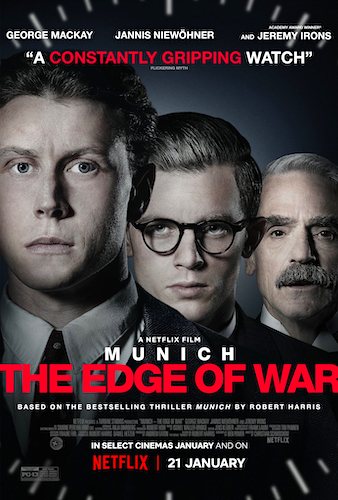
    Robert Harris has been a best-selling author for decades, but his works have had a rockier reception on the screen; perhaps not helped by the fact a couple have been helmed by director non grata Roman Polanski. Harris’s stock in trade is fictionalised tellings of historical events — the eruption of Vesuvius in Pompeii; the politics behind the invasion of Iraq in The Ghost; and so on. His 2017 novel Munich is set around war-avoiding negotiations between Adolf Hitler and Neville Chamberlain that took place in the titular city in 1938. This film adaptation gains a subtitle, presumably to differentiate it from Steven Spielberg’s Best Picture nominee, which retold entirely different historical events.

    The big names aren’t the main characters, however. Those would be a pair of low-ranking civil servants from the opposing sides: Brit Hugh Legat (1917‘s George MacKay) and German Paul von Hartmann (Jannis Niewöhner), former university chums who fell out when Hitler came to power. Now, von Hartmann is disillusioned with the Nazi regime and wishes to pass information to the British, but will only make contact with Legat, thus roping the inexperienced diplomat into the world of espionage, untrained. If the storyline is ringing bells, perhaps you too recently watched The Courier with Benedict Cumberbatch. It’s not an identical narrative — I’m not accusing anyone of plagiarism here — but there are definite parallels. Legat even has a strained relationship with his wife, who he has to leave at home and not tell the truth.

    But where the story in The Courier was true, and thus lent an inherent fascination, the story of Legat and von Hartmann is fictionalised. That’s not necessarily a problem — most thrillers are entirely made-up, of course — but Munich is hampered by feeling kind of muddy. It’s not so bad as to be described as muddled, but does seem like it’s perhaps the victim of being badly truncated from the book, or possibly just in its own edit. It’s not always clear what the point is of what we’re watching, or where certain characters have disappeared off to. That makes the overall experience longer and, occasionally, more plodding than it needs to be.

    That said, though it takes time, it does eventually develop the tension it needs; and it has definite merit for depicting a bit of history that’s normally relegated to footnote status. Indeed, it makes an interesting argument for “what Chamberlain did was good, actually”, which is not the normal point of view on politicians’ pre-WW2 actions.

    3 out of 5

    Munich: The Edge of War is the 27th film in my 100 Films in a Year Challenge 2022.


    tick, tick… BOOM!

    (2021)

    Lin-Manuel Miranda | 120 mins | digital (UHD) | 2.39:1 | USA / English | 12 / PG-13

    tick, tick… BOOM!

    Rent was one of the definitive Broadway musicals of the ’90s, but its creator didn’t live to see its success: composer, lyricist, and author Jonathan Larson died, with poetic timing, the night before the show’s premiere. It came after years of Larson struggling trying to break into the industry, much of which was documented in his semi-autobiographical (almost-)one-man show, Tick, Tick… Boom! This film adaptation broadens out and adds additional detail to become a more direct biopic of Larson, albeit one with musical numbers.

    Struggling musical theatre people in Manhattan… Yes, some people are going to find this insufferable. Others will look upon it as a dream life, especially as any actual hardship (Larson’s apartment didn’t have heating, for example) is played down or romanticised. Even setting that side, it remains the kind of movie that will speak to anyone who’s dreamt of making art (especially if that art is musical theatre), but might leave others (primarily those without such ambitions) identifying more closely with some of Jonathan’s friends — “there are bigger things to worry about,” they say.

    In the centre of it all is a pitch perfect performance from Andrew Garfield. He throws himself into the role, transformatively so: his Larson seems to be powered by a restless enthusiasm that I don’t think I’ve seen the actor portray in anything else. In the musical numbers, he holds his own against much more experienced singers (Garfield couldn’t even sing before production began — he spent a year learning and practicing).

    This is more than just a ‘one good performance’ film, though. Although based on a stage show, the screen version certainly doesn’t feel stage-bound, coming to cinematic life through Alice Brooks’s photography and Myron Kerstein and Andrew Weisblum’s editing as if it had always been meant for the screen. However, many people have been critical of Lin-Manuel Miranda’s direction. While I wouldn’t shout it out as anything amazingly special, I also don’t think it’s bad. You routinely see lesser work in Marvel movies, for example.

    4 out of 5


    Move Over, Darling

    (1963)

    Michael Gordon | 99 mins | digital (HD) | 2.35:1 | USA / English | U

    Move Over, Darling

    Doris Day and James Garner star in this remake of My Favourite Wife, one of the trio of screwball comedies Irene Dunne and Cary Grant made together, and which I watched back in May 2020. Two years ago?! Time flies. Despite which, I’ve not reviewed it yet.

    Well, Move Over, Darling is an incredibly close re-envisioning. If someone authoritative told me it used the same screenplay with only minor tweaks, I’d believe them. I’m sure it’s not that close, in actual fact, but it’s darn near it. Certainly, one bit is definitely new: a fun sequence that sees Day recount the plot of the earlier film. Very meta. Alongside the screenplay, the remake also carries the original’s primary flaw, which is that they both lack the pace and snap of the very best screwball comedies. Day does her best to enliven the material, being a consistent source of fun and clearly game for a laugh — a sequence where she goes through a car wash in a convertible is a highlight. Garner can’t manage to equal Cary Grant, but who can?

    Nonetheless, on balance, I slightly preferred this version. That might just be due to my lowered expectations — knowing it had the double drawback of being (1) a remake, and (2) of a film I hadn’t particularly loved the first time, it was able to overcome that by simply being not too bad.

    3 out of 5


  • Spider-Man: No Way Home (2021)

    Jon Watts | 148 mins | Blu-ray (UHD) | 2.39:1 | USA / English | 12 / PG-13

    Spider-Man: No Way Home

    I’m currently both behind and out of sync with my viewing of the Marvel Cinematic Universe. I’ve seen Black Widow, but overleapt Shang-Chi and Eternals to get to this widely-discussed and already-beloved instalment. And that’s without discussing the various canonical TV series there now are, which I think some of us still thought would be treated as ‘side projects’ but seem to be being used to introduce and explore key elements that underpin Phase Four. Which is another way of saying: hopefully this film makes sense without having seen Loki. (It does, assuming you know what a multiverse is — and as that was also discussed in the previous Spidey film, I think we’re good.)

    No Way Home picks up at the exact moment the last Spidey movie, Far from Home, left off: Peter Parker’s identity has been revealed to the public, and he’s accused of murder. Rather than make a whole story from the fallout, No Way Home uses it as a jumping off point. As revealed in the film’s own trailers, Peter asks Dr Strange to magic things back to how they were before, but the spell goes awry and drags in villains from alternate realities. As the trailers didn’t give away — but was, frankly, inevitable (and has been widely used in post-release promos, so I’m not counting it as a spoiler anymore) — it also pulled through alternate Peter Parkers, as played by Tobey Maguire and Andrew Garfield.

    And that’s not the half of it! It feels like they’ve gone out of their way to crossover with everything possible: as well as the two previous Spider-Man film series, there’s something from spinoff Venom, and even the MCU Netflix series, which were previously of dubious canonicity (of course, now they’re on Disney+ so they’re allowed to count again). About all that’s missing is Into the Spider-Verse, and there’s even an oblique reference to that. With all of that in the mix, it plays kinda like Fan Service: The Movie. Normally that would be a criticism, but it does it so entertainingly — and it’s so much the movie’s very raison d’être — that I think it works, in its own way. It feels similar to X-Men: Days of Future Past in the way it mixes different eras and facets of the same franchise together to create an ‘anniversary special’ kind of feel. That also means it doesn’t just feel like “The MCU: Episode 27”, but instead a climax to all the Spider-Man movies. That’s a pleasant change of pace, and one befitting such a storied superhero.

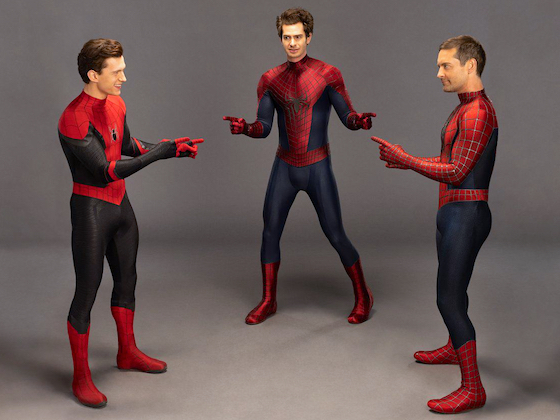
    Your friendly neighbourhood Spider-meme

    Keeping the appearance of the other Spideys out of the marketing may have seemed daft — of course we all knew they’d be in it — but it at least means we hadn’t already seen their best interactions in the trailer(s). How rare is it for a blockbuster nowadays to actually keep some of its biggest thrills for the film itself, rather than blowing them in advance! Indeed, my favourite bit of the whole film was the Spideys just hanging out and chatting while they waited for the villains to show up for the climax. It’s mostly fan service again — their discussion is almost entirely framed in references to previous films — but it’s nice as a moment of calm. And, like all of the film’s fan service, it tickles the nostalgia glands in those of us who get the references.

    It’s notable that each of the Spider-Men has a distinct personality. We’re now familiar with Tom Holland’s childlike, motormouthed take. Garfield brings the earnest, kinda skater/surfer dude feel that he sometimes has in real life — witness the moment he pauses mid action sequence to tell the other two Spideys, quite sincerely, that he loves them. Maguire, on the other hand, is very quiet and still. He only speaks if he needs to, and that doesn’t seem to be too often. It’s an innate calmness — perhaps also maturity — but it goes beyond that. It’s not that you feel he doesn’t want to be there, more like he’d feel exactly the same way if he wasn’t there — whatever; it’s all fine. If that sounds like “laidback” might be the right label, it isn’t. It’s almost that he’s doing… nothing. But that would be a rude thing to say to an actor, because of course he’s not doing nothing. It’s a bit of an odd one; or odd within the context of the hyperactive MCU, at any rate.

    The (literal) cheers that greeted No Way Home on its release have led to it being labelled a Great Movie by some (there was even a campaign to get it Best Picture recognition). Part of that is the regular thing of certain MCU fans apparently not watching anything other than MCU movies and so not having a proper frame of reference. But it’s also how the movie works: it tickles certain pleasure glands in such a way that, for some people, there’s confusion between “this is a lot of fun” and “this is a genuinely superb piece of cinema”. Heck, maybe, for some people, those are the same thing. Not for me. I don’t even think it’s the best Spider-Man film. But let’s not end on a negative, because it is a highly entertaining and, in its way, rewarding couple of hours of entertainment.

    4 out of 5

    2022 | Weeks 12–13

    So, it’s already the 15th — fundamentally halfway through the month — and this is just my ffith post in May. (It would’ve been third, but then my West Side Story and F9 reviews felt like they should have their own posts.) In my mind, I’ve raced this batch out as quickly as possible following my start-of-month posts, but it certainly doesn’t feel very speedy when you look at the dates.

    And, talking about messing with time, this roundup begins by taking us all the way back to March: week 12 ended on the 27th of that month. I might’ve posted sooner, were it not that week 12 seemed too small to run by itself. For what it’s worth, week 13 ended on 3rd April, so I’m still over a month behind now.

    Anyway, here are the rest of the new films I watched that fortnight…

  • Muriel’s Wedding (1994)
  • Cobra (1986)
  • Django & Django (2021)
  • A Man Escaped (1956), aka Un condamné à mort s’est échappé
  • Death on the Nile (2022)


    Muriel’s Wedding

    (1994)

    P.J. Hogan | 101 mins | digital (HD) | 1.85:1 | Australia & France / English | 15 / R

    Muriel's Wedding

    This is one of those films I’ve been sort of aware of forever, but never really paid a huge amount of attention, until suddenly I’m watching it almost on a whim. It’s the story of the misadventures of small-town Australian girl Muriel (a breakout performance from Toni Collette), who doesn’t fit with her family or ‘friends’ and so sets off to the big city for a different life.

    I don’t know what I was expecting from the film, exactly — a kooky Aussie romcom, I guess — but not a surprisingly dark, quirky almost to the point of being twisted, black comedy. Not that that’s a bad thing, but it kind of bamboozled me by being a lot odder and more tonally complex than I’d anticipated. I liked it, but it’s a weird one.

    4 out of 5


    Cobra

    (1986)

    George P. Cosmatos | 87 mins | digital (HD) | 16:9 | USA & Israel / English | 18 / R

    Cobra

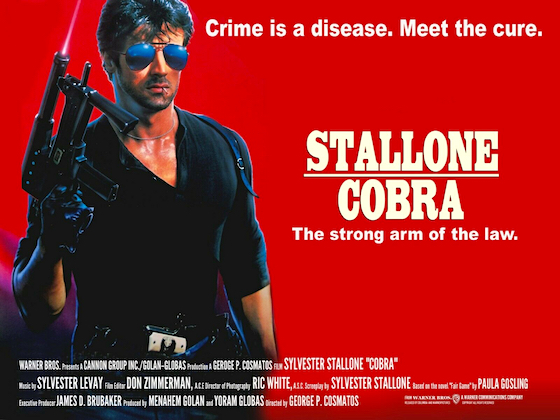
    This is the kind of film I might never have watched were it not for my WDYMYHS challenge. It’s a film I’d heard very little about, and what I had heard wasn’t good, but when it came to selecting the 12 most significant films I hadn’t seen from 1986, it scraped in. I’m glad things like that happen, because while Cobra is far from being a new favourite or something, I did enjoy it.

    Sly Stallone stars as a hot-shot cop on the trail of a serial killer with cult affiliations. That’s about it for the plot. This is a film that’s all style and no substance — though, when you’ve got this much style, maybe that is the substance. It’s so much a stereotypical ’80s macho action fest that it plays like a spoof of itself in places, with over-the-top editing, performances, and one liners that all seem driven by some sense of ‘cool’. I kinda love it for that. Take the car chase at the halfway mark: it’s a ludicrous sequence (one bit barely connects to the next; cars explode when shot; etc), but it’s filmed and cut with style and packed with excitement. It’s epic.

    Remarkably, it’s based on a novel. I say that’s remarkable because novels are devoid of being able to show off flashy visuals or dynamic action sequences, so you think of them as being heavier on things like plot and character — but, as discussed, this has very little plot, and even less character development. The already-brief running time seems to mostly contain music montages and extended action scenes. Reportedly the original cut was around two hours, which was then mercilessly shorn down to the under-90-minute final cut in an attempt to squeeze in more screenings per day. I imagine a lot of what went was the plot, although apparently there was also a lot of graphic violence — and what we’re left with still earnt an 18.

    I guess if a “director’s cut” was going to surface it would’ve done so by now (given all the other films that got them back in the ’00s). It’s something of a shame, because perhaps that version would round out the storyline enough to match the flair that’s all we get from the existing cut. Really, it’s a trashy film, but I rather enjoyed its trashiness. As stated, it’s all style and, at just 87 minutes, all business.

    3 out of 5

    Cobra is the 23rd film in my 100 Films in a Year Challenge 2022. It was viewed as part of “What Do You Mean You Haven’t Seen…?” 2022.


    Django & Django

    (2021)

    Luca Rea | 77 mins | digital (UHD) | 16:9 | Italy / English, Italian & French | 15

    Django & Django

    The work of the “second-best Spaghetti Western director”, Sergio Corbucci, is analysed by admirer Quentin Tarantino, and supplemented with a handful of anecdotes from a couple of people who worked with him. The small number of interviewees means the film is lacking in the depth you get from having multiple perspectives, but it’s a fine overview of Corbucci’s work nonetheless.

    Indeed, the title — implying a focus on two specific films — is a bit of a misnomer. Not only is it about Corbucci’s career as a whole, with Django just one film among many, but there’s only a single clip from Django Unchained, when QT mentions how Corbucci’s style influenced his choice of Southern setting. That’s it for discussion of Tarantino’s own work — barring a lengthy opening aside into the alternate history of Once Upon a Time in Hollywood; a ‘short story’ about Rick Dalton’s time in Italy and his meetings with Corbucci. Tarantino relates these events as if they’re historical fact — the guy really did thoroughly imagine his alternate history!

    3 out of 5

    Django & Django is the 24th film in my 100 Films in a Year Challenge 2022.

    A Man Escaped

    (1956)

    aka Un condamné à mort s’est échappé ou Le vent souffle où il veut

    Robert Bresson | 101 mins | digital (HD) | 1.33:1 | France / French & German | U

    A Man Escaped

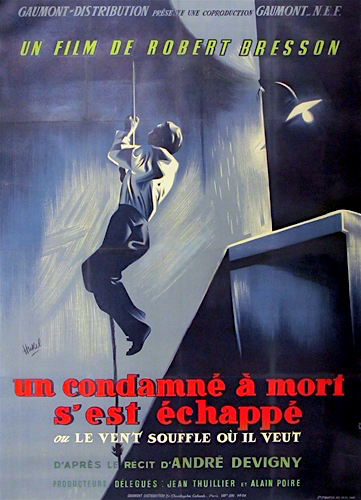
    Most “prisoner of war” movies are about plucky Brits and/or Yanks stuck in jail somewhere behind enemy lines, working out ways to escape almost as a time killer, or at best a matter of honour. A Man Escaped is something different. Based on the memoirs of André Devigny, a member of the French Resistance held in a French prison by the occupying Germans during World War II, and written and directed by Robert Bresson, who was also imprisoned by the Germans as a member of the Resistance, you can’t doubt its pedigree for authenticity. Indeed, Devigny was an adviser on the film, and lent the production the actual ropes and hooks he had used in his escape. More than these points of fact, it’s the film’s overall tone that’s striking — more dour and pessimistic than the usual POW drama, at least as I remember them. Here, the need to escape isn’t a game, it’s literally life or death.

    Bresson certainly knows where he wants his focus to be. The film begins with our hero, Fontaine (François Leterrier), arriving at the prison, although an escape attempt on the way there sees him immediately condemned to solitary confinement. Nonetheless, we remain by his side, never leaving him or his point of view, right until the end, when… well, that would be a spoiler. In terms of background, there’s only what we can pick up along the way; the barest outline of who he is, why he’s there, and what awaits him on the outside. That’s extraneous detail — this is all about his time in prison, his mentality in prison, and how he intends to escape the prison.

    To that end, Bresson spends a lot of time detailing very little. The process by which Fontaine fashions ropes, or chips away at a crack in his door to facilitate a way out, is shown in almost-excruciating detail. It’s all about the prep. When something truly dramatic does happen — like Fontaine gaining a roommate, and the question of whether that man can be trusted — it’s dealt with quickly, confined to a couple of quick scenes. I can only think that’s part of the point: much of the work to escape prison is tedious preparation, but when a spanner gets in the works it has to be dealt with quickly lest it derail the whole enterprise. Such ‘big things’ are a potential threat, but it’s arguably the little things that are even more dangerous. Accidentally drop something noisily, thus alerting the guards to your suspicious activities, and it’s all over.

    As a film, it doesn’t feel as strikingly stylised as the other Bressons I’ve seen, but it definitely has a stripped-back simplicity that’s part of his overall ethos. It’s debatable if we need the semi-monotone voiceover that describes exactly what we can see on screen — I’m no expert, but such an unnecessary and purely cinematic addition seems out of sorts with Bresson’s usual style. That said, at points it adds insight into Fontaine’s thought process, so the narration is not without merit.

    4 out of 5

    A Man Escaped is the 25th film in my 100 Films in a Year Challenge 2022. It was viewed as part of Blindspot 2022.


    Death on the Nile

    (2022)

    Kenneth Branagh | 127 mins | digital (UHD) | 2.39:1 | USA & UK / English & French | 12 / PG-13

    Death on the Nile

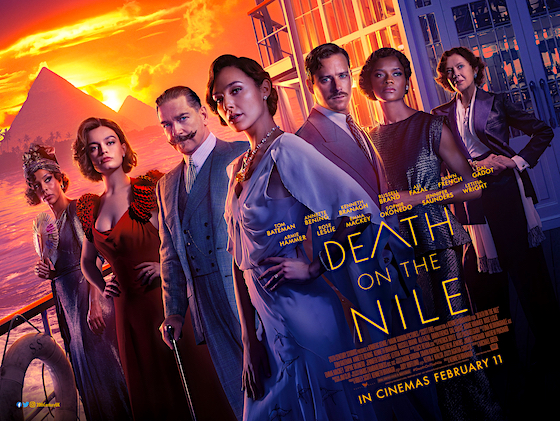
    Kenneth Branagh returns as both director and star for another Hercule Poirot mystery, after the somewhat-surprising success of his Murder on the Orient Express — “surprising” in the sense that it did better at the box office than I think anyone expected. It performed less well with critics, but I enjoyed it. Sadly, this followup is not its equal… though that’s not necessarily saying it’s bad.

    For me, it was a film of two halves — although, often as not, those two halves occurred simultaneously. For example: there’s an over-reliance on CGI for the Egyptian vistas makes many scenes look disappointingly fake; but then there’s a fantastic, huge set for the boat where much of the film takes place, and the real-life elements are quite handsomely shot on 65mm. Story-wise, there’s been a lot of rejigging (try to line up the cast with who played the roles in previous adaptations, for example, and you’ll soon discover a lot of the characters are amalgamations), but Christie’s typically excellent plotting survives mostly intact. That said, the ratio of buildup to detective work feels off, with the murder seeming to occur quite late in the film and the subsequent investigation feeling rather rushed.

    The motive behind screenwriter Michael Green’s remixing seems to be a serious attempt to make the film All About Love — not just the motive for the crimes, but all the subplots and whatnot too. I guess they were seeking some kind of justification for why this story is being filmed again, and what makes it worthy of the all-star movie treatment, rather than being just a run-of-the-mill, see-it-every-week-on-TV whodunnit. Plus, there’s a bizarre attempt to provide a backstory for Poirot’s moustache. No, seriously.

    Branagh initially seemed miscast as Poirot, but wasn’t bad in Orient Express, and that continues here. His version of the character is rather likeable, imbuing the Belgian with a neat sense of humour that marks his interpretation out from previous incarnations (Ustinov often played it for laughs too, but with less subtlety). There’s the customary all-star supporting cast, but they’re somewhat wasted, with some big names or talented performers left with too little to do. Though, when about half of them are employing dodgy accents, maybe that’s no bad thing.

    A mixed bag, then. It’s far from my favourite Christie adaptation; although it might actually be my favourite Death on the Nile by default, because I don’t think the previous versions (a Ustinov film and Suchet TV episode) are the best their respective series have to offer either. Whatever — I love this kind of stuff, and I’m glad to hear they’re intending to forge ahead with a third outing.

    3 out of 5

    Death on the Nile is the 26th film in my 100 Films in a Year Challenge 2022.


  • Fast & Furious 9 (2021)

    aka F9

    Justin Lin | 137 mins | digital (HD) | 2.39:1 | USA / English | 12 / PG-13

    Fast & Furious 9

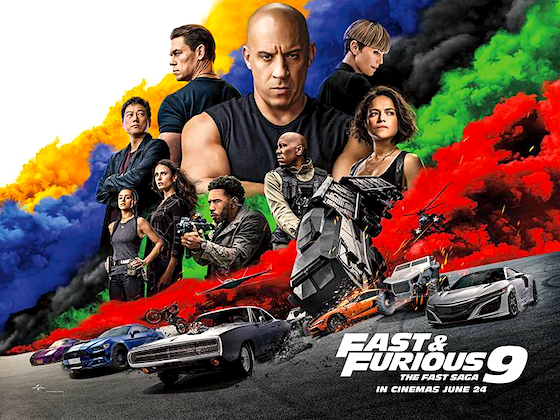
    Between spinoffs and Covid-related delays, it’s been four years since the preceding film in what we’re apparently now meant to call “The Fast Saga”. As the series’ storyline has become increasingly serialised, I’m sure I can’t be alone in wishing they’d begin with some kind of “previously on”. That might sound a bit much for a series whose rep is, not undeservedly, “dumb action with cars”; but while that action was revving up, I was left digging around in my memory for where we’d left these characters and why some things were the way they were.

    But, let’s be honest, it doesn’t matter all that much, because before long they were racing around (literally) after one Macguffin or another, plus all the requisite shooting stuff and blowing stuff up and performing physics-defying CGI-aided stunts that have become The Fast Saga’s hallmarks. If that makes it sound a bit tired — just “more of the same” — well, remember, we’ve reached film #9. Now, in fairness, if there’s any franchise that bucks its numbering system, it’s The Fast Saga: it tried on different lead characters and various underlying formulae throughout its first four movies, only settling on one that sang in the fifth film. Nonetheless, that means we’re now on the fifth instalment that’s driven by said formula — sixth, if you count the Hobbs & Shaw spinoff, which we should — and it’s beginning to wear thin.

    Since landing on that magic formula, the series has walked a couple of tightropes: with its action, being outrageous and ridiculous but still exciting and fun; and with its mythology, being unnecessarily complicated but still followable. F9 is where, for me, it finally stumbles, and perhaps even falls off. Who can still remember the ins and outs of what went on with Han and when? Not me! And… rocketing a car into space? Seriously? Well, Top Gear almost did it for real once, so maybe it’s not entirely implausible. But that’s far from the only so-ridiculous-it’s-ridiculous stunt in the film. Fast’s stunts have never carried the same thrill as, say, Tom Cruise’s in the Mission: Impossibles because they’re unquestionably not being done for real. We’re not impressed by what they managed to physically pull off, more amused by what they dreamt up and rendered in a computer. Most of them are implausible. But here, it reaches the tipping point where I went from laughing along with it to just finding it silly.

    Sunday drivers

    What changed? Well, missing from the cast are Jason Statham and The Rock, perhaps the only two actors in the franchise who knew precisely where to pitch their performances to reassure us the filmmakers knew it was all ludicrous but it was ok. But they were only supporting players — does removing them from the equation answer every misstep? Surely not. Perhaps the director? But that’s Justin Lin, the man who saved the franchise in the aforementioned fifth film, continuing the style into the sixth; so he’s only sat out #7 and #8. But perhaps his taste or touch for the material has gone — he did recently abandon production of the series’ forthcoming two-part finale, after all.

    Whatever the root cause, I found F9 lacked the fun of the last four films (five, counting the spinoff). Looking at it another way, five entertaining movies is a good run — they were overdue another dud. As that, it’s certainly not the weakest film the series has to offer.

    3 out of 5

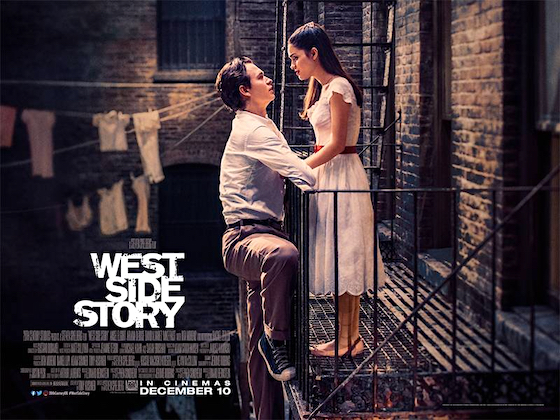
    West Side Story (2021)

    Steven Spielberg | 146 mins | Blu-ray (UHD) | 2.39:1 | USA / English & Spanish | 12 / PG-13

    West Side Story

    I remember when I first heard about this remake, I couldn’t quite understand what they were going to add by redoing it. The original is a widely-acclaimed classic — why remake it? I should’ve remembered one of the golden rules of cinema: always trust Spielberg.

    If you’re somehow unfamiliar with West Side Story, it’s a reimagining of Romeo and Juliet set in 1950s New York City, with the two warring families replaced by two warring street gangs. Although the teenage love story is still present, obv., the strength here is more in its depiction of cultural clashes between different groups of immigrants — essentially, the heart of the American experience. Like most musicals, it started out on the stage before being filmed in 1961. I’m not going to dispute the classic status of that film, but it has dated — most problematically in the use of brown face to depict Puerto Rican characters, but also in its overall style, which, though shot in part on the real streets of New York, is quite stagey. Plus it made various changes to the original work, primarily in the order and therefore context of multiple musical numbers; something that Spielberg, as a fan of the stage production, sort to restore.

    In short, it worked. Well, I’ve never seen the stage production, so I don’t know if this film is more faithful to it, but it feels like a superior execution of the constituent elements. Primarily, it deepens some of the characters and their motives, most especially Tony (the Romeo figure) and Chino (his ostensible love rival, though you’d be forgiven for missing that entirely in the ’61 film). In the original film, I almost felt like Tony and Maria were a subplot, only being regarded as the leads because they’re Romeo and Juliet in what we know is an adaptation of Romeo and Juliet. Here, they get more screen time, both together and apart, and more shades to their characters, so it actually feels like they’re the leads. That doesn’t suddenly make them the most interesting characters, but you can’t have everything.

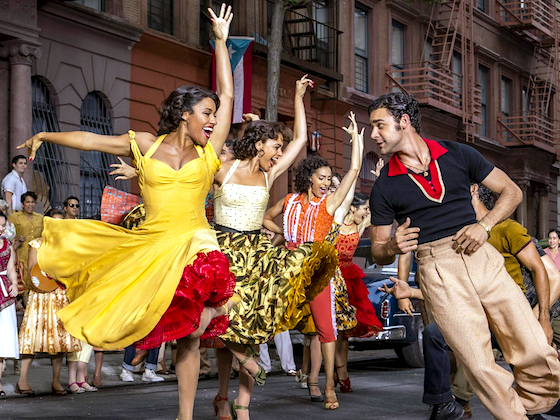
    Dance in the streets in America

    This added depth comes from the screenplay as much as the performances, which were great in the original but are fantastic here too. The Oscar-winning turn by Ariana DeBose as Anita is indeed the standout, but Rachel Zegler is perfectly sweet as Maria, and Rita Moreno thankfully has more to offer than just a tribute cameo in the Doc role. There was a lot of talk that Mike Faist was snubbed by awards for his Riff. He’s good, but doesn’t quite equal Russ Tambyln for me. The weak link is clearly Ansel Elgort as Tony. I had wondered if people were just saying that because of the allegations against him, but he’s not ideal for the role. That said, I do think he’s adequate, and the only reason to find his presence actively distasteful is if you can’t set aside the real-life stories.

    All these comparisons are inevitable, and it’s mostly in the eye of the beholder which individual aspect is better in which version; but I think it’s undeniable that Spielberg’s film looks more cinematic. It’s not just superior to the ’61 film, but a masterclass in itself: the lighting, the shot composition, the camera moves, the blocking; several songs are more excitingly staged than in the original, not least arguably the most famous, America. DoP Janusz Kaminski has been doing sterling work with Spielberg for decades now, so perhaps it’s easy to overlook just how talented they both are. In an era when mega-budgeted films increasingly look like TV shows that lean on green screen to scrape by, this is Cinema at its purest.

    Perhaps that’s why, overall, I prefer this version. Sure, the original is a classic, but Spielberg’s film is ultimately more cinematic (less stage-minded), less campy (though it doesn’t entirely ditch that aspect), and more modern, but appropriately so (with race-appropriate casting instead of awkward brownface). It’s perhaps proof that any remake can be worthwhile if done for the right reasons by the right people.

    5 out of 5

    West Side Story placed 7th on my list of The Best Films I Saw in 2022.

    April’s Failures

    I guess I could begin this months’ failures with the same film as last time: The Batman. It was still in cinemas for most of the month, but I still didn’t work out my schedule to see it. It’s now on “home premiere”, but I’ll be damned if I’m going to pay £16 to watch it once when I’ve already preordered the 4K Blu-ray for £30-odd. So, that’s one that’ll be getting watched in June, then.

    As for new releases at the cinema, there have been plenty worth a mention, but none that have actually dragged me out. Well, the likes of Sonic the Hedgehog 2 and The Bad Guys were never going to tempt me to spend cinema-level time and money, but I’m sure they’ll go on my watchlist once they hit a streamer I already pay for. Similar story with what looks like it’ll be the last of the Fantastic Beasts films (due to low box office), The Secrets of Dumbledore, although I’ll likely buy that one on disc to complete my collection. The nearest I’ve come to actually venturing out is Robert Eggers’ new one, The Northman, but obviously that didn’t happen either. There have also been strong notices for The Unbearable Weight of Massive Talent, which I was surprised to see screening at my local Odeon (I assumed it was an indie release that’d never make it near me). Other major releases that will go on the ‘some day’ watchlist included The Lost City (looks fun), Operation Mincemeat (should I watch The Man Who Never Was first?), and Downton Abbey: A New Era, I guess (I did watch the first movie, but haven’t seen the vast majority of the TV series, so how much do I care?)

    Original movies premiering on Netflix included Judd Apatow’s COVID/making of Jurassic World 3 spoof The Bubble, which looked fun but didn’t review well so I’d forgotten about until now, and Richard Linklater’s autobiographical animation Apollo 10½: A Space Age Childhood. But it’s Amazon who have the one that’s most likely to actually find its way to the top of my viewing pile: All the Old Knives, a weirdly meaningless title that hides a grownup spy thriller starring Thandiwe Newton and Chris Pine, amongst others. On Disney+, kid-friendly musical Better Nate Than Ever caught my eye with some solid reviews, but the trailer looks like, well, a live-action Disney movie for kids. I think it might be a Bit Much for my taste.

    MUBI again have the most noteworthy post-cinema streaming premiere, with Japanese Oscar winner Drive My Car. They had quite a bit to add to my watchlist this month, in fact, including The Souvenir: Part II (I’ve not seen Part I, but it’s coming back to MUBI tomorrow), Kumiko the Treasure Hunter, The Second Mother (a film that, frankly, I know nothing about, but is a staple of the middle of Letterboxd’s Top 250), The Turin Horse, and Showgirls. Yes, that Showgirls; though, based on its listed running time, I have concerns it might be cut. They’ve also got the documentary that delves into the film’s critical rehabilitation, You Don’t Nomi.

    Comfortably in second for such things was Sky Cinema, whose headliners included Dune (which I’ve seen, of course, but still not reviewed) and Venom: Let There Be Carnage (which I already own on disc). More pertinently for me, then, was Sopranos prequel The Many Saints of Newark. I’ve not seen all of The Sopranos — not even close — so do I leave the movie until the theoretical future date when I’ve finally watched the TV series, or, as it’s a prequel, do I just go ahead and watch it anyway? (I don’t have an answer. Don’t worry, I don’t expect you to either, dear reader.) Also, The Boss Baby 2. I enjoyed the first more than I expected, so maybe I’ll watch the second.

    I don’t think there was anything so new on iPlayer or All 4— I guess they’re hampered in such things by still essentially being TV catchup services — but that does make them more reliable for older stuff worth watching, some of which I’ve never otherwise heard of, like When Eight Bells Toll, a 1970s spy-fi action-thriller with Anthony Hopkins, which obviously sounds up my street. Also the documentary The Truffle Hunters, although reportedly the BBC version is cut for time. Shame.

    I don’t think Netflix or Amazon had any catalogue titles in the same league as any of those. I noted down a bunch of stuff for each, but it’s mostly watchlist filler I won’t get round to, or stuff I already own on disc and really should’ve watched. The one exception is Snake Eyes — not the Brian De Palma / Nic Cage thriller, but the G.I. Joe prequel starring possible-next-Bond Henry Golding. It’s the kind of weightless action movie I’ll bung on of a lazy evening someday. Speaking of which, Amazon also (re)added White House Down, which I’d like to rewatch sometime purely because it was quite fun. Whenever I see it pop up on streaming, I add it to my list for a rewatch; yet I’ve never felt any compulsion whatsoever to buy it on disc, despite my huge disc collection being full of total blind buys. Weird.

    And talking of blind buys, that’s what makes up the majority of my disc acquisitions this month. Well, I think it always does. Just one thing I bought this month is something I’ve watched before: the BFI’s 4K edition of The Proposition, a film I haven’t seen since the cinema but liked very much back then. That said, I did pick up Network’s bundle marking 50 years of The Persuaders, which included all eight of the films in HD — except the films were edited together from TV episodes, all of which I’ve seen, so… Also in the TV/film grey area (in that it was definitely a TV programme, but it was a one-off feature-length production, so do we count it as a TV movie nowadays or something?) is the BBC’s 1950s production of Nineteen Eighty-Four, which finally made it to disc from the BFI, years after they first tried to release it (I can’t remember when that was, but it was only scheduled for DVD back then).

    In the realm of things that are 100% definitely movies, the new Scream (that’d be the fifth Scream movie, sadly missing the opportunity to be called 5cream) is the only brand-new film entering my collection this month. Other new releases were catalogue titles, like Kino’s 4K release of In the Heat of the Night, which comes bundled with its two sequels on regular Blu-ray (did you know it had two sequels? I didn’t); or classic martial arts action from Eureka in the form of Yuen Woo-ping’s Dreadnaught and Sammo Hung’s Knockabout; or the grab-bag release Three Monster Tales of Sci-Fi Terror, featuring a trio of lesser-known entries from Universal’s cycle of horror movies in the ’40s and ’50s. And speaking of horror, that may be what Arrow is best known for releasing, but the only titles I bought from them this month were Rogue Cops and Racketeers, a small box set featuring a duo of poliziotteschi (crime/action films made in Italy in the ’70s), and 1990 neo-noir crime thriller King of New York, on sale in 4K.

    Finally for this month, Indicator had one of their rare sales, which I used to pick up a mixed bag of titles that were on offer and also recent releases I hadn’t yet bought. In the latter camp were early Mexican horror The Phantom of the Monastery and P.D. James adaptation An Unsuitable Job for a Woman, while the former included The Gorgon (originally from the first volume of their Hammer box set series), neo-noir erotic thriller Jagged Edge, and their lavish edition of a Peter Cushing flick I’d never heard of, Corruption. Based on the fact the limited edition hasn’t sold out, even after being subjected to massive price cuts (I paid just £10.99), I guess a lot of other people hadn’t heard of it either. What inspired Indicator to give it the box set treatment, I don’t know.

    That’s the Second Biggest Monthly Review of April 2022 I’ve Ever Seen!

    If you’re unfamiliar with the work of the once-formidable computer game developer LucasArts, you might think the title of this month’s review is setting up an almost-but-not-quite record-breaking affair. Not so, dear reader.

    As those au fait with the aforementioned studio’s venerable output are doubtless already aware, this month’s title is, rather, referencing a running gag from the Monkey Island games. That was prompted by the recent announcement that 2022 will see the release of a sixth game in the series. The Monkey Island games have been a big part of my life, ever since I played the original on our family’s first PC when I was about six years old, so I’m thrilled that we’re getting another. I’ve already begun replaying the preceding games in anticipation.

    None of which has anything to do with films, of course (except for the trivia that Steven Spielberg and ILM did nearly make a Monkey Island film once), other than that it’s taken away some of my film-viewing time. Consequently, the following has occurred…


    This month’s viewing towards my yearly challenge

    #26 Death on the Nile (2022) — New Film #4
    #27 Munich: The Edge of War (2021) — Wildcard #1
    #28 Encanto (2021) — Series Progression #2
    #29 The Father (2020) — Rewatch #4
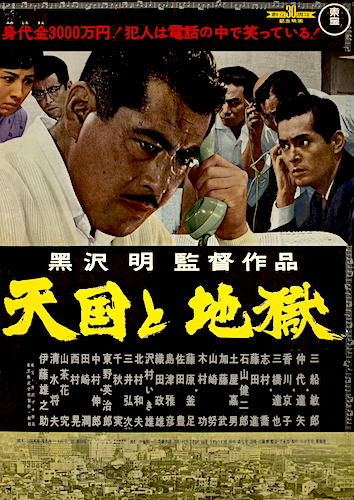
    #30 High and Low (1963) — Blindspot #4


    • I watched 11 feature films I’d never seen before in April.
    • Just four of them counted towards my 100 Films in a Year Challenge, along with one rewatch.
    • That means I’ve fallen behind schedule for the first time this year — I should’ve reached #33 to be on track to hit #100 in December at a steady pace.
    • I’m not too worried, though. This month, for example, I watched seven films that didn’t count towards the challenge, so there’s plenty of leeway to watch more challenge-compliant films in the future.
    • Nonetheless, I deployed my first ‘wildcard’ in April, counting Munich: The Edge of War as a second 2022-released film watched this month. It’s a nice category to be able to use a wildcard in… but now that I’ve done it once, I can’t do it again. Them’s the rules.
    • In case you weren’t sure, the series Encanto progresses is the Disney Animated Canon (or Animated Classics, or whatever else you want to call it — the official name has varied over time). It’s not the ‘next’ entry I need to see in that series, but that’s okay, because it’s one of the few I’m making my way through in any old order.
    • This month’s Blindspot film saw the great Akira Kurosawa in a Hitchcockian mode for kidnap thriller cum social drama High and Low.
    • This month’s WDYMYHS film didn’t happen in the end, leaving me with one to catchup — next month, hopefully.
    • From last month’s “failures” I watched Death on the Nile and Fast & Furious 9.


    The 83rd Monthly Arbitrary Awards

    Favourite Film of the Month
    Aside from the films listed above, my viewing this month included such acclaimed and/or popular recent releases as Spider-Man: No Way Home and Best Picture Oscar winner CODA. But, while they were good isn their own ways, probably the best film I saw was a classic: Akira Kurosawa’s High and Low.

    Least Favourite Film of the Month
    Nothing truly terrible this month, but Fast & Furious 9 finally burst that franchise’s bubble, for me. Those films have been ridiculous but fun for about half the series’ run now, but I thought F9 tipped the balance too far — it was more ridiculous than ever, but it was no longer fun.

    Most Unfortunate Casting That Didn’t Happen of the Month
    Withnail & I is one of those films I’ve been meaning to watch forever but never quite cared enough to make the effort to get round to, until this month. Then, entirely by coincidence, I later happened to see on Twitter this bit of trivia: apparently, early in the development of Sherlock, creator(s) Steven Moffat and/or Mark Gatiss mentioned to Paul McGann that they were considering casting him as Watson with Richard E. Grant as Holmes. Now, obviously they’re Withnail & I personas wouldn’t be right for those roles, but they’re both much more versatile actors than that. As great as I think Benedict Cumberbatch and Martin Freeman were, a film/series with Richard E. Grant as Sherlock Holmes and Paul McGann as Dr Watson is something I now feel we’ve been robbed of.

    Most Pointless Extra-Textual Question of the Month
    When the trailer for Death in the Nile came out, one line from it went semi-viral: “we have enough champagne to fill the Nile!” Of course, the character is being metaphorical: no one thinks they actually have that much champagne; she just means they have a lot. But, as I said, the line went viral, and therefor you can find multiple articles that tried to answer the question, how much champagne would it take to fill the Nile? The answer? It’s complicated. And, really, for such a fundamentally pointless question (no one’s going to try to do it for real), does any answer closer than that matter?

    The Audience Award for Most-Viewed New Post of the Month
    Just three posts compete for this honour, once again (hopefully May will be when I finally get back on top of that), and the winner is the one with actual reviews to read: 2022 Weeks 9–11.


    Every review posted this month, including new titles and the Archive 5


    I’m going to try to get both my challenge viewing and my general reviewing back on track. We’ll see how that goes…

    2022 | Weeks 9–11

    Right, let’s try (again) to get things back on track.

    These compilations were/are meant to keep my reviewing roughly up-to-date with my viewing, but I don’t think stuffing them with too many films at once is the right way to go. I don’t know about anyone else, but I feel like five or six per post is about right (with some leeway, of course — I’m sure four or seven would be fine too). However, dividing like that means getting out of sync with Real Life, so I suppose I should clarify when “weeks 9–11” were: Monday February 28th to Sunday 20th March, to be precise. And back then, I watched…

  • Tintin and the Temple of the Sun (1969), aka Tintin et le temple du soleil
  • Los Olvidados (1950), aka The Young and the Damned
  • The Very Excellent Mr. Dundee (2020)
  • The King’s Man (2021)
  • Dirty Rotten Scoundrels (1988)
  • Nothing Like a Dame (2018)


    Tintin and the Temple of the Sun

    (1969)

    aka Tintin et le temple du soleil / The Adventures of Tintin: The Prisoners of the Sun

    Eddie Lateste* | 75 mins | DVD | 4:3 | Belgium & France / English | U

    Tintin and the Temple of the Sun

    This fourth big-screen outing for the Belgian reporter also continues the popular TV series, Hergé’s Adventures of Tintin, made by Belgian studio Belvision from 1957 to 1962. Having adapted ten of Hergé’s volumes for TV, here they tackled two more: two-parter The Seven Crystal Balls and Prisoners of the Sun. The story sees Tintin and chums head to Peru on the trail of their kidnapped friend, Professor Calculus, and to investigate an Incan curse that has befallen a previous party of archaeologists.

    Trekking up mountains and through jungles, with nefarious agents in pursuit, plus all the to-do with ancient curses and whatnot, this is chock-a-block with good old “Boy’s Own Adventure” stuff. As with so many of those, the joy lies in being swept along with the adventure rather than thinking about it too hard (our heroes are saved at the end because the Captain happens to have a scrap of newspaper that Snowy happens to steal that Tintin happens to fancy having a look at that happens to mention a handy forthcoming event). By the same token, there’s also the unavoidable effects of time: some of it feels a teensy bit racist nowadays; Tintin makes his way through the jungle merrily murdering animals left, right and centre. The animation itself is fine, with designs and an overall visual style that emulate Hergé well, but it does have a certain TV-ness.

    It’s also not available in the greatest of copies, at least to English-language viewers. Reportedly the original version contains two songs, both of which were cut from the UK video release, but only one of which has been restored for the DVD (and, I presume, the version currently available to stream from Apple, etc). Although most of the film is dubbed, the song is in the original French, unsubtitled; and has clearly been edited, because there are digital freeze frames around it. At the start of the film, the title card has been replaced in a similarly awkward fashion. Then there’s the 5.1 remix, which seems to be missing some effects and music cues. You can still enjoy the majority of the film despite these distractions, but it’s disappointing that we still have to put up with such palaver nowadays.

    3 out of 5

    Tintin and the Temple of the Sun is the 19th film in my 100 Films in a Year Challenge 2022.

    * Many (but not all) online sources list Lateste as the director, including IMDb, but the film itself doesn’t actually credit him — the only director-like credit is for “Belvision”. Lateste is credited as one of the screenwriters, at least. ^


    Los Olvidados

    (1950)

    aka The Young and the Damned

    Luis Buñuel | 81 mins | digital (HD) | 1.37:1 | Mexico / Spanish | 12

    Los Olvidados

    Combine the literal translation of the film’s title — The Forgotten Ones — with the US retitling — The Young and the Damned — and you build a sense of what Los Olvidados (as it’s been released in the UK) is about. To be clearly, it’s a socially-realist depiction of life for children in the slums of Mexico City. Although initially condemned (according to IMDb, it only played for three days in Mexico before the “enraged reactions” of the press, government, and upper- and middle-class audiences caused it to be pulled), it’s since been reevaluated as one of the greats of Latin American cinema. Certainly, watching it after films like The 400 Blows (made almost a decade later), City of God (over 50 years later), and Capernaum (almost 70 years later), its influence is felt.

    The downside to that is the film feels somewhat less fresh and more worthy than the later efforts. It’s got an overt anti-poverty message that is admirable but sometimes heavy-handed (a school principal character feels like he’s been inserted just to state the film’s thesis out loud) or naïvely optimistic (the opening voiceover asserts that child poverty will ultimately be solved by progress. Over 70 years later, I don’t think progress is doing a great job…) While much of the movie works at its intended goal, when aspects like these intrude it stops feeling like a realistic depiction of poverty and more like a straightforward polemic about how it should be fixed. On the bright side, it avoids the lure of a pat happy ending — although one was actually discovered in 2002, apparently shot to appease Mexican censors. Clearly they managed to get the film released without having to cave on that point, and it’s better for it.

    4 out of 5

    Los Olvidados is the 20th film in my 100 Films in a Year Challenge 2022. It was viewed as part of Blindspot 2022.


    The Very Excellent Mr. Dundee

    (2020)

    Dean Murphy | 88 mins | digital (HD) | 2.35:1 | Australia & USA / English | 12 / PG-13

    The Very Excellent Mr. Dundee

    Not a fourth Crocodile Dundee film, but rather a depiction of the accidentally-chaotic life of that series’ leading man, Paul Hogan, the archetypal Aussie now living in LA and, reaching his 80s, somewhat bemused by the modern world.

    Even from that quick summary, you can tell it’s not a terribly original premise. Couple that with a clearly small budget and you have a recipe for many dismissing the film out of hand. Personally, I found it to be surprisingly enjoyable, in a laidback, undemanding way. None of it is properly hilarious (though a bizarre musical sequence comes close), but it’s kinda amiable, and almost heartwarming at the end. Discerning viewers should perhaps not apply, but if you have any affection for the second or third Crocodile Dundee films (again, widely maligned instalments that I found passably entertaining), this is worth a punt.

    3 out of 5


    The King’s Man

    (2021)

    Matthew Vaughn | 131 mins | Blu-ray (UHD) | 2.39:1 | UK & USA / English | 15 / R

    The King's Man

    Co-writer/director Matthew Vaughn expands the Kingsman universe with this World War I-era prequel that delves into the backstory of how the eponymous organisation was founded. Unlike so many prequels, this does feel like a story worth telling — we don’t necessarily need it, but it’s not merely an exercise in visualising events we’ve already been told, or coming up with over-elaborate reasons for people’s names or whatever (why couldn’t Han Solo’s birth name have just been Han Solo, hm?)

    The story begins with Europe on the brink of war, and our heroes — led by the Duke of Oxford (Ralph Fiennes) — attempting to stop it. History tells us they fail, and so the narrative unfurls across WWI as they try to bring it to a close. That will see them come up against the manipulations of Rasputin (Rhys Ifans), who’s part of a secret organisation plotting to bring down the great empires.

    Let’s cut to the chase: the Kingsman films have a rep for elaborate fight scenes set to pop music. One of the major villains is Rasputin. You only need a passing familiarity with the disco hits of the ’70s to know what I was looking forward to here. Well, it doesn’t happen. Indeed, that stylistic calling card is more or less entirely abandoned (the fight does happen, of course, but it’s set to Tchaikovsky’s 1812 Overture — kind of like era-appropriate ‘pop’ music, I guess?) Apparently Vaughn did originally intend the sequence to be set to an orchestral version of the song in question, but ultimately felt it didn’t work.

    This, perhaps, speaks to another concern I had going in, which was that Kingsman’s highly irreverent, almost satirical tone might clash with the all-too-real WWI setting. Such an historical tragedy doesn’t feel right to be made light of in that way, even over a century later. So, as if to compensate, Vaughn and co have toned down the humour, making The King’s Man fairly serious… but without fully sacrificing the near-whimsy at other times, because, well, it’s part of the franchise. The result is a little awkward, tonally, swinging back and forth between historical seriousness and franchise-establishing fun. Put another way, it’s hamstrung by being an entry in a series known for its irreverence that feels the need to show due reverence to WWI. That’s a clash of values it struggles with, some might say admirably, but can’t quite reconcile. In short, it’s too serious to be a Kingsman film, but too Kingsman-y to be a standalone WWI-set action-adventure.

    I wouldn’t say it’s a disaster, by any means — but then, I enjoyed The Golden Circle when many lambasted it, so make of that what you will. Nonetheless, I’m looking forward to the next film getting back to Eggsy & co in the present day.

    3 out of 5


    Dirty Rotten Scoundrels

    (1988)

    Frank Oz | 110 mins | digital (HD) | 1.85:1 | USA / English | PG / PG

    Dirty Rotten Scoundrels

    Michael Caine and Steve Martin star as a couple of chalk-and-cheese con men, pilfering the fortunes of wealthy single ladies on the French Riviera, in this fun con caper with a neat sting in its tail.

    Caine hits just the right note as a charming con artist, his manner inspired by David Niven, who played the role in the original, 1964’s Bedtime Story. I was unaware the film was a remake until after watching it, though I did know it was itself subject to a gender-bent do-over in 2019, The Hustle. I don’t know how similar Bedtime Story and Dirty Rotten Scoundrels are, but, based on its trailer, The Hustle seems to be a direct lift from this, albeit peppered with the kind of pratfalling that’s de rigueur in modern big screen comedy.

    Marlon Brando was Niven’s co-lead, whereas here Caine gets Steve Martin as the very embodiment of a brash American — a little too brash, if anything, though reportedly there were bits he actually reined in. The running time could have done with a similar consideration, because it’s a little long for its breezy premise and tone (running 110 minutes, it would be better nearer 90), but that’s a minor complaint — it rarely feels too slow or draggy, just a little long overall.

    4 out of 5

    Dirty Rotten Scoundrels is the 21st film in my 100 Films in a Year Challenge 2022.


    Nothing Like a Dame

    (2018)

    aka Tea with the Dames

    Roger Michell | 77 mins | digital (HD) | 16:9 | UK / English | 12

    Nothing Like a Dame

    Four thespian friends, Dames all — Eileen Atkins, Judi Dench, Joan Plowright, and Maggie Smith — gather for a natter about their careers and lives. That’s it, that’s the film.

    Given the setup, plus the style of advertising and US retitle, you’d be forgiven for expecting a gentle bit of fluff; eavesdropping on a pleasant chinwag with four venerable British actresses. The film is that, in places, but it also has a surprising undercurrent of sadness running throughout, as these ageing ladies reflect on the ups and downs of their careers and personal lives now that they’re (shall we say) closer to the end than the beginning. It rarely bubbles to the surface, but it always feels like it’s there, somehow inescapable.

    If that gives proceedings more texture than you might’ve expected, then the film’s biggest flaw lies elsewhere. For me, it’s that it wasn’t long enough. The conversations are often delightful and occasionally insightful, but you feel like there’s so much more to be gleaned from these women. The film chops about between topics and pairings, always feeling like we’re getting snippets of the full conversation, never the true depth; like we’re watching a highlights reel of what should be a three-hour series, or something like that. I know it’s an old theatrical adage to “leave ’em wanting more”, but I really did want some more.

    4 out of 5