

George A. Romero | 101 mins | Blu-ray | 1.78:1 | USA / English | 18
 Threequels, eh — who’d make ’em? It used to be received wisdom that sequels were poor, with only a few exceptions. That’s less often the case these days — indeed, it’s almost de rigueur that the first film in a potential franchise will exist to establish the world in preparation for a superior sequel. But how many great third films are there? There are some good ones, it’s true, but are there any that are the best film in their series? If there are, they’re certainly outweighed by the number that couldn’t live up to the quality of the two preceding parts.
Day of the Dead has its fans (including director George Romero, who has said this is his favourite of the ‘Dead’ films); but the impression I’ve always gotten is that, while not regarded as a bad film, it’s seen as the weakest of Romero’s original ‘Trilogy of the Dead’. Whereas Night was a taught, socially-conscious horror-thriller, and Dawn an epic, socially-conscious character drama, Day feels like it’s the kind of quotable gore-filled cult-friendly B-movie the series is often perceived as (and, in fairness, is taken as by some of its less brain-engaged fans). Of course, that’s not true: this is a George Romero movie — the subtext is definitely still there.
Here, Romero sets his sights firmly on the military mindset. Criticism of weapons fetishism isn’t something new to the series — indeed, there’s an element of it in both the preceding films — but here he specifically takes on the military, a recurrent theme in 1980s cinema: this is the era of films like Rambo: First Blood Part II, Rambo III, Predator, and other less well-remembered films in which a one-man-army (importantly, a one man American army) takes on some less-friendly locals on the other side of the globe and shows them who’s boss. As ever, Romero doesn’t tackle this head on. His methodology, it would seem, is to create a situation, put in elements (be they political, social, etc), and let it play out. The resultant work is driven by the story of the situation, the criticisms or analysis becoming subtle and secondary.
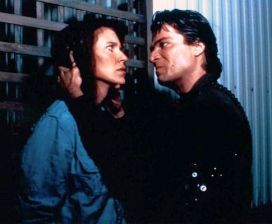 The same is true in Day’s criticism of science, especially vivisection. According to Romero (in the booklet that accompanies Arrow’s Blu-ray), he didn’t set out specifically to tackle that controversial area of scientific research. Instead, he developed a “next logical step” for what scientists would do to the undead. Of course, it’s horrific and criticism is implicit. Thankfully, Romero isn’t painting all science as bad: the lead character, our de facto hero, is also a scientist; but she’s not really interested in the vile work of her colleague, dubbed ‘Frankenstein’ by the soldiers.
It has been said that Day is the darkest and most nihilistic of all Romero’s films, lacking the humour that played such a significant role in Dawn. It’s not as if Night was rolling in laughs, but in the end the humans won (or seemed to), and there are no villains — characters conflict, but their motives are all understandable. Whoever you might side with, you can understand the other person’s perspective. The same is true of Dawn, even with those bikers. But Day has a clear-cut villain: the base’s new commander, Captain Rhodes, a power-mad borderline-caricature of small man syndrome. This is where that B-movie thing comes in: he’s eminently quotable, but he’s also thoroughly unlikeable. His men all fall into the same bracket, whatever effort the actors may have intended to humanise them.
The real development here, in terms of the zombie mythology, is that the creatures are beginning to learn and develop. Central to this is Bub, who doesn’t seem to crave flesh, imitates shaving, listens to music, and almost manages to talk. There’s a parallel with how monkeys have been kept captive for similar experimentation, and again of an unthinking military mindset:  Bub salutes the Captain, an instinctive reaction the same as his shaving. That it leads to an ironic repetition at the film’s climax is perhaps satire, or perhaps just another cool moment. You have to hand it to Romero and co, though: it’s a great villain’s death scene.
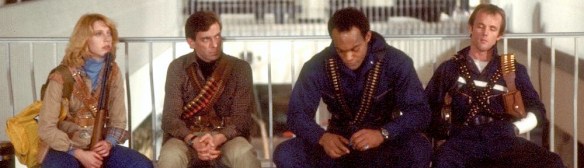
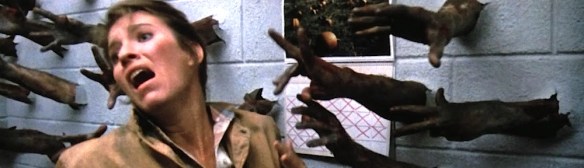
Indeed, the special effects throughout are the finest the series has to offer. After the hit-and-miss work on Dead, the zombie make-up here is right on, especially Bub. The flesh-ripping finale is the most gruesome yet, but so over-the-top as to become comical — which, again, has been Romero’s intention all along. The location work looks great, too. Filming in a real underground storage facility lends a quality that you’d never get from studio sets, with huge empty rooms, the small band of soldiers and scientists huddled around the edges or needlessly sprawled across spaces.
For me, the main problem with Day is it feels like a bit of a rehash, thematically. Humans are the biggest enemy? That’s been touched on in both previous films. It’s at its most central here, with the base’s military contingent and scientific team clashing from the off, but it’s also at its most blatant. The characters are B-movie archetypes through-and-through, from the Villain to the Henchman, the Mad Scientist to the Wise Ethnic Guy, rather than the more rounded characters that even Night offered. Similarly, Romero punishes or rewards them in a straightforward fashion: everyone dies except for the likeable handful, who get to escape to tropical paradise — away from the epidemic forever!
 There’s probably an in-depth piece to be written on the evolving gender politics of the ‘Dead’ films, which I’m sure must reflect changes in society. Here, we have an unequivocal female lead, a scientist and voice of reason amongst the madness of both sides. She stands up for herself against the men, who belittle her as much as possible. Actress Lori Cardille has commented that she wanted to develop the woman’s role in these films, even beyond that of Fran in Dawn, who she saw as little more involved than the useless females of Night. Of course, as I noted last time, the role of Fran is considerably more involved and competent than that of Barbra or Judy, so it’s interesting that Cardille felt there was work still to be done. Not that she’s necessarily wrong; and the way the men treat her character in Day suggests that someone having a similar reflection on this film, nearly 30 years on, would find room for continued improvement.
I find it hard to disagree with the consensus on Day’s status within Romero’s initial trilogy. It’s not that there aren’t good things in there, both thematically and on more basic entertainment levels, but it feels like less of a cohesive whole than either of the previous films. Although it develops the mythology (as well as the more intelligent zombies, this is the first time we have no sign of what’s going on in the outside world: power is out in most of the US so there’s no long-range radio or TV for further reports; these people are isolated — again, adding to that nihilistic world view mentioned earlier), there’s a slight sense of it going in circles, thematically. Maybe that’s a tad harsh, especially as I wouldn’t disagree with 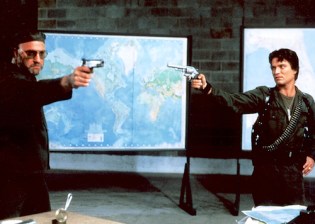 Romero’s critical stance evidenced here. I don’t even object to it being a bleak film, with little sense of hope for the future of humanity; in fact, there’s a lot to commend in that.
Put plainly, Day is certainly a good film, rewarding in several different ways. It just isn’t as good as the predecessors it inevitably butts up against.

Part of Week of the Living Dead for Halloween 2013.
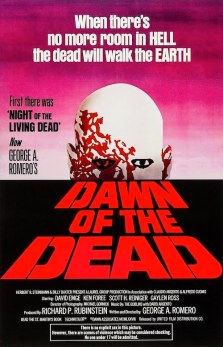 Dawn of the Dead is the
 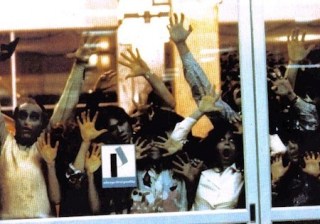 Romero has said he considers his zombie movies to be about the time they were made; a little snapshot of the world (or the US, at least) at the time. Thus consumerism is only one of Dawn’s targets, albeit the easiest to spot. Romero was ahead of his time here: gigantic out-of-town malls of this type were, apparently, new propositions at the time the film was made, and the one that stars here was amongst the country’s largest (it still exists, I believe, but now it’s considered a little’un). It’s not just the zombies who are critiqued either. Our protagonists choose to stay in the mall because it apparently has everything they could ever need, even though it also has the constant threat of the undead. On their first trip out for supplies, they’re as interested in expensive watches as food and tools. As time goes on it only gets worse: they turn their little attic apartment bit into a chic pad, with stylish chairs and all the mod-cons. In a world where the apocalypse has happened, they’re not fighting for their very survival, they’re living the high life. They even ‘rob’ the mall’s bank, “just in case” money is still worth something.
 The men, meanwhile, help shape a commentary on society’s desensitisation to violence. There’s disgust early on at having to shoot these human-like creatures in the head to get rid of them, but so unrelenting is such a task that it becomes everyday. This and the consumerism thread come together in the final act, when a gang of bikers invade the mall: declaring that the place is their possession, one of our ‘heroes’ has become so used to killing the living dead that he now has no trouble opening fire on the plain ol’ living.
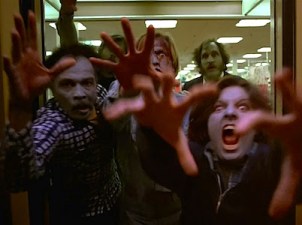 I also don’t hold much truck with that “the effects are bad” waffle. I mean, really, what do you expect? The film’s 35 years old! And y’know what, it’s not that bad. OK, the zombie’s skin tone is a little blatant — special effects maestro Tom Savini has said he was aiming for grey but it registered as rather blue on film. Then the blood is a vibrant red — well, loads of older films have that garish red blood, what of it? In fact, it was specifically requested by Romero, who wanted a comic-book-y colour to match what he saw as a comic-book tone to the violence. Then there’s all the flesh-eating gore, which is by turns heightened to the point of silliness and gorily realistic — the stuff with the guts towards the end… Savini was a war photographer in Vietnam and that in part inspired his effects work. You want to argue with a guy who’s seen the real thing that his work doesn’t look as ‘realistic’ as some post-millennial computer nerd’s hyper-CG version of things?
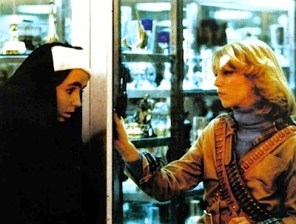 I have to say, the more I think and write about Dawn, the more I come to like it. It’s not really perfect — the biker climax comes almost out of nowhere, and I’m not convinced they were the most effective way to explore an ending. Perhaps this is where the “snapshot of the times” idea begins to fall down: distanced from the time in question, how resonant are those themes? Is that why modern viewers, coming to the film for the first time, miss them? (That’s not to discount the fact that most modern genre film viewers aren’t looking for grown-up viewing, but kids’ movie-style brightly-coloured action — with added gore and swearing to prove it’s actually for adults, despite the lack of adult thought or consideration required. Ironically, these once-B-movie cheap horror/thrillers are now, thanks to their political undertones, more suited to the art house crowd. I see why so many venerate ’70s cinema.) But (to get back to this paragraph’s point) there’s so much in Dawn, so much more than either a zombie kill-fest or a criticism of consumerism, that thoughtful reflection — and, I’m sure, future re-watches — are only to its benefit.
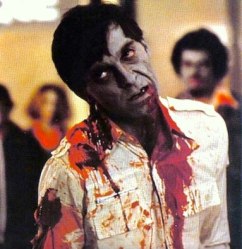 Immediately after viewing, I’d say I didn’t like Dawn as much as Night. Though it has many qualities I admire, it also felt a little less focused and more sprawling. The first I found tense and chilling — a Horror movie, albeit one with observable dramatic and thriller-ish elements. Dawn is, at heart, a Drama — it’s about the people in this situation, that situation happening to be an extreme horror one. But on reflection, the bits I was less sure of pale behind the things it does right.
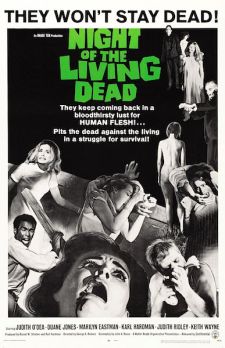
 (see
(see 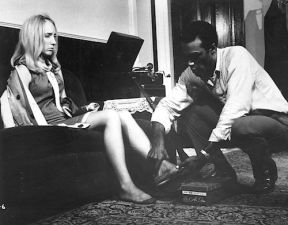 while the men are capable and get on with things. Poppycock. Barbra is clearly in shock and, even more so, traumatised. It’s a great performance by Judith O’Dea in that regard, thoroughly believable as to how someone with such damage to their mental health might behave. Far from being the weakest or most irritating character, I think she’s the most fascinating, especially when you add in her final reaction.
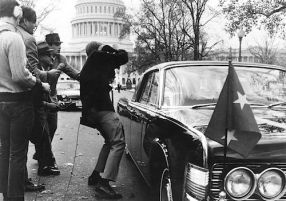 and suddenly you’ve got dozens of men with guns setting up posses, and then military officials apparently in Washington D.C., being hounded by the press; and then our heroes attempt to escape and there’s bombs and shooting and fire and explosions! You become unsure of where it might go next, and that’s never a bad thing.
 That may not be to the taste of the gore-hounds that the horror genre can attract (particularly zombie movies, with all their flesh-ripping), but it does make it of more merit to a wider film-fan audience.
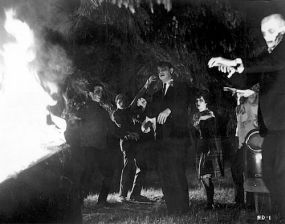 After nearly five decades, numerous sequels, innumerable remakes, rip-offs, and films just plain influenced by it, you’d expect a low-budget shocker to have gone stale. The most remarkable thing about Night of the Living Dead, then, is just how well it holds up. It still feels fresh, with a story and style that seem as if it could have been made yesterday, only the fashions and film stock letting us in on its ’60s origins.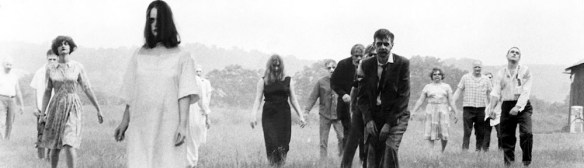

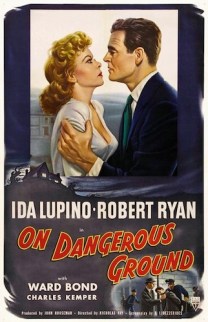 Helmed by acclaimed director Nicholas Ray (
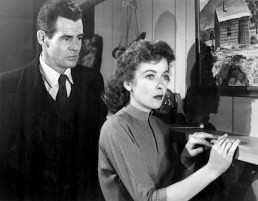 On the plus side, Bernard Herrmann’s score is unequivocally excellent, particularly the pulsating opening theme and the insistent action climax.
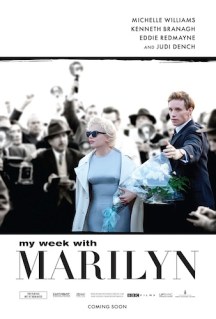 1956: global superstar Marilyn Monroe (Michelle Williams) comes to England to star opposite Laurence Olivier (Kenneth Branagh) in his latest directorial effort,
 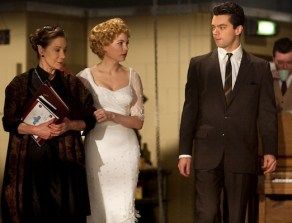 The supporting cast is a veritable who’s who of recognisable British faces, stars of screens both big and small. Barely a speaking part goes by without an actor you’re certain to recognise. I’d list them but, honestly, there are far, far too many. Despite Marilyn coming with a hefty entourage, Williams is the only American in the cast, meaning American accents are lumbered (to varying degrees of success) upon Zoe Wanamaker, Toby Jones, Dougray Scott, and Dominic Cooper. Hey, of course Dominic Cooper’s in it — is it even legal to make a mid-budget British movie without him now?
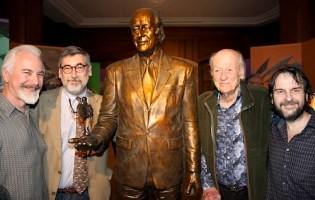
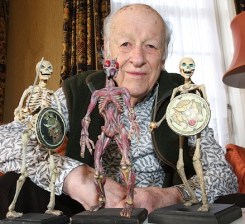
 If you don’t know that name then you must be a young whippersnapper, because otherwise Ray Harryhausen needs no introduction.
 Sometimes they’re a bit jerky, maybe, and the inevitable issues of scale show they’re models fighting or interacting with actors on set… but for all that they’re still not significantly less realistic than so many modern computer-based techniques, and they carry a charm and obvious level of skill that said renderings usually lack.
 One thing I always wonder about ‘specialist’ documentaries is, do they have crossover appeal? Will someone with no interest in Harryhausen, or even in Cinema, get something out of this? Probably not, I guess. But that’s not a bad thing per se, because this is an informative overview of a man’s influential body of work that deserves all the appreciation it can muster. Even if, like me, you’re not that familiar with said work, this is a film that will show you why you should be.
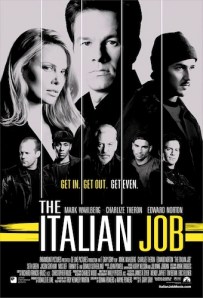 This came in for quite a bit of stick on release — how dare they re-make a British classic, etc etc. It didn’t help matters that one of the stars, Edward Norton, was apparently forced to appear against his will as part of his contract with the studio.
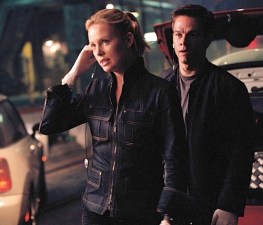 and while Edward Norton’s performance is hardly remarkable, it doesn’t smack too much of being phoned in.
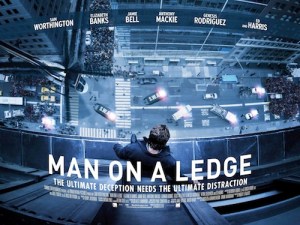 A man books into a swish hotel, has a nice meal, then climbs out the window. Onlookers and police gather. Will he jump? Or is he just a distraction?
 The island town of Swallow Falls exists for one purpose: sardines; the fishing, packing, and distribution thereof. But when the world suddenly realises that sardines are gross, the town’s economy is left in tatters and the only foodstuff the islanders have is sardines. (While we’re on the glum bit, the location of Swallow Falls is identical to the real-world location of Bermuda, except in this reality almost every inhabitant is Caucasian and the island is indisputably part of the US. This is why you don’t scrutinise the geopolitics of kids’ movies, especially American ones.)
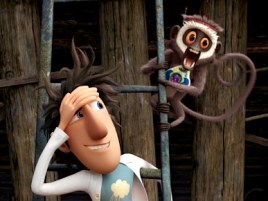 not an unworthy aim, and something Cloudy also achieves, but not a main consideration in my personal assessment of things. The main selling point is that it’s very funny. Of course there’s the slapstick cartoon humour, which is well done, but there’s also a lot of great one-liners, random asides, and the like. Not ‘adult jokes’ by any means, but I think it makes the film fun for grown-ups too.
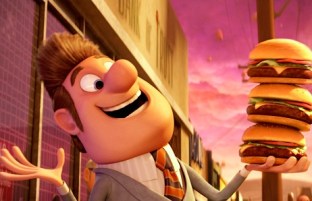 He’s a very funny character, but that’s in the writing, directing and animation — the voice work is spectacularly minimal. Apparently Harris was offered the lead but turned it down for the “more interesting” part of Steve. Nothing against Hader, but if I were the directors I’d have tried to persuade him to do both.
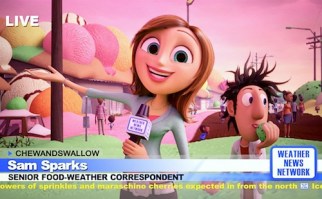 I should probably learn to stop writing off non-Pixar animated movies so readily (and, based on what I’ve heard and seen of their last few efforts, maybe slacken off on the Pixar love. I say that as if it’s news — plenty of people already have; and I’ve never been wholly on that bandwagon anyway. But I digress…) Big, bold, colourful, funny and exciting, Cloudy with a Chance of Meatballs is the kind of film I imagine a lot of kids love and watch on loop. In the process they may even be learning some Important Moral Lessons, which, crucially, aren’t too heavy-handed. Many of these aspects work for adults too. I don’t know if you’d want to watch it on loop, but you may certainly want to watch it again.
