Archive 5, Vol.8

I have a(n insanely huge) backlog of 533 unreviewed feature films from my 2018 to 2023 viewing (not to mention the 77 shorts, but they’re a problem for another day). This is where I give those films their day, five at a time, selected by a random number generator.

Today, it’s killers galore with Korean zombies, comical hitmen, rampaging security robots, and plain ol’ murderers. Plus, dying of boredom in Saturday detention.

This week’s Archive 5 are…

  • One Cut of the Dead (2017)
  • The Breakfast Club (1985)
  • Chopping Mall (1986)
  • Dead Man’s Folly (1986)
  • Wild Target (2010)


    One Cut of the Dead

    (2017)

    aka Kamera o tomeru na!

    Shinichiro Ueda | 96 mins | Blu-ray | 16:9 | Japan / Japanese | 15
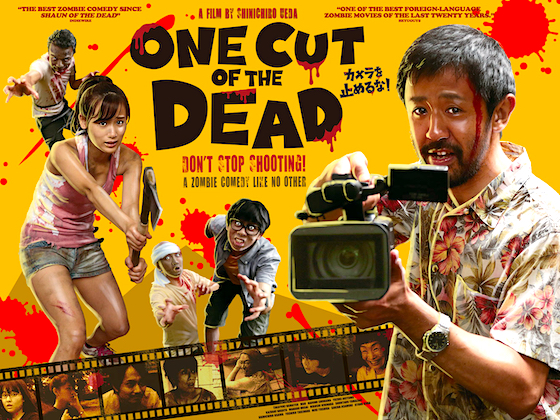
    One Cut of the Dead

    You know, it’s not just my reviews that are tardy: I bought this because it was hyped up, both as “good” and as “see it knowing as little as possible”, and it went on my “must watch soon” pile… where it sat for 14 months. And that’s far from the most egregious example of “ooh, I must get round to that” equally a long, long delay.

    Now, it’s taken me another 46 months to write this review. Eesh. On the bright side, perhaps I shouldn’t be so worried about spoilers anymore. I mean, if you’ve not seen it by now, whose fault is that? And it definitely is the kind of film where the less you know the better, because it’s going to pull the rug out from under you. Of course, even knowing that means you’re on the lookout for what’s going to happen; and the film gives you a helping hand, because right from the off there are nods to the conceit. Still, I’ll try to be fairly vague.

    It’s a film of three parts. The first is, with hindsight, an establisher; setup and groundwork for what comes next. Alternatively, some genre fans will take that as the purpose of the movie, and what follows as extraneous. Then there’s a long, slow middle section. Again, no direct spoilers, but we know where this part of the narrative ends up, so it feels like it’s over-expounding stuff (we don’t need as much backstory as we get) and consequently goes on a bit. Halfway through, I began to wonder what all the fuss was about. I worried that I’d left it too long to see it and let the hype get the better of me.

    But, ultimately, it’s all setup for the final half-hour, and it pays off in hilarity. The middle could still do with a trim, but it’s worth sticking with for the payoff.

    4 out of 5

    One Cut of the Dead was #54 in my 100 Films in a Year Challenge 2020.


    The Breakfast Club

    (1985)

    John Hughes | 97 mins | Blu-ray | 1.85:1 | USA / English | 15 / R
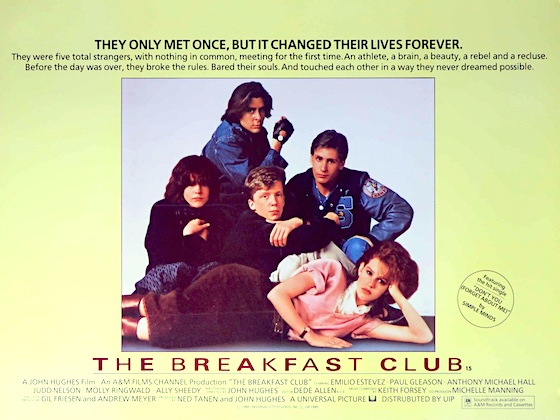
    The Breakfast Club

    Is The Breakfast Club the definitive ’80s high school movie? It’s got to be on the shortlist, right? Personally, I preferred Heathers, or, if you want to stay within the John Hughes universe, Ferris Bueller, but that doesn’t mean this is without its qualities.

    If you’re unfamiliar, it’s about a gaggle of misfits in Saturday detention. Over the course of the day, the unlikely group form a bond — well, there’s a surprise. One thing I did like about that: even after they’ve become ‘friends’, the slightest thing can still set off their animosity to one another. They’ve not really changed and it’s a fragile allegiance. The stuff about how they’d never talk to each other in real life after this rings true. So, I don’t want to come down too heavily in the region of the idea that the film might be clichéd. I’ve read other modern reviews criticise it for that, and you have to wonder: when you’re writing about a popular movie 35 years after it came out, was the film clichéd or did it create the clichés? That said, my favourite observation in this sphere was: “if this is cliché, then life is too.” Oh boy is that a sentiment I agree with about so many fictions that are deemed “cliché”.

    That said, I guess we’re beyond the film’s era of influence now. I mean, if you made something like this today, it would probably be an arthouse-aimed indie production (in fairness, the original is also an indie), probably produced for a similar (or lower) budget than it was almost 40 years ago; and it would be adored and analysed by 30- and 40-something-year-old cineastes while actual teenagers were at the multiplex watching MCU XXIV. (You can tell I wrote these notes four years ago, because I would not now suggest the latest MCU release as a default popular success.)

    On the other hand, I know we all look down on remakes, but if you’re going to remake any popular film, this is the kind of thing that would withstand it. It’s so much about its era that if you took the basic concept and remixed it for the 2020s, there are a several interesting avenues to be explored. I’m sure cliques still exist in American high schools (based on media depictions, they never seem to go away), so you’d still get the contrasting personalities; and you could shift the sexual dynamics, the way different groups view each other, and sort out the ending (the way certain characters are ‘fixed’ is very of its time, and not in a good way); and put a modern spin on it all, of course, with some race and LGBT points. You know, make it “woke”, as dickheads say. That would be a pretty different film, but that’s entirely the point: if you’re going to remake something, make it different, make it new. (To be clear, I’m not criticising the original film for not including those elements — it’s a product of its time and it’s not choosing to be about those things, which is entirely valid.)

    I appreciate I’ve talked more about what the film could be today than what it is. Oops. But, look, this is the kind of film where I can’t remember any of the characters’ names — if I wanted to talk in specifics, I’d have to refer to them by their actors (or do a bit of googling, of course). That’s another way of saying I did like it, but it’s not a film that’s stuck with me in the way it has for its many fans.

    4 out of 5

    The Breakfast Club was #56 in my 100 Films in a Year Challenge 2020. It was viewed as an additional film in my Blindspot 2020 project, after I failed to watch it for Blindspot 2019.


    Chopping Mall

    (1986)

    Jim Wynorski | 76 mins | digital (HD) | 16:9 | USA / English | 18 / R
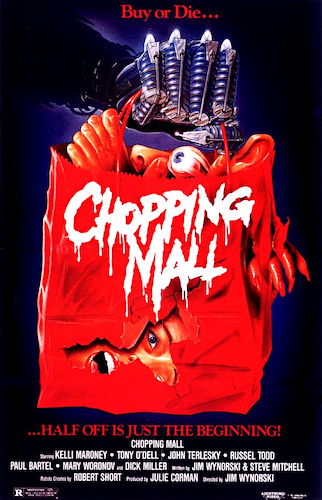
    Chopping Mall

    Blood, boobs, and berserk ’bots are the order of the day in this campy sci-fi actioner.

    That’s right: “sci-fi actioner”. I don’t know where I’d heard about this, or if I’d just made inferences from the title and poster, but I’d assumed it was a regular slasher whose USP was simply “it’s set in a shopping mall”. But nope, it’s actually about security robots who go barmy and start killing a bunch of young people who’d locked themselves in a mall overnight. According to IMDb, it was originally released as Killbots — a more to-the-point title — but it performed poorly, and the producers’ reasoning was the title had made audiences think it was a Transformers-like kids movie (if anyone did take their kids to see it, boy, were they in for a surprise!) So, after cutting over quarter-of-an-hour, they re-released it with the more-clearly-exploitation-y title and… well, I don’t know if it as a major success or anything, but I guess it performed better and that’s the version that has endured.

    I don’t know what was in those deleted 15 minutes, but presumably nothing of great import. Indeed, the short running time is a blessing: it gets on with things at the start, and doesn’t try to drag them out later. It knows what we’ve come to a movie like this for, and it delivers that with admirable efficiency. What’s left is so barmy and schlocky that it’s kinda fun, even if most of it doesn’t make a lick of sense. Even allowing for the implausible setup (lightning sends robot security guards berserk), there’s little to no logic in what follows (the robots have turned murderous? Fine, but why are they such shit shots? And why, when they have an easy shot, do they suddenly stop shooting? And so on).

    Chopping Mall is no lost gem, although it may make you nostalgic for an era when they actually made stuff like this. Would the world be a better place if people were still churning out low-budget schedule-fillers full of gratuitous-but-clearly-fake violence and unnecessary-but-welcome nudity? I don’t know, but I doubt it could be any worse. At least it might’ve desensitised younger generations enough that we wouldn’t have to suffer endless rounds of “sex scenes are bad, actually” discourse on Twitter…

    3 out of 5

    Chopping Mall was the 13th new film I watched in 2023.


    Dead Man’s Folly

    (1986)

    Clive Donner | 94 mins | digital (SD) | 4:3 | USA / English | PG
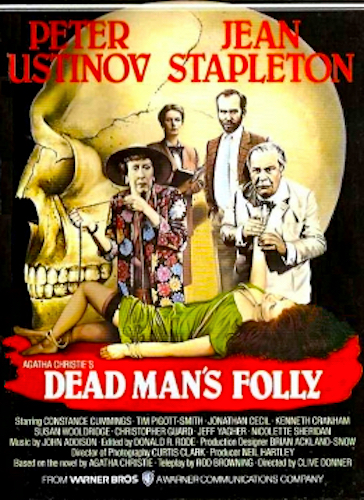
    Dead Man's Folly

    This second of three TV movies starring Peter Ustinov as Poirot marks the fourth of his six appearance as the character overall, and it might be the low point of the generally-underwhelming bunch. Ustinov was no doubt a quality performer, and I know his version of Poirot has its fans, but, for me, he remains a lesser interpreter of the Belgian sleuth.

    This particular film does nothing to outweigh his shortcomings. I don’t know if it’s the fault of the original story, this adaptation, or just me, but I didn’t feel there was enough provided for the the viewer to join in with the whodunnit guessing game, which I think is half the fun of a murder mystery. Events just unfurled until, eventually, Poirot explained it all. Add to that a portrayal of Poirot’s sometime-sidekick Hastings by Jonathan Cecil that verges on the lascivious, and production elements (costuming, hairdos, music) that are painfully ’80s, and the recipe is all-round distasteful.

    2 out of 5

    Dead Man’s Folly was #154 in my 100 Films in a Year Challenge 2021.


    Wild Target

    (2010)

    Jonathan Lynn | 98 mins | digital (HD) | 2.35:1 | UK & France / English & French | 12 / PG-13

    Wild Target

    In this remake of French comedy-thriller Cible émouvante, Bill Nighy plays an ageing hitman who falls for his latest target, pretty young thief Emily Blunt. Romance blossoms, in what must be one of the most implausible storylines ever committed to film. That’s partly because of the 33-year age gap between 26-year-old Blunt and 59-year-old Nighy (who, frankly, seems even older — the age gap may be roughly father/daughter, but she feels more like his granddaughter), but also because the movie does little to overcome this blatant shortcoming. If it wants us to buy it, it needs to sell it, but instead it half-arses it. When you learn that Helena Bonham-Carter was originally cast in Blunt’s role (but had to pull out due to commitments to Alice in Wonderland), it all begins to make sense: you can imagine a relationship between her and Nighy working on screen, and presumably they didn’t bother to retool the screenplay in between actor changes.

    All of which says, the film just about survives because there’s enough else going on. The hitman and thief wind up on the run from the people who want her dead, with a young apprentice (Rupert Grint) in tow, and the ensuing farcical hijinks are all daft fun, with the great cast (which also includes Martin Freeman, Eileen Atkins, and Rupert Everett, among others) clearly having a good time. Sometimes that’s off-putting, but here it’s infectious.

    4 out of 5

    Wild Target was #59 in my 100 Films in a Year Challenge 2021.


  • The Return of Archive 5

    Hey, look what else is back! Almost a whole year on from the last instalment in the series, I’ve finally managed to rustle up a new Archive 5. Although, that previous post was also a comeback after a long time off, so I probably shouldn’t celebrate until I mange two in a row.

    Being another year on, the pool of possible reviews has increased — quite significantly, as I’ve so far covered hardly anything from my 2023 viewing. But today’s five were chosen (but not written up, otherwise I’d’ve posted it) back when Vol.6 was published, so they were selected (at random) from the backlog of then-443 unreviewed feature films from my 2018 to 2022 viewing.

    This week’s hideously delayed Archive 5 are…

  • The Mummy (1932)
  • So Dark the Night (1946)
  • The Adventures of Ichabod and Mr. Toad (1949)
  • A Brief History of Time Travel (2018)
  • Misery (1990)


    The Mummy

    (1932)

    Karl Freund | 73 mins | Blu-ray | 1.33:1 | United States / English | PG

    The Mummy

    The third classic Universal Monster film, following Dracula and Frankenstein, The Mummy ditches literary adaptation for a horror based in then-contemporary fears. Nowadays, the notion of digging up of mummies is an Old Thing, but in 1932 they were just a decade on from the discovery of Tutankhamen’s tomb, and it was only in that year that it was finally fully excavated, so that kind of thing — and, of course, the attached curses — were still fresh in the public imagination.

    In the wake of Frankenstein, The Old Dark House, and The Mask of Fu Manchu, Boris Karloff was now the horror star in Hollywood, and so The Mummy was conceived as a starring role for him. Perhaps that explains why, plot wise, it’s a remix of Universal’s take on Dracula: the villain is after the girl, using supernatural tricks to lure her; the dashing young man is in love with her; there’s even a Van Helsing-esque figure with the knowledge to stop the monster. But originality is not the be-all-and-end-all — overall, I much preferred this to Dracula. Karloff is superb as the antagonist; Zita Johann (and her array of skimpy outfits) makes for an appealing (and, perhaps in spite of said clothing, competent) female lead; and there’s some intensely atmospheric direction from Karl Freund. His name may not seem as familiar as Dracula’s Tod Browning or Frankenstein’s James Whale, but he was already an acclaimed cinematographer, who’d shot the likes of Metropolis and, er, Dracula.

    The Mummy presented considerably less bandaged-wrapped foot-dragging living-corpse action than I expected. I guess those clichés come from the sequels (reportedly, their stories are entirely unconnected to this one) or another studio’s efforts (Hammer, perhaps). Instead, it’s quite simply one of my absolute favourites from the initial wave of Universal’s classic monster movies.

    4 out of 5

    The Mummy was #122 in my 100 Films in a Year Challenge 2021.

    So Dark the Night

    (1946)

    Joseph H. Lewis | 70 mins | Blu-ray | 1.37:1 | USA / English | PG

    So Dark the Night

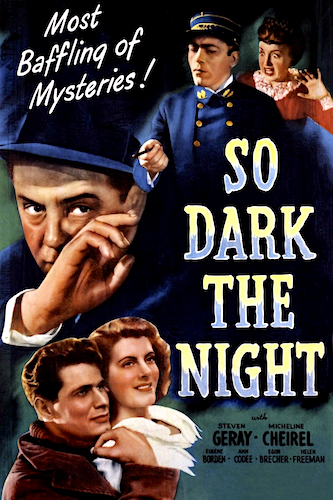
    How many serial killer mysteries have you seen that spend their first half being bucolic romances? I can’t think of any others than So Dark the Night. The title and setup don’t prepare you for it, but the first half-hour is more of a genteel country romcom, with only the slightest hint there might be darker turns to come. Half-an-hour isn’t long generally, but it’s almost halfway through a film this short — and that’s when things take an abrupt turn for the murderous.

    The short running time probably works against the film, on the whole. For example, it makes it easy to miss that there are several interesting supporting characters or facets to main characters. Love interest Nanette is sort of depicted as an innocent ingénue, but we first meet her ogling the expensiveness of Henri’s car, and then she and her mother conspire for her to meet Henri and try to elicit a romantic connection, even though she’s already got a long-standing engagement. That’s not exactly upstanding and sweet behaviour, is it? Then there’s the widowed maid, who’s so lonely and desperate to escape that even after she suspects the killer, she pleads to be taken with him.

    Along with a few other factors that are rather spoilersome, this is a film that takes the usual shape of the whodunnit and subverts it to disquieting effect. It’s a film that, on the surface, looks nothing like a noir — it’s set in a pretty French village (created with surprising authenticity on Columbia’s backlot) — but exposes that the darkness and violence of the human condition can exist anywhere. I say “on the surface” because the film’s photography is great, with many interesting shot and lightning choices peppered about, without overwhelming proceedings with unnecessary flourishes.

    4 out of 5

    So Dark the Night was #57 in my 100 Films in a Year Challenge 2020.


    The Adventures of
    Ichabod and Mr. Toad

    (1949)

    James Algar, Clyde Geronimi & Jack Kinney | 69 mins | digital (HD) | 4:3 | USA / English | U / G

    The Adventures of Ichabod and Mr. Toad

    Disney’s canon of animated films goes through a weird blip between Bambi in 1942 and Cinderella in 1950. That’s when the six so-called “package films” were released, bundling together short films into themed features. They’re almost a footnote in the Disney animated canon — I mean, before them you’ve got Snow White, Pinocchio, Fantasia, Dumbo, and Bambi, and after you’ve got Cinderella, Alice in Wonderland, Peter Pan, Lady and the Tramp, Sleeping Beauty, and so on… and on… But it’s not a period of hidden gems: these are films mostly only worth bothering with if you’re a completist. This final one is, perhaps, the exception. At any rate, it’s easily the best of the package films.

    Whereas the others contained multiple short features, here there are just two: adaptations of The Wind in the Willows and The Legend of Sleepy Hollow. There’s barely any faffing about with linking segments, either: a quick intro from Basil Rathbone (who narrates Willows), and an equally speedy transition from Bing Crosby (who narrates Sleepy Hollow), and that’s it. And that’s all it needs, instead spending time and resources on the stories themselves.

    I’ve never been a huge fan of The Wind in the Willows, but this is a fast-paced and fun version, with a particularly entertaining ‘action sequence’ in Toad Hall as the good guys and weasels run around trying to keep hold of the property deed. Then, The Legend of Sleepy Hollow recasts the famous horror story as… a small-town romantic farce. No, seriously. It’s fine if a little dull, but picks up considerably when it reaches Halloween and we get a song about the headless horseman, a highly atmospheric sequence in spooky woods, and an exciting/comical chase between Ichabod and the horseman. It takes a while to get there, but it’s worth it.

    3 out of 5

    The Adventures of Ichabod and Mr. Toad was #176 in my 100 Films in a Year Challenge 2020.


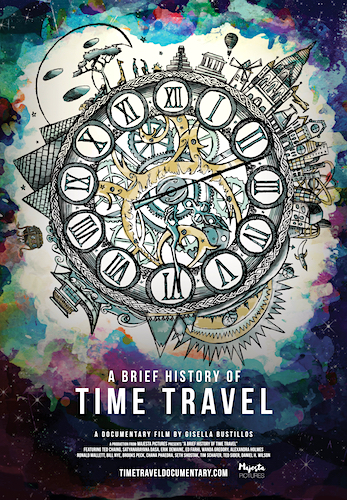
    A Brief History of Time Travel

    (2018)

    Gisella Bustillos | 69 mins | digital (HD) | 16:9 | USA / English

    A Brief History of Time Travel

    It’s a decade this year since I backed this documentary on Kickstarter — how’s that for time travel for you? I mean, technically, “normal and linear”, but also: time flies. It doesn’t feel like Kickstarter’s even been around that long. What the hell is going on with our perception of time (for example, the increasingly widespread observation on social media that everyone’s perception of how long ago things were is stuck somewhere in the early- to mid-2000s) would be an interesting topic for a documentary.

    But anyway, that’s not what this is. This is a wide-ranging overview of the concept of time travel, taking in fiction, science (both real and theoretical), and religion, as well as how those things interrelate and influence each other. It’s probably most interested in the science side, using other angles to illustrate rather than be examined in their own right. For example, it details the significance of H.G. Wells’s The Time Machine (the first story to involve time travel into the future, and one of the first where the travel was achieved via a man-made machine rather than some form of magic), but that’s about the last fictional story it describes. There are clips from Doctor Who and Back to the Future, but no discussion of their influence, nor of the kinds of time travel they present.

    At its best, the film draws interesting links and parallels between the different spheres it’s encompassing. This is at its most poignant when we meet a physicist who got into the field because his father died when he was young and time travel stories offered the idea that he might be able to revisit his dad, which developed into him learning the real science and becoming a physicist. Now, he believes he has a workable theory for how information could be sent into the past. I have no idea if that stands up to scrutiny, mind — the film doesn’t vet it with other interviewees’ opinions.

    Considering it only runs a little over an hour, it’s unsurprising that there’s not room to cover everything in depth. Nonetheless, it’s so blatantly leaving significant amounts of material untouched that you can’t help but feel disappointed. To be kind, it’s a reasonable primer for the uninitiated, with interesting bits of info dropped here and there, but almost every topic covered would merit a deeper, dedicated examination.

    3 out of 5

    A Brief History of Time Travel was #123 in my 100 Films in a Year Challenge 2021.


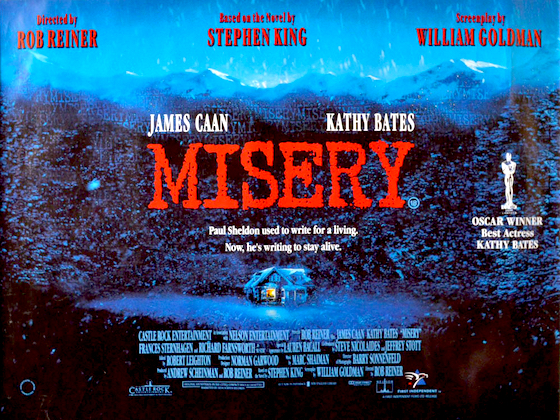
    Misery

    (1990)

    Rob Reiner | 107 mins | digital (HD) | 1.85:1 | USA / English | 15 / R

    Misery

    I feel like Misery is one of those movies that was once very well known in general pop culture, but has since slipped back, if not into obscurity then certainly into a lesser-known status, remembered only when mentioned by people who were there or as one in a list of Stephen King adaptations, that sort of thing. And that also feels fair enough, because it’s very much a movie that’s pretty good but not exceptional. The author whose work it’s taken from, the filmmaker who’s adapted it, and the main players on screen have all been responsible for or involved in even better and more enduring works of cinema, so of course this has become an “and also” note in their careers.

    Perhaps transcending that — and, certainly, by far the most famous thing about Misery — is the ankle-bashing scene, which unfortunately means you spend most of the film waiting for it to turn up, and when it does it’s rather unaffecting. That’s time and infamy for you. The former: it’s not as gruesome as it would be if shot today. The latter: I’d already seen the clip a dozen times. I can see how it was striking on the film’s original release, but familiarity has really blunted it.

    Fortunately, there’s more to the film than one shocking act of violence. Kathy Bates is excellent as Annie Wilkes, making her wild mood swings terrifyingly plausible. Her Oscar was well earned. Then there’s the subplot with the local sheriff and his unceasing investigation, which also introduces a welcome note of comedy via his interactions with his deputy (who’s his wife) and some of the other townsfolk. He’s brought to life with immense likability by Richard Farnsworth, and I’d’ve happily watched a whole movie based around him. On the whole, the film has a somewhat underwhelming “TV movie” feel to its visual (lack of) style, but there are some nicely done bits: the scene where Annie’s coming home while Paul tries to cover up that he’s been out and about; the final fight, which is just the right mix of tense, scrappy, and believably comical.

    4 out of 5

    Misery was #230 in my 100 Films in a Year Challenge 2020.


  • 2024 | Week 2

    Hey, look, it’s an actual reviews post! Well I never! Wonders will never cease! Etc.

    Yeah — I thought, “new year, new start”, and so here I am with short reviews of the first three films I watched in 2024. I was going to call this “Weeks 1–2”, even though they’re all from Week 2, because beginning the year with a post titled “Week 2” just felt wrong. But then I figured I’d begun the year already with my various other posts, so in some respects Week 2 feels natural and right. I could’ve waited for “Weeks 2–3” (there are only three films reviewed herein, after all), but I wanted to set out the stall of “look, reviews are back!” Whether they’ll stay back… I mean, they didn’t in 2023… But we live in hope.

    Anyway, onwards to:

  • Lift (2024)
  • Only Yesterday (1991), aka Omohide poro poro
  • Jackass Forever (2022)


    Lift

    (2024)

    F. Gary Gray | 104 mins | digital (UHD) | 2.40:1 | USA / English | 12 / PG-13

    Lift

    Netflix’s latest original is a high-concept heist thriller, in which a gang of art thieves are recruited by Interpol to steal a terrorist’s gold bullion fortune from a passenger flight in mid-air.

    I love a good heist movie, and Lift is certainly a heist movie. The joy of the genre, at least for me, is in the almost magic trick-esque way in which our gang pull off the score — doubly so when it’s eventually revealed in a third-act twist that what we thought was going on wasn’t going on at all. Unfortunately, that means someone — the writer, director, whoever’s in charge — needs to have a big, clever idea, and those are hard to come by. Lift‘s heist isn’t bad, it’s just nothing special. On the bright side, it ticks the box of having that last-minute reveal. Again, it’s not a particularly innovative subversion (if you were tasked with guessing it, it would probably be your first idea), but at least it’s there.

    Another common aspect of the subgenre is snappy, funny dialogue. Not so here, I’m afraid. Indeed, the dialogue is unrelentingly mediocre, and never more so than when it tries to be funny. Characters’ emotional arcs are built via Screenwriting 101 backstory dumps. You know: “How did you learn that?” “Well, when I was a kid, this very specific thing happened that taught me exactly that.” Perhaps belying a lack of confidence in the screenplay (or perhaps just Netflix realising they don’t need to spend as much as they have in the past), the film doesn’t look particularly expensive either, with middle-of-the-road CGI. Like everything else, it’s not bad, but you’re never going to imagine they went down the Mission: Impossible / Christopher Nolan route of staging it for real.

    The cast is headed by Kevin Hart, doing his best to channel whatever he’s learnt from previous co-stars and be a charming leading man type. I’ve seen worse, but it’s not a natural fit. The Interpol agent / love interest at his side is Gugu Mbatha-Raw, who you can feel is doing her best to inject some verve into proceedings. Some of the supporting roles hint at where the budget may actually have gone. Why else would Jean Reno drop in as a villain who’s mostly just on the end of a phone? Or Sam Worthington pop by as a senior Interpol agent who’s not even interesting enough to turn out to be a secret baddie? Plus most of the henchmen are faces you might recognise from British TV, like Torchwood’s Burn Gorman and Peaky Blinders’ Paul Anderson, who you’d think would be getting better offers than Henchman #2 at this point.

    If this review sounds full of faint praise… yeah, that’s about right. Lift is nothing special, but if a gang of crooks pulling off a seemingly-impossible score is your bag, then it’s passably entertaining fare for an undemanding Friday or Saturday night.

    3 out of 5

    Lift is the 1st film in my 100 Films in a Year Challenge 2024.


    Only Yesterday

    (1991)

    aka Omohide poro poro

    Isao Takahata | 119 mins | digital (HD) | 1.85:1 | Japan / Japanese | PG / PG

    Only Yesterday

    The fifth feature animation from Studio Ghibli’s other director, Only Yesterday introduces us to 27-year-old Tokyoite Taeko as she prepares to take a short summer holiday working on a farm in the countryside, which brings up memories of her ten-year-old self. The latter were the subject of the original manga the film is based on, with Takahata adding the storyline of the older Taeko reflecting on her childhood as a way of tying the stories together into a cohesive narrative.

    I didn’t know that piece of trivia going in, but I sensed something along those lines, because I generally dislike movies that play as “nostalgic vignettes from the author’s childhood”, and this is no exception. The ‘present day’ stuff, on the other hand, is very good, with beautiful moments in and about nature, and superb character beats related to what Taeko really wants and what she’s really like. (“Ever since I was little, I just pretend to be nice,” she says at one point, a sentiment I certainly felt I could agree with. Mind you, it’s in moments like this that the film’s dual timelines pay off, contrasting how younger Taeko behaved and how she has and hasn’t changed.

    Only Yesterday is sort of a film of two simultaneous halves, then. Not that I would lose the childhood bits entirely, but I would prefer a version of the film that pared them back considerably, only retaining the material that really enlightens the older Taeko’s storyline. As it stands, the bits I didn’t care for were quite tedious, but the bits I liked were captivating.

    4 out of 5

    Only Yesterday is the 2nd film in my 100 Films in a Year Challenge 2024. It was viewed as part of Blindspot 2024.


    Jackass Forever

    (2022)

    Jeff Tremaine | 96 mins | digital (HD) | 16:9 | USA / English | 18 / R

    Jackass Forever

    A decade and change after their last outing, the Jackass crew are back (minus some members, for various reasons, and plus some new ones; the latter distinctly upping the diversity quotient), doing the same crazy and dangerous shit they always did. Why? I think most of them are asking themselves the same thing. There was a definite sense in the last film that they were getting too old for this and it was time to call it a day, so what inspired them to come back to it — even older, even more prone to injury, with even longer recovery times — I don’t know.

    It certainly wasn’t fresh ideas. Despite all that time away to think up new stunts, nothing here feels particularly innovative or freshly imagined. Maybe that’s a highfalutin’ thing to analyse about a franchise that has always been just about doing dumb stunts, but some of them have been memorable, even to the extent of transcending the series itself (surely you’ve heard about the paper cuts, even if you haven’t seen it?) Forever is just variations on a theme; sometimes literally, as they expressly revisit old stunts in slightly different ways, like testing an athletic cup against various fast-and-hard objects, or pitting ringleader Johnny Knoxville against a bull — a stunt that ends rather seriously. Maybe if the film had taken that as a cue to say something about mortality or ageing… but that wouldn’t be so much fun, would it?

    So, it is what it is, which is it what it always has been: a bunch of silliness, usually resulting in pain and injury for the cast, and sometimes in laughter for the audience. It’s not the best Jackass film, but it’s not so significantly inferior as to warrant a lower rating. If you were a fan back in the day, you might appreciate the value of hanging out with old favourites for one last rodeo. And if you’re watching the films afresh, presuming you enjoyed them enough to get through the first three, you may as well watch the fourth too.

    3 out of 5

    Jackass Forever is the 3rd film in my 100 Films in a Year Challenge 2024.


  • What Do You Mean You Haven’t Seen All of the IMDb Top 250?

    Ever since I began my 100 Films in a Year Challenge all the way back in 2007, I’ve kept track of my progress in completing one of the best-known “best of” lists on the internet: the IMDb Top 250. At first, I just noted how many I’d seen from the list as it stood at the end of December (21 in my first year, for example). Later, I began to monitor how many that meant I had left (I first noted in 2012 that there were 119 to go — i.e. almost half). Ultimately, over the first 17 years of this blog, my annual statistics say I’ve watched 211 films from the Top 250 — but films come and go from the list, and many of those 211 won’t even be on there anymore. For example: since I had 119 films left to go, I’ve watched 145 more, but I still have 19 outstanding.

    That’s why I’ve made the IMDb Top 250 the subject of 2024’s WDYMYHS: to push myself closer to completing the list. I’ve thought about doing this for several years, but WDYMYHS requires only 12 films and I’ve always had more than that left to go. But the chances of landing on exactly 12 at exactly the right time (i.e. in December/January) are moderately remote. It could probably be done, but it would require specific effort, and always carry the risk of a new film entering or one dropping out. Indeed, as if to prove my point, when I made the decision to do this in mid-December there were 17 films I’d not seen on the list and had been for many months. A couple of weeks later, almost out of nowhere, two more have popped on. If I’d managed to get my unseen count to exactly 12, it would now be 14 and I’d have to abandon the idea again. So that’s why I’ve decided to just go for it with 17 19 remaining.

    All of them are listed below, in the order they appeared on the Top 250 last Sunday, from highest to lowest ranked. (The films and their ranking may well still be the same on the day I post this, but it’s already changed since New Year’s Day so nothing is guaranteed.) “But WDYMYHS is a 12 film category!”, I hear you cry (um, maybe). “How can you do it with 19 films?!” More on that post-list.


    Spider-Man: Across the Spider-Verse

    Spider-Man: Across
    the Spider-Verse

    12th Fail

    12th Fail
    Incendies

    Incendies

    To Kill a Mockingbird

    To Kill a Mockingbird
    A Separation

    A Separation

    Like Stars on Earth

    Like Stars on Earth
    The Great Escape

    The Great Escape

    Godzilla Minus One

    Godzilla Minus One
    In the Name of the Father

    In the Name
    of the Father

    Wild Tales

    Wild Tales
    The Wages of Fear

    The Wages of Fear

    Mr. Smith Goes
    to Washington

    Mr. Smith Goes to Washington
    Hotel Rwanda

    Hotel Rwanda

    Jai Bhim

    Jai Bhim
    The Best Years of Our Lives

    The Best Years
    of Our Lives

    The Handmaiden

    The Handmaiden
    My Father and My Son

    My Father and My Son

    The Grapes of Wrath

    The Grapes of Wrath
    Amores Perros

    Amores Perros


    So, 19 films, eh?

    Well, the rules of WDYMYHS haven’t changed — to complete the category, I still need to watch 12 films, preferably one per month — but this year it’s from a list of 19, not just a specific 12. I could have chosen 12 of those 19, but it seemed silly to specify them when any of the 19 contributes towards my ultimate aim of completing the Top 250. I don’t know if I’d bend the rules that much for Blindspot, but as WDYMYHS is my own thing (albeit created with the same intent (and, *ahem*, first)), well, I can do what I want (not that the Blindspot Police are going to come and arrest me if I did start messing with that too. But I digress…)

    Plus, IMDb’s list is an ever-changing beast. It was quite stable for most of 2023, but there’s always the possibility an older film will suddenly gain enough votes to chart, or a new release will be so well-received it shoots right in — as we’ve seen in the past couple of weeks. So if I did specify 12 films, one or more of them could become outdated as the year went on.

    Relatedly, therefore, even the 19 films listed above may not be the ones I watch to actually complete the category. Any film that is on the Top 250 at the time I watch it will count for WDYMYHS. So, it’ll probably be 12 of these 19, but possibly not. (If a film drops off after viewing, it will still count towards my challenge. Putting myself in the position of having to retrospectively rule out films that previously counted would be madness.)

    And that’s that. Which of the 19 will make the final 12? Or maybe I’ll watch them all and finally finish that bloody list? Or could 2024 be a year of cinematic brilliance and upend the whole lot? We’ll see in (just under) a year’s time…


    Blindspot 2024

    This is my 12th year doing a version of Blindspot, so I’m not sure my customary introduction to the concept is still necessary. But just in case: this is a challenge in which you pick 12 films you’ve never seen but should have (your blindspots) and watch them one per month over the next year. It’s a great way of ensuring you watch films that you might otherwise not get round to. Or intending to get round to them, anyway, as I’ve failed to complete the list on various occasions. Always a shame, but not the end of the world.

    Anyway, below are my 12 picks for 2024, followed by an unnecessarily long-winded explanation of why I chose them. But to jump ahead of myself slightly: the picks all come from a ranked list, and so are presented here in their order from that list, highest to lowest.


    Rosemary's Baby

    Rosemary’s Baby

    Yi Yi

    Yi Yi
    Army of Shadows

    Army of Shadows

    Only Yesterday

    Only Yesterday
    Le Trou

    Le Trou

    My Darling Clementine

    My Darling Clementine
    Rio Bravo

    Rio Bravo

    The Innocents

    The Innocents
    Where Is the Friend's House?

    Where Is the
    Friend’s House?

    Scenes from a Marriage

    Scenes from a Marriage
    The Cranes Are Flying

    The Cranes Are Flying

    Possession

    Possession

    Traditionally, my methodology for choosing my 12 films has been some degree of complicated and thus merited explanation. (“Merited” in the sense that my procedures interest me, even if they don’t interest anyone else.) Last year, I simplified things greatly by basing it around Sight and Sound’s then-new list of greatest films. With this year’s WDYMYHS also being drawn from a list of highly-acclaimed all-timers, I was certain I’d need to return to making Blindspot’s selection process a complicated one.

    Well, why make work for yourself when others have already done it? You see, the first step in my Blindspot process is to decide on and/or find lists that are going to contribute to the rankings that will decide this year’s 12. (I could just use the same list(s) year on year, but that would mean I just select the next 12 each time, which seems dull.) Normally one of the first to go in the mix is the IMDb Top 250, but that was ruled out thanks to WDYMYHS, so where else to start? I do have a couple of other go-tos, but then I remembered a list from Letterboxd: The 1001 Greatest Films, ranked as objectively as possible. I won’t regurgitate the whole rationale behind that list here (you can read the introduction at the link for that), but, suffice to say, it’s a list that has already combined multiple other lists with a view to creating a ‘definitive’ greatest films list. (The popular 1,000-film list curated by They Shoot Pictures, Don’t They? has long had a similar aim, but that has certain baked-in biases that this one aims to correct.) Job done!

    Well, not quite. I didn’t just take the list as final gospel — as well as ruling out films I’d already seen (obviously), I applied a few of my own rules to reach my final selection. Firstly, I limited it to things I already own or have near-permanent access to on streamers (I don’t normally trust them to keep content, but the Netflix Ghibli deal seems pretty solid). This was a common decider back when I first started WDYMYHS/Blindspot, but after a few years it seemed prudent to ignore it. I’ve brought it back again now because I’ve got a ludicrous number of films on disc I’ve never watched, so why not start with them rather than downloading even more? It’s not as if I was having to go to the dregs of the list just to include stuff in my collection, either.

    Next, my most commonly enforced rule: one film per director. Normally that would have meant including A Brighter Summer Day at the expense of Yi Yi, but I decided to apply another rule I’ve used fairly regularly: no films that I’d failed to watch the year before. So out went A Brighter Summer Day, which I should’ve watched in 2023, and in goes Yi Yi (which I should’ve watched in 2022, but hey, can’t go excluding stuff forever). It also meant ditching Le Samouraï in favour of Army of Shadows. If I were ranking this in terms of my personal anticipation, Le Samouraï would’ve been higher; but the list is the list — if I wanted to make this “any 12 films I want to see”, I could’ve done that as my selection process.

    Then, a few bits of housekeeping. Firstly, ruling out films that were also on the WDYMYHS list, as I’d settled on that one first. That took out three: The Wages of Fear, The Best Years of Our Lives, and A Separation. I suppose I could’ve left them on to help further complete the IMDb Top 250 (a ‘guaranteed’ 15 instead of only the 12 that WDYMYHS ‘guarantees’), but, eh. I also ruled out Apur Sansar because it’s the third film in a trilogy and I’ve only seen the first one. I’m not going to watch them out of order, and I didn’t want to commit myself to watching 13 films for a 12-film challenge. I also could have included Werckmeister Harmonies, because I do have a copy (one I went to the effort of bodging together myself from multiple DVD-era sources, to get in-sync subtitles), but there’s reportedly a 4K restoration on the way, so it seems prudent to wait for that to enjoy the film properly. I could’ve included it on the list anyway, as I did with The Hitcher, but look how that worked out. (For those who don’t remember, The Hitcher was on a 2022 list, assuming a promised release from Second Sight would definitely be out that year, but we’re now in 2024 and it’s still not been announced beyond “we’re working on it”.)

    Finally, the list includes a couple of movie-adjacent TV series that fell within my catchment zone; specifically, Dekalog and Berlin Alexanderplatz. I’ve often discussed on this blog the blurred line between TV and film, so I didn’t remove them out of snobbery, more out of practicality. I mean, last year I failed to watch nine-hour Shoah, so having either one of ten-hour Dekalog or fifteen-hour Berlin Alexanderplatz on the list would likely be a failure in waiting, but having both? Maybe I could’ve attempted one, but it would’ve been inconsistent to only include one when they both qualified. The final decider was this: if I watched either of them under normal circumstances, I wouldn’t count them on the blog (because, y’know, they’re TV series, not films), so I shouldn’t really count them just because they happen to be on a list.

    In the end, to get my final 12, I had to go through 36 films — ruling out twice as many as I included. Most of those (15) were simply because I didn’t own them. The remaining nine, I’ve already mentioned. As some kind of insight into those 36 films’ overall standings, the first one I rejected, A Brighter Summer Day, is in the list’s top ten (7th, to be precise), but only four of my final selection are in the top 100, and I had to go as deep as 193rd to finish my 12. Still, it’s always the way: the more acclaimed films you’ve seen, the further you have to go for your next ‘blindspot’.


    The 100 Films in a Year Challenge 2024

    They say the definition of insanity is doing the same thing over and over again and expecting a different result. Nonetheless, here I go for a third time with the new-style 100 Films in a Year Challenge, despite having failed to complete it the first two times. Hopefully, another hoary old saying will apply: third time lucky.

    There are two reasons to be optimistic. First, it’s not exactly the same each year — it’s (mostly) new films, and I’ve also tweaked the categories… although not necessarily to make them easier, because of the second reason: I’ve almost got there both years so far. Okay, in 2022 I stopped pretty far short at #89, but that was because 100 became unattainable and so I didn’t keep trying to close the gap. In 2023, I stuck at it a bit longer, reaching #92. In both cases, better time management earlier in the year could have made a huge difference in terms of completing the challenge. Indeed, in both years I met my old-style challenge (“watch any 100 films I’ve never seen”) with relative ease.

    I’m hoping that in 2024 I’ll finally learn from my mistakes and pull my finger out earlier in the year — though I did try to do that in 2023, with limited success, so we’ll have to see how it goes.


    Now, this year’s categories and their rules.

    First, the one rule that applies across all categories: a film can only count once. Sounds kinda obvious, but the categories are not mutually exclusive: I could rewatch a film from a series I’m halfway through that’s in this year’s genre, and thus it could qualify in three categories — but it can only be counted in one of them.

    New Films

    x12. Any film that’s general release date (i.e. not festival screenings, etc) in the UK (i.e. not in the US, nor any other country) is between 1st January 2024 and 31st December 2024. Maximum one per month (but rolls over if I fail to watch one).

    Rewatches

    x12. Any film I’ve seen before (unless it’s already been counted in 2024’s Challenge). Maximum one per month (with rollovers, as above).

    Blindspot

    x12. Unlike most other categories, these 12 films are specifically chosen and named in advance. They’re all films I feel I should have seen, or that “great movies” lists tell me I should have seen. Designed to be watched one per month, but doesn’t have to be. You can read about this year’s 12 in their own post here.

    What Do You Mean You Haven’t Seen…?

    x12. Similar to Blindspot, in that these are 12 specifically chosen films to be watched one per month, but my selections here are based around a theme. This year’s theme: the IMDb Top 250. Wait — 250 films?! No, don’t be silly. But it’s not exactly 12, either. For a full explanation, look here.

    Failures

    x12. Every month, I list my “failures” — brand-new releases, additions to streamers, and disc purchases that I failed to watch in the previous month. Sometimes, I catch up on some of them the next month. Often, I don’t. Making them a Challenge category helps force my hand. A maximum of one per month counts, but rolls over if necessary.

    50 Unseen

    x10. This year’s only entirely-new category, although it’s broadly similar to “failures” in that it’s an incentive to watch films I missed — in this case, from previous years (my annual “50 Unseen” lists) rather than just the previous month.

    50 Unseen replaces Physical Media. It was a nice idea to try to make me watch more DVDs that I’ve owned for decades, or 3D Blu-rays that I simply haven’t got round to, and I still support that as a goal; but, in reality, I foresaw that category in 2024 filling up with Edgar Wallace Mysteries and/or random freshly-purchased 4Ks. I wanted to find space here for my 50 Unseen, and Physical Media seemed the best category to lose for now. If I ever get my series watches in hand, hopefully I can replace Series Progression with a new version of Physical Media sometime in the future.

    Genre

    x10. Any films from within a specified genre. Unlike most of the above categories, these can be watched at any time — maybe I’ll spread them throughout the year; maybe I’ll binge them all back to back. Most likely it’ll be somewhere between the two. This year’s genre: martial arts.

    Series Progression

    x10. Any instalment in one of the many film series I’m already watching (there’s a Letterboxd list of them here). If I start a new series, the first film can’t count, but any further films can.

    Wildcards

    x10. Slots that can be used to add a film or films to any other category, provided the category’s own requirements have already been met (e.g. no 11th Genre film until I’ve filled the original ten, but I could use a wildcard for a second New Film in January).


    As the year goes on, you can follow my progress on the Challenge Tracker page, and also via my monthly reviews; or there’s always my Letterboxd for the guaranteed most up-to-date status of my film logging.

    The Best of 2023

    My review of the year reaches its end in the way it always does: with the best films I watched for the first time in 2023, plus a few honourable mentions, and a list of notable new releases I missed.

    For almost a decade now, my annual “top ten” has actually been my “top 10%”, the final total of entries taking its cue from how many first-time watches there were that year. Well, this year there were 103, and 10% of 103 is 10.3, which rounds down to 10 — so, for the first time since 2014, my top ten is actually a top ten. Huh.


    The Ten Best Films I Watched for the First Time in 2023

    As alluded to in the previous paragraph (but I’ll spell it out again), all the movies I watched for the first time in 2023 are eligible for this list, not just brand-new releases. In the past I’ve also provided a yearly rank for the films that were released during the previous year, but in 2023 I only saw 17 such films, and less than half of them were what you’d call “major” releases. More to the point, only one of them appears in my top ten, so there’s not much point providing a “2023 ranking”.

    So, let’s crack on…

    10

    Confess, Fletch


    Once played by Chevy Chase in a couple of ’80s films I’ve never seen, here Jon Hamm takes over the role of Fletch, a journalist who seems to have a habit of getting embroiled in mysteries. Hamm is one of those guys that Classic Hollywood loved but we don’t see enough of anymore: typically handsome fellas who can also be hilariously funny. That makes him perfect to lead this comedy thriller, which manages to be consistently bouncy fun while also unspooling a pretty decent mystery storyline. We deserve a whole pile of sequels, but I suspect we won’t get any. I guess I’ll have to see if those two earlier flicks measure up, or maybe even read the books.

    9

    Night and the City


    The basic plot — small-time hustler with big ambitions gets in over his head — feels familiar from many a noir, but the devil’s in the details, which here include an absolutely superb performance from Richard Widmark as wannabe-somebody Fabian and first-rate direction by Jules Dassin, plus a post-war London setting that brings a different flavour than the genre’s usual LA/NY locales. Fabian may have only been “so close” to greatness, but Dassin certainly achieved it.

    8

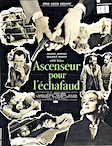
    Elevator to the Gallows


    Louis Malle’s debut tells a film noir narrative with a dose of French Nouvelle Vague style, which results in an unpredictable thriller with a kind of tragic beauty and casual existentialism you don’t often get from the genre’s hard-boiled American counterparts.

    7

    The Killers


    The first screen adaptation of Ernest Hemingway’s short story covers the original work in its opening sequence — and what a sequence it is — before spinning off into an entirely original narrative to explain the backstory to that opening. Following an insurance investigator as he pieces together one man’s life, it’s like noir’s answer to Citizen Kane; and, at its best, that’s a comparison it stands up to. Burt Lancaster’s swagger belies this being his screen debut; screenwriter Anthony Veiller juggles a nonlinear storyline to revealing effect; and director Robert Siodmak gets to show off with scenes like a single-take heist — and that opening, of course, which was so good, the two hitmen characters who briefly star in it earnt their own (radio) spin-off.

    6

    In a Lonely Place


    One of the great things about film noir being a trend that was observed retrospectively, as opposed to a genre that had been codified and its makers were aware of, is that you can come across well-established and widely-agreed noir films that don’t feel much like anything you’d expect of the ‘genre’. That’s true of these next three entries in my top ten (yes, from #9 to #4 is a straight run of noir). In a Lonely Place starts out like a Hollywood-insider screwball comedy, with wry observations of the industry and amusing rat-a-tat dialogue. But then there’s a murder — suddenly, oh so noir. But kinda not really, because what follows is more of a character study. To say too much would be spoilersome, other than to add that Humphrey Bogart’s performance starts out as fairly standard fare for the star, but develops into something incredible.

    5

    Mildred Pierce


    Even more so than In a Lonely Place, here’s a noir that’s almost (almost) one in technicality only. James M. Cain’s novel about a housewife struggling to make her way, while contending with a self-absorbed and demanding daughter, has been described as a psychological thriller, but plays on screen as a familial melodrama — except screenwriter Ranald MacDougall’s adaptation adds a murder investigation framing device, sliding it sideways into noir. The end result runs all three simultaneously, to magnificent effect.

    4

    Sweet Smell of Success


    At first blush, this might not look like your typical noir: it’s centred on a grifting New York talent agent (Tony Curtis, in what feels like the role he was born to play) and an influential newspaper columnist (Burt Lancaster, also excellent), the former desperate for the attention of the latter to promote his clients. Hardly the world of private dicks and gangsters and femme fatales that you’d expect of the genre. But, really, noir is about the dark side of the American dream, and that can play out as well in the cutthroat world of Broadway as anywhere. Like every great dystopia, it’s made to seem so appealing you want to be part of it, even as we’re shown that to actually live it would be horrid.

    3

    Oppenheimer


    There’s been a sense from some quarters that Oppenheimer represents writer-director Christopher Nolan finally realising his potential as a Serious Filmmaker, making this clearly his best film. I don’t know about that (I love Bond-type films at least as much as Nolan himself, so my taste still errs toward The Dark Knight and Inception and maybe even Tenet, and we can’t disregard The Prestige or Interstellar either), but there’s no doubting this is his most “mature” work to date. It is, to be clear, a stunning achievement — a three-hour partially-black-and-white character-driven drama, mostly told through scenes of men (and occasionally women) sitting in rooms talking, that is gripping throughout. But even that description is reductive, because there’s so much more going on in the way Nolan tells this story — the juggling of time; the use of montage. He’s always done that kind of thing to an extent (Memento, Inception, and Dunkirk foreground it), but here it feels less formalised, more intuitive, and that pays dividends.

    2

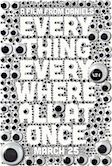
    Everything Everywhere All at Once


    It took me a long time to get round to this, meaning it had been through multiple praise/backlash cycles, so I approached it with an odd mix of hype and trepidation. As it turned out, it’s very much My Kinda Thing: science fiction with big ideas; character drama with big emotions; action with a sense of fun; all cut with enough comedy and bizarreness to take the edge off any earnestness, but without undermining the heart. And when I say “bizarreness”, I truly mean it — it’s not just “ooh, a little quirky”, but tossed through with crazy, random concepts. I’m sure some people find that kind of thing off-putting, but for me, it just makes it all that much more fun.


    If Knives Out felt zeitgeisty in its pillorying of rich people, Glass Onion is full-on prophetic: the character the plot revolves around is a thinly-veiled spot-on parody of idiot-billionaire Elon Musk, but the film was only released as the depths of his stupidity were beginning to be publicly exposed. His disastrous reign at Twitter X has only further clarified the parallels. If Glass Onion has a problem, that may be it: its cast of influencers and wannabes are sometimes more caricatures than characters. Or maybe that’s just the fault of the vapidity of the modern world. Either way, it offers a murder mystery narrative full of clever reveals and reversals, rewarding both if you try to second-guess it (good luck) or just allow yourself to be swept along. [Full review.]


    As usual, getting the 103 new films I watched in 2023 down to a top ten proved a challenge. Indeed, as the statistics ultimately revealed, this was a year of high quality, so it follows naturally that it would be hard to narrow it down to just a small number of favourites. Now, while I always include some “honourable mentions” at this point in my “best of” post, I don’t normally just list films that almost made it in to my top ten. I figure if I’m going to do that, I may as well just expand the list. But I’m making something of an exception this year, simply because the final list ended up so dominated by noir that I watched for WDYMYHS. Maybe that was inevitable when I put specific effort into watching a pile of highly-acclaimed movies from a genre I love, but it also feels kinda unfair.

    So, other films that made it as far as my “top 20” list, but didn’t quite go all the way, included (in alphabetical order) The Bird with the Crystal Plumage, Cléo from 5 to 7, John Wick: Chapter 4, Mission: Impossible – Dead Reckoning Part One, The Pied Piper, Remember the Night, Roald Dahl’s Matilda the Musical, and Shiva Baby. There were also a couple more noirs that didn’t quite make it: Nightmare Alley and Scarlet Street. All great films, but there’s only so much room.

    Indeed, if my top ten was based on films’ best individual sequences rather than, y’know, the entire movie, there are some “almost made it”s that would actually top the chart — films like Roald Dahl’s Matilda the Musical (for Revolting Children, a proper anthem of a song by Tim Minchin that Matthew Warchus directs the hell out of) and Mission: Impossible – Dead Reckoning Part One (for the whole train climax… or the Rome car chase… or even just the absolutely perfect cut into the opening titles) and John Wick: Chapter Four (for… oh God, I can’t even decide: it’s wall-to-wall extravagantly fantastic action set pieces). Some films from the actual top ten would feature in such a list too, like the opening diner sequence from The Killers, or the finale of Oppenheimer (so good, even the Linkin Park meme version is a banger).

    Moving away from the top ten itself, let’s recap the 12 films that won the Arbie for my Favourite Film of the Month — some of which have already been mentioned in this post, but some of which haven’t. In chronological order (with links to the relevant awards), they were Glass Onion, Ace in the Hole (another great noir!), Everything Everywhere All at Once, Scarlet Street, The Shiver of the Vampires, In a Lonely Place, Night and the City, All the Old Knives, The Pied Piper, Alien Love Triangle, The Killers, and Mildred Pierce.

    Finally, as always, a mention for the 17 films that earned a 5-star rating this year. All ten of my top ten made the grade this year, but the other seven were (again, in alphabetical order) Ace in the Hole, The Banshees of Inisherin, Cléo from 5 to 7, John Wick: Chapter 4, The Pied Piper, Roald Dahl’s Matilda the Musical, and Scarlet Street.


    With the caveat that I’ve inevitably forgotten or misjudged something really noteworthy, here’s an alphabetical list of 50 films designated as being from 2023 that I haven’t yet seen. They’ve been chosen for a variety of reasons, from box office success to critical acclaim via simple notoriety, representing a spread of styles and genres, successes and failures.

    Asteroid City
    Cocaine Bear
    Godzilla Minus One
    The Killer
    Napoleon
    Scream VI
    Barbie
    Dungeons & Dragons: Honour Among Thieves
    The Hunger Games: The Ballad of Songbirds & Snakes
    Knock at the Cabin
    Poor Things
    Spider-Man: Across the Spider-Verse
    Anatomy of a Fall
    Ant-Man and the Wasp: Quantumania
    Aquaman and the Lost Kingdom
    Are You There God? It’s Me, Margaret.
    Asteroid City
    Barbie
    Bottoms
    The Boy and the Heron
    Chicken Run: Dawn of the Nugget
    Cocaine Bear
    The Creator
    Creed III
    Dungeons & Dragons: Honour Among Thieves
    Elemental
    Evil Dead Rise
    The Exorcist: Believer
    Expend4bles
    Extraction 2
    Fast X
    Ferrari
    Five Nights at Freddy’s
    The Flash
    Godzilla Minus One
    Guardians of the Galaxy Vol. 3
    Hunger Games: Ballad of Songbirds & Snakes
    The Killer
    Killers of the Flower Moon
    Knock at the Cabin
    The Last Voyage of the Demeter
    The Little Mermaid
    Maestro
    The Marvels
    May December
    Meg 2: The Trench
    Napoleon
    No Hard Feelings
    Past Lives
    Plane
    Poor Things
    Rebel Moon – Part One: A Child of Fire
    Saltburn
    Saw X
    Scream VI
    Silent Night
    Spider-Man: Across the Spider-Verse
    The Super Mario Bros. Movie
    Teenage Mutant Ninja Turtles: Mutant Mayhem
    The Three Musketeers: D’Artagnan
    Wish
    Wonka


    So, that’s it for 2023. All wrapped up within the first week, same as last year. I feel like I’ve got this down to some kind of science. (Oops — fate: tempted. Next year I’ll probably wind up having to post this stuff throughout the whole of January.)

    And with a new week — the second of the year, already — beginning tomorrow, I feel like there’s no time to waste: onwards to 2024!

    2023 Statistics!

    Here we are again: the best bit of the year — the statistics!

    As was the case last year (and will surely remain so going forward), these haven’t been fiddled with to fit with my new-format Challenge, but instead continue to encompass all of my first-time watches from the past year (as listed here). That’s just the way I like it (in part because it means I can compare across the years, whereas switching to a Challenge focus would basically be starting again).

    Before the onslaught of numbers and graphs, I’ll just mention that, because I’m a Letterboxd Patron member, I get a yearly stats page over there too, which can be found here. In some places that’ll look a bit different to this one, because I also log whatever TV I’m allowed there; but it does have some interesting additional and alternative stats, like my most-watched and highest-rated stars and directors. So, if you love this stuff as much as I do, be sure to check out the extra goodies there at some point.

    And with that said, it’s on to the main event…


    I watched 103 feature films for the first time in 2023, which is my lowest final tally in over a decade (you have to go back to 2012’s 97 for less). It snuggles in between the handful of years in which I reached exactly 100 and 2013’s 110 as my all-time 5th lowest year (out of 17).

    Of those 103 films, 67 counted towards my 100 Films in a Year Challenge. Alongside 25 rewatches, that means I totalled 92 films for my Challenge — sadly falling short of the goal of 100 for the second year running.

    Outside of the Challenge, I rewatched a further three films, for a total of 28 rewatches. That’s somewhere in the middle of the pack — my 7th best year ever for rewatches, which also makes it my 10th worst.


    NB: I have no rewatch data for 2007 and only incomplete numbers for 2008.

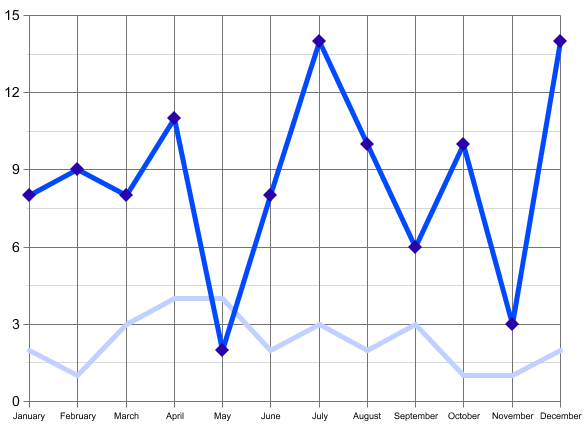
    Here’s how that viewing played out across the year, month by month. The dark blue line is my first-time watches and the pale blue is rewatches. As is usually the case, my viewing month to month is wildly unpredictable.

    I also watched 15 short films in 2023. (Those don’t count in any statistics, with the sole exception of the version of the total running time that expressly mentions them.) That’s only the third time my shorts count has been in double figures, sitting behind 2019’s 20 and 2020’s festivals-driven whopper of 65.

    The total running time of my first-watch features was 173 hours and 11 minutes. That’s my lowest since 2012, which makes sense when you remember the stat from the first paragraph. Add in the shorts and the figure rises almost 2½ hours to 175 hours and 33 minutes, though you still won’t find lower since 2012. (In the graph, I would also include any alternate cuts I watched for the first time in that “others” block, but there weren’t any this year.)

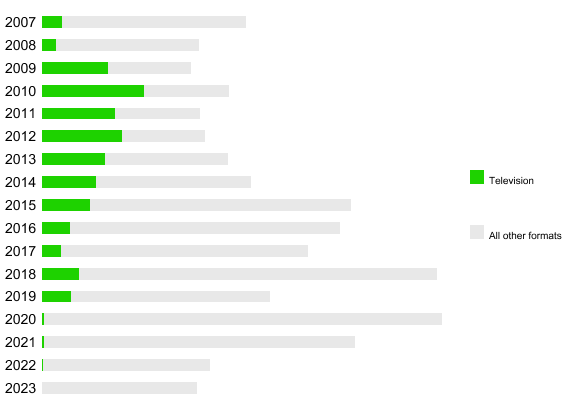
    On to formats now, and the big news (if you can call it that) isn’t what’s #1, but what isn’t here: I didn’t watch a single film on TV in 2023, the first time that’s happened in the history of the blog. TV was once my dominant format, making up over half my viewing in 2010, and the largest portion in 2009, 2011, and 2012, but tailed off thanks to the rise in streaming. It’s also a personal thing: its number of films was still in the 20s as recently as 2019, but then I got rid of Virgin Media and its easy recordability, and the number went off a cliff. But I won’t lament it too much, because there’s always a chance it’ll return — unlike, say, VHS, which still accounted for five films back in 2007 and two in 2008 before disappearing entirely.

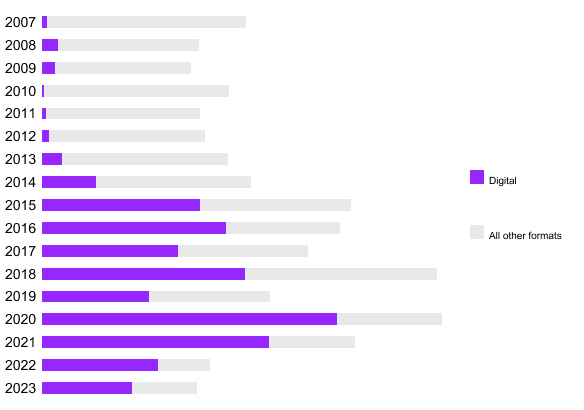
    As for what is #1, that’s not really news at all: it’s digital again, with 60 films — though at 58.25% of my viewing, that’s its lowest percentage since 2019. My streaming viewing had been hovering around 50% from 2015 to 2019, but then suddenly darted up to almost 74% in 2020. I know most would blame the pandemic for that kind of thing, but during lockdown I still had all my many, many Blu-rays, so I don’t really know why that happened. It dropped marginally to 72.5% in 2021, then a little more to 69.4% last year, but a fall of over 10% is… well, I approve. Maybe it’s silly to look at it that way — I mean, this is my own viewing: I could ban myself from streaming anything if I wanted to — but I kind of just watch what I want to or feel like, then look at these numbers in retrospect. With that in mind, I continue to want to see Blu-ray do better, and this is a step in the right direction.

    Of course, “digital” is actually made up of multiple streamers, plus downloads. This year was a tight one, with Netflix’s 16 films (26.7% of digital) narrowly claiming the crown from Amazon Prime on 15 (25%). Next were downloads on 13 (21.7%), before a small handful of other streamers filled out the rest: Disney+ with six (10%), MUBI with five (8.3%), Now on three (5%), and Apple TV+ on two (3.3%). That’s right, nothing in 2023 for iPlayer, nor ITVX, nor Channel 4, nor YouTube, nor any of the multitudinous other streamers that are available nowadays.

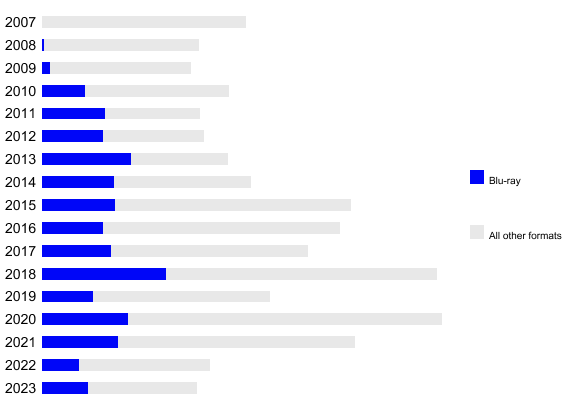
    Overall second went, also as usual, to Blu-ray, with 31 films (30.1%). That’s up on last year, though doesn’t by itself totally cover the drop in digital.

    So where else have those lost digital percentage points gone? Well, DVD held steady on eight films. With my overall viewing down, that means it accounts for a slightly higher percentage — 7.8% in 2023 vs 7.2% in 2022. Hardly making the world of difference, that, is it? DVD has theoretically enjoyed a boost these last couple of years thanks to the Physical Media category of my Challenge, although in fact it hasn’t made that much of a difference (looking at the graph, the two Challenge years aren’t notably different to pre-Challenge years like 2016, 2017, 2019, and 2020). Spoilers: the Physical Media category is going away in 2024, so it’ll be interesting to see how DVD charts next year.

    Our search for those lost digital percentage points finds perhaps its biggest culprit in cinema. I went four times this year — less than I’d hoped, but tied with 2020. It’s only 3.9% of my viewing, but if we’re talking about how percentage points have moved around, I guess those are all nabbed from digital. (For those who want the full maths: add cinema’s 3.9% to DVD’s 0.6% increase for 4.5% of streaming’s lost 11.1%. That leaves 6.6%, and Blu-ray went up by 8.6%, so… um, wait, what? Oh, I’m just confused now. Let’s abandon the pretence I know what I’m talking about, have a graph, and then on to something else.)

    In 2022 I only watched one new film in 3D. I’d hoped to improve on that in 2023 (the general public may think 3D is dead, but it still has its fans — like me — and I’ve still got a 3D TV and plenty of unwatched discs), but I didn’t — in fact, I watched no films in 3D. Oh. Well, at least that’s an easy figure to improve upon… (In overall terms, I did watch two 3D titles this year, both Doctor Who ones. That too is the same as 2022, when my one new 3D film was supplemented by a 3D rewatch.)

    As for the new high PQ standard, 4K Ultra HD, that fared significantly better, with 27 films in 2023 — up from 24 in 2022, even though I watched fewer films overall. Indeed, at 26.2% of my viewing, you could argue it’s 4K’s strongest year yet. (I watched 40 back in 2020, but that was only 15.2%.) Still, 1080p HD remains the standard overall, accounting for 62.1% of my viewing. Of course, sometimes the only option is lower quality, and so I still watched 12 films in SD. That’s my lowest raw number yet, and even as a percentage — 11.65% — it’s down on the last two years.

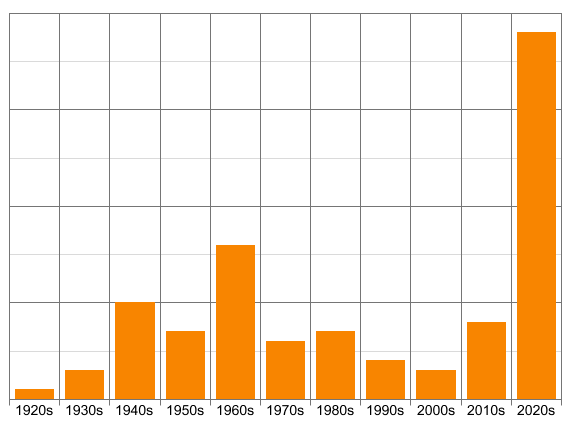
    In terms of the age of films watched, it’s normally the present decade that tops the chart, although it typically takes a couple of years to assert that position. The 2020s got there for the first time last year, matching the 2010s record of doing it in the decade’s third year. No surprise, then, to find the 2020s in first place again, with 38 films (36.9%). Normally you’d then find the preceding decade in second place, but — for the second time in a row, and only the fifth time ever — that’s not the case. In fact, two decades bested it: for no immediately obvious reason, the ’60s are second with 15 films (15.5%); and, boosted by my noir-focused WDYMYHS selection, the ’40s are third with 10 films (9.7%). That leaves the 2010s in fourth place with just eight films (7.8%).

    Every decade since the 1920s cropped up in my feature film viewing this year. That means the 1910s miss out for the first time since 2019, but the 1900s & earlier were represented by shorts, as they have been every year since 2020. I specify “and earlier” because one even came from the 1890s. Counting down the remaining decades, in joint fifth place we have last year’s #2, the ’80s, tied with the ’50s on seven films (6.8%) apiece. From there we’ve got the ’70s with six (5.8%), the ’90s with four (3.9%), the ’30s and 2000s each with three (2.9%), and finally the 1920s with just one (0.97%).

    As well as watching older films, I’ve also tried to watch more films from around the world — in a relatively “hands off” way, that is. By which I mean, it’s not like I’ve disqualified US/UK productions from my Challenge, nor anything else particularly radical or concerted; I’ve just tried to, y’know, vary things. That approach means that, while the USA remains clearly the dominant country of production, with 60 films this year, its percentage has dropped significantly, to 58.3% — down from almost 73% last year, and well below the previous low, 67.6% in 2021. Meanwhile, the UK has actually gone up, with 33 films equating to 32.04%, its highest ever, over 2013’s 29.3%.

    In total, there were 23 production countries in 2023 — up from 17 in 2022, which is good considering I watched roughly the same number of films. It’s fewer than in any year from 2014 to 2021, but I did watch a lot more films in that period. France came third for the third year in a row with 12 films (11.7%), Germany were fourth with 10 films (9.7%), Italy were fifth with nine films (8.7%), and Mexico had an uncommonly strong showing to reach sixth place with five films (4.9%). There were three each for Canada and Hong Kong, and two apiece for China, Cuba, Ireland, and Sweden. That leaves eleven other countries with one film each, including Japan, who I mention because they built up to a huge spike a few years ago, culminating in third place in 2018, but have tailed off again since, for no readily discernible reason.

    Unsurprisingly, it’s a similar story with languages — although the UK and US combine here (along with various other countries, including foreign films where it’s spoken a significant amount) to leave me with 77 films in English. It remains by far the highest single language, but features in less than three-quarters of films in 2023 — 74.8%, to be precise — which is far down on last year’s obscene 92.8%, and well below the previous low, 2020’s 84.5%. Nonetheless, it’s a long drop to second placed French, featured in nine films (8.7%), which is only just ahead of Italian in eight films (7.8%) and Spanish in seven films (6.8%). In all, 16 languages were spoken in 2023’s viewing, slightly up from last year, but you’d have to go back to 2014 to find lower again. But, as I’ve said, I watched far more films per year in those years, so of course the number of countries and languages represented was higher.

    A total of 89 directors plus seven directing partnerships helmed the feature films I watched in 2023, with a further seven directors and one partnership added by my short film viewing (one feature director also directed a short, as we shall see in a moment). No director had more than two features to their name this year, but those with two were Allan Davis (both from the Edgar Wallace Mysteries series), Dario Argento (if things had gone as planned, he would’ve had at least four), Eric Appel, Joselito Rodríguez, Kenneth Branagh (if rewatches counted, he’d have more), Mario Bava, and Roger Michell. It was Danny Boyle who was behind one feature and one short, while Dean Fleischer Camp helmed three shorts (the original Marcel the Shell with Shoes On trio) and George Albert Smith is credited with two.

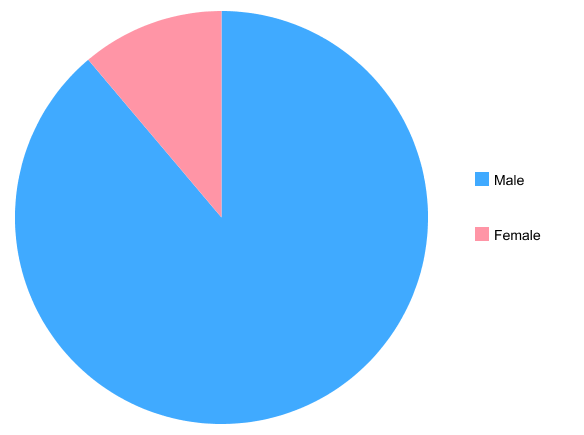
    For a few years now I’ve been charting the number of female directors whose work I’ve watched each year. This had been steadily improving, but fell back considerably in 2022, unfortunately. In 2023, I watched 12 films with a female director (11 with a woman directing solo, one where she was part of a duo with a man). Counting the shared credit as half a film, that comes out as 11.17% of my viewing. That’s actually my second highest percentage since I started monitoring this, but remains shockingly low considering that women make up a little over 50% of the population. I say that’s an industry problem, primarily — if more women were allowed to direct movies as a matter of course, I’d see more movies directed by women.

    At the time of writing, just one film from my 2023 viewing appears on the IMDb Top 250 — that would be Oppenheimer at 68th. However, because that list is ever-changing, the number I have left to see has actually gone up, from 18 at the end of 2022 to 19 now — the first time that’s happened since I started tracking this a decade ago. One of those 19 films has only just inserted itself into the list though, so I presume it will speedily drop off (that tends to be what happens to new entrants). Still, even that would leave me with a net change of zero. Maybe my 2024 viewing will have more of an impact…

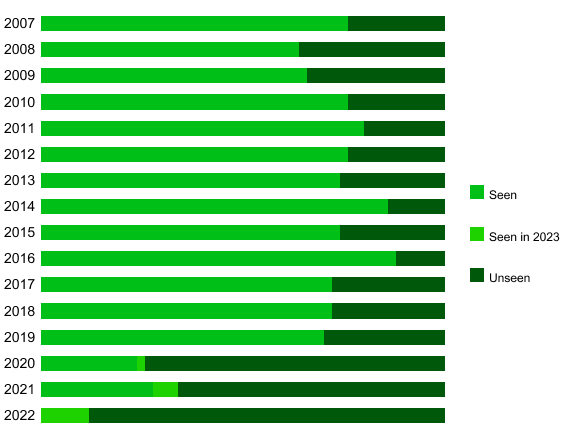
    Talking of minimal impact, let’s move on to the disaster zone that is my progress with my “50 Unseen” lists — you know, the list I publish at the end of every year of 50 notable new films I missed that year, which I’ve continued to track my progress watching down the years. I went through a period where they helped to decide a lot of my viewing, and consequently I was constantly chipping away at every old list. Not so much nowadays. In fact, “not at all” might be more accurate: in 2023, I only watched 10 films across all 16 lists. I haven’t even watched that few from just the previous year (i.e. in this case, 2022) since I only watched eight from 2009’s list in 2010. To be precise, I watched six from 2022’s 50. That’s my second-worst ‘first year’ ever, beating only the four from 2008’s list that I watched in 2009. Eesh. The only reasoning I can offer for such a drop off is that I’m watching far fewer films than I used to, and more of them are older.

    In total, I’ve now seen 523 out of 800 ‘missed’ movies. That’s 65.4%, the lowest it’s been since 2017. I was pleased to get it above 70% for the first time in 2018 and my aim had been to keep it up there, which I managed for the next few years. I’d like to get back there, but it’s unlikely to happen in 2024: I’d have to watch 72 films (from across all 17 years), which would be a new record. Considering I watch at least 100 (ish) films every year, hitting 72 seems theoretically possible, but only if I were to devote most of my viewing to only films from these lists. I won’t be doing that. Maybe I can achieve 70% in 2025… or 2026… Of course, the goal posts keep moving because the list increases by 50 titles every year (speaking of which, 2023’s 50 will be listed in my forthcoming “best of” post).

    And so we reach the finale of every review, and thus a fitting climax to these statistics: the scores.

    For the avoidance of doubt, this stat factors in every new film I watched in 2023, even those for which I’ve yet to publish a review (this year, that’s a ludicrous 95% of them — it was just 27% last year, although it was 98% in 2021). That means there are some where I’m still flexible on my precise score; usually films I’ve awarded 3.5 or 4.5 on Letterboxd, but which I insist on rounding to a whole star here. For the sake of completing these stats, I’ve assigned a whole-star rating to every film, but it’s possible I’ll change my mind when I eventually post a review (it’s happened before). Still, hopefully this section will remain broadly accurate (because I’m not going to come back to modify it!)

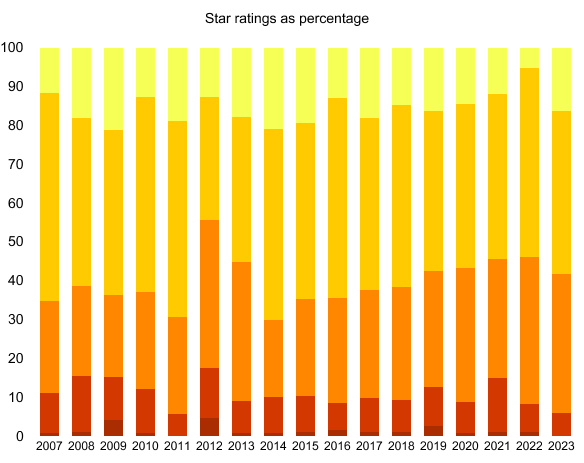
    At the top end of the spectrum, in 2023 I awarded 17 five-star ratings (16.5% of my viewing) — a massive increase on 2022’s six (5.4%). Having last year asserted that my marking has become harsher as I’ve got older / more experienced, this year suggests that, eh, maybe not; although, historically, 16.5% is slap bang in the middle of the board (by which I mean: eight years had a higher percentage and eight years had a lower percentage). I’ve always been a relatively lenient grader and, to be honest, I see no reason why that should change — I just like films, ok?

    At the other end of the spectrum, though perhaps indicative of the same thing, I gave zero one-star ratings — only the second time that’s ever happened, after 2011. I’m always stingy with them, feeling that the lowest-of-the-low should be reserved for things that are truly execrable, so in many respects it’s nice to have gone a whole year without watching anything so meritless.

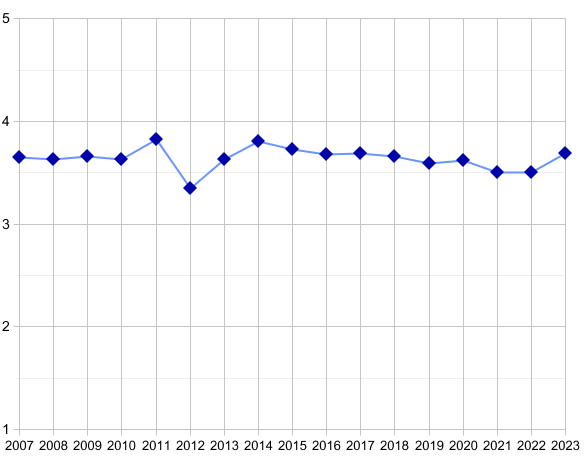
    My most commonly awarded rating was, as usual, four stars, which I gave to 43 films (41.7%). That’s down from last year, although together the top two ratings add up to 60 films in both 2022 and 2023 (and, remember, I only watched slightly more films last year, so it’s broadly equal). Slightly behind were the 37 three-star films (35.9%), while only having six two-star films means their percentage — 5.8% — is the lowest since 2011 (a year you may remember for its similar lack of one-star films).

    So, from all that we can calculate the final stat of the year: the average score for 2023. The short version is 3.7 out of 5 — the highest it’s been since 2018, which was the fourth year in a run of 3.7s. It bucks the trend, too, as 2019 and 2020 both averaged 3.6 before 2021 and 2022 hit 3.5. If we want to get more precise (and we do), we can add a few more decimal places and see the score comes out at 3.689. That makes 2023 the fifth highest scoring year ever — again, quite the turnaround from the last two years, which were both my second-lowest year ever at the time.

    All of which said, as you can see from the graph above, my average score has remained pretty consistent across the years. There are no truly bad years, just weaker ones — or, in 2023’s case, stronger ones. Hurrah.


    All that remains now for my review of 2023: which of those 103 films were my favourites?

    December’s Failures

    I habitually begin this column with the theatrical releases I’ve missed in the past month, but this time the true biggest failures are of a more personal nature: all the films I should have watched to complete my 100 Films in a Year Challenge. Those were, in alphabetical order, A Brighter Summer Day, Pierrot le Fou, Shoah, and, er, any five gialli. The monthly “failures” category of my 100 Films Challenge will continue in 2024, so now those failures from last year have the possibility of helping me complete next year by being the “failure” I watch in January. It’s almost beautiful… though, to be honest, I suspect I’m more likely to watch one of the following…

    Well, probably not any of this first batch either, seeing as many of them are still in cinemas and the others won’t hit disc or streaming for a while. The one that nearly tempted me out of the house this month was Godzilla Minus One — I was interested anyway, but then the glowing reviews sealed the deal. Unfortunately, its limited release coincided with a busy weekend of pre-Christmas family stuff and then a busy week of pre-Christmas work stuff, so I just didn’t have the opportunity. If it weren’t such a limited release, maybe it would still be showing and I could go in January; but it was limited, it isn’t still showing, and now I’ll have to wait for a disc release.

    Also on the big screen… Charlie and the Chocolate Factory prequel Wonka — the first review I saw called it charmless, the second thought it was a magical delight, and now I don’t know what to think (I could look up the consensus, of course, but where’s the fun in that). Yet another end for one version or another of the DC cinematic universe in Aquaman and the Lost Kingdom — I rather enjoyed the first one, so remain cautiously optimistic for the sequel. Talking of final (again) films, there was also Hayao Miyazaki’s latest last movie, The Boy and the Heron. Then there’s the latest from Michael Mann, Ferrari, and from Taika Waititi, Next Goal Wins. Closing things out, part two of French swashbuckling adaptation The Three Musketeers: Milady, which I’m hoping they’ll do a two-film 4K release when it reaches disc, as they skipped 4K for part one outside of France. Oh, and rom-com Anyone But You, which I might watch one day if it garners a good rep.

    The concept of major end-of-year releases extended to the streamers, too. Netflix led with Zack Snyder’s latest, a rejected Star Wars pitch turned into an attempt to launch a standalone universe, Rebel Moon — or, rather, Rebel Moon: Part One, as apparently it was just too big to be contained to a single film. Or perhaps that should be Rebel Moon: Part One – The Neutered First Cut, as apparently this is a PG-13-friendly version ahead of an R-rated director’s cut due… in the future. This cynical viewership-grabbing idea (because why not just go straight to the uncut version?) seems to have backfired, with the film receiving poor reviews from all but the die-hard Snyder fans. It still sits on my watchlist, but then what doesn’t?

    Trying to cover all bases, Netflix also released Bradley Cooper’s latest shot at an Oscar, Maestro; starry apocalyptic drama Leave the World Behind; and some family-friendly fare in the shape of belated sequel Chicken Run: Dawn of the Nugget. Amazon’s offering was comparatively paltry. Well, there was an Eddie Murphy Christmas comedy that I didn’t even bother to note down the title of, so little am I likely to watch it. Elsewise, there was odd-looking animation Merry Little Batman. Its visual style put me off, but then I thought I’d watch it anyway as it’s just a short, but it turned out to be a full-length feature, and now… well, now it’s January. Who wants to watch a Christmas film in January?

    Talking of Christmas films, the other streamers were at it too: Disney+ served up kid-friendly heist comedy The Naughty Nine alongside aviation-themed “Christmas miracle”-style short The Shepherd; and Sky boasted as Originals the latest Richard Curtis effort, Genie, alongside John Woo’s much-anticipated Silent Night. They also had the UK debut of May December, but I don’t think that’s very Christmassy. Nor was MUBI’s How to Have Sex, or Apple TV+’s action-comedy The Family Plan. The latter is a Mark Wahlberg vehicle, so I’m prepared for it to be weak, but the trailer amused me nonetheless. As for more reliable action stars, Disney+ also debuted Timeless Heroes: Indiana Jones and Harrison Ford, a feature-length documentary directed by DVD special features producer extraordinaire Laurent Bouzereau (but sadly not included on the latest Indiana Jones disc release), which is billed as follows: “From his humble beginnings as TV bit-player to his era-defining turn as a blockbuster action movie star and onto his more introspective roles that followed, this new documentary tracks the storied career of Harrison Ford.” Ford’s great and Bouzereau’s work is typically fab, so that’s gotta be worth a look, right?

    In terms of films making their streaming debut, Sky are back to dominance, with a December that also featured everything from hit blockbusters Spider-Man: Across the Spider-Verse and The Super Mario Bros Movie to flop blockbuster Shazam! Fury of the Gods; British flicks from grey-pound plays Allelujah and The Unlikely Pilgrimage of Harold Fry to action-comedy Polite Society; plus foreign-language action in Sisu and The Three Musketeers: D’Artagnan. The best the others could offer were warmed-over releases like the Extended Version of Spider-Man: No Way Home on Netflix (the never-released-on-disc cut with 12 minutes of extra stuff). As always, there was plenty of back catalogue stuff to fill out my watchlists, but as they all tend to come and go, and jump about from one service to the other now and then, I won’t be listing them all.

    Instead, let’s jump on to the never-ending drain on my finances: disc purchases! (Ah, I love ’em really, otherwise I wouldn’t do it.) It’s a shorter list than normal this month, for whatever reason, but that doesn’t mean it’s devoid of exciting titles. For example, there’s The Warriors on 4K from Arrow — a release I’ve been hoping for for years, although was slightly less keen on after Australia’s Imprint put the film out a while back in a very good 1080p set. Fortunately (or unfortunately, depending on your point of view), Arrow’s and Imprint’s releases have completely different special features, so I’ll be keeping both sets. Another one I’d been waiting for was The Exorcist — not in desperation for any kind of decent release, but because they’ve been putting out multiple different configurations of its 4K discs over the past couple of months, and in December they finally released the one I wanted. Finally on 4K, I updated and/or completed my Indiana Jones, Guillermo del Toro, and Christopher Nolan collections with, respectively, Indiana Jones and the Dial of Destiny, Guillermo del Toro’s Pinocchio, and Oppenheimer.

    Regular Blu-ray was a tale of two labels, with the latest releases from Eureka, HK gambling thriller Casino Raiders and samurai epic The Fall of Ako Castle; and the almost-latest-but-not-quite releases from Radiance (their actual December releases are currently somewhere in the postal system, having only dispatched to me this week), including French “noirish drama” Le combat dans l’ile, Umberto Lenzi’s poliziottesco Gang War in Milan, and a box set of Polish sci-fi / horror / “satirical, surrealistic apocalypse” fantasies directed by Piotr Szulkin, The End of Civilization. It sounds like the kind of stuff I have no idea if I’ll actually like or not, but it’s definitely worth a go (just don’t ask how much I spend on stuff that seems “worth a go”…)

    2023: The List

    My December “failures” are still in the works, but, in the meantime, let’s continue with the overall review of 2023.

    I’ve published an end-of-year list of all my first-time watches every year since this blog began. They used to be of dubious worth, considering I’d either reviewed everything throughout the year or listed it all in my monthly progress reports. But nowadays — with posting of the former being scattershot to nonexistent, and the latter focusing on my 100 Films in a Year Challenge — it feels like there’s a point to it again.

    Nonetheless, as well as the aforementioned list of all my first-time watches from 2023, there’s also a full set of links to my monthly progress reports, which uses their header images to present a kind of visual summation of how my Challenge went.

    Without further ado (aside from me reintroducing each list before itself), off we go back through 2023…


    Below is a graphical representation of my viewing for the 100 Films in a Year Challenge, month by month. Each image links to the relevant monthly review, which contain a chronological list of my Challenge viewing, as well as other exciting stuff, like my monthly Arbie awards.


    Leaving the Challenge behind, here is an alphabetical list of all my first-time watches during 2023. That’s followed by a list of short films I watched for the first time. (Normally there’d also be a list of rewatches that have ‘Guide To’ posts, but there weren’t any this year.) On the rare occasion that a title is a link, it goes to my review (no link, no review yet).

    • 65 (2023)
    • 7 Women and a Murder (2021), aka 7 donne e un mistero
    • Ace in the Hole (1951)
    • Air (2023)
    • All the Old Knives (2022)
    • Ammonite (2020)
    • The Asphalt Jungle (1950)
    • Au hasard Balthazar (1966)
    • Austenland (2013)
    • The Banshees of Inisherin (2022)
    • Beau Travail (1999)
    • Belfast (2021)
    • Benediction (2021)
    • Best Sellers (2021)
    • The Bird with the Crystal Plumage (1970), aka L’uccello dalle piume di cristallo
    • Black Girl (1966), aka La Noire de…
    • Blood and Black Lace (1964), aka 6 donne per l’assassino
    • The Book Thief (2013)
    • A Castle for Christmas (2021)
    • The Cat o’ Nine Tails (1971), aka Il gatto a nove code
    • Chitty Chitty Bang Bang (1968)
    • Chopping Mall (1986)
    • Cléo from 5 to 7 (1962), aka Cléo de 5 à 7
    • Clerks II (2006)
    • Close-Up (1990), aka Nema-ye Nazdik
    • Clue of the New Pin (1961)
    • Clue of the Twisted Candle (1960)
    • Confess, Fletch (2022)
    • A Deadly Invitation (2023), aka Invitación a un Asesinato
    • Die Hart (2023)
    • The Duke (2020)
    • Elevator to the Gallows (1958), aka Ascenseur pour l’échafaud
    • Engima (2001)
    • Escape Room: Tournament of Champions (2021)
    • Everything Everywhere All at Once (2022)
    • Fantasia (1940)
    • Far from the Madding Crowd (2015)
    • Fear Eats the Soul (1974), aka Angst essen Seele auf
    • Fisherman’s Friends: One and All (2022)
    • Flora and Son (2023)
    • From Beijing with Love (1994), aka Gwok chaan Ling Ling Chat
    • Georgetown (2019)
    • The Girl Who Knew Too Much (1963), aka La ragazza che sapeva troppo
    • Glass Onion (2022)
    • The Goddess (1934), aka Shen nu
    • Greatest Days (2023)
    • Guillermo del Toro’s Pinocchio (2022)
    • Gun Crazy (1950)
    • A Haunting in Venice (2023)
    • In a Lonely Place (1950)
    • In the Heights (2021)
    • Indiana Jones and the Dial of Destiny (2023)
    • Jeanne Dielman, 23 Quai du Commerce, 1080 Bruxelles (1975)
    • The Jigsaw Man (1983)
    • John Wick: Chapter 4 (2023)
    • Killer of Sheep (1978)
    • The Killers (1946)
    • The Lady in the Van (2015)
    • A Life Less Ordinary (1997)
    • Living (2022)
    • The Magician (1926)
    • The Man Who Was Nobody (1960)
    • Marriage of Convenience (1960)
    • Mildred Pierce (1945)
    • Mission: Impossible – Dead Reckoning Part One (2023)
    • Mr. Vampire (1985), aka Geung see sin sang
    • Murder Mystery 2 (2023)
    • Night and the City (1950)
    • A Night at the Opera (1935)
    • Nightmare Alley (1947)
    • Nothing Sacred (1937)
    • Operation Fortune: Ruse de Guerre (2023)
    • Operation Mincemeat (2021)
    • Oppenheimer (2023)
    • Out of the Past (1947), aka Build My Gallows High
    • Partners in Crime (1961)
    • The Pied Piper (1986), aka Krysař
    • The Pigeon Tunnel (2023)
    • Police Story (1985), aka Ging chaat goo si
    • The Possessed (1965), aka La donna del lago
    • Quiz Lady (2023)
    • Remember the Night (1940)
    • Road to Utopia (1945)
    • Roald Dahl’s Matilda the Musical (2022)
    • Santo vs. Evil Brain (1961), aka Santo contra Cerebro del Mal
    • Santo vs. Infernal Men (1961), aka Santo contra Hombres Infernales
    • Santo vs. the Zombies (1962), aka Santo contra los zombies
    • Scarlet Street (1945)
    • Shadow of a Doubt (1943)
    • The Shiver of the Vampires (1971), aka Le frisson des vampires
    • The Shop Around the Corner (1940)
    • Shotgun Wedding (2022)
    • Song for Marion (2012)
    • Star Trek IV: The Voyage Home (1986)
    • Swallows and Amazons (2016)
    • Sweet Smell of Success (1957)
    • Trading Places (1983)
    • Tropical Malady (2004), aka Sud pralad
    • Urge to Kill (1960)
    • Le Week-End (2013)
    • Weird: The Al Yankovic Story (2022)
    • You Hurt My Feelings (2023)
    Shorts
    • Alien Love Triangle (2008)
    • The Calm (2023)
    • The Consequences of Feminism (1906), aka Les Résultats du féminisme
    • Grandma’s Reading Glass (1900)
    • Hammer A.D. 2023 (2023)
    • An Irish Goodbye (2022)
    • Marcel the Shell with Shoes On (2010)
    • Marcel the Shell with Shoes On, Two (2011)
    • Marcel the Shell with Shoes On, Three (2014)
    • My Year of Dicks (2022)
    • Oak Thorn & the Old Rose of Love (2022)
    65

    Austenland

    The Cat o’ Nine Tails

    Clue of the New Pin

    Elevator to the Gallows

    Everything Everywhere All at Once

    Greatest Days

    Gun Crazy

    A Life Less Ordinary

    Mission: Impossible – Dead Reckoning Part One

    Out of the Past

    Road to Utopia

    Santo vs the Zombies

    Star Trek IV: The Voyage Home

    Weird: The Al Yankovic Story

    An Irish Goodbye

    My Year of Dicks

    .

    The above list gets cut up every which way in my annual statistics breakdown — genuinely, my favourite part of the year.