Their Finest (2016)

2018 #223
Lone Scherfig | 117 mins | streaming (HD) | 2.35:1 | UK & Sweden / English | 12 / R*

Their Finest

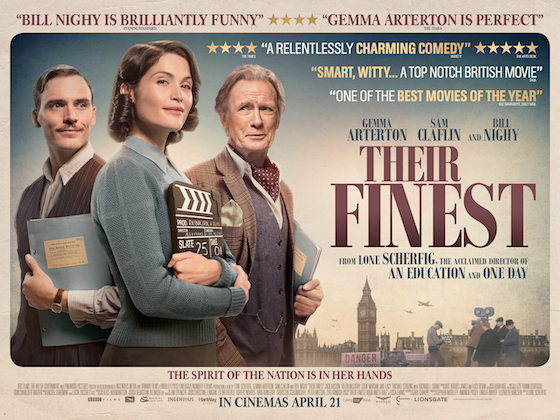
One of three Dunkirk-related movies released in 2017 (which is a bit random — it wasn’t a particular anniversary or anything), Their Finest is adapted from a novel by Lissa Evans called Their Finest Hour and a Half, which is a much better title. “Their Finest” is kinda bland and meaningless — slap it on any wartime film and it’d work just as well. The original title is a neat pun, though, mixing the famous saying (which comes from a 1940 Churchill speech, if you didn’t know) with the common running time of a movie, thereby indicating when the story is set (World War 2), what it’s about (the making of movies), and indicating a tone (it’s a pun, but not an outrageous one, suggesting lightness without going full-blown comedy). Maybe someone noticed this runs nearer two hours and didn’t want to give audiences the wrong idea…

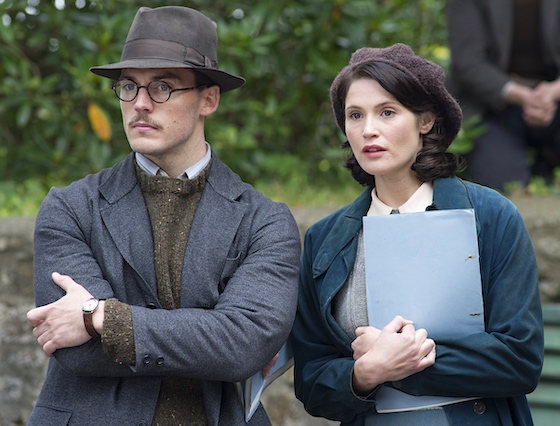
Their Finest Hour and a Half stars Gemma Arterton as Catrin Cole, a young woman in wartime London who finds work writing female characters’ dialogue in movies — “the slop”, as it’s derisively called by her combative superior, Tom Buckley (Sam Claflin). When a news story about twin sisters who took part in the evacuation of Dunkirk is fast-tracked into production, with a cast that includes fading leading man Ambrose Hilliard (Bill Nighy), Catrin and Tom wind up on location with the film, hastily rewriting to include changes mandated by the War Office. Despite Tom’s standoffish attitude and Catrin’s marriage to a good-for-nothing war artist (Jack Huston), who’s jealous of her newfound status as the breadwinner, affection begins to blossom between the two writers…

Hooray for the writers!

Yeah, much of Their Finest follows the expected shape of a story like this (the love triangle; the woman coming to be respected by her initially dubious colleagues; etc). Two things work to stop it feeling too staid: an engaging lead cast, and some weightier developments and subplots. The latter includes at least one wholly unexpected twist, which helps make this a more powerful film than the potentially-light “people go on a jolly to make a movie during the war” premise initially seems. There’s a somewhat classical balance of comedy and tragedy there, which is reminiscent of movies from the era the film’s set. Frame it in 4:3, shoot in black & white, and give everyone RP accents, and parts of it could almost be a ’40s melodrama.

Talking of accents, why oh why did they lumber Gemma Arterton with a Welsh one? It isn’t bad, exactly, but I did find it constantly distracting. Presumably it’s because the story is loosely based on the life of Diana Morgan, a Welsh screenwriter whose wartime work for Ealing Studios mostly went uncredited (though she does have one on the famous propaganda film Went the Day Well?, amongst a handful of others), but, considering it’s not actually a biopic, surely there’s no need for the accent? Well, other than to attract funding from the Welsh Government’s Media Investment Budget, I suspect… Anyway, it’s a minor complaint (as I said, her accent isn’t bad), and even with it Arterton is typically charming, generating good chemistry with Claflin, who plays a Mr Darcy-esque role as the initially-unlikeable inevitable love interest. As usual, Nighy threatens to steal the show, hamming it up just the right amount as Ambrose. He gets a significant subplot about his hard-fought transition from leading man to character actor, which also brings in Eddie Marsan and Helen McCrory — just two more high-quality actors helping round out a strong cast, which also includes Rachael Stirling, Richard E. Grant, and Jeremy Irons, among others.

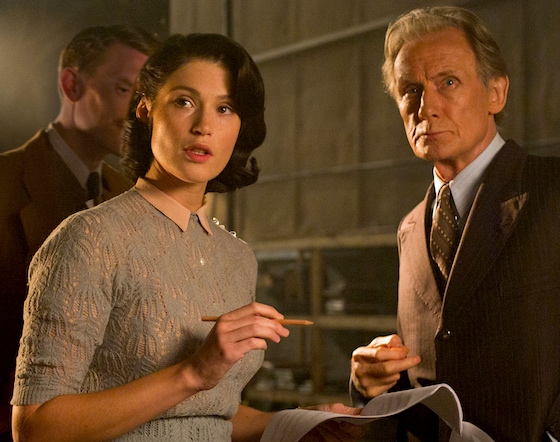
She's holding a pencil, she must be a writer

Ambrose is another man who initially misreads Catrin but eventually comes round to her. I suppose the “a woman proves her worth” element is another that’s been well-worn, but it seems fitting here, given that women in the film industry are still struggling to be treated equally. In this case, it’s using the “women suddenly in the workplace” reality of WW2 to make it both feel relevant to the present while remaining era-appropriate, unlike so many period movies that project present-day values onto eras where they don’t truly fit. It’s not as heavy-handed in its moralising as others can be, either.

Indeed, I’d say the entire film is very well pitched. It straddles the comedy-drama divide skilfully, entertaining as a jolly romance set in the world of moviemaking, but with enough grit from the reality of wartime to give it an edge. Everyone involved has, I’m sure, given it their finest hour-and-a-half(-and-a-half).

4 out of 5

The UK TV premiere of Their Finest is on BBC Two tonight at 9pm.

* It’s rated R for “some language and a scene of sexuality” — there’s a couple of “fucking”s and a brief glimpse of one practically-silhouetted breast. God, the MPAA are daft. ^

Bad Times at the El Royale (2018)

2019 #75
Drew Goddard | 142 mins | streaming (HD) | 2.39:1 | USA / English | 15 / R

Bad Times at the El Royale

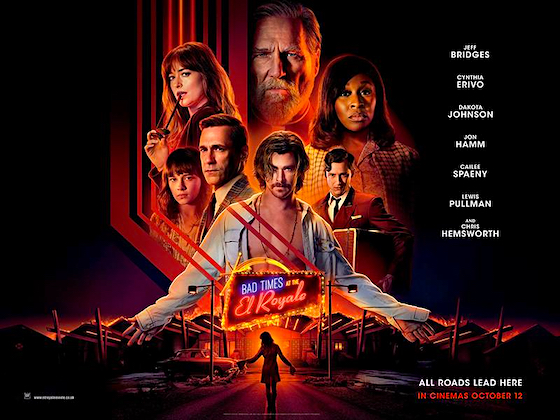
If you thought Tarantino copycats died out after the mid-’90s boom in Reservoir Dogs / Pulp Fiction wannabes, well, you’re sweetly naive — those still crop up from time to time, a quarter of a century too late. But the better emulators have evolved along with their inspiration, as writer-director Drew Goddard demonstrates in Bad Times at the El Royale, a film which feels like an imitation of latter-day Tarantino flicks. At least Goddard has the good sense to dodge the carbon-copy style of those Reservoir Dogs mimics by shifting genre, taking some of what QT brought to war movies in Inglourious Basterds and Westerns in The Hateful Eight and applying it to a neo-noir mystery-thriller. He even preempts Tarantino’s own oeuvre by including a Charles Manson-esque cult leader, thereby prefiguring Manson’s role in QT’s own Once Upon a Time in Hollywood.

Also like Once Upon a Time, El Royale sets its scene in 1969; and, like The Hateful Eight, its setting is an isolated establishment. That’s the eponymous hotel, a destination straddling the California/Nevada state line, which in its heyday attracted celebrities and what we’d now call “influencers”, but has faded since it lost its gambling licence and the wealthy patrons dried up. Now, over the course of one day and night, a variety of customers arrive, strangers, each with secrets, all of which will out in the twists of fate that ensue. All of that plays out in chaptered sections, divided with title cards, that mix in flashbacks and juggle the timeline of the present section as necessary — all of which are familiar Tarantino flourishes, of course.

One thing it shouldn’t’ve copied from Tarantino is the running time: just like many of his recent works, it’s longer than it needs to be. That’s not because the material is bad per se, but because the pacing isn’t tight enough. It seemed to drag its heels for no reason (again, I felt the Tarantino comparison), whereas a tighter pace might’ve contributed some tension, which I rarely felt despite the scenario screaming out for it.

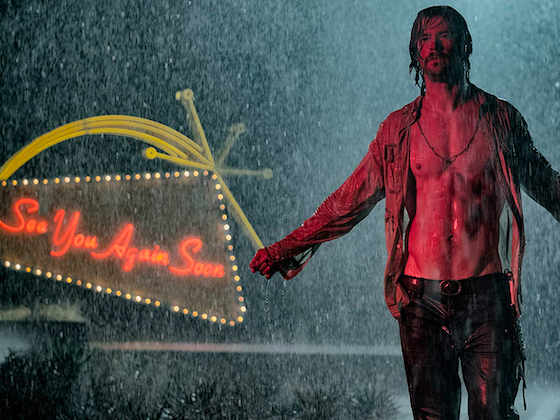
Heavy rain at the El Royale

Well, as the saying goes: if you’re going to steal, steal from the best. Heck, Tarantino has certainly borrowed plenty from his own wide-ranging influences. If you are going to imitate another filmmaker, this is the way to do it: by bringing your own characters and settings and plots and twists to the table. That might sound obvious, but so many of those wannabes are slavish in their borderline-plagiarism. Goddard doesn’t sink to that level overall, though there were some parts I felt were only a couple of steps above it. For example, the whole “the hotel is on the state line” bit seemed quirky for the sake of being quirky, imitating a bit that a filmmaker like Tarantino would use but without quite knowing how to use it (it plays a big role in the opening sequence, after which there’s one slight gag with it before it’s never mentioned again).

But such lapses were outweighed by the good. For one, there’s some very nice photography by Seamus McGarvey. It looks like it was shot on 35mm (I checked and it was, which proves Nolan & co are right when they say it does make a difference), which didn’t always translate too well to the 1080p stream I watched, but I suspect might look all the more stunning in 4K. Visual aside, much of what’s good stems from the characters, especially the strong performances by actors like Cynthia Erivo, Jeff Bridges, and Lewis Pullman. It was those, and in particular how each role comes together in the final act to define the whole character, that definitely elevated the quality of the film for me. And while those three are the highlights, there are also good turns from the likes of Jon Hamm, Dakota Johnson, Chris Hemsworth, and Cailee Spaeny. I’d say more, but so much of the meat of these characters comes from how they present themselves vs what the truth is revealed to be — the less you know, the more there is to uncover.

Rewatch you again soon

That said, I wonder if this is a film that will play better on a rewatch. There are several surprise plot developments I wouldn’t wish to spoil for a first-time viewer, for sure, and I do feel like that’s a worthy filmmaking tool (I don’t agree with that research that ‘proved’ audiences enjoy something more if they know the story beforehand — you don’t appreciate it more, you just appreciate different stuff, same as with a rewatch). But I feel like some of that plotting did distract focus from other bits of the film that were working well. Put another way, in my memory the niggles have damped down and I primarily recall the good stuff, so my enjoyment has gone up with hindsight. I’ll have to pick up the 4K disc at some point and give it another go.

For the time being, while I did like it overall, I judged it to be the kind of 4-star effort that could’ve easily become a 5-star top-ten-of-the-year film if it had just polished up everything that I felt didn’t work.

4 out of 5

Bad Times at the El Royale is available on Sky Cinema from today.

Sholay (1975)

2018 #200
Ramesh Sippy | 205 mins | DVD | 4:3 | India / Hindi | PG

Sholay

For many Western readers (and the stats say most of mine are, though India is in 3rd of all countries for 2019 so far), there’s every chance you’ll’ve only heard of Sholay (if you’ve heard of it at all) as “one of those Indian films that’s on the IMDb Top 250 nowadays”. But in Indian culture it’s a much bigger deal, a huge and longstanding success; like Star Wars or something is to us, I guess, only without the reams of sequels and spinoffs and merchandise and theme parks. Instead, it’s enjoyed remarkable success of its own: it topped the Indian box office for 19 years, was the first film in India to celebrate a Silver Jubilee at over 100 cinemas, and eventually set a record of 60 Golden Jubilees across India. From a British perspective, in 2002 it topped the BFI’s “top ten Indian films of all time” poll, and in 2004 it was voted the “Greatest Indian Movie” in a Sky poll of 1 million British Indians. I first heard about it years ago in that context, and my desire to see it was only exacerbated when it made it onto IMDb’s list. All of which is why I chose it to be my second-ever #200.

It’s a tricky film to sum up, because it offers a massive mash-up of tones and genres in a way we’re not accustomed to from Western cinema. There are whole sequences (not just fleeting moments) of broad slapstick humour, epic action, heartfelt romance, brutal violence, colourful musical numbers, intense tragedy, plus backstory that’s filled in via regular, lengthy flashbacks. It wouldn’t be a stretch to say its primary genre was Action, or Comedy, or Musical, or Western — it’s all of those things, by turn; sometimes at the same time. Apparently it’s a defining example of the “masala film”. Masala is, of course, a mix of spices in Indian cuisine, and the films that take that name blend genres together, typically (according to Wikipedia) action, comedy, romance, and melodrama, plus musical numbers.

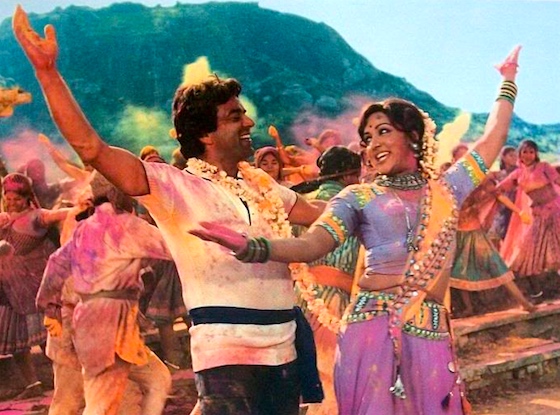
Who doesn't enjoy a colourful sing-song?

That sounds like a recipe for disaster, but what’s perhaps most remarkable about Sholay is that it pulls them off. Thanks to engaging characters and relationships, powerful and humorous performances, quality filmmaking (there’s some strikingly effective camerawork and editing in the big scenes), it all flows. You can see why it became such a success: there’s something for everyone. And you can see why it struggles to transcend the culture it originates from, because when Western movies ever even vaguely attempt this kind of range of tones, there are trolls aplenty waiting to rip them apart for the perceived fault of being tonally inconsistent.

The heroes are Veeru (Dharmendra) and Jai (Amitabh Bachchan), a pair of crooks with hearts of gold, who are recruited by a retired policeman who once arrested them, Baldev Singh (Sanjeev Kumar), to capture a wanted outlaw, Gabbar (Amjad Khan), who’s terrorising Singh’s village, and who he has a personal history with. The way that storyline plays out is highly reminiscent of Spaghetti Westerns and the samurai movies that inspired some of them — anyone who’s seen the likes of A Fistful of Dollars, Seven Samurai, or Once Upon a Time in the West (or any of the other films that have riffed on / ripped from them) is going to see a lot of reflections here. I don’t mean that to be a criticism — after all, Dollars was an unendorsed remake of Yojimbo, and Seven Samurai was remade as classic Hollywood Western The Magnificent Seven, so there’s strong pedigree among these movies for reworking each other to excellent effect.

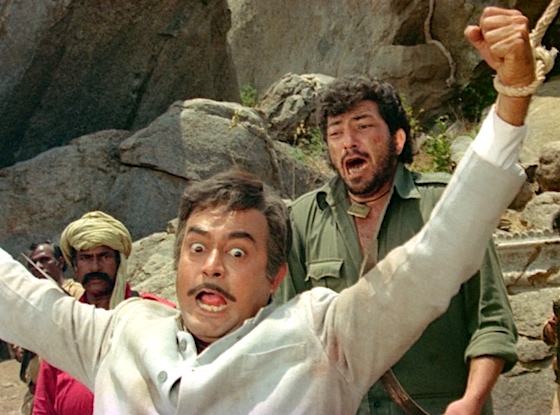
I'm not sure that's safe...

Sholay certainly adds its own stuff to the mix. I mean, those other films I’ve mentioned don’t have musical numbers or slapstick comedy (not much of it, anyway). Lest you think this plays as a spoof, Singh eventually unveils a tragic backstory (and a neat twist to his character), and Gabbar is a properly despicable, nasty villain. Plus, like most of the best bad guys, he’s not just evil for evil’s sake — he’s motivated to subjugate this particular village for a reason — but he’s still a properly nasty piece of work, excessively and inventively cruel. Rather than a spoof, then, the different genres come into play via an array of plots and asides. At times it does feel like a selection of unconnected subplots to bulk out the running time (and, as you may’ve noticed, it does have a long running time), but most of them come together in the end. Your tolerance for those that don’t (a lengthy comedic aside in a prison, for example) is another matter.

Musical numbers are another thing that put some people off. There are only five though, and they don’t actually drive the plot that much — I was kind of forced to assess their impact, because for some reason my DVD copy didn’t bother to subtitle the songs, leading me to search out translations online so I could get the gist. Still, when they fill several minutes of screen time each, it is nice to at least have an idea what’s being said sung!

In the West, Sholay has been hard to find at times (personally, it was years ago that I managed to source an out-of-print DVD by a label you’ve never heard of from an Amazon Marketplace seller), but as of this week it’s available on Amazon Prime Video in the UK (either as part of a subscription or to rent and buy individually), and in HD to boot! Based on the running time it’s the shorter widescreen theatrical version; there’s also a longer, open matte 4:3 “director’s cut”, which is what I watched. There’s info on the differences between the two cuts here, but the mostly it’s a couple of bits of violence that were censored. The biggest change, though, is the ending. No spoilers, but I think the original version is better — it included one of my favourite parts of the entire film, in fact. The revised version was at the insistence of India’s censor board, and includes a heavy-handed moral lecture — it’s not just less good in itself, it also feels overtly censor-mandated. Oh well.

Vicious villainy

On the bright side, the 4:3 version isn’t great to watch compositionally. The makers wanted to produce an epic 70mm widescreen kinda movie, but didn’t have the tech to do it properly, so they shot it in full frame 4:3 on 35mm and then had it cropped and blown up in London. Watching in 4:3, it’s obvious that it was always intended to be cropped to widescreen: there’s loads of dead space above everyone’s heads, things like that. That said, every once in a while there’s a shot that seems to be perfectly framed. Maybe they look just as nice cropped, I don’t know. To further muddy the waters about different versions, five years ago Sholay was converted to 3D. Despite the film’s enduring popularity, it didn’t come close to making its money back (the conversion cost US$3.5 million, but the 3D release only grossed US$1.4 million). In the West the studio would seek to recoup more of that with home media, but apparently Blu-ray isn’t popular or successful in India, so the chance of getting a 3D BD is basically nonexistent. But, as I said, it’s on Amazon in HD now, so at least there’s that. (Hopefully it has subtitles for the songs…)

Whichever version you watch, Sholay is best described as “an experience”. Perhaps lots of Bollywood movies are like this (after all, with huge success comes huge influence, and I’m sure many have tried to emulate it), but I’m not familiar with them so this was all new to me. That epic running time makes it feel like an event to watch, and the winding plot and variety of tones it encompasses make it feel like a whole buffet of entertainment, as opposed to the just one meal that most films offer. I guess, like any food that is foreign to an individual, it comes as an acquired taste, but it’s one I enjoyed immensely. It would also be entirely accurate and fair to roll out a somewhat clichéd sentiment: if you only watch one Bollywood film, this is the one to watch.

5 out of 5

As mentioned, Sholay is available on Amazon Prime Video now.

It placed 25th on my list of The 26 Best Films I Saw For the First Time in 2018.

The Past Month on TV #50

Last month, I said this month would hopefully feature Stranger Things 3, Veronica Mars season 4, and The Boys season 1. It doesn’t. Not any of them. But I’m not short of other things to write about…

Years and Years
Years and YearsThe writer most popularly known for reviving Doctor Who, Russell T Davies, returns to science fiction for the first time in almost a decade with this acclaimed miniseries. This is a very different kind of sci-fi, though — no space invaders or malicious AI or mad scientists here. No, this story begins in 2019 as we know it and then moves across the next 15 years to explore just where we’re headed, in a realistic and grounded way. It focuses on a normal family from Manchester — four siblings, their grandmother, and assorted spouses and children — and how the changes in society and technology affect them. It’s a story of the ordinary people; the folks who don’t shape history, history happens around and to them.

Cannily, it dodges the Brexit bullet — there are implications it went ahead, but it doesn’t have any bearing on the story: these big changes are happening everywhere anyway, whether Britain leaves the EU or not. What it is aware of is how much society and technology are now intertwined. In the first episode, a teenager comes out to her parents as trans — not trans gender, but transhuman. She wants to ditch the limitations of flesh and live forever as data. Some people will scoff at that, but the way it’s presented and plays out over the next five episodes is highly plausible. RTD tackles a whole host of societal issues in a similar way — immigration, the gig economy, nationalism, etc — all mixed together in a way that reflects real life. After all, we’re never just dealing with or worried about one thing at a time, especially nowadays.

As someone who grew up in the ’90s and ’00s, learning about the Cold War as an historical event, I sometimes wondered how people lived their day-to-day lives with the constant threat of nuclear annihilation. Except that’s not what it was actually like, was it? It may’ve been there, in the background, ebbing and spiking depending on the political factors of the day, but people just got on with their everyday lives while that played out on the news. It’s the same nowadays, isn’t it? There’s so much crap going on in the world, and most of it we just see on the news — unless it happens to butt into our own lives for whatever reason. And Years and Years is that same thing, but projected into future events; and not fantastical things, like a mission to Mars or an AI breakthrough, but a very plausible extrapolation of where we’re headed.

Personally, I thought it was a work of borderline genius. RTD has always had a way with characters — of quickly shading in believable individuals, their families and lives; of writing scenes that sing with dialogue and interactions that seem plucked straight from real life — and here that’s married with an imaginative vision of the near future, the two working in harmony to create a drama that’s also a warning about what we’re getting ourselves into… although it’s also an admonishment, showing us what we’ve got ourselves into and wondering if it’s too late to stop it. But there’s a dash of hope in there, too; just a sliver of “maybe it’ll be mostly OK in the end.” Fingers crossed.

Peaky Blinders  Series 4
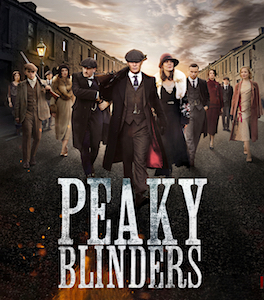
Peaky Blinders series 4Birmingham’s premier gangsters return with a storyline that forces them to reckon with their past actions. So it’s unfortunate that this is a show that can’t be doing with recaps at the start of episodes. I spent most of the first instalment trying to remember the events of previous series and how they’d led to where things were, which is an unwelcome distraction that could be easily solved with a simple “previously on” at the opening. I don’t know why Netflix hate them so much (well, I do — it’s the assumption you’ll just binge-watch everything, and if you don’t then they want you to feel you have to; and we’re all just buying into what we’re told to do, which is half the problem (funnily enough, that’s a lot of what Years & Years was all about…)

Anyway, once things get up and running, and you can get your head around what’s going on enough to be going on with, this is another thrilling story of ’20s criminality. Adrien Brody pops in as a series-long guest star, a Mafia enforcer from New York who has a vendetta against the Blinders because they killed his dad, and now he’s brought his American muscle to wipe them out. With bigger forces out to gobble them up, the Blinders must rely once again on a mix of their wits and straightforward firepower. The show itself is the same, blending together tricksy plotting (Tommy Shelby may always have a plan, but we’re not always privy to it until after the fact) and impressively staged action scenes (there’s an extended shoot-out at the start of episode five that must’ve eaten up a lot of the budget; and if it didn’t, they’ve done a good job making it look like it did). In fact, the series as a whole looks stunning — style drips off the screen, whether it be the slow-mo hero walks or the pulsating rock soundtrack.

For my money, the plot was a little smaller-scale than previous seasons, despite involving ever-bigger outside forces, which made it feel almost like an extended movie rather than a dense season of television. But don’t take that criticism too much to heart — previous seasons may’ve been even better in my personal estimation, but this is still top-drawer drama.

Unforgotten  Series 3
Unforgotten series 3Where the other shows reviewed this month are big, brassy productions told on a mythic scale, Unforgotten is almost the opposite, and yet it tackles themes no less grand. But it’s a quiet, understated drama, as London detectives Nicola Walker and Sanjeev Bhaskar (along with their team) investigate a cold-case murder, in the process having to tackle the fallout that time has wrought on the victims left behind.

This time, the skeleton of a teenage girl is found under a motorway, and it turns out to be a girl who disappeared on December 31st, 1999, and was a huge story at the time, which naturally leaves our little team under intense media scrutiny. (It’s somewhat amusing seeing this ITV-produced show get to use real ITV News presenters and graphics while the hero characters are slagging off the attitudes and methods of the media.) Unforgotten has the usual murder mystery array of suspects for us to theorise about, but what it also does well is portray the terrible sadness of such crimes. Reveals in the final episode push the storyline in a slightly different direction which allow it to pull focus in a different direction, too, although I’m not sure it really has the time or space to dig into that aspect.

Like Peaky Blinders, I don’t think this was the very best series of the programme (series two was harder hitting and even more emotionally complex), but it’s still more or less on form. It wears its heart on its sleeve, trying to treat these victims and suspects not just as pawns in an elaborate guessing game, but as real people whose lives have been torn apart. That makes it one of the better cop shows on TV, I think.

Also watched…
  • Agatha Raisin Series 2 Episodes 1-3 — Sky 1’s murder mystery series (which they cancelled but an American outfit revived and now they just buy in) is the very definition of cosy crime, though with enough humour that it plays more like a rom-com than a crime drama. Also, looks surprisingly gorgeous in UHD. Happily, there’s a third lot in production.
  • Beecham House Series 1 Episodes 4-6 — Oh yes, I stuck with this to the end. (Please let this be the end.)
  • Grantchester Series 4 Episodes 5-6 — Been catching up with this in bits and pieces, but just realised I’ve not mentioned it until now. James Norton’s gone off to bigger things (Joss Whedon’s new show, to be precise), so they’ve got a new co-lead, who’s fine. This season attempted an arc subplot with contemporary social relevance (a woman being harassed by a coworker), which went for the happy modern-ish ending rather than what I expect was the full misery of actually suffering that kind of thing in the 1950s.
  • Lucifer Season 3 Episodes 1-3 — Since I last watched it Lucifer has been cancelled, revived, recommissioned, and extended (Netflix ordered a ten-episode final season but, after fan outcry, added a further six), so I thought it was about time I got on with it. It’s a fun show, that I’ll probably be watching in dribs and drabs for a while. (See my reviews of seasons one and two, which broadly apply to season three as well.)
  • Susan Calman’s Fringe Benefits Series 1 — A mix of chat and standup from the Edinburgh Festival Fringe. Calman’s an infectiously jolly host, and the chance to get an overview of different acts, including ones you don’t see on TV as often, is nice. If anything, it’s a shame it’s only three 45-minute episodes — there’s so much going on at the Fringe, I expect they could do a half-hour every night and still not touch the sides.

    Things to Catch Up On
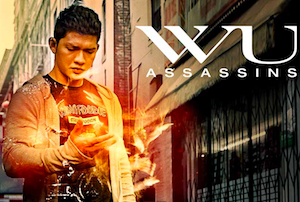
    Wu AssassinsThis month, I have mostly been missing Wu Assassins on Netflix, starring Iko “The Raid” Uwais. The trailers look perhaps a bit cheesy, but also promise regular doses of Uwais’ incredible combat skills, so that’ll do me. Elsewhere, Preacher has embarked on its fourth and final season. Considering I’ve not seen most of season two and none of season three, that’s a bigger catchup project. And talking of stuff I’ve not seen, I never got round to Mindhunter season one, even though David Fincher directed some of it, and now there’s a second season, which he’s also partly directed. Considering it’s been five years since his last movie, I do kinda need that Fincher fix…

    Next month… take your pick for what I’ll’ve watched and what I’ll’ve missed out of Peaky Blinders season 5 (starts tonight), Dad’s Army: The Lost Episodes (starts tonight), Sanditon (starts tonight), The Great British Bake Off (starts on Tuesday), Carnival Row (out on Friday), and The Dark Crystal: Age of Resistance (out on Friday). Bear in mind: I’ve only just finished one season of Peaky Blinders, and I didn’t much like The Dark Crystal. (Why do I feel like that means it’ll be the only one of these I end up actually watching…)

  • Aquaman (2018)

    2019 #55
    James Wan | 143 mins | Blu-ray (3D) | 2.40:1 | USA & Australia / English | 12 / PG-13

    Aquaman

    DC Comics have had a turbulent time of it on the big screen these past few years. After Zack Snyder’s Marmite Superman reboot Man of Steel they tried to get in on the Marvel-inspired “cinematic universe” boom with the unfairly-derided Batman v Superman and the behind-the-scenes mess that was Justice League, in between which the similarly “buggered about in post” Suicide Squad did them no favours. But they also attracted a lot of praise for Wonder Woman, mainly because it starred a female superhero (not unheard of, but a rarity on screen, and even rarer for a female superhero film to be good), and, earlier this year, Shazam! So maybe their fortunes are on the up again, especially as anticipation is high for both of their 2020 efforts, February’s Birds of Prey and June’s Wonder Woman 1984.

    In amongst all of that, in pretty much every respect (release date, critical standing, etc), we have Aquaman. Like Wonder Woman, it’s tied to the Justice League attempt at launching a shared continuity between these films; but, also like Wonder Woman, it doesn’t seem to have been tarnished by that association, grossing over $1.1 billion at the box office (Justice League maxed out at just over $650 million). While something about it obviously clicked with the general audience, in some respects it’s as much of a Marmite film as Man of Steel — although, tonally, they could hardly be further apart.

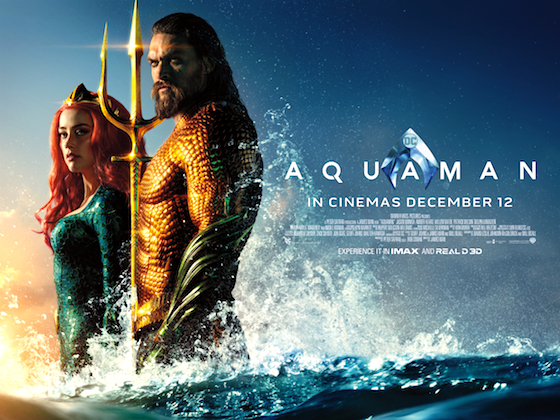
    For thems that don’t know, Aquaman is Arthur Curry (Jason Momoa), a half-human half-Atlantean chap, who was raised as the former by his lighthouse-keeper dad but has the underwater fish-communicating powers of the latter, which he uses to do superheroic things like rescuing submarines from pirates (those being modern high-tech pirates, natch). Arthur also has claim to the throne of Atlantis, but he doesn’t want it and there are plenty in the kingdom who would dispute it. But when the current king, Orm (Patrick Wilson), attempts to unite the undersea kingdoms to attack the world of men, his betrothed, Mera (Amber Heard), goes in search of Arthur, to convince him to return to his rightful place and blah de blah de blah.

    Searching for something. An understanding of the plot, probably.

    Yeah, the plotting is mostly sub-Game of Thrones fantasy gobbledegook, attached to an Indiana Jones-inspired quest plot that sends this sea-based superhero to the Saharan desert (in which he arrives to a rap-based cover of Toto’s Africa. I shit you not). That’s just one reason the film stretches out to a mind-boggling 143 minutes (aka almost two-and-a-half hours). It does feel like several movies stitched together; like someone couldn’t quite decide whether they wanted to do “medieval fantasy but under the sea” or “a globetrotting Indiana Jones adventure”, so just did both at the same time.

    Along the way, some of it is thoroughly cheesy — the dialogue, the outright fantasy-ness, the vibrant colour palette, the music choices (see above). It’s hard to know if it’s being deliberately cheesy, or if someone felt this stuff was a good idea in seriousness. Whether or not it works is a matter of personal taste, but at least it’s noticeably different from its po-faced label brethren or the slick factory-produced adventure-comedy tone of the Mouse House competition.

    There’s an odd vein of ’80s-ness, too: some of the plot directions, Rupert Gregson-Williams’ score, that aforementioned song choice again (whether you despise that song or find it kinda tackily amusing is perhaps a bellwether for your opinion of the film.) This feels like the kind of undersea adventure movie someone would’ve made in the wake of Raiders of the Lost Ark and Conan the Barbarian, if only they’d had the effects tech back then. Except, of course, by using all the CGI that current tech allows, it’s also very much a modern graphics-laden blockbuster. Those two eras, the 1980s and the 2010s, kind of butt up against each other — it’s not being outright an ’80s emulation like, say, Stranger Things; it’s more this weird influence that sometimes rears its head.

    Imagine this in IMAX 3D. Just imagine.

    That includes in some of the action scenes, which were shot on real sets with real actors (gasp!) Not all of them, naturally (there’s a mindbogglingly massive undersea battle involving thousands of soldiers and sea creatures), but those that were done for real are incredibly staged and shot — a running rooftop fight in Italy is beautifully done. The general imagery is often fantastic, too. Not always (sometimes it’s just fine; sometimes it’s too much), but there are incredible, impressive, comic-book-panel-on-screen shots here. So it’s a real shame that Warner have forced a choice between 3D or a shifting IMAX aspect ratio on Blu-ray. As regular readers know, I enjoy 3D and I love a shifting aspect ratio, so being forced to pick is upsetting. Marvel normally tick both those boxes by including the IMAX ratio only on their 3D releases — annoying for 2D-only IMAX fans, I know, but I’m well set. Warner have done the opposite, however, with the 2D releases including the IMAX ratio and the 3D remaining locked to 2.40:1. To say I’m disappointed would be an understatement, because the 3D adds so much to the big sequences, but I can imagine the IMAX ratio shift would too — together, they’d be perfect, but Warner won’t let us have that. So, I did enjoy the film’s 3D a lot, but at some point I’m going to make time to watch it again in 2D for the ratio shifts. I’ll plump for it in 4K too because, considering that the film’s colours are already pretty vibrant in SDR, I bet they’d pop delightfully with HDR.

    Setting format complaints aside, I had a lot of fun with Aquaman. The spectacle is so genuinely spectacular, and the humour and/or cheesiness is so don’t-know-whether-to-laugh-or-groan fun, and the overlong running time stuffed so full with so many different ideas, that I couldn’t help but find the whole heady mix downright entertaining.

    4 out of 5

    Aquaman is available on Sky Cinema from today.

    Rampage (2018)

    2019 #61
    Brad Peyton | 107 mins | download (HD+3D) | 2.40:1 | USA / English | 12 / PG-13

    Rampage

    A big-budget live-action movie adaptation of a 32-year-old arcade game that I’m pretty sure only old and/or hardcore gamer geeks remember? Was that the wisest moviemaking decision? I mean, there’s nothing wrong with being old, but is a PG-13 CGI-fest like this really aimed at that age group? Well, I guess these days it is, so maybe it wasn’t such a poor commissioning decision after all — and it made over $428 million at the box office, so someone knew what they were doing. And, before this year, Rampage was tied for the honour of being the best-reviewed video game adaptation ever made… though as it achieved that with a Rotten Tomatoes score of just 52%, it’s certainly damning with faint praise.

    Anyway, I don’t really care about all the video game-y stuff. I’m here because it’s a The Rock movie, and I tend to find his stuff pretty entertaining nowadays (as do many others — I bet he’s a bigger part of that $428 million than “based on a video game” is), and it’s about an ape, a wolf, and a crocodile who get mutated into giants and set about destroying Chicago. I mean, who doesn’t want to see that? (Yes, I know: well-adjusted adults who actually grew up.)

    If you think I’m being facetious, nah, that’s the plot; or it’s the climax, anyway, and the rest of the film exists as a way to find a narrative reason for said climax to happen. Naturally, with such a batshit barmy climax as the end goal, the story that gets us there is thoroughly daft also. It involves corporate skullduggery and genetic experimentation and all kinds of stock plot-building stuff like that, but at least it’s all executed with a certain amount of humour. No one is taking this too seriously.

    Monkeying around

    So it’s a little odd, then, how gruesomely violent and gory it gets, and sometimes kinda unnecessarily cruel with it. But there are no nipples and only one use of “fuck”, so, sure, PG-13! I would describe the gore, but a lot of it is kinda spoilery so I’ll refrain; but the film’s opening shot features a drop of blood floating into a dead guy’s empty eye socket, and later we see people ripped in half, one character falls into the mouth of a monster in slow motion, we see another get beheaded and the head get eaten… Yeah, okay, it’s all ridiculous CG BS, but still.

    The Rock is truly the closest thing we have to a genuine Movie Star right now, I think — a guy who can still lead a movie on the strength of his name and likeability alone (look how many original or near-as-dammit-original movies he’s done in the past few years that’ve made bank). He’s got just the right level of charm to keep us engaged and on side without it tipping over into smarminess. He also has a remarkable skill (or at least I think he does) whereby, without breaking character or immediately undermining what’s happening, he lets us know that the story and its antics shouldn’t be taken too seriously because, hey, it’s just an action movie. Or maybe that’s just something I inherently infer from his very presence, considering the kinds of movies he stars in and the fact he always plays more-or-less the same character. Anyway, in this one he convinced me that he had a tight brotherly bond with a giant CGI ape, and consequently made me care about the fate of said collection of pixels, so that’s an achievement in itself.

    “Jeff, stop chewing the scenery — that's the CGI's job.”

    This time, most of the rest of the lead cast are in on the gag too, with Jeffrey Dean Morgan chewing more scenery than the monsters as a cowboy-ish government agent, and Malin Akerman and Jake Lacy hamming it up as the corporate bitch villain and her halfwit brother. Naomi Harris pops up as The Rock’s love interest cum sidekick, who’s a clever scientist lady and can hold her own in a verbal slanging match with him, but, yeah, is still primarily there to be the love interest.

    Rampage is not big and it’s not clever, but it is kinda fun. Although it is actually quite big — that’s kinda the point. But anyway, it’s mostly big dumb fun, and naturally a lot of that looks pretty awesome in 3D. I liked it as a thoroughly ludicrous, brain-off entertainment.

    3 out of 5

    Free Love Freeway: A Final Roundup from Quentin Tarantino’s Swinging Sixties Movie Marathon

    Free Love Freeway may contain the most memorable gag in the original version of The Office (two of them, actually), but it’s also a surprisingly good song in its own right (catchy, at any rate). And it seemed a very fitting title for this final selection of films from Quentin Tarantino’s Swinging Sixties Movie Marathon, which all deal with end-of-the-’60s cultural movements about love and freedom. Heck, if Easy Rider had actually been called Free Love Freeway, it wouldn’t’ve seemed ill-fitting.

    In today’s roundup:

  • Cactus Flower (1969)
  • Easy Rider (1969)
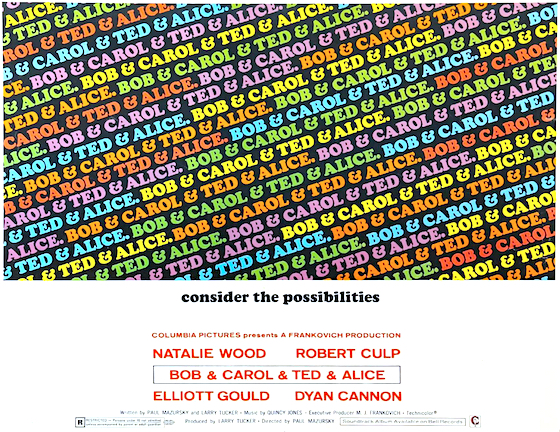
  • Bob & Carol & Ted & Alice (1969)


    Cactus Flower
    (1969)

    2019 #113
    Gene Saks | 99 mins | TV | 16:9 | USA / English | PG / PG

    Cactus Flower

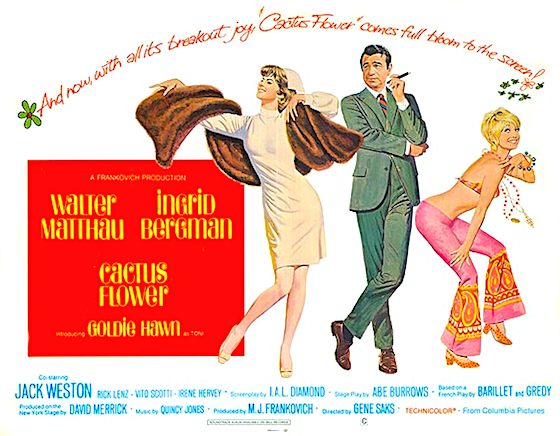
    Perhaps most noted for featuring the big-screen debut of Goldie Hawn (sort of), from which she won an Oscar and a career, Cactus Flower has a lot else to commend it. Indeed, it’s easily arguably that her’s isn’t even the film’s best female performance…

    Hawn plays Toni Simmons, a young New Yorker who’s having an affair with an older dentist, Julian Winston (Walter Matthau), under full knowledge that he has a wife and three kids. When they cause him to miss a date with her, she decides to kill herself, only to be saved by her neighbour, wannabe playwright Igor (Rick Lenz). When Julian hears of Ton’s suicide attempt, he realises he actually loves her and wants to marry her. There’s just one small problem: his wife and kids… who aren’t actually real, they’re a lie he told Toni to avoid commitment. Now she’s determined to meet them, to ease her conscience about breaking up a household, so Julian coerces his redoubtable secretary Stephanie (Ingrid Bergman) to play his wife. And from there, the lies spiral farcically out of control.

    It’s easy to see why Goldie Hawn, with her pixie haircut and pixie-like demeanour, became a star after this. Toni is a bit kooky and funny, almost a Manic Pixie Dream Girl, especially as she’s inspiring a change of lifestyle in a man. To reduce her to MPDG status does a disservice to Hawn’s performance, though. She also brings heart and an honesty to the part, giving Toni more of a plausible internal life than you find with true MPDGs. She’s not just some fanciful construct there to direct the male lead to a ‘better’ life — she has her own desires and needs, and a moral compass that, while maybe slightly irregular (she was knowingly having an affair with a married man, after all), still points true and directs the story.

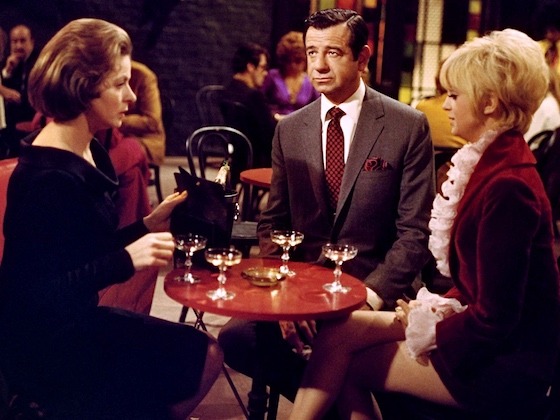
    Walter's women

    But while Toni may be the headline act, what becomes clear over the course of the film is that this is actually Stephanie’s story — she is the titular flower. It starts off as a one-note supporting role: the formidable secretary to the male lead, running not only his practice but also his life because he’s incapable of doing it himself. Asked to be embroiled in his latest love affair, she’s reluctant — that’s one part of his life she’s never been involved in; indeed, it’s an aspect of her life she’s not been involved in for a very long time. But, almost accidentally stumbling her way into it regardless, she begins to come out of her shell and realise what she really wants from life.

    That’s why it’s more Bergman’s film than Hawn’s, or anybody else’s; not only because Stephanie, as it turns out, is the title character, and not only because she goes through the biggest change, but also because Bergman plays it so well. There are obvious bold moments where we see how she’s developing, but Bergman also plots out it with subtle bits of acting along the way, and her comic timing is spot-on too. But whoever you argue is ‘better’, the film really belongs to the two women. Nothing against Matthau and the other men, who aren’t at all bad (you can see how Lenz was once earmarked as a new Jimmy Stewart, and Jack Weston pops in for a comic relief sidekick part). But the story is really about the women, how they behave and develop and change; and dictate the men’s actions, deliberately or otherwise, as pretty much anything any man does in this film is a reaction to one of the women’s actions.

    The film was adapted by I.A.L. Diamond (Billy Wilder’s regular screenwriter) from a Broadway play (by Abe Burrows) that was based on a French play (by Pierre Barillet & Jean-Pierre Grédy), it’s difficult to say who exactly is responsible for the sparkling, funny dialogue (well, anyone who’s read the play would know where to attribute credit, I guess); but Diamond opens things up enough that, unusually, the theatrical roots are well hidden.

    4 out of 5

    Easy Rider
    (1969)

    2019 #114
    Dennis Hopper | 91 mins | TV | 1.85:1 | USA / English | 18 / R

    Easy Rider

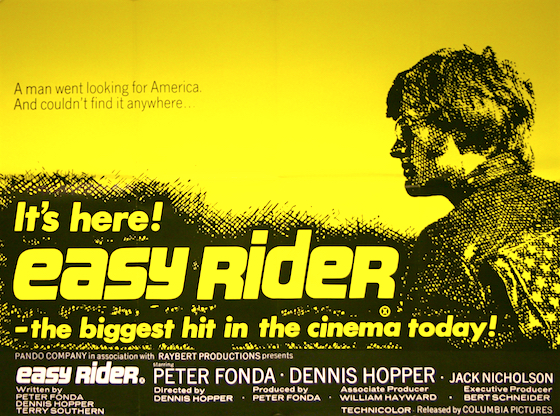
    Perhaps the defining movie of the ’60s counterculture, this bike-based travelogue sees Peter Fonda and Dennis Hopper travel across the US in search of… what? Some specific goals are mentioned, but really it seems they’re searching for something to search for; for what life they really want.

    Easy Rider is very much a movie of its time. It’s not just from 1969, it is 1969 — a loose, freewheeling, drug-fuelled (apparently Hopper and Fonda were off their faces for most of the shoot, which was significantly improvised) portrait of a lifestyle and an era. While the filmmaking qualities may have endured such that it’s still an engaging watch today, with a fresh and experimental edge that makes it kinda timeless, there’s no doubting that this is a movie wholly located at the end of the ’60s. Or, as Tarantino put it, “it captures the sixties in a way that’s tangible.”

    Parts of it almost look like a travel documentary, with montages of the scenery and places that the characters pass by. But it’s also like a documentary of attitudes: from a hippy commune, whose residents are even more invested in the radical social notions of the era than our transitory heroes, to the traditional Southern towns, where long-haired bikers are viewed with suspicion. Jack Nicholson pops in for a cameo-ish supporting role where he makes a speech about the American attitude to freedom that sums up what the film has to say quite succinctly: that talking about freedom and being free are two very different things; and those average Americans, who go on about “freedom” as one of the country’s cornerstones, see real freedom and are scared by it. At first glance Nicholson’s speech is just one rambling tangent in a film made up of them (at first I was on board with that, though I confess I ended up getting a little bored by it), but the ending makes its relevance clearer. As Tarantino realises on the spot during filming of his post-film chat, “in a weird way, the ending is actually what makes Easy Rider have a story. I don’t even know if you could say Easy Rider has a story until the ending. The ending makes what’s happened before a story.” He’s got something of a point, although I still wonder: does it actually have a story? Or is it just a hangout movie with some hippies on a road trip that forces an abrupt ending because (a) it has to end sometime, and (b) well, maybe it can kinda make a point in how it concludes.

    Born to be wild

    Still, there’s a lot to be analysed about the film’s ending, not only its retrospective effect on the rest of the movie but also what it itself is saying. Part of its power comes in its shock value, so I don’t want to give away what happens; although Tarantino reckons it’s also part of why the film was such a box office success (in an era when a high-grossing film brought in something like $12 million, Easy Rider netted over $41 million), so audiences likely knew what happened before seeing it. Certainly, “how it ends” is not the only reason to watch the film (if ever the saying “the journey is more important than the destination” was relevant, it’s here); but also, as I say, the finale comes out of the blue and surprise is part of its effect. Well, to offer a spoiler-free commentary I’ll just quote Tarantino again, who says the “nihilistic ending […] kind of promoted a new view amongst young people in America. ‘Well, you can’t win.’ It was a very nihilistic time in America when it came to thinking about the America we had grown up in, the America we had been told what America is, the apple pie image. Easy Rider kind of flies in the face of that.”

    Easy Rider is so embedded in a particular worldview that your opinion of that, and how much you embrace that lifestyle (or the romantic image of it), is liable to influence your opinion of the film itself. If these characters are the kind of people you’d enjoy hanging out with, you’ll likely enjoy hanging out with them for 90 minutes of screen time. If you despise that whole way of thinking, this movie isn’t going to convert you (you’ll be glad of the ending in more ways than one, though). For those of us somewhere in between, well, it’s an interesting experience to try out.

    4 out of 5

    Bob & Carol & Ted & Alice
    (1969)

    2019 #117
    Paul Mazursky | 101 mins | TV | 16:9 | USA / English | 15 / R

    Bob & Carol & Ted & Alice

    If Easy Rider was the freeway, here’s the free love.

    Bob (Robert Culp) and Carol (Natalie Wood) are a middle-aged, middle-class couple who go on a weekend retreat that changes their perspective on the world — they come back with freer thoughts and a freer attitude. Their friends, couple Ted (Elliott Gould) and Alice (Dyan Cannon), are a bit bemused by their new outlook and how it seems to have changed them. And things are really thrown for six when Bob has a one night stand while on a business trip and confesses it to Carol, who not only instantly forgives him but also tells Ted and Alice, who have a more complicated reaction.

    At first glance the film looks like a character study, because it’s so centred around its eponymous quartet and their feelings about a specific set of circumstances (I’ve described almost the entire ‘plot’ above — the rest is to do with how the characters feel about it, and what they do in response). But it’s not so much a study of characters as it is of an issue, with the four characters representing four different perspectives and attitudes. And that issue is sex. Or as Alice puts it at one point, “that’s all that’s on their minds, is sex. Sex, sex, sex, and sex.” Actually, that’s a bit of a simplification, because it’s also about marriage, and what sex means relative to marriage. That’s probably what makes it interesting: it’s not about young hippies demonstrating “free love” by shagging everyone; it’s about affluent adults encountering this philosophy and seeing how it adapts to their own situation.

    Married life (before orgies)

    It’s also another film with an ending that’s open to interpretation —even more so than Easy Rider, perhaps, because it’s more ambiguous. It’s given away by some of the film’s posters: the four friends end up in bed together. “Listen, you tell me why do you think we came up here?” asks Alice. “To have fun,” replies Carol. “And what is more fun than an orgy?” What indeed. Well, possibly going to see Tony Bennett, as it turns out. Or possibly not. It looks like the four friends get to a certain point, then regret it and get dressed and go out to the concert they’d been planning to attend… but then the final sequence is dreamlike, clearly non-literal. So did they actually stop, or did they just get it on off camera? Writer-director Paul Mazursky expressed a definitive opinion later in his autobiography, so we know what he intended, but the film as-is kind of allows you to form your own opinion. Depending what you think should happen — which of the different perspectives you became aligned with — allows you to pick what does happen. Or you can just believe Mazursky and then decide whether you like the ending or not, I guess.

    Bob & Carol & Ted & Alice is as specifically about social attitudes of 1969 as Easy Rider was, but the different here is many of those attitudes have endured. There are certain sectors of society that have moved well past the arguments being had here, but many haven’t, and you can almost imagine this self-same series of debates playing out in a modern setting (although nowadays I’d say Bob and Carol’s radical thinking is less likely to come from a weekend away at a camp and more likely to be something one of them read on the internet). Plus it’s got a quote for every occasion, though if you want one that sums up the overall philosophy of the time, perhaps Carol says it best: “It’s just nice feelings. It’s something that we’ve never done before. It’s physical fun. It’s just sex. Oh, come on, it’ll be fun!”

    4 out of 5

  • Quentin Tarantino’s Swinging Sixties Marathon Roundup: Westerns

    Here are two more selections from Tarantino’s movie marathon. He included them because they’re the kind of fare the lead character from his new film (Leonardo DiCaprio’s Rick Dalton) might’ve appeared in. They’re both Westerns (obv.), and they’re on TV (in the UK) again as a double-bill later today.

    In today’s roundup:

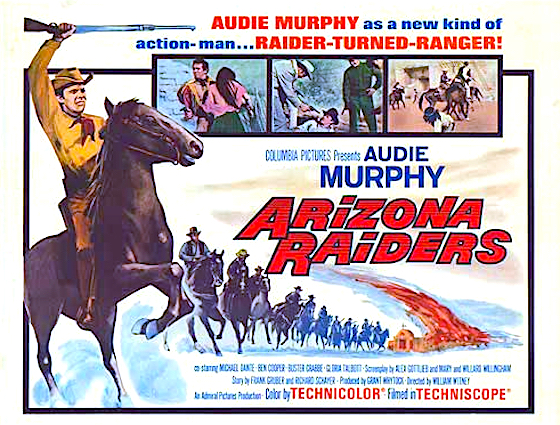
  • Arizona Raiders (1965)
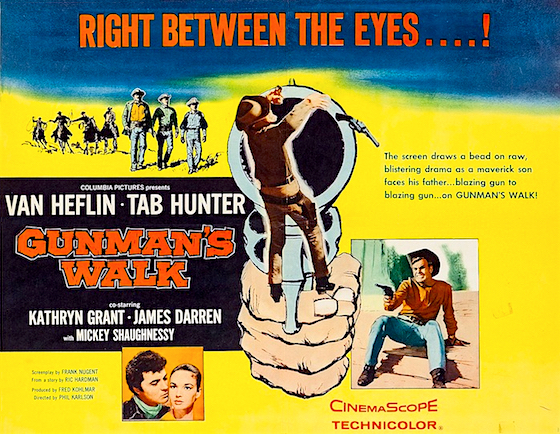
  • Gunman’s Walk (1958)


    Arizona Raiders
    (1965)

    2019 #108
    William Witney | 93 mins | TV | 2.35:1 | USA / English | NR* / PG

    Arizona Raiders

    Arizona Raiders begins with a double prologue that fills us in on the history of Quantrell, a bloodthirsty commander for the losing side in the American Civil War, who now runs rampant with his gang of former soldiers. In what would be a kind of prologue if it wasn’t for the two other prologues, the good guys, led by Captain Andrew (Buster “Flash Gordon” Crabbe, who starred in an unrelated film with the same title three decades earlier), finally catch up with Quantrell’s gang, who scatter, though some are captured and some are killed — including Quantrell himself. All that time telling us his life story, and the guy’s barely in it…

    But that’s not the end for his gang, as an already mutinous lieutenant re-establishes it and begins rampaging again. A few years later, they’re terrorising Arizona, and Andrew is tapped to establish the Arizona Rangers — like the Texas Rangers, but in Arizona (clever, that) — and stop the gang. His bright idea is to break out two of the gang members he captured in the raid, Clint (Audie Murphy) and Willie (Ben Cooper), and send them undercover. The prison break works fine, but the guys aren’t convinced about whose side they should be on, even though Clint’s adoring younger brother is a fully signed-up Arizona Ranger and helping them on the mission.

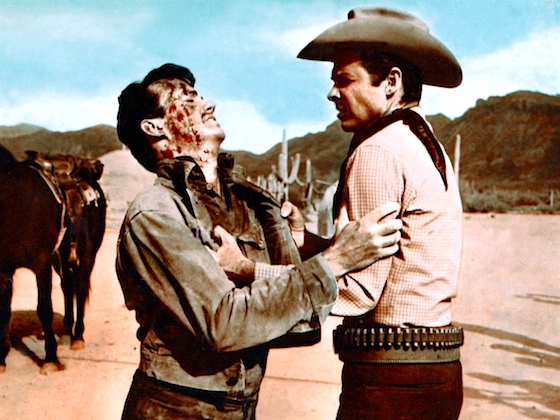
    Really quite brutal in places. Mainly his face, it looks like.

    I guess this is the kind of programmer they used to make piles of back in the day — the sort of good old fashioned Western where outlaws who’ve been living rough for months wear neatly-pressed shirts and boast clean-shaven features. At least its morality is more complicated than the old “white hats good, black hats bad” style, with anti-hero(es) for the lead role(s) — Clint and Willie aren’t just former criminals, you’re not sure they won’t just go back to their old ways once they meet up with their former gang. It gets really quite brutal in places too, with more bloody violence than you might expect from a Hollywood feature of its time.

    Initially I thought this was only interesting for the context it provides to Once Upon a Time in Hollywood, especially during the unusual opening 20 minutes. But it steadily improves as it goes on, developing into a pretty entertaining adventure, which includes a tense shoot-out halfway through and some surprising developments in the second half. Plus, with the dubious morality of its heroes and some relatively graphic violence, it’s perhaps a surprising for a classic-era Hollywood Western, too.

    3 out of 5

    * This hasn’t been classified by the BBFC since its original release in 1965, when it was cut to just 89 minutes and given an A. You can rent it from Amazon (in HD too), where they say it’s rated 12. ^

    Gunman’s Walk
    (1958)

    2019 #109
    Phil Karlson | 90 mins | TV | 2.55:1 | USA / English

    Gunman's Walk

    I found that much of Quentin Tarantino’s Swinging Sixties Movie Marathon was, to be kind, a mixed bag. I’d never even heard of most of the movies (the two I had will be in the next roundup), and it seemed like that was for good reason: watching them was interesting in one way or another, but I didn’t always particularly enjoy them. Proof in point: in the six reviews I’ve posted so far, I’ve given four poor two-star ratings and two middling three-star ratings. Gunman’s Walk is a definite exception, however: I’d never heard of this one either, but it’s a great Western, easily my favourite film of the marathon (so far), and I feel like it generally deserves to be better remembered than it is (and better treated — for example, the only Blu-ray release is in Germany).

    At its most basic, it’s the story of a powerful rancher, Lee Hackett (Van Heflin), and his two grown sons, Ed (Tab Hunter) and Davy (James Darren), and the tribulations they face after Davy falls for a half-Sioux girl (Kathryn Grant) and Ed kills her brother, he says by accident, but witnesses say not. More than that, though, it touches on a handful of thematic points. It’s set at a time when the West was becoming less Wild: with towns and communities established, civilisation has truly arrived, and it risks leaving behind the frontiersmen who conquered the West — men like Lee Hackett. Tied to that is the way Lee has tried to raise his sons, in his own image, and almost more as underlings than children — he encourages them to call him “Lee”, for instance, and insists they obey rules like always wearing a gun.

    I won’t spoil the twists and turns of the plot, but it’s a great narrative, powered by some superb performances. Heflin gets the biggest arc, with a multi-faceted role that takes a confident, commanding man through his paces to expose who he really he is, and how he really feels about his effect on the world. There develops an inner conflict within Lee, and the story and Heflin’s performance navigate its expression in various ways, both positive and negative. It seems like he’s an upstanding father at first, but then we see how this upbringing has twisted one of his sons, and when he’s confronted with problems we see the real man underneath — the man who thinks he’s above the law, and will do anything to get his own way. He likely doesn’t think of himself as having such negative qualities, but they’re clearly part of his character, and his sons — one of them, at least — has picked up on that and adopted it more overtly. At the end, when Lee realises that he’s ultimately responsible for creating this monster (albeit unintentionally), he then seems to realise his own flaws too.

    Toxically masculine

    Hunter and Darren’s characters are a bit more straightforward — the good son and the bad son — but they embody those roles well, with Darren a likeable nice guy and Hunter a boo-able wayward son. That’s a bit of an unfair simplification, actually, both of the story and character arcs and of Hunter’s performance. At the start Ed is merely not a very nice chap, bullying and sullen, whereas over the course of the movie he develops into a cold-blooded murderer. At no point are we on his side, but his degeneration affects characters we do like.

    These days we’d say Gunman’s Walk is about toxic masculinity, in particular how it’s perpetuated, even if unintentionally. Lee has set very macho examples for his boys; although, while his ways are certainly becoming outdated, they’re not wholly dishonourable. Unfortunately, Ed has taken the wrong lessons from his father, and consequently developed values that are not only out of time but also twisted out of shape. He believes they’re How A Real Man Should Behave, even as we can clearly see how nasty they are. Davy stands in counterpoint: he was raised by the same father but has turned out alright, although that’s clearly by rejecting some of his father’s instructions. So both kids are formed in reaction to their father, for good or ill — literally for good and ill, respectively.

    Talking with Tarantino, Kim Morgan says the film is more progressive than you’d expect from a ‘50s Western, specifically with regards to how it presents quite an anti-violence stance. I think that’s a fair assessment, and the film seems ever so timely, over 60 years later, with talk of prohibiting the carrying of firearms in town, etc. Apparently this was a genuine social issue back in the late 19th century too, which really shows how slowly the USA changes its attitudes. But a similar point can be made about the film’s treatment of Native American characters. After that killing of the brother, its his two Native American friends who were the witnesses to Ed’s actions. They’re the ones telling the truth, and, in fairness, the judge weighs their evidence equally against Ed’s… although as there’s two of them and one of him, and he takes that as being unsolvably balanced, I guess maybe not wholly equal. (Then again, the two guys are friends, so of course they’d support each other’s accounts.) But as soon as another white witness steps forward, well, that settles it. So even as they’re not specifically ill-treated, the system is still stacked against them. Elsewhere, characters use derogatory insults (“half breed”), but those issuing the insults are clearly pitched as bad guys, while Davy, the good son, wants to marry someone who places herself clearly on the Natives’ side. OK, so they’re still minor supporting characters, and the girl is half white and looks it (of course she does — it’s a ’50s Western, everyone’s white really), but, for the time it was made, it’s pretty advanced.

    For whatever reason, Gunman’s Walk has become rather lost to time. I think it really merits a rediscovery, though: so many of its themes are exceptionally timely right now; but even aside from that, it’s just a damn good tale.

    4 out of 5

    Gunman’s Walk placed 14th on my list of The 15 Best Films I Saw For the First Time in 2019.

    Arizona Raiders and Gunman’s Walk are both on Movies4Men today from 5:10pm.

  • Quentin Tarantino’s Swinging Sixties Movie Marathon Roundup: Spy-Fi

    I introduced the concept behind QT’s movie marathon in my previous roundup of films from it, but to quickly recap, these are all movies with a connection to Tarantino’s latest flick, Once Upon a Time in Hollywood.

    While many of Tarantino’s selections speak to the setting of OUaTiH (in terms of depicting its time and place on screen, or the social landscape of its era), others have a bearing on it in quite a different way. These are movies his characters might’ve seen, or might’ve appeared in, or (in the case of Sharon Tate) did actually star in. Three of those also fall under the banner of espionage fiction. Two hail from the James Bond-inspired spy-fi craze of the ’60s, while one is a ’50s war movie about a secret mission. (Yeah, that last one is stretching the definition — it’s not really a spy movie at all — but it doesn’t pair up with anything else in Tarantino’s selection, so here it is.)

    In today’s roundup:

  • Hammerhead (1968)
  • The Wrecking Crew (1968)
  • Battle of the Coral Sea (1958)


    Hammerhead
    (1968)

    2019 #112
    David Miller | 95 mins | TV | 16:9 | UK / English

    Hammerhead

    The success of the James Bond movies led to a whole raft of imitators throughout the rest of the ’60s, a spy-fi craze that kickstarted other long-running franchises like Mission: Impossible and The Man from U.N.CL.E. Of course, as well as the memorable and enduring successes, there were piles of cheaply-made, entirely-forgettable knockoffs. Hammerhead is one of the latter. Like Bond, it’s based on a series of espionage novels, these ones by James Mayo (pen name of English novelist Stephen Coulter) and starring the character Charles Hood. Coulter had been friends with Ian Fleming, and apparently (according to Quentin Tarantino) his Hood novels were popular with secret agent fans because they were written in a similar style to Fleming. Hood didn’t have the staying power of Bond, though, the series running to just five novels which (as far as I can tell) haven’t been in print for decades. On film, he fared even less well: this is the only Charles Hood movie.

    The film’s biggest problem is its desire to be a Bond movie, but without the money or panache to carry it off. As Hood, Vince Edwards has none of the easy charm of Sean Connery, instead seeming like a stick-in-the-mud who’d rather be anywhere else (preferably back in the ’50s, I suspect). And the film itself so wants to be like Bond that there’s even a pop song named after the titular villain… though rather than playing over the opening credits, it pops up two or three times mid-film, incongruously played diegetically. As a Letterboxd reviewer put it, “apparently in the late ’60s if you were a pornography-obsessed master criminal you could also be the subject of a pop song.”

    Oh yes, that’s right: the villain collects porn. Not just any old rags, though, but Art — paintings and sculptures by renowned masters, that kind of thing, just ones that feature boobies. Something about that does feel ever so ’60s. The film itself is as pervy as its villain’s obsession. Well, okay, maybe not that pervy, but there are certainly gratuitous shots of women in their underwear, etc. Perhaps the most egregious is the closeup of female co-lead Judy Geeson’s bouncing behind as she rides on the back of a motorbike up some steps, complete with boinging sound effect. That’s about as explicit as it gets, though: it may be firmly set in the Swinging Sixties, with up-to-the-minute fashions and scenes set at experimental art happenings, but it’s stuck in the past enough to not feature any actual sex or nudity, just plenty of cleavage, gyrating dance moves, and the odd bit of innuendo (don’t expect any Bond-quality puns, mind — it’s not that clever).

    Trying to swing

    I haven’t mentioned the plot, but it’s a frequently nonsensical bit of nonsense involving a report so top-secret its author has to have a highly public cover story for what he’s supposed to be doing while he actually sneaking off to present to international delegates who’ve arrived in the country unannounced. If anyone ever said what this report was actually about, or why the conference had to be kept a secret (or how something like 23 different countries, and their associated delegates and security staff and so on, all managed to keep it hush-hush), I missed it. The villain wants to intercept the report — not steal it, not stop the conference, just learn what’s in it — which requires an elaborate plan with an impressionist and various decoys. Why not just honeytrap one of those 23 delegated? I guess that’d be too easy. What’s the villain’s motivation for wanting the report? No idea — he’s defined by being a reclusive pornography connoisseur, not by whatever he does to make money to afford his expensive porn habit.

    Well, it’s all part of the film wanting to be like Bond, but not seeming to really understanding what makes the Bond films tick. On the bright side, it doesn’t take itself very seriously, which means it’s kooky fun in places (there’s a nice bit of farce in a hearse, for example). Not without entertainment value, then, but only hardened ’60s spy-fi fans need apply.

    2 out of 5

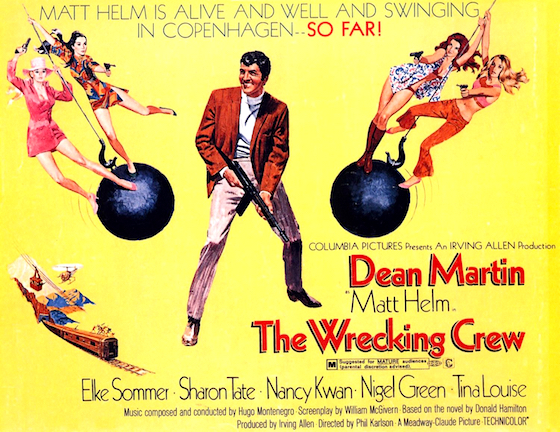
    The Wrecking Crew
    (1968)

    2019 #115
    Phil Karlson | 101 mins | TV | 16:9 | USA / English | PG / PG

    The Wrecking Crew

    Unlike Hammerhead, I’m not sure anyone should apply to watch The Wrecking Crew, the last in a series of four movies starring the Rat Pack’s Dean Martin as Donald Hamilton’s Matt Helm. The character was a mite more successful than Charles Hood, then, but on screen and in his original literary form: the book series ultimately ran to 27 novels, the last published in 1993, with a 28th written but left unpublished after Hamilton’s death in 2006. The film series would’ve continued too — I guess not for that long, but for at least one more film. Reports vary on why a fifth instalment never happened, but one highly plausible version ties it to the murder of Sharon Tate. Tate co-stars in The Wrecking Crew and is quite the best thing about it. Martin loved working with her, and the plan was for her to return as Helm’s sidekick in the next film. But then what happened happened, and the followup was abandoned. (The alternate version is that poor reviews and poor box office for The Wrecking Crew just led the studio to scrap the series.) There are several tragedies about the murder of Sharon Tate, but I don’t think depriving us of more Matt Helm movies is one of them.

    As for the lead character, Helm is a secret agent cum fashion photographer — and that’s not the only thing here that’ll remind you of Austin Powers. The Bond movies are often cited as the sole inspiration for Powers, but it was really drawn from across the ’60s spy-fi spectrum, and it’s clear Matt Helm was part of the mix. Unfortunately, The Wrecking Crew plays like a low-rent Austin Powers movie with any humour value sucked out. In his discussion around the film, Tarantino recalls seeing it in the cinema on its original release, and how audiences found it hilarious at the time. That wasn’t a quality I observed, personally. It’s clearly all tongue-in-cheek, but it rarely achieves levels of genuine amusement.

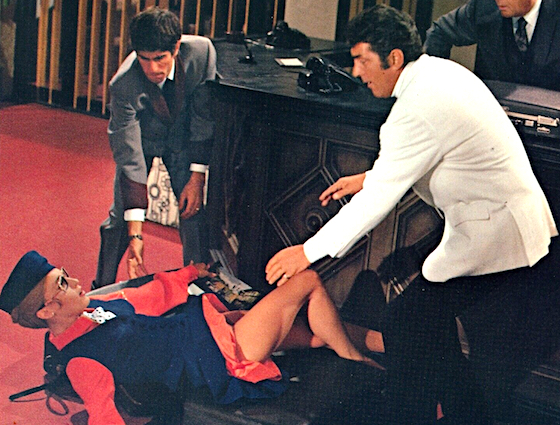
    Enter Sharon Tate

    More tangible is the sensation that the film thinks it’s super cool and hip, but really isn’t. That might just be because of its lead. Dean Martin feels a bit like Roger Moore in his later Bond films: still behaving like he’s a young playboy while looking far too old for it. But even Moore, with his ageless class, felt more ‘with it’ than this. It really shows that the “effortless cool” of Bond does require some effort. The past-its-date feel is underscore (literally) by frequent random snippets of old-fashioned-sounding songs — presumably Dean Martin numbers, placed awkwardly to convey some of the hero’s thoughts (sample lyric: “If your sweetheart puts a pistol in her bed, you’d do better sleeping with your uncle Fred”). So much for the Swinging Sixties… and this was nearly 1970, too!

    There’s no respite in the actual storyline, which is at least broadly followable (the villain has stolen $1 billion in gold, because who doesn’t want to be rich?), but then drowns itself in a flood of little logic problems and implausibilities, shortcomings of research or insight into foreign cultures, casual racism, lazy casting (why does someone called Count Massimo Contini sound like an English public schoolboy, other than because he’s the bad guy?), and no consideration for where surveillance cameras might actually be placed. You despair of constructively criticising the film for its mistakes — it’s beyond help.

    The Wrecking Crew is another movie no doubt inspired by the desire to emulate the success of James Bond, but this is the kind of mediocre imitation that gives you a new appreciation for even the worst Bond movies. Hammerhead clearly struggled to compete due to the constraints of a tight budget, which it at least made up for somewhat with a vein of authentic Swinging Sixties antics. The Wrecking Crew, on the other hand, seems to have all the money it could need (it was produced by a major studio and had star names attached, remember), but nothing like enough charm or skill. It can’t even find benefit in fight choreography by the great Bruce Lee, with stunt performers incapable of convincing combat.

    2 out of 5

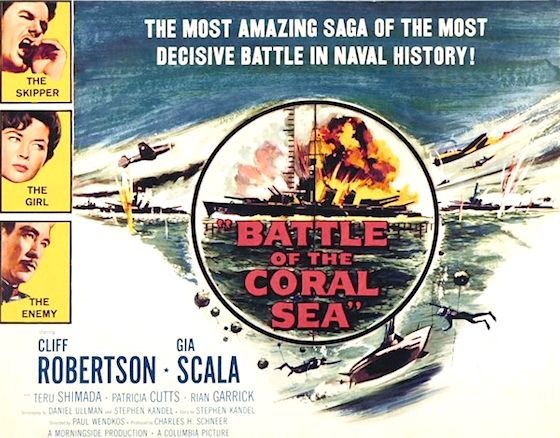
    Battle of the Coral Sea
    (1958)

    2019 #116
    Paul Wendkos | 83 mins | TV | 16:9 | USA / English | PG

    Battle of the Coral Sea

    May, 1942, the South Pacific: a US submarine on a top-secret reconnaissance mission is captured by the Japanese fleet. Its crew are taken to remote island interrogation camp, where they just have to keep silent for a couple of days until what they know will no longer be of use to the enemy.

    Yes, far from the combat movie the title implies, this middle-of-the-road World War 2 movie is one part submarine adventure (the first act) to two parts POW thriller (the rest). The latter also includes an action-packed escape for the climax, which is almost a moderately exciting action sequence, but is marred by a litany of minor daft decisions. For example: the escapees start by killing a couple of guards, but only pick up one of their guns; then they use that gun to mow down more guards, but still don’t bother to grab any more weapons. When some of them get killed a minute or two later, you can’t help but feel it was their own damn fault.

    It picks up some points for making the camp’s commander a reasonable man — a human being, rather than an alien, vicious, evil torturer, which is the stereotype of Japanese WW2 prison camps. That said, considering how infamously brutal said camps were/could be, the niceness of the prisoners’ treatment makes the film feel somewhat neutered. It’s not like the captured seamen get to laze around all day — they’re put to work — but you feel like these guys aren’t really suffering, not compared to what others went through. It contributes to the feeling of the film being a something-or-nothing tale; just another story of the war, rather than an exceptionally compelling narrative.

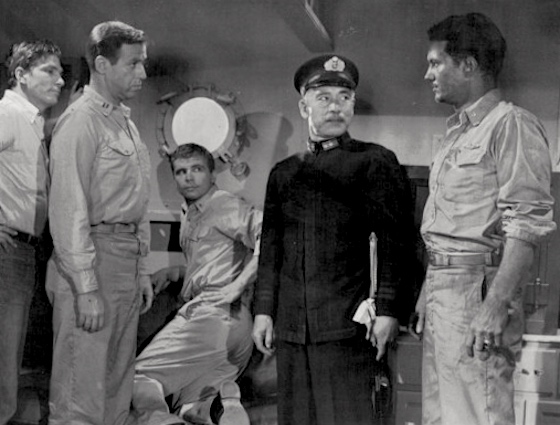
    Under the Coral Sea

    Apparently the eponymous battle was rather important, though: a voice over informs us that “it was the greatest naval engagement in history”… before adding that “the victory laid the groundwork for the even greater sea victory at Midway.” So it was the greatest… except the next one was greater? Who wrote this screenplay, Donald Trump? We do actually get to see the battle, eventually, when it turns up as an epilogue, conveyed via a speedy stock-footage-filled montage. I wonder how much of that was fed into the trailer…

    Battle of the Coral Sea is the kind of film I would’ve completely overlooked if Quentin Tarantino hadn’t included it in his Swinging Sixties Movie Marathon (it represents the kind of thing Once Upon a Time in Hollywood’s Rick Dalton would’ve appeared in early in his career, as one of the seamen with a couple of lines), and I don’t feel I’d’ve really missed anything. It’s not a poor film — anyone with a fondness for ’50s-style war movies will find something to enjoy in it — but it’s not a noteworthy one either.

    3 out of 5

    Once Upon a Time in Hollywood is in cinemas now.

  • Review Roundup

    This small selection may at first look a little disparate, including as it does two comedies, with release dates separated by a quarter of a century, and a horror movie. The two points of connection are that I watched them all last year, and I didn’t really enjoy any of them.

    In today’s roundup:

  • Phantasm (1979)
  • National Lampoon’s Vacation (1983)
  • Step Brothers (2008)


    Phantasm
    (1979)

    2018 #92
    Don Coscarelli | 89 mins | TV | 16:9 | USA / English | 15 / R

    Phantasm

    A cult classic horror that spawned a pile of sequels and numerous novelty-packaged disc releases, Phantasm is about a supernatural undertaker, the Tall Man (Angus Scrimm), who (to quote Wikipedia) “turns the dead of earth into dwarf zombies to be sent to his planet and used as slaves.” Sounds totes plausible, right?

    Well, implausibility is no sin — many great fantasy or horror movies feed off setups that are just as outlandish. No, the problem here comes from the storytelling, because what happens in Phantasm is resolutely illogical. None of it makes any sense. No one behaves plausibly. Is there a mythology? I don’t know, because it all seems random. It appears to operate on some kind of dream logic, wherein stuff… just happens. And then at the end it’s revealed that it was, in fact, all a dream! Eesh. Are either of those things ok? Telling a story with “dream logic”, maybe. But then again, why should that be ok? We can’t control dreams, so we can’t expect them to obey the rules of narrative; but films are consciously made, so surely they should aim for coherence? And as for an “it was all a dream” ending, that’s just about the most despised device in storytelling for a reason. (Of course, there’s an “or was it?!” final twist, because it’s a horror movie and that’s how they always end.)

    It doesn’t help matters that the film simply isn’t well made. No one can act. Characters turn up out of nowhere. Most of it is cheaply shot and uninterestingly edited. There are a couple of good bits of imagery, but the rest of the movie is so nonsensical that that’s all it is — imagery. There’s no meaning attached.

    And yet the Phantasm series has its fans (or, predictably, “Phans”). Perhaps, if we’re being kind, we can say it’s an acquired taste — you either get something from its strangeness or you don’t. Clearly there are people (“Phans”) who see something in it. I wasn’t one of them.

    2 out of 5

    Phantasm featured on my list of The Five Worst Films I Saw For the First Time in 2018.

    National Lampoon’s
    Vacation

    (1983)

    2018 #140
    Harold Ramis | 98 mins | streaming (HD) | 16:9 | USA / English | 15 / R

    National Lampoon's Vacation

    Written by John Hughes and directed by Harold Ramis, Vacation certainly has strong pedigree (I’m not even going to begin to list all the classic comedies attributable to their names). It also spawned three sequels and a remake, so it’s clearly popular. Unfortunately, something about it didn’t click with me.

    It’s about a family going on a summer holiday; specifically, a cross-country road trip from Chicago to California, to visit Disney Walley World. Naturally, the journey doesn’t go to plan, and a series of episodic hijinks ensure. These include such hilarious escapades as meeting some black people (who of course steal their hubcaps); falling asleep at the wheel and careening through a town; hanging out with a cousin who French kisses his own daughter; and accidentally dragging their aunt’s dog along behind the car until it dies. Good times!

    There’s also a song by Lindsey “Fleetwood Mac” Buckingham, called Holiday Road, which is played again and again throughout the film. I started out hating it, but by the end I was listening to it on loop while I updated all my post-viewing lists. It’s sort of gloriously terrible. Sadly, I didn’t have the same Stockholm syndrome reaction to the film itself.

    2 out of 5

    Step Brothers
    (2008)

    2018 #204
    Adam McKay | 98 mins | streaming (HD) | 2.35:1 | USA / English | 15 / R

    Step Brothers

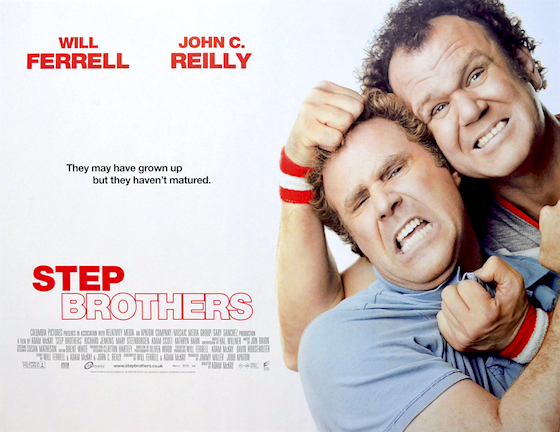
    Will Ferrell and John C. Reilly star as two developmentally-stunted man-children who are forced to live together after the former’s mom (Mary Steenburgen) and the latter’s dad (Richard Jenkins) move in together.

    The movie relies on the notion that watching two 40-year-old men behave like bratty 10-year-olds will be constantly hilarious. Spoiler alert: it isn’t. Unlike the infamous recent collaboration between Ferrell and Reilly, Holmes & Watson, this effort does at least manage some funny bits, though they generally occur when it moves away from the primary conceit for a moment. It also has the most implausible sex scene this side of The Room, which is some kind of achievement, I guess.

    2 out of 5