The Ragtag Review Roundup

My review backlog has got a bit silly: there are currently 128 unposted reviews on it, dating back to stuff I watched in January 2018. I was hoping to really get stuck into that as 2019 began, but I’ve been busier than expected. Anyway, I’ll keep trying — and here’s a start, with a real mixed back of films that have basically nothing in common.

In today’s roundup:

  • American Psycho (2000)
  • Logan Lucky (2017)
  • A Nightmare on Elm Street (1984)
  • The Treasure of the Sierra Madre (1948)


    American Psycho
    (2000)

    2018 #66
    Mary Harron | 102 mins | streaming (HD) | 2.35:1 | USA & Canada / English | 18 / R
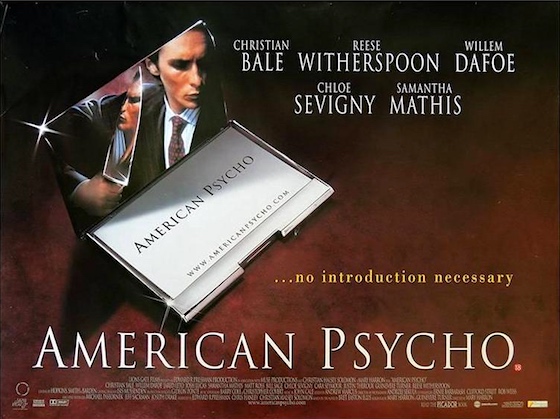
    American Psycho

    The film that made Christian Bale’s name sees him play Patrick Bateman, a high-flying New York banker with psychopathic tendencies — well, that just sounds like all those Wall Street types, right? Except hopefully they’re not actually engaging in literal killing sprees, unlike Bateman.

    While the murdering stuff may look like the draw, American Psycho is more interesting as an examination of the corporate mentality. It manages to be remarkably insightful, satirical, and terrifying all at once. Take the scene where they compare business cards, for instance: it’s ridiculous how much interest and importance these guys are placing in little cardboard rectangles with their name and number on, and yet you can believe such business-wankers would care about it. The anger Bateman feels when other people’s cards are considered classier than his is palpable.

    It’s a great performance by Bale across the board — so well judged, despite being barmy. It’s also interesting to observe the links between this and his version of Bruce Wayne, which is a wholly appropriately connection. I mean, who’s more of an American psycho than a guy who spends his days pretending to be a playboy businessman and his nights dressing up as a bat to beat up bad guys? I’m sure someone must’ve already developed a theory / amusing trailer mashup connecting the two films…

    The only thing that really let the film down for me was its final act. No detailed spoilers, but while I thought the rest of the film was engagingly made, the ultimate lack of resolution felt empty. To me, it seemed like it didn’t know how to end.

    4 out of 5

    Logan Lucky
    (2017)

    2018 #65
    Steven Soderbergh | 119 mins | Blu-ray | 2.39:1 | USA / English | 12 / PG-13

    Logan Lucky

    Two brothers, whose family has a historical proclivity for bad luck, decide to rob one of the US’s largest sporting venues, the Charlotte Motor Speedway, during one of its quieter events. But when the situation changes, they end up having to pull the job off during the biggest race of the year.

    Director Steven Soderbergh’s return to the heist genre a decade after Ocean’s Thirteen is something to be noted; and while Logan Lucky is a very different kind of heist movie (there’s none of that trilogy’s Hollywood glamour to be found here), it’s a more successfully entertaining movie than either of the Ocean’s sequels.

    Like them, it’s not terribly serious, instead ticking along as generally quite good fun — though there’s a scene with Take Me Home, Country Roads that’s quite affecting. Between this and Kingsman 2, I’m left to wonder how that wound up becoming just about the most emotional song ever recorded…

    Anyway, the showpiece heist is clever, in its own way, and rolls around sooner than I expected — it’s funny to read some people criticise how long it takes to get to, because I assumed it would be Act Three. Instead, the film constructs a post-heist third act that was the only time it really got too slow for me, though it does eventually reveal a purpose that was kinda worth the wait. That said, the whole thing might benefit from being a little bit tighter and shorter — ten minutes trimmed across the pre- and post-heist acts might make it zing just that bit more.

    4 out of 5

    A Nightmare on Elm Street
    (1984)

    2018 #71
    Wes Craven | 87 mins | TV (HD) | 16:9 | USA / English | 18 / R
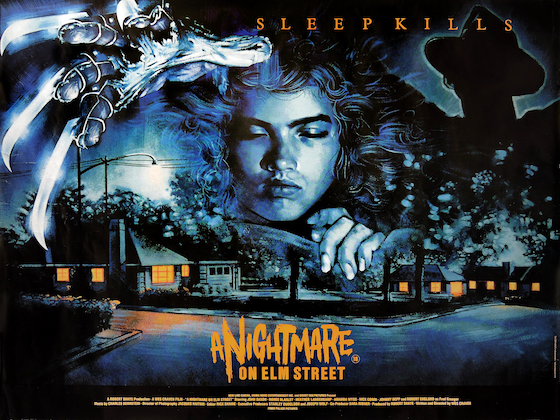
    A Nightmare on Elm Street

    It may be regarded as a horror classic, but I have to admit that I found A Nightmare on Elm Street to be a crushing disappointment. To me, it seemed to be a pretty poor movie (all weak: the acting, the dialogue, the music, the timescale events supposedly occur in) with some fantastic imagery. Director Wes Craven was a master, of course, and he manages to construct some truly great shots and moments amid a dirge of mediocrity. There’s a lot of nonsensical stuff too. I guess “dream logic” is meant to excuse it, but… eh.

    I do really like that poster, though.

    3 out of 5

    The Treasure of the Sierra Madre
    (1948)

    2018 #6
    John Huston | 121 mins | TV (HD) | 4:3 | USA / English | PG
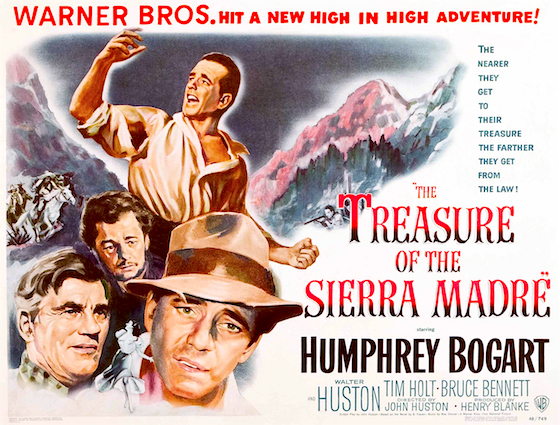
    The Treasure of the Sierra Madre

    Set in the mid ’20s, two American drifters in Mexico (Humphrey Bogart and Tim Holt) team up with an old and experienced prospector (Walter Huston, director John Huston’s father) to hunt for gold in them thar hills. Along the way they have to contend with rival prospectors, violent bandits, and — most dangerous of all — their own suspicions and greed.

    The Treasure of the Sierra Madre blends genres like there’s no tomorrow: it’s been described as a plain drama, an adventure movie, a neo-western, it’s included on film noir lists… Of course, depending which angle you look at it, it’s all of the above. It’s both an exciting adventure movie and a character-centric exploration of the effects of greed. In depicting that, Bogart’s performance is excellent, though Huston Sr threatens to steal the show. Poor Tim Holt is overshadowed by them both, even though he gives a likeable turn.

    5 out of 5

  • Velvet Buzzsaw (2019)

    2019 #11
    Dan Gilroy | 112 mins | streaming (UHD) | 1.85:1 | USA / English | 15 / R

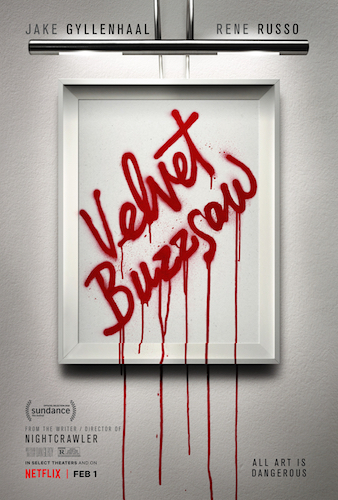
    Velvet Buzzsaw

    The team behind neo-noir modern classic Nightcrawler (writer-director Dan Gilroy, stars Jake Gyllenhaal and Rene Russo, cinematographer Robert Elswit, among others) reunite for this direct-to-Netflix genre mash-up — it’s part art-world satire, part mystery-thriller, part horror. The Verge described it as “Robert Altman’s Final Destination”, and that so succinctly articulates what the film reminded me of that I decided to just lift it. Well, just pilfering someone else’s work is in-keeping with the film’s themes, at least.

    Set in the world of high art, it stars Gyllenhaal as all-powerful critic Morf Vandewalt, whose reviews can make or break sales worth millions of dollars, plus the careers that go along with that. One person his tastes always align with is prominent dealer Rhodora Haze (Rene Russo), whose assistant Josephina (Zawe Ashton) is falling out of favour due to relationship woes. But when her reclusive neighbour dies, she finds his apartment full of striking and original artwork, which she promptly steals. Mort is bowled over by their quality, Rhodora muscles in on the sales, and soon the deceased artist is a sensation. But there’s more to his disturbing work than meets the eye, and soon people start dying…

    So far so Final Destination, but not very Robert Altman, I know. The latter comes more in the execution than the subject matter, in particular that this is really an ensemble piece — the marketing pitched Gyllenhaal as the lead, I guess because he’s the biggest and most marketable name, but Ashton’s role is at least as large and central, if not more so, for example. Plus, as well as those two and Russo that I’ve already mentioned, there are significant roles for Toni Collette (as an art buyer for a museum), John Malkovich (as an uninspired elder-statesman artist), Natalia Dyer (as an intern struggling to break in), Billy Magnussen (as a handyman who wants to be an artist), Tom Sturridge (as a rival dealer), and Daveed Diggs (as an up-and-coming artist everyone wants to sign). Before the thriller and horror elements come into play, this spread of characters makes the film seem much more like a portrait of the art world from multiple different perspectives.

    Critique is so limiting and emotionally draining

    Gilroy has specifically cited Altman’s Hollywood satire The Player as an influence on how he approached things. By complete coincidence, I watched The Player just a few days before this, and so that similarity was very clear to me. That said, Gilroy’s lack of experience relative to Altman perhaps shows through. Where The Player was very pointed and effective in its satire, Velvet Buzzsaw takes more of a vague, scattershot view of the contemporary art scene. Gilroy does have a specific theme in mind — the disjunct between art and commerce, and their negative effects on each other — which manifests in various ways (it’s part of the film’s horrors as well as its satire), but that seems slightly disconnected from the Altman-esque “different perspectives” approach. Having so many key characters does lend a slightly different feel from what you might expect, but it doesn’t lead to the same kind of forensic dissection that Altman was capable of.

    It’s just one aspect of the film that seems somewhat muddled. It’s not fatally flawed, but there are things about it here and there that just don’t seem to add up. It’s almost as if scenes had been arbitrarily removed; not ones that particularly affect the plot, but maybe ones that affect the details. For example, at one point Mort exclaims that he’s been seeing strange things recently, but the only evidence we’ve seen of that came with the thing that prompted his exclamation. These kind of vague, not-quite-right bits pop up now and then. You’d almost wonder if it had something to do with the film’s horror side, like it was trying to be disquieting, but it doesn’t correlate or connect up to the actual horror bits.

    About to connect with the film's horror bits

    And yet, despite that, it’s so good in places. In particular, it looks gorgeous, especially in UHD. That’s how Elswit has shot it, of course, but also some of the striking visual ideas Gilroy throws into the mix. His screenplay definitely has its moments also. One of Mort’s first reactions to the startling work Josephina has unearthed is that “critique is so limiting and emotionally draining,” which is just begging to be quoted in reviews. That line was in the trailer, so it’s already threatened to take on a life of its own outside the film, but it’s certainly not the only meme-in-waiting that’s thrown up. “The admiration I had for your work has completely evaporated” is another choice example. Heck, about half the rest of the dialogue is as well, never mind some reaction shots.

    Sometimes, star ratings really aren’t nuanced enough to represent one’s reaction to a film. There are bits of Velvet Buzzsaw I adored — performances, scenes, individual lines, the cinematography — at a level normally found in a five-star film. But there are other things it fumbles, like the way the story sometimes jumps as if scenes have been deleted, or the way it doesn’t seem to have an answer for some of its mysteries, or the way the trailer spoilt pretty much everything (not a fault of the film itself, I know, but still a grievance). Some of those err down towards a three-star experience. It’s quite frustrating in that respect. Overall, there’s enough I liked that I’m going to give it a four, albeit a cautious one.

    4 out of 5

    Velvet Buzzsaw is available on Netflix now.

    Zatoichi the Outlaw (1967)

    aka Zatôichi rôyaburi

    2018 #257
    Satsuo Yamamoto | 95 mins | Blu-ray | 2.35:1 | Japan / Japanese | 15

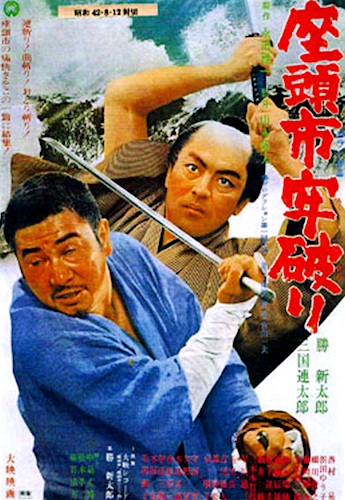
    Zatoichi the Outlaw

    The sixteenth Zatoichi movie begins by boldly declaring it’s “the first feature by Katsu Productions”, the production company of series star Shintaro Katsu. While the change isn’t radical — this is still the Zatoichi we know and love — there does seem to be a different style and tone about this particular instalment.

    It all starts as a pretty regular tale: wandering into a new town, Ichi finds himself accidentally drawn into a feud between two neighbouring gangs, one run by the usual unscrupulous and vicious boss, the other by a kind-hearted and socially conscious chap. But even more moral than him is a ronin, Shusui Ohara (Mizuho Suzuki), who’s renounced violence and is preaching to the local farmers about the evils of the yakuza way of life. He challenges Ichi’s sword-based moral code, which is fertile ground for the series — Ichi is often questioning his own actions, after all. Ohara suggests there might be another way, but Ichi isn’t convinced — sometimes violence is necessary to help, he believes, and that goodly boss proves that the yakuza way can work for the people.

    Anyway, at the risk of spoiling things, that plot comes to a head in the usual fashion… but before the halfway mark. Via a montage (something I’m not sure we’ve seen in a Zatoichi film before, and it’s not the only one in this movie either), it’s a year later, and Ichi’s somewhere else in the world living a different life, only to receive news of trouble back in that earlier town. Naturally, he heads back to sort it out. It’s an effectively wrong-footing structure: the film wraps up more-or-less the usual Zatoichi movie within its first 40 minutes, then jumps ahead to show the long-term fallout of Ichi’s actions. It’s not the first time the series has touched on the fallout of all Ichi’s good intentions, but it’s the first time it’s been done so explicitly and succinctly.

    Hot stuff

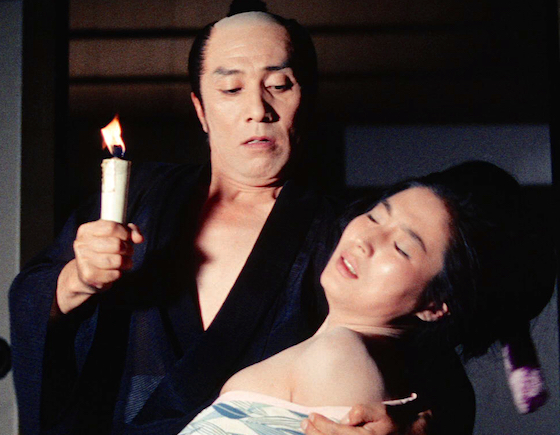
    It’s not just structurally different to the norm, though. This is a particularly brutal film, with dismembered limbs, attempted rape, torturous beatings, punishment by hot wax, women being forced into prostitution, multiple suicides, a graphic beheading…! There’s a crudeness to situations and dialogue too, with Ohara giving a lecture about how the yakuza are “shits and farts”, and an extended (and unwelcome) comedy interlude when Ichi lives with a bunch of bawdy and lascivious fellow masseurs. This is one of the few Zatoichi films rated by the BBFC (due to it being released in a DVD box set in the early ’00s — Criterion don’t seem to have bothered to get them certified for their recent set, which is perhaps why it isn’t available from major retailers anymore), and I don’t know what the other films would be classified as, but this easily earns its 15.

    This is also the most political movie in the series, something you’ll see regularly noted in reviews because it’s rather hard to miss — after all, Ohara is effectively trying to unionise the farmers against the bosses. Director Satsuo Yamamoto was a left-wing political activist, known for his films that engaged with such subjects, and also real-life protests that had seen him fired from Toho in their “red purge” of 1948. Hat-tip to Weird Wild Realm for that detail; that review also includes more analysis of this film’s politics and the way they impact — or don’t — Ichi and the viewer. By which I mean, the film makes a point of contrasting the perspectives of Ichi and Ohara, and the way events unfold suggest the ronin’s ideals of pacifism and reform may well be correct… but that wouldn’t do future Ichi adventures any good, so of course he maintains his violent ways.

    Violent delights have violent ends

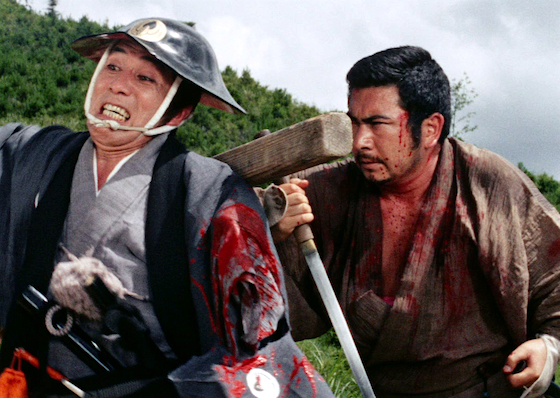
    And of course we still enjoy it. Indeed, the final fight is a stunner — well, they almost always are, but this is certainly another for those burgeoning ranks. Initially taking place in torrential rain, it’s a muddy and bloody scramble, including a great shot of Ichi unrelentingly coming for his foe, even as he’s pelted with rocks, blood dripping down his face (see this post’s header image). And that’s not even the end, because the peasants pick up an injured Ichi and, in a dramatically-scored sequence, carry him down backroads to intercept the caravan transporting the captured Ohara, who Ichi rescues in another flurry of swordplay. Even as the film seems to preach against violence, it revels in it. Parse that how you will.

    There were a lot of bits I didn’t like along the way in Zatoichi the Outlaw (that comedy interlude is a real mood-killer), and I can see why some fans think it gets too dark for a Zatoichi movie (it’s not just the events themselves, but the bleak atmosphere they create), but I admired its commitment to being a bit different. In a long-running series, films that challenge the norm are to be welcomed.

    4 out of 5

    The Redefining Monthly Review of January 2019

    Here I go again: the 13th year of 100 Films in a Year!

    Ah, “100” films… Once upon a time that goal was a challenge: in my first six years, although I did surpass it twice, I also only just reached it twice, and twice fell short. But since then things have improved considerably: in the last six years I’ve doubled it twice (and then some, in last year’s case), and twice more ended up closer to 200 than 100. I’ve also been reaching #100 quicker and quicker — it’s less “100 films in a year”, more “100 films in five or six months”.

    That said, I’ve had a particularly good run of it in terms of free time the past couple of years, and I don’t know if that’s going to continue, so I’m loathe to boldly establish a brand-new goal for myself. Maybe next year. For the time being, my official target has technically changed, in a couple of ways. For one thing, the titular “100 films” have only ever included films I’ve not seen before, and consequently I often rewatched very little. Nowadays, I’ve countered that with my Rewatchathon (2019 being its the third year), which adds 50 films to my viewing goal. Secondly, I’ve watched at least ten new films every month since June 2014, and I intend to keep that up — and as there are 12 months in a year (did you know?), that rounds up my aim to 120 new films.

    So I guess my official minimum goal is 170 Films in a Year. Doesn’t have the same catchy ring, does it? Especially as it should technically be 120 Films I Haven’t Seen and 50 I Have in a Year. Eesh.

    Anyway, enough of that — let’s get properly started on 2019. Here are all the films I watched in the first 12th of this 13th year…


    #1 Happy New Year, Colin Burstead (2018)
    #2 Cool Hand Luke (1967)
    #3 Godzilla: The Planet Eater (2018), aka Gojira: Hoshi o Kuu Mono
    #4 1941 (1979)
    #5 Rambo (2008)
    #6 The Stewardesses 3D (1969)
    #6a Experiments in Love 3D (1977)
    #6b La jetée (1962)
    #7 Glass (2019)
    #8 The Player (1992)
    #9 The Happytime Murders (2018)
    #10 Zatoichi Challenged (1967), aka Zatôichi chikemurikaidô
    Rambo

    The Player

    .


    • So, I only watched ten new feature films in January.
    • That’s bang on my minimum goal, which is a good thing, but it also means January was my lowest month since September 2017, which is less good.
    • On a more positive note: since I started achieving a minimum of ten films per month year-round back in 2015, I’ve had no more than a single only-ten-films month each year (November in 2015, December in 2016, September in 2017, and none in 2018) — so maybe getting it out of the way in January bodes well for the rest of the year?
    • Also, while this may be the joint-lowest month of the past 4½ years, before then I regularly had sub-ten months. Indeed, pre-2014, 56% of months failed to reach double figures at all.
    • I didn’t watch a film on the 5th, one of the remaining dates on which I’ve ‘never’ watched a film. Two months in a row I’ve messed that up! I’ll have to be more attentive at the end of this year and the start of 2020…
    • In fact, I didn’t watch my first film until the 9th, which is the second latest start ever (in 2011 it was the 10th). That made the film in question — Happy New Year, Colin Burstead — feel somewhat ironic, what with it being, y’know, quite well past New Year by that point.
    • This month’s Blindspot film was Robert Altman’s Hollywood satire cum neo-noir thriller, The Player.
    • This month’s WDYMYHS film was Cool Hand Luke, which I had little choice about: no sooner had I included it in my 2019 selection because it was streaming on Amazon than I discovered it was to be removed a mere two days later! Just another reminder why relying on streaming services is a bad idea. Physical media 4eva!


    The 44th Monthly Arbitrary Awards

    Favourite Film of the Month

    I found surprising depth in the fourth Rambo, and was one of the apparently-few people who didn’t walk away disappointed from Shyamalan’s trilogy-closing Glass, but this month’s winner has to be The Player. Mixing sharp Hollywood satire with a perverse respect for the wonders of Tinseltown, shaped into a neo-noir thriller storyline and delivered via bravura filmmaking, that includes a justifiably-famous opening oner, Robert Altman’s comeback film promised so much that I love in movies, and delivered on it all too.

    Least Favourite Film of the Month

    I may’ve watched several notoriously bad films this month (Spielberg’s 1941, R-rated puppet flop The Happytime Murders, gimmicky 3D sexploitation The Stewardesses), but I actually enjoyed all of them on some level. No, this choice was easy. Apparently while promoting his latest film Happy New Year, Colin Burstead, director Ben Wheatley talked about it being his first movie where no one dies. Sure, no one in the film dies, but while watching it I became concerned that I might die from boredom.

    Favourite Short Film of the Month
    La jetée may be an innovative and influential arthouse sci-fi classic, but does it have full frontal nudity displayed in genuine 3D? No, no it does not. As I wrote on Letterboxd, “whether you want a little knowingly irreverent comedy, a cornucopia of 3D tricks, or some relatively explicit softcore porn, Experiments in Love has you covered.” It’s way more fun than it should be.

    Most Explosive Orgasm by an Inanimate Object of the Month
    I’m sorry to subject you to such crudeness, my dear, gentle readers, but here’s the thing: The Happytime Murders’ trailers made a fairly big deal of its puppet’s silly-string-spraying climax, but it was already beat by (once again) Experiments in Love. The latter features a huge retro computer, which for some reason speaks with a dodgy Japanese accent, and for even less reason has a grabby protuberance that tries to grope the film’s female characters, and which eventually gets very excited and, well, shall we say shoots off… directly at the camera lens, of course, because this is 3D. Take that, Gaspar Noé.

    The Audience Award for Most-Viewed New Post of the Month
    I don’t always watch my stats closely, but sometimes something catches my eye. This month, my Christmas TV review soared to an early lead — TV posts are always popular, and this one went up on the 2nd, so it had almost the whole month to rack up hits. By the halfway point, it already looked unassailable. Then Glass came along, and while it didn’t do spectacular short-term numbers, a strong day-by-day count saw it creep up the chart — could it challenge, even surpass Christmas TV? Well, no — those numbers actually tailed off pretty sharpish, leaving the Past Christmas on TV this month’s clear victor. (Glass did come a respectable second though, far outstripping this month’s other TV post.)


    Real life got in the way a bit this month, so it’s been a rather quiet one (this is my first post for 11 days!) Nonetheless, there’s still a chunk of stuff to recap. For starters, January began (as always) with my review of the previous year…

    And then regular business brought this little lot…


    While my main goal only just scraped to its minimum monthly target, my Rewatchathon began by exceeding it by 25%…

    #1 Twelve Monkeys (1995)
    #2 Unbreakable (2000)
    #3 Ghostbusters (1984)
    #4 Split (2016)
    #5 Les Misérables (2012)

    …of course, when your target is “four”, 25% is “one”. Sounds less grand like that, though.

    At this point I’d normally share a thought or two about some or all of the above listed films, but instead I’m going to mention my Letterboxd account. My stats on the site inform me that I ‘review’ films on there about 50% of the time. Those aren’t proper reviews, mind — usually I’m aiming for a ‘witty’ comment, but sometimes it’s a quick initial impression, especially if a film really made me feel something (for good or ill). Sometimes those comments end up getting mixed into the full reviews I later post here; other times they don’t.

    This month, I wrote something about each of my rewatches (hence why I’m mentioning this now), which you can locate quickly as follows: Twelve Monkeys, Unbreakable, Ghostbusters, Split, and Les Misérables.


    Here’s a new regular section for 2019. (Assuming I always have something to say in it. If I don’t, I guess it’ll disappear again.) These are films I’d been specifically meaning to watch (or rewatch) this month, but for whatever reason didn’t get round to — my failures.

    For January, this includes a tonne of stuff — I’m about to name 19 different titles, enough to almost triple the number I actually watched. (If that’s the kind of level I’m operating at, there probably will be something to say here every month!) Those include some much-discussed recent streaming releases (Roma, Bird Box); some Amazon rentals I got on the cheap (First Reformed, Leave No Trace, Mandy); some films I’ve been meaning to see for yonks that recently popped up on streaming services (Gods and Monsters, The Purge: Anarchy); recent Blu-ray purchases (One Cut of the Dead, Waterworld, Crimson Peak); at least one film I recorded off TV (The Eyes of Orson Welles); some new Blu-ray/rental releases that I haven’t actually purchased yet (Dave Made a Maze, The Predator); and anything at all on 4K Blu-ray — I got a player for Christmas, and I’ve set it up and watched a few bits and pieces as tests, but not a whole film. Top contenders for that honour include Escape from New York, Mission: Impossible I, II or Fallout, Blade Runner, and Blade Runner 2049.

    One thing I can say: some of those will definitely be amongst next month’s viewing. I mean, if they’re not, I wasted money on those rentals…


    It’s the shortest month of the year! Better pick up my average weekly viewing, then, or I won’t even make it to ten…