Assassin’s Creed (2016)

2017 #135
Justin Kurzel | 115 mins | download (HD+3D) | 2.35:1 | USA, France, UK, Hong Kong, Taiwan & Malta / English, Spanish & Arabic | 12 / PG-13

Assassin's Creed

There seemed to be great hope when the Assassin’s Creed movie was announced. Partly because it’s a popular video game series, so of course its fans were excited; but also because it attracted star Michael Fassbender, an actor doing Oscar-calibre work, who then hand-picked director Justin Kurzel, whose previous movies suggested loftier ambitions than just trashy blockbusters. Feelings seemed strong that this could be the first great video game adaptation. But it was not to be.

Fassbender plays Cal, a criminal who is ostensibly executed but then wakes up in a strange facility where a doctor (Marion Cotillard) informs him that they’re going to strap him into a machine called the Animus, which uses Cal’s DNA to kind of send him back in time to relive the memories of his ancestor, who was an Assassin (with a capital A, because they’re like a guild or something). Her organisation, the Templars (who are the bad guys, presumably), want to use this totally plausible science to access the aforementioned memories so that they can locate the world-changing MacGuffin, hidden away by Cal’s ancestor (who was a good guy, I think). Something like that, anyway.
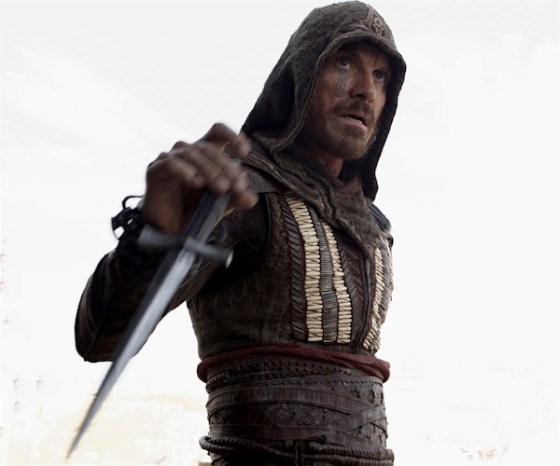
Academy Award Nominee Michael Fassbender

To be honest, a “something like that” feeling pervades the film. It’s a very strange viewing experience, in that you can follow what’s going on while at the same time feeling like it makes no sense whatsoever. Until the last act, anyway, when it goes thoroughly WTF. In part that’s because all the nonsensical bits and bobs that you let slide earlier finally come into play. Like, what’s going on with the other inmates? Are they actual Assassins? Did using the Animus make them Assassins? That seems to be what happens to Cal. So, how does that work exactly? And then the actual ending… what the hell was it all about? I’m not sure I could even summarise my confusion — like I said before: it’s both completely followable and completely nonsensical. Of course, it’s very much trying to leave things open for a sequel. I guess that won’t be happening…

For a video game adaptation marketed as an historical actioner, there’s altogether too much plot (whether it’s followable or not, the story is dull and unengaging) and too little action. What’s there is mostly well realised — apparently a lot of it was done for real, and although there’s obviously a lot of CGI background extension (with a nice painterly look), there’s a definite physicality to the parkour and fisticuffs that you don’t get with CGI body doubles. I mean, there are only three or four action sequences total, and only one and a half of them are really worth it, but at least there’s something to like in them. Unfortunately, the action carries no weight: our hero can’t change the past, just witness it as he helps the bad guys watch to see where the MacGuffin ended up. So we are literally watching someone watch someone else do all the action — like, y’know, watching someone else play a video game. It’s almost a meta commentary on video game movies, except I don’t think that was the intention.

Running and jumping

So what is it trying to comment on? I mean, it’s an action blockbuster, so “nothing” would be a perfectly adequate answer. Nonetheless, some reviews claim it’s trying to consider philosophical, religious, and/or genetics-related concepts. I suppose it does technically mention such things, but it fails to actively engage with them to such a degree that I think it’s doing it a kindness to even claim it’s attempting to be a thoughtful movie. In a similar shot at intelligence, apparently we were meant to feel neither the Templars nor Assassins are good or bad, but both morally grey. However, rather than creating ambiguity in who to root for, it just comes across as a smudge of indifference.

Nothing else impresses either. It’s a very visually gloomy film. I can’t discount the possibility that’s because I watched it in 3D, with the notorious darkening effect of the glasses, but my setup usually compensates for that (I don’t recall noting any undue darkness on other 3D viewing). Actually, the 3D itself was fine — good, even, at times — but it’s battling the largely unappealing visuals.

Come up to the lab and see what's on the slab

I’ve never played an Assassin’s Creed game, but I’d wager they don’t primarily consist of people nattering in a lab interspersed with the occasional period action scene. Maybe a greater adherence to such thrills, and less needlessly convoluted plotting, would’ve made for a more likeable movie. My rating’s possibly a tad harsh, but Assassin’s Creed could and should have been better.

2 out of 5

Assassin’s Creed is available on Sky Cinema from today.

Eye in the Sky (2015)

2017 #8
Gavin Hood | 102 mins | streaming (HD) | 2.35:1 | UK & South Africa / English & Somali | 15 / R

Eye in the Sky

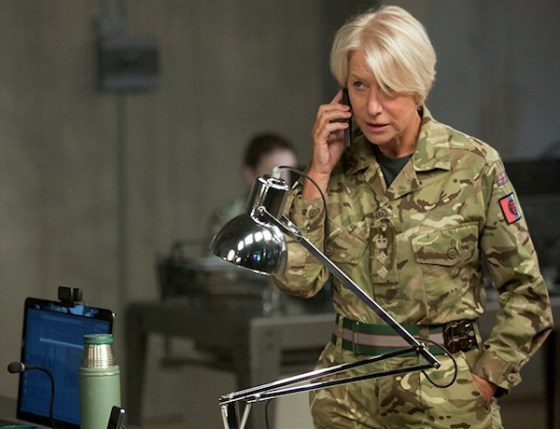
Drone warfare is a fairly hot and contentious issue of our times, though as it seems to have “just kinda happened” I’m not sure how much significant public debate there’s been around it. It’s certainly provided fodder for moviemakers, however, with multiple productions seeking to be “the one about drones”. I’ve heard the best of these is Good Kill (though IMDb ratings disagree), but that’ll have to wait for another day (I’ve been sitting on this review since frickin’ January because I’ve still not got round to Good Kill!) Even if Eye in the Sky is the inferior film, it’s no slouch.

After a multinational mission is launched to capture wanted terrorists in Kenya, surveillance observes them prepping suicide bombers. The mission objective is changed to “kill”, but commanders watching from afar via drone are forced to reconsider their options due to a civilian presence near the target. It’s a tense thriller driven by a compelling moral dilemma — in fact, the dilemma is an old one: would you sacrifice one innocent life to potentially save dozens more? It’s just that it’s now framed in the super-modern context of using drones to dispatch death from the other side of the world.

Someone's got to make the call

Getting ahead of myself a little now, but events build to a very tense climax. That’s how you want your thrillers to end, isn’t it? It also pays off the sometimes slow, borderline stagey “people talking in rooms” film that precedes it. Maybe that’s unfair — yes, it’s people talking in rooms, but there’s dynamism in what they’re debating and, er, the number of different rooms it takes place in… It also has a very plausible line in the passing of the decision-making buck, up the chain through the military, then through politicians. I guess for this to work the operation depicted had to be British-led because, as the film reveals, the American military machine would’ve had no such compunction about possibly killing a little girl.

Much of the film lets you make up your own mind about its ethical conundrums, which is a strong point; but then, after all the actual debating is done and decisions have been made, it uses its final scene to show an outcome it could’ve left open-ended. This makes it seem to come down quite heavily in one direction. There’s not necessarily anything wrong with having a position and advocating it in art, but for a film which seems designed to tackle a contentious issue and put it up for genuine debate, it ends up feeling a tad one-sided. That said, there’s a long and well-liked screed on Letterboxd about how “it’s a film with an agenda that pretends to have none”, that agenda being to “have you rooting for the bombing of a little girl” — which is funny because I felt that, if anything, it came down a little too heavily the other way.

Emote control

One thing that distracted me to an inordinate degree was the agents on the ground using cameras disguised as birds and bugs — not just models with cameras in them, but imitation creatures that have the ability to fly around, reposition, etc. Even if such tech is possible nowadays, would Kenyan forces have access to it? And even if it’d been provided to them by their US/UK allies, would the equipment produce results of such good quality, or be capable of sending the images across such distances? Surely real-life drones are the size and shape they are (i.e. pretty big) for a reason? I guess the applicable point about this is: if you’re trying to make a serious modern-day moral thriller, don’t throw James Bond tech in there.

Nonetheless, Eye in the Sky manages to put a very-present moral issue up for debate, framing it as a kind of case study so that it also serves as a tense thriller. Thought-provoking and nail-biting.

4 out of 5

Anomalisa (2015)

2017 #2
Charlie Kaufman & Duke Johnson | 90 mins | streaming (HD) | 2.35:1 | USA / English | 15 / R

Anomalisa

Written and co-directed by Charlie Kaufman (of Being John Malkovich, Eternal Sunshine of the Spotless Mind, and so on), Anomalisa tells the story of Michael (David Thewlis), a depressed customer service expert who perceives everyone else as looking and sounding the same — until he meets Lisa (Jennifer Jason Leigh), whose uniqueness to him immediately attracts Michael.

If you hadn’t noticed, Anomalisa (a portmanteau of “anomaly” and “Lisa”, not “anonymous” and “Lisa” as I’d assumed) is an animated movie. Although an everyday kind of drama that would be largely achievable in live-action, it uses the form to its advantage when depicting the central conceit, giving every character who isn’t Michael and Lisa the same face and having them all voiced by the same actor (Tom Noonan). For me, this was the most effective part of the movie. It’s a really neat way of executing the concept of not being able to tell people apart. Noonan is the film’s real star, too, voicing “everyone else” in a way that makes them sound plausibly unique but also all the same, a tricky balancing act that he nails.

The one thing that did disappoint me about it was this: the inability to distinguish people is a genuine medical condition, but the film tackles it only as a signifier of Michael’s depression rather than as an issue some people live with. Conversely, I presume that’s a pretty rare condition, whereas depression and isolated feelings are increasingly widespread, so the film perhaps has more to say in that regard. Ultimately, I shouldn’t be criticising a film for not being about something it’s not trying to be about (even when I thought that was what it was going to be about).

Even puppets get the blues

As for the rest of the movie… hm. It takes an age to get going, but once it does there are a few funny scenes (the “toy” shop; the hotel shower; Michael struggling with his room key), and who’d’ve thought a puppet movie would have one of the more realistic sex scenes in the movies? Especially as it pulls that off without becoming laughable thanks to Team America. More pertinently, it gradually unfurls a sometimes touching story about isolation and love. However, by the time it reaches the happy-sad ending (one person’s life seems to have been transformed; the other continues to be miserable), I wasn’t sure what it all signified. Maybe the line that “sometimes the lesson is there is no lesson” is very relevant.

So, some good stuff, but that long slow open takes getting over, and I’m not sure what it all meant.

4 out of 5

Awakenings (1990)

2017 #154
Penny Marshall | 116 mins | TV | 16:9 | USA / English | 12 / PG-13

Awakenings

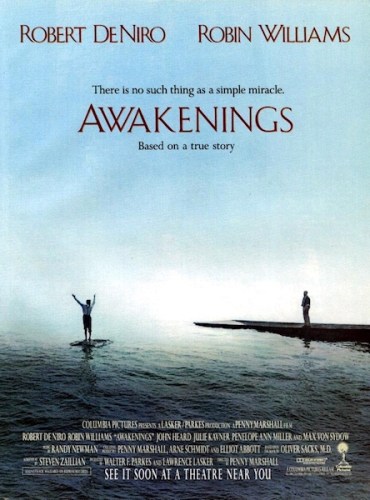
Based on a true story, Awakenings tells of Dr Malcolm Sayer (Robin Williams), who stumbles across an element of responsiveness in previously catatonic patients on his hospital ward. Finding a condition that links them buried in their medical histories, he supposes that a newly-invented drug might help their condition, subsequently testing it on Leonard (Robert De Niro), who ‘wakes up’ for the first time in 30 years. As Sayer continues his work, the new treatment reinvigorates the lives of more people than just the patients.

I hadn’t even heard of Awakenings until the untimely passing of Robin Williams, when it was brought to my attention by Mike of Films on the Box (er, I think — I can’t find where this occurred. Either it’s on someone else’s blog or I’ve entirely misremembered the circumstances). Frankly, I’m not sure why it isn’t better remembered. Okay, it’s a little schmaltzy towards the end, but there are plenty of films that are worse for that which are held in higher esteem by some. Perhaps it’s not schmaltzy enough for those people, but still too much for people who hate that kind of thing? Or maybe it’s something else — but I don’t know what, because the rest of the film is packed with quality and subtlety.

Such qualities are to be found in its writing — a screenplay by Steven Zaillian that conveys not only the usual story, character, and emotion, but also relates medical facts and processes in a way that is expedient to the narrative but still seems genuine. Whether it is or not I couldn’t say, but I didn’t feel conned by movieland brevity. Such qualities are to be found in the directing — unshowy work by Penny Marshall which matches the screenplay for its attention to detail in a way that never makes it feel as if we’re being fed a lot of information (although we are); that finds moments of beauty and life in the humanity of the characters, their plights, their successes, and their connections.

You waking up me? Well I'm the only one here...

Such qualities are to be found in the acting — De Niro’s immersive performance as a teenager trapped in a 50-year-old’s body, bookended by a medical condition so extreme that in lesser hands it could easily have become a caricature. Also Williams, giving quite possibly the most restrained performance of his career, but fully relatable as the socially inept doctor who is slowly, almost imperceptibly, brought out of his shell. And also an array of supporting performers, who each get their moment to shine in one way or another — although “shine” feels like the wrong word because, again, it’s understated. One or two moments aside (the schmaltziness I mentioned), there’s no grandstanding here.

Combine those successes with the knowledge that this is a true story (heck, you wouldn’t believe it if it weren’t) only makes the film’s events — and its messages about being attentive of others and embracing the life we’re given — all the more powerful.

4 out of 5

What We Do in the Shadows (2014)

2017 #138
Jemaine Clement & Taika Waititi | 86 mins | Blu-ray | 1.78:1 | New Zealand & USA / English & German | 15 / R

What We Do in the Shadows

There’s no two ways about it: I’m late to the party with What We Do in the Shadows. After rave reviews at film festivals and when it was released in some countries (including the UK) in 2014, its acclaim as a cult comedy seemed to reach a focal point in early 2015 when a Kickstarter campaign to give it a wider US release attracted over 7,000 backers and the best part of half-a-million dollars. I recall preordering the Blu-ray in the wake of the slow-burning fuss I kept hearing about it. That came out in April 2015, and swiftly ended up on one of my many unwatched piles… until now!

For the sake of those who are even later to it than me, it’s a mockumentary about a group of housemates in Wellington, New Zealand, who are vampires. With each of them being hundreds of years old, they’re thoroughly out of touch with the modern world — until they make some new, younger friends…

This juxtaposition allows the film two rich strands of humour. Firstly, it riffs off vampire movie clichés and references — there are bits about sleeping in coffins, turning into a bat, and so on. In a similar vein, each of the housemates is a version of a classic movie vampire: there’s a silent Nosferatu-ish one; a violent womanising Dracula-ish one; an effeminate dandyish one; and so on. There are also various scenes that play on vampires’ familiar abilities by featuring a neat and often surprising use of special effects — the film’s so low-budget and so naturalistically staged, you’re not expecting any outright fantastical stuff. That element of unexpectedness makes such moments all the more effective.

Night life

In the second strand, it embraces mundanity — putting these supernatural creatures in the same dull suburban lifestyles that we all know, like struggling to get into the good nightclubs, or a supposedly grand ball taking place in a rundown community centre. Perhaps best of all are bits which straddle the two stools — the practicalities of being a vampire; like how do you get dressed up to go out if you can’t see your reflection, or having to clean up the mess after drinking someone’s blood. The film plays these various comic facets with a great deal of wit and cleverness, but it’s also suitably silly, which allows the humour to function at various levels. What’s even more surprising is that, as it goes on and we build up a connection to these characters, it becomes actually quite touching at times.

Apparently writer-directors Jemaine Clement and Taika Waititi wrote more than 150 pages of screenplay for the film, then didn’t actually show it to any of the cast so they would improvise scenes and be surprised by plot developments. That resulted in over 125 hours of footage, which took almost a year to edit down to just an hour and a half. (No wonder the Blu-ray includes piles of deleted, extended, and additional footage.) On the one hand, perhaps that helps explain why the film is so funny — they were able to really cherrypick the best bits. On the other other, it makes the final result all the more impressive — that they were able to hone storylines and character arcs from that immense supply of material. And it still clocks in at just 86 minutes! Hollywood moviemakers who let their part-improvised comedies sprawl to baggy two-hours-plus running times might learn a thing or two here.

Drinking blood

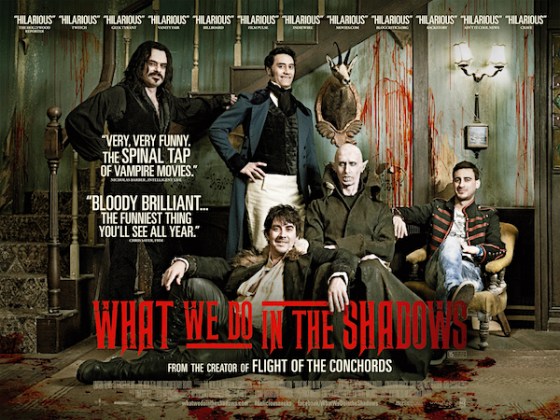
Perhaps the more familiar you are with vampire fiction the more you’ll get out of What We Do in the Shadows’ humour, but I don’t think that’s a prerequisite to enjoying it — I should think knowing the basics of vampire mythology is enough to get laughs from the majority of the movie without feeling like you’re missing anything. And in the end, the most important thing is that it’s incredibly funny. Or, as the poster accurately puts it, “hilarious, hilarious, hilarious, hilarious, hilarious, hilarious, hilarious, hilarious, hilarious, hilarious, hilarious, hilarious.”

5 out of 5

What We Do in the Shadows is available on iPlayer until 28th November.

It placed 12th on my list of The 17 Best Films I Saw For the First Time in 2017, which can be read in full here.

The UK TV premiere of Taika Waititi’s previous film, Boy, is on Film4 tonight at 10:50pm.
His new film,
Thor: Ragnarok, is out everywhere now and is reviewed here.

The Lost in Time, Like Tears in Rain, Monthly Update for October 2017

This month includes three shorts and two feature films in the Blade Runner universe, one of them a contender for Film of the Year. Now I just need to dig out the old computer game…


#129 Twilight Zone: The Movie (1983)
#130 Public Access (1993)
#130a Blade Runner: Black Out 2022 (2017)
#130b 2036: Nexus Dawn (2017)
#130c 2048: Nowhere to Run (2017)
#131 Perfect Sense (2011)
#132 Blade Runner 2049 (2017)
#133 The Straight Story (1999)
#134 Manchester by the Sea (2016)
#135 Assassin’s Creed 3D (2016)
#136 Frost/Nixon (2008)
#137 Vixen (2017)
#138 What We Do in the Shadows (2014)
#139 Journey to the Center of the Earth 3D (2008)
#140 Train to Busan (2016), aka Busanhaeng
#141 Silence (2016)
#142 The Twilight Saga: Eclipse (2010)
#143 Rurouni Kenshin (2012), aka Rurouni Kenshin Part I: Origins
#144 The Heat (2013)
#145 Moon (2009)
#146 RocknRolla (2008)
#147 In the Loop (2009)
#148 Thor: Ragnarok (2017)
#149 Rurouni Kenshin 2: Kyoto Inferno (2014), aka Rurōni Kenshin: Kyôto taika-hen
#150 The Exorcist (1973)
#151 Vehicle 19 (2013)
Blade Runner 2049

Train to Busan

Rurouni Kenshin 2: Kyoto Inferno

.


  • With 23 new feature films watched this month, October becomes the best month of 2017 so far, beating the 20 of March.
  • It smashes the October average (12.78), raising it over one whole film in the process (to 13.8). It’s not the highest October ever, but October 2015 is my highest-ever month, so, you know.
  • It also surpasses the average for 2017 to date (14.2; now 15.1) and the rolling average of the last 12 months (13.83; now 14.58).
  • Reaching #151 means 2017 is already my third best year. I’d have to reach #196 for second place, which I’m not on track to do. But come the end of the year I’ll factor in the Rewatchathon too, and that may say differently…
  • This month’s Blindspot film: it was Halloween, so I saved the film still advertised as “the scariest of all time” for October — William Friedkin’s The Exorcist. S’not that scary. S’good, though.
  • This month’s WDYMYHS film: with Duncan Jones’ new film coming to Netflix sometime this year, I finally got round to the movie that made his name (and his Twitter name in particular), Moon.


The 29th Monthly Arbitrary Awards

Favourite Film of the Month

There were a fair few films I enjoyed a lot this month — indeed, when I’m finally done reviewing them, there could be as many as nine five-star ratings handed out (that’d be 39% of this month’s films, well above my average of 16.7%). In most months that’d make this a very tough choice, but after only a little consideration it’s clear that the winner has to be Blade Runner 2049.

Least Favourite Film of the Month

Conversely, there were a few clangers too — again, several I’d be happy to give this dishonour to. The most egregious of them all was Vehicle 19, a thriller whose high concept was right up my alley, but was so poorly realised that I’ll be giving it a very low score indeed.

Film I Most Often Forgot to Review This Month
I watched Taika Waititi’s What We Do in the Shadows partly so I could review it the day his Thor sequel hit UK cinemas… but I forgot. Then I discovered it was going to be on BBC Two last Sunday night… but that was only 55 minutes before it was due to start. I guess next I’ll aim to tie my review to Thor 3 coming out in the US… but I’ll probably forget.

Most Surprisingly Popular Review of the Month
My most-read post for the past two months in a row is The Past Fortnight on TV #22. Is that because of The Defenders? The Game of Thrones finale? The long-awaited return of Agent Cooper to Twin Peaks? Well, I’m sure they all helped, but my stats say the highest number of referrals from IMDb (far higher than anything else in that post) came from Designated Survivor. Who’d’ve thunk it?

The Audience Award for Most-Viewed New Post of the Month
Reviews of new cinema releases almost always do well, and so two of them duked it out for the top spot this month: Blade Runner 2049, which sat clear for most of the month, and Thor: Ragnarok, which took a run at it in the last week. With 24 hours to go it was still a tight race: they were separated by fewer hits than Thor had typically been getting in a day. But in the end the Marvel movie didn’t get anywhere near that many yesterday, leaving Blade Runner 2049 this month’s victor.


I always thought that the next time I watched Blade Runner it would be to finally see the original theatrical version. That’ll have to wait for another day: because I was rewatching it the night before 2049, it seemed most appropriate to choose the ‘official’ final version.

#36 Blade Runner: The Final Cut (1982/2007)
#37 Austin Powers: International Man of Mystery (1997)
#38 Austin Powers: The Spy Who Shagged Me (1999)
#39 Austin Powers in Goldmember (2002)
#40 The Reckless Moment (1949)

I’ve got a long list of things to consider rewatching for this project, but that’s frequently going ignored in favour of where my whims take me. So, after randomly alighting on Wayne’s World last month, I fancied carrying on through Mike Myers’ oeuvre, thus all three Austin Powers flicks are here (with my short Letterboxd comments on each linked to above). It’ll be Shrek next. (That was a joke, but, actually, it is something I’ve been planning to rewatch…)

Finally, film noir The Reckless Moment. I first watched it over a decade ago (and reviewed it here) and have been meaning to revisit it for a lot of that time because I thought I’d been unfair to it. Now, I’m not so sure. It’s got a lot of good stuff — the cast, the direction, the concept — but parts of it are rushed or underemphasised. Although it’s not all it could be, I feel like something will keep drawing me back to it. Not any time soon — that’s not in my nature — but someday. Maybe, ironically, some of the appeal lies in the imperfections.


As 2017 hurtles towards 2018, the big screen offers up a death on a train, a marmalade-loving bear, and a league of justice. Feel free to guess which is the only one of those I’m likely to bother going to the cinema for.