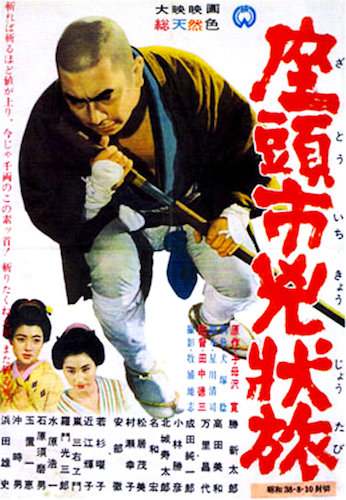
Zatoichi the Fugitive (1963)

aka Zatôichi kyôjô-tabi

2017 #159
Tokuzô Tanaka | 86 mins | Blu-ray | 2.35:1 | Japan / Japanese

Zatoichi the Fugitive

His sword is shiny and ice-cold. The only thing it won’t cut in this whole wide world is oil and the bond of lovers.

The fourth film in the Zatoichi series finds the blind masseur (Shintaro Katsu) with a bounty on his head, which only increases when he kills the first person who tries to claim it. Travelling to a nearby village to apologise to the guy’s mother, Ichi finds himself in the middle of a yakuza scheme to grab territory from a young boss. There’s also the small matter of a ronin (Jutarô Hôjô) and his companion, Ichi’s old love Otane (Masayo Banri).

That’s the straightforward version — much of the plot is an overly complex account of yakuza plotting that, frankly, I sometimes struggled to follow. Especially at the start, there are so many bosses to keep track of, with broadly similar names, all of whom are more often referred to in dialogue than established on screen. I got my head round it eventually, but it took some work. It makes stretches of the film a bit dry and awkward, however.

Fortunately, that’s not all that’s going on. Otane is back from films one and two, but she’s different to how Ichi remembers her. Rather than just bringing back a familiar face for the sake of it, the film uses her to make a point about how people aren’t always who we think they are — a bit like Ichi himself, in fact. I imagine this would be even more effective if I’d watched The Fugitive closer to when I watched her previous two appearances, but there’s enough information recapped within the film to get the gist. It also continues what seems to be a definite theme of the Zatoichi films (at least so far) about past people and actions coming back to haunt our hero.

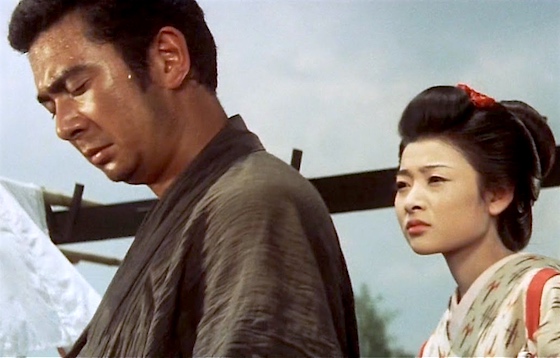
The bond of lovers

However, the best part of the film is the final 20 minutes, a tour de force of emotion and action that sees Ichi surrounded and, enraged into action, taking down an army that stands between him and vengeance. Said vengeance comes in the form of a one-on-one sword duel, of course. Obviously we know our hero will triumph, but it’s still a tense scene, especially as it seems to be a rare occasion when Ichi’s been out-fought. This third act elevates the whole movie, its very existence justifying everything that came before.

Reading other reviews, I’ve seen The Fugitive described as both “one of the weaker installments in the series” and “thus far the best [of the series,] a spectacular action-packed entry that deftly showcases why this series matters so much.” I think this stems to which you weigh heavier between the first-rate climax (plus a few choice sequences before that) and the occasionally dry plotting earlier in the movie. For me, the way it eventually comes together and concludes makes it all worth it.

4 out of 5

Valerian and the City of a Thousand Planets (2017)

2017 #160
Luc Besson | 137 mins | Blu-ray (3D) | 2.40:1 | France, China, Belgium, Germany, UAE, USA, UK & Canada / English | 12 / PG-13

Valerian and the City of a Thousand Planets

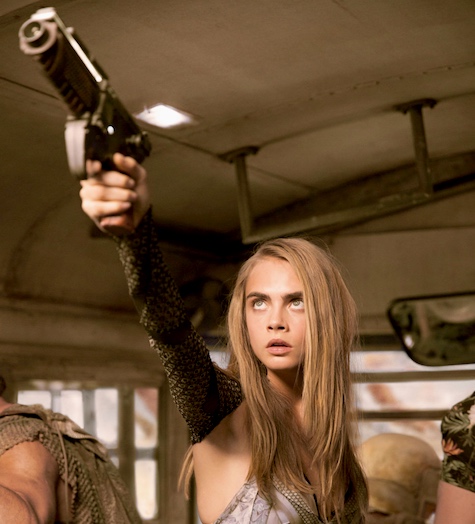
Luc Besson returns to the sci-fi genre that he so memorably visited 20 years ago in The Fifth Element for another colourful, crazy, adventure romp. Based on the French comic book series Valerian et Laureline, it sees special agents Major Valerian (Dane DeHaan) and Sergeant Laureline (Cara Delevingne) on a mission to protect Alpha, the titular city, from forces that threaten to destroy it.

Valerian got a pasting from critics and was a flop at the US box office, a particular problem when it’s apparently the most expensive independent movie ever made. Fortunately for it, it did alright internationally, to the point where home video sales could still secure a sequel (Besson has already written a second and has moved on to developing a third!) While it’s far from a perfect movie, it deserves to find an audience. It’s probably a bit too barmy — a bit too European, even — for mainstream US tastes, but there’s a lot to like here for those who are so inclined.

The main selling point is the imagery. Simply put, it’s incredible. There’s so much going on, all the time. There’s background detail galore. It whizzes through worlds that could be the entire setting for some other story. There are dozens, probably hundreds, of alien species thrown around. It’s so casually inventive, as if it’s got imagination to spare. And it’s mostly vibrantly colourful too, a real comic book of a movie in the traditional sense. All that depth and detail looks particularly amazing in 3D, it must be said, especially during the action sequences that whoosh though intricate, layered environments at breakneck speed.

Valerian, without Laureline

This visual exuberance sometimes comes at the expense of the plot. The main storyline is pretty straightforward — for example, there’s a third-act twist that’s obvious from the moment the character it concerns first appears on screen — but it keeps getting distracted by total asides, as Besson meanders off course to showcase some other species or environment or set piece he and his army of designers have cooked up. If that kind of shaggy storytelling annoys you then Valerian is set to get up your nose, but if you go along for the ride then Besson’s showing off can be delightful.

Some of the other screenwriting details suffer even more, however. It almost engages in some interesting themes about colonialism and that kind of stuff, but instead more nods its head in their direction than actually says anything about them. More overtly, a lot of the dialogue is atrocious. In fact, it’s so bad that you begin to wonder if it’s deliberately ultra-mannered and you’ve just missed some kind of joke. It doesn’t help that DeHaan feels at least somewhat miscast as the cocky heroic lead. Or possibly that’s the point — that Valerian isn’t as irresistibly attractive and amazingly competent as he thinks he is. Model-turned-actress Delevingne, on the other hand, is surprisingly good.

You’ll notice that Valerian and Laureline are (a) co-leads, and (b) both in the name of the original books, and yet the female half of the duo has been ditched from the film’s title. Unfortunately, that does indicate the film’s sometimes-dated attitude towards gender politics. On the bright side, Delevingne manages to imbue Laureline with a feistiness that allows her to mostly hold her own against the men, and — despite the old-fashioned shape of a romantic subplot — Besson’s screenplay lets her be a capable agent in her own right as well. Still, Laureline vs. the Space Patriarchy would not be a wholly unapt alternative title for the film.

Laureline vs the Space Patriarchy

These less-good aspects of Valerian glare out at one rather, and make me want to declare that much of it is kind of rubbish, really… and yet I rather enjoyed the whole shebang. Perhaps it just takes a rewatch or two to settle into the film’s own particular rhythm? Even if that’s not the case, I’d still rather have the messy ambition of a Valerian than another dozen run-of-the-mill Hollywood CGI extravaganzas. Fingers crossed for those sequels.

4 out of 5

Valerian and the City of a Thousand Planets is released on disc in the UK today.

It placed 17th on my list of The 17 Best Films I Saw For the First Time in 2017, which can be read in full here.

Hail, Caesar! (2016)

2017 #23
Joel & Ethan Coen | 102 mins | streaming (HD) | 1.85:1 | UK, USA & Japan / English | 12 / PG-13

Hail, Caesar!

The Coen brothers’ ode to the golden age of Hollywood provoked mixed reactions from their faithful fans (i.e. all film critics and most moviegoers) — some say it’s just a lightweight romp, others that there’s more meat on its bones.

Well, maybe there are indeed hidden depths here, but I think I’d prefer it as just a zany caper centred on Josh Brolin’s character, surrounded by the game all-star supporting cast, rather than having lengthy asides where a room of kinda-recognisable supporting actors discuss economics and communist philosophies and that kind of thing. Is that shallow of me? Maybe. But the movie is so entertaining when it’s riffing off classic Hollywood staples and making light work of many an amusing scenario, it’s tough not to want it to be no more than that.

Fundamentally I enjoyed it (those handful of political longueurs aside), but I’m not entirely sure what to make of it as a whole. I can believe there’s a deeper reading there if one looks to interpret it, but I’m not sure I’m bothered — I’m satisfied with it being merely a comical tribute-to-old-Hollywood caper, thanks.

4 out of 5

Hail, Caesar! was viewed as part of my What Do You Mean You Haven’t Seen…? 2017 project, which you can read more about here.

Napoleon (1927)

aka Napoléon vu par Abel Gance

2016 #184
Abel Gance | 333 mins | Blu-ray | 1.33:1 + 4:1 | France / silent (English) | PG / G

Napoleon

At one point in time, arguments over rights made it seem unlikely you’d ever be able to see Abel Gance’s epic biopic of French leader Napoléon Bonaparte if you were a regular person not prone to attending all-day cinema screenings with a live orchestra and multiple intermissions. But a year ago this week things panned out so that the BFI were finally able to release it on Blu-ray. While a theatrical marathon is probably still the best way to see the film (if only for the full effect of the famed triptych finale), this release is certainly more convenient and accessible. Apparently it sold better than expected, too — I guess that’s what happens when you combine years of anticipation with being a worldwide-exclusive release of a film of this stature. It’s also a daunting film to review — for the aforementioned reasons, plus its length and its artistic importance. Nonetheless, here are what thoughts I had.

At 5½ hours, Napoleon is rather like a miniseries from the silent era — a comparison that feels more apt than ever in this age of binge-watching. It’s divided into four acts, each running anywhere from 49 to 114 minutes, but it could even be subdivided into further episodes: Napoleon’s schooldays; his observation of the French Revolution; his opposition to Corsica being sold to England; the siege of Toulon (which takes up all of Act 2 and is the best bit, in my opinion); the reign of terror (a half-hour section that barely features Napoleon); a chunk where he falls for and woos Josephine that plays like a rom-com; the invasion of Italy… Yet despite that length, the film doesn’t even reach the Napoleonic Wars. No wonder Gance wanted to do six movies — or six seasons, as we might interpret it today. (In the end, he went over-schedule and over-budget on this first film, covering just two-thirds of the story he’d intended and spending the budget for the entire series. I imagine I’d outrage some silent film fans/scholars if I called him the Peter Jackson of his day…)

Albert Dieudonne as Napoleon

Part of the fourth act is that triptych climax, a 21-minute sequence shot with three cameras side-by-side, and therefore designed to projected on three 1.33:1 screens side-by-side, to create a 4:1 widescreen image. It’s undeniably less powerful when rendered as a thin strip across a 16:9 television, suddenly shrinking the height of the image rather than suddenly tripling its width, but what other choice is there? (Well, if you’ve got three sets of equipment, the three-disc Blu-ray contains each screen full size, one per disc, so you could set it up yourself.) Even shrunk like that, the imagery in the sequence remains stunning. I bet the effect is marvellous when seen as intended. (There’s an alternate single-screen ending, which is quite different. It contains fundamentally the same ‘plot’, but there’s one whole new sequence, and the others are truncated or slightly rearranged. Worst of all, it loses the tricolour-inspired finale.)

Widescreen properly arrived when CinemaScope was invented in 1953, so Gance was about 25 years ahead of his time with that technique. It’s Napoleon’s most striking innovation, but the whole film shows off a surfeit of cinematic techniques: a wide variety of shot lengths (close-ups, medium, long, wide, etc, etc); tracks and pans, many of them fast; handheld photography, including what we’d now call ShakyCam; swaying back and forth, in and out of focus, or swinging over a large crowd; mounted on fast-moving vehicles, including dipping under the waves on a boat; in the thick of the action rather than observing it from a distance; multiple exposures and superimposition; animated maps to indicate Napoleon’s strategising; split screen; split-second impressionistically-fast cutting… and most of that’s found in just the first hour! Some of this is stuff that would still feel revolutionary when filmmakers were doing it 20, 30, even 40 years later. The fast-cut pulse-racing action scenes, like a horseback chase on Corsica, are not what you commonly expect from a silent movie, especially an ‘artistic’ one rather than a swashbuckler, say.

Epic

Lest you think a film of this vintage must be in black and white, Napoleon features a lot of tinting and toning, which works very well at times to create striking and meaningful imagery: golden sunlight illuminating the debut of La Marseillaise; the burning red of revolution forged in a furnace; a tumultuous purple ocean… Similarly, Carl Davis’ original score is great, helping to emphasise the emotion and lend the images a storytelling shape. Again, the sequence with La Marseillaise is a good example; a particularly effective tour de force. Davis makes good use of other familiar tunes for shorthand — there are variations on Rule, Britannia whenever the British are involved, for instance.

Making Abel Gance’s Napoleon was an epic undertaking, as was its decades-long reconstruction, as is the viewing experience (it is 5½ hours, after all). It may not be perfect for all of that immense running time (which does not merit adjectives like “indulgent” or “excessive” but is, nonetheless, long), but it is a monumental achievement in cinema that undoubtedly deserves full marks.

5 out of 5

That completes my reviews from 2016, finally.

Another Earth (2011)

2017 #15
Mike Cahill | 92 mins | streaming (HD) | 16:9 | USA / English | 12 / PG-13

Another Earth

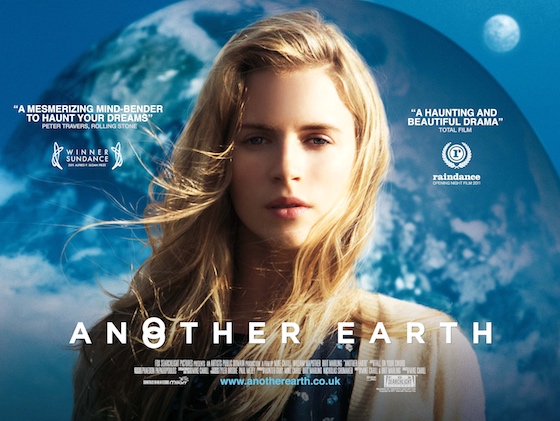
Driving home drunk, 17-year-old Rhoda (Brit Marling) hits another car, leaving its driver, John (William Mapother), in a coma and killing his pregnant wife and their young son. Released from prison four years later, her grand life plans abandoned, Rhoda seeks out John to apologise, but when he doesn’t recognise her she pretends to be from a cleaning service and becomes his maid. Meanwhile, a planet that seems to be a mirror image of Earth has appeared in the sky and one member of the public can win a place on an exploration mission.

Bit of a curveball, that, isn’t it? The main thrust of the film is a very grounded character drama about two emotionally damaged people and how they connect with each other, but there’s this big old sci-fi plot ticking away in the background — one which is referenced in the title of the film and all its marketing too, which immediately elevates its importance in the film: it’s not just a funny little background quirk, it’s central to what’s happening or will happen.

By combining these two disparate genres Another Earth moves outside the accepted norms of either, which seems to discombobulate some viewers. I’ve seen it decried for not ditching the sci-fi stuff to focus on the characters’ emotional situation and relationship, and the same for not ditching the emotional stuff to focus on the sci-fi concepts. Personally, I think the film is doing exactly what it sets out to do: using aspects of each genre to comment on, reflect, and influence the other. That’s not to say it’s in some way a deconstruction of genre — it’s not working with tropes or clichés, at least not deliberately — but I mean it’s using a sci-fi idea to influence what could just be a straight-up dramatic story, and using a realistic human drama to explore a sci-fi concept from a different angle. Truth be told, I think some people can’t quite handle that. Of course, some people just think it doesn’t do it very well, which is fine. I thought it was at least interesting.

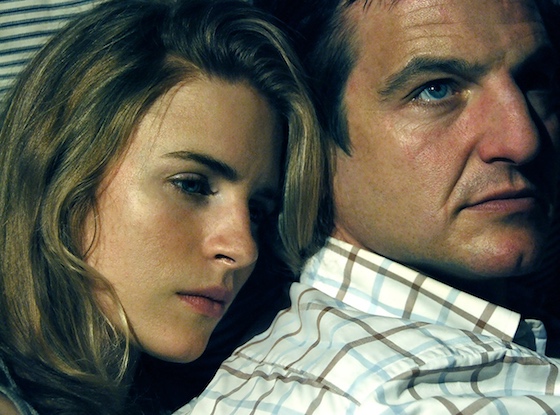
Emotionally damaged

Perhaps it doesn’t help that some of it looks like shit, as if it was shot by some inexperienced amateurs using their home movie camera… which it was. After having the idea for the film, co-writer/director Mike Cahill and co-writer/star Marling began shooting it using just an HD camcorder, even before they’d secured any funding. Well, haven’t they done well for themselves? Still, there are worse-looking movies.

Another Earth may not please those looking for a straight science-fiction movie, nor those after a grounded character drama, but for anyone open to a combination of the two — a plausible, human-scale take on a high SF concept — it’s certainly worth a look.

4 out of 5

Justice League (2017)

2017 #157
Zack Snyder | 120 mins | cinema | 1.85:1 | USA / English, Russian & Icelandic | 12A / PG-13

Justice League

This review contains spoilers, but only for stuff everybody knows.

DC’s answer to Avengers Assemble begins with a doom-laden cover of Leonard Cohen’s Everybody Knows (a Zack Snyder music choice if ever there was one), and there’s a lot that “everybody knows” about the troubled production of this long-awaited superhero team-up. Everybody knows that the so-called DCEU was deemed to be in need of a course-correction after Batman v Superman. Everybody knows that this was to take the form of making this film tonally lighter, something Snyder and co said was always the plan. Everybody knows Snyder eventually had to leave the project for personal reasons. Everybody knows Joss Whedon was brought in as his replacement. Everybody knows that meant reshoots and an attempt to lighten the tone further. Everybody knows that was a recipe for a conflicted movie…

For those who are thinking “I didn’t know any of that” and aren’t so familiar with superhero things on the whole anyhow, Justice League is set in the aftermath of Superman’s self-sacrifice at the end of Batman v Superman, which has given Bruce Wayne aka Batman (Ben Affleck) a change of heart: he wants to make the world a better place. When he discovers than an alien invasion is imminent, he teams up with Diana Prince aka Wonder Woman (Gal Gadot) to put together a team of metahumans (read: people with superpowers) to fight it. That team includes Barry Allen aka the Flash (Ezra Miller), Arthur Curry aka Aquaman (Jason Momoa), and Victor Stone aka Cyborg (Ray Fisher) — and, following an opportunity to revive his cold dead corpse, Clark Kent aka Superman (Henry Cavill).

The new trinity?

Justice League has certainly provoked a mixed reaction from critics and opening weekend audiences. It was always going to: Batman v Superman has been very divisive, with critics largely hating it but a dedicated fanbase to be found without too much digging. Justice League compounds that issue by trying to appease critics, risking alienating fans in the process. The end result inevitably falls somewhere between the two stools, which means there’s no predicting what any one person will make of it — following social media the past couple of days, I’ve seen every possible combination of people who loved, liked, hated, or were indifferent to previous DCEU films and now love, like, hate, or are indifferent to Justice League.

So, my personal reaction is that I enjoyed it. On the whole it’s not as thought-provoking as BvS, but is instead a fun time with some good character bits thrown in. From early reviews I feared the whole story would be choppily edited, and the opening act is indeed a bit disjointed and jumpy, but the closer it gets to the team being assembled the more it settles down. Once they’re together, it’s a fairly straightforward action-adventure movie, with the heroes in pursuit of the villain to stop his world-ending plan. Unlike BvS it’s not full of portentous (or, depending on your predilections, pretentious) themes to ponder, but it’s still a reasonably entertaining action movie.

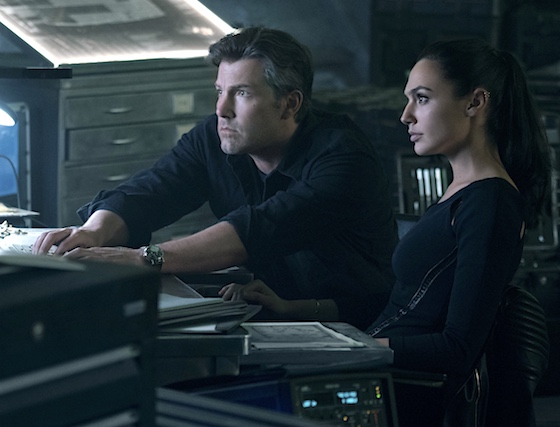
Bruce and Diana

As for those character bits, it completes arcs for Bruce and Diana that have played out over their past couple of movies, both of them opening up to the world and their place in it. Moments that emphasise Bruce being old and tired and Diana stepping into the role of leader seem to have been added during reshoots, no doubt indicating the future direction the DCEU is now reported to go in — Affleck stepping away in the not-too-distant future; the popular Wonder Woman becoming central to the universe. (As a Batman fan, I hope this doesn’t kill off the raft of Bat-family films they’ve been planning. We’ll see.)

For the new team members, it does a solid job of introducing the Flash and making him likeable — he’s under-confident but good-hearted and funny. Fans of the currently-running TV show may find he’s “not their Flash”, and his costume is one of the worst ever designed, but I’ve never been that big a fan of the series and I can live with the costume. Cyborg gets a mini-arc that works well enough, considering he’s mainly there to be a walking talking plot resolution. Aquaman’s also OK, but a good chunk of his part feels like a tease for his solo film — which, by total coincidence, is the next DCEU movie. This all might’ve been more effective if DC had gone the Marvel route of introducing everyone in solo films first, but the film makes a fair fist of the hand it was dealt.

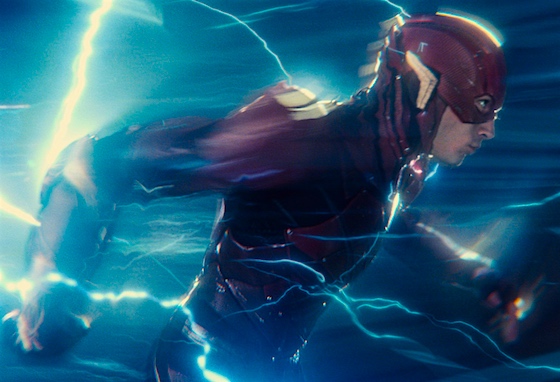
Flash! Ah-ah!

And as for Superman… well, that’s a whole kettle of fish. Firstly, it’s the worst-kept open secret in the history of movies. The final shot of BvS was a clear hint he’d return, so there’s that for starters. Then early promotional materials included him; behind-the-scenes photos referenced him; when reshoots rolled around, the fact they’d have to deal with Henry Cavill’s Mission: Impossible 6 moustache was big news. Despite all that, they left him off all the posters and out of every trailer. Would it have made a difference if they’d publicly acknowledged he was back? Who knows. Let’s judge what we were given.

In short, he’s not in it enough. The story of his resurrection is a decent idea, but the film has to rush and condense the arc of his return, presumably because Warner were pushing for a lighter tone and brisk running time. How his return affects him does complete the overall story that started in Man of Steel and continued through BvS — the story of how an ordinary young man with extraordinary abilities develops into the paragon of virtue that Superman is to many people. Honestly, I believe this was (more or less) Snyder and co’s plan all along, and those haters of Man of Steel and BvS who now say that “Justice League finally got Superman right” have perhaps misunderstood how something like character development works. (Should that entire character arc have been contained in the first movie? I think that’s a different argument — in our current franchise- and shared-universe-driven blockbuster era, character arcs are routinely designed to play out across a trilogy.)
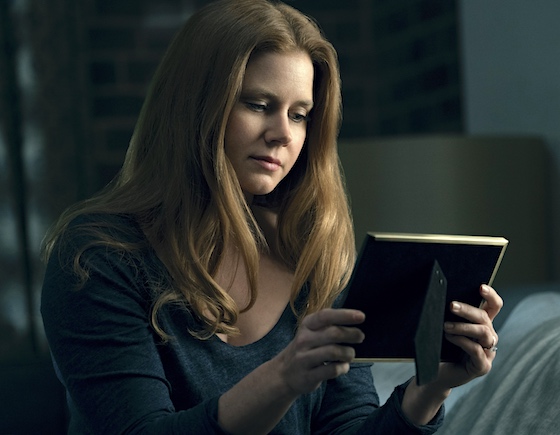
There are no official photos of Superman from this movie, so here's a photo of Lois Lane looking at a photo of Superman
There are no official photos of Superman from this movie,
so here’s a photo of Lois Lane looking at a photo of Superman.

Much attention has also been focussed on the ridiculousness of the moustache removal — both how funny it always was, and how poor the end result is. Honestly, I don’t think it’s as bad as you may’ve heard. I’d wager most people won’t even notice, especially if they’re not looking for it. It’s the kind of thing film buffs see because they’re looking and, yeah, sometimes it’s not great. Personally, I didn’t even think it was the worst computer-generated effect in the movie. Main villain Steppenwolf looks like a character from a mid-range video game, and has about as much personality as one too. There’s terribly obvious green screen all over the place, which is undoubtedly the result of reshoots — sometimes it crops up mid-scene for no obvious reason, other than because they’ve dropped in a new line. Other effects — stuff they’ve probably been working on since principal photography — look fine.

Naturally the effects drive all of the action, for good or ill. Some have said these sequences are entirely forgettable, which I think is unfair. There’s nothing truly exceptional, but how many movies do manage that nowadays? I’d say what Snyder offers up is at least as memorable as your typical MCU movie, which is presumably what critics are negatively comparing this to. The everyone-on-Superman punch-up is probably the high-point, with an effective callback to “do you bleed?” and a striking moment when Superman looks at the Flash (that sounds completely underwhelming out of context…) I also thought the desperate escape with the Mother Box on Secret Lady Island was a strong sequence. The big tunnel fight has its moments, but needed more room to breathe and a clearer sense of geography. The climax is a great big CGI tumult, which clearly aims for epic but is mostly just noise — again, with one or two flourishes.

AQUAman

Another late-in-the-day replacement was Danny Elfman on music duties. It’s proven controversial — turns out there are a lot of fans of Hans Zimmer and Junkie XL’s work on the previous Snyder DCEU films. Personally, I think Elfman’s score largely works — its numerous callbacks to classic themes are better than Zimmer’s musicless thrumming. There’s a massive thrill in hearing Elfman’s iconic Batman theme again, and John Williams’ even-more-iconic Superman theme. In his work on Man of Steel and BvS, Zimmer never produced anything even close to that memorable. Elfman’s style works other places too: an early scene where a bunch of criminals take a museum hostage immediately brought to mind the feel of Tim Burton’s Batman for me, mainly thanks to Elfman’s score. That’s no bad thing in my book.

The biggest point of discussion swirling around the film this weekend, in many circles at least, has been “which bits were Snyder and which were Whedon?” According to one of the producers, the final movie is 80-85% what Snyder shot during principal photography, making 15-20% what Whedon added during reshoots. Not a huge amount, but also not inconsiderable. Personally, while I felt some Whedon additions were glaringly obvious, it also felt to me like a shot or line here and there rather than whole chunks of the movie. I think they’ve done a better job of integrating it than some have given them credit for. I put this down to some people thinking any humourous line must be a Whedon addition, but we know that isn’t the case — they were showing off lighter stuff during press set visits and in the initial footage previewed at conventions, both of which were long before Whedon became involved in re-writes, never mind reshoots. The lighter tone was intended from the off, Whedon just added even more of it.

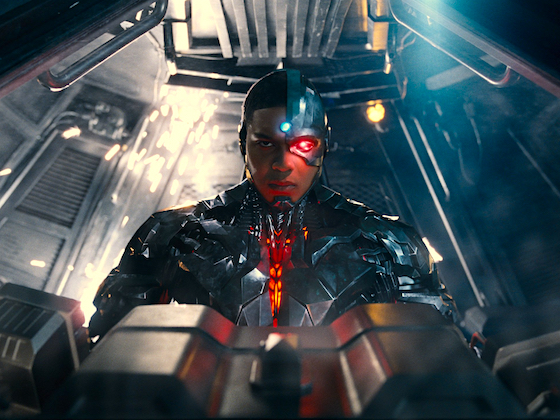
Born 'borg

For those interested, someone who worked on the film has posted a very long list of changes, attributing various bits to Snyder and others to Whedon. There’s also this tweet, which says Snyder’s original cut went down badly with WB execs (hence why Whedon was sought out) and that the vast majority of Superman’s role was reshot to change it entirely — supposedly all that remains of Snyder’s Superman are his action beats (though Whedon added some more), the final scene with Bruce (“I bought the bank”), and maybe one or two other individual shots. This, then, would be Whedon’s biggest contribution to the film. Some love him for it, others not so much. There seems little doubt this is a lighter, more fun Superman. I liked him, though it can’t hurt that I have a bit of a soft spot for Henry Cavill.

Generally speaking I’m a fan of Whedon — I grew up with Buffy; I’m certainly a Browncoat — but I think his additions (assuming those accounts are accurate) are a mixed blessing. Most vital is all the character stuff he’s slotted in, some of which really adds to the movie — Batman’s pep talk to the Flash about “save just one person” was a highlight, I think. The jokey dialogue sometimes lands, sometimes feels forced — the obvious insert of Batman complaining “something’s definitely bleeding” feels incongruous. I’ve seen some complain that he added too many pervy shots of Diana’s ass in that short skirt or those tight trousers, but then whenever I noticed such shots they were in footage that’s been attributed to Snyder, so who knows.

Well if you wear a skirt that short what do you expect to happen?

Everything to do with the Russian family was certainly Whedon, which I’d rather suspected. I mean, there are civilians there to add stakes to the final battle, so that it’s not just the villain being villainous in the middle of nowhere, but why is it that just one family lives there? Because they were added during reshoots and there was probably neither time nor money for crowds of people, that’s why. Their subplot could’ve been integrated better (it felt like they kept just popping up for no reason), but I liked the eventual pay-off with the Flash and Superman saving them — the Flash saving one carload while Supes flies past with an entire building is the kind of humour I think works in this film.

Justice League is a different movie for Whedon’s involvement, that seems unquestionable. Is it better or worse? That’s partly a matter of personal taste. As my taste stretches to include both directors’ works, I can see positives and negatives every which way. My ideal cut of the movie would likely keep some of Whedon’s additions but lose others, as well as reinsert some Snyder stuff they cut. There’s no pleasing everyone, eh? (If you want to see some of what was definitely cut, there are various shots in the trailers, and someone’s leaked eight short clips from Snyder’s version — mostly of unfinished CGI, but one reveals what Iris West’s role was. (If those clips are even still there by the time you read this, of course…))

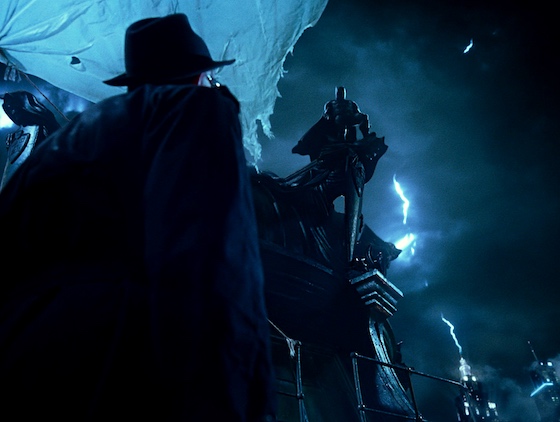
The Batman

Finally, the post credits scenes. It’s obvious that the first is a Whedon addition (confirmed by the above breakdown) — it’s just a little coda that doesn’t add anything other than some fun. The second scene, however, is an odd one, because it feels like it’s teasing a movie that’s been uncertain for a long time. If it’s setting up The Batman (because Deathstroke was meant to be that film’s villain), well, we know director Matt Reeves is massively reshaping whatever Affleck had planned, quite possibly ditching Deathstroke altogether. If it’s setting up Justice League 2 (because Lex Luthor’s back with a team-building plan of his own), well, who knows if that’s even happening anymore? It was originally planned this movie would be Justice League Part 1 and be closely followed by Justice League Part 2 — presumably that’s why Steppenwolf is the villain, because he was meant to lead into Darkseid (it’s long been reported that a cliffhanger ending to set up just that was cut by Whedon) — but I believe Part 2 has gone MIA from the schedule, and with Affleck now making definitive noises about wanting out of the franchise… Well, who knows what’ll happen.

Back in the present day, Justice League is set to underperform at the box office this weekend: predictions have been revised ever downwards over the past few days, to the point where it’s now at under $100 million — which is kinda funny because it feels like everyone’s talking about it. I guess that’s the difference between “film Twitter” and movie blogs compared to regular folks. Movie Nerds v Regular People: Box Office of Justice, or something. Funny thing is, for all the hatred these DC movies have attracted, they don’t half get people talking. As I saw someone point out on Twitter the other day, you may not’ve liked Batman v Superman, but it’s more than 18 months later and you’re still talking about it. I can’t even remember which Marvel movie was out 18 months ago without looking it up. This is no doubt a simplification — not everyone’s still arguing about BvS, and one of the reasons Marvel movies don’t stick so long is that they produce so darn many of them — but I do think Marvel films give you fun for a couple of hours, and you can call them to mind again if prompted, while DC films stick around, turning over in your mind, love it or hate it. At least for some of us, anyway.

All in

With Justice League, there’s the added complications of its multiple directors and fraught production. Should we judge a film for what it could have been or for what it is? The latter, surely. The former is definitely an intriguing proposition, but not what’s in front of us (and, as the likes of Blade Runner, Alien³, and Superman II have shown, maybe one day we’ll get a chance to judge that movie anyway). Nonetheless, how much should we take into account the behind-the-scenes issues? Should we just pretend they don’t exist? I guess for a lot of regular moviegoers this isn’t even an issue, but for many of us film-fan types it’s hard to put aside the knowledge that this movie was the product of two directors with very different styles and very different production timeframes.

I don’t have any easy answers, I’m afraid. All I know is that Justice League is far from perfect, but I enjoyed it nonetheless.

4 out of 5

Justice League is in cinemas everywhere now.
Wonder Woman (2017)

2017 #81
Patty Jenkins | 141 mins | cinema | 2.35:1 | USA, China & Hong Kong / English | 12A / PG-13

Wonder Woman

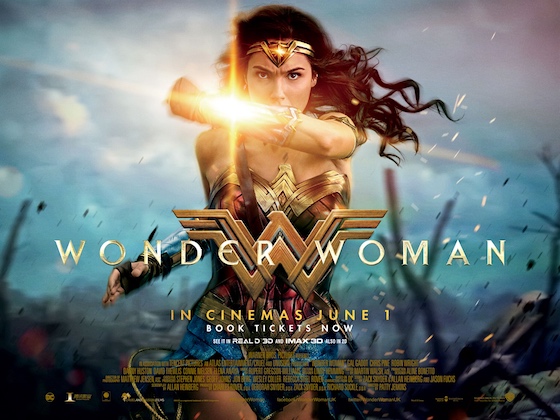
Following Wonder Woman’s introduction in Batman v Superman: Dawn of Justice (her central role in that film’s final act surely being the inspiration for its terrible subtitle), here we flash back in time to learn her origin — of her childhood on a hidden island of warrior women; of the events that brought her into our world; and of what made her keep quietly to the sidelines for almost a century.

The fourth film in DC’s shared cinematic universe, commonly dubbed the DCEU, is by far its best reviewed to date. It’s also the first superhero movie of the modern era (i.e. post Iron Man) to be based around a female character. I can’t help but think one has a lot to do with the other, because, in my estimation, Wonder Woman is not massively better than or different to the action-adventure blockbusters we get several of every year — the only exception being, of course, that it stars a woman. While that is undoubtedly important, and its meaningfulness can apparently not be understated, it doesn’t automatically elevate the quality of the rest of the movie. Or maybe it does for some people — maybe “the same, but with a woman” is enough to make it a genre classic.

The film’s strongest feature (gender politics aside) is its cast. Gal Gadot is fantastic — it’s no wonder this role seems to have made her an instant star. Chris Pine also gives a likeable performance, while Lucy Davis nails the comedic support. Also of note are the strong Amazonian ladies who shape Diana’s childhood, Connie Nielsen and Robin Wright. On the other side of the fence, Danny Huston is pretty much wasted, while David Thewlis ultimately feels a little miscast.

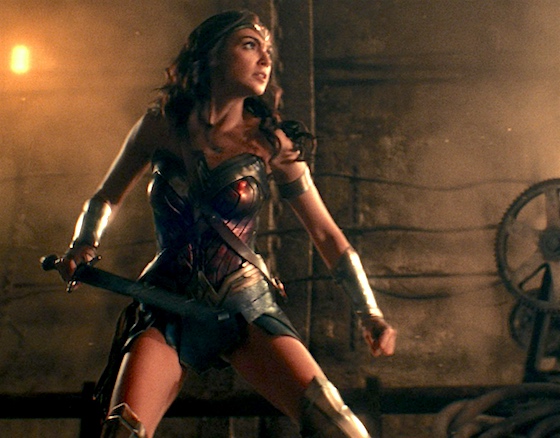
If anyone can take a sword to a gun fight...

The action is very much from the Zack Snyder school — an inexplicable mix of slow-mo and almost-sped-up (or speed-ramped, as it is either known or people have become fond of calling it). Fortunately it doesn’t degenerate into this all the time — while it was a neat effect when it was new, now it feels derivative and overdone. The rest of the action is of mixed quality: some of it is exciting and well-staged, but at other times succumbs to the modern foibles of shooting it too close and cutting it too fast. The climax is a disappointingly bland CGI-athon, which goes on and on as if someone is stalling for time while they try to think how to end it.

The third act as a whole is probably the film’s biggest problem. The opening stuff on Secret Lady Island is all great; the middle stuff in London is often fun; and there’s some dramatic stuff when Diana & co first arrive on the front lines. It does drag a little in places, mainly when we get the umpteenth go-round of Diana and Steve debating their relative morals; but it’s as the film tries to bring itself towards a conclusion that it really begins to flounder, forcibly manoeuvring our heroes into a position to actually face the villains (who we’ve been seeing on-and-off in scenes where the only purpose is to remind us those characters exist). For instance, there’s a party scene which serves very little purpose. It’s not a bad idea for a sequence (even if it is a well-worn one), but it doesn’t contribute much to justify its existence. You could cut it entirely and nothing would be lost.

Undercover woman

Even after the climactic battle, some things just aren’t rounded off. Like, how Secret Lady Island sort of just disappears from the story (does Diana want to get back there? Does she try? What’s happened to it now Ares is dead?) There’s no closure given to the supporting cast either; and, as the inevitable sequel is reportedly to be set in the present day, I doubt there ever will be. They may not be the greatest or deepest characters, but Davis at least feels like she needs a final moment (there’s one included on the Blu-ray, at least, though it feels like it was intended as a post-credits tease that someone thought better of).

I don’t want to try to ‘mansplain’ (*shudder*) away the significance of either Wonder Woman as a character or this Wonder Woman movie to female audiences both young and old. It’s fantastic that there’s a strong, capable, independent, successful role model being presented in the blockbuster arena. It’s brilliant that it was also directed by a woman, something all too rare in movies as a whole, never mind big-budget ones (though note that none of the three credited screenwriters are female). It’s marvellous that it’s been such a big box office success, proving that these issues are important, and that Hollywood’s received wisdom that “female superhero movies don’t sell” is exactly as bullshit as it always has been. And, actually, all of that is good for men and boys too — to be exposed to such high-profile representations of women that are more than just objects of desire or support for their own endeavours. That’s part of how you begin to change thinking and status in the wider world.

Climbing the ladder of progess, or something

But, if you set societal significance aside, I don’t think this particular film is any better, nor any worse, than your averagely good male-led blockbuster. And that’s okay. I like those films. It’s important to have female leads in movies at the same level as their male counterparts. But I think some people have got carried away, hailing a film that’s averagely-good as being incredibly-great just because it has a female protagonist. In some respects, maybe they’re right, just to make the point (I won’t be surprised if the same thing happens next year with Black Panther and heroes of colour). But there’s been talk of Wonder Woman launching a Best Picture campaign, and I feel that’s just a little bit daft.

Still, let’s not end on a down note. I enjoyed Wonder Woman a lot, even as it exhibited many of the flaws — and, equally, many of the successes — found in most blockbusters nowadays. It’s a good blockbuster, and its significance in terms of little girls (and boys) seeing a strong, capable female hero is immense.

4 out of 5

The latest DCEU movie, Justice League, is in cinemas now.

The Past Month on TV #26

The strangest thing is the Duffer brothers’ apparent obsession with giving starring roles to only-available-in-North-America sweet things.

FYI, rest of the world: I have discovered a 3 Musketeers is in fact a Milky Way.

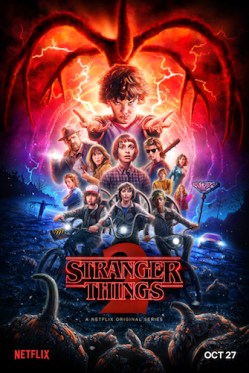
Stranger Things 2
Stranger Things 2Netflix’s most talked about show (well, unless you count House of Cards for all the wrong reasons) returns wth a second season that isn’t just a continuation, it’s a sequel — note how it’s officially called Stranger Things 2 (which briefly sent IMDb skwiffy), and how the episode titles aren’t Chapters Nine to Seventeen of Stranger Things but Chapters One to Nine of Stranger Things 2. Set almost a whole year after the first season, and telling a self contained story (though one that obviously builds out of the first season) which takes place over just a couple of days (in fact, more or less half the season takes place on a single day and night), it feels more like watching a follow-up movie than the next set of instalments in a series that is reported to run another two years yet.
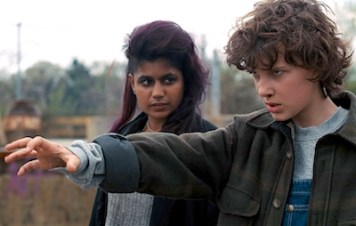
The idea is emphasised further by the fact its form seems largely inspired by The Empire Strikes Back — well, it’s Stranger Things: of course it borrows heavily from an ’80s movie. (If you want to see a whole array of its visual homages/rip-offs in a succinct two-minute video, check out this.) It doesn’t map one-for-one onto Empire’s structure, but it takes the same broad shape: splitting our heroes up into different smaller groups off having their own adventures; throwing new characters into the mix; expanding the universe and the mythos. If anything, Eleven is Luke — by herself, learning about her past, developing her telekinetic abilities. And Dustin and Lucas are kind of Han and Leia — supporting characters now given their own important arc, including both romance and the introduction of a major new character. And so Mike is… I dunno, Obi-Wan? A former main character who’s now barely present. As for Joyce, and Hopper, and Nancy and Jonathan, and Steve, and Will… yeah, Star Wars doesn’t have this many lead characters. Well, I did say it wasn’t exactly like-for-like.

Perhaps another side effect of the movie-esque style is that it feels… short. Like, just as things seem to be getting going, it’s the finale. It’s a problem many binge-focussed series have these days, but this struck me as a particularly pronounced example. It could just be my own fault for watching it all in double-bills, but then I do that quite routinely with Netflix shows and I’ve not felt it so keenly before. Nonetheless, it has enough moving parts that the two-part finale (it’s not officially billed as that, but it is that) remains highly satisfying. As with season one, it’s when everyone finally comes together to fight the threat that the season is at its most satisfying, those two episodes feeling like an adrenaline-fuelled mini-movie (well, movie-length movie) of their own.

Blood ElNow, you can’t discuss Stranger Things 2 without mentioning the infamous Chapter Seven. If you’ve missed the internet’s collective exclamation of disappointment and/or annoyance, IMDb has it in a nutshell: on there, the user ratings of all the other episodes (from both seasons) range from 8.5 to 9.5, a spread of 1.0 (obviously), but Chapter Seven has 6.2, a full 2.3 marks below the next lowest score. Ouch. It’s not great, but I didn’t think it was that bad. It’s a total aside from the main action, and placed where it is seems designed just to delay the pay-off to Chapter Six’s cliffhanger for another 45 minutes (in a regular programme it’d be two weeks, but this is Netflix). I don’t really hold with that being an actual problem, though — that’s just taste. No, the real problem is that it rushes through a character arc for Eleven that would’ve been better presented over multiple episodes. Considering before that she’s spent several episodes just sat around watching TV, there were surely better ways to structure her role this season.
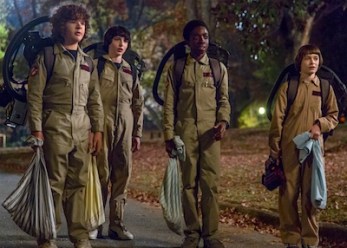
That’s no slight on Millie Bobby Brown’s performance, mind — she’s great again, displaying so much character and emotion even through Eleven’s limited understanding of being a normal person. Also worthy of note is Noah Schnapp as Will. Considering he had so little to do in season one, they either lucked out with his casting or knew where they were going enough to cast it well — a lot is asked of him here, and he’s up to it. I could keep going, but if we begin to single people out we’ll be here all day: almost every lead cast member gets either a stand-out scene or a decent arc. They even made Steve likeable. Finn Wolfhard draws the short straw — Mike spends most of the season just being grumpy about Eleven — but as he was the centre of attention last time it’s okay to let the others shine.

Something stranger in their neighbourhoodEven though it has all the big action stuff you’d expect, Chapter Nine still devotes a serious chunk of time to a character-focussed epilogue; reminding you that, as with most loved shows, the heart of it is the characters and their relationships. Indeed, although the season as a whole didn’t have the same effectiveness as the first, I thought the finale was a better climax. In fact, it would be a perfectly valid place to leave the entire series… but there are (at least) two more seasons to go. It might be nice if season three opened up the timeline a bit, because so far Hawkins seems to be a place where Crazy Terrible Shit happens over a couple of days and then everything’s fine for a whole year.

Red Dwarf XII  Episodes 4-6
Red Dwarf XIII had nice things to say about the first half of Red Dwarf XII in my last TV column, which kindly glossed over the fact that episode three, Timewave, was a bit of a disaster. I think it’s safe to say the second half of the series is stronger — it represents everything I said last time, but better. The final two episodes, M-Corp and Skipper, even throw in some fan-pleasing callbacks — real deep-dives too, aimed squarely at the long-term fanbase. (No spoilers here — the last episode has been available on demand for a week but doesn’t officially air until tonight.) The episodes don’t need such devotee delights just to curry favour — their concept-driven comedy is satisfying enough to stand on its own — but there’s no denying the added pleasure to be found in the references and cameos. You can certainly hear the glee of the live studio audience as they recognise what’s going on each time (it even messes up the pacing of one bit for us regular viewers, but I guess that’s the trade-off). So, even more than last time, this set of episodes demonstrate there’s definitely life in the old Dwarf yet. Bring on series XIII.
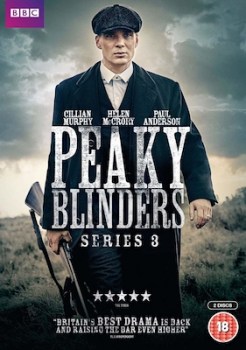
Peaky Blinders  Series 3
Peaky Blinders series 3Beginning with a significant time-jump and monumental change in circumstance worthy of a Mad Men season premiere, the third series of Peaky Blinders soon sees everyone’s favourite Brummie gangsters embroiled in espionage and counter-espionage as they’re enlisted to help exiled Russian aristocracy launch a bid to reclaim their country. There’s so much more going on than that, but I won’t get into it here because we’ll be here all day — Peaky Blinders is a complexly plotted series; right up the final episode, which contains revelations that turn the previous six hours on their head. Even with all that narrative to get through, it still finds plenty of time to give most of its large-ish ensemble cast some strong character arcs. There are a few streaming series that could learn a thing or two from that…

Rick and Morty  Season 1 Episode 2
Neither Rick nor MortyI confess: I started watching Rick and Morty fully expecting to hate it. I’d always thought it looked and sounded annoying, so I paid it no heed… but then it seemed to keep coming up — people referring to it in excited tones, and it ranking 7th on IMDb’s top TV list. So I decided to see what all the fuss was about, still expecting my initial impressions to be proved correct but endeavouring to have an open mind. The pilot (which I covered back in August) did little to sway my mind: it wasn’t terrible, but it had many of the irritations I’d perceived and only a few redeeming qualities. But I read that it was an unrepresentative and below par episode, so I pressed on. Things immediately pick up: the second episode, Lawnmower Dog, mixes together Inception, Nightmare on Elm Street, and super-intelligent canines into an entertaining and clever half-hour. It’s bought my attention for a couple more episodes, at any rate.
Also watched…
  • Arrow Season 6 Episodes 1-2 / The Flash Season 4 Episodes 1-2 — Here we go again… At least The Flash seems to have perked up again this year, which I used to find a little irritating but is actually quite welcome after the dour last two seasons.
  • Bounty Hunters Series 1 Episodes 1-2 — Belatedly started this Jack Whitehall comedy-thriller, which tonally is a bit like The Wrong Mans, which I loved. More thoughts when I’ve finished the series.
  • Castle Season 8 Episodes 4-9 — The arc plot this season is really rather irritating. This is when I’m thankful for binge-watching: it makes that crap go by faster.
  • Detectorists Series 3 Episode 1 — Promptly started the new series of this Mackenzie Crook comedy, which I previously named one of my ten favourite series of the last decade. More thoughts next month.
  • The Good Place Season 1 Episodes 1-2 — Belatedly started this Kristen Bell comedy-fantasy (which only arrived in the UK with the start of season two anyway, so not that belatedly). It’s kind of brilliant so far. More thoughts when I’ve finished the season.
  • Upstart Crow Series 2 Episodes 5-6 — See last month.

    Things to Catch Up On
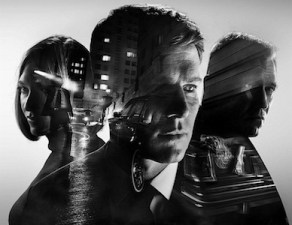
    MindhunterThis month, I have mostly been missing Mindhunter, David Fincher’s new Netflix series about the early days of criminal psychology and criminal profiling at the FBI. It was actually released before my last TV post, but I didn’t have Netflix at the time so I didn’t bother to mention it. I would watch it next, but The Punisher is out tomorrow. Maybe after that…
    Next month… Netflix gets punishered.

  • Fandango (1985)

    2017 #22
    Kevin Reynolds | 91 mins | streaming (HD) | 16:9 | USA / English | 15 / PG

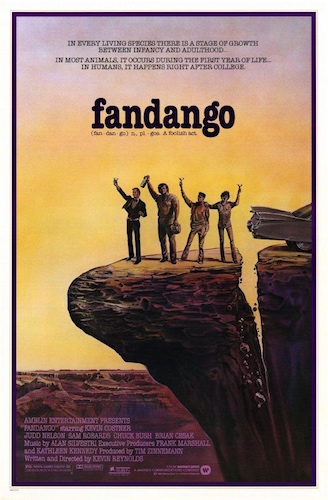
    Fandango

    In this coming-of-age comedy drama, pitched as “celebrating the privilege of youth”, a group of college buddies — two of whom are about to be drafted into Vietnam — go on a final road trip to celebrate their graduation and defer the impending seriousness of adulthood.

    Fandango began life as a student short made by writer-director Kevin Reynolds that just featured the skydiving sequence. That was seen by, of all people, Steven Spielberg, who liked it enough that he gave Reynolds the money to develop a feature film around the idea. But when he saw the finished result, Spielberg distanced himself from it — he even had his name taken off the credits. No idea why — it’s a super movie. If we’re being picky then its structure is a little episodic, but the scrapes the gang get into are linked by arcs that chart their characters’ development, which is where the film has its heart. It’s also resplendent with nice little touches, like well-composed shots (for a first timer, Reynolds clearly knew what he was doing), poignant character moments, and some occasionally profound dialogue, too. A sequence that sees the guys fighting with fireworks in a graveyard, foreshadowing the war several of them are about to head off to, is a particular standout.

    Boys will be boys

    Kevin Costner, tearing through Texas as a free-spirited college flunk-out wearing one-armed sunglasses, an increasingly grubby tailcoat, and a shit-eating grin, has never seemed cooler. That almost masks the fact that it’s also a very good performance, actually. It might’ve been forgotten under some of the blockbusters he did, and some of the crap in more recent years, but the guy can act. The lead cast surrounding him is equally as likeable — it genuinely feels like hanging out with a ragtag gang of college mates on their last hurrah. The final act stretches credibility pretty darn thin with what those guys are able to pull off, but it’s nonetheless a suitably emotive finale.

    I’d never even heard of Fandango until the ghost of 82 recommended it to me last year, which is possibly the end result of Spielberg having disowned it. The history of cinema is no doubt littered with these little gems that, for whatever reason, only resonated with some people at the time. One of the real benefits of the blogging era is that we can recommend them on.

    4 out of 5

    Batman vs. Two-Face (2017)

    2017 #153
    Rick Morales | 72 mins | Blu-ray | 1.78:1 | USA / English | PG / PG

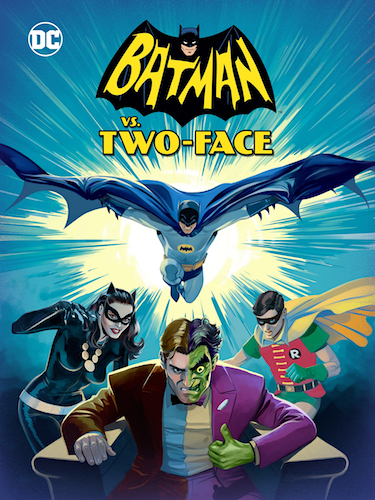
    Batman vs. Two-Face

    Last year the spirit of 1966 was revived when Adam West and Burt Ward returned to the roles of Batman and Robin (or their voices did, anyway) in Return of the Caped Crusaders, a fun comedy-adventure animation that paid tribute to the enduringly popular ’60s incarnation of the (not-so-)Dark Knight. Given the film’s success, it was no surprise a sequel was instantly in development. West completed work on it before his death earlier this year, meaning it now acts as a tribute. It’s unfortunate, then, that it’s not very good.

    As the title makes clear, it sees West’s Batman come up against Two-Face — perhaps the most major member of Batman’s extensive Rogues Gallery to never appear in the TV show. Famed sci-fi author Harlan Ellison did actually write a treatment for a Two-Face episode, but the series was cancelled before it could be produced. It was adapted into a comic in 2015, and there was speculation it would form the basis for this animation too, but that isn’t the case. Maybe it should’ve been.

    Things are weird from the off. The film begins by depicting a version of Two-Face’s origin — one that involves Harleen Quinzel, aka Harley Quinn, a character who wasn’t created until 25 years after the series this is based on. Anyway, it still sees DA Harvey Dent getting half his body fried and subsequently turning into a supervillain whose every decision is ruled by the flip of a coin. With this established in the pre-titles, there’s then a title sequence that shows plenty of Batman vs. Two-Face adventures. Is this a preview of what’s to come? No, because post-titles the story resumes with Harvey being cured. What a weird idea for a ‘first’ Two-Face story.

    Why you two-faced...

    Then Batman has to take on a variety of other foes, and you begin to wonder why the hell this is called Batman vs. Two-Face if he’s fighting everyone but Two-Face. Perhaps unsurprisingly, it does come back around to the eponymous enemy, though Batman refuses to believe his involvement — Harvey has been cured, so is someone impersonating Two-Face? The Boy Wonder isn’t convinced, but Batman is determined to believe his old chum. Oh yes, that’s right — this guy who’s just turned up in the series is apparently Bruce Wayne’s oldest bestest buddy. No wonder Dick’s nose is out of joint.

    At the core of this, once what’s going on is eventually unravelled, is a not-half-bad Two-Face story. Unfortunately, that’s not really a strong marriage for this version of Batman — we don’t want a serious Bat-adventure, we want something light, daft, and above all fun. Batman vs. Two-Face isn’t exactly a sombre affair, but it isn’t funny enough either, lacking the gadabout charm of Return of the Caped Crusaders. The tone is just wrong. The makers admit they were trying to mix “camp with noir”, but — as I think any of us could’ve told them — that’s an unnatural combination that just doesn’t work. None of this is helped by the fact the animation looks cheap, even by the standards of DC’s other direct-to-video movies.

    Best buds, supposedly

    Clint Eastwood was being lined up to take on the role of Two-Face back in the ’60s, but he’s a bit above this kind of fare nowadays. Instead, the villain is voiced by another megastar of ’60s genre TV: William Shatner. Known for his mannered, scenery-chewing acting and ability to send himself up, Shatner seems the perfect foil for West’s Batman. Sadly, the material doesn’t allow Shatner to ham it up like you expect him to. Two-Face’s side of the story is played pretty straight, allowing none of the excess you’d expect from Shatner in comedy mode. Instead, the erstwhile starship captain delivers a genuinely decent acting performance. His voice work creates a clear delineation between the characters of Harvey Dent and Two-Face, and he delivers a fine interpretation of a man held hostage by his own alter ego. But, again, such a straight portrayal is not what’s desired from a Batman ’66 movie.

    I was surprised to discover that Batman vs. Two-Face comes from the exact same writers and director as Return of the Caped Crusaders. The previous film nailed what it needed to be so perfectly, yet this seems to miss the mark almost entirely. My score errs on the side of harshness — there is fun to be had here — but it reflects my feeling immediately after the credits rolled that, overall, this was a massive disappointment.

    2 out of 5