It Follows (2014)

2017 #17
David Robert Mitchell | 100 mins | Blu-ray | 2.35:1 | USA / English | 15 / R
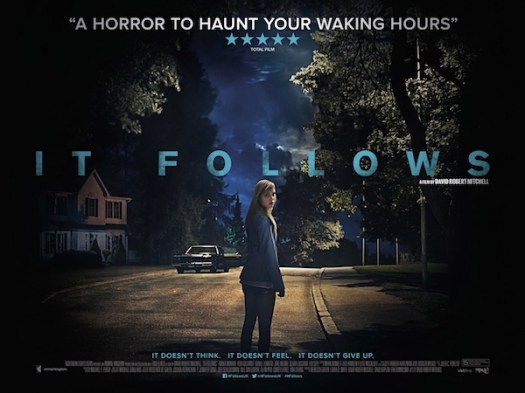
It Follows

It’s always fun when you come across a divisive movie — “which camp are you in?” It Follows is one of those (naturally — I wouldn’t’ve mentioned it otherwise). Some say it’s an instant horror classic, others that it’s slow, boring, unscary, and can’t even follow its own rules. I’m not qualified enough as a horror viewer to claim the former, but nor do I hold with the latter.

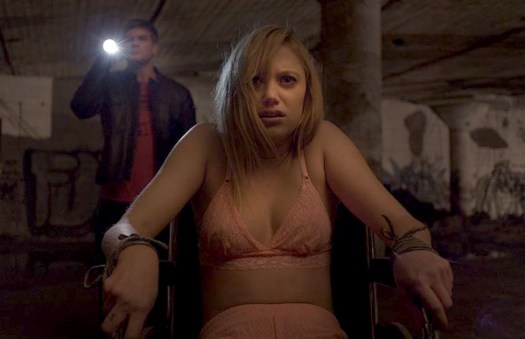
If you’ve not already seen it, it’s based around an original horror concept — that, at least, has been near-enough universally praised. After teenager Jay (The Guest’s Maika Monroe) sleeps with her new boyfriend, he reveals that he’s passed a curse to her. She will be followed by something. It always takes human form, but that form changes — it could be a face in the crowd, someone she knows, whatever it needs to get close to her. Only people who have (or have had) the curse can see it. If it catches her, it will kill her, and then return to hunting the previous target (i.e. the boyfriend). The only way to get rid of it is to sleep with someone else and pass it on — though, of course, if they get killed then it’s back to you. The one advantage you have is that it only walks, and slowly — but it never, ever stops. Naturally, Jay doesn’t quite believe it… until things start happening to change her mind, and along with her friends she tries to find a way to shake the curse permanently.
Pretty in pink

A deadly force that moves towards you slowly but unceasingly and unstoppably — sounds like the stuff of nightmares. And it literally is, having been inspired by a series of nightmares writer-director David Robert Mitchell had as a child. He has not made those childhood fears into a childish movie, however. Far from it. Even leaving aside a couple of splashes of gore, the creature’s frequently nude form, and all the sex stuff, It Follows is adult in its filmmaking attitude. Much like the creature, it often moves slowly, letting its story and situations breathe. This is not a multiplex movie; not a teen-friendly horror flick for date night. It feels more like an indie drama, with Mitchell creating a slow, methodical pace, which doesn’t linger on things — he trusts we’ll spot them. It’s subtle filmmaking, respectful of the audience and our ability to work stuff out. There’s the subject matter, too, about disaffected youth killing time… until they start being stalked by a murderous force, anyway.

One thing I’d say it excels at is creating that ambiance of teenage life. That sense of endless time to do nothing, to be bored — who gets bored once they’re a grown-up and there’s not enough time to do everything you want to do, never mind have time to kill doing nothing? There are parents, but they’re barely present — they exist, but they also aren’t part of your life. They never really tell Jay’s mother what’s going on, nor get the police involved, beyond an initial, fruitless investigation into the boyfriend. Well, why would they? Like being a teen, adults have no real power in your world (i.e. your friendship circle); you can’t talk about all your ‘problems’ with them. Some of this is literally applicable to the film (seriously, are the police going to believe a teenage girl who says she’s being stalked by an invisible killer?), but it’s also part of the film’s broader metaphor.
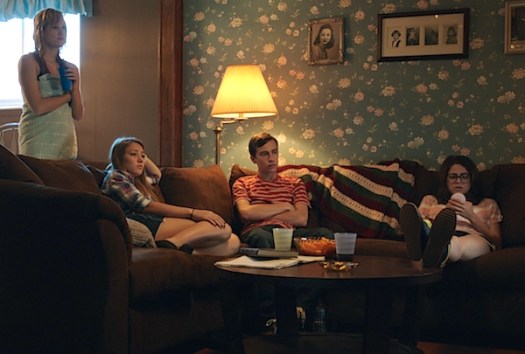
Normal teens

They’re also a decent evocation of normal teens, not the Cool Kids you usually see in movies and TV — they don’t talk in pop culture references or be all hip and aware, like the cast of Sceam or Buffy or something. They’re more normal… apart from the fact they’re always watching black-and-white B-movies, anyway. They’re fumbling their way through life, and the situation they’re in forces them to wake up a little — and they fumble their way through that, too. Again, more metaphors for the real experience of adolescence.

Of course, if you don’t want that kind of stuff from your Horror movie, then I guess It Follows would seem slow and disinterested. So what of the scary stuff? As with pretty much all horror movies, your mileage will vary — perusing various reviews and comment threads shows no consistency in that regard. Personally, I found it more than sufficiently creepy. The whole effect is built on being very atmospheric rather than simplistically Scary. It’s not without its jump scares or freaky moments, but it’s the building sense of dread and tension where it most chills; that has you looking in the back of every frame for what’s coming; longing for a reverse shot, because what if it’s coming from the other direction? There are some very edge-of-your-seat sequences where Mitchell establishes there is something there, that something is coming, but then the camera pans slowly around, or it cuts away, and keeps cutting to other stuff, and you’re begging for it to cut back to the original shot, or for the pan to speed up, so that you can see how things are going, how close it’s getting, to LET US KEEP A BLOODY EYE ON IT.

Ahem.
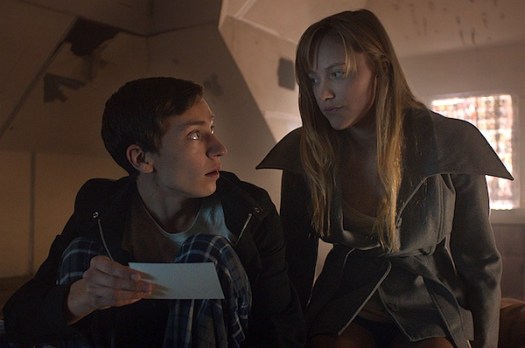
Rules? What rules?

Also from reading others’ comments, it strikes me that the people who are most let down by the film are the ones who are either: a) looking for it to establish and follow a set of rules, or b) reading it as a great big sex metaphor. While it undoubtedly has rules (as a horror movie with a supernatural foe, it requires them) and obviously there’s a sex-related reading (the curse is passed on through sex — how can there not be?), I’m not sure either of these are the film’s main concern; at least, not in the way you’d expect them to be.

People as high and mighty as Quentin Tarantino have criticised the film for its faulty internal logic, for not following its own rules, but I don’t agree. For starters, some of the faults QT calls out are actually explained in the film itself. For seconds, the rules are never established with perfect clarity. We’re given some rules up front, but they come from a scared teenage boy whose only source for this information is his own experience. This isn’t some sage old wise-man or some ancient textbook, this is just some kid who’s been lucky enough to survive a while — who’s to say his observations are 100% accurate? Personally, I don’t think they are. Some people defend the film by saying there are no rules, that it’s operating under dream logic, and that’s fine because the point is to be scary, but I don’t agree with that either. I think the behaviour of “it” does bend the rules we’ve been told, but that’s because the rules we’ve been told are incomplete. I believe it is operating under a set of specific rules, which Mitchell knows but hasn’t fully shared with us. And further, I think that’s not only OK, but actively a good thing. Rules create a safety net — you know what it can and can’t do, and you can work out what to do to defeat it, and, by extension, a way for the characters to win. But if you can’t be certain what it’s going to do next, that’s scarier — and this is a horror movie, not an instruction manual.

Sex

As to the sex stuff, the obvious reading is the good old horror movie cliche of “having sex = getting killed”; or, more specifically, “losing virginity = getting killed”. Except that’s not the case at all. There’s a throwaway reference to the fact Jay isn’t a virgin, never mind the lack of general “it’s my first time” handwringing you’d realistically expect if she were, so if it’s a punishment for sex then it’s a bit late coming. Even more omnipresently, the way to beat the curse (albeit temporarily) is to sleep with more people. If the message was intended to be “sex is bad, mmkay kids” then it’d’ve royally fucked that up.

There’s an awful lot of theories that can be crafted out of It Follows — about what it’s saying about sex, about teenage life, about growing up, about the inevitability of death. I don’t think it’s the kind of horror movie that’s designed to scare you for 90 minutes in a darkened cinema in a comforting fashion (there are no pauses or fake-out scares to elicit reassuring laughter). It’s designed to chill you on a more fundamental level, and perhaps to say something about something too — though what those somethings are, well, we can debate that.

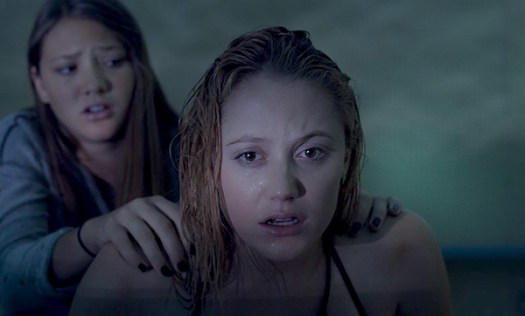
I also think its shortage of hard-and-fast rules should not invite derision, but rather our own theories. Like, what’s going on with water — does it really have an aversion to it? If so, why? Can it stop it? Spoilers: apparently not. More spoilers (just skip to the next paragraph if you’ve not seen it): does it require a chance to manifest as one of your parents before it can kill you? We don’t see how it appears to the girl at the start, though note she’s on the phone apologising to her father just before it does. Jay’s friend who dies identifies it as his mom just before we see it fuck him to death. When it finally catches up with Jay in the pool, it’s her dad. Conversely, when it attacks her on the beach earlier it starts by just grabbing her hair — why not get her then?
Wet

And I haven’t even mentioned the awesome synth score by Disasterpiece, or the era-unspecific production design. Maybe that doesn’t signify anything beyond an aesthetic throwback (the score is very Halloween; there’s some modern tech but they’re not all on their mobiles).

As I said at the start, my experience with the horror genre is too slight to ever go labelling something a genre classic. But this isn’t ‘just’ a horror movie. Like the same year’s The Babadook, there are dramatic elements that stretch out beyond the genre’s usual stomping ground, not to mention an atmosphere of terror that exceeds simplistic attempts to make you jump in your seat every few minutes and call it a day. It’s the kind of film that lingers after the credits roll, as you ponder the gaps it leaves you to ponder, and keep looking over your shoulder, because you never know when something might be following you…

5 out of 5

The UK network premiere of It Follows is on Film4 tonight at 9pm.
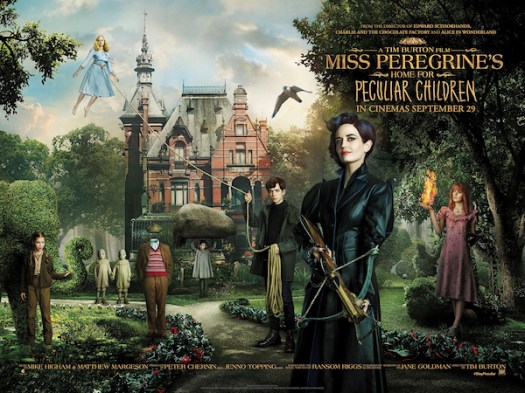
Miss Peregrine’s Home for Peculiar Children (2016)

2017 #16
Tim Burton | 127 mins | Blu-ray | 1.85:1 | UK, Belgium & USA / English | 12 / PG-13

Miss Peregrine's Home for Peculiar Children

After his beloved grandpa Abe (Terence Stamp) dies in mysterious circumstances, Floridian teen Jake (Asa Butterfield) seeks closure by visiting the children’s home in Wales where his grandpa was raised. As a child, Abe regaled his grandson with tales of the home’s other residents and their fantastical abilities — tales which were completely true, as Jake discovers when he meets Miss Peregrine (Eva Green) and her peculiar wards.

The quickest route to defining the experience of watching Miss Peregrine is by referencing other films, if only in a broad sense. For starters, it’s adapted from a young adult fantasy-adventure novel, and there’s a definite shape to things which reflects other entries in that genre — the whole “ordinary kid discovers a fantasy world of incredible powers and approaching danger” type thing.

It’s also directed by Tim Burton, and does feel like a Tim Burton movie. However, what’s incredibly pleasant about that is it doesn’t feel aggressively Burtoneseque. As if in reaction to the blandness of his Planet of the Apes remake, much of Burton’s output since then has slipped towards self-parody, and suffered for it. Miss Peregrine has recognisable flourishes, undoubtedly, but is a little more restrained with how it deploys them. Some have criticised it for this, citing it as another example of Burton removing his unique stamp from the picture, much as he did with Apes, but I disagree.

Her special ability is being a badass

The final other work I would reference is the X-Men; in any incarnation, but the most relevant filmic one is probably First Class. Or not, because that was all about the establishing of Xavier’s school and the equivalent establishment here is already established. Nonetheless, it’s about a country house owned by a British matriarch-figure who cares for a gaggle of misfit kids with special powers. Rather than the X-Men’s potentially-violent array of action-ready skills, however, the ones on display here are a little more whimsical — like Emma (Ella Purnell), who’s lighter than air, or Horace (Hayden Keeler-Stone), who can project his dreams through his eyes.

Also like X-Men, the threat comes from within this secretive world. The starter X-baddie is, of course, Magneto, a mutant seeking to use scientific methods to turn the whole world into mutants. Here, the baddie is Barron (Samuel L. Jackson), a peculiar seeking to use scientific methods to grant immortality to himself and his cronies. Part of their thing is eating people’s eyeballs, which has benefits for them — again, that’s quite Burtonesque… though a mite less whimsical.

The eyes have it

Being on board with this whole milieu is important to enjoying Miss Peregrine, because the film does spend a lot of time establishing it. For those not interested in world-building, the action-packed third act must be a long time coming. There is a lot to marvel at along the way though, and Burton keeps things pleasingly real in his filmmaking techniques: there’s a fight between two creatures that was created with stop-motion, while another sequence involved constructing underwater rigs, and the vast majority of Emma’s floating was achieved by dangling Purnell on wires. That’s not to say there’s no CGI — ironically, the foremost example is a sequence that could otherwise be considered a tribute to Ray Harryhausen — but Burton’s filmmaking encapsulates varied techniques to lend a satisfying physicality to much of the film.

On the whole Miss Peregrine seems to have received a rather muted response, but I thoroughly enjoyed it. It might be best to qualify that by reiterating that it’s playing with a lot of things I enjoy — “X-Men by way of Tim Burton” sounds fantastic to me, and that’s not a bad definition of this movie. I’d even go as far as saying it’s his best work this millennium (though, in fairness, I still haven’t seen Big Fish. Well, it’s only 14 years old.) The shape of the story is no great shakes, but it’s built from magical elements and fantastical imagery, and a game cast of quality thesps hamming it up magnificently and eager youngsters with a slightly earnest likeability.

Let's go fly a kite

Actually, in many ways it reminds me of another heightened, stylised young-adult adaptation that suffered from a mixed reception. See you in 2029 for the Netflix re-adaptation, then?

4 out of 5

Miss Peregrine’s Home for Peculiar Children is released on DVD & Blu-ray in the UK tomorrow.

The Tale of Zatoichi Continues (1962)

aka Zoku Zatôichi monogatari

2016 #194
Kazuo Mori | 73 mins | Blu-ray | 2.35:1 | Japan / Japanese

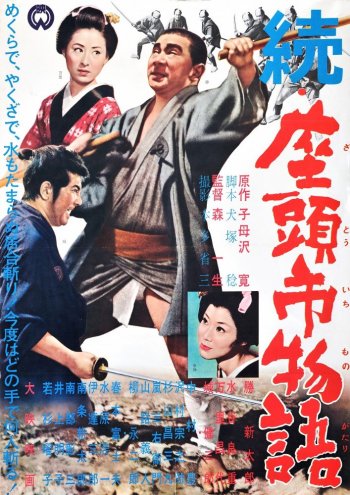
The Tale of Zatoichi Continues

Back in 2014, when I reviewed the debut Zatoichi movie a year after first watching it, I promised that reviews of the series’ future instalments would follow in 2015. Well, it’s 2017, and here’s Film #2. Yeah, this is going to be the new Rathbone Holmes, isn’t it?

Anyway, this second movie is — as its title might suggest — a direct sequel (a rarity for the series, so I gather), which sees our hero, the blind masseuse and skilled swordsman Ichi (Shintarô Katsu), back in conflict with one of the gangs from the first film. Despite that, it doesn’t start like a direct sequel at all. Reference is made to the previous film, the events of which have given Ichi a reputation, but that could be a reference to something that occurred off-screen for all its significance to the story. Later, however, we learn that Ichi is travelling to pay homage to the grave of the samurai he killed before, and we end up in the same town with some returning characters. It’s quite a nice structure for a sequel: to seem like a new adventure before revealing and exploring connections to the previous movie. Unfortunately, to say this film “explores” anything would be doing it a kindness.

All the ladies love a blind man

The consensus seems to be that The Tale of Zatoichi Continues is a faster-paced and more action-packed movie than its predecessor, which is obviously to some viewers’ taste. The fight scenes are certainly on a more epic scale: where the first movie ended with a one-on-one between Ichi and an opposing samurai, here he takes on a small army of men. It’s less than an hour-and-a-quarter long, too, at which length it’s hard to avoid running at a brisk speed. However, I thought it lacked the artistry of the first film. It’s very focused on plot rather than digging into character, which is especially problematic when it comes to a subplot about a rogue who turns out to be Ichi’s brother. It’s structured to make for good reveals, but they aren’t always well executed, and what should carry a weight of emotion ends up rushed.

The movie as a whole is oddly paced and very oddly ended. What turns out to be the de facto climax starts earlier than you’d expect, but then the film moves on from it… before suddenly stopping. Is this meant to be a cliffhanger? It doesn’t quite play like one, but it’s also unresolved. Film 1 felt like a complete story, but this ends with the need for a Part 3 — or rather a Part 2.1, because it doesn’t feel like a whole movie. The fact the next one is called New Tale of Zatoichi isn’t promising…

Brotherly love

Technical merits are similarly mixed. It’s not poorly shot, but it’s not as striking as its predecessor. The music is occasionally horrendous. There is indeed more sword fighting, and with it more involved choreography, but it doesn’t feel like an earned trade-off with the lightweight story.

The Tale of Zatoichi Continues comes with lots of great ideas and potential themes, but the rushed production seems to have led to a weak execution. It’s almost like you want to say to the filmmakers, “good effort, you’re almost there. Now try again and do it properly.” Of course, there are 23 more films where they may do exactly that…

3 out of 5

The Riddle of the Monthly Update for January 2017

How is it February already?!

OK, how about we stave off the inevitable just a little longer and take a look back at January…


#1 Green Room (2015)
#2 Anomalisa (2015)
#3 Ninja Scroll (1993), Jūbē Ninpūchō
#4 Hunt for the Wilderpeople (2016)
#5 Kubo and the Two Strings (2016)
#6 Donald Trump’s The Art of the Deal: The Movie (2016)
#7 Into the Wild (2007)
#8 Eye in the Sky (2015)
#9 Charlie Bartlett (2007)
#10 The Conversation (1974)
#11 iBoy (2017)
#12 Under the Shadow (2016)
#13 Sing Street (2016)
#14 London Has Fallen (2016)
#15 Another Earth (2011)
Hunt for the Wilderpeople

Kubo and the Two Strings

.


  • 2017 gets underway with 15 new films. (I’ll talk about my Rewatchathon in a bit.)
  • That’s the 32nd consecutive month with ten or more films.
  • It’s just shy of the 2016 average (16.25), and makes the average for the last 12 months 15.83.
  • It does beat the January average of 11, though. However, it’s the lowest January since 2014; but it’s also the third largest January ever. Swings and roundabouts, eh?
  • This month’s Blindspot viewing: Francis Ford Coppola’s great ’70s paranoid surveillance thriller, The Conversation.
  • This month’s WDYMYHS viewing: getting the film I had least interest in out of the way, Sean Penn’s Into the Wild. And I was right, it was a mess.


The 20th Monthly Arbitrary Awards

Favourite Film of the Month

Multiple films snagged full marks this month, and several I’d say are already hot favourites for my best-of-year list in 11 months’ time, which makes this a particularly tricky choice. On balance, however, I’m going to say charming Kiwi comedy is trumped (on this occasion) by the fantastical world conjured through the incredible artistry of Kubo and the Two Strings.

Least Favourite Film of the Month
For all its faults, London Has Fallen was pretty much what I expected it to be. Into the Wild, on the other hand, is misguided and overrated.

Best Original Song of the Month
I’m sure La La Land is great ‘n’ all, but the lack of Oscar recognition for Sing Street’s music is disappointing. My personal pick would be The Riddle of the Model, but there’s a lot to be said for Drive It Like You Stole It too — especially considering…

Best Dance Routine of the Month
You haven’t lived until you’ve seen Littlefinger do a steering wheel-inspired dance move to Drive It Like You Stole It.

The Audience Award for Most-Viewed New Post of the Month
As we know, statistics are The Best Thing Ever, which surely explains why my 2016: The Full List post was by far the most-read in January. Lists are almost as good, which surely explains why my Best & Worst of 2016 came second.


My goal to rewatch 52 movies this year got off to a weak start, as you don’t have to scroll very far to see.

#1 Enemy of the State (1998)

Yeah, that’s it. I watched it after The Conversation, because of the theory about Gene Hackman’s characters being the same guy. I can see where the idea came from, but it does not hold up.

Anyway, only rewatching one thing is OK — although my goal of 52 films was inspired by the principle of watching one per week, I never intended to stick to that slavishly; especially as I had Netflix this month, which led me to focus on newer stuff available there while I had it. I’ll make it up later.


It’s about time for an update to my director’s page header image, which features the 20 directors who have the most films covered on this blog. My 100 Favourites series created a bit of a shake-up in this area, with the main beneficiary being Steven Spielberg. I also watched a fair few of his films that I hadn’t got round to in 2016, so all told he was catapulted from six films at the end of 2015, to 17 at the end of 2016. But he’d already made it onto the header last year, so his newfound abundance doesn’t actually affect that.

As for what has changed, then, six directors drop out: Danny Boyle, Marc Forster, Alfred Hitchcock, Fritz Lang, Vincente Minnelli, and George A. Romero. In their place we have (in descending order of number of movies): Peter Jackson, Bryan Singer, John Carpenter, Tony Scott, Robert Zemeckis, and Michael Bay.

Wait… Michael Bay? Yeah, I can’t stand for that. No Bay; Hitchcock stays.


It’s the official 10th birthday of 100 Films at the end of February, for which I’m working on a whole host o’ posts.