The Twilight Saga: New Moon (2009)

2016 #170
Chris Weitz | 131 mins | download (HD) | 2.35:1 | USA / English | 12 / PG-13
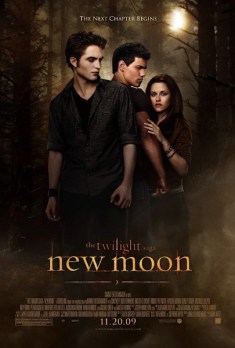
The Twilight Saga: New MoonLast Halloween, I reviewed one of the most horrifying movies of all time: Twilight. This Halloween, at the risk of establishing a terrible tradition that could potentially run for another three years, I’m turning my attention to its first sequel, New Moon.*

If you watched the first movie and thought things couldn’t get any worse… well, you clearly didn’t watch New Moon. I don’t blame you. My original plan had been to watch all five and review them over the course of a week last Halloween, like I did for George A. Romero’s zombie movies in 2013 (plug!), but after the first I couldn’t stomach any more straightaway. Or for an entire year, apparently.

Anyway, the film. New Moon picks up more or less where Twilight left off, with human teen Bella (Kristen Stewart) and 109-year-old vampire Edward (Robert Pattinson) deeply in love. Their relationship is complicated by the slightest sign of Bella’s blood making members of Edward’s vampire pseudo-family want to kill her, but he refuses to turn her. Then Edward’s family have to leave the area and he decides it would be better if she didn’t come. Bella goes into extreme mourning — OK, teens over-feel break-ups, but Bella goes fucking mental, screaming in her sleep like a junkie going cold turkey. Her father confronts her: “It’s just not normal, this behaviour.” Bang on, daddy-o!

So, Bella discovers that doing crazy adrenaline-generating things — like riding on motorbikes with strangers — gives her visions of Edward. It’s unclear if she’s imagining these or if he’s actually manifesting to her. In most movies you’d know it was the former, but this is a supernatural flick about vampires and werewolves, for crying out loud — make yourself clear, moviemakers! Anyway, to replicate this rush Bella salvages some bikes from a tip or something and gets her chum Jacob (Taylor Lautner) to rebuild them. She still can think of nothing but Edward… until Jacob takes his top off. My face is up here, BellaAnd they accuse teenage guys of being shallowly obsessed with the opposite sex’s chests. But then Jacob starts acting aggressively, and hanging out with a gang, and there are stories about beasts in the woods killing people, and his tribe leader type guy looks shifty whenever all that’s mentioned, and… wait, could there be a connection between Jacob and his friends and the wolf-like attacks in the woods?! Gasp!

New Moon is a terribly slow, terribly mopey movie, which takes forever to get to really obvious ‘reveals’ — like, yes, Jacob and co are werewolves (after a fashion). That’s when it’s not trying to build a love triangle that we all know can only end one way. I mean, Bella tells Jacob “it will always be Edward”. Not subtextually — she tells him literally, with words. Those exact words. And when it’s not doing that, it’s slowly building up some form of mythology, presumably to use properly in future instalments. Then it ends with what I think is meant to be a cliffhanger and/or surprise ending, but it’s so ridiculously unsurprising or cliffhanger-y that it’s almost insulting. Bella’s forced Edward’s hand, making him agree to turn her into a vampire because they can’t bear to be apart and want to spend forever together, so why should it be such a surprise that he wants to marry her?!

Then there’s the pathetically hand-holding direction — a shot that shows the changing seasons conveys the passage of time perfectly decently, so why superimpose the names of the months on top as if we’re all 5 year olds who can’t understand it hasn’t literally turned from late summer to autumn to winter in 90 seconds? The CGI is uniformly terrible, We feel your pain, Bellaso that even bits that aren’t bad in isolation (the wolves, for instance) are poorly integrated into the live-action. And at one point the characters go to the cinema to see an action movie… called Face Punch. At this point New Moon slips from ineptitude into genius. It’s the best worst fake action movie title ever. The scene where they discuss it is so hilarious, I actually had to pause the movie to finish laughing.

Though it may contain the funniest thing I’ve seen in any movie this year, it’s not enough to save New Moon. It’s even worse than the first one, because it’s boring. Some bits and bobs may actually be improved (some of the direction is slicker; Bella’s terrible voice over is reduced), but goddamn, it’s so dull. So little actually happens. It feels like it’s probably setting things in place for whatever’s to come next for an entire movie.

On the bright side, that might mean the series improves from here. I can but hope.

1 out of 5

New Moon featured on my list of The Five Worst Films I Saw in 2016, which can be read in full here.

* Here’s a thing: the film has two title cards: the first says New Moon, the second says Twilight Saga: New Moon — no “The”. But as all the posters and, y’know, everyone else uses the “the”, I am too. Fighting my urge to use the accurate on-screen nomenclature here, people. ^
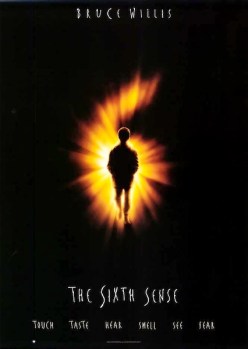
The Sixth Sense (1999)

100 Films’ 100 Favourites #85

Not every gift is a blessing.

Country: USA
Language: English
Runtime: 107 minutes
BBFC: 15
MPAA: PG-13

Original Release: 6th August 1999 (USA)
UK Release: 5th November 1999
First Seen: DVD, c.2000

Stars
Bruce Willis (Pulp Fiction, Sin City)
Haley Joel Osment (Bogus, A.I. Artificial Intelligence)
Toni Collette (Muriel’s Wedding, Little Miss Sunshine)
Olivia Williams (Rushmore, The Ghost)

Director
M. Night Shyamalan (Unbreakable, Signs)

Screenwriter
M. Night Shyamalan (Wide Awake, The Village)

The Story
Child psychiatrist Dr Malcolm Crowe tries to help a new patient, Cole Sear, who claims he can see ghosts.

Our Heroes
Dr Malcolm Crowe doubts his abilities to help people after a former patient shot him before committing suicide, an event which has also left him distanced from his wife. But he may be the only person who’ll believe young Cole Sear, a reclusive child who’s struggling with delusions of seeing dead people… unless they’re not delusions…

Our Villains
Are the dead dangerous, or do they just need help?

Best Supporting Character
Cole’s mom, Lynn, who loves him a great deal and worries about him just as much, but has no idea what’s really wrong or how to help her son.

Memorable Quote
“I see dead people… Walking around like regular people. They don’t see each other. They only see what they want to see. They don’t know they’re dead.” — Cole

Memorable Scene
Stuck in traffic, Cole reveals his ability to his mother for the first time — that there’s been an accident ahead and someone died, which he knows because they’re stood at his window. Naturally Lynn doesn’t believe her son, but then he begins to talk about his grandmother…

Technical Wizardry
The twist ending is immaculately constructed. There are clues throughout the film, but, like all the best twist-ending clues, the vast majority of viewers will completely miss them first time through, even though they seem almost blatant when revisited.

Making of
The colour red is used only to indicate times and items where the worlds of the living and the dead have connected; if something red was present in a scene where this wasn’t relevant, Shyamalan had it changed. There’s a massive list of these moments here, but if you somehow haven’t seen The Sixth Sense yet, do beware of spoilers.

Next time…
There are no actual sequels to The Sixth Sense, but it kicked off M. Night Shyamalan as a kind of one-man genre, making supernatural thrillers with a twist ending — and decreasing critical acclaim with each new movie. It seemed to end with The Happening and he transitioned to be a director-for-hire, but he’s coming back somewhat with The Visit and next year’s Split.

Awards
6 Oscar nominations (Picture, Supporting Actor (Haley Joel Osment), Supporting Actress (Toni Collette), Director, Original Screenplay, Editing)
4 BAFTA nominations (Film, Director, Original Screenplay, Editing)
2 Saturn Awards (Horror Film, Performance by a Younger Actor/Actress (Haley Joel Osment))
2 Saturn nominations (Actor (Bruce Willis), Writer)
2 Teen Choice Awards (Choice Drama, Choice Breakout Performance (Haley Joel Osment))
1 Teen Choice nomination (Choice Sleazebag (Trevor Morgan))
Nominated for the Hugo for Best Dramatic Presentation

What the Critics Said
“the film eventually abandons the heroic-therapist model and ventures toward other ground, ever so gently tightening its squeeze. It seems really to achieve something that Stanley Kubrick was possibly groping after in Eyes Wide Shut, or that Nicolas Roeg achieved in Don’t Look Now, which might be called an extreme sense of the bizarre, not as invented by special-effects wizards with unlimited space on the hard drive but in the subtler ways of film craftsmanship. […] The movie is a maximum creep-out. It’s invasive. It’s like an enema to the soul as it probes the ways of death – some especially grotesque in a family setting. You leave slightly asquirm. You know it will linger. It becomes a clammy, chilly movie building toward a revelation that you cannot predict. As I say: I cannot tell you. You’d hate me if I did. I can only say, don’t look now, but look sometime.” — Stephen Hunter, Washington Post

Score: 85%

What the Public Say
“The film is rich in symbolism, and colour plays a large part in signifying spirits invading the real world. This is what makes The Sixth Sense so captivating. Watching the film for the first time, you don’t expect the ending, and so the shock of it tends to overshadow the subtlety of the beginning. It is only once you have re-watched the film, that you begin to notice little suggestions of what is to come. A success from start to end, this is at once an exercise in potent suspense, and a carefully crafted tale of child psychology.” — Cat Barnard, Screen Muse

Verdict

M. Night Shyamalan gets such a bad rep these days, it’s easy to forget how great his breakthrough movie was. It flew completely under the radar back in 1999: the guy at Disney who bought the screenplay was fired for doing so without permission; Bruce Willis starred in it because he owed Disney two films, and was paid half his normal salary; Entertainment Weekly’s extensive summer preview detailed over 140 films, but The Sixth Sense wasn’t even mentioned. By coming out of the blue, and in an era before the internet was dominant (these days there’d be plot dissections and spoiler-filled director interviews online by the Monday after release, wouldn’t there?), the film obviously had surprise on its side, which is particularly effective when it has such a memorable twist. But even before that ending, it manages to mix plausible emotional drama with scenes of chilling everyday horror, crafting something that is undoubtedly a genre movie but also not out of place in a list of Best Picture nominees.

The Sixth Sense is on Film4 tomorrow night at 1am.

#86 will do… whatever a spider can.

The Big Short (2015)

2016 #161
Adam McKay | 130 mins | streaming (HD) | 2.35:1 | USA / English | 15 / R

The Big ShortYou wouldn’t think the 2008 financial crisis would make good fodder for a comedy-drama — it’s both too complicated and too grim — but Anchorman writer-director Adam McKay clearly felt differently. With co-writer Charles Randolph, he adapted the non-fiction bestseller by Michael Lewis (the author of the books that became awards season contenders The Blind Side and Moneyball) and turned it into… well, an awards season contender — but a funny one.

Specifically, it’s the story of the handful of men who saw the financial crisis coming, and arranged their finances to bet on it, too. It’s not a completely true account but, as it’s presented here, Michael Burry (Christian Bale) is the only one who actually spots it. He takes out insurance policies or something — look, the whole film is full of really complicated financial stuff and this was right at the start, OK? Here’s the Wikipedia plot description of what he does: “his plan is to create a credit-default swap market, allowing him to bet against market-based mortgage-backed securities.” So, he does that, the investment banks gladly accept his money because they think he’s mad, but a handful of others (including Ryan Gosling, Steve Carell, and Brad Pitt) stumble across his research one way or another, believe he’s right, and begin to make similar investments.

Christian Bale tries to understand the screenplayThe narrative is laden with concepts that are so complicated even people within the industry don’t properly understand all of them (however did the market fail?!), but the movie nonetheless attempts to explain them in an accessible way. It’s half successful: you kind of understand them at the time, about enough to follow along, but the chances of remembering them later are next to naught. One of McKay’s tricks to engage us with these explanations is to wheel in random celebrities to deliver analogies. It’s a fun idea, though it’s success is debatable — I mean, I’ve just about heard of Selena Gomez, and I guess the “famous chef” that turns up must have a TV show in America, or something, maybe? Yeah, the ‘names’ he’s chosen are going to date this movie far more than its 2008 setting ever will.

Indeed, on the whole I could’ve done without McKay’s jittery directorial style, amped up through ADD editing by Hank Corwin. Both were Oscar nominated and I’ve read other reviews that praise the style, but to me it just felt needlessly hyperactive, like the film is so afraid of being dull that it has to constantly dance around in the hope you won’t notice. I did notice — not that the film was dull, just that it thought it was. I guess that’s what happens when a guy more at home making movies like Anchorman and The Other Guys instead makes one about the world of real-life high finance.

Not very impressedThough the conceptual explanations may fade almost as soon as you’ve heard them, what does stick with you is how it all ends. Essentially, the financial industry that destroyed peoples’ lives in pursuit of never-ending profit not only got away with it, but they actually started doing the same stuff all over again, just with new acronyms. What’s even more sickening is that people are clearly aware it’s going on — I mean, we’ve been told as much in an Oscar-winning movie — but they’re still doing nothing about it.

How’s that for a scary thought this Halloween weekend, eh?

4 out of 5

The Rocky Horror Picture Show: Let’s Do the Time Warp Again (2016)

2016 #165
Kenny Ortega | 88 mins | download (HD) | 16:9 | USA / English

The Rocky Horror Picture Show: Let's Do the Time Warp AgainWhen this TV movie kicks off with Ivy Levan sashaying her way around a cinema while she mimes to a pre-recorded and over-produced backing track of Science Fiction/Double Feature, full of licks and runs and finding four notes to hit where there used to be one, like a desperate X Factor wannabe who has no concept of the meaning of the lyrics she’s warbling but is ever so desperate to show she can saaang (that’s like singing but with added Cool), you get a pretty fair idea of the terrible experience about to be unleashed upon you by the not-so-catchily titled The Rocky Horror Picture Show: Let’s Do the Time Warp Again. That’s to say it’s been modernised, Americanised, and sanitised.

If you know the original then you know the plot, and if you don’t know the original then you have no business watching this so-called tribute version, which premiered on Fox in the US last week and makes its way to the UK on Sky Cinema from today. “Tribute” is the latest word someone has co-opted to avoid saying “remake”, a marketing strategy that was presumably settled upon after they realised they’d produced a witless, regressive clone of material that, though over 40 years old, is still more subversive and boundary-pushing than this plastic Disneyfied tosh.

Sweet transgender womanThe interpretation of the songs is appalling. The recordings are all overworked, full of needless warbles and added “oohs”. They’ve been modernised in such a way that, when current popular fads for over-singing things (“licks” or “runs” or whatever else they call them) have passed — as they surely will — these new versions will sound even more dated than the already-40-year-old originals, which have a certain timelessness. The lyrics are sung with the same amount of attention to what they mean as you get from a computer’s text-to-speech function, including or echoing parts of the original without understanding why they’re there or what function they perform; or if it does know the function, it doesn’t know how to replicate it.
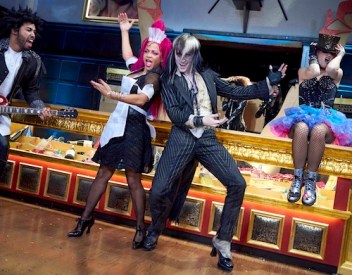
To say its performances are like a bad am-dram production would be an insult to am-drammers everywhere. Almost everyone is miscast. It was, perhaps, a nice touch to include Tim Curry, but his limited scenes are uncomfortable to watch because it’s painfully obvious that the poor man is still labouring under the aftereffects of his stroke. As Brad, Ryan McCartan overacts as if he thinks that’s the whole point. Reeve Carney makes Riff Raff a leering creep, and his needless affected British accent is awful. As Magenta, Christina Miian’s is worse. As Frank, Laverne Cox’s imitative mid-Atlantic twang is even worse again. Why did they do it?! Presumably because, as I said, it’s all a thoughtless copy of the original.

The casting of a transgender woman as a transvestite is its own kettle of worms — either she’s a woman doing radical things like fancying men and being jealous of another woman stealing her guy, or you’re saying she’s not actually a woman but still a man and… well, like I say, it’s a mess. A commenter on the A.V. Club’s review summed up the cumulative effect quite succinctly: “Fox was actually able to pull off a pretty conservative casting choice while appearing uber progressive… By casting Cox, who identifies as female, in the role of Frank-N-Furter the seduction scenes actually became far less risqué”.

Well, it's certainly been warpedEverything is blunted further by Kenny Ortega’s ineffective direction. The camerawork is flat and uninteresting, the shot choices unimaginative. Some of the choreography looks interesting — it’s certainly more elaborate than in the original film — but the camerawork seems to be actively trying to obscure it. The editor must have struggled, unable to generate any additional excitement due to a shortage of options. At times it looks as if it was filmed live, under which circumstances its weaknesses might be understandable, if not excusable… but it wasn’t.

Occasionally there are cutaways to a cinema audience — not a real one, but a gaggle of extras, sat in a theatre watching what we’re watching. These moments are pathetic and pointless. I get that it’s meant to be a nod to the interactive midnight showings that have made Rocky Horror the phenomenon it is, but they demonstrate none of the wit or verve that make those screenings so popular. Plus the original film is good entertainment even without such intrusions; this isn’t. You might think that makes the asides necessary to liven it up, but there are so few of them, and they’re so lacking in imagination, or any discernible content whatsoever, that they just feel like they’re dragging the experience out even further.

Believe it or not, it’s not all bad. There’s one new gag in the dinner scene that’s actually pretty funny. It’s delivered by Faye Marsay lookalike Annaleigh Ashford, who makes a good fist of Columbia. Rounding out the leads, Victoria Justice has all the necessary charms to make a pretty fair Janet. Victoria Justice's omnipresent cleavage. May also be omnipotent.I refer partly to her omnipresent cleavage, but also her acting. It’s not great by any means, but she’s suitably sweet and twee at the start, then manages to sell Janet’s near-instantaneous transformation from uptight goody-two-shoes to sex-mad strumpet using just a handful of expressions and line deliveries in the slight gap her character has between Over at the Frankenstein Place and Touch-a Touch-a Touch Me. The latter is one of the film’s rare highlights, for various reasons. One of those is actually Staz Nair as Rocky — undoubtedly the least challenging role in the piece, but at least he gets it right, and his musclebound chest counterbalances Justice’s for those of the other persuasion. The only downside are his tattoos: he was supposedly just grown in a tank, how does he have tattoos?!
More than the ’75 film, Let’s Do the Time Warp Again brings to mind the 2010 episode of Glee that essayed the same musical. If you suffered through The Rocky Horror Glee Show, as I did, you’ll know it was a travesty. Is this even worse? Well, that’s a bit like someone forcing you to eat a dog shit and a cat shit before asking you which tasted nicer. That’s a little unfair: the Glee version was meritless; this one has a couple of minor plus points — so maybe it’s like someone making you eat a very small shit while occasionally showing you a picture of a sexy half-naked person. But unless someone forces you to choose between only this and Glee, there’s no earthly reason to do this particular Time Warp again.

1 out of 5

The Rocky Horror Picture Show: Let’s Do the Time Warp Again is available on Sky Cinema from today, screening on Premiere at 12:25pm and 8pm.

It featured on my list of The Five Worst Films I Saw in 2016, which can be read in full here.

Doctor Strange (2016)

2016 #169
Scott Derrickson | 115 mins | cinema | 2.35:1 | USA / English | 12A / PG-13

Doctor StrangeThe latest from Marvel (or Marvel Studios, as they’re now branded, presumably in a bid to differentiate themselves from the properties owned by other studios that have been only too keen to use the Marvel logo and blur the line for the casual moviegoer) opens the door on a new facet of their shared cinematic universe, though does so in a movie whose plot follows the familiar “superhero origin story” rulebook. On the bright side, Doctor Strange has several other qualities to recommend it.
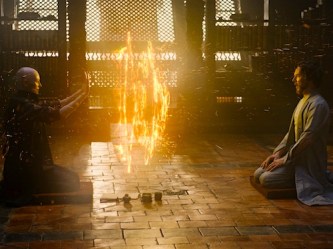
It’s the story of Dr Stephen Strange (Benedict Cumberbatch), a brilliant but cocky New York neurosurgeon, whose hands are ruined in an accident, taking his career — the sole focus of his life — with them. In search of groundbreaking healing, he travels to Nepal, where he meets the Ancient One (Tilda Swinton) — not a doctor, but a mystic, who introduces him to the world of magic. Which in this case is real and not just, like, some Derren Brown stuff, because that wouldn’t make a very good superhero movie. Then there’s some stuff about evil sorcerer Kaecilius (Mads Mikkelsen), who wants to destroy the world, blah blah blah.

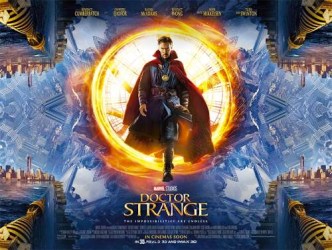
So yes, the story is familiar — but you can say that about most superhero movies, especially origin films. It’s only a problem if you think movies are entirely about their plot. What Strange offers to accompany this through-the-motions narrative is its visuals, and oh, what visuals they are. You’ve likely seen some of it in the trailers — the folding cities, which look like Inception run through a kaleidoscope. Certainly, their complicated detail and intricacy leaves Nolan’s movie in the shade. The old idea of “an effects movie” — Wowzerswhere the incredible effects are half the point — seemed dead in an era where every movie has CGI and every blockbuster has its share of once-impossible visuals. Strange demonstrates the form can be alive and well. The way the effects are created — with green screen and pixels — is the same as any other movie, but the designs and the visual imagination are exciting.

The action scenes that are choreographed around and through these effects are suitably imaginative also, making use of the concepts and ideas of the magic, rather than just having people punch each other in front of swirly backgrounds. To say too much would be to spoil the movie, but the Inception-y stuff is not the film’s climax — it has several other tricks up its sleeve. There’s one bit where time flows backwards, which I specifically mention because at that point the music does a bit too, which is primarily notable because the rest of the score is your typical bland, generic, forgettable Marvel music. On the other hand, I’ve read others praise the music for being more memorable than Marvel’s usual temp-tracked output, so maybe I’m wrong.

When the film isn’t tickling your adrenal glands, it at least has the courtesy to sweeten the pill of its Superhero 101 storyline. For one thing it’s very funny, though in a way that doesn’t steal from the drama. This lightness of touch has become Marvel’s forte, and Strange handles it as well as any, without going all-out like Guardians of the Galaxy or half of anything starring Tony Stark.

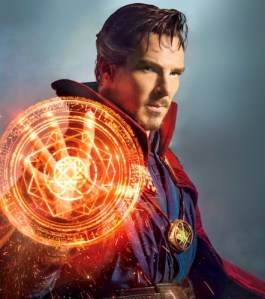
Practical magicThen there’s the cast. Obviously keen to avoid being typecast after playing an arrogant British genius in both Sherlock and The Imitation Game, Benedict Cumberbatch here plays an arrogant American genius. Strange doesn’t have the charm of Cumberbatch’s Sherlock, nor of some of his Marvel stablemates, like Tony Stark or Peter Quill, but his character arc takes that arrogance and transforms it into a kind of caring aloofness that, with flashes of dry wit, makes him an appealing character — even if it may take further films for that appeal to be fully realised.
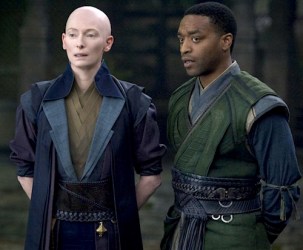
Mads Mikkelsen is somewhat wasted as Marvel’s typically lightweight villain, though his inherent skill as an actor allows him to flesh out the few speeches he is given. You could expand that assessment out to most of the cast: they’re all above this — four of them are Oscar nominees or winners (clearly Mikkelsen has been overlooked by the Academy) — but the fact that quality flows through their veins helps elevate some of the material. You could argue their talent is wasted with this stuff, but what do you expect? It’s an action-adventure blockbuster from a company known for their consistently light tone — that’s never going to dig into proper emotive character drama. Suffice to say that such top-tier actors effortlessly add resonance to their roles, however little they had to work with on the page.

More controversial was Tilda Swinton’s casting. You could see it as whitewashing, or you could see it as dodging a racial stereotype — there’s a visual gag to that effect, in fact. “Oscar winners get bigger parts than Oscar nominees, okay?”Besides, one of the film’s best characters is of Asian ethnicity, so it kinda balances out. That’s Benedict Wong as the sorcerers’ librarian, who’s likely to emerge as the film’s most popular character. It helps that viewers aren’t likely to expect much of him. Conversely, Chiwetel Ejiofor and Rachel McAdams are seriously underserved, perhaps hoping for more meat in the no-doubt-intended sequel(s).
Actually, that’s an understatement, isn’t it? This is a Marvel movie, and one that’s garnered positive reviews thus far to boot — it’s going to be a box office success, and sequels will inevitably follow. Nonetheless, some reviews have been bizarrely keen to frame Strange as “Marvel’s greatest risk yet” and “a radical departure for the studio”. That’s all empty hyperbole at this point and I don’t know why they do it. Guardians of the Galaxy already proved that no change of genre is a risk for the studio — and Guardians was a much bigger change of form for Marvel than Strange is. Plus, the way Strange handles magic is no more out-there than the way it handled gods ‘n’ that in two Thor films. Indeed, if anything Strange should look like a moderately safe bet: it’s following in Thor’s footsteps with the whole magic/other worlds/dimensions thing, but married to a fairly standard superhero origin arc. It’s no riskier a proposition for Marvel than any other new property. Nonetheless, it does open up some tantalising possibilities, especially when it comes to teaming Strange with the Avengers… though they’ll have to find a way to remove some of his abilities, otherwise he’ll be far too powerful.

To further those connections, there are two end credits scenes. I shan’t spoil their contents, of course, but in my opinion they’re the wrong way round. One is basically Magic toucha teaser for another Marvel film, the other relates to the plot of the movie we’ve just seen. The former is first (and about 10% of my screening walked out before it came on) and the latter is, obviously, second (by which time about 90% had left). Those percentages ‘matter’ because, a) how do people not know Marvel’s rep for these scenes by this point?, and b) I think the scene related to the film you’ve just watched is the one that should be more attached to it, with the ‘teaser trailer’ being a fun bonus for those dedicated to stick around to the bitter end. But maybe that’s just me.

Much earlier in the movie, shortly after encountering the Ancient One, Strange is offered tea. He drinks it, then something amazing happens, and he asks what was in the tea. The Ancient One answers, “Just tea. With honey.” That line struck me because it rather sums up Doctor Strange as a movie. In its well-rehearsed superhero-origin-story-ness, it’s just tea; but the quality cast, the genuine laughs, the imaginatively choreographed action, and, most of all, the mind-bending visuals add a very pleasurable sweetness.

4 out of 5

Doctor Strange is in UK cinemas now, and is released in the US next month.

Sideways (2004)

100 Films’ 100 Favourites #84

In search of wine.
In search of women.
In search of themselves.

Country: USA & Hungary
Language: English
Runtime: 127 minutes
BBFC: 15
MPAA: R

Original Release: 22nd October 2004 (USA)
UK Release: 28th January 2005
First Seen: cinema, 2005

Stars
Paul Giamatti (Big Fat Liar, Shoot ‘Em Up)
Thomas Haden Church (George of the Jungle, Spider-Man 3)
Virginia Madsen (Candyman, The Number 23)
Sandra Oh (Under the Tuscan Sun, Hard Candy)

Director
Alexander Payne (About Schmidt, Nebraska)

Screenwriters
Alexander Payne (Jurassic Park III, The Descendants)
Jim Taylor (Election, I Now Pronounce You Chuck & Larry)

Based on
Sideways, a novel by Rex Pickett.

The Story
Middle-aged wine lover Miles takes his friend, groom-to-be Jack, up to California wine country for a more mature kind of bachelor trip, but Jack’s lascivious ways lead them to become involved with a pair of women — while keeping Jack’s impending nuptials a secret…

Our Hero
Miles Raymond is a divorcee, a teacher, and an unpublished novelist, depressed at the state of his life. His one love is wine appreciation, though when Jack goads him into getting closer to a waitress he casually knows, Maya, things begin to look up.

Our Villain
Jack, a has-been actor and Miles’ college roommate. Not really interested in wine; very interested in women — even though he’s engaged, he hooks up with Maya’s friend Stephanie, not telling her about his imminent marriage. Not strictly a villain, but his antics bring Miles little but misery.

Best Supporting Character
Maya is a waitress at Miles’ favourite restaurant, and they bond over a shared appreciation of wine. Unfortunately, her friendship with Stephanie and the secret of Jack’s engagement poses a threat to her burgeoning relationship with Miles…

Memorable Quote
“If anyone orders Merlot, I’m leaving. I am not drinking any fucking Merlot!” — Miles

Quote Most Likely To Be Used in Everyday Conversation
See above.

Memorable Scene
Jack hooks up with a random waitress but has to flee when her husband comes home, leaving his wallet behind with the wedding rings inside. He gets Miles to take him back to her house, where Jack convinces his friend to sneak in to find the wallet. Inside, the waitress and her hubby are having sex, but they spot Miles grabbing the wallet — so he’s chased back to the car by a very angry naked man. (It’s not exactly the film’s cleverest bit, but it is memorable.)

Making of
Sideways was so popular, it actually had an effect on the wine market. Miles is famously critical of Merlot (see above), which actually caused its sales to drop in the US and UK. However, there was a bigger impact on Pinot Noir, which he expresses a love for. After the film’s release, sales of Pinot Noir wines increased by over 20% compared to the year before. The effect lasted, too: a 2009 study found that sales volume of Merlot had slowed and its price had dropped, while sales and prices of Pinot Noir were still up.

Next time…
Author Rex Pickett has penned two sequel novels, Vertical and Sideways 3 Chile, but Alexander Payne has said he has no interest in adapting them and, though Fox owns the rights to the characters, they have no interest in making sequels without Payne. Of gossipy interest, however, is that Pickett deliberately wrote Sandra Oh’s character out of the sequels, because the actress made script changes he disliked and he didn’t want to work with her if they did make a sequel.

Awards
1 Oscar (Adapted Screenplay)
4 Oscar nominations (Picture, Supporting Actor (Thomas Haden Church), Supporting Actress (Virginia Madsen), Director)
1 BAFTA (Adapted Screenplay)

What the Critics Said
“how different these two characters are: the crass actor and the sensitive writer, linked by being roommates at college, but by little else these days. Viewers will probably identify with one or the other, but the beauty of the script is that these are rounded, believable people with recognisable failings and strengths — one is not superior than the other. So, while Jack is a bit dim, crude, and thinks largely with his crotch, he’s also enthusiastic, loyal and embraces life. And while Miles is funny, clever, and knowledgeable, he is also timid, drink-dependent, and crippled by insecurity” — Nev Pierce, BBC Movies

Score: 96%

What the Public Say
“This performance made [Thomas Haden Church] a star, earning him roles in everything from Spider-Man 3 to Easy A. By turns charming and crass, his laconic man-child is a perfect foil to the tightly-wound Miles, and their chalk-and cheese riffing is minded to fine comedic effect at times, most notably in Miles’ horrified discovery that Jack has been chewing gum throughout his detailed tutorial into wine tasting. It’s Giamatti’s picture though. He makes Miles vulnerable, sarcastic, grouchy and tender – sometimes all at the same time. He’s capable of expressing a depth of emotion with nothing more than a flicker in his eyes or furrowing of his brow. It’s a performance he’s never bettered.” — Rob D, Random Movie Guy

Verdict

Do you ever watch a film, like it well enough, but then find that, without re-watching or consciously re-evaluating, it sneakily grows in your estimation? That was Sideways for me, after I saw it on its original release. I’ve watched it a few more times since which have cemented my opinion. It’s a pretty perfect example of the comedy-drama, being both very funny but with a core story based in characters going through emotional crises, whether they know it or not. It’s a deceptively gentle film, the kind of movie where it can seem like nothing’s happening, but the cumulative effect builds to a nice, complicated aftertaste. Like a fine wine, then.

I see #85 walking around like regular movies.

Cover Girl (1944)

2016 #168
Charles Vidor | 103 mins | TV | 4:3 | USA / English | U

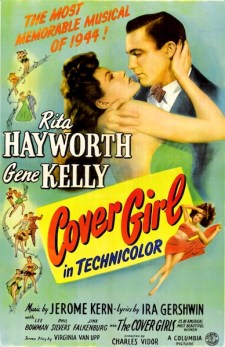
Cover GirlRun-of-the-mill musical starring Rita Hayworth as a Brooklyn showgirl who finds fame after accidentally landing a prestigious magazine cover because the editor was in love with her spitting-image grandmother.

Gene Kelly co-stars as the owner of the low-rent joint she used to star in, and provides two decent dance numbers: the first alongside Hayworth and Phil Silvers, the second alongside himself, double exposure allowing his shop-window reflection to leap into the street.

Otherwise the songs are forgettable, despite the fact it won an Oscar for its score, and the predictable story is allowed too much leeway by the running time.

3 out of 5

Christine (1983)

2016 #85
John Carpenter | 106 mins | streaming (HD) | 2.35:1 | USA / English | 18 / R

ChristineOne of a couple of films John Carpenter directed “for hire” in an attempt to restore his Hollywood reputation after the box office failure of The Thing, Christine is an adaptation of a Stephen King novel about a car possessed by evil. Yes, a car. I guess if you wait long enough, anything and everything will be possessed by evil eventually (in fiction, at any rate).

Despite that pedigree, Christine is about as scary as… well, I was trying to think of something soft and fluffy that hasn’t ever been used in a horror movie, but that list is increasingly short. But you get my point: it’s not scary. Its 18 certificate is earned by an abundance of very strong language — which, according to screenwriter Bill Phillips, was added for that exact purpose: the film wasn’t violent enough to get an R, and they didn’t think people would see it if it was a PG (this being before the PG-13), so they just inserted a lot of swearing. It’s still a pretty entertaining film, though, thanks to some humour and the almost-there thematic subtext of America’s obsession with the automobile.

The central (human) character is Arnie, a nerdy teen who becomes obsessed and then empowered by the eponymous vehicle. Keith Gordon is pretty good as this “worm that turned” type, albeit in a somewhat melodramatic way: he’s a heightened version of a nerd at the start, and a heightened version of a car-obsessed teenage dick later on. One review I read reckoned the film “sacrifices character logic” — what, there’s a flaw in the logical behaviour of a guy who’s semi-possessed by his demonic car, you mean?

Girl on girl action, of a sortEven if Carpenter was doing it only for kudos with the studios, he still turned in solid work. Christine may not be scary, but she is menacing, and her attacks work as individual sequences. Unsurprisingly it’s not his strongest film, and it’s not the greatest adaptation in the Stephen King movie canon either, but if all movies by jobbing filmmakers were this good then we’d be luckier moviegoers.

4 out of 5

Christine is one of the first releases from new UK Blu-ray label Indicator, out today.

The Shawshank Redemption (1994)

100 Films’ 100 Favourites #83

Fear can hold you prisoner.
Hope can set you free.

Country: USA
Language: English
Runtime: 142 minutes
BBFC: 15
MPAA: R

Original Release: 23rd September 1994 (USA)
UK Release: 17th February 1995
First Seen: TV, c.1999

Stars
Tim Robbins (Jacob’s Ladder, Mystic River)
Morgan Freeman (Driving Miss Daisy, Invictus)
Bob Gunton (Demolition Man, Ace Ventura: When Nature Calls)

Director
Frank Darabont (The Green Mile, The Mist)

Screenwriter
Frank Darabont (A Nightmare on Elm Street 3: Dream Warriors, The Green Mile)

Based on
Rita Hayworth and Shawshank Redemption, a short story by Stephen King.

The Story
When Andy Dufrense is incarcerated in Shawshank State Penitentiary, he soon finds himself helping the corrupt warden money-launder his bribes. With a measure of protection from the guards, Andy’s common decency leads him to try to improve life for his fellow inmates, all the while thriving on the hope he’ll one day get out.

Our Heroes
Andy Dufrense is an intelligent fella, who earns himself protection and privileges by helping with the guards’ finances, and befriends fellow inmates by overhauling the prison library. He’s serving two consecutive life sentences for murdering his wife and her lover, despite claiming he’s innocent — like everyone else in Shawshank. Conversely, his new best friend, Red — the film’s narrator — is the only guilty man in Shawshank. He’s the guy you go to if you want anything smuggled in, like, say, a rock hammer…

Our Villains
Warden Samuel Norton is outwardly a good Christian and forward-thinking prison governor, but is actually a corrupt and vicious sonuvabitch, only too happy to use Andy’s skills to fiddle the books — and punish him harshly for any signs of dissent. His right-hand-man is the captain of the guards, Hadley, who’s not above giving a wayward prisoner a life-altering beating, or worse…

Best Supporting Character
The prison’s librarian, Brooks, who’s been locked up for almost 50 years. The old chap gets paroled, but the outside world has become a very different place by 1954, and he has a heartbreaking fate.

Memorable Quote
“The funny thing is, on the outside I was an honest man, straight as an arrow. I had to come to prison to be a crook.” — Andy Dufresne

Quote Most Likely To Be Used in Everyday Conversation
“Get busy living or get busy dying.”

Memorable Scene
Left alone in the warden’s office, Andy comes across a record. He puts it on the turntable, locks the door, and switches on the PA system, broadcasting opera to the entire prison. Guards and prisoners alike stop where they stand to listen. Meanwhile, the warden bangs on the door and demands Andy turn the music off. He leans toward the record player… and turns it up. The insubordination will cost him, but, for a few minutes, the beautiful music makes the prisoners feel free.

Making of
The American Humane Association monitored filming that involved Brooks’ pet crow. During a scene where it’s fed a maggot, the AHA objected — because it was cruel to the maggot. They demanded the filmmakers use one that had died from natural causes, which was duly found.

Awards
7 Oscar nominations (Picture, Actor (Morgan Freeman), Adapted Screenplay, Cinematography, Editing, Score, Sound)
2 Saturn nominations (Action/Adventure/Thriller Film, Writing)

What the Critics Said
“The mood swings rigorously through every emotion as the cranky, wiseguy and downright crazed array of criminals bare the brunt of the turbulent life within the doomy Shawshank catacomb. […] If you’re miserable enough to look for gripes then, yes, it does drift on too long and who needs prison buggery again? Yet the ending has such poetic completeness you’re too busy contentedly chuckling to worry about sore behinds. This may have confounded American audiences — it flopped big-time on planet Yank — but a more divine movie experience you will not find this side of Oscardom. […] If you don’t love Shawshank, chances are you’re beyond redemption.” — Ian Nathan, Empire

Score: 91%

What the Public Say
“it has these amazing feel good moments yet it doesn’t feel contrived. Most of us film lovers can see right through that. If Shawshank was guilty of that, it wouldn’t have stayed in the number one spot for all these years. […] I think there are a lot of things that make The Shawshank Redemption such a widely loved film and the movie just gets so many things “right” that they all combine to give us something spectacular: Feel good moments like the beer & opera scenes (which never fail to move me no matter how many times I watch this movie). Andy & Red’s friendship. The lesser characters such as Brooks & Heywood (and the heartbreakingly beautiful “Brooks Was Here” theme from Thomas Newman). Seeing the posters on the wall change, showing the passage of time. Alexandre Dumbass. The pet bird. Rita Hayworth. And, of course, the overall message of hope. More than anything, though, I think it’s Stephen King’s story and Darabont’s ability to give us scenes of pure beauty in a movie based someplace as awful as a prison” — table9mutant, Cinema Parrot Disco

Verdict

The Godfather sat seemingly unassailable atop IMDb’s Top 250 for nine years, until The Dark Knight kicked it off, not everyone agreed, and when the dust settled Shawshank was the new #1, a position it’s now held for eight years. Naturally that means there’s been a backlash in some circles. It’s a particularly snooty kind of reaction in general, I find, probably because Shawshank is exactly the kind of movie primed to emerge as a consensus favourite: it has drama and darkness, but also humour and optimism, and elicits emotions across the spectrum — it’s neither too grim to depress people into not enjoying it, nor too sentimental to make them do that mock “throwing up” noise some people do when things get really schmaltzy.

I wager some people confuse the notion of “consensus favourite” with “produced by committee”, which sound similar — a large group of people coming to agree on something — but are actually very different. The latter typically produces bland work that no one loves; something that wouldn’t curry favour with the former. Is The Shawshank Redemption the greatest movie ever made? Not in my opinion. I’d wager not in the opinion of most of the people who’ve given it a score on IMDb that’s contributed to it being #1. But it is a very good film indeed — and, clearly, most of us can agree on that.

#84 will be… not a fucking Merlot.

One Flew Over the Cuckoo’s Nest (1975)

2016 #100
Miloš Forman | 134 mins | download (HD) | 16:9 | USA / English | 18 / R

One Flew Over the Cuckoo's NestBy many accounts this is the greatest film I’d never seen (hence it being this year’s pick for #100). How are you meant to go about approaching something like that? Probably by not thinking about it too much. I mean, something will always be “the greatest you’ve never seen”, even if you dedicate yourself to watching great movies and the “greatest you’ve never seen” is something pretty low on the list… at which point I guess it stops mattering.
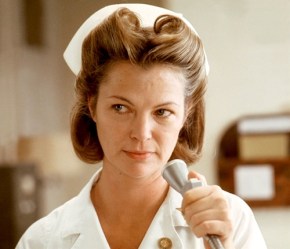
Anyway, this acclaimed drama — one of only three films to win the “Big Five” Oscars — follows Randle McMurphy (Jack Nicholson), a prisoner who’s claiming to be mentally ill in order to avoid hard labour, as he’s sent to a psychiatric hospital for evaluation. His ward is run by the firm hand of Nurse Ratched (Louise Fletcher), who subtly controls and oppresses the other inmates (who include early appearances by Danny DeVito, Christopher Lloyd, and Brad Dourif). With his antiauthoritarian nature, McMurphy sets out to usurp her control… with ultimately disastrous consequences.

Cuckoo’s Nest is very ’70s in its bleakness; also in being about someone sticking it to The Man, and The Man winning. We often conflate such qualities with realism — “it’s not all happy, it must be more like real life” — but I wonder if Cuckoo’s Nest is actually too on the nose as an indictment of the system. McMurphy is a highly disruptive influence, which in reality would surely be a problem, but he’s seen to bring the other inmates a joy they previously hadn’t known. His actions give one, Billy Bibbit, confidence and cure him of his stutter — until Ratched reasserts control, his stutter returns, and… worse happens.

Wretched RatchedHollywood is notorious for adapting novels by grafting on happier endings, but here they did the opposite, removing even the glimmers of justice that the novel offers. In the book (according to Wikipedia), when McMurphy strangles Ratched he also exposes her breasts, humiliating her in front of the inmates; when she returns to work, her voice — her main instrument of control — is gone, and many of the inmates have either chosen to leave or have been transferred away. Conversely, in the film there is no humiliation, and we explicitly see that she still has her voice and that all the men are still there. Of course, McMurphy’s ultimate end isn’t cheery in either version. It’s almost like the anti-Shawshank in its hope-less ending. While the cynical part of me thinks this is more realistic, I do like a bit of optimism, a bit of victory, a bit of justice for the real perpetrators.
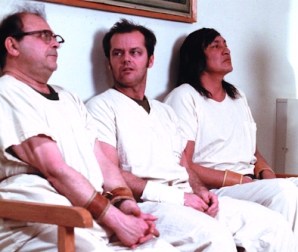
Even aside from the ending, I don’t think the film is as focused as it could or should be. I’m not asking to be handheld through it all, but at times it meanders. The best qualities lie in the acting. Nicholson and Fletcher won the Oscars, and both are very good — Nicholson with his familiar crooked charm, Fletcher despicable as the everyday megalomaniac — but for me the best performance is Brad Dourif, making his screen debut as the stuttering, sweet, ultimately tragic Billy Bibbit. He was nominated for an Oscar, but lost to George Burns in Only sane one hereThe Sunshine Boys (anyone remember that? No, didn’t think so); though he did win the BAFTA, once again proving that we have all the taste.

I’m not quite on board with all the praise Cuckoo’s Nest has received — I think it might be improved by a streamlining of purpose. Either way, it is not an enjoyable movie, though it is perhaps a significant one.

4 out of 5

One Flew Over the Cuckoo’s Nest was viewed as part of my What Do You Mean You Haven’t Seen…? 2016 project, which you can read more about here.