
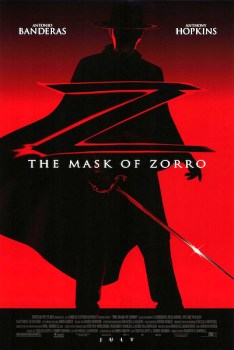
Country: USA & Germany
Language: English
Runtime: 138 minutes
BBFC: PG
MPAA: PG-13

Original Release: 17th July 1998 (USA)
UK Release: 11th December 1998
First Seen: TV, 31st August 2002 (probably)
Stars
Antonio Banderas (Desperado, Puss in Boots)
Anthony Hopkins (The Silence of the Lambs, The Remains of the Day)
Catherine Zeta-Jones (Entrapment, Chicago)
Director
Martin Campbell (GoldenEye, The Legend of Zorro)
Screenwriters
John Eskow (Pink Cadillac, Air America)
Ted Elliott (Shrek, Pirates of the Caribbean: Dead Man’s Chest)
Terry Rossio (Aladdin, Pirates of the Caribbean: The Curse of the Black Pearl)
Story by
Ted Elliott (Pirates of the Caribbean: At World’s End, The Lone Ranger)
Terry Rossio (The Legend of Zorro, National Treasure: Book of Secrets)
Randall Jahnson (The Doors, Sunset Strip)
Based on
The character of Zorro, created by Johnston McCulley.
The Story
After his brother is murdered, Alejandro Murrieta seeks revenge by becoming the protégé of Don Diego de la Vega — the man who used to be Zorro. Alejandro’s nemesis is Captain Love, righthand man to Don Rafael Montero, who 20 years ago killed de la Vega’s wife and stole his daughter — so de la Vega wants some revenge of his own.
Our Hero
A headstrong street thief, Alejandro Murrieta would surely get himself killed were it not for the intervention of Don Diego de la Vega and the training he provides — and his own charm, of course.
Our Villain
Don Rafael Montero plans to purchase California from General Santa Anna using gold secretly mined from the General’s own land. When Zorro’s actions threaten to expose the plan, he decides to destroy the mine and kill its slave workers. As if murdering de la Vega’s wife and stealing his child didn’t make him evil enough.
Best Supporting Character
Anthony Hopkins still seems an unlikely choice for the ageing former Zorro, Don Diego de la Vega, but his performance is perfectly calibrated nonetheless: wise and teasing of his young charge in equal measure. Hopkins also has the remarkable ability to absolutely own every line — reading the quotes page on IMDb, it’s impossible not to hear his voice.
Memorable Quote
“There is a saying, a very old saying: when the pupil is ready the master will appear.” — Don Diego de la Vega
Memorable Scene
Escaping from the villains, Zorro finds refuge in a nearby church, where he hides in the confessional. In comes Elena, wanting to confess her infatuation with the masked bandit. Hilarity ensues.
Technical Wizardry
The key to most good swashbucklers is the sword-fighting, and The Mask of Zorro is up to scratch. Banderas was trained by Bob Anderson, a legendary sword master — he also worked on Highlander, The Princess Bride, Star Wars, The Lord of the Rings, and many more. Not least, he coached Errol Flynn of all people — and Anderson reckoned Banderas was the best swordsman he’d worked with since Flynn.
Making of
Producer Steven Spielberg originally considered directing, but was eventually busy with Saving Private Ryan. Apparently Tom Cruise would’ve been his Zorro. Spielberg’s contributions included putting Catherine Zeta-Jones forward to be cast, and suggesting the epilogue scene (with Alejandro and Elena’s baby) because the original stopping point (Old Zorro dying in his daughter’s arms) was too depressing. At one time Robert Rodriguez was also set to direct — he cast Banderas, and wanted Salma Hayek in the Zeta-Jones role — but he clashed with the studio over budget and, apparently, his concept of the film as violent and R-rated.
Previously on…
The Mask of Zorro was a new, standalone Zorro adventure, but the character has a long screen history — over 40 film appearances, according to Wikipedia, including five serials, plus a dozen TV series and multiple radio dramas. The first was 1920’s The Mark of Zorro, starring the original swashbuckler, Douglas Fairbanks. Better known nowadays is the 1940 remake starring Tyrone Power and Basil Rathbone (which nearly made it on to this list).
Next time…
Seven years later, sequel The Legend of Zorro sees Zorro attempt to thwart a threat to California’s pending statehood, this time with his kid in tow. It wasn’t that good. Naturally, there’s talk of a reboot.
Awards
2 Oscar nominations (Sound, Sound Effects Editing)
1 BAFTA nomination (Costume Design)
3 Saturn nominations (Action/Adventure/Thriller Film, Actress (Catherine Zeta-Jones), Costumes)
What the Critics Said
“a pointed riposte to those who say they don’t make ’em like that anymore. The return of the legendary swordsman is well served by a grandly mounted production in the classical style [which] favors dashing adventure, dramatic and political intrigue, well-motivated characters and romance between mightily attractive leads over fashionable cynicism, cheap gags, over-stressed contemporary relevance and sensation for sensation’s sake. […] Achieving the right tone for the picture was crucial, as it easily could have tilted either in the direction of old-fashioned stodginess or, more likely in this day and age, of inappropriately high-tech thrills and gratuitous violence. Clearly, everyone concerned, beginning with scripters John Eskow, Ted Elliott and Terry Rossio and GoldenEye director Martin Campbell, was at pains to endow the story with sufficient dramatic and emotional credibility, and to go beyond glibness in its humor.” — Todd McCarthy, Variety
 Score:
 83%
83%What the Public Say
“as this is a Steven Spielberg production, what The Mask of Zorro is really about is the art of filmmaking, and it shows what some imaginative people (director Martin Campbell among them) can do with a movie camera. There are some old-fashioned stunts and physical comedy that are carried off just about perfectly here. And usually, these shoot-the-works movies peter out just before the end credits, but this one has the most satisfying adventure-movie wrap-up I’ve seen in a long time.” — Movie Movie Blog Blog

A couple of years after he revitalised the Bond franchise with GoldenEye, director Martin Campbell does the same for a whole subgenre — the swashbuckler — in this fun revival of the masked Californian vigilante. Mixing slickly choreographed action with doses of humour, the film doesn’t take itself too seriously but doesn’t tip over into farce either (traits definitely shared with the aforementioned Bond revival). The result is thoroughly entertaining, and an example of ’90s blockbuster filmmaking at its finest.

#60 will… take the red pill.

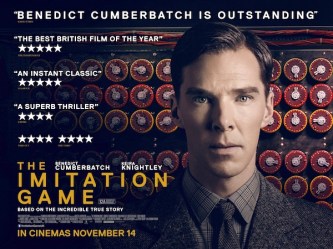 Alan Turing was a war hero: he led a team of cryptologists who managed to break the Germans’ Enigma encryption, thereby giving the Allies access to tonnes of vital information that (historians estimate) helped shorten the war by up to four years. This information was beyond top secret — so much so that they created a new designation for it, “ultra secret” — so when the war was over, Turing & co’s contribution went unrecognised for decades. Alan Turing was also a homosexual in an era when that was illegal. When he was caught, he was sentenced to chemical castration, which caused (or at least contributed) to him taking his own life. Fine way to treat a war hero, but that’s what you get with discriminatory attitudes.
 The screenplay by newcomer Graham Moore topped the Black List in 2011, so it’s probably of little surprise that it went on to win an Oscar, but I think it’s fair to say its quality, while good, isn’t that good. The use of three concurrently-told timelines seems to be too much for Moore and/or director Morten Tyldum to handle at times, occasionally flitting to a different era with little purpose beyond “it’s about time we told more of that storyline”. That’s not to say a wholly chronological telling would’ve been more effective — though perhaps it would’ve placated critical viewers who expected (and retrospectively demand) a cryptography-based wartime thriller — but the period juggling clouds the point as often as it illuminates it.
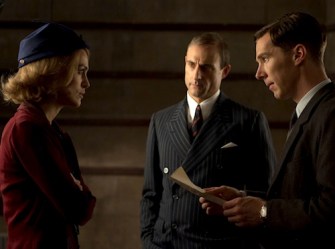 Also up for the golden man was Knightley, who does give one of her better turns as Turing’s sort-of-sidekick. The pair have a fairly complex relationship — both halves are key to conveying that, and they both do. At least as remarkable as either is young Alex Lawther, who arguably gets the film’s stand-out acting moment in his final scene, where a tumult of emotion is contained beneath a stiff-upper-lip surface in a tight close-up. On the strength of this, an actor to watch out for. The rest of the cast don’t get the same depth of material, but Charles Dance and Mark Strong provide exceptional value, as always, and Rory Kinnear does his best to bring some nuance and interest to a part he’s overqualified for.
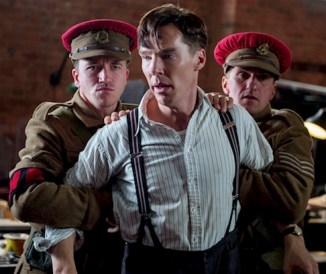 Perhaps that just stems from a frustration at some of the film’s other issues. It clearly has a flexible relationship with historical accuracy — well, what biopic doesn’t? Without wanting to spoil plot developments, some viewers feel the film suggesting Turing knew of the spy at Bletchley Park is insulting to his memory, because in real-life he didn’t even know the individual. Alternatively, is it not a way to integrate that part of the Enigma story into a film that otherwise wouldn’t have a satisfactory way to touch on it? Everyone’s mileage will vary on whether that should’ve been done or not.
 Without meaning to sound too judgemental (though when has that ever stopped me?), those factors making me think this is the kind of film “normal people” will probably love a lot more than “film fans” — which probably explains why it’s in the IMDb Top 250 but all the most-liked reviews on Letterboxd have exceptionally low scores. Personally, I’m going to side with the populous: not everything has to be a groundbreaking feat of Cinema to be a story worth telling and told well, and if it is indeed some kind of “historical revisionism” to say that there’s nothing wrong with being gay and the way Turing was treated post-war was horrendous, well, I’m OK with that revisionism.
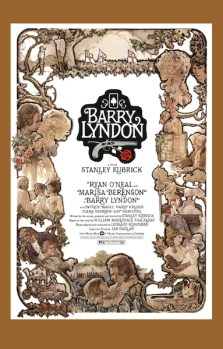 Stanley Kubrick made a good many exceptionally well-regarded films — indeed, with possibly the exception of his first semi-amateur feature,
 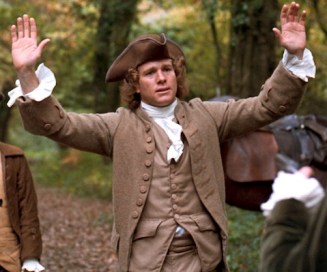 who often tells us less-than-favourable things about the lead character. Apparently this is an example of an unreliable narrator, and I suppose some of the things we’re told aren’t directly evidenced on screen, but I’m afraid I’m going to have to leave that seam to be mined by other writers, because (on a first viewing at least) I didn’t see where or to what effect the narrator was lying to the viewer.
 but a fictional biopic, that ranges across Europe and across time to… what effect? It’s a Kubrick film, so the ultimate goal of the tale, the message(s) it may be trying to impart, are debatable. You could see a story of the pitfalls of hubris. You could see an exploration of how a certain class lived in this time period. You could just see a man who led an adventurous life.
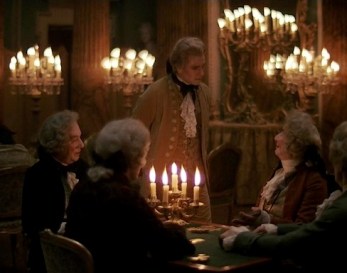 just that it remains the best among greats. (That said, having looked up images online for this review, it seems slightly less striking to me now. That may be the quality of the screengrabs; it may be that the painterly quality is so remarkable at first appearance (before becoming more familiar when the whole movie has that quality) that its memorableness is heightened.)
 The director of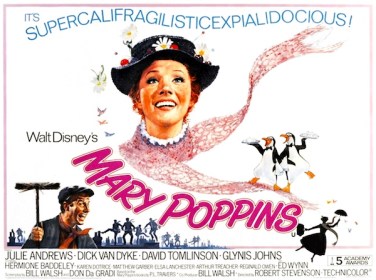


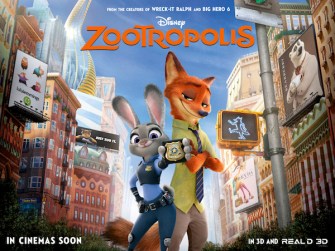 Disney’s 55th Animated Classic is their second highest-grossing ever, the 25th film to take over $1 billion at the worldwide box office, which makes it a hit of
  I think Zootropolis may be the first time they’ve attempted a neo-noir crime thriller, though. And I bet no one ever thought they’d see a Disney film with a sequence set at a nudist resort. Or in a drugs lab, for that matter. Or one with a substantial parody of
  However, that’s not to say kids can’t get enjoyment out of it: there are plenty of colourful characters and locations, relatable situations, cross generational humour, and a moral lesson young’uns will understand. There’s the DMV sequence, for instance, which is grounded in an adult experience but so funny it must cross over. Considering all the praise I’ve heard for that one scene, it’s also a feat it lives up to the hype. It’s gorgeously animated throughout, bolstered by a world that has been magnificently realised, with all the different themed districts of the city. (After all the Disney movies that have had contrived TV series spin-offs, this is a film that actually feels like it deserves one. The setup is obvious — a police procedural — and the world the film suggests is big enough to warrant it. Heck, it practically demands it — there’s so much more of this world, you want to see it explored.) Michael Giacchino’s score is different too: memorable and fun, in part thanks to using a cornucopia of unusual instruments to provide a ‘world music’ sound that’s in-keeping with the movie.
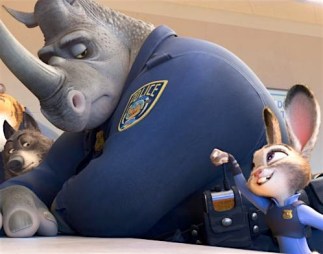 too, but that doesn’t mean the journey getting there is any less fun.



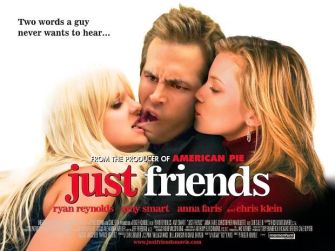 I was aware of the existence of Just Friends in the way you’re aware of any movie with name actors that came out during the period in which you were cognisant of films that were being released — that is to say, I knew it was a film and it was a comedy, and I had paid it no heed beyond that. Until a couple of months back, when
  For all kinds of reasons, Just Friends spends a long time feeling like a morally bankrupt movie. It’s unclear if it’s praising or condemning Chris’ frivolous lifestyle, if he needs saving by coming home, or if he deserves revenge on the people who mistreated him. We know what the standard Hollywood perspective on these things is, so kudos to some degree for dodging it (at least for a while), but it doesn’t commit to the other direction either. What the story really amounts to is wish fulfilment on an epic scale. Its message is essentially: you can go back to your past and make it better. Maybe I’m just a cynic, but that’s not something I believe.
 One lesson I took from watching Just Friends (as if I didn’t know this already) was that just because a bunch of people defend something they like in a comments thread on the internet, it doesn’t mean you’ll like that thing too, even if that comments thread is on the A.V. Club. Nonetheless, while Just Friends is not any kind of “must see” film, as a 90-minute diversion — with, at this temporal distance, a splash of mid-’00s nostalgia — it’s passably entertaining.
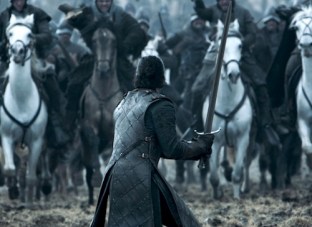 GoT produced two of its greatest-ever episodes to conclude this season. Actually, that’s arguably an understatement: based on IMDb votes, if nothing else, Thrones produced two of the best episodes of TV ever made. But what do IMDb voters know? Well, more than some people give them credit for. Obviously everyone has different tastes, but for the genres Thrones operates in — and, in some instances, even transcending those — these are incredible hours of TV. Episode 9, Battle of the Bastards, is surely one of the most thoroughly-realised medieval-style battles ever depicted on screen: the scale is epic, the strategy is clear, the feeling of what it’s like to be in the thick of that environment is palpable. How it turns out may have been predictable, but something being predictable is not the same as it being bad — not everything needs to be a twist.
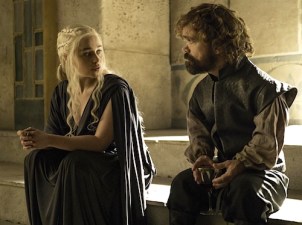 As for the forthcoming seventh season, it’s pretty clear we’re now entering the show’s endgame — though we’re going to have to wait even longer for it, with the next season set to have a later-than-normal premiere and the final end not coming until the season after that. It’s going to be an excruciating wait, but if they can maintain the form displayed throughout season six, it’ll be worth it.
 This is done and dusted Stateside now, but goodness knows when Channel 5 will choose to ‘officially’ air it over here, so I’m just getting on with it. I used to despise most of PoI’s arc plots and often wished it would stick to being just a pretty cool vigilante procedural; but at this point, it’s so invested in the epic Super-AI vs. Super-AI sci-fi storyline that any attempts at case-of-the-week episodes feel like a waste of time — especially when this truncated season is fast approaching the show’s final end. I really hope it comes to a proper conclusion, because there’s too much going on here to let it end forever on a cliffhanger. (Obviously that answer’s now out there, but naturally I’m avoiding spoilers.)
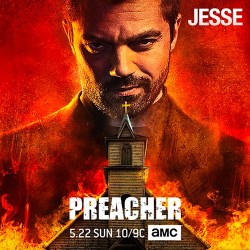 I’m a bit behind on this at the minute (the latest episode was the eighth), but, as of the halfway point, it’s definitely settled into its own skin — or maybe it was always settled there, but it’s taken time for viewers (or this viewer) to get past the expectations brought as a reader of the comic books. It’s still far from being a literally faithful adaptation, carving out its own path from some of the comic’s building blocks, which makes it an odd and hard-to-judge work if you have read any of the original. Still, it’s an entertaining series, and people involved keep talking about this season being something of a prequel to what we saw in the comic, so maybe the already-commissioned season two will feel more recognisable.
 This month, I have mostly been missing stuff I don’t even know I’m missing. By which I mean, I haven’t been paying enough attention to the TV schedules to know what I’ve missed. The BBC’s supernatural drama The Living and the Dead sounds kind of interesting; I know Mr Robot is back, not that I ever got round to season one; plus The Musketeers continues (though I hear it’s gone off the rails this season); and I keep hearing vaguely good things about Netflix’s new series, Stranger Things, like that it’s a cross between Steven Spielberg and Stephen King, or The Goonies mixed with The X Files… which just reminds me that I need to get round to seeing The Goonies someday.

 100Films.co.uk