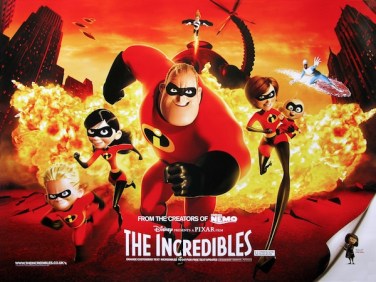
The Incredibles (2004)

100 Films’ 100 Favourites #44

Expect the incredible.

Country: USA
Language: English
Runtime: 115 minutes
BBFC: U
MPAA: PG

Original Release: 5th November 2004 (USA)
UK Release: 26th November 2004
First Seen: DVD, 2005

Stars
Craig T. Nelson (Poltergeist, Action Jackson)
Holly Hunter (Raising Arizona, The Piano)
Samuel L. Jackson (Pulp Fiction, Snakes on a Plane)
Jason Lee (Mallrats, Alvin and the Chipmunks)

Director
Brad Bird (The Iron Giant, Mission: Impossible – Ghost Protocol)

Screenwriter
Brad Bird (*batteries not included, Ratatouille)
(I bet you could count on one hand the number of Western animated movies written by one person.)

The Story
After public opinion forced superheroes into a civilian relocation programme, Bob and Helen Parr — formerly Mr Incredible and Elastigirl — live a quiet domestic life with their three children. Bob is dissatisfied, however, and easily tempted back to heroic ways by a call to defeat an evil robot. When it emerges this is part of a plan to kill retired superheroes and give powers to everyone in the world, Bob’s wife and superpowered kids must enter the fray to save the world.

Our Heroes
The fantastic four titular heroes: Bob Parr, aka Mr Incredible, who has super strength and limited invulnerability; his wife Helen, aka Elastigirl, who can stretch her body like rubber; their daughter Violet, who can become invisible and generate a force shield; and her younger brother Dash, who has super-speed (name/power coincidencetastic!) There’s also their chum Lucius Best, aka Frozone, who can form ice from the air. He’s very cool, hence casting Samuel L. Jackson.

Our Villain
Disillusioned superhero fanboy Buddy Pine, who grew up and used technology to give himself powers, dubbing himself Syndrome. Wants to give everyone in the world powers, because when everyone’s super, no one will be.

Best Supporting Character
Fashion designer Edna Mode, who makes the superheroes’ costumes. Inspired by Hollywood costume designer Edith Head, Bird wanted Lily Tomlin to voice her, and provided an example of how she should sound. Tomlin thought it was perfect, so she instead persuaded Bird to play the role himself.

Memorable Quote
“No matter how many times you save the world, it always manages to get back in jeopardy again. Sometimes I just want it to stay saved! You know, for a little bit? I feel like the maid — ‘I just cleaned up this mess! Can we keep it clean for ten minutes?!’” — Mr. Incredible

Memorable Scene
After tearing his old costume, Bob visits Edna for a new one. He wants a cape. Cue montage of why capes are a bad idea.

Technical Wizardry
The film presented a whole host of new technical challenges for Pixar, not least fully animating a whole cast of humans for the first time — they had to develop new technology to animate detailed anatomy, clothing, skin, and hair. The latter was a particular challenge. On Monsters, Inc., the animators persuaded director Pete Docter to give Boo pigtails to make her hair easier to animate, but Brad Bird accepted no such compromises, particularly as Violet’s long, face-covering hair was integral to her character — and it had to be depicted underwater and blowing in the wind, too. Ultimately, Violet’s hair was only successfully animated toward the end of production.

Next time…
One of the few Pixar sequels people actually wanted, The Incredibles 2 is in development for a 2019 release. That’s only a 15-year wait.

Awards
2 Oscars (Animated Film, Sound Editing)
2 Oscar nominations (Original Screenplay, Sound Mixing)
1 BAFTA Children’s Award (Best Film)
10 Annie Awards (Feature, Directing, Writing, Voice Acting (Brad Bird), Music, Production Design, Animated Effects, Character Animation, Character Design, Storyboarding)
6 Annie nominations (Voice Acting (Samuel L. Jackson), Character Animation (again, x3), Character Design (again), Storyboarding (again))
1 Saturn Award (Animated Film)
2 Saturn nominations (Writer, Music)
Won the Hugo for Best Dramatic Presentation Long Form

What the Critics Said
“what really makes The Incredibles work is the wit of Bird [though] much of it will be over the heads of very young viewers who account for so much repeat business. Bird’s satiric take on suburbia, conformity and forced notions of equality is surprisingly sophisticated and biting for an animated feature, matched by a visual panache that is often breathtaking.” — Kevin Lally, Film Journal International

Score: 97%

What the Public Say
“Most Disney films are about people meeting and falling in love. Incredibles is one of the only ones I can think of about how important marriage is. It shows a couple fighting, getting along, and working together.” — Rachel Wagner, Reviewing All 54 Disney Animated Films and More!

Verdict

Even before the present glut of big-screen super-heroics, Pixar were in on the game with this affectionate genre entry. Writer-director Brad Bird mixes together classical superhero antics with elements of 1960s spy-fi to create a retro world of optimistic heroics and larger-than-life villainy — at odds with the dark-and-serious tone of so many superhero movies of the past 17+ years, but all the more memorable for it. It’s also great at the kinds of things Pixar is known for. The combination means it transcends both the kids’ animation and superhero subgenres.

#45 will be… keeping up with the Joneses.

The Revenant (2015)

2016 #103
Alejandro G. Iñárritu | 156 mins | Blu-ray | 2.40:1 | USA, Hong Kong, Taiwan & Canada / English, Pawnee & French | 15 / R

Oscar statue2016 Academy Awards
12 nominations — 3 wins

Winner: Best Actor, Best Director, Best Cinematography.
Nominated: Best Picture, Best Supporting Actor, Best Film Editing, Best Costume Design, Best Makeup and Hairstyling, Best Sound Mixing, Best Sound Editing, Best Visual Effects, Best Production Design.

The Revenant is the Oscar-winning, acclaim-gathering story of Hugh Glass, the expert guide for a pelt-collecting group (is that what they are? Is that a thing?) in the Old West, who’s mauled by a bear to within an inch of his life. Eventually betrayed and left for dead by the members of the group who’d vowed to stay with him to the end, Glass somehow survives, and crawls across the wintery wilderness in search of his revenge! And it’s all the more remarkable for being based on a true story… though this retelling contains approximately as many “historical events that actually occurred” as does Game of Thrones.

The main talking point of The Revenant has been Leonardo DiCaprio’s performance, which finally bagged him an Oscar after four unsuccessful nominations (and I’m sure plenty of other roles that he thought might snag him some Academy recognition but didn’t). How much is it acting and how much was it just an endurance test that director Alejandro González Iñárritu subjected him to? Is there a difference? If you have to suffer for great art, Leo certainly did that. In some ways it’s testament to the Academy being able to look past delivery of dialogue as an indication of performance quality, because Glass doesn’t speak much — not when he’s in the company of others, and certainly not when he’s trying to get by on his lonesome, which he is for much of the film. Nonetheless, Leo conveys thoughts and emotions — which do go beyond, “I can’t believe Iñárritu is making me eat this raw liver” — effectively through expression and action.

In some respects it’s a shame the rest of the cast were consequently overshadowed — Leo may spend a huge chunk of the film on his own, but there are frequent cutaways to what everyone else is up to. Tom Hardy is the obvious standout as selfish bastard Fitzgerald, a perfectly detestable but completely believable villain — I’m not saying we’d all sink to his depths, but I’m not convinced most of us are above some of the choices he makes, either. Will Poulter steps outside the comedy roles he’s mostly taken since his Son of Rambow debut to give an effective turn as the group’s youngest, most conflicted member, while Domhnall Gleeson is commanding as the group’s leader. Gleeson was something of a lucky charm last awards season, appearing in no fewer than four Oscar-nominated films, including two that were up for Best Picture. Not only that, but look at his turn here (as an honourable, disaster-struck Captain) alongside his appearances in those other films (a small town nice guy in Brooklyn; an inexperienced evil military commander in Star Wars; a naive, selfish, sort-of-moral, easily-led programmer in Ex Machina) and you can see the kid’s got range.
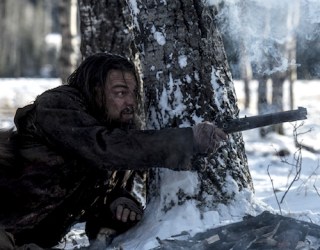
Far from just an acting showcase, The Revenant is a film of thematic weight. In fact, it’s like an old-fashioned blockbuster — the kind of thing you’d’ve seen in the 1950s (epic revenge Western) or 1970s (bleak revenge Western) as among the year’s biggest movies — crossed with a slow-paced, scenery-loving, meditative arthouse piece. If it’s about anything (beyond, y’know, the plot), it’s surely about nature — both the amazing vastness of natural spaces, but also the brutality of survival. And not just humans, either, which is the go-to simplistic message (“isn’t nature good? aren’t humans bad?”) of such cod-thoughtful fare. Like the rest of nature, humanity is varied: there are some very harsh, cruel acts herein, but also acts of kindness — sometimes perpetrated by the same people.

The avoidance of pat depictions extends to its portrayal of Native Americans, too. They’re neither simplistic Evil Foreigners, nor a “we’re so sorry for how we’ve treated them before, they’re great really” apologia. Instead, they’re just as brutal and as human as the rest of us, and made up of varied groups who behave differently, or even slaughter among themselves. The main band of Indians we see do serve as the film’s villains (as if Fitzgerald wasn’t bad enough), a hunting party acting out an inverted Searchers as they hunt for a kidnapped daughter. In The Searchers the group hunting and killing in search of a girl are the heroes; here, they’re the villains. Makes you think, don’t it? I’m not accusing Iñárritu of casual racism — I imagine that’s exactly their point.
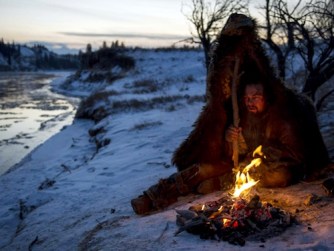
And speaking of Iñárritu, I wonder if this is his first genuine masterpiece. I didn’t care for 21 Grams or Babble, and Birdman was good but overrated. (In fairness, I’ve not seen Biutiful, which people seem to disregard nowadays, or Amores Perros, which is a rare foreign language film in the IMDb Top 250.) It seems like he was a nightmare during production — the budget was set at $60 million, but ultimately more than doubled to $135 million due to delays thanks to his production choices. In hindsight it looks like genius — “I knew it would be amazing so we kept going” — but if it had flopped, I’m sure an awful lot more would’ve been made of Inarritu’s excessively picky directorial style and fractious treatment of the crew, which apparently led Tom Hardy to try to strangle him…

At the Oscars, I was pulling for Roger Deakins to make it 13th time lucky, or for Mad Max to do a technical sweep and take cinematography with it (not undeservedly); but having now actually seen Lubezki’s work on The Revenant, it’s hard to deny it’s an immensely deserving winner. His mastery of all elements of the form is on regular display: the use of light (all natural!), perspective, lenses, focus; the single-shot techniques he and Iñárritu learnt for Birdman are put to superior use here, creating some stunning sequences (rather than taking over the entire movie). It looks incredible on Blu-ray, too — so detailed, crisp, epic. If anything was going to convince me 4K was an idea worth investing in, it’s material like this. (The cost of a new TV, new Blu-ray player, re-buying films, and the real estate needed in the lounge for a screen big enough to appreciate it puts the other half me off again.)
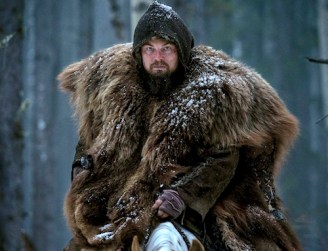
The film’s biggest flaw is that it goes on a bit too long in the middle. I’m not saying it needs to be a fast-paced thrill-ride, I just think it lingers a little longer than it needs to in places. Individual shots are beautiful, but the sheer volume of them stretches the centre part thin. There’s probably one too many action sequences where Indians attack and our hero has to escape, not least the one that ends in a too-obviously-CGI dive off a cliff. Equally, for every one of those there’s an incredible sequence, like the opening Indian attack. For a film that could easily be described as arthouse-y and thematically-driven, there are some truly stunning action scenes. The long middle means you couldn’t really call it “an action movie”, but focus on the first and last acts and it absolutely is.

I slipped in the word “masterpiece” a few paragraphs back, and I’d wager that’s what The Revenant is. It’s not perfect, and I don’t know that I’d say it’s the best film of last year either; but it is magnificently made, telling its story in a way only cinema can truly manage.

5 out of 5

The Revenant is out on DVD and Blu-ray in the UK as of yesterday.

It placed 4th on my list of The 20 Best Films I Saw For the First Time in 2016, which can be read in full here.

Highlander (1986)

100 Films’ 100 Favourites #43

There can be only one.

Country: UK
Language: English
Runtime: 116 minutes | 111 minutes (US theatrical cut)
BBFC: 15
MPAA: R

Original Release: 7th March 1986 (USA)
UK Release: 29th August 1986
First Seen: TV, 6th October 2000 (probably)

Stars
Christopher Lambert (Greystoke: The Legend of Tarzan, Lord of the Apes, Mortal Kombat)
Sean Connery (Goldfinger, The Rock)
Roxanne Hart (The Verdict, Pulse)
Clancy Brown (The Shawshank Redemption, The SpongeBob SquarePants Movie)

Director
Russell Mulcahy (The Shadow, Resident Evil: Extinction)

Screenwriters
Peter Bellwood (St. Helens, Highlander II: The Quickening)
Larry Ferguson (Beverly Hills Cop II, The Hunt for Red October)
Gregory Widen (Backdraft, The Prophecy)

Story by
Gregory Widen (see above)

The Story
Connor MacLeod is an immortal, a race of men living in secret among the rest of us, who must one day come together for the Gathering, after which there can be only one immortal left standing. That time comes in New York, 1985, as hulking savage the Kurgan hunts down the remaining immortals so that he can be the only one, and use the power that imbues to dominate the world. MacLeod is the only man in his way. Who will win? After all, there can be only— yeah, okay, you get it.

Our Hero
There can be only one Connor MacLeod, the 16th Century Scotsman with a suspiciously European accent who can live forever (who wants to live forever, anyway?)… unless someone lops his head off. That tends to do for most people, to be fair.

Our Villain
The strong and silent type, the Kurgan is certainly a physically imposing menace. Also immortal except for the decapitation thing. Wants MacLeod’s head, literally.

Best Supporting Character
Juan Sanchez Villa-Lobos Ramirez — the perpetually Scottish-accented Sean Connery as an Egyptian from Spain. It’s that kind of movie.

Memorable Quote
Connor MacLeod: “I’ve been alive for four and a half centuries, and I cannot die.”
Brenda: “Well, everyone has got their problems.”

Quote Most Likely To Be Used in Everyday Conversation
“There can be only one!” — everyone

Memorable Scene
(Spoilers!) As Connor talks with his assistant Rachel, an old woman, the film flashes back to World War 2: fleeing from Nazi soldiers, Connor runs into a barn, where he discovers a little girl hiding — Rachel. When a German officer turns up, Connor takes a bullet for her… then gets up and kills the officer, of course. This scene wasn’t even in the truncated US theatrical cut (it’s the largest single deletion, as detailed here), but has always stuck in my mind. It’s one of the best executions of the concept of the immortal: his only friend, an old woman, is someone he rescued as a little girl. (Short-lived half-decent US procedural crime series Forever explored this same concept more thoroughly over its single season a couple of years ago.)

Memorable Song
Who Wants to Live Forever is one of Queen’s best songs — and it was written by Brian May on the cab ride home after watching some rough footage from the movie! The band had only intended to record one song for the film, but after enjoying that footage they were inspired to compose more. The exact number of tracks they produced varies depending which source you listen to — they’re all on the A Kind of Magic album, but not all the tracks on that album were for Highlander. The exception is their recording of New York, New York for the film, which has never been released.

Technical Wizardry
Before CGI, filmmakers had to find other ways to do things like make swords spark when they clash. Animation was one method, of course. Not in Highlander, though. No, they attached a wire to each sword that then went down the arms of the actors to a car battery. One wire was connected to the positive terminal, the other to the negative terminal, so that when the blades touched there was an arc of electricity. Sounds super safe. Imagine the insurance costs of possibly electrocuting two lead actors…

Letting the Side Down
You might say the accents, but I think they’re part of the charm.

Making of
The opening scene was scripted to take place during a hockey match, emphasising the violence of the sport in contrast to the flashbacks of Connor warring in Scotland. The NHL weren’t impressed and refused permission. It was replaced with a wrestling match, which is presumably less violent than hockey.

Next time…
There should be only one! No one pays much attention to anything Highlander-related beyond the first film anymore, it feels like, but there’s a whopping great franchise lurking underneath that surface. It begins with much-maligned sequel Highlander II: The Quickening, also directed by Mulcahy and starring Lambert and Connery, which is set in the future and explains away the immortals as being aliens, or something. In spite of the minor improvement in the form of a “Renegade Version” director’s cut, the rest of the franchise ignores it. Spin-off TV series Highlander: The Series began in 1992, following the adventures of Duncan MacLeod (Adrian Paul), another immortal from the same clan. It ran for six seasons, begetting a spin-off of its own, Highlander: The Raven, which only lasted one. An animated series set in a post-apocalyptic future began in 1994, titled Highlander: The Animated Series (imaginative with their names, weren’t they?), which followed “the last of the MacLeods”, Quentin. It lasted for 40 episodes across two seasons. Also in 1994, second sequel Highlander III: The Sorcerer (aka Highlander: The Final Dimension) returned to the story of Connor MacLeod, ignoring both The Quickening and the TV series. Apparently it’s just a rehash of the first movie. After the TV series ended, fourth film Highlander: Endgame attempted to merge the two branches of the franchise, with a movie that followed Duncan MacLeod and led him to encounter Connor. It’s been shown on the BBC with surprising regularity. For some reason they made an anime movie in 2007, Highlander: The Search for Vengeance, which pits Colin MacLeod (yes, another one) against an immortal Roman general in a post-apocalyptic future. What is it with animation and post-apocalyptic futures? The whole shebang ultimately ground to a halt with Highlander: The Source, a post-Endgame continuation that was supposed to be the first of a trilogy but didn’t go down very well (plus ça change). It’s also been shown on the BBC with surprising regularity. There are also novels, a Flash-animated webseries, a handful of comic books released in the mid-’00s, and a couple of series of audio dramas from Big Finish that continue the TV series. A remake/reboot has been in development since 2008.

What the Critics Said
“Film starts out with a fantastic sword-fighting scene in the garage of Madison Square Garden and then jumps to a medieval battle between the clans set in 16th-century Scotland. Adding to the confusion in time, director Russell Mulcahy can’t seem to decide from one scene to the next whether he’s making a sci-fi, thriller, horror, music video or romance – end result is a mishmash.” — Variety (they say that as if it’s a bad thing!)

Score: 68%

What the Public Say
“I hear this won the Oscar for Best Movie Ever Made.” — Jope @ Blu-ray.com

Verdict

Highlander is a cult favourite — many reviews will tell you as much. I guess I’m in that cult, then, because I bloody love it. Of course it’s preposterous, of course the screenplay and performances are ridiculous, and of course it’s directed as much like an ’80s music video as it is a film… but it’s also a fantastic fantasy concept, so rich for further exploration that they keep trying to do just that (even though they keep messing it up). Also, it’s about men who have sword fights — excitingly choreographed sword fights — so, yeah, it’s right up my alley in that, too. Highlander may not be a “great film” in the artistic history-of-the-medium sense, but my goodness is it a great film.

A 30th anniversary restoration of Highlander is released on DVD and Blu-ray next month.

#44 will be… the best Fantastic Four movie.

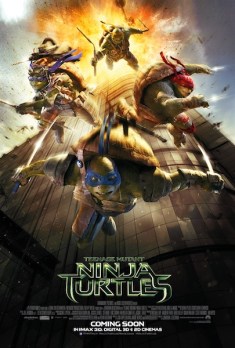
Teenage Mutant Ninja Turtles (2014)

2016 #48
Jonathan Liebesman | 97 mins | streaming (HD) | 2.35:1 | USA / English & Japanese | 12 / PG-13

While I was killing time waiting for my coffee to brew before I sat down to watch Teenage Mutant Ninja Turtles, 2014 edition, I drafted the introductory paragraphs to this review. Yes, before I’d even started the movie, so sure was I that I would dislike it. Naturally they took an appropriately condemnatory tone, talking about how it was a product and not a movie, designed primarily to sell tie-in plastic to grown men who wish they were still children, etc etc. Unfortunately writing those paragraphs was a waste of my time, because I can’t use them, because — shock of shocks — I actually quite liked this movie.
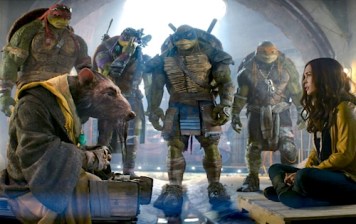
Now, let’s immediately throw some caveats on that, because it’s clearly riddled with flaws. The story is slight and so filled with over-familiar tropes that it barely bothers to play them out in full. On the bright side, that does mean it rattles along. However, the grand plan/climax is lifted straight from The Amazing Spider-Man. The action is often poorly directed, a too-close whirlwind of pixels. That said, there’s one sequence so OTT crazy that — if you ignore that the film is supposed to be live action and embrace the wild camerawork, physically impossible antics, and mind-boggling speed — it’s almost impressive. The CGI is variable: the Turtles themselves actually look alright, maybe even good, but Splinter is piss poor.

Megan Fox is miscast, not that she can act anyway. She’s clearly only there because producer Michael Bay thinks she’s hot (bit too plastic for my taste). Shredder is Bay-ed to the max, essentially becoming a Transformer made of knives. The Turtles’ personalities are pretty one-note, but not unfaithful to the original — the franchise started life as a spoof of things like Daredevil, after all, not a realistic character drama. That said, turning Mike into basically a turtle version of Michael Bay — i.e. he’s focused on lusting after Megan Fox and occasionally causing explosions — is a little cringe-y. Quite a few bits are a little cringe-y, actually; but they’re tempered by a few comedic bits that hit home, and a general veneer of “well, it could’ve been worse”.
“Well, it could’ve been worse” is pretty much the definition of “damning with faint praise”, but for all those many problems, I actually enjoyed myself while watching the film. It was funny enough, it was exciting enough, it was almost well-made enough. It’s not a good movie, but I did think it was an “entertaining enough for a couple of hours on a particularly lazy evening” kind of movie. And, despite the weak reviews it’s been receiving, the trailers for the second movie make it look better. I’m not going to fork out cinema prices to see it anytime soon, but on the strength of this first one, I will eventually. Which may not please the plastic-pedlars, exactly, but is a better result than I’d expected.

3 out of 5

Teenage Mutant Ninja Turtles: Out of the Shadows is in cinemas worldwide now.

The Assassin (2015)

aka Cìkè Niè Yǐnniáng

2016 #99
Hou Hsiao-Hsien | 105 mins | Blu-ray | 1.40:1 + 1.85:1 | Taiwan, China, Hong Kong & France / Mandarin | 12

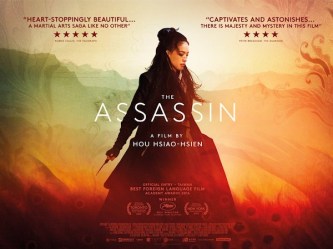
The Assassin is a martial arts drama about Nie Yinniang (Shu Qi), a woman trained since childhood to be a highly-skilled assassin. When her emotions lead her to renege on a mission, her master sets a difficult task for Yinniang to prove herself: she must return to her homeland and assassinate its leader, Tian Ji’an (Chang Chen) — her cousin, to whom she was once betrothed.

The Assassin is also a Palme d’Or nominee, winner of Best Director at Cannes, a BAFTA nominee for Best Film Not in the English Language, and Sight & Sound’s critics’ poll winner for the best film of 2015.

If those paragraphs sound somewhat incompatible, it’s because they kinda are. Has the artier side of the film appreciation world gone genre mad? In short, no. If you take those two paragraphs at face value — martial arts flick vs. Sight & Sound poll-topper — then The Assassin is more befitting of the latter. It’s a slow film, that revels in shots of the countryside or people sat waiting. The backstory is told in infodumps (at least, that’s what we’d flag them as in ‘lesser’ films), while the present narrative comes in dialogue about political intricacies or the looks people give each other at certain times.

So little happens at times that it’s very easy to become disconnected from it. At one point my mind wandered to other films it reminded me of. Ashes of Time, for instance, which was an arthouse-bent martial arts movie that I really liked. Also, oddly enough, The Wolverine. I wondered how and why that film seemed to have been so quickly forgotten, concluding it wasn’t just because it’s not as memorably great as the finest X-Men films, but also because it wasn’t as memorably bad as The Last Stand or X-Men Origins; and therefore that that was pretty unfair, because shouldn’t the fact it’s better (quite a bit better) than those two mean it comes up more often; and— wait, what were we meant to be talking about? Oh yes, this calming scenery shot, which hasn’t ended yet.
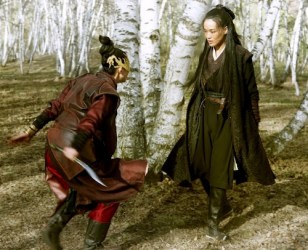
The cinematography is certainly pretty — we’re all agreed on that. Framing it in more-or-less Academy ratio (apparently the ratio shifts slightly from shot to shot, but you’d have to be some kind of wunderkind obsessive to even notice that) is an uncommon choice, but not an unprecedented or unattractive one. However, the choice of ratio is brought to our attention by the inclusion of one scene in widescreen, especially as it’s difficult to see what purpose this serves. It’s not a scenery shot or an action sequence, the kind of things that might benefit from a wider canvas, but someone singing a song in flashback. Maybe it’s simply to differentiate that it is a flashback? That seems a pretty shallow reason for such an extravagance as completely switching aspect ratio, though.

For all that, there is some action, but director Hou Hsiao-Hsien has said he’s more concerned about the before and after of a fight than the process itself — it’s about the mood, the tension, the ultimate outcome of winning or losing, rather than the choreography of the combat — so there’s a lot of build-up for very brief bursts of action. That’s certainly not an invalid way to handle it — it’s Leone-esque, in its way — but it does mean anyone looking for the detailed swordplay or fisticuffs you expect of a martial arts film will come away disappointed.

The Assassin is far from your typical martial arts film, and so will appeal to a different kind of viewer. Hou has said it’s more about the spirit and deeper meanings of martial arts than it is the physical combat, and I can only presume that’s true. Besides looking very pretty, and presenting a (barely explained) adjustment in the mentality of one character, it’s difficult to know what to take away from it.

3 out of 5

The Suspenseful Monthly Update for May 2016

The number of films I watched this May dipped well below the monthly average for 2016, but was that still enough to get to #100 this month?

I know, the suspense must be killing you. Read on…


#89 The Hateful Eight (2015)
#90 The Raid 2 (2014), aka The Raid 2: Berandal
#91 Calvary (2014)
#92 Captain America: Civil War (2016)
#93 Future Shock! The Story of 2000AD (2014)
#94 Ted 2 (Extended Edition) (2015)
#95 Moonrise Kingdom (2012)
#96 Hamlet (1964), aka Гамлет
#97 Just Friends (2005)
#98 X-Men: Apocalypse (2016)
#99 The Assassin (2015), aka Cìkè Niè Yǐnniáng
#100 One Flew Over the Cuckoo’s Nest (1975)
#101 Return of the One-Armed Swordsman (1969), aka Du bei dao wang

.


  • This month’s WDYMYHS pick coincides with #100, so it seemed only natural to pick the most acclaimed film I’d never seen (at least according to IMDb users), One Flew Over the Cuckoo’s Nest.


Last year I reached #100 by the earliest date I’ve ever done it, July 27th. It finally beat a personal record that had stood since 2007. At the time, I wrote that 2015 had “been rather good by my standards, so it’s [a record] I don’t foresee breaking again. I mean, if I had five consecutive best-ever months (i.e. better than I’ve ever done, x5) then I could squeeze it in by the end of May.” Hahaha, what a ridiculous notion that would be!

That was before October 2015’s ludicrous 31-film tally, so in the end I didn’t need five “better than I’ve ever done” months, just four really good ones and one fairly average one to reach #100 on May 28th.

“Fairly average” there is a relative term: May 2016’s total of 13 films may rank =17th out of the last 24 months, but it’s above the all-time average for every month (the nearest is October’s 12.63), so it ain’t bad really. And although it breaks the 20-films-per-month run I’d been having in 2016, it does maintain my 10-per-month streak for the 24th month — i.e. two straight years.

Looking ahead, May may be a better indicator of what’s to come for the rest of the year — as I keep mentioning in these monthly posts, I’ve been intending to watch fewer film this year (to make room for other stuff), and I only pushed to #100 so quickly after I ‘accidentally’ had a really good couple of months at the start. My goal is to maintain that 10-per-month minimum, which now sees 2016 looking at #171+ (up from last month’s 160-ish). If the rest of the year does look like May (i.e. about 13 films a month), I’d end up around #192. If I ‘slip’ back into watching a lot of films, the average for the year so far (20.2) places me in the 240s.


It’s 100 Favourites’ G-spot! Experience ghosts, gladiators, and gangsters, in a month that’s all about films beginning with the letter G.


The 12th Monthly Arbitrary Awards

Favourite Film of the Month
I was quite down on its predecessor for all sorts of reasons, but my unquestioned favourite film this month is The Raid 2. I won’t be surprised if it turns up again on my year-end top ten, too.

Least Favourite Film of the Month
I’ll talk about what in hell led me to watch it when I get round to reviewing it, but, while I actually wound up not minding Just Friends (for what it is, anyway), it’s definitely the lowest-quality movie I watched this month.

Winner of Marvel’s Civil War
Tom Holland, aka Spider-Man.

Loser of Marvel’s Civil War
Zack Snyder and his plans for DC’s movie universe.

The Audience Award for Most-Viewed New Post of the Month
Was it massively popular new-release Captain America: Civil War? No, that came third. Was it one of the widely-acknowledged greatest movies of all time, The Godfather? No, that came second. This month’s most popular post was a 21-year-old James Bond movie, GoldenEye.


2016 starts looking towards its place on the all-time ranking of 100 Films years: with 2008, 2009, 2011, and 2012 already passed, sights are set on beating 2013’s 110, and maybe 2010’s 122…

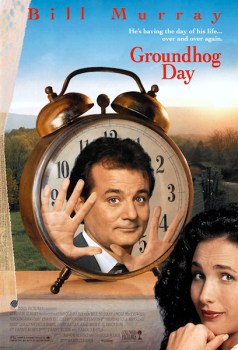
Groundhog Day (1993)

100 Films’ 100 Favourites #42

He’s having the day of his life…
over and over again.

Country: USA
Language: English
Runtime: 101 minutes
BBFC: PG
MPAA: PG

Original Release: 12 February 1993 (USA)
UK Release: 7th May 1993
First Seen: TV, c.1996

Stars
Bill Murray (Ghostbusters, The Life Aquatic with Steve Zissou)
Andie MacDowell (sex, lies, and videotape, Four Weddings and a Funeral)
Chris Elliott (Cabin Boy, There’s Something About Mary)
Stephen Tobolowsky (Thelma & Louise, Memento)

Director
Harold Ramis (Caddyshack, Analyze This)

Screenwriters
Harold Ramis (Animal House, Ghostbusters)
Danny Rubin (S.F.W.)

Story by
Danny Rubin (Hear No Evil, Stork Day)

The Story
Dispatched to cover the Groundhog Day ceremony in the small town of Punxsutawney, Pennsylvania, a TV news team get stuck overnight by a snowstorm. When weatherman Phil Connors wakes up the next morning, he finds it’s Groundhog Day again — he’s stuck in a time loop which no one else is aware of, reliving the despised day over and over again. The only advantage is he might be able to use the special knowledge he gains to woo his producer.

Our Hero
Grumpy TV weatherman Phil Connors definitely doesn’t want to be covering the ridiculous Groundhog Day ceremonies, so it’s a personal hell to relive that particular day over and over, possibly for the rest of time. Equally, it might just wind up making him a better man.

Our Villain
Who knows what caused Phil’s predicament? Maybe it was the groundhog — he’s in the title, after all.

Best Supporting Character
Now, don’t you tell me you don’t remember Ned because he’d sure as heckfire remember you. Ned Ryerson. Needlenose Ned. Ned the Head. From Case Western High. Ned Ryerson, did the whistling belly-button trick at the high school talent show? Bing! Ned Ryerson, got the shingles real bad senior year, almost didn’t graduate? Bing, again. Ned Ryerson, dated Phil’s sister Mary Pat a couple times until Phil told him not to anymore? Ned Ryerson? Bing!

Memorable Quote
“Well, what if there is no tomorrow? There wasn’t one today.” — Phil

Memorable Scene
Fed up with his limited immortality, Phil tries to commit suicide. It doesn’t work — so he keeps trying, in new and ingenious ways. I mean, when you put it like that it kinda doesn’t sound funny…

Making of
So, how long is Phil trapped in the time loop? Director Harold Ramis said the original idea was 10,000 years, though he later said it was probably more like 10 years. Various websites have tried to work it out, because of course. Estimates range from just under 9 years to more like 34 years, in order to account for all the time Phil spends learning to play the piano, become an ice sculptor, etc. In the film itself, we see events from just 38 days.

Next time…
The creative team behind the RSC’s successful musical Matilda are working on a stage musical adaptation of Groundhog Day, including songs by Tim Minchin, which will premiere at The Old Vic later this year before opening on Broadway in March 2017.

Awards
1 BAFTA (Original Screenplay)
1 British Comedy Award (Comedy Film)
1 Saturn Award (Actress (Andie McDowell))
5 Saturn nominations (Fantasy Film, Actor (Bill Murray), Director, Writing, Costumes)
Nominated for the Hugo for Best Dramatic Presentation.

What the Critics Said
“While Murray’s deadpan putdowns and dry dismissals of provincial peccadilloes are the comic highlights, Groundhog Day is no supercilious rip of small-town U.S.A. Under Ramis’ even-handed, smartly tilted direction, Groundhog Day also shows the strong virtues of small-town decencies and the maturing-effect they have on the glib media-slicker.” — Duane Byrge, The Hollywood Reporter

Score: 96%

What the Public Say
“What has always come best from Bill Murray is a kind of flat, dead-pan delivery, a manner of looking at bizarre situations and sizing them up […] Groundhog Day is right at home for Murray because it affords him at least two dozen moments like that. It is the perfect playground for his kind of humor. Yet, it is something more than that. Here he begins by playing a man who is smug and self-important and slowly transforms into a man who is happy.” — Jerry, armchaircinema

What the Philosophers Say
“perhaps the ultimate meditation on man’s struggle to give meaning to his life within the abyss of an inconsequential existence, at least as far as ’90s comedies go.” — Colin Newton, Mind Over Movies

Verdict

A Twilight Zone-esque setup gets a comedic twist in the hands of co-writer/director Harold Ramis and star Bill Murray (teaming up in a version of that configuration for the sixth time). While the film is undoubtedly a showcase for Murray’s comedic talents (which is no bad thing), alongside that it develops an endearing vein about what it means to be a good person, touching on some pretty philosophical stuff along the way. It’s also a movie about leading a repetitious life, but it isn’t repetitious itself — surely a feat all of its own.

How many #43s can there be? There can be only one.