
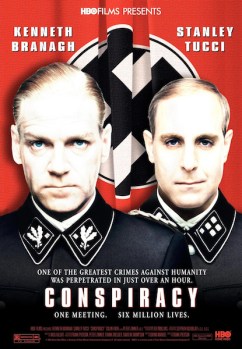
Country: UK & USA
Language: English & German
Runtime: 96 minutes
BBFC: 15
MPAA: R

Original Release: 19th May 2001 (USA)
UK Release: 25th January 2002
First Seen: TV, 25th January 2002
Stars
Kenneth Branagh (Henry V, Valkyrie)
Stanley Tucci (The Terminal, The Hunger Games)
Colin Firth (Bridget Jones’s Diary, The King’s Speech)
David Threlfall (Scum, Nowhere Boy)
Kevin McNally (Pirates of the Caribbean: The Curse of the Black Pearl, Valkyrie)
Director
Frank Pierson (The Looking Glass War, A Star is Born)
Screenwriter
Loring Mandel (Countdown, The Little Drummer Girl)
The Story
1942, Berlin: a group of high-ranking Nazis gather for the Wannsee Conference, its purpose being to determine the method by which they will implement Hitler’s policy of making Germany free of Jews. Put another way, this is the meeting that created the Final Solution.
Our Heroes
I mean, they’re all Nazis, plotting the Final Solution — heroes are in short supply. That said, some object… just not very many, and not for long.
Our Villains
I mean, they’re all Nazis, plotting the Final Solution — there are plenty of villains. Chief amongst them, however, is SS-Obergruppenführer Reinhard Heydrich (Branagh), whose calm and charming demeanour hides a will of steel and a sure belief in their terrible purpose.
Best Supporting Character
There’s a strong cast of British character actors (as well as those mentioned above, we have Ian McNeice, Ben Daniels, Brendan Coyle, Owen Teale, Peter Sullivan, Nicholas Woodeson, and Jonathan Coy — you might not know all the names, but you’ll likely know the faces), so it’s hard to name just one stand-out. However, Dr. Wilhelm Stuckart (Colin Firth) is particularly memorable: he’s a nice guy because he only wants to sterilise the Jews. He’s also one of the few men in the room who’s aware of how the rest of the world will judge them if they proceed down a path of extermination.
Memorable Quote
Hofmann: “Evacuation to where?”
Heydrich: “Let us postpone that question for a while.”
Klopfer: “To hell, one hopes.”
Lange: “Many already have.”
Luther: “Do they even have a hell?”
Heydrich: “They do now. We provide it.”
Memorable Scene
Although it’s bookended by arrivals and departures, and occasionally broken up in the middle with pauses for food, etc, the film is essentially one long meeting. Which sounds incredibly dull, but of course isn’t.
Making of
Pierson chose to shoot the film’s meeting sequences in long takes, sometimes getting through 20 or more pages at a time. A highly unusual method for a screen production, so the fact most of the cast had a stage background must’ve been a boon. It was shot on Super 16 film for similar reasons: it has longer film magazines and smaller cameras, allowing the cameramen to get closer to the actors.
Awards
1 Golden Globe (TV Supporting Actor (Stanley Tucci))
2 Golden Globe nominations (Best Miniseries or TV Movie, Best Actor in a Miniseries or TV Movie (Kenneth Branagh))
2 Emmys (Actor in a Miniseries or Movie (Kenneth Branagh), Writing for a Miniseries or Movie)
8 Emmy nominations (Outstanding TV Movie, Supporting Actor (both Colin Firth and Stanley Tucci), Directing, Cinematography, Editing, Sound Editing, Sound Mixing)
1 BAFTA TV Award (Single Drama)
1 BAFTA TV nomination (Actor (Kenneth Branagh))
Peabody Award
What the Critics Said
“What a week for thoroughly exceptional, audaciously gripping fact-based dramas. We had Bloody Sunday on Sunday and now here’s Conspiracy. […] The performances are uniformly outstanding, but out of all of them it will be images of Kenneth Branagh as Heydrich you will take away with you. They may even haunt your nightmares. Branagh, who won an Emmy for the role, is flawless, and in Heydrich this fine actor has re-created a monster. Just watch the iron come into his eyes when he is contradicted or questioned. Watch that smooth charm slip as he calmly threatens those who are not completely on his side.” — Alison Graham, Radio Times
 Score:
 100%
100%(Sort of.)
What the Public Say
“to see the planning of the Final Solution played out is chilling, to say the least. Obviously, it’s not an easy watch, but it’s an important film. If you’re at all interested in how scary and terrible things happen in this world, and how the death of millions can be plotted the same way your company runs a board meeting, this is definitely a movie to see.” — Dan Bergstrom @ Letterboxd

“A group of men have an administrative meeting” is possibly the least exciting logline for a movie you could ever read, but when those men are Nazis, at the height of the Third Reich’s pomp and opulence, and the businesslike meeting is to plot one of the greatest atrocities ever committed by mankind, it becomes horrendously fascinating. For that we can also thank Loring Mandel’s precise screenplay, and perfectly calibrated performances from a magnificent cast of seasoned actors.

#21 will be… nothing to do with Phillip Schofield.
 Con man Gordon Liu poses as San Te (Liu’s character from

 I have very mixed feelings about Person of Interest, whose fourth season has only made it to UK TV in the past few weeks (the belated fifth starts in the US in May, they announced yesterday). When it works, it’s a good quality vigilante/procedural action show; but its array of arc plots are as unrewarding as they are never-ending, and are consequently unsatisfying to a fault (literally). However, now that I’m so deep into it, and with cancellation finally confirmed (the foreshortened and delayed fifth season will indeed be its last, as was also finally announced yesterday), I feel like I’m in ’til the bitter end. The makers just bloody better have had the notice to get a proper ending into that now-final episode…
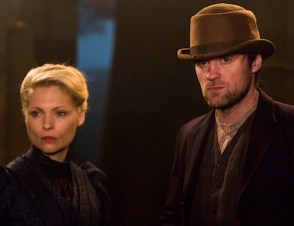 When Amazon picked up Ripper Street after the success of the third series, it was for a fourth and fifth season totalling 13 episodes. The show’s writers seem to have taken the double recommission to heart and crafted an arc plot to last throughout those two seasons, meaning this first half ends on a big surprise and with all sorts of things left up in the air. And now we have to wait. Still, it’ll be fascinating to see how there are six or seven more episodes left, considering the predicament they’ve put the characters in.
 I think I sounded a little more dismissive of Shetland than I’d intended in
  The quality of this revival has certainly been all over the place. I was wary of episode three, Mulder & Scully Meet the Were-Monster, because comedy always seems at odds with The X Files’ grand conspiracy storylines, but I thought it was hilarious and deserving of its acclaim as the best episode of the season. Home Again felt like solid standard X Files fodder, and Babylon was clearly trying to be zeitgeisty but perhaps wasn’t fully thought-through. As for the much-maligned finale, My Struggle II… well, it was a mess, and over-ambitious, and a stupid idea to end it on a cliffhanger when no one knew how well the revival would go down. Let’s hope Chris Carter is right that there’ll definitely be more.
 This month, I have mostly been missing The Night Manager. The critically-acclaimed ratings hit is, as you likely know, a spy thriller adapted from a John le Carré novel, which not only means it has pedigree, but that its star — Tumblr-beloved Marvel villain Tom Hiddleston — is now being tipped to take over as Bond. I wouldn’t know, I’ve not seen it yet.



 Blighted by behind-the-scenes difficulties, 47 Ronin wound up among
 Feeling in need of more intellectual fare after helming
  Though Spielberg is certainly not immune to the Africans’ plight — the depiction of life on a slave ship is appropriately harrowing — it’s clear from early on which side he expects us to identify with, in terms of cultural background if not shared morality: as survivors of the mutiny talk the next day, the slavers’ Spanish dialogue is subtitled but the slaves’ African dialect is not. It’s a simple but effective technique to align us with one side — as I say, not morally (in no regard is Spielberg trying to apologise for the slavers), but socially. Unfortunately, it’s not sustainable: later, when we need to understand the Africans to follow a scene’s point, their dialogue is suddenly subtitled, and from then it’s sporadically translated as needed. I can see why that choice was made, but it makes the unsubtitled bits feel like a cheat.
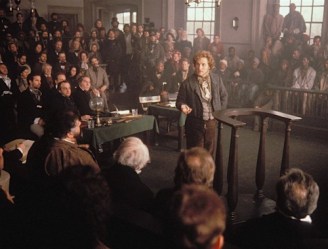 This can be said of Spielberg’s approach to the drama, too. Some of the courtroom stuff is suitably mired in legal technicalities and argument, but by film’s end it gets a little bit too… what’s the word? Not “preachy”. Not “sentimental”, exactly, though it’s born of that old criticism of Spielberg. “Melodramatic” may be on the money, though. It doesn’t help that everything reaches a climax — not only narratively, but also in the way it’s written, shot, acted, and scored — only for it to be revealed that it’s just the end of act two. Okay, that’s the truth of what happened (or near enough, for the purposes of this dramatisation), and by adapting it in that way it emulates the emotions the characters experienced; but from the audience’s perspective, you feel like you’ve reached the end… only to be served up another half-hour of movie. And it’s a long film too, so you feel that. It gets by because it’s fundamentally a good film, with strong performances and technical merits, but it’s a little bumpy for a bit.
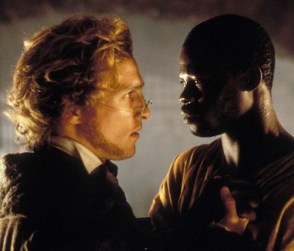 It’s easy to criticise Amistad, because Spielberg makes the production of very good movies look effortless, so the missteps stand out all the more. The story of La Amistad and its ‘cargo’ is a powerful one, and Spielberg has — naturally — turned it into a good film; but by remixing history to over-egg the message, it loses a little something. A valiant effort, but a film like


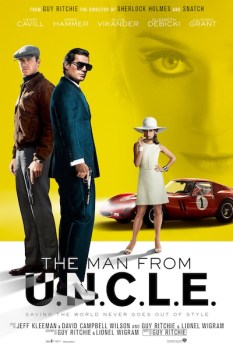 Guy Ritchie is a self-confessed non-fan of the classic ’60s spy-fi series
  I appear to be coming at director Ben Wheatley’s films in reverse order (having covered
  Kill List mixes in its genre elements — and they’re elements from a couple of different genres at that — so gradually that, as I said, it’s hard to discuss them without spoiling the film. (Much like the film itself, this review is getting progressively more revealing, so jump off when you’ve had enough.) It’s kind of a compilation of traditional British movie genres: we begin with kitchen sink, then discover we’re actually watching a crime film, before the final act swerves (though not without foreshadowing) into folk horror. The skill of Wheatley, and his co-writer Amy Jump, is in not making these transitions too implausible. That’s not to say they’re not surprising, but the doom-laden music, inexplicable proclamations by some characters, and a couple of very strange events should all clue the viewer in to the film not being a common-or-garden hitman flick.
 The final act is naturally where the film reveals its overarching purpose… or rather doesn’t reveal, because there are a shortage of answers here. It’s a lot more straightforward than A Field in England, but it still offers few (or, some would say, no) explanations for what’s occurred. According to Wheatley, the screenplay was more explicit about what was happening and why, and so was some of what they shot, but he cut back on the exposition to leave it up to audience interpretation. This isn’t a film to passively watch and have everything explained, but even viewers prepared to do a little work for themselves may find it frustrating.
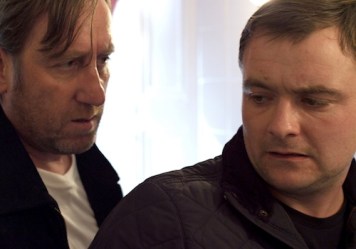 Memorable sequences keep it ticking over throughout — and so they should: taking inspiration from the likes of Kubrick and Stephen King, Wheatley started from specific images and worked backwards to a plot. Here, I think that method has been effective. The abstruse ending won’t be to everyone’s taste, but the journey there is worth experiencing.
 Most of mankind have become vampires, but the blood supply is running out and without it people mutate into monsters. Ethan Hawke’s scientist is developing a substitute, but when he encounters human resistance fighters he learns there may actually be a cure…
 100Films.co.uk