
François Simard, Anouk Whissell & Yoann-Karl Whissell | 93 mins | Blu-ray | 2.35:1 | Canada & New Zealand / English | 15
 I’ve observed before that the ’80s seem to be everywhere in film these days, and here’s another example: Turbo Kid is in every respect an homage to low-budget ’80s genre fare.
Set in the future year 1997, after an unspecified apocalypse has devastated the world and made water a rare commodity, orphaned teen The Kid (Munro Chambers) survives by scavenging junk and enjoying the comic book adventures of BMX-riding superhero Turbo Rider. The Kid encounters and accidentally befriends the quirkily obsessive Apple (Laurence Leboeuf), who is promptly kidnapped by agents of water-controlling maniac Zeus (Michael Ironside). While escaping the kidnappers, the Kid stumbles across the remains of the real Turbo Rider, including his energy gauntlet weapon — perfect for rescuing his new friend and living his dreams.
All of which is semi-incidental, because the point of Turbo Kid is not this storyline, but the genre and era elements that have been used to build it, and the stylistic elements that have been cribbed to execute it. I can’t cite many specific points of reference, because I’m not au fait enough with the kind of cheapo, grindhouse-y, watched-on-video-by-’80s-kids genre films that the film’s trio of writer-directors are riffing off (beyond the obvious “Mad Max on BMXs”, one reviewer’s observance of which is regularly featured on the film’s posters and DVD/Blu-ray covers), but the general feel of those kind of films is certainly evoked. It’s there in the bonkers plot; the bizarre characters, like a kick-ass arm-wrestling-champion cowboy (Aaron Jeffery); the post-apocalyptic world that’s just a quarry somewhere; and the very gory practical special effects. Very, very gory. Gleefully, perversely gory. It’s so over-the-top that it’s not genuinely disgusting, of course, but it’s certainly over the top. Way over the top. At times, inventively, hilariously over the top.
 Then there’s the score, which is of course all ’80s synths, in a similar style to the score of The Guest. Unfortunately, the score is often indiscriminately applied, like someone composed a generic ’80s score and then slapped it on with minimal regard to what was occurring on screen, meaning some moments fly past without the requisite emphasis. But perhaps this was deliberate — I can well believe that’s what cheapo efforts of the era did, and doing it here is a deliberate reference. This is a bit of a problem with the whole film: points where you can’t be sure if it’s being deliberately wonky or poorly-done as part of the homage, or if there’s some tweaking required. The pace could certainly do with some attention, especially early on. It’s only 93 minutes long, but it would be even better if it was only 85.
However, when it’s on form, there’s a lot of fun to be had with Turbo Kid. I imagine its greatest admirers will be those who lived through and enjoyed the era it’s acting as tribute to, but it’s also entertaining for those who have a broad-strokes familiarity with that period. Although some tightening and polishing would make it even more effective, viewers happy to indulge in its self-consciously retro mindset should find enough to like, and may also consider this score a little harsh:

Turbo Kid is available on Netflix UK from today.

 Score:



 2013 Academy Awards
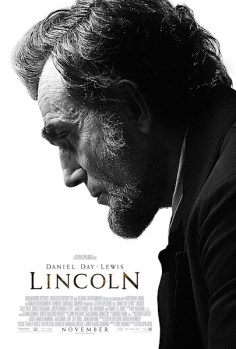 Daniel Day-Lewis allegedly stars in this account of the final months of President Abraham Lincoln’s life, which might more pertinently be called The 13th Amendment due to where its focus lies. I say “allegedly” because I’m not convinced they didn’t find a way to resurrect Lincoln to appear as himself, then just pretended it was Day-Lewis acting.
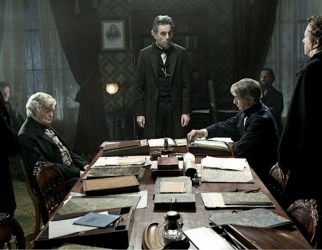 who might be persuaded to vote which way, and how they might be persuaded, and what they will want in return, and what deals need to be struck, and so on and so forth — sounds like it might make for an engrossing movie, then there’s a fair chance Lincoln will be your cup of tea. A not-insignificant proportion of viewers protest that it is boring, however, and while I in no way agree with them, your mileage may vary.
 Not to do anyone else in the film — or, indeed, any other performance in any film ever — a disservice, but Day-Lewis embodies the President in a way few other actors have ever embodied a role. It’s quite remarkable.
 For me, there are few black marks (unfortunate choice of phrase…) to be held against Lincoln. Does it give in to Spielberg’s sentimentality? Yeah, a little — but it’s a long, long way from the worst case of that, and I think you’d be nitpicky (or have a different opinion on history, which, you know, is a matter of opinion) to criticise the film too harshly for that. As to whether it’s boring, that’s entirely a matter of preference. If you think The West Wing is boring, people who write lists of “the greatest TV shows ever” will disagree with you, and you also likely won’t like Lincoln. I like The West Wing, though.
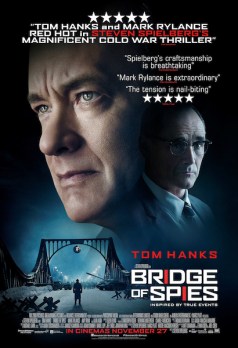 Steven Spielberg’s true-story Cold War drama stars Tom Hanks as insurance lawyer James B. Donovan, who is tapped to defend captured Soviet spy Rudolf Abel (Mark Rylance). After Donovan insists on doing his job properly, he manages to spare Abel the death penalty — which comes in handy when the Soviets capture spy-plane pilot Francis Gary Powers (Austin Stowell) and a prisoner exchange is suggested, which the Russians want Donovan to negotiate.
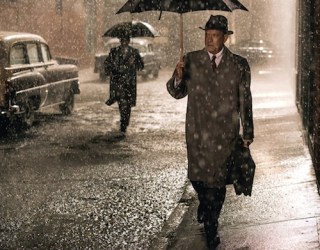 If we’re talking storytelling oddities, another is the manner in which Powers’ backstory is integrated. As Donovan continues to defend Abel, the film suddenly becomes subjected to scattered interjections, in which we see pilots being selected and then trained to fly secret reconnaissance missions in a new kind of plane. Any viewer who has read the blurb will know where this is going, but it’s so disconnected to the rest of the narrative that it felt misplaced, at least to me. The same is true when we suddenly meet Frederic Pryor (Will Rogers), an American student in Berlin who’s mistaken for a spy and arrested by the East. It turns out we need to know about him because Donovan attempts to use his negotiations to get a two-for-one deal, exchanging Abel for both Powers and Pryor. Knowing the stories of the men Donovan will be negotiating for is not a bad point, but I can’t help but feel there was a smoother way to integrate them into the film’s overall narrative.
 hints at emotions under the surface rather than declaiming them. A lesser film would’ve made a point of this — would’ve had Hanks’ lawyer struggling to understand and relate to his client’s low-key nature — but, instead, Donovan is a man who can identify with this mode of being, at least to an extent. There’s a reason they talk a couple of times about the ‘stoikiy muzhik’.
 allows the whole film to be equally as subtle, even as it remains gripping and entertaining. However, the storytelling quirks are a mixed success, the pace they sometimes lend offset by the almost non sequitur style of the captured Americans’ backstories. Nonetheless, this is a classy but still enjoyable dramatic thriller, which takes a seat among Spielberg’s better works.



 After martial arts student Fang Cheng is killed protecting his master, the latter takes in Cheng’s infant son, Fang Kang, as his student. Years later, Fang Kang is bullied by his aristocratic classmates and treated as a servant by the master’s daughter, Pei, though he’s a better student than any of them. Eventually goaded into leaving, his fellows corner him, challenge him, accidentally lop off his sword arm, and leave him for dead. Kids, eh? Fortunately, Kang is found by orphan Xiao Man, who nurses him back to health. With the help of an old textbook, he learns to fight left-handed, which is handy because there’s a conspiracy underway to kill all of his master’s former pupils…
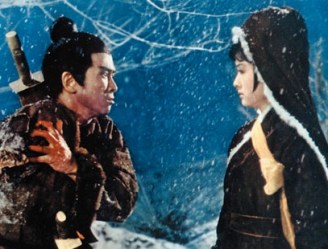 However, for me the film also worked very well as a drama, and even sometimes as a romantic drama. Fang Kang is an interesting protagonist. His lifestyle is torn from him, and rather than simplistically train to regain it or give up entirely, he battles with that decision. He returns to that way of life only to defend himself and his rescuer, and then out of a sense of loyalty to the master who raised him, but he’s also prepared to abandon the martial life to be a farmer… when the job is done, naturally. Jimmy Wang Yu, in a star-making turn, sells this character arc as well as anyone in a kung fu picture ever has. He’s also (somewhat) torn between two women, the kindly and supportive Xiao Man, and brat-with-a-heart Pei. While no one could truthfully call this a romantic picture, the love-triangle aspect also functions surprisingly well.
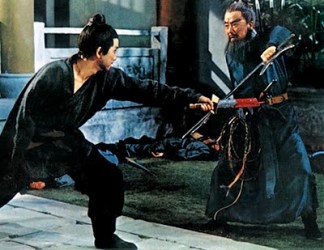 I disagree with that. Perhaps those lists are based on the abundance of action in these films, by which metric this probably has too much drama — though, as I said, it’s not devoid of fisticuffs and swordplay. Combine that with a solid story, engaging characters, and a brisk pace (even with its near-two-hour running time), and you have one of my favourite Shaw Brothers movies I’ve yet seen.
 After the success of


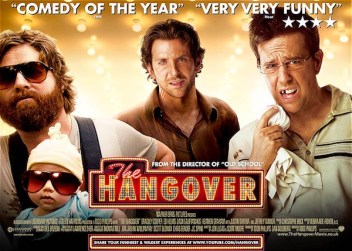 I confess, I only watched The Hangover to see what the fuss was about, and to get the tick on
  Oh (Jim Parsons) is a Boov, a race of friendly aliens looking for a new home planet to escape their enemies. When they arrive on Earth, Oh tries to invite everyone to a party, but accidentally alerts their enemies to their new home. Outcast, he bumps into Tip (Rihanna), a girl accidentally left behind when the rest of mankind was relocated by the Boov. Desperate for friendship, Oh agrees to help her find her mother.
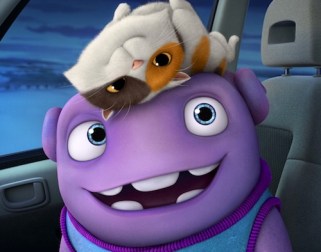 but the entire universe, including our enemies”? Why is there no option to cancel such a transmission that is going to take 40 hours to reach said enemies? I mean, that last one’s a stupid question, because why is there even a way to message the enemies?
 100Films.co.uk