Back to the Future Part III (1990)

100 Films’ 100 Favourites #7

They’ve saved the best trip for last…
But this time they may
have gone too far.

Country: USA
Language: English
Runtime: 118 minutes
BBFC: PG
MPAA: PG

Original Release: 25th May 1990 (USA)
UK Release: 11th July 1990
First Seen: VHS, c.1991

Stars
Michael J. Fox (Homeward Bound: The Incredible Journey, The American President)
Christopher Lloyd (Who Framed Roger Rabbit, Things to Do in Denver When You’re Dead)
Mary Steenburgen (Parenthood, Step Brothers)
Thomas F. Wilson (Back to the Future, Born to Be Wild)
Lea Thompson (SpaceCamp, Some Kind of Wonderful)

Director
Robert Zemeckis (Death Becomes Her, The Polar Express)

Screenwriter
Bob Gale (Used Cars, Back to the Future)

The Story
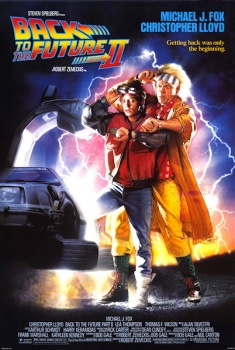
With Doc stuck in 1885, Marty McFly must travel back to save him before he’s killed by Biff Tannen’s ancestor, Buford “Mad Dog” Tannen. With the DeLorean damaged during his arrival in the past, they also have to come up with a plan to get back to their correct time…

Our Heroes
Marty McFly finally grows as a human being as he learns some stuff this time, while Michael J. Fox also gets to ham it up a little as his Irish ancestor, Seamus. Christopher Lloyd, meanwhile, is still the one and only Doc.

Our Villain
It’s Thomas F. Wilson again, this time as Biff’s trigger-happy Wild West ancestor, Buford ‘Mad Dog’ Tannen. Who also gets covered in excrement.

Best Supporting Character
Mary Steenburgen is one of the few wholly original characters in either sequel, the love of Doc’s life, Clara Clayton. She’s also a confident, competent, and capable female character — a character type that’s only now ceasing to be a rarity in effects-y blockbusters, 25 years after this was made.

Memorable Quote
“Your future hasn’t been written yet. No one’s has. Your future is whatever you make it. So make it a good one, both of you.” — Doc

Memorable Scene
Marty and Doc hijack a train in the hope of using it to get the DeLorean up to the required 88mph. As the looted locomotive heads towards a mighty fall off an unfinished bridge, it turns out Clara is on board too. Tension! Action! Excitement! What more do you want from a climax?

Truly Special Effect
With the DeLorean destroyed, the film ends with a reveal of Doc’s new time machine, and it’s awesome.

Making of
There are tonnes of lines, jokes, characters, locations, and even background details referenced back and forth across the whole trilogy, but only one actual scene appears in all three: the moment Marty travels from 1955 to 1985. It’s the climax to the first film, then appears at the end of Part II, and consequently is in the ‘recap’ at the start of Part III.

Previously on…
Part III indeed: this picks up exactly where the second film left off, and they were shot back-to-back. It’s fundamentally standalone other than that, mind.

Next time…
As mentioned on the first film, Back to the Future has continued in an animated series, theme park ride, video game, and a comic book that started last year. Plus Doc Brown turned up in A Million Ways to Die in the West, so… there’s that…

Awards
2 Saturn Awards (Supporting Actor (Thomas F. Wilson), Music)
4 Saturn nominations (Science Fiction Film, Director, Supporting Actress (Mary Steenburgen), Costumes)
Nominated for the Hugo for Best Dramatic Presentation.

What the Critics Said
Back To The Future Part II teed off a lot of critics by not being a remake of the first film, and for daring to be a) complicated, b) very fast and c) heartless. Part III, which is slightly less fleet of foot, restores heart interest of the first film and has a satisfying complete storyline.” — Kim Newman, Empire

Score: 74%

What the Public Say
“One of the clearest indications of an excellent series is an ending is so satisfying you can’t even be mad the adventure is over. Part III delivers a happy ending so well-rounded […] there is no yearning for more story. I remember feeling quite content after seeing that movie for the first time; actually more like thrilled that the trilogy ended on such a great note.” — Avril Brown, Comics Waiting Room

Verdict

The consensus used to be that Part III was unquestionably the weakest part of the trilogy, a slightly bizarre Old West-set addendum to the first two. These days, I feel like an increasing number of people say it’s definitely better than Part II. Personally, I’ve always had a particular fondness for it. I’m not entirely sure why. Much like the second film, it can’t attain the perfection of the first movie, but it can be the next best thing — a fun and funny adventure with these great characters. And even as I say “they’re not as good as the first one”, I don’t wholly believe it: to me, Back to the Future never has and never will be just one film, or one film and its two sequels — it’s a trilogy; a three-parter. (So there.)

#8 will be… an alliterative origin.
The Two Faces of January (2014)

2016 #15
Hossein Amini | 97 mins | streaming (HD) | 2.35:1 | UK, France & USA / English, Greek & Turkish | 12 / PG-13

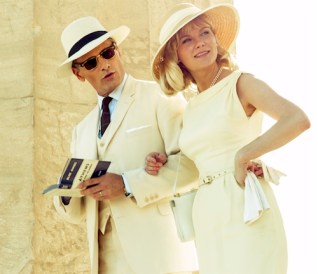
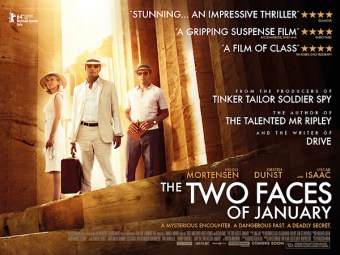
The writer of Drive (and co-writer of Snow White and the Huntsman and 47 Ronin, but maybe he’d prefer we didn’t mention those) moves into the director’s chair with this Patricia Highsmith adaptation. Best know for her Ripley (as in Talented Mr.) tales, this is instead the story of a young American man, Rydal (Oscar Isaac), who, while working as a tour guide in Greece, falls in with middle-aged American couple Chester (Viggo Mortensen) and Colette (Kirsten Dunst). Apparently on holiday, they look like an easy mark for Rydal’s somewhat-con-ish moneymaking practices, but events soon transpire to reveal the pair’s secrets, and Rydal’s greed draws him deeper into their affairs.

Amini has picked some quality material for his directorial debut. The storyline is pretty straightforward, but it’s driven by some interesting characters with complex motivations. You’re never entirely sure what’s driving Rydal and Chester, even if it may appear obvious; and sometimes it can be as much of a twist that a character didn’t have a better plan as it is when their implausibly-intricate machinations are unveiled. It helps that the film has a pair of quality actors in these roles, who effortlessly bring believability to even the slightly-far-fetched elements of the narrative. This is only the second thing I’ve seen where Isaac has made an impression (the other being The Force Awakens; I’d forgotten he was in Robin Hood and Sucker Punch), but I can see why everyone’s calling him one to watch.

If Dunst doesn’t leave as much of a mark as the two chaps, it’s only because Colette is a subtler-still character. Some people reckon The Two Faces of January has a thin story and no development of its characters, but I can’t help but feel it was too subtle for such critics. On the surface it might just seem like Colette is the dim-blonde wife, going along with her husband whatever happens and flirting with their sexy tour guide, but there’s clearly more going on under the surface. How much does she really know about Chester’s actions? Is she an innocent bystander, or is she involved? Is it harmless flirting with Rydal, or are Chester’s drunken suspicions on the money?
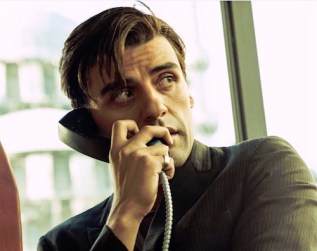
By choosing to set the film in the novel’s original 1960s timeframe, Amini adds instant style and class to the whole picture. Didn’t everything look classier back then? I mean, Chester wears linen suits and Panama hats, not T-shirts, shorts, and a baseball cap. It just wouldn’t be the same set today. Even the locations look straight out of the ’60s, even though they’re hundreds or thousands of years old and the film was shot this decade. Marcel Zyskind’s attractive cinematography is surely to thank for that. Again, it’s an element I’ve heard some criticise as boring or plain, which (much like the above views on plot and character) I just don’t understand. It’s not showy or show-off-y, but that’s part of what works. It lets the natural beauty of the locations speak for themselves, with classical compositions and rich lighting.

The era of the setting also helps emphasise the film’s Hitchcockian overtones, which given Highsmith’s other most-famous work is Strangers on a Train (filmed by Hitch, of course) is perhaps an obvious point of comparison, but by no means an inappropriate or negative one. As the narrative twists and turns, tightening the tension ever more, you think the Master of Suspense would’ve been quite pleased if this had been one of his pictures.

Filming this particular Highsmith novel was a long-held ambition for Amini (he first tried to acquire the rights after his big-screen writing debut, Jude, back in 1996). Such much-awaited dreams can sometimes lead to poor results, thanks to a rose-tinted perspective or close-minded obsession, but on other occasions the lengthy preparation pays off. The Two Faces of January is most certainly a case of the latter, a ceaselessly classy, subtly complex thriller that’s very rewarding for those open to its numerous charms.

4 out of 5

The UK TV premiere of The Two Faces of January is on Film4 tomorrow, Sunday 31st, at 9pm.

Come Drink with Me (1966)

aka Dà Zuì Xiá

2015 #178
King Chuan (aka King Hu) | 91 mins | streaming (HD) | 2.35:1 | Hong Kong / Mandarin

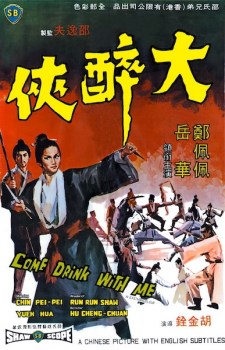
The first wuxia film directed by King Hu (King Chuan, that’s Hu! #MildlyRacistHomophoneJoke), the success of which allowed him to make his next even-more-significant movies in the genre, Come Drink with Me sees a gang kidnap the governor’s son to use him as leverage to release their leader. Instead, the governor sends his daughter, Golden Swallow (Cheng Pei-pei), to rescue her brother. She receives some help from local drunkard Fan Da-Pei (Yueh Hua), who may be more than he’s letting on…
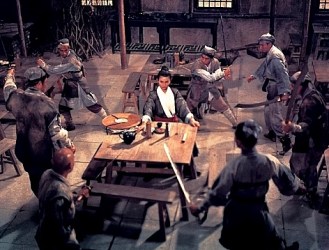
The film features good swordplay action, for the era — i.e. it’s not as tightly choreographed as you’d expect today. There’s a mix of huge free-for-all clashes, and Leone-esque long pauses followed by short bursts of violence. It also establishes Hu’s tendency to feature a strong female protagonist. Okay, she has to be saved by a man in the middle of the film, but at the climax she’s back kicking ass. To cement the point, it’s the female guards who fare best in the climactic battle, surviving long after most of the men have been slaughtered.

For all the fun, the story gets derailed a bit halfway through. Revealing that Fan Da-Pei is not just a drunk but actually an awesome fighter is okay — the groundwork is laid — but shifting the focus on to him and his old rivalry, which springs up out of nowhere two-thirds of the way through, isn’t good. Even the final duel is based on this last-minute subplot. It feels like a late-in-the-day addition designed to add a one-on-one aspect to a climax that would otherwise be about two ‘armies’ duking it out.

But this is a structural niggle, really. There’s so much else to enjoy — not just the action, but some amusing scenes, engaging characters, strikingly brutal villains (they not only kill a child (you wouldn’t get that in most movies) but they do it for no particular reason), and beautiful widescreen Technicolor cinematography — that it doesn’t grate too much.
Two points to be aware of when viewing. Firstly, when Golden Swallow arrives she’s pretending to be a man. This isn’t obvious to the viewer because she’s rather pretty, but all the characters behave as if she’s a fella nonetheless. Secondly, the version available on Netflix doesn’t bother to subtitle a couple of songs, which is frustrating because it’s clear from dialogue that they convey plot points. You get the gist, but it’s not as thorough as it should be. (Hopefully Film4’s screening will be more complete.)

I confess, I primarily watched Come Drink with Me because last year Masters of Cinema released Hu’s next film, Dragon Inn, and this week released the one he made after that, A Touch of Zen — I do like to watch things in order. Those follow-ups are regarded as seminal classics of the genre, a conversation Come Drink with Me doesn’t often come into. Whether that’s right or not, I’m glad to have been led to it, because it’s a very good swordplay movie in its own right. If Dragon Inn and A Touch of Zen are indeed even better, they’re a very exciting prospect.

4 out of 5

The UK TV premiere of Come Drink with Me is on Film4 tonight at 11:15pm.

A Most Wanted Man (2014)

2015 #186
Anton Corbijn | 122 mins | streaming (HD) | 2.35:1 | UK, USA & Germany / English | 15 / R

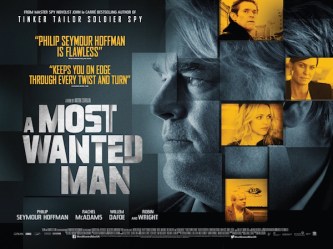
John le Carré adaptation starring Philip Seymour Hoffman as a German secret intelligence operative who must battle internal politicking while tracking a political refugee who may actually be a terrorist.

A typically complex plot requires the viewer to keep their attention level high. Some find the story a plod, but (one languorous interrogation sequence aside) I thought it relatively brisk, aided by accent-defying performances from Hoffman, Willem Dafoe, Robin Wright, Rachel McAdams, and Grigoriy Dobrygin as the refugee. Though beware: its level of realism, with real-life levels of compromise and betrayal, doesn’t make for an ultimately cheery or triumphant conclusion.

4 out of 5

Back to the Future Part II (1989)

100 Films’ 100 Favourites #6

Getting back was only the beginning.

Country: USA
Language: English
Runtime: 108 minutes
BBFC: PG
MPAA: PG

Original Release: 22nd November 1989 (USA)
UK Release: 24th November 1989
First Seen: VHS, c.1991

Stars
Michael J. Fox (Doc Hollywood, The Frighteners)
Christopher Lloyd (Clue, The Pagemaster)
Lea Thompson (Red Dawn, Casual Sex?)
Thomas F. Wilson (Back to the Future, High Strung)
Elisabeth Shue (Adventures in Babysitting, Leaving Las Vegas)

Director
Robert Zemeckis (Who Framed Roger Rabbit, Cast Away)

Screenwriter
Bob Gale (1941, Interstate 60: Episodes of the Road)

The Story
Marty and Doc travel forward to 2015 to save Marty’s son from imprisonment, but this allows future-Biff to steal the DeLorean, taking it back to 1955 to allows his younger self to profit from future knowledge. Faced with a nightmare version of 1985, Marty must travel back into the events of the first movie to fix things.

Our Heroes
Michael J. Fox is not only Marty McFly, but older Marty McFly, and his son, Marty McFly Jr., and also… his daughter, Marlene McFly. Just in case you’d forgotten these were comedy movies, I guess. Christopher Lloyd, meanwhile, is the one and only Doc.

Our Villain
It’s Thomas F. Wilson’s Biff again, but this time he’s not just a bully, but someone who — thanks to his meddling in time — represents a threat to Marty’s whole lifestyle. And he’s a right nasty piece of work in the dystopian variant of 1985, too. Still gets covered in excrement, mind.

Best Supporting Character
Spare a thought for Marty’s girlfriend, Jennifer. The end of the first film has her getting in the DeLorean with Doc and Marty, because she was there and the ending was never intended to lead to anything (yes, kids, once upon a time movies weren’t made with the assumption there’d be sequels). Come the second film, Zemeckis and Gale were stuck having to integrate her into the story, which they did by… knocking her out early on and leaving her out of it.

Memorable Quote
“The time-traveling is just too dangerous. Better that I devote myself to study the other great mystery of the universe: women!” — Doc

Memorable Scene
30 years in the future, they’re still making crappy Jaws sequels. (The irony now is, in the real 2015 we were still getting often-crappy sequels to pretty much every major ’70s/’80s franchise except for Jaws.)

Technical Wizardry
You’ll believe a board can hover. Well, you probably won’t, but some people did. That’s just testament to how well made the sequence is.

Truly Special Effect
Quite apart from the hoverboard, the sequence where they first arrive in 2015 — a ‘road’ of flying cars in a rainy nighttime sky — is a triumph of model work.

Making of
For various reasons (possibly moral, possibly financial) Crispin Glover refused to return as Marty’s father, George McFly. Instead, the filmmakers used outtakes from the first film, as well as an actor wearing prosthetics made from casts of Glover taken for the first film. Glover objected to his likeness being used without permission, sued, and Universal settled out of court. More than that, it led to a change in contract rules at the Screen Actors Guild to stop the same thing happening again. (See also: The Four Musketeers.)

Previously on…
Not only does Part II pick up exactly where the first film ended, it goes back into its events and interacts with them.

Next time…
Part II ends with a huge cliffhanger, leading directly into the series’ final trilogy-forming instalment.

Awards
1 Oscar nomination (Visual Effects)
1 BAFTA (Special Effects)
1 Saturn Award (Special Effects)
3 Saturn nominations (Science Fiction Film, Costumes, Make-Up)

What the Critics Said
“Like its predecessor, Back to the Future Part II does not merely warp time; it twists it, shakes it and stands it on its ear. But as before, the film’s technical brilliance is the least of its appeals. Satirically acute, intricately structured and deftly paced, it is at heart stout, good and untainted by easy sentiment.” — Richard Schickel, TIME

Score: 63%

What the Public Say
“the biggest prediction the film nails is not any one piece of technology, but our reaction to it: indifference met with annoyance of its imperfections. The movie focuses not on what the technology can do, but on what it can’t. The skyway’s jammed. Marty’s hover board doesn’t work on water. The voice-activated home-entrance lights don’t turn on when Jennifer enters. […] What we get is “the future” as “the present.” None of the doom, destruction and dystopia of Blade Runner or The Time Machine. 2015 Hill Valley and 2015 Chicago are just like 1985 Hill Valley and 1985 Chicago, only with cooler stuff.” — Jack M Silverstein, ReadJack.com

Verdict

There are some who consider Back to the Future an all-time classic and think the two sequels are meritless wastes of space. There are others who see them as a complete trilogy of more-or-less equal quality. Considering that ever since I’ve seen them all three parts have existed, it isn’t much surprise I’m one of the latter. Part II may not have the elegant simplicity of the first film, but it still has plenty of original and exciting ideas, not least using the time travel conceit to go back into the first movie. It may not be as good, but it’s a fine adventure in its own right.

#7 will be… wicky wicky wild wild West.

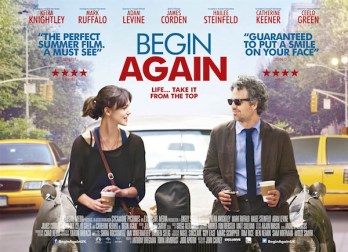
Begin Again (2013)

2015 #188
John Carney | 104 mins | streaming (HD) | 1.85:1 | USA / English | 15 / R

Once’s writer-director returns with a film that could’ve been dubbed Once 2: New York.

Mark Ruffalo’s out-of-favour record exec discovers Keira Knightley’s singer-songwriter, stranded after her ex became a hit. Convinced she could salvage his career, he persuades her to record an album. They bond; will there be romance?

The songs aren’t as catchy (though some are decent) and the shape of the story is overfamiliar, but likeable performances from the stars, plus James Corden and Hailee Seinfeld, keep Begin Again a pleasant experience — albeit one that occurs more in the imagination of dreamy creative types than the real world.

4 out of 5

The Golem (1920)

aka The Golem: How He Came into the World / Der Golem, wie er in die Welt kam

2015 #163
Carl Boese & Paul Wegener | 85 mins | streaming | 4:3 | Germany / silent (English) | PG

The word “prequel” was first coined in the ’50s, arguably entered the mainstream in the ’70s, and was firmly established as a term everyone knew and used in the ’90s by the Star Wars prequel trilogy. Works that can be defined as prequels predate their naming, however, and surely one of the earliest examples in the movies must be this silent German horror.

Now lost, 1915’s Der Golem was set in the present day, when “an antiques dealer (Henrik Galeen) finds a golem (Paul Wegener), a clay statue brought to life by a rabbi four centuries earlier. The dealer resurrects the golem as a servant, but the golem falls in love with the dealer’s wife. As she does not return his love, the golem commits a series of murders.” The film was written and directed by both Galeen and Wegener, but the latter was reportedly unhappy with the film due to compromises he’d made during production. So, after a sequel (also lost), Wegener tried to more directly convey the legend as he’d first heard it — hence Der Golem, wie er in die Welt kam, translated as The Golem: How He Came into the World, and commonly abbreviated to just The Golem, what with the original The Golem being lost. (Got it? Good.)

Set in 16th Century Prague (not that there’s any way to know that from the film itself), The Golem 3 tells the story of that rabbi who brought the clay statue to life in the first place. When the Roman Emperor decrees that Jews must vacate their ghetto, a rabbi builds a monster out of clay then summons a spirit to bring it to life. Meanwhile, one of the Emperor’s knights has fallen in love with the rabbi’s daughter, who is also the object of the rabbi’s assistant’s affections, and this love triangle — combined with access to control of the Golem — will eventually spell “climax”.

Regarded as one of the first horror films, The Golem is more of a moderately-dark fantasy, or a fairytale-type myth. There are clear similarities to Frankenstein, though I don’t know if either influenced the other. However, it does feature what I presume is one of first instances of that most daft of horror tropes: running upstairs to escape the monster. It goes as well here as it ever does, i.e. not very. Said monster looks a bit comical by today’s standards. Built by the rabbi to defend the Jewish people, he immediately uses the hulking chap to chop wood and run errands — he doesn’t want a defender, he wants a servant! A terrifying beast nonetheless, it’s ultimately defeated because it picks up a little girl for a cuddle and she casually removes its magic life-giving amulet.
Golem aside, there are some good special effects, like the ring of fire that summons a smoke-breathing demon; composer Aljoscha Zimmerman’s score is largely atmospheric; and there are some nice shots, like when the rabbi walks up to camera, does something with his hands (in what is effectively now a close-up), then walks back to the Golem at the rear of the set. These are the exception, though: it’s mostly a mix of flat long and medium shots. Oddly, the credits on the version currently available note that it adds computer graphics and animation. Presumably this is the English text that’s been digitally pasted into the film on letters, decrees, books, and the like. It also means that the judder, grain, and print damage on the English intertitles is utterly fake. How silly.

Revered for its place in film history, The Golem has elements to commend it still, but doesn’t hold up as well as other films of the era.

3 out of 5

Back to the Future (1985)

100 Films’ 100 Favourites #5

He was never in time for his classes…
He wasn’t in time for his dinner…
Then one day…
He wasn’t in his time at all.

Country: USA
Language: English
Runtime: 116 minutes
BBFC: PG
MPAA: PG

Original Release: 3rd July 1985 (USA)
UK Release: 4th December 1985
First Seen: VHS, c.1991

Stars
Michael J. Fox (Teen Wolf, Stuart Little)
Christopher Lloyd (Star Trek III: The Search for Spock, The Addams Family)
Lea Thompson (All the Right Moves, Howard the Duck)
Crispin Glover (Willard, Alice in Wonderland)
Thomas F. Wilson (Action Jackson, The Heat)

Director
Robert Zemeckis (Romancing the Stone, Forrest Gump)

Screenwriters
Bob Gale (I Wanna Hold Your Hand, Trespass)
Robert Zemeckis (1941, A Christmas Carol)

The Story
After Marty McFly travels back to 1955 in a time machine invented by his friend, Dr. Emmett “Doc” Brown, he accidentally prevents his teenaged parents from meeting. It’s up to Marty to make them fall in love and therefore ensure his own existence.

Our Hero
A star-making turn from Michael J. Fox as Marty McFly, cocky teen and guitar hero.

Our Villain
Thomas F. Wilson is Biff Tannen: in the ’80s, McFly Sr’s bullying supervisor; in the ’50s, McFly Sr’s high school bully. Prone to getting covered in excrement.

Best Supporting Character
An equally iconic turn from Christopher Lloyd as Doc, mad scientist extraordinaire.

Memorable Quote
“Roads? Where we’re going, we don’t need roads.” — Doc

Memorable Scene
The climax: Marty’s one hope to get back to 1985 is a bolt of lightning that will strike the town’s clock tower, which he can use to power the DeLorean. As the moment approaches, Doc battles to connect the wiring, and Marty must make sure the car is travelling at the right speed at the right moment… Well, of course they succeed, and Doc skips happily between the time machine’s flaming tyre tracks.

Write the Theme Tune…
In a rare case of an iconic movie theme from the ’70s and ’80s not composed by John Williams, Back to the Future’s memorable motif was composed by Alan Silvestri.

Technical Wizardry
To some, the DeLorean is a failed automobile. To a generation (and, probably, every generation since) it’s one of the most iconic movie cars of all time. “Are you telling me that you built a time machine… out of a DeLorean?” “The way I see it, if you’re gonna build a time machine into a car, why not do it with some style?” Genius.

Making of
It’s now quite well known that Eric Stoltz was originally cast as Marty, and had even started filming before it was decided he wasn’t right and was replaced with Michael J. Fox. This wasn’t after just a day or two of production, though: Stoltz filmed for four weeks, completing a significant chunk of the film. So much, in fact, that it wasn’t all re-shot with Fox: most of the material without Marty actually on screen was retained (Fox had to film reverse angles for dialogue scenes without the other actors present), and a couple of long shots in the finished film actually feature Stoltz.

Next time…
Two direct sequels (the first of which picks up immediately from the end of this one), as well as an animated series, an iconic theme park ride, a computer game from adventure maestros Telltale, an ongoing comic book that launched last year, and a semi-disastrous Secret Cinema event.

Awards
1 Oscar (Sound Effects Editing)
3 Oscar nominations (Original Screenplay, Sound, Original Song)
5 BAFTA nominations (Film, Original Screenplay, Editing, Production Design, Visual Effects)
3 Saturn Awards (Science Fiction Film, Actor, Special Effects)
6 Saturn nominations (Director, Supporting Actor (Crispin Glover and Christopher Lloyd), Supporting Actress (Lea Thompson), Music, Costumes)
Won the Hugo for Best Dramatic Presentation.

What the Critics Said
“though it is hardly one of the greater flights of cinematic imagination to be seen since science fantasy reared its head as mass appeal material again, it would be virtually impossible not to enjoy it in some way or another.” — Derek Malcolm, The Guardian

Score: 96%

What the Public Say
“nothing short of an example of screen-writing brilliance. Tightly pack[ed] and interwoven from the opening scene to the final ‘cliffhanger’ which, let’s face it, was never meant to be a cliffhanger as much as just a cool and intriguing ending to a stand alone film.” — nEoFILM

Verdict

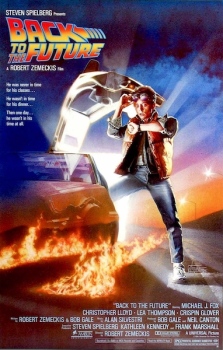
Who knew a movie about mother-son incest could be one of the most entertaining family comedies ever made? That’s because it’s magnificently written, faultlessly performed, packed with inventiveness… oh, and because the mother is the same age as the son, doesn’t know he’s her son, and the incest doesn’t actually happen. Ah, time travel! A notoriously difficult sci-fi nut to crack, another reason BTTF succeeds is because it isn’t really about time travel. One of those times where talent and good fortune come together to craft perfect movie entertainment.

Roads? Where #6 is going, it doesn’t need roads…

About Time (2013)

2015 #192
Richard Curtis | 123 mins | streaming (HD) | 2.35:1 | UK / English | 12 / R

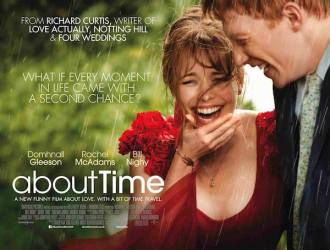
After Tim (Domhnall Gleeson) learns he can time travel back through his own life, his father (Bill Nighy) cautions him not to attempt anything too drastic — so he sets about finding love.

Ostensibly another of Curtis’ oh-so-British rom-coms, it plays that way for a while, but long before it’s done develops into something deeper: Tim gets the girl (Rachel McAdams), then learns about life, family, and what you might really want to do with such power.

About Time ultimately displays an emotional depth and maturity that marks it out from its science-fiction stablemates, and the rest of Curtis’ oeuvre too.

4 out of 5

Tomorrow: more time travel in my next 100 Favourites selection.

The Lone Ranger (2013)

2015 #177
Gore Verbinski | 149 mins | streaming (HD) | 2.35:1 | USA / English | 12 / PG-13

Hated by Americans and loved (well, ok, “liked”) by everyone else (well, ok, “by lots, but by no means all, of people who reside outside America”), Disney’s attempt to pull a Pirates of the Caribbean on Western adventure IP The Lone Ranger is by no means as successful as the first instalment in their piratical franchise, but is at least the equal of its sequels — and, in some cases, their better.

The convoluted plot sees us arrive with John Reid (Armie Hammer) in the frontier town where he grew up, where his brother Dan (James Badge Dale) is now sheriff. Construction of the railroad is running by the town, spearheaded by Latham Cole (Tom Wilkinson), who letches after Dan’s wife (Ruth Wilson); but work is plagued by a band of outlaws led by Butch Cavendish (William Fichtner). Receiving information on his whereabouts, Dan rounds up a posse and heads out to tackle him, with John insisting on tagging along. Unfortunately it’s an ambush and they’re all slaughtered (oh dear)… except John just about survives, and is found and nursed back to life by a Native American, Tonto (Johnny Depp). He has his own grievances, and together they set out on a mission of revenge.

And if you’re wondering where Helena Bonham Carter is in all that: despite her prominence on many of the posters, her role is really just a cameo. That’s marketing, folks.

I know some people complain about simplistic stories that are used to just string action sequences together, and that’s a perfectly valid thing to get annoyed about, but The Lone Ranger swings to the other extreme and uses an over-complicated story to string together its action sequences. All it actually needs is a little streamlining, because the film is allowed to swing off into too many sideplots. This makes the middle of the film a slog, and you feel every minute of its excessive two-and-a-half-hour running time.
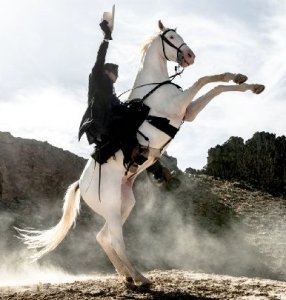
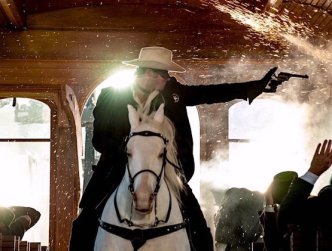
That slog is made worthwhile by what comes before and after said middle: a pair of train-based action sequences that are each truly fantastic. The second, in particular, is arguably amongst the grandest climaxes ever put on screen (providing you don’t feel it’s tipped too far into being overblown, of course). It’s inventively choreographed, fluidly shot, and perfectly scored with just an extended barnstorming version of the Lone Ranger’s theme music (aka the William Tell Overture). It’s an adrenaline-pumping action sequence that single-handedly justifies the entire film’s existence, if you’re into that kind of thing.

With multiple trains, horses, actors, guns, stunts, and copious CGI to tie it together, that sequence must’ve cost a bomb. Notoriously, the whole film was deemed too expensive and Disney insisted the budget be slashed, resulting in delays… and it still cost a fortune. That, quite apart from the negative critical response in the US, is a big part of why it flopped at the box office — a recurring problem for Disney at the minute. To be frank, I’m not convinced anyone made a truly concerted effort to stem the overspend. When a gaggle of CG rabbits hopped on screen, all I could think was, “who allowed this?!” You’ve got a massively over-budgeted film that the studio want cut back, and one reason for that is CG bunnies that have almost no bearing on anything whatsoever! The amount of time and effort that must’ve gone into creating those fairly-realistic rabbits for such a short amount of screen time… it cost millions, surely. Millions that could’ve been saved with a simple snip during the writing stage if only someone had said, “well, those bunnies don’t add anything and they’ll be bloody expensive, so let’s lose them.”
So criticism is not unfounded, but the film doesn’t deserve the level of vitriolic scorn poured on it by the US press and, consequently, public. Discussing this, the “critical response” section on the film’s Wikipedia page is interesting, and this part pretty much nails it:

Mark Hughes of Forbes, analyzing what he felt was a “flop-hungry” press desiring to “control the narrative and render the outcome they insisted was unavoidable” for a highly expensive movie with much-publicized production troubles, found the film “about a hundred times better than you think it is … [a] well-written, well-acted, superbly directed adventure story.”

I’m not quite as effusive as Hughes, but The Lone Ranger is worth the time of anyone who enjoys an action-adventure blockbuster. It’s a three-star adventure-comedy bookended by a pair of five-star railroad action sequences, which make the trudge through the film’s middle hour-or-so feel worthwhile. There was a better movie to be made here — one that was half-an-hour shorter, more focused, and probably several tens of millions of dollars cheaper to make — but that doesn’t mean the one we got is meritless.

4 out of 5