
2015 #156
James Ward Byrkit | 88 mins | streaming (HD) | 2.35:1 | USA & UK / English | 15
2015 #157
Aaron Hann & Mario Miscione | 86 mins | streaming (HD) | 2.35:1 | USA / English
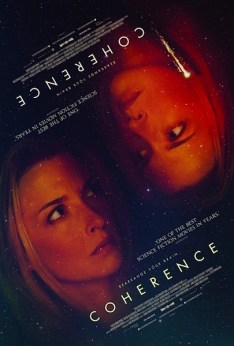 This isn’t something I normally do, but certain factors made me want to review these two films together. They’re both low-budget single-location sci-fi thrillers, but they’re also both more about humanity than ideas — they use sci-fi high concepts as a way to expose, examine, and comment on human behaviour. That I happened to watch them back to back only highlighted the similarities.
They’re also both currently available on Netflix, and both of their titles begin with the letter “C”. I mean, it was meant to be.
Despite those similarities, they’re tonally different, but quite subtly so. Part of the point of this double review is to try to tease out and explain what I think those differences are, because it was interesting to me that I felt the pair were so similar and yet so different. We’ll see how that goes.
To introduce them in age order (as well as the order I watched), Coherence begins in a very normal situation: a dinner party for a group of thirtysomething friends, who have a smattering of interpersonal issues. Then odd things begin to happen: mobile phones lose signal and shatter for no reason; there’s a power cut, but there are lights on at a house down the street… Could it be related to the meteor passing overhead? The way the story develops was part improvised: the cast met in the same location for five days, were given story and character prompts by the filmmakers, and went from there.
 Circle, on the other hand, must’ve been very tightly constructed. A group of fifty people wake up stood in two circles in a black space, with an array of arrows on the floor in front of them. Every couple of minutes, a klaxon blares out a countdown and one of them is killed. They soon realise they have some control over this, so together they try to work out what’s going on and how to escape, whilst constantly having to select who’s next. Broadly speaking, this is a high-concept thriller in the vein of Cube or Exam.
It’s in this respect that the two films most differ. Both take place in very obviously sci-fi situations, but only one is really about its high concept — that would be Circle. The way the characters interact and the decisions they make are rooted in human nature, true, and the film keeps you engrossed by exposing their prejudices and how that affects their decision making. But, in many respects, it’s operating with familiar stereotypes: the young people who think the old should die first because they’ve had their life; the rich businessman who has no time for immigrants; white-black racial tensions; and so on. As is almost always the case, stereotypes are stereotypes for a reason — if this were real, I imagine those kind of points would still be major factors — and writer-directors Aaron Hann and Mario Miscione manage to create tension and suspense nonetheless. This is more of a “what would I do?” kind of film, though; a high-concept thriller, rather than a true character exposé.
Now, Coherence undeniably has some similarities in this respect: the friends’ true characters are only revealed thanks to the sci-fi situation they find themselves in. It’s a more gentle kind of sci-fi, though; more domestic. It’s about how these particular people react to the strange situation, rather than being about the situation itself, a difference emphasised by them being slightly less archetypal than the characters in Circle. There are some scientific-y explanations for what’s going on, but writer-director James Ward Byrkit has said these were meant as a kind of inside joke — they’re a bit technobabbly and they don’t make complete sense. I have to say, I’m not sure I wholly buy this excuse, because I think you could look at Coherence as an exploration of a sci-fi-y idea, if that’s the way you were inclined.
 However, it’s clear Byrkit’s focus lay elsewhere. Thematically, it’s about our fear of others, but, as Byrkit explains in this interview (which is very much worth a read for anyone interested in the film), “we’re projecting our fears onto other people, but the reason we’re afraid in life is because we’re projecting our own fears. Whether it’s fear of another country or another race, we’re projecting our worst fears about ourselves.” One character has this realisation quite succinctly in a “what if we’re the bad ones?” scene. But again, there are thematic similarities to Circle: projecting our pre-existing opinions and prejudices on to other people, and using that as a basis for decision-making, rather than assessing the actual evidence in front of us.
The kind of interest the two films offer to the audience are quite different. Although the situation in Circle is mysterious, the mystery isn’t the point — it’s an excuse to kick off the situation, as it were, and the point of the film is the ‘game’ and how it unfurls. In that respect it’s more of a “watch once” kind of film; a thriller that will have you engrossed and on the edge of your seat (provided you’re the kind of viewer who goes along with the concept, rather than thinking “well that would never actually happen”), but perhaps has little to offer beyond that.
Coherence, on the other hand, feels more like a deeply considered film. The mystery of the situation is ever-present, asking to be kept track of and deciphered along with the characters — however much Byrkit may insist that’s not the point! Then those characters, the way they behave and evolve through the situation, are also more richly drawn. 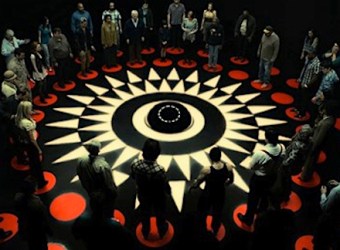 With fewer to illuminate they’re less quickly-sketched than Circle’s mass of ‘contestants’, and so feel more like rounded humans. By the end, they’re doing things that might initially seem out of character, but actually aren’t at all. (If you can take it, dear reader, there’s a crazy-detailed explanation of the ending (one reading of it, anyway) to be found here.)
Although the similarities between those two works are clear to see, I’m not sure I’ve illuminated their differences as much as I’d’ve liked. Nonetheless, I thought they were both engrossing sci-fi thrillers, driven more by people than by concepts (albeit people dealing with those concepts!) In terms of rating them, Circle is a solid-four single-location thriller, while Coherence is a sci-fi-mystery character-drama that butts right up against the five-star bracket.

This review is part of the 100 Films Advent Calendar 2015. Read more here.
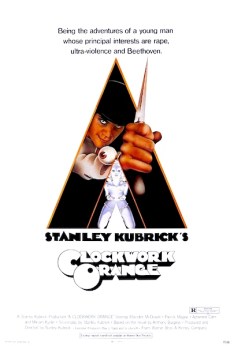 Yet more dystopian sci-fi! Who doesn’t love some dystopian sci-fi? Here we’re in the ’70s, though (makes a change from the ’80s), with writer-director Stanley Kubrick adapting Anthony Burgess’ novel into a film so controversially violent the director himself eventually banned it from release in the UK for decades. Almost 45 years on, it’s testament to the film’s power that it is still in parts shocking.
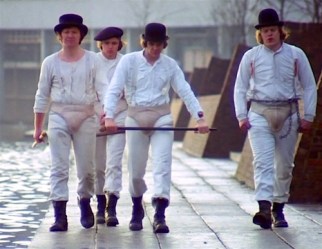 unfortunate byproduct of the film’s age. Other parts just go on a bit too long for my taste — there’s barely a sequence after Alex’s arrest that I didn’t feel would benefit from getting a wriggle on. I don’t think this is me bringing a youth-of-today “everything must be fast cut” perspective to the film, I just found it needlessly languorous at times. Maybe I was missing a point.
 Kubrick ends on a much more ambiguous note… so ambiguous, I’m not really sure what it’s saying… or even what all the ambiguities actually are…
 This neo-noir revenge drama with a twist has received such acclaim from critics and bloggers alike that it’s practically set up to fail.
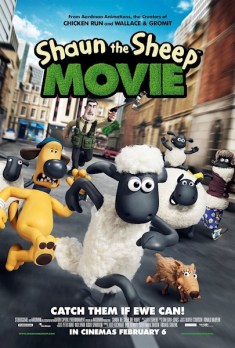 Shaun the Sheep started life in the 1995 Wallace & Gromit short
  (that US PG is thanks to a couple of oh-so-rude fart jokes), but there’s a sophistication to the way that simplicity is handled that adults can enjoy. There are also references and in-jokes for the grown-ups; not hidden dirty jokes that’ll put you in the awkward position of having to explain to the kids why you were laughing, but neat puns (note the towns that the Big City is twinned with) and references to other films (like
 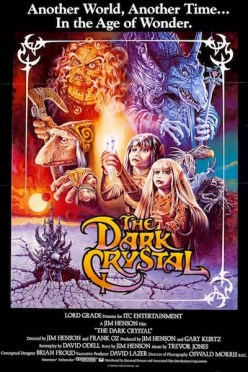 High-fantasy adventure about some elves trying to stop a crystal from destroying their planet.
 Essie Davis is best known for playing the sassy title role in
 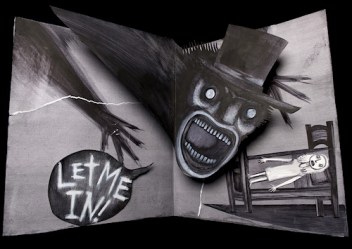 a horror film for people who think about what they’re watching, rather than just waiting for something to be thrown at the screen to make them jump. The slow burn tension will bore those content with the latter, who I suspect don’t tend to think a great deal (for one thing, they’d spot most of the jumps coming if they did).
 There is little in The Babadook that will make you jump, and even less that will make your stomach turn in disgust, but that’s absolutely fine. What it will do is chill your blood, make your hair stand on end, make you worry about every little creak or thump you hear elsewhere in the house after dark, and make you want to sleep with the lights on. Not just the bedroom lights, all the lights. Because once you’ve seen it, you can’t get rid of the Babadook.
 From the makers of
 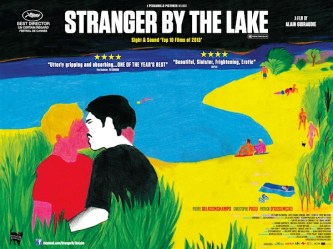 Iiiiiit’s the arthouse gay sex thriller!
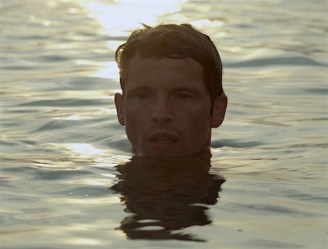 In this regard it has a very particular speed and style — even if there was a version without copious full-frontal male nudity and explicit sex, it still wouldn’t be for everyone. It helps to evoke both a certain time and place (lazy summer days on holiday) and a particular lifestyle (that of gay cruising — which, much to the (presumably straight) policeman’s bafflement, continues virtually unabated even after one of their number is murdered in unexplained circumstances). This is further emphasised by the gorgeous cinematography. Claire Mathon apparently shot it using only natural light, and it looks fantastic — understated (this isn’t a heavily-graded hyper-real kind of beauty), but sumptuous.
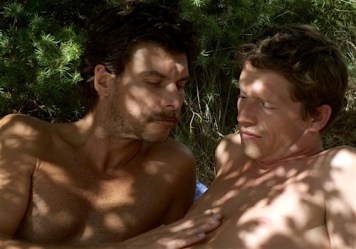 The style is supported by strong performances. I suppose some would say “brave”, by which they’d mean “they’re naked a lot and having gay sex”… so, I mean, maybe it is brave, but, still, that’d be a euphemistic description. What I mean is that they’re strong because they’re calm, understated, realistic, and believable without tipping over into amateurish. You feel Franck’s complex mix of fear and excitement, his lust overpowering common sense; there’s a certain timidity, maybe even naïvety, present in his eyes. Conversely, his lover Michel is unreadable; a closed book, where you never know what he’s thinking, feeling… plotting. Franck’s new friend Henri is similarly tricky to get an accurate handle on, but he’s the yin to Michel’s yang (or vice versa). He’s not plotting, he just is. Or maybe he was plotting all along…?
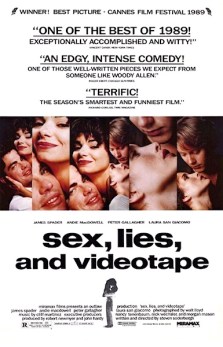 Four acquaintances partake in duplicitous relationships and candid sexual discourse in writer-director Steven Soderbergh’s debut drama.
 This melancholic apocalyptic comedy wasn’t too well received, which is a shame because I thought it was absolutely brilliant.
 is an overwhelming sense of melancholy. It’s a hard feeling for films to evoke, I think — more complex than happiness or sadness, or excitement, or even fear. It comes to a head in an ending that actually brought a tear to my eye, a rare enough feat that it cemented a five-star rating.
 100Films.co.uk