
Antoine Fuqua | 107 mins | TV | 2.35:1 | USA / English | 15 / R
 The first of Summer 2013’s “Die Hard in the White House” movies, Olympus Has Fallen casts Gerard Butler as the top Secret Service agent who’s also super chummy with President Aaron Eckhart and his kid (Finley Jacobsen). However, after Something Goes Wrong™, Butler is moved to a desk job… but then, when the White House is attacked by terrorists, he’s the only good guy left standing inside. You know the rest, even if you haven’t seen White House Down.
The remarkable thing, watching both movies, is just how many plot beats are so similar. Even when they’re not exactly the same, they’re functionally identical. For example, a plane shoots up Washington merely as a distraction to get the President sent to the White House’s bunker; in White House Down, an explosion at the Capitol is staged merely as a distraction to get the President sent to the White House’s bunker. Both films feature a kid sneaking around the building; a former-Secret-Service traitor-in-their-midst; major characters, including the Speaker of the House, managing the crisis remotely… At least the villains are different: White House Down was based on the Middle East conflict, the villains being Americans wanting it to continue; Olympus Has Fallen is based on the Korean conflict, with nasty foreign villains. Maybe that’s why America liked this better: foreign bogeymen rather than unpatriotic Americans. To be frank, the latter is more interesting.
The real problem with Olympus Has Fallen is that it’s just as daftly OTT as White House Down, but with none of the self-awareness. There are slow-motion shots of characters screaming “no” as someone dies; bullet-torn American flags are tossed to the ground… It’s just as clichéd, but without the knowing wink that makes the other one fun.  In fact, it takes itself very seriously indeed — Fuqua even puts characters’ names and jobs up on screen, as well as timecodes and locations, as if it’s a dramatisation of a real event. Obviously we all know it isn’t, making it feel incredibly odd. The CGI is just as bad as White House Down’s, though the exterior White House stuff looks more real than the obviously-greenscreen locales of the other film. Strikingly, this cost less than half as much ($70m vs. $150m).
On the bright side, the battle on the White House lawn is a good sequence. It’s played as straight as the rest of the film, but on this occasion it works. That said, it’s still just a big shoot-out, of which equally-strong examples can be found in many other action films. White House Down may come up a little short in the exceptionally-memorable sequences stakes too, but at least things like the car chase around the White House lawn — complete with the President firing a rocket launcher! — are trying a bit harder to be original.
Most of the time, the po-faced-ness would render this no more than an adequate and semi-forgettable actioner. By direct comparison to White House Down and all its irreverent fun, 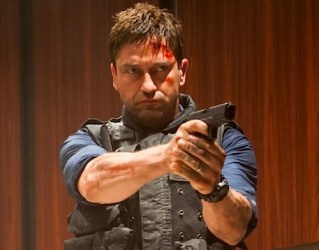 however, Olympus Has Fallen looks like a far lesser movie. It’s a shame it made it out of the gate first, and that some viewers are not blessed with enough of a sense of humour, because their comparative success has left some quarters with the impression this is the better movie and White House Down is just a clone. Hopefully that’s a wrong we can eventually right.

Sequel London Has Fallen is out in October.
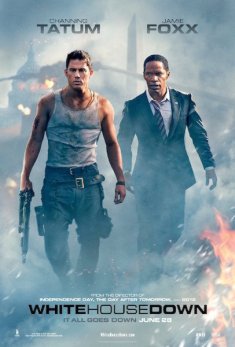 US Capitol policeman Channing Tatum is visiting the White House, trying and failing both to impress his estranged daughter and get a job in the Secret Service, when terrorists attack and try to take President Jamie Foxx hostage. Tatum rescues him from some of them, but with the rest occupying the building the stage is set for “
 If there’s a downside, it’s that this $150 million movie looks like it was made for closer to $15. There’s an overabundance of digital sets, ‘exteriors’ obviously shot on incorrectly-lit soundstages, and terrible CGI. Goodness only knows where all that money went — the actors’ salaries? Tatum and Foxx are good, but I’m not sure they’re worth that much. And here’s a good a time as any to say that this year I’ve become a bit of a Channing Tatum convert. I’d written him off because, to be honest, he looks a bit of a lug and I still think he’s woefully miscast as Gambit in
 Will Smith is the eponymous drunken vagrant, who also has the powers of Superman, in this under-appreciated superhero comedy-drama. Hated by the public for the destruction he causes while ‘helping’, and wanted by the authorities for the same — though they can’t catch him because, you know, superpowers — he gets an image makeover when he saves wannabe entrepreneur Jason Bateman. Bateman’s wife, Charlize Theron, is less sure of Hancock’s merits.
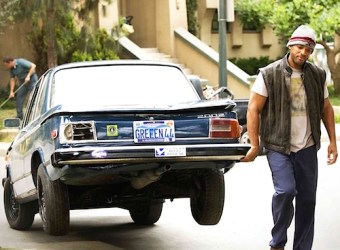 but it rubs against comedy stuff that feels like it’s from a Comedy. The extended cut includes an early sex/ejaculation joke/sequence that wasn’t in the theatrical cut because Berg thought it wasn’t funny and test audiences agreed. Goodness knows why it got put back, other than because of length — it accounts for over half of the extensions (more details
 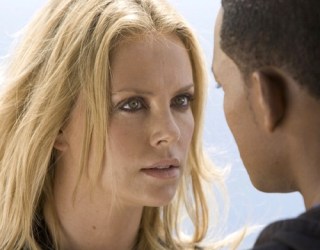 Why indeed, because a) she’s not a supervillain, and b) even if she were, why get changed?! It’s a kind of bait-and-switch: she’s made to look like a villain because we think that’s what she’s about to be revealed as, and a big hero-vs-villain fight follows too… but she isn’t. It’s not quite up there with the magically-changing Batsuits of
  The film would work a lot better on the whole if the tone had been settled on as definitively as Smith’s performance, rather than trying to have its cake and eat it by mining both the “what if this were real?” and “haha, an unlikeable drunk superhero!” versions concurrently. For my money, however, if you treat Hancock as a fairly seriously-intended movie that was forced to contain more (half-arsed) action and (misjudged) comedy for the sake of box office, it’s not a bad experience at all.
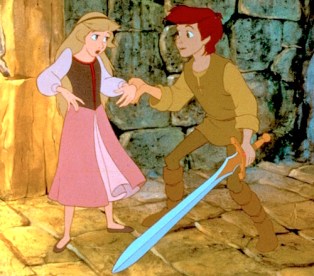
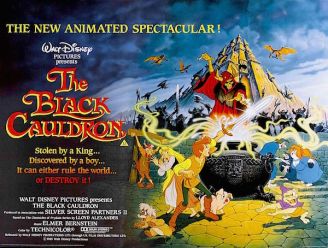 The Black Cauldron is best remembered as an intriguing footnote in the history of Disney animation. Their 25th ‘official’ film, it was the first with no songs, the first to earn a PG (after being cut — twice — to avoid a PG-13), and flopped so badly they disowned it for over a decade. Fully-animated sequences were cut after disastrous test screenings for parents, and famed exec Jeffrey Katzenberg, who came into Disney management during the film’s production, reportedly ordered 12 minutes cut, muddling the film’s story. What a mess.
 It’s always interesting when a company like Disney break outside of the norm, and it’s certainly brought them some degree of success in recent years with the likes of
  Possibly-crazy people offer definitely-crazy theories on the subtextual meaning of
  After winning the Best Adapted Screenplay Oscar for
 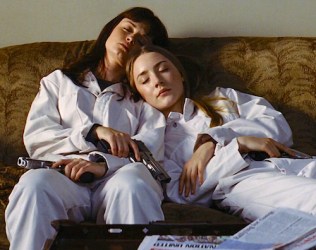 Here, Fletcher either needs to settle on one or the other, or clearly signal his intentions earlier.
 May’s films in full
 #67 Hummingbird (2013), aka Redemption















 100Films.co.uk