
Ruairí Robinson | 94 mins | streaming (HD) | 2.35:1 | UK & Ireland / English | 15 / R
 The first manned mission to Mars is reaching the end of its six-month tour. As they count down the final hours, battling a dust storm and its attendant power outages and communications blackouts, one of the team secretly discovers bacterial life on the surface. Attempting to recover further samples, a sink hole opens beneath him. When the rest of the crew try to recover his body, it’s not there. Then he arrives back at base… only, he’s not quite himself anymore…
Starting as a sophisticated, plausible vision of what a manned Mars mission might look like in the relatively-near future, The Last Days on Mars attempts an awkward transition into schlocky B-movie horror when Space Zombies turn up about half-an-hour in. Unfortunately, it’s not really trashy enough to work on that level, but equally, it’s not classily written enough to transcend the genre limitations the undead bring. The attempts at a kind of realist sci-fi are to be appreciated, particularly by genre fans who might fancy a change (though in the wake of Gravity, near-future realism may be in vogue), but it doesn’t gel with the often-rote zombie elements. To really succeed it needs a more original threat. These may not be zombies in the “magically brought back to life” sense, but having a semi-scientific explanation for their existence doesn’t negate their storytelling function, which is very trad.
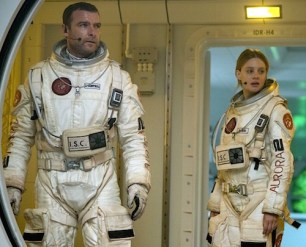 These faults persist despite the best efforts of a quality cast, particularly Romola Garai as (in functional terms) the capable sidekick, and Olivia Williams as the bitch whose heartless practicality becomes an asset when the going gets tough. First-time feature director Ruairí Robinson assembled his cast on the principle of “people who aren’t normally in sci-fi movies”, and that does feed in to the sense of realism. It also looks great, the production, costume and effects designs gelling to create a believable Mars mission, all in spite of a tiny budget (funded by the BFI and the Irish Film Board, it had about a tenth of Gravity’s budget, for example). Credit, too, to cinematographer Robbie Ryan for lensing the Martian surface convincingly (it’s actually the Jordanian desert). The editing may descend into fast-cut blurriness during action scenes — only emphasised by Max Richter’s predictably derivative horror movie score — but during calmer moments the film looks very good.
All things considered, it plays a bit like an R-rated, traditional-zombie-emphasised remake of Doctor Who adventure The Waters of Mars (it’s actually adapted from a 1975 short story, but hey-ho). From the tail end of David Tennant’s time in the role, the award-winning Who episode concerns the first manned mission to Mars battling a previously-undiscovered alien menace that mysteriously turns them into zombie-like creatures and prevents them leaving the planet. And the similarities go further than that, including sequences involving a hydroponic dome, a race down the tunnel that links said dome to the main base, and fears about bringing the deadly virus back to Earth. Thinking through the comparison perhaps enlightens some of where the film goes wrong, as the Who episode had a more effective and original enemy, had more thematic weight to explore (in fairness, concerning Who-specific time travel issues), had characters who were better drawn than the repeated “I’d like to see my kids again” simplicity of the ones here,  and was more sure of its tone. There may be elements to commend The Last Days of Mars in this comparison (the much bigger budget pays off in the scope of the visuals, of course), but as a story and viewing experience, The Waters of Mars wins hands down.
It’s not just Doctor Who — despite the film’s plus points, most of what The Last Days on Mars has to offer has been done better elsewhere. There are certainly superior zombie thrills to be found. The well-realised plausible Mars mission makes the movie more enticing for sci-fi fans, though your mileage will vary on how much that justifies the investment.

The Last Days on Mars debuts on Sky Movies Premiere today at 10am and 9pm.
 This time it’s not personal for Nick and Nora Charles (the joyous William Powell and Myrna Loy), as they stumble upon the murder of a race-fixing jockey and the subsequent killing of a corrupt journalist… and then one of their friends (Barry Nelson, aka
  As murder mysteries go, the Thin Man series tends to offer plots that are somewhere between perfunctory and over-complicated to the point of being unsolvable, and Shadow is a typical example. But that doesn’t matter a jot, because the story’s abundance of incident keeps things moving, and the real entertainment value lies in the comedy chops of the three leads: Powell, Loy, and, of course, Asta the dog.
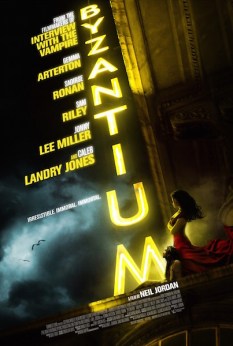 18 years after he adapted Anne Rice’s seminal vampire novel Interview with the Vampire into a seminal vampire
  The most effective part of the movie isn’t so much its plot or its mythology, though, but its atmosphere. Vampire movies take place in castles or drawing rooms, or high schools in more modern iterations. They are grand and sensuous. Any glamour in Byzantium is discarded and decrepit, like the titular hotel that Clara reshapes as a whorehouse; faded and left to ruin. The seafront is characterised by graffitied concrete, the glaring lights of arcade machines, heroin-chic Eastern European prozzies. The pier appears to have burnt down at some unspecified previous time and just been left. The only people left behind are the ones without a means of escape, stuck with their miserable lot. Clara and Eleanor fit in almost seamlessly.
 Other alleged faults include the film not giving enough time or heft to facets individual viewers want it to cover. For one example, someone criticised it for not fully exploring the issue of voluntary euthanasia. I’d argue it doesn’t explore it at all, because it’s not trying to. That Eleanor chooses to only kill people she perceives as wanting to die is not her making a moral statement on a contentious issue, but finding a way to marry her conscience and upbringing with the necessities of her vampiric life; and it’s probably practical, too. That’s not to say a vampire movie can’t be used to explore a topic like voluntary euthanasia, but if you want that I’m afraid you might have to write your own.
 Technically, DoP Sean Bobbitt grants us some gorgeous cinematography. There’s a cruel, aptly soulless beauty to the faded town, while some countryside vistas, both past and present, offer more traditional scenic pleasure. A remote rocky, misty isle — central to the mythology and so repeatedly visited — is particularly notable. Captured entirely on digital cameras, it seems sometimes that Bobbitt tried to push his equipment too hard: some shots during the climax look flat-out weird, as if someone has applied a Photoshop “comic book” filter or something. Also of note is the score by Javier Navarrete, which makes particularly good repeated use of The Coventry Carol.
 For all its dual-period storytelling and its grubby settings, it’s a resolutely modern kind of take on vampire mythology.
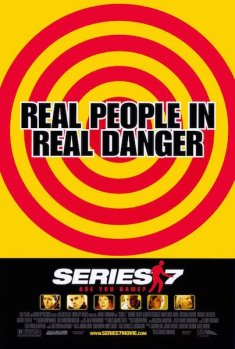 The debut of director Daniel Minahan — who’s since helmed episodes of over a dozen TV shows, including HBO hits
 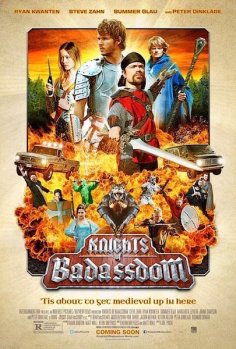 After being dumped by his long-time girlfriend, Joe (
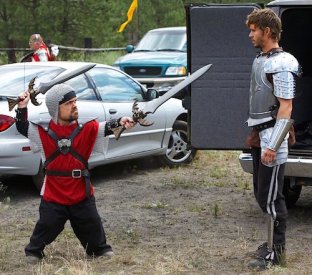 It’s a fine line to tread, and it seems to me that Knights of Badassdom manages it well. You get a sense of why people choose to do this and the fun that it can be — indeed, the final epic battle between the two factions of LARPers, complete with grand pre-fight speeches from each army’s general, and an awesome surprise, is kinda cool. Equally, the film doesn’t hold back from riffing off the sillier aspects of LARPing, including the rules of combat.
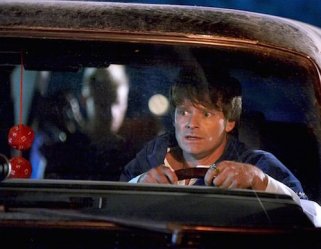 if that’s your bag, there are plenty of films to cater for it; is a comedy about role-players really the occasion? There are elements of the film that could do with tightening up — the beginning is a little slow, as well as the issues with the middle, and towards the climax it’s sporadically jumpy in a way that makes it clear something has been excised — but just adding gore is not what this film needs to improve it.
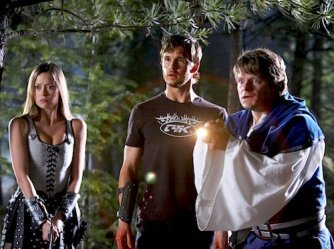 As it stands, Knights of Badassdom is an entertaining way to spend just under 90 minutes. A more restrained approach might yield a tighter movie, one that could be funnier by percentage (the trailer remains popular, and you don’t get more condensed than that), but I think it’s still well enough constructed to keep genre-minded viewers entertained.
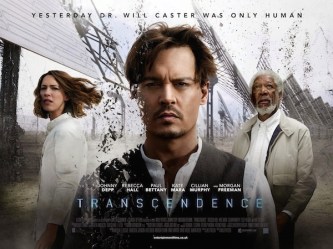 Christopher Nolan’s regular director of photography (he’s lensed seven Nolan films, from
 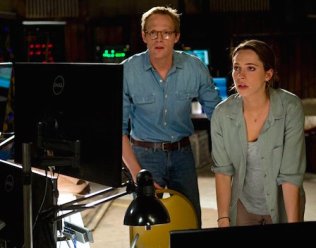 Another element that’s probably too challenging for some is where our allegiances are meant to lie. (Some spoilers follow in this paragraph.) At the start, it’s clear Depp & friends are the heroes and the murderous anti-tech terrorists are the villains. As events unfurl, however, artificial-Will perhaps goes too far, Bettany teams up with the terrorists, and eventually so do the government and Will’s other friends. There is no comeuppance for some characters who are initially begging for it; a good one self-sacrifices somewhat heroically. This doesn’t fit the usual Hollywood mould at all (well, the last bit does, sometimes), no doubt to some’s annoyance. The number of people who clamour for any sliver of originality or texture to their blockbusters, but then are unhappy when they actually get it…
 robbing the entire film of tension and nullifying any sense of surprise, and the movie doesn’t compensate with, say, a feeling of crushing inevitability. The climax in particular becomes a drawn-out exercise in connect the dots: we’ve been shown how this all ends up, now we’re just seeing the minutiae of how it got there. There’s no twist or reveal to speak of, just a wait for it to marry up with what we already know.
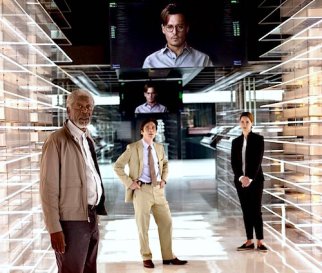 I guess that’s probably the explanation for Transcendence’s poor reception, in the end: it’s too blockbuster-y for viewers who’d like a dramatic exploration of its central moral and scientific issues, but too lacking in action sequences for those who misguidedly expected an SF-action-thriller. I maintain it’s not slow-paced, especially if you think it’s going to be, but nor does it generate doses of adrenaline on a committee-approved schedule. It’s not all it could have been, but if all you’ve heard is the mainstream drubbing, it’s probably better than you expect.
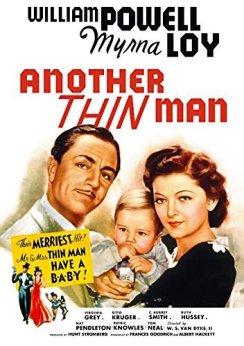 Husband-and-wife detective duo Nick and Nora Charles (William Powell and Myrna Loy) — now with a baby in tow — are once again coerced into investigating a crime when the manager of Nora’s estate fears a dismissed employee is plotting murder.
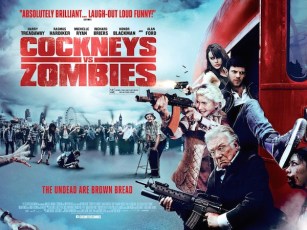 Screenwriter James Moran doesn’t like it when people compare Cockneys vs Zombies to
  And why is their imagination so stunted that they can’t accept them anyway?
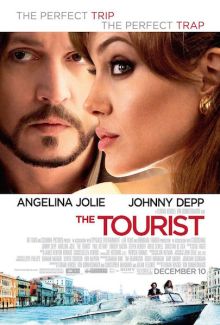 Much maligned on its release, I thought The Tourist was actually a decently entertaining light thriller.
 An unnamed woman (Martina Gedeck) goes to stay with some friends at their lodge in the Alps. The friends pop into town, leaving their dog behind with the woman. When she wakes up the next morning, they’ve not returned, and she finds an invisible wall surrounding the mountain. Exploring its boundaries, she sees people outside, paused mid-life, as if frozen. As hours turn into days turn into weeks, she begins to realise the need to fend for herself, farming the land and caring for her animals, which come to also include a cow and a cat. As weeks turn into years, she comes to accept her new life, from which it seems there may be no end…
 The Wall starts out with a compelling mysterious premise, but seems to have no interest in exploring it or answering the many questions it raises. In some respects that’s better than the kinds of rote explanation offered by lesser films — you know, “Aliens did it. Why? Because.” — but it’s a bit like a joke without a punchline. Taking the setup as a mere excuse for an exploration of the human condition, I don’t know that it’s that illuminating. Either way, it makes for a sporadically interesting but ultimately unsatisfying experience.
 100Films.co.uk