All is Lost (2013)

2014 #130
J.C. Chandor | 102 mins | streaming (HD) | 2.35:1 | USA / English | 12 / PG-13

All is LostRobert Redford on a boat with no dialogue for over an hour and a half. That’s not a spurious way of describing All is Lost — that is what it is. Well, OK, he does say a couple of words — more or less literally “a couple”, though.

Redford plays “Our Man”, who’s pleasantly drifting around on his small yacht when it strikes a shipping container that’s just floating in the middle of the ocean. Now with a massive great hole in the side of his boat, he has to repair it using what he has to hand. The radio is damaged too, so he can’t call for help. And then an almighty storm rolls in…

It’s hard to succinctly pigeonhole All is Lost. It’s a survival movie, if that’s really a genre; man vs the elements. It’s an adventure movie, a little bit in the old-fashioned sense, as here’s a man who, through no choice of his own, has what you might describe as “an adventure”. He doesn’t have a companion to natter to, which would’ve surely been easier to write and more readily palatable to audiences; nor is there any narration of his thoughts, besides opening with the reading of a letter he will write later, which is, frankly, a needless addition to the movie. Redford doesn’t need to speak, because he conveys his character’s every thought, emotion, fear, indecision, and resolve through his face and his movement. Some viewers may overlook it because there’s no dialogue for him to emote with, but it’s a sublime example of acting.

Indeed, it’s testament to Redford’s performance (much discussed but ultimately overlooked during last year’s awards season), J.C. Chandor’s direction, and the work of the special effects and stunt teams, that the film remains gripping throughout. A bit choppyThrough chance, coincidence, bad luck, but never forced tension-mounting on the part of the filmmakers (at least, not obviously so), our man’s fortunes go from bad to worse to even worse to even worse than that. Despite his best efforts, he’s on a downward spiral, a seemingly irreversible series of unfortunate events. If you ever had an interest in solo sailing, this is liable to put you off.
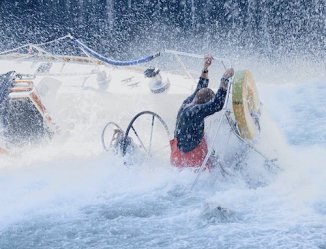
It all leads to an ending that has proven divisive. I shan’t spoil it, but I was fine with it. I don’t think it’s in any way a betrayal of what’s gone before. I will say that it provides a resolution, rather than leaving things open-ended, which I give away purely because some reviewers have stated a preference for a lack of resolution here. Why? Once our man finds himself in this situation, there are all of three possible outcomes: he gets himself out of it, he gets rescued, or he dies at sea. Not telling us which happens would be a contrivance on the part of the filmmakers — if this were a real story, for example, we’d know which happens, so why deny it in fiction too? I’m not saying unresolved/ambiguous endings are always bad, because I think they do have a place, but this isn’t one of those places. Indeed, I’d argue that to leave it open would have been a cop-out. Fortunately, Chandor is man enough not to do that. As to which of the three aforementioned options he went with, they all seem fundamentally just as likely to me, so I also don’t object to the one he did pick.

SeamanSometimes self-imposed filmmaking limitations lead to an exercise in competency over good moviemaking — “can we pull this off?” rather than “can we make a good film?” Chandor and co do pull their limitations off, I suspect not because someone set out purely to make a film with one character and no dialogue, but because it’s a gripping, exciting, tense movie, carried by a powerful near-silent performance and first-rate direction.

5 out of 5

After the Thin Man (1936)

2014 #124
W.S. Van Dyke | 108 mins | DVD | 1.33:1 | USA / English | U

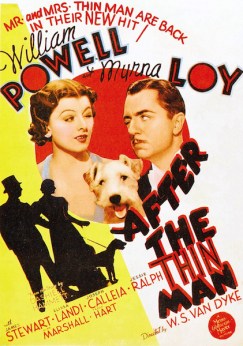
After the Thin ManImmediately after their New York Christmastime adventure in The Thin Man (the sequel’s title is very literal!), married detectives Nick and Nora Charles (William Powell and Myrna Loy) are back home in San Francisco for New Year. Summoned to dinner by Nora’s stuffy aunt, it turns out Nora’s cousin’s rascally husband has gone missing and they want Nick to investigate. They find him easily, but he’s shortly murdered and our heroes are drawn into a web of conspiracies and deceptions.

For my money, After the Thin Man is a more successful venture than the first film, however good that was. From the start it has its focus in the right place: rather than a lengthy preamble with the supporting cast (as in the first film), here we begin with Nick and Nora arriving in San Francisco and teasing the horde of journalists that greet them. It takes a little while to actually get to the case they need to investigate, but that’s fine because it isn’t really the point — it’s the interactions, the humour and good-natured teasing, particularly between our wedded heroes, that are the films’ primary joy.

Nonetheless, I still found the case to be a more puzzling and intriguing one than the first film’s, though the subsequent fame of a supporting player — namely James Stewart, in just the second year of his career, looking young but sounding like he always would — might help some along in their deductions.

He won't stay thin if he's always in the fridge...There’s also an increased role for the couple’s dog, Asta, granted his own subplot as he has to fend off a philandering Scottie with intentions toward Mrs Asta. I make no apologies for preferring this over the previous film in part because there’s more amusing doggy action.

The original Thin Man may have attracted Oscar nominations and all that, but this first sequel clarifies, sharpens, and perfects the formula, placing more emphasis on the elements that worked so well and still presenting a mystery that’s at least as good as its predecessor.

5 out of 5

Read my reviews of all the Thin Man films on Thin Man Thursdays.

The Running Man (1987)

2014 #116
Paul Michael Glaser | 97 mins | TV | 1.85:1 | USA / English | 18 / R

The Running Man25 years before Jennifer Lawrence had to fight for her life on TV, Arnie had to do the same.

In an ever-so-’80s vision of the future (my God, those costumes!), Arnie’s wrongfully-convicted fugitive ends up on TV’s most popular show, where criminals fight for their freedom against a variety of imposing opponents. Secretly, he’s there to try to overthrow the corrupt regime.

The implications of the central concept have been explored better several times since, but, despite dated design, the solid direction from Starsky (yes, as in and Hutch) ensures this is an entertaining SF action movie for genre fans.

3 out of 5

In the interests of completing my ever-growing backlog, I decided to post ‘drabble reviews’ of some films. For those unfamiliar with the concept, a drabble is a complete piece of writing exactly 100 words long. You’ve just read one.

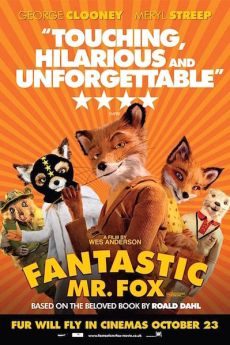
Fantastic Mr. Fox (2009)

2014 #95
Wes Anderson | 83 mins | TV | 1.85:1 | USA / English | PG / PG

Fantastic Mr. FoxQuirky cult-y director Wes Anderson tries his hand at stop motion animation with this Roald Dahl adaptation, in which an all-star cast voice the tribulations of a gaggle of talking animals — led by the eponymous vulpine — who come into conflict with three vicious farmers.
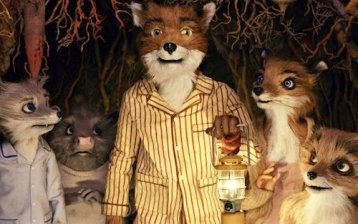
I’ve never seen a Wes Anderson film before, but his reputation is such that I don’t think you need to have to spot that Mr. Fox has been heavily Anderson-ised. It’s probably for the best I’ve not actually read Dahl for decades, because the purist in me would hate it for that. So it’s Quirky with a capital Q, and yet, miraculously, not irritatingly so — it feels like it should be considered self-consciously Quirky, but somehow isn’t. Instead, it’s almost (almost) charming. Whatever, it works.

Ostensibly a kids’ film, because it’s based on a children’s book and it’s animated, I don’t think it really is a film for kids. Not that it’s unsuitable for them, but only so in the literal sense that it’s an animated movie without extreme violence or swearing. A lot of the humour and the storytelling style, not to mention the slightly-creepy animation, are clearly aimed at a more mature viewer. The aforementioned animation was shot at the half-normal speed of 12 frames per second, to emphasis the nature of stop motion. That’s part of the creepiness, but it’s also the gangly designs, and that the animals look like they’ve been made out of real fur (because they have), which ruffles all of its own accord (accidentally moved by the animators’ hands, of course, but when seen in motion…) Honestly, I think it would give some kids nightmares more than joy.

Fox familyCompositionally, I thought I’d get sick of the squared-off 2D style, but Anderson’s cleverer than that. It might look flat and lacking in dimension at first, but that’s the starting point for variation, including some great bits of depth (farmer Bean trashing a caravan is a particular highlight of this), and when it breaks form (like a rabid dog chase) it’s all the more effective. There’s also a fantastic score by Alexandre Desplat. Not your usual plinky-plonky Quirky Kids’ Movie music (though there are instances of that), but something more raucous. Nice spaghetti Western riffs, too.

The main downside is the ending: it kind of reaches a conclusion, but also kind of just stops. It’s like Anderson doesn’t know how to end it… which, as it turns out, is almost exactly true. The ending isn’t the same as the book, because Anderson and co-screenwriter Noah Baumbach weren’t happy with it, but they couldn’t think of anything else. The final moments they’ve ended up with are apparently based on alternative material found in Dahl’s original manuscript, making it faithful (in its own way) while also settling the writers’ desire for a new finale. As I said, I’m not convinced.

(While we’re on trivia, residents of or regular visitors to Bath may spot the recognisable red facade of the Little Theatre towards the end. Its appearance is indeed based on the real one, though goodness knows why.)

Fantasticer in the future?Fantastic Mr. Fox is the kind of film I feel I may enjoy more on a re-watch. Indeed, some comments on film social networking sites (e.g. Letterboxd) do suggest that it only improves the more you see it. Having parked any desire for faithfulness to the original at the door, then, I feel there’s a chance the film’s boundless originality and almost-incidental outside-the-norm creativity may potentially render it an all-time favourite. But that’s something future viewings (if or when ever they occur) will have to ascertain.

4 out of 5

This is Not a Film (2011)

aka In film nist

2014 #97
Jafar Panahi & Mojtaba Mirtahmasb | 79 mins | DVD | 1.78:1 | Iran / Persian | U

This is Not a FilmYou know the kind of people who wait ages and ages for something and really want it and pre-order it or whatever and then when it finally arrives they… add it to a pile and don’t get round to watching/reading/listening to it for even longer than the ‘forever’ they were waiting in the first place? If you don’t, you do now — that’s me.

I first read about This is Not a Film when it premiered at the 2011 Cannes film festival (coming up to four years ago now). “Films where people sit around in rooms and talk to themselves in a foreign language” isn’t among my favourite of movie genres (it is for some people though, so each to their own), but nonetheless this one sounded like an intriguing must-see. My personal hype for it built further through multiple praise-filled reviews, the slow crawl through distribution deals being signed, and the long wait for a UK cinema or DVD release… Finally, a British DVD debuted in March 2013. My copy arrived and I put it on a pile. Just over 18 months later, I finally watched it. (Because it was going to be on TV. That’s often a catalyst for me.)

Jafar Panahi is, I suspect, not the kind of man who waits ages for something and then when it arrives does nothing with it. Quite the opposite, in fact: he’s the kind of man who’s told by law he has to wait ages to do something, and instead does it straight away. After being banned from filmmaking for 20 years, and while waiting for a decision on his appeal against the sentence, Panahi invites his friend and fellow filmmaker Mojtab Mirtahmasb to his house, where the latter films the former as he reads and enacts portions of the screenplay for his intended next project, as well as chatting about the nature of filmmaking. This is not an iguanaTo be precise, Panahi’s ban is from filmmaking, writing screenplays, leaving the country, or giving interviews, so they conclude that reading aloud an existing screenplay while someone else films him doesn’t contravene any of those rules. Nonetheless, the edited (not-a-)film was smuggled out of Iran on a USB stick hidden in a cake in time for its Cannes premiere.

That result is certainly an atypical film viewing experience. The form has a natural looseness, a wavering focus, a lack of structure — all of which is deliberate, and yet not deliberate. It’s not the raw footage — it has been edited and shaped; but only to an extent. After some preamble where he checks in with his family and his lawyers, Panahi starts to describe the film he wanted to make, but is frequently distracted by the futility of the exercise — cue the film’s famous quote, “if we could tell a film, then why make a film?” — before returning to it regardless, because that was the goal of the exercise. In the end, he never really finishes it; certainly not the whole film, anyway. This is Not a Film is not a film told by a man in his own front room, but that is part of it.

So what is it, then? It’s a statement, I suppose, but not so bluntly as an actual statement would be. It’s main message, perhaps, is that art and artists will find a way — you can try to suppress them, but if they want to speak out they will continue to try, and they will find the gaps in your rules that allow them to do so. But it’s also about the nature of movies. What is a film? Is this a film? And if it isn’t a film, what is it? The screenplay Panahi is describing isn’t a film, it’s a series of ideas and concepts that he’s explaining. Does him explaining it make it a film? No, because it lacks the input of important filmmakers like the actors (in one sequence, Panahi demonstrates how the improvisational style he uses generates unpredictable results) or the cameraman (Panahi attests he knows nothing about technology). This is not nothingIn fact, despite the singular input and focus put into this ‘project’, it could be used quite successfully as part of an argument against auteur theory. But that isn’t what it sets out to do either.

What does it set out to do? Nothing… and yet, obviously, not nothing.

By this point you have probably got the gist that this is not a mass-appeal movie. It’s one for students and fans of film, or for those interested in artists working under oppressive regimes. It’s a behind-the-scenes documentary for a film that doesn’t exist; a polemic that never polemicises; a portrait of the artist that has to eschew most of his art… yet, in the spaces around what can be shown and what is shown, it is all of those things. (Just to get a bit pretentious about it.)

For those on the fence about whether This is Not a Film is deserving of an hour-and-a-half of their time, I think the whole exercise is worth seeing for the climax alone. As Mirtahmasb leaves to go home, the stand-in maintenance man for Panahi’s apartment complex arrives to collect the trash. They get talking and, with nothing better to do, Panahi comes out with him on his rounds. A bizarrely captivating elevator ride follows, Panahi holding the camera as he just chats with the guy about his life, his work, his goals; not an interview, but an informal polite natter. It lasts, unbroken, for many minutes, and ends with them emerging outside, to a stunning, unexpected, though equally logical, and no doubt highly allegorical, final shot. The whole sequence makes you begin to question: was this staged? Or a genuine serendipitous event? Questions you may ask about the whole film; This is not a setquestions that are always worth asking about purported documentaries.

Whether This is Not a Film is a film or isn’t doesn’t really matter. It makes you think — and actually, all that oppressive regimes ever really want is to stop you thinking. Unfortunately for them, that’s one thing they can’t control so easily.

4 out of 5

The Crab with the Golden Claws (1947)

aka Le Crabe aux Pinces d’Or

2015 #1
Claude Misonne | 58 mins | download | 1.37:1 | Belgium / French

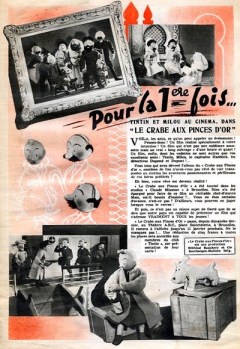
Le Crabe aux Pinces d'Or DVDBy 1947, Hergé’s boy reporter/adventurer Tintin had already been around and increasingly popular for nearly two decades; had survived World War 2 and the controversy of being published in a Nazi-controlled newspaper; and the release of his adventures had recently been transferred to a dedicated magazine, Le Journal de Tintin. What better time to bring the character to the big screen?

Adapted from the ninth Tintin adventure, which is the one that introduces popular supporting character/co-lead Captain Haddock, the plot sees Tintin following clues left by a dead seaman to uncover an opium smuggling operation being run on Haddock’s boat without his knowledge. Animated via stop motion using doll-like puppets, the film was only ever screened twice before being seized when its producer declared bankruptcy and fled to Argentina. A print is stored at the Cinémathèque Royale in Belgium, where it seems it used to only be available to paying Tintin club members, but in 2008 it was released on DVD in France. English-friendly versions are available online, not least via YouTube. The picture quality is poor, but, having gone to the trouble of acquiring a higher-res copy, I can say it doesn’t get much better. It is in the wrong aspect ratio, though — approximately 1.69:1. It doesn’t look too distorted, but if you see a 4:3 version it suddenly looks right. (I presume the DVD was incorrect because I had to adjust the copy I downloaded.)

As for the film itself, it’s incredibly faithful to Hergé’s original tale — it may not be adapted frame-for-frame, but it’s incredibly close. A couple of action sequences have gone astray, presumably because that’s harder to achieve with puppets, but it also streamlines the story slightly. I can’t speak for the French dialogue, but the fan-made English subtitles are word-for-word with the book. Of course, that may be where they’re sourced from.

Haddock, Tintin, Snowy, 1947 styleIn my review of the Spielberg film, I remarked I hadn’t read the albums it was adapted from so couldn’t vouch for its fidelity. Watching this, it’s clear that a sizeable chunk of the storyline was actually adapted from The Crab with the Golden Claws, to the point where I was starting to wonder if Moffat & co had taken the entire plot from Crab but subbed in the MacGuffins from Secret of the Unicorn. In the end, about half of this made its way into the 2011 film, including everything aboard the Karaboudjan, the lifeboat and plane sequences, and some of the desert material, too.

In this version, there’s quite a good bit where Tintin and Haddock escape from the Karaboudjan but we don’t see any of it, instead following the traitorous Mr Mate as he discovers all the crewmembers our heroes have tricked and tied up. As with everything else, this is book-faithful, but works even better on screen. Plus, Captain Haddock has a musical number, about his love for “the bottle and the sea”; and later he has another with Tintin, too. The main lyric is, “tra la la la lai doo”.

Technically, it’s not the most sophisticated stop motion you’ll see, but it’s not bad considering its age. The models are of their era too, but pretty good on the whole. The two exceptions are, firstly, the black characters — a weakness of Hergé’s book, they were replaced with white characters in later years, but this is faithful to the original version. The dolls aren’t any better than Hergé’s drawings. Secondly, the facial design of Tintin’s doll Le Crabe aux Pinces d'Or original advertmakes it look as if he’s permanently shocked by everything.


The Crab with the Golden Claws must be the most adapted Tintin adventure now (it was also animated in both the ’50s and ’90s series), which isn’t necessarily warranted: it was a tale compromised by the circumstances surrounding its publication, and apparently is largely a rehash of an earlier story. It’s not without merit, though — all of the good stuff was filched for the Spielberg film, funnily enough. This version isn’t bad, but is really no more than a funny little curio. One for the hardcore fan, be that of Tintin or the history of stop motion animation, or the insatiably curious.

3 out of 5

‘Thin Man’ Thursday

William Powell and Myrna Loy starred in 14 films together between 1934 and 1947, and the most famous of these are a series of detective films that started life as a B-movie adaptation of a Dashiell Hammett novel, before earning multiple Oscar nominations and enough popularity to inspire multiple sequels, a spin-off TV series, and more. That film, of course, is The Thin Man.

Powell and Loy play Nick and Nora Charles, a retired detective and his well-to-do wife, who are trying to enjoy the high life but are regularly dragged in to investigating murders, mainly thanks to her curiosity and his crime-solving genius. Special mention must also be made for the couple’s dog, Asta, a wire fox terrier who was so popular he was paid many times more than your average movie dog, and whose role only increases as the series continues — he even has a romantic subplot in the second film.

The films on the whole are more concerned with the screwball-ish relationship between the leads than they are with the mysteries, which are so speedily intricate as to barely be worth following — just accepting what Nick tells you and going along with it may be the order of the day. They all have the air of Agatha Christie-esque parlour games more than genuine criminal undertakings, which of course means they make for splendid entertainment.

Six films were produced in all, over the course of 13 years — rather the opposite to most of these ’30s/’40s detective series, which were more likely to churn out 13 movies in six years. Anyway, it’s the perfect number to allow every Thursday between now and the end of February to be Thin Man Thursday here at 100 Films. Below you’ll find links to all the reviews as and when they’re available, starting today with (naturally) the first:


The Thin Man

After the Thin Man

Another Thin Man

Shadow of the Thin Man

The Thin Man Goes Home

Song of the Thin Man

The Thin Man (1934)

2014 #120
W.S. Van Dyke | 87 mins | DVD | 1.33:1 | USA / English | U

The Thin ManProduced as a B-movie, but eventually nominated for four of the biggest Oscars (Picture, Actor, Director, Screenplay*), comedic detective mystery The Thin Man went on to spawn five sequels and a TV series (not to mention a radio series, a stage play, and a musical), as well as inspiring a host of similar comic-mystery B-movie series like the Saint and the Falcon.

Playing like a cross between an Agatha Christie mystery and a screwball comedy, it’s in fact based on a novel by Dashiell Hammett, author of The Maltese Falcon, The Glass Key, and other hard-boiled tales. This is definitely not one of those. The murder mystery is standard enough — a businessman has disappeared, but when his former secretary and lover is found dead, he’s the prime suspect — albeit with enough genuine suspects and twists to keep the viewer guessing. The real joy comes from the investigators: retired detective and alcohol fan Nick Charles (William Powell) and his rich, interested wife Nora (Myrna Loy). Plus their dog, Asta, who gets up to all kinds of mischief. Regular readers will know I’m half-sold on the film at that point.

The film luxuriates in the interactions between Powell and Loy, and between them and any other character. The plot regularly takes a back seat to the cast’s playfulness, which only the most mystery-focused viewer will find objectionable, because it’s so delightful. Acting drunk for the sake of comedy might seem like a cheap fallback, but Powell is on just the right side of the line to make it work flawlessly, especially in scenes that border on farce, Screwing aroundlike a Christmas party which is regularly interrupted by victims and suspects. Even the final scene, a rambling and none-more-Christie-like “gather all the suspects and reveal the answers” dinner party, seems natural because of the characterisation throughout the rest of the film. Loy’s part may not be quite as showy — as demonstrated by its failure to gain an Oscar nomination — but she’s an invaluable half of the double act.

Across the decades the detective story has transitioned to be a staple of television, with dozens of US dramas each churning out 22+ mysteries per year, not to mention all the British ones and, more recently here in the UK, European imports — you can’t move for a fleet of complex murder mysteries being solved on the gogglebox every day. It can make older movies that do the same thing feel less significant; less deserving of their big-screen status. Not so with ones like The Thin Man, which has so much more to offer besides the narrative and its revelations. Here a solid mystery, with potential to keep the viewer guessing, gives a structure on which to hang the real joys, which are provided by the central screwball-ish relationship. And the dog, of course.

5 out of 5

Read my reviews of all the Thin Man films on Thin Man Thursdays.

* It lost to the father of screwball comedy, It Happened One Night, in every category. ^

The Grey (2011)

2014 #85
Joe Carnahan | 112 mins | TV | 2.35:1 | USA / English | 15 / R

The GreyLiam Neeson shoots wolves for an arctic drilling company, but when his flight home crashes, he must attempt to lead the small band of survivors across an icy wilderness to the mere hope of safety — pursued all the way by murderous wolves…
Promoted as Neeson’s latest Taken-style actioner, The Grey is more of a survival horror, but with wolves instead of some mystical entity — though given the apparent lack of accuracy in the wolves’ behaviour, perhaps they’re supernatural after all. Between chases and escapes there’s a fair bit of existential pondering, including some literal staring at the sky and talking to an unresponsive God — “Bergman for Blokes”, you might say.

Couple this with an ambiguous ending, and the whole is unlikely to please the action-orientated folk the marketing targeted. You might think it’s better suited to an artier crowd, but, conversely, the equally-present genre elements may weigh too heavily for their tastes. At least one over-ambitious sequence rendered through mediocre special effects does little to help.

It’s very much a film of two co-existant halves, then. For anyone who can reconcile those disparate faces as they come, co-writer/director Carnahan has (some iffy special effects and suspect wolf behaviour aside) crafted an effectively tense, almost scary, movie.

4 out of 5

Parker (2013)

2015 #2
Taylor Hackford | 119 mins | download (HD) | 2.35:1 | USA / English | 15 / R

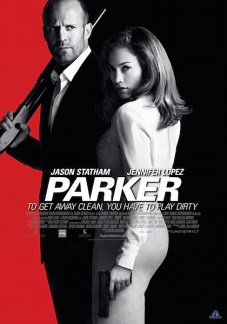
ParkerParker trailed well — funny lines, promising action, solid setup — but doesn’t deliver.

The funny lines remain funny, but the trailer has them all. The plot’s generic — not necessarily a problem, but here it’s hampered by pointless asides and subplots. The action only delivers once or twice, the best being a mano-a-mano brawl featuring a great climax on a hotel balcony.

Reportedly Hackford wanted to make this a film noir. You can spot story elements he must have been thinking of, but it doesn’t feel like one, and certainly doesn’t look like one.

Fitfully adequate, but not even among Statham’s best.

2 out of 5

Jason Statham stars in the superior Safe, on 5* tonight at 9pm and reviewed here.

In the interests of completing my ever-growing backlog, I decided to post ‘drabble reviews’ of some films. For those unfamiliar with the concept, a drabble is a complete piece of writing exactly 100 words long. You’ve just read one.