aka Beauty and the Beast
2014 #104
Jean Cocteau | 94 mins | Blu-ray | 1.33:1 | France / French | PG
“When it comes to “fairy-tale movies” — if such a genre exists as something other than a profit center for the Disney corporation — there is Cocteau’s Beauty and the Beast and then there is everything else.”
 So states Geoffrey O’Brien in his essay “Dark Magic” (included in the booklet for Criterion’s Blu-ray release of La Belle et la Bête, and available online here). Despite the varied list of titles people have selected to cover for the Fairy Tale Blogathon, I feel it’s a pretty accurate statement — ask most people to name a film based on a fairy tale and they’re going to come out with a Disney; ask a cinephile and I suspect, as a rule, Cocteau’s acclaimed film would come to mind ahead of most others. After all, it’s on a variety of well-regarded best-ever lists, including both the cineastic (TSPDT, Sight & Sound, Cahiers du cinéma) and the mainstream (the Empire 500, IMDb Top 50s for Fantasy and 1940s). It’s a film considered almost without peer in its now-animation-dominated sub-genre.
I imagine you know the story — it’s a tale as old as time, after all — but let’s recap anyway: in lieu of her father, Belle (Josette Day) goes to be the ‘guest’ of the animal-like Beast (Jean Marais) in his castle. Initially repulsed by him, Belle comes to realise there’s something there that wasn’t there before as she grows attracted to her captor. Meanwhile, Belle’s would-be suitor (Marais again) resolves to kill the Beast…
As if I haven’t made it explicit enough with my shoehorning of song titles and lyrics, the elephant in the room when discussing La Belle et la Bête today is Disney’s 1991 adaptation of the same story. It may have come 45 years later and I’m sure is less kindly looked upon by cineastes, but there’s no doubting its popularity — and acclaim, in fact, notably being the first animated movie to be nominated for a Best Picture Oscar. Simply put, Cocteau’s film is less accessible than the Disney version. That might sound like it goes without saying, but even allowing for the differences in production style (slick colourful animation with catchy Broadway-style tunes vs. black-and-white French poetic realism), 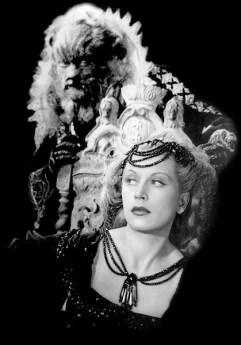 here the characters’ relationships are more complex and ambiguous, particularly at the climax. It isn’t a simple “see the true beauty behind the ugly exterior” moral fable; indeed, if anything, Marais’ Beast is more beautiful than the man he becomes.
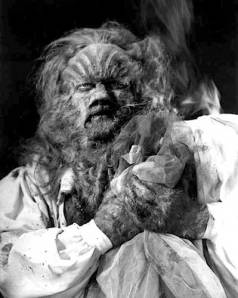
There are several reasons for that. One is the visual: Marcel Escoffier’s resplendent costuming, Henri Alekan’s gorgeous cinematography (more on that later), and, primarily, Hagop Arakelian’s make-up. Taking five hours to apply every day, the look of the Beast is in no way a dated ’40s special effect, but a marvellous, expressive, essential part of the character. Nonetheless, as O’Brien notes,
[The Beast says,] “You mustn’t look into my eyes.” It is, of course, his eyes that we look at, glistening from within the multilayered makeup… makeup so expressive that Marais’ real face seems a blank by comparison.
As is alluded to there, it’s not just the stuck-on fur that makes the man a Beast, but Marais’ performance. The eyes may indeed be the window to the soul, for it’s through them that we can see he’s a man underneath the beastly visage. But even in that sphere the character is a man transformed — his manner, his voice, and the steely look that often lies behind those eyes. In her essay named after the film in the BFI’s Gothic – The Dark Heart of Film compendium, Marina Warner summarises the cumulative effect of the numerous filmmaking disciplines that created the character:
[Cocteau] imagined a beast who has no rival for hideous fascination among fairytale beasts before or since: Jean Marais’s growling, slowed, incantatory delivery, his sweeping, elaborately princely magnificence of apparel, his thick pelt curling out exuberantly from his lace collar and fine linen as he springs and lopes, and, above all, his staring pale eyes in the great leonine and brindled mask of his face with the two sharp incisors defining his mouth, has never been matched for erotic power. He captures a perfect and irresistible synthesis of repulsiveness and attractiveness.
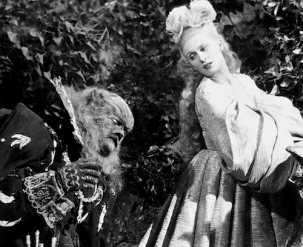 That final idea, of the erotic or sexual in the film, seems a favourite theme for critics: O’Brien reckons “the magic is sexual throughout — a fantastic… sex magic”, and I think we’ll skip Warner’s lengthy discussion of the feelings the film elicits in her. How prevalent such undercurrents are is surely in the eye of the beholder — O’Brien notes that “it is so chaste that no censor could have ever assailed it”, and I suspect many a viewer would feel the same. That said, the soft-lensed scene in which the Beast gently laps water from Belle’s delicately cupped hands may make viewers with a particularly-disposed mind think of certain other acts.
A more defining feature of the film’s depiction of magic, I think, is its groundedness. O’Brien sums it up most succinctly when he says that “if this is magic, it is a shaggy, palpable sort of magic… we sense at each moment that we are caught up in a process governed by laws”. We rarely know what these laws are, in fact, but there’s a sense that there’s some governing order to what occurs, that some things are possible and others not — there’s clearly no love potion to solve the Beast’s problem, for instance. Many uses of magic in the film come with associated “how to use it” guides from one character or another; not presented in some kind of deconstructionist technical-manual style, but neither are they a hand-wavy “it’ll do whatever we need it to when we need it to”. To quote O’Brien again:
Cocteau was able to realize the fantastic not as an escape from the real but as an extension of it… He approaches the paraphernalia of the fairy tale — those enchanted mirrors, keys, gloves — with a technician’s dispassion, no more taken aback by their existence than by the existence of trees or streams or horses or rose gardens.
 Cocteau was trying to move away from a wishy-washy kind of fantasy — indeed, he says as much in the press book for the film’s US premiere (a piece entitled “Once Upon a Time” and also included in Criterion’s booklet): “To fairyland, as people usually see it, I would bring a kind of realism to banish the vague and misty nonsense now so completely outworn.” In these respects you could probably draw a line from Cocteau to something like Peter Jackson’s films of the Lord of the Rings trilogy, where a not-real world with magical qualities is rendered with the precision of historical drama, and even Game of Thrones, which you could certainly mistake for a real-life medieval epic (until the dragons turn up). Cocteau’s vision feels a little more storybook than either of those, but everything’s a step on a journey.
Plus, unlike either of those examples, Cocteau’s film needs to draw a line between the everyday world and the fantastical one. Much as with the Beast, this is achieved with a synthesis of production elements. The farmhouse of Belle’s family is shot on location, providing inescapable realism, and with relatively straightforward photography from Alekan. It’s not that these section are unimaginative, just that they present a world that is ‘normal’. The Beast’s castle, on the other hand, is heightened and expressionistic. Christian Bérard’s production design offers sets with lots of black emptiness in place of floors and walls, with decorations and dressings that shine, gleam and glow in Alekan’s lighting — not to mention the candelabras with self-lighting candles, held by moving arms; or the faces set in the fireplace, whose roving eyes follow the action; or the hand protruding bizarrely from the tabletop, there purely to pour the wine.
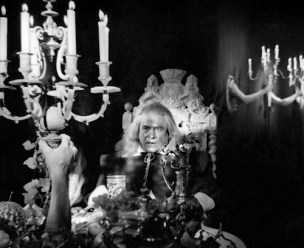 It’s in the Beast’s castle that the most enduring images of the film are played out, most famous among them being Belle’s father’s arrival, with the candles igniting themselves and the hands pointing the way, and Belle’s own arrival, a slow-motion run with billowing dress and curtains — if you haven’t seen the original, you’ve surely seen an advert inspired by it. For all the groundedness Cocteau and co may be bringing to the fantastical, it’s still a strange realm; one rendered with loving beauty in its design and photography, but with an unsettling effect. Right on the money, then.
And if we’re talking about “unsettling beauty”, we’ve surely come back round to the Beast himself, and in particular his role in the ending. You know how that turns out: having been able to see the true goodness beneath the ugly exterior, Belle is rewarded when the Beast is transformed back into a handsome prince. Hurrah — she gets a hubby who is both nice and pretty! But is it such a victory after all? Not if Cocteau gets his way:
My story would concern itself mainly with the unconscious obstinacy with which women pursue the same type of man, and expose the naïveté of the old fairy tales that would have us believe that this type reaches its ideal in conventional good looks. My aim would be to make the Beast so human, so sympathetic, so superior to men that his transformation into Prince Charming would come as a terrible blow to Beauty, condemning her to a humdrum marriage.
 Good moral message, but isn’t the “superior” Beast the same fella as Prince Charming? The way a felled Avenant is transformed into the Beast at the same time as Charming is unveiled as a more-perfect duplicate of Avenant (it’s Marais in all three roles, of course) suggests some kind of parallel should be drawn. Warner wonders, “Has the Beast taken on [Avenant’s] appearance because [Belle] admitted to him that she was fond of Avenant?” Could be, but isn’t that a bit simple? She has another theory: “does Cocteau want to suggest that a ne’er-do-well like Avenant can also be transformed by love?” Could it be Avenant is about to get a lesson in how to be a better person, as Charming has already endured?
These are all attempts to find a positive reading of the ending, I think — one where love conquers all, and what it hasn’t conquered is a mission for the future. O’Brien is a bit more pessimistic, concluding the film is “a story more full of suffering than of wish fulfillment”. Oh dear. He believes that “even as Belle and her prince (the Beast transformed into the double of the unreliable Avenant) soar in the sky, she seems already to realize that this is not exactly what she wanted.” It’s certainly true that every character in the film goes through some misery, be it small (Belle’s sisters being snubbed from social engagements) or big (the family’s destitution), and by the end very few of these are resolved. If Belle thought she was getting an honourable Beast and instead has to suffer a preened Avenant for her foreseeable future, then she’s lost out too. Indeed, the only one who got what he wanted was the Beast: transformed back into a man, and with a lovely new wife to boot.
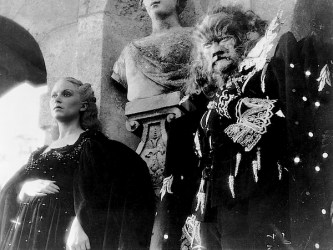 There’s a cheery message to end on. But then, this is “a fairytale for grownups” — a quote from Warner, but, to an extent, it would seem Cocteau agreed (by implication, with his statement at the start of the film urging the audience to embrace child-like acceptance of the story they are about to see) — and the resolutions of grownup stories are rarely “happy ever after”.
This review is part of the Fairy Tale Blogathon. Be sure to check out the many other fascinating articles collated at Movies Silently, including my review of fairytale-inspired miniseries The 10th Kingdom.

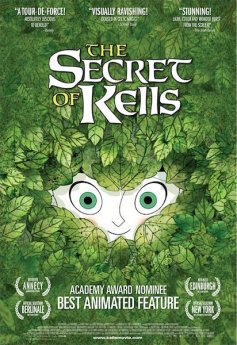 You can lament the quality of Oscar voters’ choices all you want, but if it wasn’t for their 2010 Best Animated Feature nominations I’m not sure many would have heard of this Celtic gem.
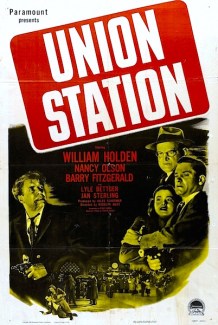 Often noted merely for being filmed in Los Angeles’ busy train station, there are some spirited defences of Union Station to be
 Based on a radio serial that spawned film serials, a famous TV series, and, eventually, comic books, The Green Hornet is a ‘superhero’ saga with a difference. For one thing, technically he’s just a vigilante — no superpowers here — and for another, as noted, it didn’t originate as a comic book. But that’s the milieu the character slots into these days, and so this attempted revival plays in that ballpark.
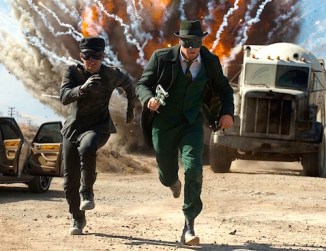 Well, screw them — The Green Hornet is brilliant. If you’re after the po-faced angsty worthiness of
 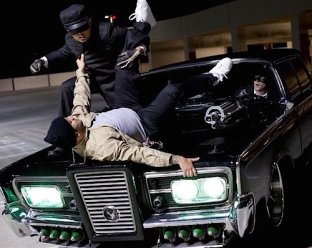 Then there’s Gondry’s direction, which is often as idiosyncratic as you’d expect. He’s at his peak during the action sequences, which explode in an array of effects and slow-motion to create multiple memorably unique fights and chases. Highlights are the first time Kato unveils his martial arts prowess, and the crazy car-driven climax. Chou and the tricked-out car, Black Beauty, are undoubtedly the stars of these bits — indeed, the film has an overall good line in making Kato the brains behind the operation. I imagine this is subverting the depiction of the Asian sidekick from previous versions, considering when they were made, but as I’ve never seen any I can’t comment fairly.
 Disgraced national TV journo Dustin Hoffman is slumming it on a local network, covering dull stories like something-or-other going on at the local museum… until a recently-fired security guard from said museum (John Travolta) turns up with a shotgun, accidentally shoots the other security guard, and takes a party of schoolchildren hostage. Suddenly Hoffman finds himself with the inside scoop — literally — as the eyes of the national news turn on the unfolding situation.
 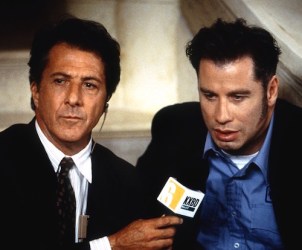 He plays against type as Sam, the nervous, naïve, childlike, and easily-manipulated hostage taker. It’s Travolta’s performance that makes Sam someone you care about, even if you don’t exactly root for him, so that the outcome — which, unusually for this kind of film, remains completely uncertain right until it’s happened — is something you’re fully invested in. There are many better-regarded films than this that don’t achieve that.
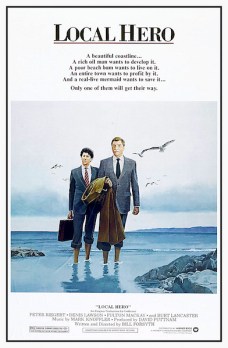 Gentle comedy in which Peter Riegert’s middle-management American oil exec has to persuade the residents of a Scottish village to sell up, unaware that they’re only too keen — for the right price. One of Quentin Tarantino’s Coolest Movies of All Time (
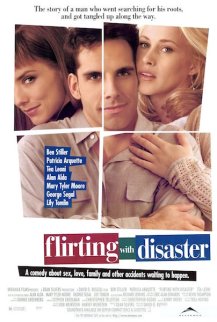 David O. Russell’s second feature sees adoptee Ben Stiller go on a kerazee road trip to find his birth parents, accompanied by dissatisfied wife Patricia Arquette and kooky adoption agency psychologist Téa Leoni, along the way bumping into Arquette’s high school crush (Josh Brolin) and his husband (Richard Jenkins). Cue an almost-PG-13 sex comedy told among sketch-like encounters with quirky people who turn out to not be Stiller’s folks.
 Jennifer Lawrence (who, depending on your mileage, is either “the most charming young movie star in, like, forever” or “actually kind of a little bit irritating”) returns as the totally-plausibly-named Katniss Everdeen in this super-successful follow-up to the super-successful
 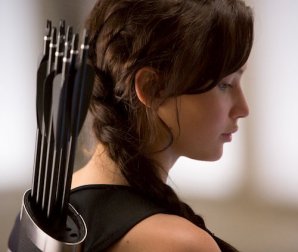 Tonally, however, it’s more similar to
 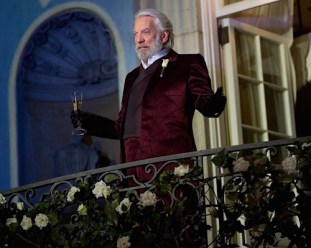 Of course, to an extent the tone of this ending comes from it being an adaptation: the filmmakers haven’t looked at the history of movie cliffhangers and chosen which to emulate, but instead brought someone else’s ending to the screen. Adapting doesn’t mean you have to take the original work faithfully, mind — you could go the
 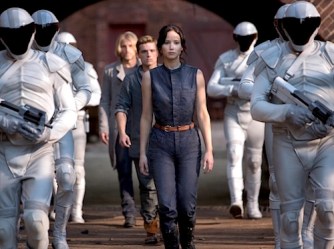 which seems richer, more detailed, despite no genuine increase in resolution. I guess it’s true what they say: if you start with a higher quality source, it filters all the way down. The “bigger screen” effect probably wouldn’t work for a film entirely shot on IMAX — it’d just fill your TV from the start — but, after an hour-or-so of black bars, it really feels like the screen has grown.
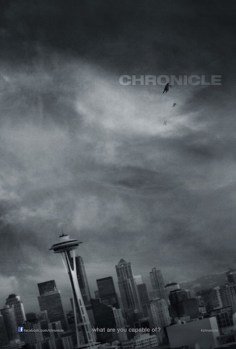 The birth of the “found footage” sub-genre and the resurgence of the superhero movie began around the same time, the former with
 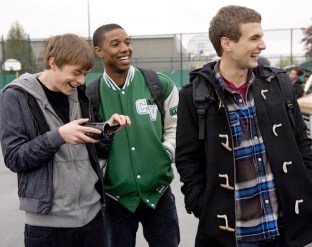 The story sees high school senior Andrew (Dane DeHaan) decide to start filming everything in his life, thanks to his borderline-abusive alcoholic father (Michael Kelly) and terminally ill mother (Bo Petersen). The same day (what a coincidence!), his cousin and only friend, Matt (Alex Russell), takes him to a party where, along with most-popular-kid-in-school Steve (Michael B. Jordan), they discover a hole in the woods with mysteries inside… Days later, all three begin to develop telekinetic powers, which they learn they can levy in various incredible ways — those ways being super, but largely without the heroic…
 This is even more pronounced in the extended version (“extended director’s cut” in the US), which includes over five minutes of extra bits that, in my opinion, make it a superior edit. Some are minor in impact, true, but there are a couple of short sequences with Andrew and Steve that deepen their relationship further, which enriches events at the end of act two. There’s also a moment that subtly prefigures the climax, and an extra bit in said finale that seems nigh-on essential to me. Considering the film still runs (just under) 90 minutes even with these additions, it’s difficult to see why they were cut in the first place. “Pace” is usually the rational for that, but if this is indeed a Director’s Cut then clearly Trank didn’t think they were an issue; equally, I can’t see why Fox would have objected. Still, they’re here to enjoy on Blu-ray…. though not on DVD… and I guess they’re not in TV screenings… Tsk.
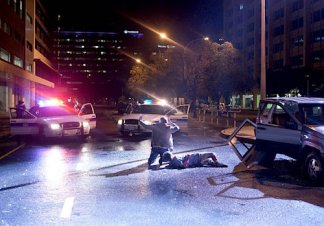 That said, spectacle it has. You wouldn’t expect that from a $12 million found-footage movie, but an epic duel through the streets of Seattle is one of the strongest climaxes to any superhero movie I can remember. It’s kind of like
  In the hands of many a desperate-to-get-noticed filmmaker, a found-footage superhero movie would likely have been a straight-to-DVD affair that could at best be described as “mediocre”. In Chronicle, however, Trank and co have crafted one of the best movies produced in either sub-genre. Most of the people involved — as well as the film they’ve all come from — can be classed as “one to watch”.
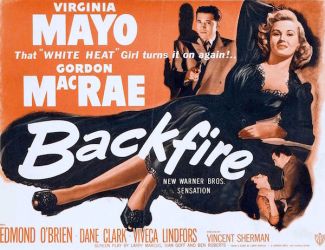 Before he was the romantic male lead in musicals like
  Besides, even if the film seems to forgo the usual gritty noir trappings for a pleasant “English murder mystery”-type tale at first, it actually has its fair share of dark elements and noir-ish features, which only increase as it goes on: secretive gangsters, nightclub singers, revenge shootings… Then there’s the photography which, again, transitions from a fairly ‘regular’ (for want of a better word) style early on, to a world of rain-slicked streets and high-contrast lighting.
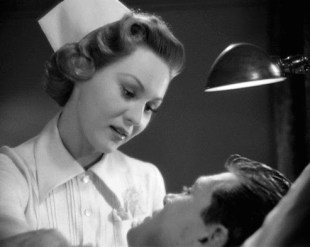 It’s in the latter’s case that the writing gets a chance to shine, too: the chief’s flashback is littered with snappy dialogue that feels kinda like he’s telling you the story himself, not just a matter-of-fact “here’s what happened earlier” objective account. Other flashbacks retain a degree of subjectivity — we only see events the characters could have witnessed, and in some cases the way they witnessed them (like the cleaning lady who only sees customers’ feet, before spying through a keyhole in a shot complete with keyhole matte) — but there’s an idea there, briefly glimpsed in that detective’s flashback, that would’ve made for an even more interesting film.
 100Films.co.uk