2012 #90
Jay Oliva | 76 mins | Blu-ray | 1.78:1 | USA / English | 15 / PG-13
 Mainstream US superhero comics underwent something of a revolution — or an evolution, if you prefer — in the ’80s, moving from simplistic good vs evil tales-of-the-week to deeper, thematic- and character-driven stories that in some cases took months or even years to relate in full. It’s a change that’s still felt today (some would contend that they’ve been stuck for decades in a rut these developments ultimately led to). It’s generally considered that there were three works at the forefront of this wave of more adult-orientated comics, all of which still rotationally top Best Graphic Novel Ever polls today: Alan Moore and Dave Gibson’s Watchmen (filmed in 2009 by Zack Snyder); Frank Miller and David Mazzucchelli’s Batman: Year One (a significant contributor to Chris Nolan’s Batman Begins in 2005, and animated in its own right last year); and Frank Miller’s The Dark Knight Returns — a definite influence on Nolan’s The Dark Knight Rises, and currently in the middle of being adapted as a two-part animation. This is, obviously, the first half; the second is out in the US at the end of January 2013.
Set in a near-future Gotham City, Batman has been retired for ten years and the crime levels in the city have risen. Bruce Wayne seeks thrills — and possibly death — while an aged Alfred does his best to rein him in. As Commissioner Gordon nears retirement, a new threat on the city rises, inspiring Bruce to don the cowl once again…
 Like Year One before it, the team behind these direct-to-DVD DC animated movies have taken a reverent route to bringing DKR to the screen. It’s in two parts because the original story is too long to faithfully adapt in their limited-length movies (it’ll work out at about two-and-a-half hours all told, which isn’t commercially viable for a direct-to-disc animation), but that also works out OK from a storytelling point of view: this first half ends with a major threat wrapped up and a great cliffhanger to kick off the second half. Those with less appreciation for the economics of film production have slated DC/Warner for splitting the film in two like this, but in some ways it works to its benefit artistically as well as commercially.
Others question the need for adapting it at all, if they’re just going to plonk what we’ve read on the page directly onto the screen. They do have something of a point, and it’s hard to argue DKR is any better off for having been animated. The obsession with faithfulness is borderline problematic at points, in fact: despite near-future tropes like gigantic tanks and mutant gangs, this is clearly a vision of the ’80s, with fashions, comic books glimpsed on shelves and references to Pearl Harbor that lock it fairly firmly some 25 years before now, never mind the future. At another point, a reveal at the climax of Two-Face’s part in the story, which works marvellously on the page, is a dud on screen when copied so precisely. It needs a little re-imagining to make it properly filmic.
 Stylistically, the film retains Miller’s designs, albeit a bit smartened up to work consistently as animation. Some will bemoan that homogenising but others may delight in it — Miller’s art is generally a bit on the scruffy side, I think. Is it an appropriate mark of respect that they’ve translated it so literally from page to screen, or would it have been more interesting for the filmmakers to have taken Miller’s plot and situated it in a world drawn from their own designs? I’m not going to argue that they could have improved on Miller’s work, but it might have been interesting to see the story given a spin in a different artistic style.
A benefit of being animated (well, arguably) is that action sequences get fleshed out. With a verve typical of these DC original movies, these sequences benefit from a fluidity and real punch imbued by animators who clearly relish this opportunity. There’s variety too, from an opening car chase, to shadowy stalking around a building site, to a silhouette-ish smoke-covered takedown of a gang of henchmen, to a mud-drenched single-take (ish) final smack-down. These sequences aren’t overplayed, but pack the necessary weight to back themselves up. They’re ably supported by Christopher Drake’s score, which betrays the influence of Hans Zimmer’s work on Nolan’s films but is too good to just be a straight-up copy.
 Voice work — the other major addition of an animated re-telling, of course — ranges from solid to very good. I wasn’t convinced by the casting of former RoboCop Peter Weller as Bruce Wayne/Batman, but he’s pretty darn good, carrying exactly the right kind of aged gruffness. It’s unique, I think, to see an active Batman this old on screen — sure, Nolan forwarded things eight years for Rises, but he’s still played by a relatively young and fit Christian Bale, whereas this Batman is grey, in his mid 50s and looking even older. I don’t recall a significant weak link in the rest of the cast, with Modern Family’s Ariel Winter’s performance as the new teenaged Robin perhaps being the most memorable of the supporting roles.
Reviews and commentary on the ‘net seem to swing between finding this a pointless, Saturday-morning-ised version of Miller’s seminal work, and an engrossing and exciting adaptation of it. I side more with the latter. It was never going to replace the original, and in surer hands — ones more prepared to change stuff, essentially — there’s an even better film lurking within (and it isn’t Nolan’s Rises, which only takes elements to construct its own new narrative). But on its own merits, I think this is a solidly entertaining Batman film. And I can’t wait for Part Two, which is surely a recommendation in itself.
Batman: The Dark Knight Returns, Part I is released on Blu-ray and HMV-exclusive DVD today in the UK. The second part is available in the US on DVD and Blu-ray from 29th January 2013.


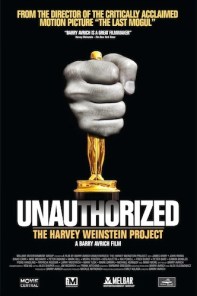 The documentary that Weinstein reportedly tried to stop existing, including discouraging people from participating in interviews. Either he needn’t have worried or really is a complete megalomaniac, because while there is a certain warts-and-all aspect to Avrich’s cinematic biography, it can’t help but admire all that Weinstein has achieved.
 Even for those who were following film culture through this era, and in spite of Harvey’s apparent efforts, there are numerous interviewees who were there — former Miramax employees, for instance — to offer insight. Thanks to archive footage we get even more opinions, including a fair few comments from Harvey himself. How much of this was available at the time, I obviously don’t know. Even if it is mostly recap, it’s a concise and well-constructed one.
 Bill Cunningham is 80. He lives in a small rent-controlled apartment in New York City that is filled with filing cabinets. His bed is little more than a mattress on some boxes. Each day, he dresses in the same distinctively simple blue smock and sets out on his bicycle. He eats at the same places each day; simple cheap food, cheap coffee. He doesn’t have a partner or kids; he may never have had a romantic relationship. He doesn’t watch TV or listen to music. It sounds like some kind of life of poverty or religious devotion. It’s neither, although you could make an argument for the latter, because all Bill does all day is photograph what people wear.
 Bill is, technically, a fashion and society photographer. His real passion, however, is clothes. Real clothes. The clothes people actually wear and how they wear them. His newspaper column — a collection of photos from the streets — is essential reading as far up the chain as Anna Wintour. He doesn’t set trends, he observes them. Exposes them, you might say, because in the past he’s used his work to call fashion designers on where they’ve copied (consciously or not) the work of another from years before, and that has sparked arguments.
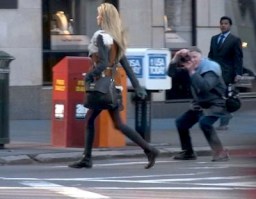 What he actually is, more than a “fashion photographer”, is a documentarian, recording how people choose to present themselves to the world, both as individuals and how that translates en masse. Fashion may seem like a meaningless, arbitrary, frivolous thing to afford such time to, and I’d have no argument against Fashion being called exactly that. But fashion — the actual clothes we wear in our actual lives — is something a good many people spend a good amount of time obsessing over; it’s how they choose to represent themselves in the world, how they indicate what they’re like as a person, how they show which groups or types of people they align with. We all do it, even if it’s not a conscious choice. Surely that’s worth recording?
 But that’s all an aside, probably because it’s so well done. What might be worth picking up on is that there’s no specific story. There are stories in there — like how Carnegie Hall is kicking out its handful of 80- and 90-something resident artists to make way for more office space — but the film doesn’t have an overarching tale. It’s a portrait; one of a fascinating, unusual, but likeable, and certainly unique, individual.
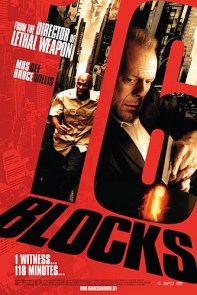 A Bruce Willis action movie? You know what you’re in for here, don’t you? Well, not quite. 16 Blocks casts Willis as less John McClane and more John McCane: old, fat, drunk, limping. He’s a copper still, but the kind of detective whose primary duties are being left to watch over an apartment full of bodies until uniform can show up.
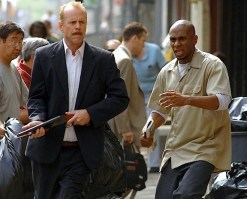 For me, it really lost its way just over an hour in, when our heroes (spoilers!) end up in a hostage situation on a bus. It’s not bad, but it feels like writer Richard Wenk (who’s gone on to co-write heights of culture like
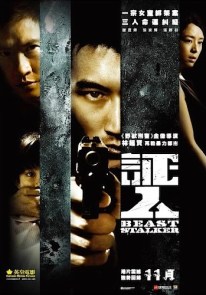 While in pursuit of an accused murderer, a cop (Nicholas Tse) accidentally kills the daughter of said murderer’s prosecutor (Jingchu Zhang). Three months later, just days before his trial, the accused has the prosecutor’s other daughter kidnapped, to persuade her to destroy the evidence proving his guilt. Despite having spent the intervening time in reclusive self doubt, the cop sets out to rescue the kidnapped little girl.
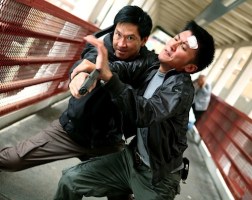 making them a little perfunctory — the real meat actually lies in the plot’s twists and turns. This is more one for fans of thrillers than beat-’em-ups.
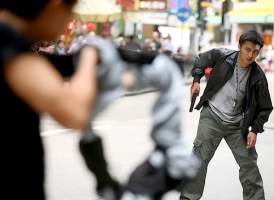 The top performance comes from Nick Cheung as a for-hire kidnapper with the Bondian trait of being blinded in one eye while the other only has black-and-white vision. He gets added complexity thanks to an invalided wife he tenderly cares for — he’s only in this life of crime to pay off his debts and medical bills, y’know. Cheung’s largely silent turn manages a fine balance of menace and sympathy. He won a couple of HK awards for it,
 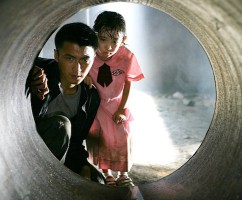 A brief couple of scenes with a bullied colleague play out nicely, though unfortunately they contrast with a painfully written bit in which another colleague tells Tse’s character what people think of him. “They said you were horrible, but I like working for you,” she tells him (I paraphrase), for no discernible reason. It doesn’t even matter that we’re told that, because we’ve already seen it. I just don’t get it.
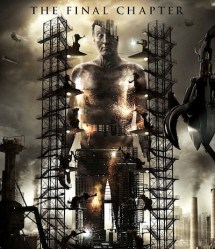 Talking of Halloween, you may have noticed that I’ve been re-posting all of my Saw reviews. Now seemed as good a time as any. To accompany that, I wrote some new words on my opinion of the franchise as a whole. If you missed it, you can read those
  #81a Dr. No (1962)
 #83 Prometheus (2012)
 100Films.co.uk