aka Evangerion shin gekijôban: Ha / Evangelion New Theatrical Edition: Break
2011 #65
Hideaki Anno, Masayuki & Kazuya Tsurumaki | 112 mins | Blu-ray | 15
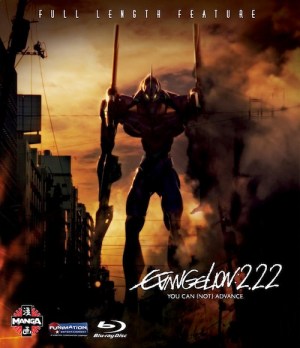 Just over a year since the preceding film made it to UK DVD and Blu-ray, and two years since this was theatrically released in Japan, the second part of creator Hideaki Anno’s Rebuild of Evangelion tetralogy reaches British DVD/BD today. Continuing to re-tell the story originally visualised in the exceptional, and exceptionally popular, TV series Neon Genesis Evangelion, You Can (Not) Advance throws in more changes to the original tale than its predecessor, including at least one significant new character.
This is very clearly a second part. It hits the ground running, with no thought for those not up to speed on the characters and events so far. Indeed, there’s perhaps little regard for those who may be familiar with it anyway: certain significant events rattle past, the storyline spewing mysteries via dialogue we barely understand, so dense is it with references and allusions. In some respects that’s realistic, of course — why would characters explain, for instance, the Vatican Treaty to each other when they all know about it — but it might leave the viewer struggling to keep up. It’s not all like that, but there’s plenty of it; and when there’s few answers forthcoming within the film itself, the mysterious references feel even more opaque.
 For my money, the first 40 minutes or so of the film are (by and large) the best bits. It opens with a barnstorming action sequence, a great scene for newbies and fans alike as we’re introduced to Eva pilot Mari, who didn’t appear in the TV series. That she then disappears for most of the film, only to make a thoroughly mysterious return later, is one of those explanation-lacking flaws. I’m sure it won’t look so bad once the next two films provide us with answers. Well, I hope not.
After that the film seems to trade one-for-one on character scenes and action sequences: ostensible lead character Shinji and his father have what amounts to a heart-to-heart, for them, in a vast cemetery; Eva pilot Asuka is introduced in another action sequence — different to her intro in the TV series, and I’d say not as memorable, though it’s still visually exciting. This is followed by some of the film’s best sequences: an “everyday morning in Tokyo III” montage is a beautifully realised piece of animation, depicting the commute to work/school under the backdrop of a megacity that can sink and rise as needed, moving into the school lives of our band of awkward misfit ‘heroes’. It’s not readily describable on the page, which is arguably the definition of properly filmic entertainment.
 Then the gang take a trip to a scientific installation which is trying to preserve the oceans and their wildlife. It feels like animation shouldn’t be as effective for such a sequence as, say, the footage in a David Attenborough documentary, but nonetheless it feels extraordinary, in its own way. It also marks itself out with the interaction of the characters on a fun day out rather than their usual high-pressure monster-fighting world. And then it’s back to that world for another impressive three-on-one Angel attack.
I’m loath to say it’s after this that Evangelion 2.22 begins to slip off the rails, because flicking back through it after (the distinct advantage of watching something on DVD rather than in a cinema!) I struggled to find any point where I felt it lost its way or dragged with an interminable or pointless sequence. That said, this is where it begins to get more complicated. Much is made of the international situation, something I don’t recall from the TV series. It’s a neat addition — the world bickering over who has the Evas and how many — but it takes some following at times and the relevance isn’t always clear.
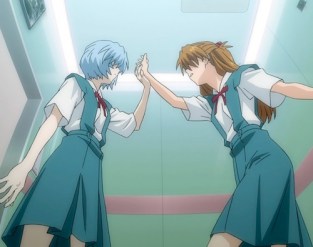 But it’s all building somewhere. For one, there’s another of the film’s best sequences — certainly, its most shocking, which readily earns the 15 certificate. I don’t want to spoil it for anyone yet to see the film, because it’s one of the plot points that differs from the TV series, but it involves the death of a main character in a brutal, deranged way. I say “death” — they pop up in the third film trailer that runs after the end credits, so there’s more to this yet…
Other than that, it sometimes feels like the story is meandering through thematic points that don’t engage as well as the character and action ones earlier in the film. Again, flicking back through, I couldn’t spot what I felt had slowed it, so maybe it functions better on a second viewing, knowing what ending it’s headed towards — at least one apparently minor subplot is, in its own way, vital to the climax, and the climax is certainly vital: unlike the first film’s ending, which was suitably climactic but clearly with story left to tell, this is a major turning point, a proper cliffhanger. Indeed, after a long stretch of confusion, it’s something of a gut-punch to reach such a dramatic point. I loved it, even if I felt I was missing some of the significance of the five minutes that led up to it.
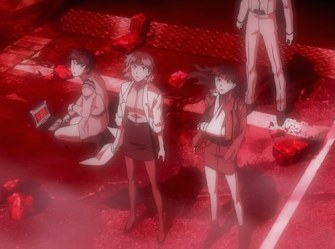 And then, after the end credits, there’s a brief scene that throws another spanner in the works! Double-cliffhanger-tastic… one might say…
Oh, and we get an explanation for why Shinji’s still using a tape player in the near-future (which, you may remember, was a (minor) complaint I had about the last film).
The second new Evangelion film isn’t as straight-up enjoyable as the first. It starts incredibly well, but then it feels like its getting too bogged down in the politics of a world that hasn’t been properly established for us and in the intricacies of some thematic considerations — the latter is especially worrying as it was this that made the ending of the TV series so unsatisfactory, which in turn led to a pair of movies that, frankly, didn’t do that much better. But the ending did cause me to rethink my position a little, and perhaps a second viewing would find the whole film a better structured and more understandable experience.
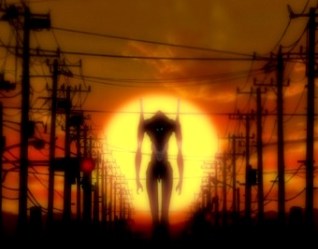 In short, if you’ve always liked Evangelion then you won’t be waiting for me to tell you this is a must-see reimagining; if You Are (Not) Alone was your first experience and you enjoyed it, this is an essential continuation of the story — but be prepared that it’s not as simplistically entertaining. I didn’t enjoy it as much on this first viewing, but it may in retrospect pan out as the better of the two.
Evangelion 2.22 is out on DVD and Blu-ray today.

 #60 X-Men: First Class (2011)
 Law Abiding Citizen is a revenge movie with a (slight) difference: wronged man Gerard Butler isn’t just going after the two criminals who invaded his home and murdered his wife and daughter — he’s going after the legal system that let one of the men walk free.
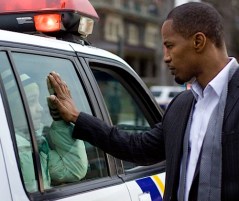 He attends the execution of the aforementioned criminal, but something goes wrong — instead of going to sleep with a lethal injection, the attacker suffers an agonising and horrific death. Someone must have swapped the chemicals. The prosecutors’ thoughts leap to the other criminal, but I’m sure we’ve all guessed who’s really behind this. And so Butler’s sprawling revenge mission begins…
 On the issue of who the film thinks is good and who it thinks is bad,
  It is a little far-fetched, granted, but it’s not so outside the rules the film sets up for itself that I find it unacceptable.
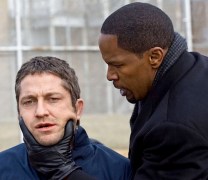 As an action-thriller that actually has something to think about wrapped up in it, I considered being a bit lenient in my score (much as I was to
 That this is the first Western directed by perennial Western star Clint Eastwood is enough to make it worthy of note. To be honest, I’m far from immersed enough in the history of Westerns to know if anything else makes it worthy of note either; but I did like it.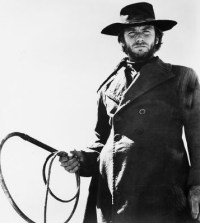
 Eastwood’s first Western in the director’s chair is obviously influenced by those he’s worked with when on the other side of the camera, but by making sure the mix is a bit dark, somewhat ambiguous, but also gratifying in turns, he crafted a supernaturally-tinged revenge tale that packs a few satisfying punches.
 Jonah Hex is not a good film. Let’s just establish that, before I start being nice about it.
 Much of the film rattles on in this way. And rattle it does: 73 minutes before credits. As blockbuster running times spiral out of control, such brevity is almost welcome. It doesn’t feel exceptionally short, mind, except for when the plot occasionally jumps forward.
 — usually improbably — or generally be a female. By “female” I mean “cleavage delivery device”. Considering her acting ability, her lack of presence is no real shame.
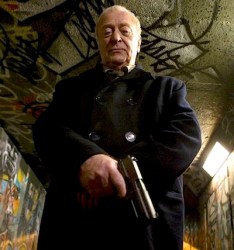
 Michael Caine killing hoodies. How great does that sound? As a film premise, that’s awesome. If it doesn’t get you excited about seeing this movie, then what kind of film fan are you, eh?
 Which in some ways is quite a chilling way to feel. I’ll be buying the Daily Mail and watching Sky News next.
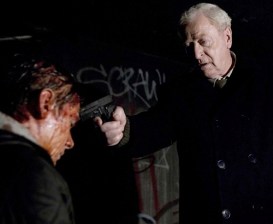 Whatever you may think of the revenge thriller it turns into, I think it’s hard to deny these early scenes have a realism and power. It is, of course, to the credit of Caine that he performs all this flawlessly. Oh yes, he’s (to quote another review) “the king of cool” when blowing away the scum that surround him, but before that he’s an affecting old gent, abandoned by the world.
 The counter to that would be that a murder spree may be viscerally satisfying but isn’t a real-world solution, so this is just as useless at relevancy as Death Wish.
 Some will think it tackles these, others that it’s just a facile revenge movie; some will think it’s cool, others despicable; some will think it plausible, others anything but. Or maybe, rather like me, you’ll think it’s all of those things, however mutually exclusive they may seem.
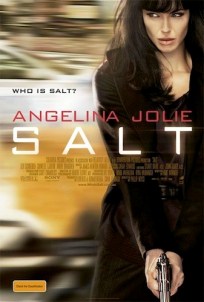 Angelina Jolie takes on a role originally earmarked for Tom Cruise in this Bourne-ish spy thriller from screenwriter Kurt Wimmer (
 This is Salt’s mystery, and this is one of its strong points. The plot developments are well-paced throughout, developing and shifting our expectations rather than stretching it all for a glut of final act reveals. In this regard it goes places you might not expect from a mainstream Hollywood thriller. For starters, you expect the funeral-set assassination to eventually be the film’s climax, no doubt revealing our heroine isn’t a Russian spy as she unmasks the real killer. But that occurs at the halfway point, spinning the film off in new directions. To say more would spoil one of the film’s strongest elements: that, as I said, it has twists and follows storylines you wouldn’t expect in a Hollywood summer blockbuster.
 The three cuts, then, are: Theatrical (100 minutes — this was trimmed for the UK to make 12A, but is apparently uncut on disc); Director’s Cut (the one I viewed, this is 4 minutes 5 seconds longer); and an Extended Cut (1 minute 5 seconds longer than the Theatrical). The latter is based on the Director’s Cut and I’ll come to it in a minute. The differences between the Theatrical and Director’s cuts are numerous, but mainly amount to some extra character beats (including more flashbacks to Salt’s childhood) and violence — more blood; seeing people get hit rather than just seeing Salt firing; the President is killed rather than just knocked out; plus a very different death for Salt’s husband (again, more on this in a moment). Plus there’s a voiceover ending too, which in my opinion sets up the sequel even more than the Theatrical version does, with a blatant cliffhanger and suggested plot direction. My regular comparison site
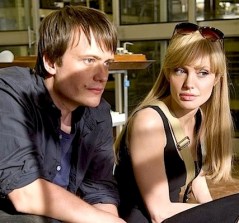 She has to control her emotions so as not to give herself away. In the other versions, however, she’s presented with him in a chamber and given a choice to save him — except trying to save him would give her away, so she’s forced to watch, blank-faced, as he slowly drowns. Salt sacrifices him for the greater good; he dies seeing her cold emotionless face. Ouch. By comparison, the theatrical cut’s blunt gunshot is much softer.
 if the filmmakers considered another option, now we can see it, and in cases like this choose our preference. Though it seems clear, by its inclusion in both the theatrical and director’s cuts, that Noyce preferred the instant-revenge option.
 is a decently dramatic way of drawing out and considering these issues. In my opinion, it works; at least, works well enough.
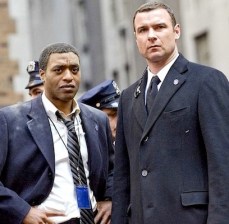
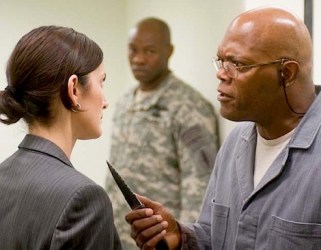 which I don’t think Unthinkable is — I think it argues both for and against torture. Perhaps if the viewer is firmly entrenched in one viewpoint then the film will seem to support it to a polemical level; or perhaps they’d read it the other way, and see it as a polemic against their viewpoint. I don’t know which, though, because I don’t think it comes down hard on either side.
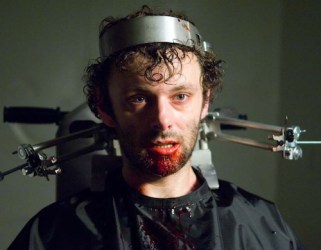 but Unthinkable is not a torture porn film. Yes, it contains torture, and some of it is shown in some degree of detail, but it does not depict it as brutally as it could, and it does not revel in it. This isn’t torture for the audience’s enjoyment, this is torture as a point for debate — “is it allowable to do this to another human being to get results?”, etc. Which brings us to:
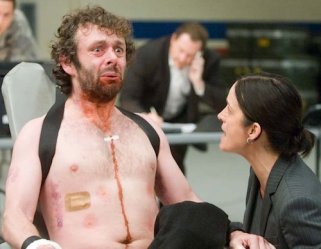 It’s much more important than simply answering a lingering question — it unequivocally presents the ultimate outcome of the characters’ actions. Like the rest of the film, it doesn’t seek to tell you whether this is right or wrong, but shows you where such decisions lead. Moralising is left up to the viewer. (Apologies if this is vague, but I don’t want to spoil it.)
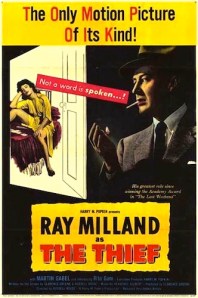 Ray Milland stars as Dr. Allan Fields, a nuclear physicist working at the United States Atomic Energy Commission, who is photographing secret files and passing them to The Other Side, until something goes wrong and the authorities are on his tail. But that’s almost beside the point, because if The Thief is known for anything it’s for its dialogue — as the poster proclaims, “not a word is spoken…!”
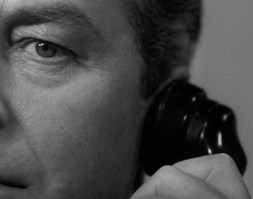 Obviously we can look back to the silent cinema for that kind of thing, but while that era could probably still teach many filmmakers something about visual storytelling, it’s hard to deny that the advent of synchronised sound adds a helluva lot to the ability of film — if it didn’t, it wouldn’t have taken over so fast and remained virtually 100% dominant for the last 80+ years.
 Perhaps this is why the villains are never explicitly named. But they’re definitely not American! Tsk tsk. More crucially, it’s a bit slow at times — it seems to take longer to explain things when stuck doing them through visuals alone. That said, it could probably have survived a speedier approach even doing what it does — perhaps, then, Rouse is playing for time: the film only runs 87 minutes in spite of its pace.
 100Films.co.uk