2010 #97
Jim Mallon | 74 mins | DVD | PG / PG-13
I’m not that well versed in the cult fandom of Mystery Science Theater 3000 but, as I understand it, Turkey Day (i.e. Thanksgiving) is the MSTie (as fans call themselves) High Holy Day (I’m presuming not literally, but who knows?) Something to do with Thanksgiving marathons on whichever network MST3K was on at the time, I think.
Anyway, with that in mind, what better day to finally post my review of MST3K’s big screen endeavour than on that beloved American holiday.
 The world, so they say (and by “they” I mean “absolutely no one” — I’m making this up), is divided into three sorts of people: those who love MST3K, those who’ve never heard of MST3K, and those who have a vague notion of what it is but have, for whatever reason, never seen any of it. (Of course, there will be that fourth group who don’t like it, but my saying’s already stretched at three. This is why I said “they say”, y’see, to absolve me of responsibility for the glaring oversight. But anyway…) I fall into the latter category. Having bought sci-fi mags for the past decade or so (thereby overlapping with the time MST3K was actually in production) I naturally have an idea what it is, but had never actually seen any of it… (you know what’s coming…) (wait for it…) …until now.
For those who’ve never heard of MST3K, it’s a bit like a DVD commentary… except instead of people involved with the film recounting anecdotes or academics offering analysis, we have people taking the piss out of it. I say “people” — one person and two robots. Who are obviously voiced by people. Look, that’s not the point. The movies they watch are all cheaply-made rubbish ones, well deserving of having the mickey taken (not to mention the all important fact that such efforts are generally copyright-free). The bloke and two robots appear on screen at the bottom as silhouettes, because… well, there’s no real need for it, other than to remind you they’re there and remove the issue of disembodied voices. The series started before DVD, remember, so the notion of an “audio commentary” wasn’t yet widely known. Besides which, I quite like seeing them there. OK, they don’t do much besides wiggle their heads or arms occasionally, but it feels more congenial than the disembodied chatter of an audio commentary.
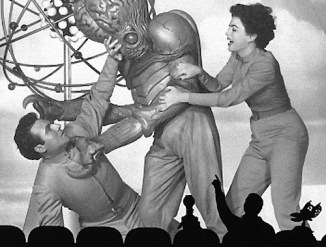 Anyway, the gang set their sights on one film per episode — or, in this feature film, one film per film. They’re being forced to watch these movies, for various unimportant reasons, and every once in a while we get comedic ‘host segments’, where they get up to hijinks on their space station (I forgot to mention, they live on a space station). These bits are well-meaning and quite funny — and in this big screen outing have been shot with a suitably filmic gloss that the video-shot TV episodes lack, which adds a surprising magnitude to the still-small-and-cheap sets and props — but the real meat of the humour is in the riffing over the film.
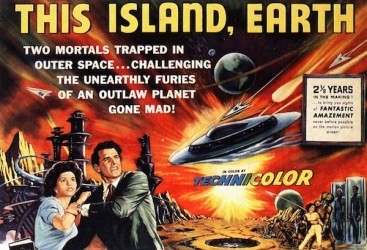
In this film, the film is This Island Earth, Joseph M. Newman’s 1955 sci-fi… film (“2½ years in the making!”). “Classic” wouldn’t be the word, though MST3K: The Movie provoked some controversy among some film critics because they considered This Island Earth to be an SF classic, one that didn’t merit the derogation that MST3K usually lavishes on B- (or lower letters) movies. On the evidence of what we see here (not, it should be noted, the full film, which runs a quarter-hour longer than MST3K: The Movie; including those host segments, quite a lot must be lost), This Island Earth is perhaps of higher quality than some of the films tackled by MST3K, but is clearly a cheap effort and no classic.
Talking of things being shortened (I was, in the brackets), MST3K: The Movie is, unusually, a good fifteen minutes shorter than a regular episode of the series. There are reasons — partly to do with helping mainstream appeal, more necessary on the big screen than a minor cable network, and not wanting to outstay their welcome. Similarly, the jokes feature fewer obscure references than on TV and they’re more spaced out, to make sure people catch them (when laughing as part of a large audience, you see). This latter fact means that when the film is watched by yourself the gags can be more spread out than might be desirable, which is a shame. This improves as it goes on though — clearly most of what got lopped out of This Island Earth was cut from later on, and as the film they’re watching becomes harder to follow so we’re compensated with more laughs.
The quality of the humour varies, as is the case with so many comedies. For me, there were enough laugh-out-loud moments and significant chuckles to make it a good experience; equally, there were also a couple of fart-related gags, something I’ve never found funny personally. There are some current affairs-related references that not so much date the film as lose their currency as time wears on (this is 14 years old now after all), as well as culturally specific jokes that don’t carry across the pond. Such occurrences are an inevitably of this kind of humour, I think, and they’re not too prevalent to destroy the experience. That experience is very much like watching a movie with some mates when you’re in the mindset to take the piss out of the film. That is, if you get on with the characters (as it were) and sync with their sense of humour; if you dislike them or their humour, or like whatever they’re watching too much, then it’s probably more like some irritating yobs nattering away over something you’d quite like to watch thank you very much. (Equally, if you embark on this intending to watch This Island Earth, more fool you.)
MST3K: The Movie was disliked by the production team — too much studio interference during production left it an unpleasant experience. Tales of this pepper the web, if you want to go looking, but they include the studio forcing a story arc on the film, before conducting test screenings (to completely the wrong audience) which concluded they should cut out the resolution to said enforced story arc. Or the stupid release pattern, which failed so badly it’s never been repeated. MSTies have a more mixed response, as far as I can tell, but a significant number like it, particularly those for who it was their first experience of MST3K.
And that’s me, as you may remember. I can see that not everyone will like MST3K — the concept won’t appeal, or the style of humour won’t tickle some funnybones. But if the concept does appeal, the only way to tell is to try. Personally, I can’t wait to get stuck into more of the series. I believe there’s almost 200 episodes…

 #112 The Spiral Staircase (1947)
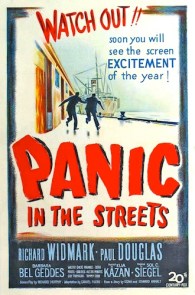 Film noir is a pretty unspecific genre, or unconscious movement, only really defined (however loosely) once it was already over. So to say a film noir isn’t particularly film noir-y might seem a tad daft, but, Panic in the Streets isn’t a particularly film noir-y film noir.
 has a beautifully bad-guy-friendly skull-like face, with his jutting cheek bones and flat-ended nose. (I imagine I’m far from the first to make this observation, but hush.)
 Alternate histories are always fun, and nothing seems to have provoked more than the Second World War. Which, as a defining event in modern history for a good chunk of the world, is understandable. It Happened Here is perhaps one of the earliest examples, depicting a 1940s Britain under Nazi occupation.
 namely, the quiet but methodical enacting of The Final Solution in an occupied territory. The whole film builds to this point, gradually showing the darker and deeper levels of cooperation — which starts out almost harmless and ends with organised mass murder — meaning it never feels like Brownlow and Mollo are pushing an agenda too hard, but still confront us with the reality: that we’d probably succumb too, and this is where we’d end up.
 Another controversy arose over the villains being British collaborators — few German Nazis are seen — and the ease with which many agreed. But this is based in the facts of what occurred in other occupied territories; maybe Britain’s plucky spirit would’ve shown through, as many like to believe, or maybe many would have caved for the easier life — or, indeed, life at all. The film is examining several perspectives of occupation, and using the fictional context to good effect: this could have happened, the film says, however much we like to believe we wouldn’t have collaborated like (and/or resisted better than), say, the French.
 Nonetheless, It Happened Here is more anti-Nazi than pro-Nazi propaganda, in my opinion, though it’s easy to see why any material critical of the Allies could have outweighed the overall bias when the film was first released, just 20 years after victory in Europe. Generally, and viewed from a much more removed perspective, Brownlow and Mollo do a good job of offering conflicting perspectives with minimal comment, allowing the viewer to decide how ridiculous certain newsreels or opinions are, or how weak or misguided characters may or may not be — on both sides.
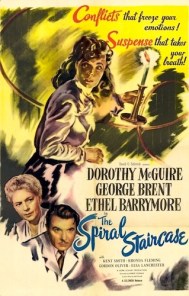 A serial murderer is on the loose in 1900s New England, or 1910s Massachusetts (pick which website you want to believe). His victims are all disabled women, so at the wealthy Warren residence, both family and staff worry for mute maid Helen — particularly as it seems the murderer may be among them…
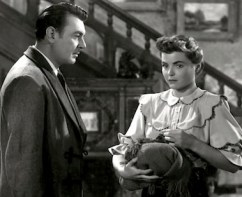 Some viewers allege that it’s at this point the story falls apart; that there’s only one possible suspect. I disagree. Though I can’t say the film entirely had me fooled, there are several suspicious characters, particularly if you’re prepared to consider extraordinary leaps of probability — and in genres like gothic horror, film noir and whodunnit, you should be. Indeed, while some see the killer as obvious others may consider them unlikely; but, for the attentive, the groundwork for the motivation is laid throughout.
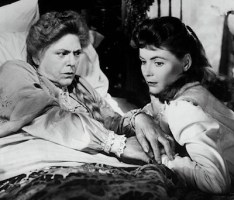 A mention for the sound design, too. Even during simple dialogue scenes, where one might expect silence but for the words in a film of this era, rain lashes against the window in the background, the heavy weather a ceaseless reminder of the threat lurking close at hand. It is, to use a cliché, a character in itself. Thanks to the enclosed setting, we spend a fair amount of time with these characters, and there are good performances too, but that’s for another reviewer to discuss — try
 Force of Evil comes well recommended, with places on several 1,000 Best Movies lists and inclusion both on
  Duncan’s analysis (Force of Evil is one of seven noirs treated to an extended segment in his book) suggests a more complex reading of the film than I took from it, explaining much as symbolic or metaphorical. Considering I didn’t engage with the film, I’m tempted to see Duncan’s reading as a way of rationalising things that either aren’t there or were flawed, but the film’s wider critical acceptance suggests he may well be right.
 Living Free is, in many ways, a tale of obsession. I’m certain that wasn’t Joy Adamson’s intention in writing the book, and I don’t think it’s the filmmakers’ intention either, but the facts can still play that way. The Adamsons devote months of their time, give up a promising career, spend all their savings, drive themselves into debt, and are nearly killed several times, all in a frequently-extreme effort to save three delinquent lion cubs who would be put down were it not for their sentimental attachment.
 The rest of the story moves into What Happened Next territory: Elsa dies, the Adamsons’ obsession with finding and saving her cubs begins. The film skips the book Living Free, adapting threequel Forever Free instead, presumably for dramatic reasons — I imagine Elsa and cubs just living isn’t as much of a Story as her death and subsequent events.
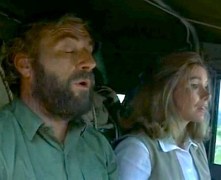 Living Free isn’t as endearing as Born Free. By the very nature of trying to keep the cubs wild, they’re less relatable than Elsa and consequently we become less attached to them. As you may’ve guessed, I found it more interesting to look on the film as a story of obsession, one that threatens to ruin the Adamsons’ lives, though ultimately it has an upbeat ending.
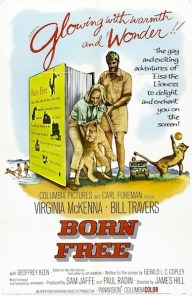 Born Free tells the true story of Joy and George Adamson, a Senior Game Warden in 1950s Kenya, who adopted three lion cubs after mistakenly killing their mother. Though they give two away to a zoo, Joy can’t bear to part with one, Elsa, and so they raise her — until circumstances force them to part with her. Despite Elsa’s age, Joy insists they try to release her into the wild rather than send her to a zoo.
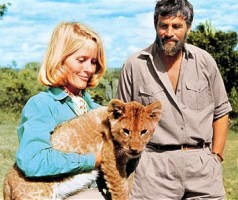 Then there are the other animals, including elephants (always wonderful) and the Adamsons’ adorable pet… rodent… (look, I’m no expert.) Best of all is a head-butting warthog, who has instantly become my favourite film animal. The entire film was worth that sequence.
 This is one of those films I always feel horrendously under-qualified to bother offering any kind of thought on. It’s the kind of film you suspect benefits most not just from repeated viewings and a desire to dig deep into its themes, but also a wider understanding of the director’s work and thematic concerns. This is only compounded in the case of Ozu by the fact I watched
 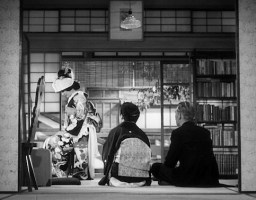 (which bolsters my belief that his most renowned work is indeed worth a second shot). One issue, I suspect, is that I knew nothing of Ozu before my first experience; having read up on him (if only a little), his idiosyncratic squared-off shots and straight-on close-ups feel less blatant and frequent here, and being aware of their deliberateness perhaps makes them less intrusive. That said, I remain unconvinced by it as a guiding notion — I’m sure there’s a reason beyond the proliferation of American cinema that the visual style we’re used to seeing in most film and TV is, well, the visual style we’re used to seeing.
 when the prospect of marriage and leaving her father seriously raises its head. (And I’m afraid that’s the closest to analysis you’ll find here.)
 100Films.co.uk