Transformers: Revenge of the Fallen (2009)

2009 #80
Michael Bay | 150 mins | Blu-ray | 12 / PG-13
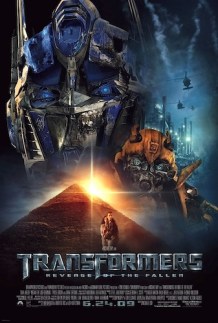
Transformers: Revenge of the FallenIf Transformers was “from the director of The Rock and Bad Boys”, then Revenge of the Fallen is “from the director of Pearl Harbor and Bad Boys II”. If you don’t get what I mean by that… well, let me explain…

The most striking thing about Transformers 2, as it inconveniently isn’t called, is that it’s over-long and indulgent. Has Bay never heard of an edit suite? The writers of a delete key? Anyone of quality control? There are too many ideas, when some should’ve been dropped for clarity and speed; the film could — nay, should — have been seriously trimmed down at every stage of production. By my reckoning, as much as an hour could be lost while still retaining all the best bits of action, humour and plot. Consequently, it’s simply not as much fun as the first film, exacerbating rather than fixing all its flaws and losing most of its charm (it didn’t have the last in spades, but it had enough).

There are good bits though. The humourous scenes highlight this contrast the most: some are genuinely amusing, others simply not, and typically go on too long. All the stuff with Sam at college — why? Especially his mum accidentally eating drugs. Or the jive-talking twins, who’d be this decade’s Jar Jar Binks if only they were as memorable. There are countless other examples — if you’ve read almost any other review you won’t need me to mention the robot balls. When the writers don’t try so hard, however, there are pleasurably funny scenes.

This applies to the action too. Some of it is exciting, but Bay has no genuine concept of rest or pause — sequence after sequence is thrown at the viewer with mind-numbing intensity. There are good beats liberally scattered throughout, but so many sequences means no stand-outs are left because there’s no time to properly process any of them. As in the first film, robot-on-robot fighting is hard to decipher. These Transformers are too realistic (as it were) — they’re all made up of thousands of gunmetal-grey parts; as soon as they come into contact you can’t tell which bit belongs to who and what exactly is hitting where. Even with the extended slow-mo shots — of which there are a lot more than in the first film — by the time you’ve actually worked out what you’re looking at, Bay cuts to the next confusing ShakyCam moment.

When things do slow it’s for brazen ‘character development’ or clunky plot exposition, both coming in great big tell-don’t-show info-dumps. At one point, one character literally urges another to “explain the plot”. The character scenes are equally forced, the dialogue functioning at a level of state-the-obvious inanity. Bay treats women with a similar absence of subtlety — every scene featuring a female is shot like a moving version of FHM, all skimpy clothes and slow-mo jiggling. The only exception is Sam’s mother.

Technically, the CGI is almost flawless, only the occasional brief shot failing to achieve little less than photo-real perfection. Bay’s typical tech fetish is also in evidence, suggesting he looked at a couple of car and military mags when he picked up that inspirational FHM. Bizarrely, however, the sound mix strikes me as a flawed technical element. I found it so odd that I had to download the digital copy and listen in plain old stereo to check there wasn’t something haywire in my surround setup. By the end it’s sounding as you’d expect (largely), but throughout there are unusually spartan patches, lacking in the music or hard-hitting explosive sound effects one expects. Perhaps we should be grateful that it’s less bombastic and wall-of-noise than you normally find in such action films, but it renders the soundtrack disconcerting at times.

On its cinema release, Revenge of the Fallen unsurprisingly jumped on the recent bandwagon of having an IMAX release, although at least some parts of the film were shot for the format — just like The Dark Knight, although with nothing like the same level of attention lavished on this in press coverage. According to the BBFC, the IMAX-exclusive version ran 91 seconds longer — 151:16 as opposed to 149:45. According to my player, the Blu-ray runs 149:53. It seems that, despite Bay’s promise of releasing the slightly-extended IMAX cut, complete with Dark Knight-style shifting aspect ratios, Paramount have been less faithful than Warner. Perhaps they considered the typical Transformers 2 fan incapable of grasping such a concept. Not that it really matters — if there’s one thing this film doesn’t need it’s to be any longer.

At times it’s like an uncomfortable amalgamation of Saturday morning cartoon and more adult-orientated action-comedy. On the one hand you’ve got a top-secret organisation with a semi-plausible acronym for a name (NEST) that sees soldiers and good giant robots travelling the world fighting bad giant robots, all without the public noticing. On the other, you’ve got whole sequences about drug use, almost brutal fight scenes, and lad’s mag-level slow-mo shots of girls running, changing and having their short dresses hiked up by robotic tails. (To be fair, there’s only one robotic tail.) In other words: if you’re an average 13-year-old boy, this is the Best. Movie. Ever.

For the rest of us, Revenge of the Fallen is, at best, the kind of blockbuster that might benefit from a second viewing, though probably after some time has passed. It’s not likely to create a better impression of the character development or comedy, but perhaps the MacGuffin-packed plot (there are at least three) would be easier to comprehend, the mythology-dumps easier to stomach, and the massive fights easier to follow. At worst, it’s a hurried production that would have benefitted greatly from some judicious editing from script level upwards. This is what happens when a studio allows someone like Bay an essentially limitless budget and less than two years to turn a blockbuster around.

3 out of 5

Transformers: Revenge of the Fallen is released on DVD and Blu-ray in the UK tomorrow.
Watchmen: Director’s Cut (2009)

2009 #79
Zack Snyder | 186 mins | Blu-ray | 18 / R

This review contains spoilers.

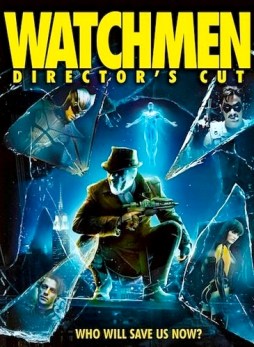
Hitting US Blu-ray so long ago that it’s shameful I haven’t watched it ’til now, and finally arriving in the UK next Monday, the Director’s Cut is Zack Snyder’s final vision of Watchmen: The Movie. The Ultimate Cut (currently available in the US but with no confirmed UK release), which integrates the animated Tales of the Black Freighter into the main feature, is, in Snyder’s words, “an experiment”. Maybe one day he’ll change his mind and say that’s actually his definitive version; I suppose these days — when it seems every major film has a proliferation of different cuts across theatrical release, home entertainment release, and home entertainment re-release — such a thing as a “definitive version” doesn’t necessarily exist. But that’s a debate for another day: for now, this — not The Ultimate Cut, and certainly not the theatrical cut — is Snyder’s Watchmen.

That said, I wouldn’t be inclined to say it’s vastly different to the previously seen version. There are some obvious new scenes and extensions, especially if you’re familiar with the original novel, but ultimately I didn’t find the additional 24 minutes created a vastly different experience. Most of the flaws still remain, from the unfixable — Malin Akerman is somewhat miscast; sometimes episodic storytelling (a largely unavoidable side effect of faithfully adapting a novel that is very much a story in 12 parts, as opposed to a story divided into 12 chunks) — to those that Snyder could potentially have rectified — the alley fight/Manhattan interview crosscutting still doesn’t quite work; Bubastis is inadequately explained; too little time is devoted to the large cast of secondary characters in New York to give Adrian’s plan the same emotional kick it has in the novel; and so on.

By the same token, none of the great bits are ruined, while some are enhanced. Although mostly faithful to the novel, the changes Snyder and co have made are almost all for the better: Rorschach’s “what do you see?” beats the fan-favourite landlady scene (goodness knows why it’s a fan favourite), and Matthew Goode’s slightly built, faintly Germanic Veidt seems a more natural fit for the character now than Gibbons’ more butch version (possibly only in my opinion, that one). Best of all is the modified climax, which retains all the significance of the original but, by changing the way in which it’s brought about, streamlines and tidies up the storytelling. The giant squid is a great comic book image, but this is superior plotting, especially in the abridged form a film adaptation must take.

As for the new bits themselves, some are slightly misguided — Rorschach’s escape from Blake’s apartment, for example, is wholly unnecessary; it shows him injuring a policeman, an incident now referred to over the next few scenes, but we don’t need to see it to follow the references, and showing it gets in the way of the previously perfect match-cut from the Minutemen photo in Blake’s apartment to the same one in Hollis Mason’s. By and large, however, the extensions add depth via little lines and moments. The most noticeable are a better building of Laurie’s backstory, and Hollis Mason’s death. The latter is a little ancillary to the main plot, its excision from the theatrical version easily justified to keep the running time down, but in itself is a well-played and tragic scene that adds further resonance to the end of Dan’s story.

Whatever you thought of Watchmen after the theatrical cut, this extended version is likely to change your opinion no more than any other re-viewing would. That said, with a little extra room to breathe and a few worthwhile extensions, and in spite of the odd tweak that doesn’t work, this is the superior cut of the film.

5 out of 5

Most of the comments in my lengthy review of the theatrical cut still stand, so I invite you to read it here.

Watchmen: Director’s Cut placed 3rd on my list of The Ten Best Films I Saw For the First Time in 2009, which can be read in full here.

Three in 3D

As you may have noticed, Channel 4 have just had a 3D week. Arguably lacking in content, it included three films. I subjected myself to all of them to provide you with the following…

#75
Flesh for Frankenstein
1973 | Paul Morrissey | 95 mins | TV | 18 / R

“The best thing about the extra dimension is that it provides some genuinely impressive visuals throughout, and not in the gimmicky, thrust-stuff-into-the-audience way — naturally there are some of those shots, but… there are also shots that demonstrate why 3D could be genuinely valuable, to visuals if not necessarily to storytelling.”

2 out of 5


#77
Friday the 13th Part III
1982 | Steve Miner | 91 mins | TV | 15 / R

“They have a whale of a time shoving stuff out into the audience for almost no reason — just like the stereotype of 3D films, of course. That’s part of the fun of trashy 3D movies so I’m not criticising it, but what sadly doesn’t work is the ColorCode 3D system chosen by C4.”

2 out of 5


#78
Hannah Montana/Miley Cyrus: Best of Both Worlds Concert
2008 | Bruce Hendricks | 72 mins | TV | U / G

“The only real exception is the 3D — being a very recent production, that was flawless.”

1 out of 5


It’s quite easy to see why 3D’s never taken off before. Even here, there are some good and/or notorious 3D films they haven’t bothered to show, which is a shame. Now they’ve distributed all those glasses, maybe they’ll consider just slipping some 3D films into the schedule now and again in the future. Doubt it, but it could be fun.

Hannah Montana/Miley Cyrus: Best of Both Worlds Concert [3D] (2008)

2009 #78
Bruce Hendricks | 72 mins | TV | U / G

Hannah Montana and Miley Cyrus: Best of Both Worlds Concert UK posterRubbish. In almost every way possible.

I could expand on that in numerous ways, but what would be the point? The only real exception is the 3D — being a very recent production, that was flawless.

Take solace in the fact that one day — hopefully, one day soon — Cyrus, Montana, this ‘movie’, and all the rest, will be completely forgotten.

1 out of 5

This was shown as part of Channel 4’s 3D Week. That’s why.

Hannah Montana/Miley Cyrus: Best of Both Worlds Concert featured on my list of The Five Worst Films I Saw in 2009, which can be read in full here.

Friday the 13th Part III [3D] (1982)

2009 #77
Steve Miner | 91 mins | TV | 15 / R

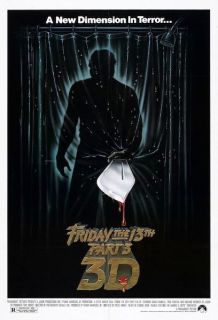
Friday the 13th Part IIIJason’s back!

Oh, forget it — I can’t get excited about that. I’ve never even seen a Friday the 13th film, and had no intention to ’til Channel 4 showed this in 3D. Fortunately, general cultural awareness of who Jason is and what he does is all that’s required to understand this third entry in the never-ending franchise.

It’s pretty much your stereotypical horror movie: a group of teenagers just waiting to be slaughtered, a remote cabin-like location, lots of jump scares over nothing, a supernaturally-powered killer stalking them for no apparent reason, lots of gory deaths which have more thought put into them than the plot, characters and dialogue put together… The acting’s all at the level of a high school play, which probably does a disservice to most high school plays. There’s no point wondering who’ll die, because inevitably they almost all will. All this considered, it’s a passably entertaining genre entry.

The good bit here, however, is the 3D. They have a whale of a time shoving stuff out into the audience for almost no reason — just like the stereotype of 3D films, of course. That’s part of the fun of trashy 3D movies so I’m not criticising it, but what sadly doesn’t work is the ColorCode 3D system chosen by C4. It provides lovely depth to normal scenes, but as soon as something’s attempting to come out at you it fails. It could be the age of the film producing flaws in the process as newer things shown during 3D Week have been better, but most do come a cropper as soon as something attempts to come out of the TV as opposed to go deeper into it. Oh well.

Friday the 13th Part III is what it is, and if that’s what you’re after that’s fine. At least the 3D silliness adds an extra dimension of enjoyment. Pun very much intended.

2 out of 5

Flesh for Frankenstein [3D] (1973)

aka Andy Warhol’s Frankenstein

2009 #75
Paul Morrissey | 95 mins | TV | 18 / R

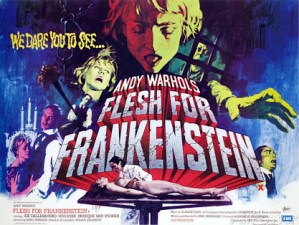
Flesh for FrankensteinFlesh for Frankenstein is thoroughly daft. But it’s also in 3D, so let’s start there.
The best thing about the extra dimension is that it provides some genuinely impressive visuals throughout, and not in the gimmicky, thrust-stuff-into-the-audience way — naturally there are some of those shots, but they seem to work quite poorly here. That could be the fault of Channel 4’s chosen 3D system, or perhaps of watching on a TV rather than a huge screen. Either way, there are also shots that demonstrate why 3D could be genuinely valuable, to visuals if not necessarily to storytelling. For example, early on the wife/sister (a discussion for another time) and her kids go for a picnic. It’s shot from a distance through branches in the foreground, which highlights that there’s a realistic sense of depth to every element of the frame that just isn’t present if you see the same shot in 2D — I know, I checked. For perhaps the first time, I got a sense of why some people harp on about 2D flattening composition.

Unfortunately, while the 3D system used is sometimes flawlessly brilliant, at others it seems to have gone wrong. There’s an odd green ringing in some shots, while at others it appears they’ve used the wrong shade of blue for monochrome-depth because it shows up (in scenes that work, the blue is clearly visible if you take the glasses off, but invisible with them on). Such problems are intermittent in the stuff shown during 3D Week, leading one to suspect it’s as much a fault of the age of the film elements.

I can also now see why people have been complaining so much about 3D — it feels like a constant struggle and strain to watch, like you’re always having to make it work. Perhaps that’s partly down to the technical flaws described above though, because I didn’t suffer as much during an hour of Derren Brown’s Magic Spectacular, whereas here I could feel the strain after just 15 minutes.

As for the film itself… The plot doesn’t make any sense for about 20 minutes, then Udo Kier’s Frankenstein (I presume he’s Frankenstein, I don’t think he’s ever addressed as more than Baron) has a bit of a monologue to explain his Hitler-ish Cunning Plan — to someone who already knows it, naturally — and suddenly most of what’ll happen for the rest of the film is abundantly clear.

The acting is uniformly atrocious. Despite that, it also provides the film’s best moments: the European cast are unable to pronounce “laboratory” — every time it’s uttered it comes out as “lavatory”. Childish I know, but it’s one of the film’s few enjoyable moments. “I had to work for two years before I could even stick my nose in the lavatory” is an instantly classic line. (As is “To know death, you have to fuck life in the gall bladder” — literally, apparently.) Continuing the accented madness, the good-guy serf sounds to be from Brooklyn. At least he can say “laboratory”.

Gratuitous nudity and gore belie some critics’ apparent view that it’s only with the emergence of torture porn that operation-level gore has become a selling point of horror movies — it’s only become more realistic. Just as the gore’s silly, so the sex seems misguided — whoever cast the whores seems to have found believable rather than attractive ones. Oops. That said, whoever in the sound department thought the most realistic sound effects for various sex acts could be found by having someone suck on a balloon, loudly, was even more misguided.

Apparently it’s all meant to be satirical or Pythonesquely humourous. Well, maybe, but it sails too close to the winds of genuine crapness to let such a defence fly — though, as noted, that certainly makes it laughable. Weak in just about every way imaginable, if you’re after a horror, gore, porn or 3D fix, look elsewhere. For “so bad it’s good” value, however, I’ve kindly given it an extra star.

2 out of 5

Ripley’s Game (2002)

2009 #67
Liliana Cavani | 106 mins | TV | 15 / R

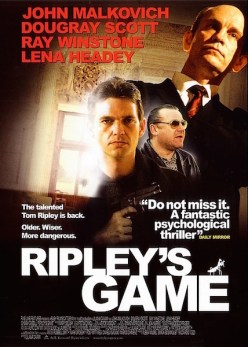
Ripley's GameMatt Damon is back as… Oh, wait, no he isn’t — he’s turned into John Malkovich.

Not quite — there’s no reasonable way Ripley’s Game can be considered a sequel to Anthony Minghella’s The Talented Mr Ripley. Though it’s adapted from a later novel in Patricia Highsmith’s Ripley series (previously filmed as the Dennis Hopper-starring The American Friend, incidentally), the action is relocated to the present day, and it’d be a pretty hard sell to believe Matt Damon would grow up to be John Malkovich.

Despite the acclaim of Minghella’s effort just three years earlier, and a cast that includes recognisable faces such as a Ray Winstone, Dougray Scott and Lena Headey alongside Malkovich, Ripley’s Game snuck out with barely anyone noticing, including going straight to TV in the US. There are surely reasons for this, reports of a problematic shoot probably among them, but the neglect is undeserved. In 2006, Roger Ebert saw fit to include it in his Great Movies list, though other critics are less favourable (the Radio Times, for one handy example, rate it just three out of five). While Ebert is in my opinion overselling the film by including it in a list of the best films ever made ever, it’s certainly an above average, consummately made, and constantly entertaining Euro-thriller.

Perhaps the difference in opinion about the film stems from one, arguably crucial, sticking point: the Radio Times criticises the humour included in the murders and thriller sections, viewing it as a failure of director Liliana Cavani; conversely, Ebert approves of it, praising them as appearing somewhere “between a massacre and the Marx Brothers”. There’s undoubtedly more to the diverging opinions than this, but it’s at least emblematic. I’m inclined to agree with Ebert: these sequences do have tension — not the most one’s ever experienced in a thriller, but enough — but they marry the humour to it, leaving you chuckling on the edge of your seat.

For the most part the story keeps moving, twisting and turning in sometimes unexpected directions. Other films would happily take the first half-hour or so of this and stretch it to a whole feature, but screenwriters Charles McKeown and Cavani — adapting from Highsmith’s novel, of course, so the credit lies with her — take the premise further and in new directions. It’s not flawless, with the climax by far the biggest let down: Ripley and Trevanny hole up in the former’s villa, preparing for a veritable war as Ripley anticipates goodness-knows how many men to turn up. When it’s only two, it seems more believable than a whole army of mafia goons descending on the relatively insignificant pair, but it’s also distinctly anticlimactic after the hype. Still, at least the story has a final twist up its sleeve.

Malkovich may be a fairly respected actor, but to me he’s always seemed detached, flat, or mannered — often all three. Here, he’s still all three, but it suits Ripley’s unusual character down to the ground. His dry wit and incessant matter-of-fact delivery craft a quietly sinister, stalking nature, aiding the character’s believable unpredictability — that is to say, you’re never certain what he’s going to do next, but when he does it’s not surprising. I’ve never read a Ripley novel (there are five) nor seen another Ripley film (there are four), but Malkovich’s performance fits so perfectly I have little doubt this is precisely how Ripley should be played.

Among the rest of the cast, Ray Winstone is landed with a role he could play in his sleep, Lena Headey is perfectly fine as an unremarkable wife, and Scot Dougray Scott plays a none-more-plummy Brit. Unfortunately this accent sometimes seems to be the main focus of his performance, and it occasionally falters when he gets highly emotional, but it’s not really a problem… though it is rather odd to hear if you’re familiar with how he normally sounds. His character, Trevanny, is primarily a pawn in Ripley’s titular amusement, leaving Scott with only a passing hint of the character arc with which the role could have been gifted.

As noted earlier, there are numerous tales of problems on set, not least the multinational cast coping with a multinational crew in multiple nations, culminating in Cavani leaving towards the end of shooting and directorial duties being fulfilled by Malkovich. But as many have noted before, happy sets can produce dreadful movies and unhappy sets masterpieces, and while I don’t quite share the view that Ripley’s Game is entirely the latter, it certainly errs more in that direction than the other.

4 out of 5

Wallander: Before the Frost (2005)

aka Mankell’s Wallander: Innan Frosten

2009 #74
Kjell-Åke Andersson | 93 mins | TV | 15

You’re likely familiar with Swedish police detective Kurt Wallander — in passing if not in detail — from the Kenneth Branagh-starring BBC series broadcast at the end of last year (a second series has just finished filming). For the sake of omitting excusatory clauses from the next paragraph, I’ll assume that’s all you know (not that I mean to sound like an expert, because, well, I’m not).

Wallander is adapted from a series of novels by Swedish author Henning Mankell, previously filmed in their original language, between 1994 and 2007, as a series of TV movies starring Rolf Lassgård. A different series of Swedish Wallander films began in 2005 — so, concurrent with the TV adaptations — featuring Krister Henriksson as the titular detective in original stories based on plots by Mankell. Three of these thirteen films received a theatrical release, the remainder going direct to DVD. It’s this latter series that BBC Four are currently halfway through showing, and it’s their theatrical releases that will see three of them reviewed as part of 100 Films 2009.

Before the Frost is the first of this series, and is actually an exception: where the others are original stories, this is adapted from a spin-off novel starring Wallander’s daughter, newly-qualified policewoman Linda Wallander. This leaves Kurt as something of a guest star in the first episode of his own series, but we still see enough of Henriksson to get a feel for his Wallander. Where Branagh is soul-searching, constantly staring silently into the distance, occasionally with a few tears for company, Henriksson is just a guy trying to do his job; struggling to be a good dad and maybe struggling with his health, but still a regular guy. Maybe the introspection and crying come later.

As the de facto lead, Johanna Sällström gets the best of the material. Linda’s troubled relationship with her father, including her decision to work in the same station as him when she could’ve gone anywhere but, are major threads. Sällström plays this central contradiction well, only occasionally (and, thankfully, briefly) slipping down into stroppy teenager histrionics, such as when she storms away from a crime scene early on. As Linda’s friend Anna, Ellen Mattsson also has daddy issues to contend with, though sadly they’re underwritten by comparison. Nonetheless, her significant role is finely portrayed.

Sadly, the majority of the detective story isn’t up to the personal relationships. The villains turn out to be Evil Christians — always a good enemy in my book — with a variety of nefarious plans that lead the story to touch (briefly) on hot-topic issues like abortion, single-parent artificial insemination, and same-sex marriage. While a British or American drama might feel the need to include more of a debate about the morals of such acts, here they seem accepted as a right that the Evil Christians want to steal. Though this arguably leaves them under-considered, it’s a refreshing change of pace.

More problematic is that the villains are never properly introduced or explored. Some events are undersold — a woman is murdered for no decent reason, a case of wrong-place-wrong-time, but once her body is discovered no thought or mention is given to her unfortunate luck or her family’s grief. Obvious deductions stare Wallander and his team in the face yet they fail to make them — the length of time it takes anyone to twig that the fundamental Christians might intend to attack the high-profile gay wedding is astounding. All of these faults rob a few plot twists of their full potential, though at least one still left me surprised and feeling like I should have spotted it (which, of course, is what a competent twist ought to do). Arguably, however, there’s too great a reliance on coincidence to connect all the dots.

Visually this Wallander is as different from the BBC’s as Henriksson is from Branagh. Where the British one seems to attempt an emulation of what our idea of Sweden might be — all cold, desaturated blues and greys, lingering shots of vast empty countryside, and so on — the Swedish version is more, well, normal. (That said, early on it contains a perversely beautiful shot of two swans in flight while engulfed in flames.) No doubt the differences between series are the product of the British version trying to create a Foreign Culture while the Swedish one is just content with filming it as-is, much the same as British-set British dramas do with Britain. On a broadly related note (in that they’re visual), the subtitles are mostly fine, though some jokes and language tricks are unfortunately lost in translation.

Before the Frost is, sadly, not all it could be. Whether this is the fault of Mankell’s novel or Stefan Ahnhem and Pelle Berglund’s adaptation I don’t know (I’ve never read a Mankell), but while it seems fine as it goes along a bit of reflection reveals all these niggling gaps. That might be a little harsh though, as there’s still much to admire and enjoy in the first of what could be a fine series.

4 out of 5

The second theatrical release, Mastermind, was on BBC Four last week and is available on iPlayer for another 24 hours. The third, The Secret (aka Hemligheten), is episode thirteen and will air later this year.

Ashes of Time Redux (1994/2008)

aka Dung che sai duk redux / Dong xie xi du zhongji ban

2009 #71
Wong Kar-wai | 90 mins | TV | 15 / R

Ashes of Time ReduxA wandering man with magic wine and no memory; a clan prince who’s also his beloved sister; a master swordsman who’s almost blind; his wife, who loves his best friend; a persistent peasant girl after revenge for her little brother, with only eggs for payment; a young swordsman with no shoes and a camel; a large gang of bandits with a left-handed member; and a desert-dwelling problem solver who connects them all. Oh if only Ashes of Time were as simple as that sounds.
Despite apparently being an Eastern action movie — it’s in the wuxia genre, which, for the uninitiated, also covers the likes of Crouching Tiger, Hidden Dragon and House of Flying DaggersAshes of Time isn’t what one would typically expect from such a billing. Reviews talk about it being a confusingly-plotted art film — and those are the positive ones — which, coupled with my relative dislike of Chungking Express, meant I didn’t really expect to like it a great deal. But I found myself surprised, because I really enjoyed it.

For one thing, I followed the plot right to the end, though the final fifteen minutes throw up a series of twists to rival any thriller. I don’t claim to understand every nuance of every character, the meaning of every event, exactly how everything is connected (assuming it is), or what it’s really all about… but based on what I’ve read, even following it is an achievement on a first viewing. I felt more or less the same way at the end of The Big Sleep, and the trick here is the same: pay attention. Yes, this requires some effort on the part of the viewer — I was aware of myself paying close attention throughout in order to follow and comprehend the story, more so than in most films (even discounting easily-followed mainstream-aimed efforts). An awareness of this need for hyper-attentiveness from the get-go (which, as I say, I had thanks to perusing a couple of reviews) is likely to aid the viewer (which, as I say, it did me).

The story itself, then, is quite episodic. There’s some overlap, but in general characters come and go from the problem solver’s home in a parade, rarely interacting with one another. Each individual piece explores a different facet of a similar theme — “anecdotes about chivalric swordsmen”, as the Radio Times puts it — which serves to tie them together, alongside other plot elements and character points — several have wives in love with others, for example, while others have left their wives at home and one has been followed by his.

Wong (again, so I read) broke ground within the genre by prioritising emotion over action. Therefore potential viewers shouldn’t expect the abundant martial arts/swordplay the genre often provides. If Hero was too arty for you (as it was for me first time round), then this will almost certainly be beyond the pale. Despite the paucity of action — despite several stories concerning assassination and death, the actual act isn’t the point in the slightest — when it does turn up (the first significant sequence is halfway through) it’s excellent; effectively, if differently, done.

Indeed, the film is beautifully shot; perhaps not as obviously as Hero’s colour-coded vibrancy, but there are frequent moments that dazzle and I can’t recall a single weak visual. Wong mucked about with the colours as part of his reduxing, to the reported distaste of cinematography Christopher Doyle, but it still looks stunning throughout.

Wong’s 2008 redux included not only these tweaks to the visuals, but also modifications to the audio and losing seven minutes from the original cut. I’ve never seen it so can’t compare, though some reports claim the changes helped clarify the plot. For the curious, a catalogue of differences can be found here. Equally, those after better-informed reviews might like to read DVD Times’ coverage, with Noel Megahey on the DVD and John White on the BD, and Heroes of the East’s review of both cuts.

Having pointed you toward those wise reviewers, let me just say that Ashes of Time Redux is not your typical wuxia film and not for everyone. My enjoyment of it came as something of a surprise, which is always nice.

4 out of 5

Film4 are showing Ashes of Time Redux tonight at 1:05am.

High Anxiety (1977)

2009 #65
Mel Brooks | 94 mins | TV | 15 / PG

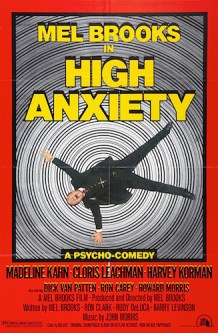
High AnxietyMel Brooks pays comedic tribute to Alfred Hitchcock — in case you can’t tell, the second credit is a prominent dedication — but those unfamiliar with the Master of Suspense’s output need not apply.

Brooks presents a largely Hitchcockian plot, though the clearest references come in a couple of sketches and one-liners. To be fair, there are several significant Hitchcock films I’ve still not seen, leaving the nagging sensation that some allusions and gags simply passed me by. On the other hand, maybe they just weren’t funny — I can’t remember many laughs that didn’t spring from a Hitchcock reference of some kind.

Indeed, whole chunks pass by without a laugh. At other times, bits that are clearly meant to be funny just don’t hit home (though I’m aware that, inevitably, they will for some people), while some gags are almost reassuringly familiar: a dramatic piece of music kicks in, causing characters to look around until they see a band in full swing has appeared nearby, for just one example.

Things pick up considerably in the second half, which is also more obviously Hitchcockian to my mind. Some scenes offer very good, though specific, riffs on famous Hitchcock moments — a version of Psycho’s shower scene is particularly memorable, though a scatological take on The Birds will please some — but these are almost exclusively asides to the story, little sketches inserted wherever Brooks can find space to squeeze them in. They provide welcome amusement, but are far from integrated into the plot.

At this point I’m beginning to suspect Brooks’ humour just doesn’t gel with me. I enjoyed Spaceballs when I was younger, but watching it a couple of years ago I found it more embarrassing than entertaining. Even the widely praised Blazing Saddles raised little more than the occasional smile. High Anxiety, unfortunately, now joins this line-up.

2 out of 5