The Wizard of Oz (1939)

2008 #60
Victor Fleming | 98 mins | DVD | U / G

The Wizard of OzThe Wizard of Oz is one of those films whose reputation unavoidably precedes it. Considering it’s nearly 70 years old now, that’s a reputation long in the making.

The biggest problem with this is that, coming to it for the first time as an adult, one knows just about everything that’s going to happen. There are still some gaps to fill for the uninitiated — it takes a surprisingly long time to get to Oz, and a surprisingly quick time from there to the Wizard — but it mostly feels oddly disconcerting: it’s such a well-known tale, even to those of us who hadn’t seen it, that having it played out in full, complete with bits one didn’t know about, is strange. That’s not really anything to do with the film, of course, just my personal impression.

My other observations amount to little more than “the second half is surprisingly light on musical numbers” and “the transition from sepia to full colour is still highly effective and glorious to watch” — as the (very interesting) restoration featurette on the DVD details, it literally looks better now than it ever has before. Beyond that, I had the sense that the film would exert a greater sense of wonder over the very young. That’s appropriate enough, but it means that, coming to it a tad later in life, it’s not a film I’m ever likely to really love.

4 out of 5

Cathy Come Home (1966)

2008 #59
Ken Loach | 77 mins | DVD | PG

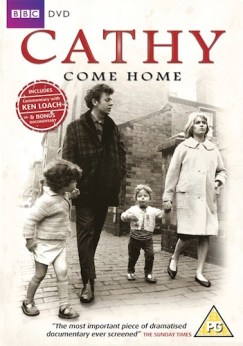
Cathy Come HomeTechnically a one-off TV drama from the BBC’s Wednesday Play strand, Cathy Come Home more than deserves consideration as a film in its own right, due to it being an early work of director Ken Loach, the fact that it’s shot largely on film using relatively experimental storytelling techniques, and also considering the huge social impact it had.

The piece tells the story of Cathy, a young woman who leaves behind a comfortable life for the excitement of the big city. There she falls in love with Reg, who she marries and has children with. But, through a series of incidents and accidents — most of them no fault of their own — Cathy, Reg and the children wind up without a house, and then gradually slide down the scale toward homelessness. In this respect the film can remind us of a facet of the ‘good old days’ that is often overlooked when our collective memory of the ’60s is made up of James Bond, the Beatles, and programmes like Mad Men. The drama also had a big impact at the time: 12 million watched, it boosted the newly-formed charity Shelter, led to debates in parliament, and, eventually, changes to the law.

Loach structures the film cleverly: Cathy and Reg’s slide into poverty is all too believable, while at the same time allowing the viewer to see a cross section of the homeless experience. He employs a documentary style throughout, so effectively that it still fools some into believing the whole piece is factual. In fact there’s a mix of interviews with those really suffering such situations, and performed scenes that are shot and cut disjointedly, as if they were observed rather than written. While some of the performances give the game away, they’re never poor enough to really detract. The downside of this style is that the storyline isn’t always clear. I’m still not sure if it was Cathy’s children that died in the caravan fire or someone else’s, just one among a few such examples. While ambiguity is no bad thing — the cruelly unresolved ending being a case in point — it sometimes just seems like a hole in the narrative. However, these moments are relatively minor, and certainly don’t dint the film’s impact.

Cathy Come Home is a powerful piece of work; an undoubted television classic that (bar a few technically-incongruous studio scenes shot on video) wouldn’t look out of place on a big screen. As an important and timely history lesson, a challenge to prejudices that some of us may hold, and a reminder of how close most of us are to such a fate — especially right now — it remains essential viewing. Sadly, I suspect it always will.

5 out of 5

Texas Across the River (1966)

2008 #58
Michael Gordon | 101 mins | DVD | PG

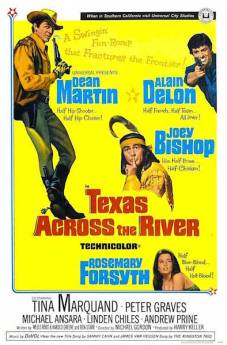
Texas Across the RiverTexas Across the River hardly seems to be a well-remembered film — the only DVD edition available (as far as I can tell) is a legally-produced DVD-R, clearly in the wrong aspect ratio. I only come to see it because a friend happened to have a VHS as a child, enjoyed it back then, and we managed to track down that DVD. [It was later released on UK DVD in 2012. (Amazon claim 2007, which is clearly BS.)]

And actually, it’s a fairly entertaining film. Little more than a comedic Western runaround, it sees Alain Delon — as a Spanish nobleman — trying to get to Texas to escape the Cavalry (led by Jim Phelps himself, Peter Graves) and marry his betrothed. On the way he enlists the help of Dean Martin and his Indian sidekick. Hilarity ensues!

OK, so it’s probably funnier if you watch it before your age hits double figures, but it still has enough entertaining moments and decent gags that its complete expungement from almost anyone’s consciousness seems unwarranted.

I don’t expect it’ll ever undergo some miraculous revival (it’s not that good), and perhaps is of primary interest as a curio for fans of Dean Martin, Alain Delon or Mission: Impossible, but it made me laugh — and, as I believe I’ve said before, that’s all I really ask of a comedy.

4 out of 5

Flushed Away (2006)

2008 #57
David Bowers & Sam Fell | 81 mins | DVD | U / PG

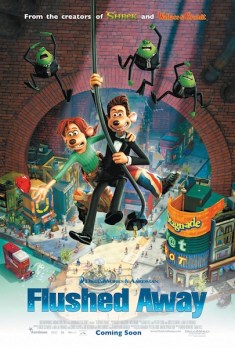
Flushed AwayAardman Animations, the Bristol-based company most famous for Wallace & Gromit and Creature Comforts, branch out into CGI for the first time with this tale of rats trying to save the sewers of London. CGI rats? Yes, thoughts of Ratatouille are inevitable. Can Aardman beat Pixar at their own game? You might be surprised…

The primary reason for comparison here, as mentioned, are the rats. Despite Pixar’s stated intention to redeem rats in the eyes of viewers — to turn them from vermin into loveable little fluffy things, essentially — I felt the same about bloody rodents at the end of Ratatouille as I did at the start. Here, however, they’re Disneyfied (oh the irony) — where Pixar had cartooned versions of the real thing, Aardman have given them a human shape. It’s surely this disjunction from reality that makes them more likeable, but it does mean there’s never that distracting “but they’re vermin” impulse. They’re humanisation is helped by the performances of a star-studded cast, including Hugh Jackman and Kate Winslet amongst the ratty voices. Ian McKellen is a fabulously dastardly villain, ably supported by a pair of comedy henchman… and Jean Reno as a French frog. Yep, the humour is that British.

One thing Pixar unquestionably still excel at is the actual animation, however. Ratatouille is gorgeous to watch and will take some effort to beat; Flushed Away, on the other hand, doesn’t really come close to Pixar’s earlier efforts, never mind Ratatouille’s artistry. It’s mostly passable, especially once the action migrates to the mini-London in the sewers, but at other times it looks little better than a computer game. The second biggest mistake (I’ll get to the worst in a minute) is opening the film in a pristine up-market house — presumably it was an artistic choice to have it so tidy and clean, but this has the unfortunate side effect of highlighting the animation’s plainness right from the start. Once the story moves underground the level of detail improves, but it takes a little while to get there.

A bigger error was made with the lip-synching, however, and obviously this dogs the film throughout. Aardman consciously designed the characters’ mouth movements to imitate the clay animation the company usually employs (Flushed Away is CG because of the volume of water featured, an element too complex to achieve in stop motion). Instead of invoking that stop motion feel it just looks cheap and underdone — such jerkiness is easily ignored as part of the technique when viewing clay animation, but there’s no need or excuse for it in CGI. Ultimately it looks like the animators were lazy or the rendering has skipped frames, and is frequently distracting.

It’s possible to put the disappointing quality of the animation aside though, because the script’s a good’un. Like the animation it doesn’t really get going until we’re flushed into the sewers, but once there it’s pleasantly witty, full of good one-liners and clever visual gags. The latter includes a good line in intertextuality, with entertaining and easily-noticed references to Finding Nemo, X-Men and others, including numerous nods to Wallace & Gromit. They don’t dominate, but their variety makes for a nice bit of I-spy for both kids and adults of varying degrees of film-buffery.

Despite the inevitable comparisons, Flushed Away is really a very different beast to Ratatouille. Pixar’s effort is, for want of a better word, artistic; Flushed Away is simply a family-orientated slice of adventure-comedy… rather of the kind you might expect Pixar to produce. Aardman’s initial CG effort is not better or worse than ‘the other CG rat flick’, but it is perhaps more like what you — or, at least, kids — would expect. With a starry cast, strong script and good sense of visual comedy, Flushed Away manages to overcome its lower production values to create an above-average piece of entertainment. And that’s, as Wallace would say, cracking.

4 out of 5

Gentlemen Prefer Blondes (1953)

2008 #56
Howard Hawks | 87 mins | DVD | U

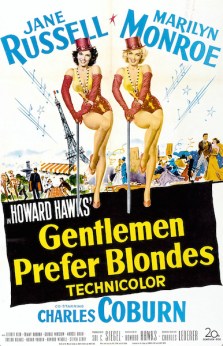
Gentlemen Prefer BlondesIt’s easy to see how Gentlemen Prefer Blondes helped launch Marilyn Monroe as a sex-symbol superstar — her ditzy, breathy blonde, who may just be cleverer than she looks, is clearly the star of the film.

For starters, she gets the lion’s share of the best bits. Diamonds Are a Girl’s Best Friend has justifiably become a classic song and there’s a solid routine attached, but the rest of the musical numbers are disappointingly weak. Jane Russell does get her fair share of good lines, but the most memorable comedic moment is Monroe’s: climbing out of a window, she gets stuck halfway and has to enlist the help of a little boy — and a big coat — to pretend she’s standing outside in the cold. That last one makes more sense in context…

Frankly, it’s all a bit sillier than I expected, more in line with the likes of Texas Across the River and the Road to… series than my memories of Some Like It Hot. That’s not necessarily a bad thing (I enjoyed both those examples), but it didn’t gel with my expectations of a film that’s got a greater reputation than they do.

I suspect said reputation is founded on Monroe’s career-making performance. I don’t have anything against her, but I’m not especially a fan either; yet despite my indifference she’s easily the best reason to watch this. Famously, when told she wasn’t the star of the film Monroe replied, “well whatever I am, I’m still the blonde.” The clue’s in the title, people.

3 out of 5

Gentlemen Prefer Blondes is on More4 today, Monday 6th April 2015, at 12:45pm.

Stardust (2007)

2008 #55
Matthew Vaughn | 122 mins | DVD | PG / PG-13

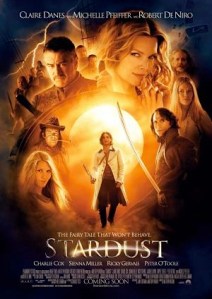
StardustPerhaps the simplest way to describe Stardust — to a film aficionado, at any rate — is as “the British Princess Bride”. That may do it a disservice however, as this tale of a boy entering a magical realm to find a fallen star is sufficiently its own beast to stand apart from such (admittedly lofty) comparisons, and be much more than a simple rehash with different accents.

Stardust succeeds in numerous ways. The plot is a good mix of fantasy archetypes, fairytale morality, a slight-but-knowing modern filter (thanks primarily to top-and-tail narration from Ian McKellen), humour and action. It rattles along, occasionally running the risk of becoming episodic, but thankfully avoiding it by linking and returning to various episodes. For a British film the effects work is perhaps surprisingly good, with impressive sequences that neither suggest restraint or budget limitations, nor smack of ambitious overreaching by the filmmakers (unlike, for example, the recent Tin Man miniseries).

This sort of fantasy adventure film is a somewhat unexpected choice for co-writer/director Vaughn, who previously produced Lock Stock, Snatch and Mean Machine, and directed Layer Cake, but his direction is neither over-grounded in reality (as you might expect from his background), nor over-done to the point of distraction (as if he were compensating). Instead, he demonstrates an entirely appropriate flair and skill, which promises much for future work.

If you watch a lot of British TV the cast seems star-studded, though even if not there’s the likes of Robert De Niro and Michelle Pfeiffer in major roles. Both are clearly having a whale of a time — as is everyone else, to be fair. De Niro’s role is especially surprising and fun, though to say any more would ruin it. It stands out as one of the best and most memorable elements in a film loaded with them. Charlie Cox is a likeable lead, while Claire Danes’ fallen star is pleasing subversive — you’d expect her to be sweetness and light (literally), but she is in fact amusingly stroppy — and Mark Strong is a perfectly villainous villain. They’re just three further standouts from an almost uniformly excellent ensemble. “Almost” because, sadly, the film’s weakest links are also among the cast. Ricky Gervais plays himself, as ever, almost shattering the well-constructed universe in the process; and Sienna Miller is too bitchy — and, to be frank, too wooden — for us to believe our hero could ever really want her.

But these are minor, easily ignored flaws in what is otherwise a fantastically entertaining fantasy. In fact, in recalling it for this review, it’s just magicked itself an extra star. How very appropriate.

5 out of 5

Stardust placed 4th on my list of The Ten Best Films I Saw For the First Time in 2008, which can be read in full here.

The Jane Austen Book Club (2007)

2008 #54
Robin Swicord | 101 mins | DVD | 12 / PG-13

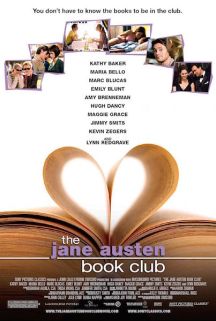
The Jane Austen Book ClubI like to think I have a fairly high tolerance for ‘chick flicks’ — over the years I’ve rather enjoyed films such as Love Actually or Bring It On, and not just because of the male-friendly porn-stand-in scenes or cheerleader costumes — but even I was a bit uncertain about this one at first. However, as it progressed, gradually revealing more about the characters, their lives, and how they cope with what the world throws at them, I found myself increasingly enjoying it. By the time we had to pause it twenty minutes from the end, I found myself itching to continue to find out what would happen.

Inevitably, it’s not flawless. At times it feels like a collection of subplots linked only by the monthly book group meetings, with whichever plot thread is the focus of a scene becoming the de facto main story… until the next scene begins, of course. A working knowledge of Austen’s novels is helpful too. I presumed the film (and book on which it is based) merely invoked Austen’s perennially popular name to boost sales, but there’s actually a fair bit of analysis of the books thrown in, which often reflects what’s happening to the characters. You can get by without an Austen familiarity, but I found the Pride & Prejudice segments made more sense than the others thanks to my (marginally) increased understanding of that particular text.

It would be very easy to pigeonhole The Jane Austen Book Club as a ‘film for women’… and, to be honest, that wouldn’t be at all unfair: it’s as squarely aimed at a female audience as Die Hard is aimed at blokes. It’s also ultimately disposable, apparently with nothing new or revelatory to say about womankind. In spite of all that, I enjoyed it more than I probably had any reason to — and not just because of the male-friendly lesbian character.

4 out of 5

Hairspray (2007)

2008 #53
Adam Shankman | 111 mins | DVD | PG / PG
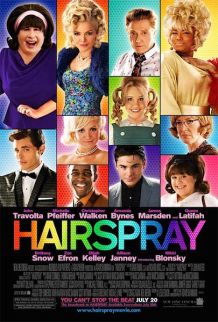
HairsprayWho’d’ve thought a John Waters film could become a bright and breezy musical? It’s a bit of a surprise but, thanks to a successful Broadway version, that’s exactly what’s happened. But while the key to Hairspray’s success may be its positive attitude and memorable songs, perhaps the key to its quality — and the eventual score of this review — are the issues it tackles around those.

It’s the latter that I found must surprising while watching the film. Everything about its advertising campaign, largely young cast and candy-coloured design suggested Hairspray was a light-as-air feel-good flick — no bad thing, but nothing more than a couple of hours of disposable fun. Pleasantly that’s not the case, as the film tackles head-on issues of racism and other such discrimination, with the ‘beautiful people’ — led by a deliciously bitchy Michelle Pfeiffer — doing their best to keep down those who are in any way different, be they black or, in the case of lead character Tracy Turnblad, fat. The apparently fluffy style of the film in many ways makes it perfect to tackle such issues, showing how they can permeate every area of life, not just Serious Social Dramas, and forces those who would normally avoid the latter type of drama to face up to them. Its ultimately happy ending may be more in keeping with the film’s overriding optimism than with reality, but equally it’s wholly appropriate: the crusade against oppression has to end well here, because if it didn’t the concluding message would be “don’t bother fighting, things won’t change”.

The film’s unwavering optimism is perfectly encapsulated by newcomer Nikki Blonsky, leading the cast as Tracy. She’s instantly and constantly likeable, irrepressibly chirpy and yet not annoying — an impressive feat. Equally remarkably, she’s never overshadowed by the heavyweights who round out the cast; instead, they provide able support. Even John Travolta, disturbingly convincing as a housewife (under a ton of makeup), doesn’t steal the show — he comes close, but Blonsky’s performance holds sway. Elsewhere, Christopher Walken, Queen Latifah, James Marsden and Zac Efron all get catchy songs and have a whale of a time — and, unlike the Ocean’s… sequels, the fun the cast is having is infectious.

The first credit at the close is an unusual one: “Directed and Choreographed by Adam Shankman”. Rather than shirking in either department, the rare combination seems to have helped proceedings: the numbers are all exemplarily executed and the direction doesn’t suffer elsewhere. It’s an indication of the music’s quality that even the three cut songs, which play over the end credits, are pretty good and wouldn’t’ve been out of place in the film itself. The first of these is clearly the actual closing number, though the decision to bump it to the end credits, thereby leaving You Can’t Stop the Beat as the final song of the film proper, was a wise one — it makes for a stronger, catchier, more upbeat finale.

Hairspray is a deft mix of issue-driven drama and colourful musical levity. Catchy, optimistic, uplifting, funny and fun, it may just surprise you.

5 out of 5

Hairspray is on Film4 today, Tuesday 11th November 2014, at 6:45pm.

Hairspray placed 6th on my list of The Ten Best Films I Saw For the First Time in 2008, which can be read in full here.

Superhero Movie (2008)

2008 #52
Craig Mazin | 85 mins | in-flight | 12A / PG-13

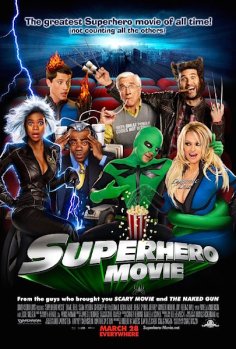
Superhero MovieYears ago, I saw Scary Movie. I don’t really know what I thought of it anymore, but I never expected I’d find myself watching another entry in the critically-derided …Movie series. But then I found myself on a plane, half asleep and with a choice of films I’d mostly rather watch on a decent-sized screen, and decided that maybe Superhero Movie wouldn’t be so bad after all…

As anyone who saw a trailer will have guessed, Superhero Movie is mainly a spoof of Spider-Man… a film that is now six years old. Unfortunately, this means that most of the best jokes have already been done in numerous other sketch-length spoofs, amongst them one at the MTV Movie Awards and one during Comic Relief 2005. The latter even did the green costume thing, though the hero was ‘Spider-Plant Man’ rather than the (less funny) Dragonfly employed here. Superhero Movie takes all this sketchery to the next level, however, crafting its story simply by reworking the first Spider-Man film almost scene by scene, inserting jokes (and, more often, ‘jokes’) where it can — which is about once per scene.

There are also asides that spoof X-Men, Fantastic Four and Batman, but they barely warrant a mention. They’re certainly not any funnier. In fact, the climax is the only wholly original plot point — or, at least, plot point not directly lifted from Spider-Man, as it may well come from some other comic source. This incessant copying makes the film feel like an over-extended sketch, and so it becomes clear that something like Mystery Men, with its genuinely original plot, makes for a much better superhero comedy movie.

As for the gags themselves, they’re childish, lewd, offensive (“isn’t Stephen Hawking funny!”), too specific to American culture, too topical (they’ll be dated within six months), already dated (“isn’t the Windows paperclip annoying!”), too obvious… It’s very much a movie made for now, not for posterity. Actually, to be fair, it’s very much a movie made for six years ago. In this respect I suppose it’s just like the rest of the …Movie series, which I’ve always felt looked like cheap TV specials owing to their specificity and, well, rubbishness. Still, believe it or not, some bits are actually amusing. Or amusing enough while they’re on. Perhaps I was just laughing out of desperation. I certainly can’t remember any of the jokes now.

Intriguingly (a word I use loosely here), there are a bunch of deleted scenes and gags during the end credits — not bloopers, but genuine deleted bits. It’s a mystery as to why these aren’t either in the film itself or relegated to DVD extras — it’s not like running time is an issue, and clearly pacing isn’t. In fact, some of the deletions are much funnier than gags that were left in. They’re probably the only reason to keep watching Superhero Movie to the end, though they’re not reason enough to start it in the first place.

2 out of 5

Superhero Movie featured on my list of The Five Worst Films I Saw in 2008, which can be read in full here.

The Golden Compass (2007)

2008 #51
Chris Weitz | 113 mins | Blu-ray | PG / PG-13

The Golden CompassThis adaptation of the first novel in Philip Pullman’s His Dark Materals trilogy (known as Northern Lights in the UK, but adopting the US title for the film — unlike Sorcerer’s Stone, it’s actually more appropriate) received quite the critical drubbing on its cinematic release, and wasn’t a huge success at the US box office either, which has cast doubt on the prospects of the following two instalments ever being produced. Which is a shame, because this is actually a fine family fantasy film.

The requisite elements are present and correct: a well-realised alternate world, engaging heroes, slightly camp villains, mysterious items, mysterious backstories, a globe-trotting quest, talking non-human characters, a couple of action sequences and casual doses of spectacle. The latter was something that worried me going into the film, in fact, as the CGI looked dreadful in the trailer. When it won the Oscar I really couldn’t understand how, but now having seen the film — and in high definition to boot — it was, to my surprise, mostly exemplary. There are weak patches, of course (Mrs Coulter’s monkey being the main one), but the majority is either appropriately realistic or in a suitable style enough that it didn’t matter. “Don’t judge a book by it’s cover,” as they say; or indeed a film by its trailer.

Another key sticking point for me was the discarding of the books’ religious elements, which is far too atheistical for most Americans (not that I’ve actually read the books yet, but I always enjoy a good bit of Christian baiting). The filmmakers have found an appropriate way around this however: there’s a subtext, blatant to the intelligent viewer, which carries such views. It will like whoosh over the heads of those who would’ve been offended by it, which is surely the point. Nonetheless, the lack of commercial success suggests that the stir it had already caused served to cement it as “the anti-Christian film” in too many people’s minds. Or perhaps it was merely that too few had heard of the books? Or there’s always those variable reviews…

Leading the cast as Lyra, Dakota Blue Richard’s accent seems forced and occasionally grates, but really speaking she’s pretty good (pun retrospectively intended). The rest of the cast make a good account of themselves, though the likes of Daniel Craig, Derek Jacobi and Christopher Lee were clearly cast in readiness for the intended sequels. Ian McKellen is as good value as ever and the rest of the voice-only actors offer able support. Nicole Kidman never really gets the chance to unleash her full evil potential however.

In fact, therein lies probably the film’s primary weakness. While Golden Compass does work in its own right, it’s as much Part One of a trilogy as Fellowship of the Ring: at the end you feel curiously fulfilled, even though there’s clearly a lot of tale left to tell. I can only hope that the muted success it achieved is enough to get the continuing and concluding parts made, though that seems increasingly, disappointingly, unlikely.

4 out of 5