L.A. Confidential (1997)

2008 #26
Curtis Hanson | 132 mins | DVD | 18 / R
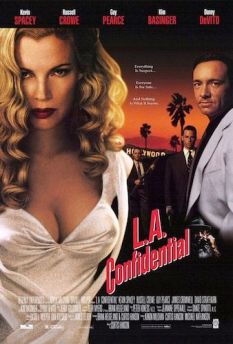
L.A. ConfidentialOnce again I’m watching an adaptation shortly after plowing through the source novel, a situation that has so far proved awkward for giving films a fair assessment. L.A. Confidential is an especially tricky one: how does a 480-page, densely written, intricately plotted crime novel, spanning seven years and “no fewer than four and perhaps as many as a dozen major crimes”, translate into a two-and-a-quarter-hour film? With more than a few surprises, as it turns out, because the apparently minor changes near the film’s start turn out to be the proverbial pebble in a pond: their ripples spread so far that, by the second half, not even a reader who can remember the many details of the novel’s complex plot will know for sure what’s coming.

This isn’t necessarily a bad thing. If screenwriters Hanson and Brian Helgeland had tried to squeeze in everything the movie would have been rushed even at three hours. Instead they’ve excised several unnecessary subplots and trimmed others to the bare minimum. Most impressively, they’ve picked apart several of the multitudinous plot threads and completely restructured them. It’s an incredible feat of adaptation. The downside is that some great strands are lost. Ed Exley’s father plays a huge role in the novel but is completely absent here; Inez Soto, the victim of a brutal gang rape, is reduced from a key supporting character to a couple of lines. Another connected loss is some characterisation. Jack Vincennes and Exley lose the most, though Bud White’s development is tied too closely to the main storyline. That said, the characters are still mostly there, painted quickly and precisely; they may lack some of the depth and complexity the novel can offer, but that’s an almost unavoidable difference between a film and a long, well-written novel. To make a good film such sacrifices are necessary — even though it’s been simplified, the novel’s complex plot is still a long way from becoming straightforward.

What impressed me most about L.A. Confidential is that, despite spending huge chunks of the film pondering what they’d cut and changed, I still enjoyed it immensely. Even while distracted with thoughts of the novel, its differences and its relative merits, I could still enjoy the fantastic filmmaking. The casting is perfect, especially Spacey, Pearce and Crowe (perhaps the last most of all, considering his penchant for real life violence). For once it really is as if the roles were written for them, making it easy to forget that Pearce and Crowe were virtually unknown at the time. They’re supported by a cracking screenplay (which I think I’ve praised plenty already) and beautiful direction, which manages to evoke the period without being shot like a period film — Hanson has stated that he aimed to make it period-accurate but shoot it like a modern thriller, and he’s succeeded. There may be one or two imperfections (the music felt a little repetitive to me, for example), but they’re slight and it seems churlish to pick on them in any depth.

I look forward to watching L.A. Confidential again without the novel hanging over my head. I’ve made my comparisons now, and my memory’s weak enough that, by the time I get round to watching it again (perhaps when the long-rumoured special edition re-release turns up), I’ll have forgotten enough of the novel’s specifics to not be bothered by them. I expect I’ll enjoy it even more then. It’s an excellent achievement, both as an adaptation and a film in its own right. You can’t say fairer than that.

5 out of 5

The Baskerville Curse (1983)

2008 #25
Eddy Graham | 67 mins | DVD | U / G

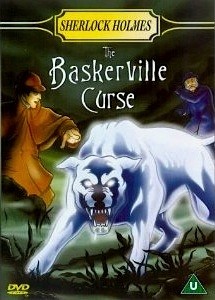
The Baskerville CursePeter O’Toole is Sherlock Holmes (well, his voice) once again in this animated Conan Doyle adaptation from the ’80s (see also my reviews of two others, The Sign of Four and A Study in Scarlet). Of course, this is an adaptation of that perennially popular Holmes story, The Hound of the Baskervilles, and as such O’Toole barely features. A shame, as he’s the only half decent thing in this mess.

As I’ve previously expressed, The Hound of the Baskervilles is not my favourite Holmes story, though it has its moments and there have been some enjoyable screen versions. Unfortunately, this pointlessly renamed offering retains all of the original’s faults but loses most of the best bits, despite wasting time on train journeys, telegram writing and pointless flashbacks to things we saw just minutes earlier. The animation is poor, even for a production of this level, with dire character design and a total lack of atmosphere (it opens with jolly music over views of primary-coloured countryside!) There are further flaws, but there’s no point wasting any more time going through them. I can only hope that the final entry in this series, The Valley of Fear, will be closer in quality to the other two instalments.

In retrospect, I’m certain I underrated the 1939 adaptation of The Hound of the Baskervilles. I’m equally certain that I shall have no such regrets over this lame attempt.

1 out of 5

The Baskerville Curse featured on my list of The Five Worst Films I Saw in 2008, which can be read in full here.

Rashomon (1950)

2008 #24
Akira Kurosawa | 88 mins | DVD | 12 / PG-13

RashomonOne has to wonder if Dr. Gregory House was exposed to Rashomon at a young age. House’s universal truth — “everyone lies” — is also the conclusion of Kurosawa’s much-lauded film, in which four witnesses tell different versions of the events surrounding a samurai’s murder.

The “Rashomon” of the title is one of two gates to Kyoto, built in 789 and in disrepair and disrepute by the film’s 12th Century setting, but thanks to this film the word has come to signify a narrative that retells the same event from multiple perspectives. Mentioning it seems unavoidable when writing about a film (or episode of TV, or novel, or…) with such a structure, as reviews of recent thriller Vantage Point would attest. However, most similar tales aren’t quite as radical as this ‘original’ (which is based on two short stories by Ryunosuke Akutagawa), in which the four tales differ wildly.

Justifiably, much has been written about Rashomon, both critically and analytically. As such I’m not going to dig too deeply here, but instead just highlight a couple of reasons why it’s so acclaimed. For one, it looks great. Kazuo Miyagawa’s cinematography is exemplary, producing gorgeous rain at the gate, wonderful shadows in the forest, and employing numerous inventive shots and moves, always effective rather than showy. Fumio Hayasaka’s music underscores proceedings beautifully, coming into its own during long dialogue-free sequences. The performances are also accomplished, especially Toshiro Mifune as laughing bandit Tajomaru, but also Masayuki Mori’s largely silent turn as the murdered samurai, and Fumiko Honma’s chillingly freaky medium.

As I said, there’s much more that could be (and has been) written about Rashomon — I’ve not even touched on the intricacies of the plot, the presentation of the courthouse scenes, the significance of the fights, and so on. Certain viewers might be put off by the subtitles, the black and white photography, the film’s age, and its occasional ‘arthouse’-ness — and, I confess, I’m one of the first people to get fed up with films like Tati’s Play Time or Ozu’s Tokyo Story — but, for me, Rashomon was an incredibly enjoyable first encounter with Kurosawa.

5 out of 5

Rashomon placed 5th on my list of The Ten Best Films I Saw For the First Time in 2008, which can be read in full here.

Sunshine (2007)

2008 #23
Danny Boyle | 103 mins | DVD | 15 / R

This review contains minor spoilers.

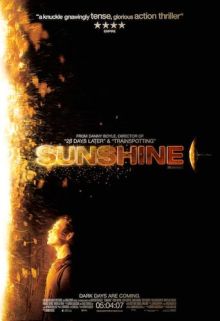
SunshineAfter branching out into the genres of horror (with 28 Days Later…) and ‘family’ (with Millions), Danny Boyle turns his hand to sci-fi with this effort, which tells the story of a spaceship in the apparently not-too-distant (but, clearly, distant enough) future transporting an improbably large nuclear bomb to restart our dying sun.

Sunshine is what some would call “grown-up science fiction”, often more concerned with the crew’s moral dilemmas than thrilling action set pieces or dazzling CGI. Luckily, though, the former aren’t too pretentious and both of the latter are still present. Similarly, the fact that it’s a British rather than American film is apparent early on: there’s an international crew (the Captain is even Foreign! Shocking!), there’s no time wasted on the melodrama of what life is like back on Earth, and the plot slow burns, carefully depicting the crew’s day-to-day relationships and tasks before, inevitably, It All Goes Wrong. The crew notice their failed predecessor floating nearby and have to decide whether to continue on their present course or divert to meet the other craft. I’m sure anyone can guess which option they choose. The ensuing slow slide from relatively minor problems to increasingly major ones fills most of the running time and, like every aspect of the film, is very well executed.

One stumbling block is that, in many ways, it’s territory that’s been trod before. Boyle and screenwriter Alex Garland mix in elements of Alien, 2001: A Space Odyssey, Armageddon, and no doubt several other spaceship-based movies. To their credit, it doesn’t feel like a total rip-off, but the influences are apparent. I was also reminded of the BBC miniseries Space Odyssey: Voyage to the Planets, though I doubt that was a huge influence! (It is quite good though, so you never know…)

Most reviews of Sunshine primarily criticise a shift in quality for the third act. It’s hard to disagree on this, as the film moves from a realistic(ish) Apollo 13-esque space mission movie into slasher horror territory. It almost works, though does feel a little like they were desperate for either a multiplex-pleasing round-off or anything that would carry the film through the last 30 minutes. The real let down is the final sequence, a logic-vacant confusingly-shot finale that consequently feels a tad disappointing.

Yet it’s not bad enough to make too large a dent in the film’s overall quality. The first hour may be better than the final half hour, but it’s all still good enough to pass. Ultimately, the weak ending’s only impact may be in knocking one star off the final score — though, without an alternate final act to compare it to (obviously), it’s hard to be certain it’s even that bad.

4 out of 5

Sunshine placed 10th on my list of The Ten Best Films I Saw For the First Time in 2008, which can be read in full here.