
Alexander Witt | 94 mins | Blu-ray | 2.40:1 | Canada, UK, Germany, France & USA / English | 15 / R

2002’s film adaptation of popular horror video game series Resident Evil may not have been particularly game-accurate (from what I can gather — I’ve never played them), but it was sufficiently entertaining as an action/horror movie in its own right, and consequently it spawned a sequel (and, eventually, four more). Picking up where the first movie left off — with the zombie outbreak, er, breaking out, expanding from one facility into a whole city — Resident Evil: Apocalypse widens the scope of the movie series’ action. It also begins to introduce more characters and plot points drawn from the games, presumably in a deliberate attempt to court fans who were disappointed first time round. Unfortunately, it’s all in aid of a film that just isn’t very good.
Where the first film was a riff on something like Assault on Precinct 13, Apocalypse turns its attention to another John Carpenter classic, clearly trying to be a version of Escape from New York. Set in a semi-abandoned, zombie-overrun city where it’s perpetually nighttime, Alice (Milla Jovovich) and the ragtag group of survivors she encounters must make it out before a nuclear bomb is dropped on it.
It’s a perfectly serviceable storyline, and I have no problem with movies broadly borrowing storylines and whatnot in homage to other flicks. The problem is, Apocalypse is an awfully written and produced film. The first film’s writer-director, Paul W.S. Anderson, sits out the latter role this time, but returns as sole screenwriter. His dialogue is bad, devoid of realism or logic. One example: they’re trapped in a walled-off city, remember, and when one character informs the others that tomorrow morning it’s going to be hit with a tactical nuke, the first response is: “what yield?” Like it fucking matters! They’re dropping a nuke designed to wipe out the city you’re in — doesn’t matter what precise yield it is, you’re all dead. Unsurprisingly, his characterisation isn’t any better, and the cast don’t have the chops to save it, even though there are some decent-to-excellent supporting players here, like Oded Fehr, Thomas Kretschmann, and Jared Harris.

His narrative structure isn’t great, either. Take the ending. The closing moments of the first film could be interpreted as a cliffhanger or sequel tease, I guess, but the final shot also work in its own right as a fatalistic reveal: that despite the efforts and sacrifices of our heroes to contain the virus, it got out and the world has gone full zombie apocalypse. Here, though, the last ten minutes or so of the film are an almost total sidestep from the story we’ve had thus far, their only purpose being to suggest some onward direction for the next movie. I suppose that’s par for the course nowadays, in the era of cinematic universes, but I still don’t think it’s good form. There are ways to have hints and teases for the future without turning a significant chunk of your current movie into an extended trailer for the next one.
The paucity of quality in the screenplay could perhaps be allowed to slide if Apocalypse delivered on its main goals. It’s an action/adventure/horror flick, after all — the boxes it’s looking to tick are not “character drama” and “narrative coherence”, necessarily. Sadly, it doesn’t tick the other boxes either, more scribbles vaguely around them. The action is terribly directed, a blur of meaningless visual noise. Taking Anderson’s place in the director’s chair is Alexander Witt, who had previously been a second unit director on some very good movies, like The Hunt for Red October, Gladiator, The Bourne Identity, and Pirates of the Caribbean. I can only presume his unit wasn’t responsible for any of the action sequences in those films. Apocalypse remains his only primary directing credit: he’s gone back to second unit, working on some more very good movies, like Casino Royale, X-Men: First Class, Skyfall, and Avengers: Infinity War. For whatever reason, I guess that’s a better fit for him.
One of the advantages to coming to a film series years after the fact is you can benefit from the perspective of others. To wit, I’ve seen people say this is the worst of the series. I pray they’re right, because I’ve kinda committed to watching them all now and I’m not sure I can take another four films this poor or, God forbid, worse. I had it down as a 2 for my 2019 stats, but I can’t recall a single redeeming feature now, so:







 Directed by
  Amateurish production values often let the side down. I don’t think Brunt’s direction would be too bad were it not for the cheap camerawork, although the action scenes are overrun with ShakyCam. There are some very good bits late on: the developments that come as a result of a stranger’s arrival; a phone call with the kids; perhaps even the very end, which is a bold climax.
 The first manned mission to Mars is reaching the end of its six-month tour. As they count down the final hours, battling a dust storm and its attendant power outages and communications blackouts, one of the team secretly discovers bacterial life on the surface. Attempting to recover further samples, a sink hole opens beneath him. When the rest of the crew try to recover his body, it’s not there. Then he arrives back at base… only, he’s not quite himself anymore…
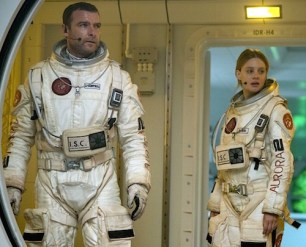 These faults persist despite the best efforts of a quality cast, particularly Romola Garai as (in functional terms) the capable sidekick, and Olivia Williams as the bitch whose heartless practicality becomes an asset when the going gets tough. First-time feature director Ruairí Robinson assembled his cast on the principle of “people who aren’t normally in sci-fi movies”, and that does feed in to the sense of realism. It also looks great, the production, costume and effects designs gelling to create a believable Mars mission, all in spite of a tiny budget (funded by the BFI and the Irish Film Board, it had about a tenth of Gravity’s budget, for example). Credit, too, to cinematographer Robbie Ryan for lensing the Martian surface convincingly (it’s actually the Jordanian desert). The editing may descend into fast-cut blurriness during action scenes — only emphasised by Max Richter’s predictably derivative horror movie score — but during calmer moments the film looks very good.
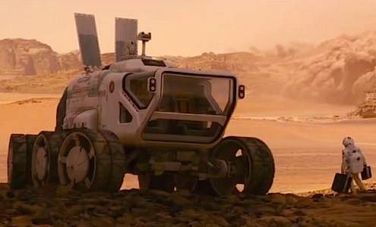 and was more sure of its tone. There may be elements to commend The Last Days of Mars in this comparison (the much bigger budget pays off in the scope of the visuals, of course), but as a story and viewing experience, The Waters of Mars wins hands down.
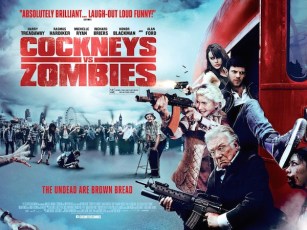 Screenwriter James Moran doesn’t like it when people compare Cockneys vs Zombies to
  And why is their imagination so stunted that they can’t accept them anyway?
 100Films.co.uk