
Adam Randall | 90 mins | streaming (HD) | 2.35:1 | UK / English | 15
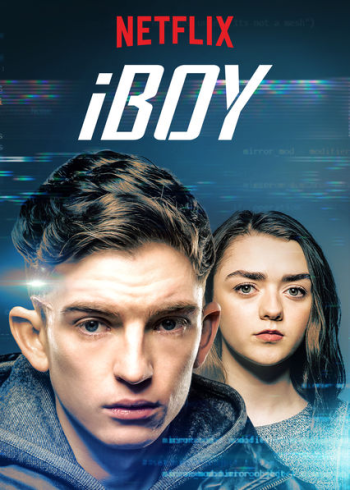
When it comes to TV, Netflix are dominating the cultural landscape with much-discussed original series like Stranger Things, Making a Murderer, Orange is the New Black, the Gilmore Girls revival, their cadre of Marvel shows… I could go on. But when it comes to their original movies — the eponymous “flix” — well, it’s a bit different. Their Crouching Tiger Hidden Dragon sequel went down like a lead balloon; Beasts of No Nation was well reviewed but couldn’t translate that into the awards buzz that was clearly hoped for; and their Adam Sandler movies… well, those are apparently very popular with viewers, at least.
Their latest effort, iBoy, is based on a young adult novel about a teenager who fights against bad people — so that’s pretty zeitgeisty at least. It’s not set in a dystopian future, though, but why bother when our own days are so bleak? So iBoy sets its stall in present-day London, where Tom (Bill “the sweet one from Son of Rambow” Milner, looking completely different) is just a normal teen — going to school by day, blocking out the sounds of violence around his tower block by night. When the girl he fancies (Maisie Williams) invites him round to study one evening, he turns up at her flat to find her being, to not put too fine a point on it, gang raped. He runs, trying to phone the police, but the gang give chase and shoot him in the head. When he wakes up, parts of his phone have been inoperably embedded in his brain, which he soon comes to realise has given him the ability to interact with technology using his mind.
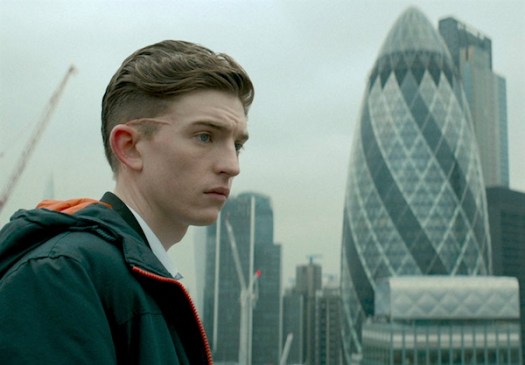
So, yeah — scientifically, it’s a thoroughly dubious premise. But is it any worse than having abilities bestowed by a radioactive spider-bite or spilled toxic goo? In respect to Tom’s newfound powers and how he chooses to use them — as a vigilante seeking revenge on the gang that have been terrorising his estate — iBoy is more in line with superhero narratives than other young adult adaptations. Where it comes unstuck is the tone. How many superhero films are going to feature gang rape? Well, somewhat appropriately, I guess the Netflix ones might. But the disjunct between iBoy’s daft premise and the grim world of inner city gangs (there are more acts of shocking violence) is a difficult one to negotiate.
To its credit, iBoy doesn’t use the assault as a starting incident and then discard its aftereffects — the presence of Maisie Williams, who’s been quite outspoken about the treatment of female characters in media, should give an indication that it’s not so thoughtless. But nor does a 90-minute movie that’s fundamentally about a superpowered vigilante have much time to dig into it properly. Nonetheless, Williams essays the role with some subtlety, aided by a screenplay that keeps things appropriately unverbalised. Perhaps the most effective part is when, home alone, she has to venture outside for some milk.

Unfortunately, the screenplay doesn’t pay the same amount of attention to the hows-and-whys of its hero and his abilities. Apparently hacking someone else’s phone involves watching a progress bar; he can learn how to fight while watching a couple of YouTube videos during the ten seconds he’s walking towards an assailant; and so on. A little more effort would’ve sold the premise more and could’ve removed these niggles (at least have him download a phone-hacking app or something; maybe the YouTube videos could be downloaded into his brain, but his unpracticed muscles struggle to perform the moves). Problem is, the notion of phone fragments getting stuck in your brain and giving you superpowers is pretty silly, so even if you provide better internal consistency, it’s still a struggle to parse that implausibility being mashed up against the ultra-real-world stylings of the rest of the story. Films like Super and Kick-Ass do the “real-life superhero” thing by making their hero a bit inept. Maybe iBoy isn’t shooting for “real-life superhero”, but then why are the threats he faces so serious?
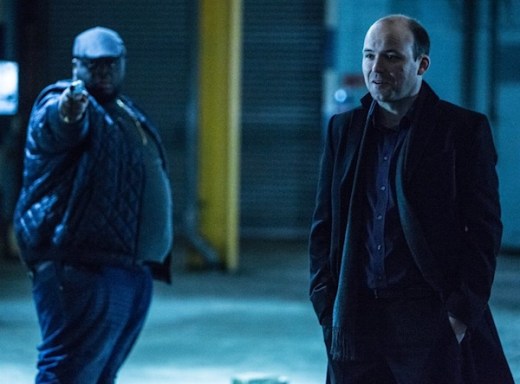
Talking of the threats, Rory Kinnear turns up near the end as the Big Bad, and lifts the film considerably. I suppose there’s not a whole lot of originality in a politely-spoken but actually horrendous villain, but Kinnear sells the part effortlessly. You kind of want to see that character (or at least that performance) turn up in something bigger and better. Elsewhere, Miranda Richardson brings some much-needed lightness as Tom’s grandma, who serves as an Aunt May figure. If nothing else, you can rely on British productions to have quality acting, eh?
For all this criticism, on the whole I didn’t dislike iBoy while it played out, it just doesn’t stand up to scrutiny. As Netflix’s first genuine original movie from the UK, it’s a shame it can’t demonstrate to the rest of the Netflix-viewing world what British film could be capable of if encouraged, but maybe that would be too big a weight to put on its little shoulders anyhow.

iBoy is available on Netflix everywhere (I presume).
 Adapted from the classic young adult sci-fi novel by Orson Scott “bigoted idiot” Card, Ender’s Game is the story of Andrew “Ender” Wiggin (Asa Butterfield), who displays uncommon aptitude in a military programme to train children to fight against an alien race that attacked Earth decades earlier. Sent to a training centre in space, Ender must battle his fellow candidates to prove their worth to their hardened commander, Colonel Hyrum Graff (Harrison Ford), ready for the real battle to come.
 It tips its hat to things like drone warfare, child soldiers, and understanding our enemy, but that’s all it does: acknowledge those parallels exist, then refuse to explore them. Conversely, the music is too heavy-handed, taking on the burden of providing emotion that’s lacking from the screenplay.
 Sadly, after all that training fun, once the cadets jet off to the other side of the galaxy for a rushed third act, interest evaporates speedily. It even has to work hard to sell its own twist as a twist! (Spoilers follow in this paragraph.) In a simulation for a war, Ender does what he’d do to win that war. Then he’s told it wasn’t a simulation, it was the actual war… and he’s all cross. I mean, okay, the fella kinda has a point when he gets angry afterwards: they’ve lied to him, and maybe he would’ve behaved differently if he’d known. But the point of the training was to teach them what they needed to do to win, and it taught them that, and he did it. Maybe this twist works in the book, but in the film it felt somehow unearned.
 I’m not a big one for Halloween, but I’ve acknowledged the horrific holiday on a couple of occasions now. For 2015, I decided to review one of the most notorious supernatural films of recent times. A movie so horrific, it sent critics cowering behind their sofas. A film so evil, it’s perverted the minds of children — and some adults — the world over. A movie so renowned, it strikes fear into the hearts of even hardened movie lovers.
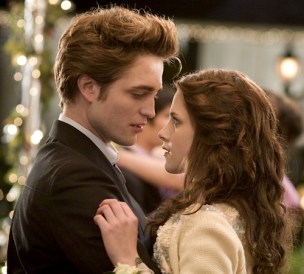
 Edward is an odd, creepy stalker — turning up in Bella’s bedroom and staring at her while she sleeps, that kind of thing — who she then finds out is a century-old man (bit of an age gap) and, literally, a predator… but she instantly unconditionally loves him. What the merry fuck? She’s given no reason to even like the guy, and plenty of reasons to run away scared of him, but no, she falls in love. What message is this sending to young girls? That the guy who follows you around everywhere just staring at you and then confesses he’s having trouble controlling his impulse to murder you (yes, he says that) is the perfect soulmate? Not to mention that he’s 100-and-something years old and dating a 17-year-old. He shouldn’t be pre-teen girls’ idol, he should be Hugh Hefner’s!
 in particular its treatment of female characters. Yet she also wrote this. Even if you allow for her being hamstrung by the novel in story terms, the dialogue is appalling, in every respect. Characters bluntly state their own and each other’s emotions at each other. We’re always being told stuff instead of shown it. Scenes heavy with exposition are shot with frenetic camerawork and underscored with driving music as if that somehow makes it filmic and exciting.
 a little light ogling of someone around my own age pales in comparison.)
 If you’re not au fait with the
  as both sides attempt to rally ordinary people to their cause through the power of the media. It’s a tale that’s as timely as ever, surely.
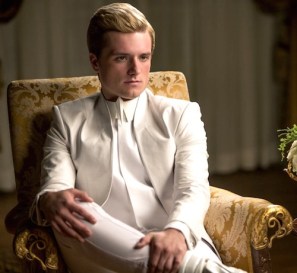 I must say that (as someone who hasn’t read the book) it didn’t feel overly like the first half of something longer to me. Of course there’s a cliffhanger and stuff, but there was at the end of the last film as well. This is no worse than that. If anything, I felt Mockingjay Part 1 built to its ending more successfully — I was quite surprised when
 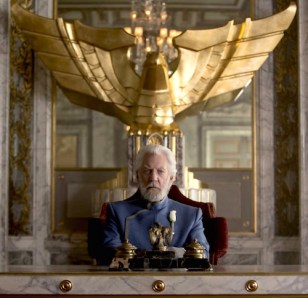 it may be your favourite instalment so far (and you wouldn’t be alone in that view). For me, Catching Fire is the best of the three because it crystallises both of those constituent elements; and if the first film was purely the action side (with a bit of the politics), then here we find its mirror image: purely politics (with a bit of action). Either way, perhaps the ultimate fate of all these films rests on how well
  100Films.co.uk