
I have a backlog of 525 unreviewed feature films from my 2018 to 2023 viewing. This is where I give those films their day, five at a time, selected by a random number generator.
Today, a couple of Agatha Christie adaptations from very different eras; plus a heist, a horror, and a Hong Kong love story for the ages.
This week’s Archive 5 are…
Evil Under the Sun
(1982)
Guy Hamilton | 112 mins | digital HD | 16:9 | UK / English | PG / PG

The third in the run of Poirot adaptations that began with Murder on the Orient Express and continued with Death on the Nile — no, not the recent Branagh ones: this is the first time they did exactly that. But, funnily enough, both third films in their respective series (i.e. this and Branagh’s A Haunting in Venice) take a UK-set Christie and relocate it somewhere more exotic, to fit with the style of the rest of the series. So, rather than a small island off the north Devon coast (which likely stretches the definition of “under the sun”, based on my experience of Devon), here the action is located to the Adriatic Sea, although actually filmed on Mallorca.
All of which is incidental when the rest of the movie is, at best, fine. It doesn’t help that the storyline is ultimately very similar to Death on the Nile, making the whole affair feel like more of a rehash than it needs to. Guy Hamilton’s direction underwhelms, giving a TV movie-ish feel, which is only exacerbated by the less-starry cast — there are recognisable names and faces here (James Mason, Diana Rigg, Maggie Smith), but, in totality, it’s not in the same league as the previous two films. It rather prefigures where Ustinov’s Poirot would appear next: literally, TV movies.

Evil Under the Sun was #2 in my 100 Films in a Year Challenge 2020.
Sneakers
(1992)
Phil Alden Robinson | 126 mins | Blu-ray | 1.85:1 | USA / English | 15 / PG-13

I never paid Sneakers any attention (not that it came up often) — I think, because it’s an American movie called Sneakers, I assumed it was about shoes — until indie magazine Film Stories announced a Blu-ray release (long since sold out, I’m afraid). I’m always keen to support small/new labels doing interesting things. And thank goodness for that, because, turns out, it’s actually very much my kind of film and good fun.
So, turns out, in this context, “sneakers” are not an Americanism for trainers, but good-guy hackers who test security systems. When the team are hired to steal a code breaking device, they get suspicious about the setup and, of course, it turns out they’re right to be. Thus unfurls a tech-based heist thriller with a strong vein of humour, but without tipping over into being an outright comedy. Stylistically and tonally, that’s right up my street — I love a heist movie, and that kind of tone (funny without being silly; what I think of as a ‘real world’ awareness of humour) often works for me. It’s the kind of film that’s just a lot of fun to watch. I can imagine it being highly rewatchable; a go-to favourite for people who do that kind of thing.

Sneakers was #132 in my 100 Films in a Year Challenge 2021.
Us
(2019)
Jordan Peele | 112 mins | digital HD | 2.39:1 | USA, China & Japan / English | 15 / R

Part of what made Jordan Peele’s debut feature, Get Out, such a success was the way it chimed perfectly with the cultural zeitgeist of 2017; indeed, of the whole decade (time may yet add “of the whole century”). This immediate followup doesn’t benefit from a similar boost, but it’s a strong work of horror cinema in its own right.
Us follows a family who are attacked by a group of doppelgängers. That’s the most basic version, anyway — Peele seems to have a lot of ideas he wants to mix in here; almost too many. It seems to operate on the level of a home invasion/slasher kind of movie much of the time, but having more on its mind means it’s a bit too slow to satisfy as something so viscerally straightforward. Thus, all the Meaningful stuff ends up crammed into the third act, which perhaps leaves it feeling back-heavy. There’s also a big twist, naturally. On one hand, it seems really obvious, pretty much from the beginning; but on the other, it does cast the rest of the movie in a different light, which is quite interesting.
If all that sounds rather negative… I blame my notes (I’m writing this review over four years later based solely on what little I wrote down at the time). Us is imperfect, but it’s also great in places, and is at least passably interesting to reflect on in light of the final reveal.
Us was #23 in my 100 Films in a Year Challenge 2020.
Crooked House
(2017)
Gilles Paquet-Brenner | 115 mins | digital HD | 2.35:1 | UK & USA / English | 12 / PG-13

Despite a moderately starry cast (Glenn Close, Terence Stamp, Gillian Anderson, Christina Hendricks fresh from Mad Men; plus Brits of varying degrees of recognisableness) and a screenplay by Julian “Downton Abbey” Fellowes, this Agatha Christie adaptation was virtually dumped straight to TV here in the UK (apparently it did have a theatrical release, but the TV premiere was less than a month later — and on lowly Channel 5 at that). Of course, some of the best Christie adaptations have been made for TV; but when something’s designed for theatrical and ends up skipping it, it’s never a good sign.
Fortunately, Crooked House isn’t a disaster, though it’s far from a resounding success. Quite what attracted the big names I don’t know — it’s a reasonable setup (big dysfunctional family), but the screenplay isn’t exactly sparkling, aside from one or two moments or scenes. There is, at least, one helluva resolution. It also feels disjointed thanks to poor editing and/or direction. If the aim was to keep the pace up, it failed, because it begins to drag after a while. All of this is only partially masked by decent cinematography from Sebastian Winterø, which is the only thing that saves it from looking very TV-ish. Maybe it found its rightful home after all.
Crooked House was #1 in my 100 Films in a Year Challenge 2020.
In the Mood for Love
(2000)
aka Fa yeung nin wah
Wong Kar-wai | 99 mins | digital HD | 1.66:1 | Hong Kong & China / Cantonese & Shanghainese | PG / PG
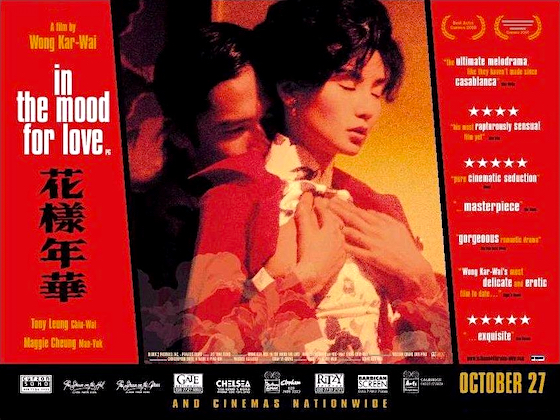
If my four-years-late review of Us was hampered by largely-negative notes, my four-years-late review of In the Mood for Love is in even worse shape: no notes at all. Some trivia? I can do that! An interesting quote from the director? Got it saved! But anything on my own thoughts beyond settling on a five-star rating? Nope. I would try to repurpose my Letterboxd review, but all I wrote was: “I mean nothing but respect when I pithily describe this as Brief Encounter in Hong Kong.” Accurate but, indeed, pithy.
On the bright side, this is a widely-acclaimed film, so if you’re after in-depth writing I’m certain you’ll find some somewhere else. Indeed, even if I did have more fulsome notes, I doubt I’d contribute anything more insightful. This is a subtle, almost delicate work, and that’s the kind of thing I feel I often struggle to properly get to grips with in my short, usually spoiler-averse reviews. Suffice to say, I concur that this is a very good film indeed; although, as with any understated work, some might prefer if the feelings and emotions were more overt. Each to their own.

In the Mood for Love was #200 in my 100 Films in a Year Challenge 2020. It was viewed as part of Blindspot 2020.
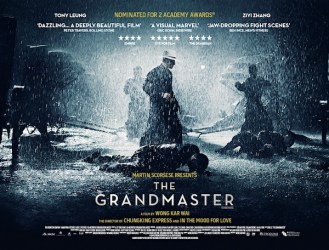 As a Western viewer, if you know anything about Ip Man beyond “he’s the chap who trained Bruce Lee”, it’s probably thanks to the
  It helps that it’s gorgeously shot. Ultra-crisp blue-black rain-soaked night time duels; rich golden hues in pre-occupation Foshan; cold bright-white snowy landscapes; a train platform fight that’s almost sepia-like. Between the photography and the ever-excellent action choreography of Yuen Woo-ping (
 However you look at it, the other Ip Man films are undoubtedly more palatable to a mainstream audience. Does that mean they’re worse? No. Better? Not necessarily. But I don’t think The Grandmaster is all it could’ve been. It seems to run out of story and lose its way as it gets towards the end. The focus shifts entirely to Gong Er, and it feels less clear what it’s meant to about as a whole film. It becomes a movie of great moments, and maybe even scenes, but an unsatisfying whole. But oh, the images…
 100Films.co.uk