
James Mangold | 137 mins | cinema | 2.35:1 | USA / English & Spanish | 15 / R

Little Miss Sunshine meets Hell or High Water via Midnight Special, with more superpowers and (probably) fewer Oscar nominations, in the film some people are calling the best superhero movie since The Dark Knight.
In the not-so-distant future, the man once known as Wolverine, Logan (Hugh Jackman), is living / hiding on the US-Mexico border, his once formidable powers diminished by age. He works as a limo driver to afford meds for an ailing Professor Charles Xavier (Patrick Stewart), whose psychic powers have become dangerous as his brain falters with age. When a woman recognises Logan and asks for his help, the disillusioned former X-Man fobs her off. But soon dark forces and a mysterious girl (Dafne Keen), not to mention his innate moral code, will force his claw-wielding hand…
While Marvel Studios harp on about how they mix other genres into their superhero movies, with such-and-such a film being superheroes-cum-political-thriller, or this-and-that film being superheroes-cum-heist-movie, and so on, everything they produce is really merely colouring within the lines of the superhero picture, they’re just using different crayons to do it. Logan not only uses different crayons, but it’s colouring a whole new picture, too. It’s not the first superhero movie to operate at a remove from the standard big-budget tropes of the genre, but it is perhaps the first from a major franchise to dare to step so far outside the norm. As I intimated at the start, the feel of the piece is more indie neo-Western road movie than CGI-driven superhero spectacular, though to imply it stints on expensive action thrills would be disingenuous. It still cost $97 million, after all, and so works at ways to retain the favour of a blockbuster-seeking crowd. Nonetheless, the overall impression is of a refreshing change for the subgenre, with a more distinctive feel than any of those aforementioned Marvel movies.
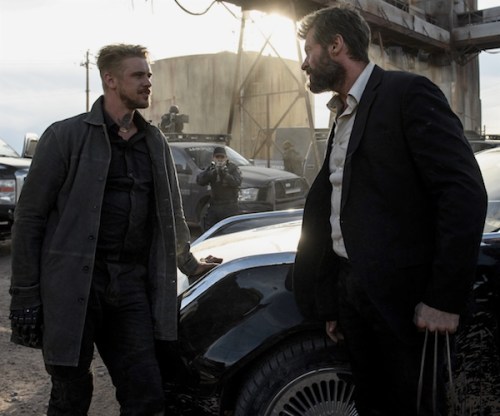
That doesn’t mean it’s perfect, sadly. Functionally speaking, Logan barely has a villain. There are some ill-intentioned and dangerous people after X-23, so our heroes have to run away from them — that’s all the role they have to play. Heading up the hunt is Pierce (Boyd Holbrook), a henchman figure who’s de facto lead villain purely because he gets the most screen time. Unfortunately, he has more personality in his defining attribute, a CGI robotic arm, than in the rest of his characterisation combined. The theoretical Big Bad is Dr Zander Rice (Richard E. Grant), an evil scientist who we’re told developed some kind of virus that all but wiped out mutantkind, but now seems incapable of tracking down a group of preteens. He’s not on screen enough to make any kind of meaningful impression. On the bright side, on my “how badly miscast is Richard E. Grant” scale (which ranges from “very badly” to “not that bad, I suppose”) this errs towards the positive end, precisely because of that lack of screen time. Lastly there’s younger, fitter Wolverine clone X-24 (also Jackman), who’s at least intentionally devoid of personality — he’s been bred without it so he’ll be the perfect biddable killing machine. Obviously he’s ripe for some sort of thematic commentary — on ageing; on morality; on heroism; on, frankly, anything — but it never comes.
With the villainous side of the equation so unbalanced, we’re left primarily with our heroes. Fortunately, they do take up the slack, mainly through a pair of fantastic performances from Jackman and Stewart. Wolverine is undoubtedly the defining role of Jackman’s career, a part he’s played on and off for 17 years across seven movies (as a lead, plus a couple more cameos). Here he’s the most human he’s ever been. In many ways Logan was always one of the most relatable X-Men, one of our points of entry into their world and taking the piss out of them and the situation when it was called for. He was still primarily a likeable character in a fantastical world though, whereas here he feels more like a real person, struggling with the physical detriments of ageing and (less explicitly) the metaphysical quandaries of what it was all for. As he puts his time with the character to bed, Jackman gets to deliver his most nuanced and affecting turn in the role. Neatly, it mirrors where it all began for this version of the character: protecting a young mutant girl struggling to come to terms with her dangerous powers in a world that’s out to get her.

Stewart is every bit as good as a man defined by his mental prowess whose mind is failing. Originally cast to play a statesman-like role in the series, here Stewart gets to have a bit more fun, to be a bit more cheeky, but also to tap into a bit more depth of emotion, as Charles struggles with whatever it was he did to land him in hiding in Mexico (I think there was some dialogue that explained it but, frankly, I missed it in the mumbly sound mix. I’ll catch that on Blu-ray, then).
Of course, they both die. Normally that’d be shocking in a major studio blockbuster, but it’s quite clear Logan is playing by different rules, and in those rules the old good guys die. Heck, nearly everyone dies, but the only deaths that matter are Charles’ and Logan’s. What’s at least a bit interesting is how they die. For Professor X, it’s almost ignominious, — in a bed, not even his own, stabbed by X-24 for virtually no reason, then later fading away in the back of a truck. It’s not a grand heroic self-sacrifice while trying to save the world, the kind of death you’d expect for a character of his stature (and more or less the kind he got in The Last Stand, the first time they killed him off). It’s a great life come to a meaningless end. Well, Logan’s that kind of movie — it has no reverence for such things, just as life itself does not. Conversely, the death of Wolverine / Logan / James Howlett (who is he, in the end?) is a sacrifice, the selfish man of the movie’s opening giving himself up to save some kids; or, in grander terms, to save the future. Ah, but he was never really selfish, was he? It was an act. An affection brought by the hard years. He was always a good guy at heart. Always an X-Man, as the neat final shot emphasises.
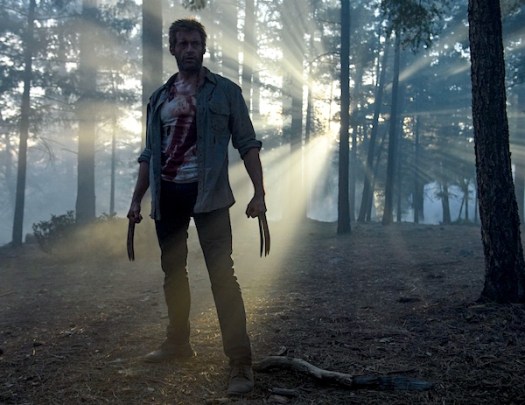
So there is some thematic meat to tuck into here, even with the apparent dead-end (pun not intended) of the X-24 subplot. Couple that with the many uncommon-to-the-genre plot and tonal points and you have a movie that does merit consideration as one of the finer superhero films. However, the perception some espouse of this being brave or bold moviemaking is not inherent to the film. If this were an original story starring new characters, especially if they didn’t have superpowers, it wouldn’t make it a bad film, but nor would it be perceived as being so original or revolutionary. What is uncommon or remarkable is making that kind of movie with a well-known character, and in particular one who’s familiar from leading CGI-fuelled PG-13 summer spectacles.
Is that alone enough to confer greatness? Logan’s consistency of style and tone render it easily the best Wolvie solo movie (as much as I liked The Wolverine on the whole, its climax was horrible), but for this X-fan it’s not enough to usurp the top-draw traditional superheroics to be found in the three or four genre classics produced by the main series. Perhaps time and re-viewing will increase Logan in my estimation, however, because it is a very strong film indeed.


 Score:




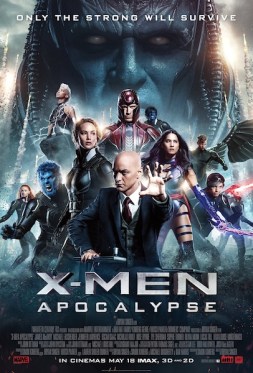 Despite fathering the modern superhero movie genre, the X-Men series always seems to punch under its weight at the box office (a point the recent
  That’s only the half of it, though. This is an X-Men movie, which not only means there’s an ensemble cast, but that it’s dedicated to constantly adding new members to it. This time around, we’re re-introduced to the ‘original’ team as teenagers: Scott Summers (Tye Sheridan) is the viewer’s “way in” to Xavier’s school after he suddenly starts shooting laser beams from his eyes; there he meets Jean Grey (Sophie Turner), a powerful telepath the other students are scared of because sometimes her dreams shake the school at night; Mystique rescues blue-skinned German teleporter Nightcrawler (Kodi Smit-McPhee) from a cage fight in Berlin, where he was up against Angel (Ben Hardy), who becomes one of Apocalypse’s Four Horsemen, alongside weather controlling street kid Storm (Alexandra Shipp) and Psylocke (Olivia Munn), who can create blades of energy with her hands. And there’s also Jubilee (Lana Condor), who has bugger all to do. Jubilee was a major character in the animated series, and the filmmakers seem obsessed with getting her into the movies (she had cameos in the first trilogy) without ever actually giving her anything to do.
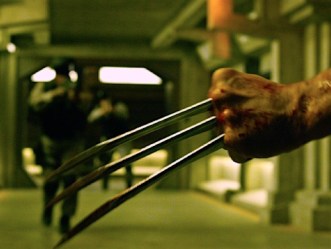 It doesn’t help that they feel the need to shoehorn a Wolverine cameo in there, an underwhelming action sequence that becomes a massive aside from the main storyline. It feels like setup for something more next time, but Hugh Jackman has stated
 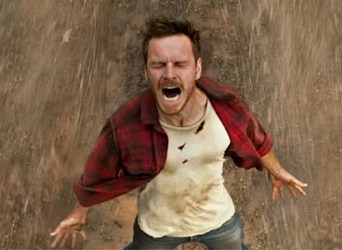 Another element lost in the mix is the real-world resonance contained in the best X-films. There’s a lot of to be said for the spectacle that’s present in all the movies, but Days of Future Past (for the most recent example) anchored it in the human conflicts between the heroes, and in their relation to the rest of the world. Apocalypse nods in that direction, with Mystique invoking Magneto’s metaphorical family to get him to stop destroying the world, but it’s not as well integrated, not as effective as previous outings. Said destruction is on a massive scale, but it’s too massive — the film doesn’t sell it; it’s just another city being destroyed somehow, emotionless computer-generated effects that are overfamiliar in these megablockbusters now (and not helped when you’ve seen similar sights two or three times right before the film in trailers for the likes of
  In fact, the film as a whole feels a draft or two away from being truly ready. Some of the dialogue clunks hard, especially when characters speak in exposition to one another. The plot needs streamlining and focusing, especially early on, and some events need appropriate weight added to them. Other things just need smoothing out — that trip to the mall happens Just Because, with no real sense of why the characters are doing it (other than some handwaving dialogue about needing to get out of the school for a change), and, as I said, in the final cut only leads to one single joke. Yet for all that, some things do work beautifully: Storm’s hero-worship of Mystique comes up almost in passing early in the film, establishing/emphasising Mystique’s place in the mutant world now; but then it becomes a key point in the climax without the need for any explanatory dialogue, as Storm wordlessly realises that her hero is fighting on the other side. It is, in a way, the best bit of the movie.
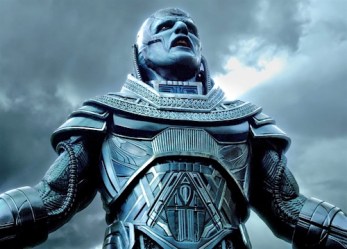 Despite being a negative nelly for much of this review (like so many others, which has given it a lowly
 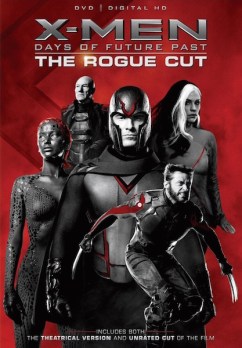 One of the big stories in the run-up to this fifth X-Men film’s release last year (my previous review is
 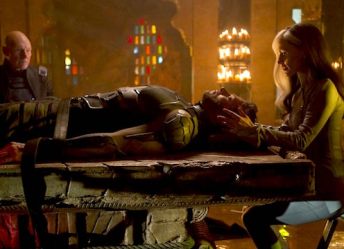 (though the theatrical cut only has 40 chapters, so I’m not entirely sure how that pans out). Most must be teeny extensions, however, and I look forward to
 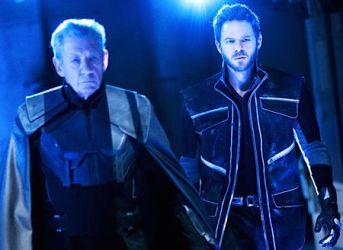 The Rogue Cut is worth seeing for anyone who enjoyed the theatrical version — and, in terms of a copy to own, the Blu-ray comes with both cuts and more special features (though it loses all the extras from the first release, including a few more deleted scenes) — but, unless you’re a huge fan of Rogue or Iceman, it’s not essential.
 I think I’ve previously discussed my life-long love of the X-Men franchise, so I shan’t go into detail again, but suffice to say Days of Future Past has been one of my most-anticipated movies ever since the title (which is that of a classic and influential story from the comics) was announced. Thank goodness, then, that the final result doesn’t disappoint.
 Beyond that, there’s the characters: the younger versions are having to deal with the fall-out from
  Not everyone gets to shine in a cast this big, although pretty much everyone gets a moment. The future-set cast have the least to do, people like Halle Berry turning up to do little more than show their face, though Stewart and McKellen get a moment or two worthy of their talents. After he was the focus of the last film, Fassbender is slightly shortchanged here; but after McAvoy gave him essential support in First Class, Fassbender plays the same service here, informing Charles’ journey. Of the new additions, Evan Peters as Quicksilver (that’s the one who’ll also be played by Aaron Taylor-Johnson in
  Later, there’s the aforementioned ‘slow-mo’ sequence, and the grand climax, which offers more “fly something big around” antics a la First Class’ submarine, only considerably grander. Yet for all the spectacle, the final moments once again come down to character: what is Magneto prepared to do? What is Mystique prepared to do? Will anyone listen to Charles? And so on. Even the much-vaunted Marvel Studios movies tend to base their climaxes in slabs of ‘epic’ CGI crashing into each other; Days of Future Past does that for a bit, then brings the characters back into focus for the real final beats.
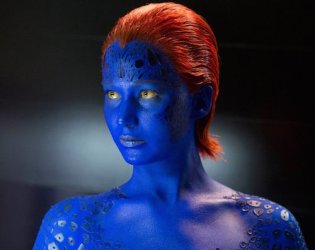 (Jennifer Lawrence being the third pillar of the past triumvirate, as they’ve already focused on Xavier and Magneto). While Days of Future Past does wrap up the majority of its threads (the open-ended ones are answered by previous films, if you want them to be), there’s plenty there to play with in the next film (and, perhaps, ones beyond that) if they want to… which they do.
 100Films.co.uk