
Michael Winner | 93 mins | TV | 18 / R
 Apparently, the recent Michael Caine-starring Harry Brown is a Death Wish for modern times. I’ve not seen Harry Brown yet (Michael Caine killing chavs? Why haven’t I seen this yet), but — as you’ve probably guessed from which review you’re reading — I have seen its spiritual predecessor.
The Death Wish series, as it would later become, seems to be remembered with a certain degree of contempt these days (despite an expressed love for Death Wish 3 from Edgar Wright & co), and I suspect that may be due to the sequels. Not that this first film is a masterpiece or something, but it has plus points.
The characters are surprisingly believable for a start, with serious effort put into their motivation and progression. One expects a shallowness from the genre, plot and director — that the hero’s wife would be killed and daughter raped, and the next day he’s on the street killing scum, building to a climax where he finally gets the gang who committed the original crime — but it’s not so. Months pass before Charles Bronson’s unlucky architect, Paul, grabs his gun and hits the streets, and even then it’s not like he’s slaughtering foes left, right and centre every night.
Indeed, realism permeates: Paul’s encounters aren’t all easily won; he gets injured; his crimes create a media storm, on which public opinion is divided; he never conveniently come across the attackers of his wife and kids — after the crime, they’re never seen again; and so on. There are still unrealistic bits, certainly, but by employing enough believability and leaving aside certain rules of the revenge thriller — for one thing, he never actually gets revenge — Death Wish manages to rise a little above the “heroic vigilante” sub-genre.
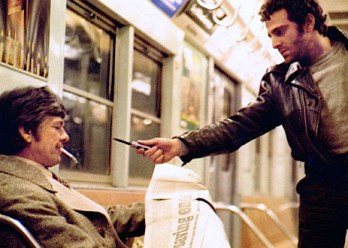 The strongest element is probably Wendell Mayes’ script, because it constructs all this. Weakest is Michael Winner’s direction — some of it’s fine, the occasional shot even good, but largely it’s pedestrian and sometimes mediocre. That said, Winner has become such an unlikeable public figure that it’s somewhat difficult to gauge how much of this is bad direction and how much bias. Still, it’s not the kind of work to make one think, “he’s an idiot, but he knows how to do his job”.
As noted, I hear the sequels get increasingly ridiculous, which I can well believe: as a standalone film, Death Wish has strength in a certain degree of realism; imagining a franchise spun off from it, however, it’s easy to see how it would quickly become diluted and lose the power such veracity gives. One wonders, though, if a well-chosen director might produce an even better remake…

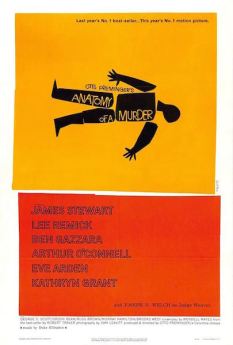 Anatomy of a Murder is a courtroom drama, adapted from a novel by a real-life defence attorney (“defense attorney”, I suppose), who in turn based his fiction on a real case. This background not only adds to the veracity of what we see, but likely explains the film’s style and structure.
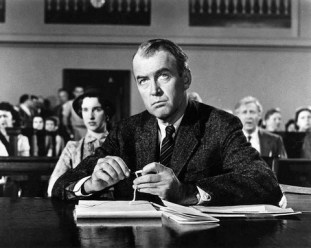 A lot of this support is down to Stewart’s performance — it feels wrong to be cheering the defence counsel of a murderer, even if he had a justifiable motive (which, remember, he may not have) — but we’d probably cheer Stewart on if he was the murderer. His Biegler is always in control, from investigation to courtroom, even when by rights he should be completely out of it. He manipulates the judge, the prosecution, the jury and the crowd to perfection; the viewer sits by his side — we know he’s playing them so we can revel in it — but, in turn, he manipulates us too, tempting us to his team — to laugh at his jokes, to support his case, to loathe the prosecution, even though they might be right. It’s a stellar lead performance.
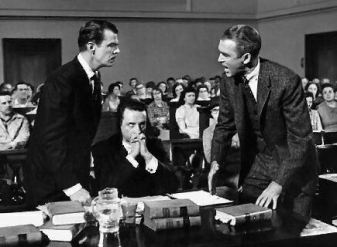 I could just as well go on to praise Ben Gazzara, Arthur O’Connell, Eve Arden, Brooks West, even the smaller roles occupied by Kathryn Grant, Orson Bean, Murray Hamilton and others. Some criticise Joseph N. Welch’s judge, and it’s perhaps true that his performance is a little less refined than the others, but as a slightly eccentric judge he comes off fine. And to round things off, there’s an incredibly cute dog. Mayes’ screenplay is a gift to them all, finding room for character even within the ceaselessly procedural structure, using small dashes of dialogue or passing moments to reveal and deepen each one.
 100Films.co.uk