
Tim Burton | 127 mins | Blu-ray | 1.85:1 | UK, Belgium & USA / English | 12 / PG-13
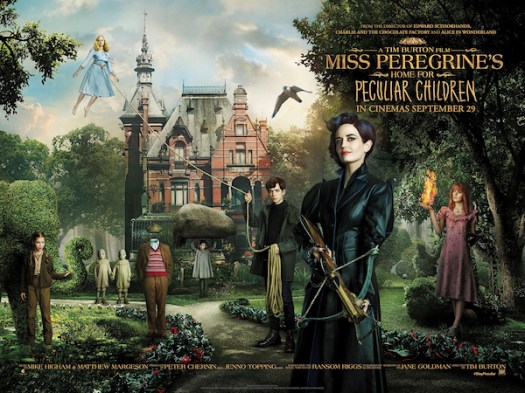
After his beloved grandpa Abe (Terence Stamp) dies in mysterious circumstances, Floridian teen Jake (Asa Butterfield) seeks closure by visiting the children’s home in Wales where his grandpa was raised. As a child, Abe regaled his grandson with tales of the home’s other residents and their fantastical abilities — tales which were completely true, as Jake discovers when he meets Miss Peregrine (Eva Green) and her peculiar wards.
The quickest route to defining the experience of watching Miss Peregrine is by referencing other films, if only in a broad sense. For starters, it’s adapted from a young adult fantasy-adventure novel, and there’s a definite shape to things which reflects other entries in that genre — the whole “ordinary kid discovers a fantasy world of incredible powers and approaching danger” type thing.
It’s also directed by Tim Burton, and does feel like a Tim Burton movie. However, what’s incredibly pleasant about that is it doesn’t feel aggressively Burtoneseque. As if in reaction to the blandness of his Planet of the Apes remake, much of Burton’s output since then has slipped towards self-parody, and suffered for it. Miss Peregrine has recognisable flourishes, undoubtedly, but is a little more restrained with how it deploys them. Some have criticised it for this, citing it as another example of Burton removing his unique stamp from the picture, much as he did with Apes, but I disagree.

The final other work I would reference is the X-Men; in any incarnation, but the most relevant filmic one is probably First Class. Or not, because that was all about the establishing of Xavier’s school and the equivalent establishment here is already established. Nonetheless, it’s about a country house owned by a British matriarch-figure who cares for a gaggle of misfit kids with special powers. Rather than the X-Men’s potentially-violent array of action-ready skills, however, the ones on display here are a little more whimsical — like Emma (Ella Purnell), who’s lighter than air, or Horace (Hayden Keeler-Stone), who can project his dreams through his eyes.
Also like X-Men, the threat comes from within this secretive world. The starter X-baddie is, of course, Magneto, a mutant seeking to use scientific methods to turn the whole world into mutants. Here, the baddie is Barron (Samuel L. Jackson), a peculiar seeking to use scientific methods to grant immortality to himself and his cronies. Part of their thing is eating people’s eyeballs, which has benefits for them — again, that’s quite Burtonesque… though a mite less whimsical.

Being on board with this whole milieu is important to enjoying Miss Peregrine, because the film does spend a lot of time establishing it. For those not interested in world-building, the action-packed third act must be a long time coming. There is a lot to marvel at along the way though, and Burton keeps things pleasingly real in his filmmaking techniques: there’s a fight between two creatures that was created with stop-motion, while another sequence involved constructing underwater rigs, and the vast majority of Emma’s floating was achieved by dangling Purnell on wires. That’s not to say there’s no CGI — ironically, the foremost example is a sequence that could otherwise be considered a tribute to Ray Harryhausen — but Burton’s filmmaking encapsulates varied techniques to lend a satisfying physicality to much of the film.
On the whole Miss Peregrine seems to have received a rather muted response, but I thoroughly enjoyed it. It might be best to qualify that by reiterating that it’s playing with a lot of things I enjoy — “X-Men by way of Tim Burton” sounds fantastic to me, and that’s not a bad definition of this movie. I’d even go as far as saying it’s his best work this millennium (though, in fairness, I still haven’t seen Big Fish. Well, it’s only 14 years old.) The shape of the story is no great shakes, but it’s built from magical elements and fantastical imagery, and a game cast of quality thesps hamming it up magnificently and eager youngsters with a slightly earnest likeability.

Actually, in many ways it reminds me of another heightened, stylised young-adult adaptation that suffered from a mixed reception. See you in 2029 for the Netflix re-adaptation, then?

Miss Peregrine’s Home for Peculiar Children is released on DVD & Blu-ray in the UK tomorrow.
 I don’t know if the true story behind Pride was big news back when it all actually happened in 1984, but I hadn’t heard of it until the film came along. For those who’ve still missed it, it’s about a group of gay activists deciding to form a group, LGSM, to support the striking Welsh miners — two groups who were poorly treated in one way or another by ’80s Britain.
 whose dancing display has to be seen to be believed. Bill Nighy and Paddy Considine are understated as quiet, hesitant characters who have inner steel, and Jessica Gunning makes a similar impact as a housewife who is completely emboldened by the activism.
 In a near future where Britain is part of a Cold War against China, a scientist (Toby Stephens) has been trying and failing to perfect artificial intelligence at a government research facility. When he hires a new associate (
 This may explain why the performances are a mixed bag. Toby Stephens can’t seem to find much to work with in his lead role, despite supposedly having a couple of emotional arcs. Lawson sleepwalks through his turn as a shady government higher-up. Lotz is unremarkable as a human, but fantastic as the AI-driven machine. Her performance as the latter is the primary reason to consider watching the film.
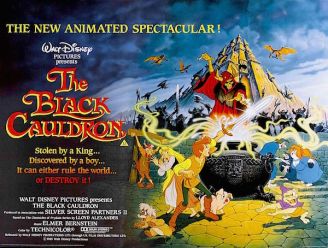 The Black Cauldron is best remembered as an intriguing footnote in the history of Disney animation. Their 25th ‘official’ film, it was the first with no songs, the first to earn a PG (after being cut — twice — to avoid a PG-13), and flopped so badly they disowned it for over a decade. Fully-animated sequences were cut after disastrous test screenings for parents, and famed exec Jeffrey Katzenberg, who came into Disney management during the film’s production, reportedly ordered 12 minutes cut, muddling the film’s story. What a mess.
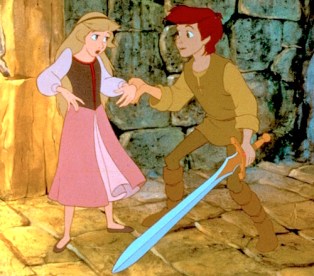 It’s always interesting when a company like Disney break outside of the norm, and it’s certainly brought them some degree of success in recent years with the likes of
 100Films.co.uk