2015 #18
David Fincher | 149 mins | Blu-ray | 2.40:1 | USA / English | 18 / R
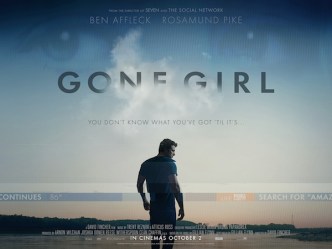 “Horrible people do horrible things to each other” is the Post-it Note summary of this dark drama-thriller from director David Fincher, adapted by screenwriter Gillian Flynn from her own novel, which is short on heroes and overloaded with villains. An alternative brief summation is, “modern society is shit.”
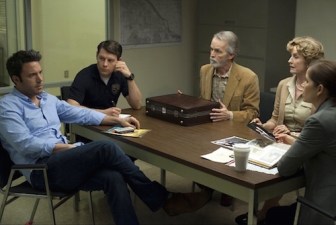
Nick and Amy Dunne (Ben Affleck and Oscar-nominated Rosamund Pike) are a married couple living an affluent-seeming life in middle America. One morning she goes missing, their house showing signs of a violent struggle. Nick calls the police, naturally. He has an alibi, but there are gaps — both to the police and for us, the viewer. Flashbacks reveal the courtship and subsequent middle-class-hardship of the Dunnes, their picture-perfect marriage built pretty much like one might build a picture of a perfect marriage. As the media descends on Nick’s small hometown, he’s swept up in the narrative of a nation deciding his guilt or otherwise in tweet-sized bursts of opinion, due process be damned. The heightened situation and an ever-lengthening chain of increasingly incriminating evidence bamboozles Nick into some ill-advised decisions, which only compounds the public’s negative perception of him. And halfway through there’s a killer twist that turns everything on its head, sending the film spiralling out in all kinds of new directions.
Depending on which set of critical reactions you choose to follow, Gone Girl is either Fincher’s latest masterpiece — possibly his most masterful masterpiece — or Fincher-by-numbers, a director treading water with a film so tailor-made for him that it’s all a bit too obvious. I think the latter is to reduce the greatness of Fincher’s work — and Flynn’s too, not to mention the talented cast and everything else that’s superb about this movie. 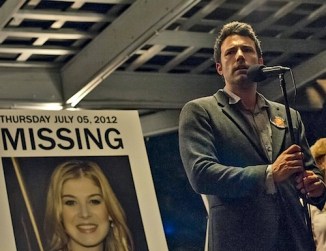 However, that opinion may stem from the same point as my view on the more praise-filled reactions: that Gone Girl is not a film as great as Se7en, Fight Club or Zodiac, but that it is, along with The Social Network, a half-step behind them. Who knows, perhaps if I re-watched the pair they’d catch up with the pack; but then Se7en is my oft-cited “favourite film ever”, so good luck with that.
So, the people who have written Gone Girl off as a thriller made of audacious twists but, ultimately, no more than that have, I would wager, missed something. Analysis pours forth already — Richard Kelly, director of Donnie Darko and several other lesser films, wrote a lengthy comparison to Eyes Wide Shut, Stanley Kubrick’s posthumous final film that had a mixed-to-poor reception on its release but, in the ensuing decade-and-a-half, seems to have been re-evaluated as something of a classic. Kelly’s piece is worth a look for those who don’t mind pieces that include multiple uses of the word “heteronormative” (no, wait, come back — he’s not as bad as most people who insist on using that phrase! And you’ll be pleased to know “cisgender” doesn’t even come up once), but do be aware it thoroughly spoils the plot of Gone Girl (and, I presume, Eyes Wide Shut, but as I’ve not seen that I’m not sure how much I’ve been spoiled).
Comparisons to Kubrick are nothing new for Fincher, of course; both directors being equally famed for their technical virtuosity and obsessive perfectionism, notoriously expressed in their renown for insisting on dozens, sometimes hundreds, of takes. (There’s a bit in the Gone Girl commentary where Fincher addresses this reputation head on, highlighting a shot that was achieved perfectly on the first take, so they didn’t do another.) However, A.V. Club’s list of the 100 best films of the decade so far (which places Gone Girl at #40) has a different suggestion: “isn’t there a bigger hint of Hitchcock in his choice of projects, the “disreputable” material to which he applies his immense talent?”
 This is an argument for which I have a lot of time. The majority of Fincher’s filmography is made up of policiers and thrillers of one form or another, and even when he breaks out of that mould — in The Social Network, for instance — he often brings a similar perspective and toolset. Many of these films are borderline-rote, heavily-generic schedule-fillers at screenplay level, and would have been just that in the hands of a lesser director; in the hands of a master filmmaker, however, they become genre-transcending classics. I think that same sentence could be said about most (all?) of Hitchcock’s best films.
Gone Girl is the latest in that vein. Yes, there are the straightforward thrills of a twisty whodunnit plot, but that’s carried off with infinite panache, the film as crisply edited and with as darkly glorious cinematography as anything else on the Fincher filmography. Beneath and around that, there’s a seam of thematic material for the engaged to sink their teeth into. Some have labelled it as a deconstruction of marriage, which is a bit broad. Although there’s no functioning relationship on screen to serve as a counterpoint, I think we’re all capable of imagining one. Rather, Fincher and Flynn are showing what a certain kind of person will do to fulfil their ambitions, especially when that ambition is only multiplied by contact with a similarly desirous other. This is a ‘perfect storm’ of two people — perhaps two fundamentally unlikeable people — setting out to achieve their goals with a “rest of the world be damned” attitude; an all-or-nothing game where the stakes are both life-or-death and, at the end of the day, the chance to live the American (1%-er) Dream. Is that worth what they go through? It is to them.
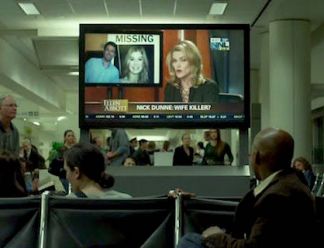 Is it for the masses, too? Maybe. In his review for Little White Lies, David Jenkins reckons that “ideas of the essential unknowability of other people and the fluid nature of trust… form the basis of the entire movie [and] this is where the 24-hour TV news cycle comes in… As events in the film play out, panel shows, news pundits and twitter feeds are swift to offer their unique spin on things, spouting wild conjecture as if it’s copper-bottomed fact.” I can’t help but be reminded of the social media reactions surrounding the Oscar Pistorius case: so many people on Twitter were so convinced they they knew what happened, and what should be done about it, that they had pre-judged him and were shocked by the trial’s outcome, leading to condemnation of the judge and/or the entire South African legal system, which must of course be inferior to the American one (because it’s different and therefore the American one is by default superior).
It’s this kind of reaction that the film is, in part, observing and commenting on; it is, as Jenkins dubs it, “the ocean of fickle public backwash… the collective hunger to say something, anything, [that] will, in the end, prevent justice from prevailing.” The role of the media may seem like a subplot, or even a sub-theme, early on, but by the end it has become vital to the film’s third act: key decisions are made to influence the media and public; further decisions are based on the media and public reaction to that influence; and, come the climax of it all, it’s the media and its consumers — more than the police, or even Nick Dunne and his relatives themselves — who decide the outcome.
I haven’t written much about Gone Girl’s production elements, because I think with a Fincher film you can trust they’ll be exemplary and you can focus on the dramatic/thematic points instead. One thing that does merit highlighting, however, is Rosamund Pike’s performance. She is incredible, offering a performance with more layers than a pack of onions, all of which she negotiates with supreme skill. Given the story,  a lesser actress could’ve given a performance with fewer notes and the film still would’ve functioned; or they would have struggled to contain the numerous sides to Amy’s personality in the form of a plausible human being. Pike does that, and more. She goes on my list of “people who were robbed of an Oscar because it was someone else’s ‘time’” (alongside Paul Greengrass’ United 93 snub in favour of The Departed).
Ultimately, Gone Girl works as a twist-laden dramatic thriller, with reveals and developments that are best discovered unspoiled for the full rollercoaster experience. Underpinning that, however, is the kind of observation and deconstruction of our modern world that has elevated several of Fincher’s best films. Even if Gone Girl isn’t quite among the films in that very top tier, I think it can stand proudly beside them.
Gone Girl debuts on Sky Movies Premiere today at 9pm and 1am.


 100Films.co.uk