
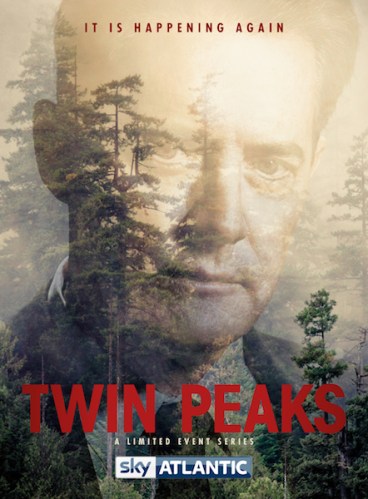
ICYMI, Film Twitter has been getting itself in a bit of a tizzy over the past couple of days about David Lynch’s return to TV… film… TV… film!… TV!!… FIL— you get the idea.
So, respected British film magazine Sight & Sound went and named Twin Peaks: The Return as the second best film of 2017. Except it’s a little more complicated than that, in the sense that their list is voted for (i.e. no one person or team specifically decided to place Peaks at #2) and that voters were expressly told they could include TV series, or indeed any other form of visual art (although Peaks was the only non-film to make the top ten, Sight & Sound have since tweeted a list of music videos, computer games, and other such things, that also received votes).
Some people seemed to find the very notion of counting Twin Peaks’ third season as a film to be personally offensive. It must’ve been like rubbing salt in the wound when respected French film magazine Cahiers du Cinéma went and ranked it 1st on their list.
Many digital column inches have been spun out of this, naturally. Two of the more interesting / accurate ones I’ve read are Matt Zoller Seitz’s 25-tweet thread/rant and Vadim Rizov’s kinda rebuttal at Filmmaker Magazine. For my part, it’s nine years almost to the day (just one day short!) since I wrote this piece on the TV vs. film shebang, albeit from a slightly different tack (TV movies vs. ‘real’ movies). My main point was that it’s a kinda arbitrary distinction nowadays. That’s only become more the case in the almost-decade since.
Similarly, I think most of the handwringing over Peaks’ inclusion in these lists has been stupid. As I said, Sight & Sound specifically okayed the inclusion of TV — The Return wasn’t singled out as “yeah, it’s TV, but it’s so good we’ll count it as a film”, a notion that’s been projected on this news by some commentators (mainly TV critics) so they can then take great offence at it. But if Sight & Sound’s voters had considered any other season of 2017 TV to be worthy of inclusion, it had just as much chance of making it in. I don’t know what Cahiers’ rules were, but I’m going to assume they were similar — and they’ve included TV before (of all things, the first season of 24 made their top ten back in 2002).
Personally, I’m not really sure where I come down on the issue of Twin Peaks: The Return in particular. I mean, it’s definitely a TV series, isn’t it? But it’s also virtually an 18-hour movie, isn’t it? Can it be both? Why can’t it be both? As I said, I kind of err towards the broad position of “why differentiate?” As someone put it in a comment I saw somewhere else, it’s all linear non-interactive visual media. Still, I probably won’t be including it in my own year-end best-of list, but is that because I don’t think it should be on a movie best-of list or because I wasn’t wholly convinced/entertained by it as a work?
And if you were wondering what I did think of it in more detail, here are all the posts I reviewed it in while it was airing:

 The entirety of The Return has been a very divisive piece of television. For all the praise it’s received from certain critics and cinephiles, there are other viewers and reviewers who think it’s a case of Emperor’s New Clothes. The finale — which looks likely to also be the finale to the entire Twin Peaks universe, unless something changes — is all of that in a microcosm, with some hailing it as a perfect capstone on a masterpiece, while others berate it for being inconclusive and overly ambiguous rather than a true ending.
 Part 17 saw most of the series’ central characters converge on the Twin Peaks Sheriff Station for a showdown with, first, the evil Mr. C, and then BOB, now in the form of a floating ball with a face. In most shows none of this would make a blind bit of sense, but in Twin Peaks it’s what amounts to clarity. Indeed, I’ve even seen some people criticise it for being too pat and obvious. Everyone’s entitled to their opinion, right? But anyone who wanted a full-blown reunion between their favourite characters was in for disappointment, because almost as soon as Agent Cooper was back among both his Twin Peaks and FBI friends, he was off again — transported into the past, into the events of
  As the episode went on, most of it seemingly filled with people driving together in silence, it became increasingly clear that we weren’t going to find out many of the things we’d been wondering about (first among them for many fans: what was going on with Audrey?), nor did it look likely we’d be getting a nice button on the main plot line of the show. That turned out to be the case, with a mysterious final scene that, as I said earlier, felt more like a cliffhanger than an ending. That
 100Films.co.uk