Verity (2010)

2010 #118a
Stephen Cheung | 9 mins | streaming

There’s probably a worthwhile biopic to be made about Verity Lambert. In 1963, she became not only the youngest-ever producer of a BBC television programme, but the first female one too; the programme she was charged with launching was Doctor Who, which she took from a short-commission no-hoper to a firm part of the national culture — and we all know what’s happened to it since she left in 1965. Her extensive career continued until her death in 2007, encompassing such televisual landmarks (for good or ill) as The Naked Civil Servant, Quatermass, Minder, G.B.H., Eldorado and Jonathan Creek.

This nine-minute effort from student screenwriters Thomas Cowell and Joey Guy is, unsurprisingly, not that biopic. Wisely, it focuses on the start of Lambert’s producing career, dramatising the events around her being chosen by Sydney Newman (then the BBC’s Head of Drama) to shepherd his idea for an educational science-fiction children’s drama, its initial ratings failure and, shortly after, its ratings success. The film’s tagline — “men, bitches and Daleks” — sums up its thematic concerns: Lambert argues with the man who hired her, faces animosity from other female members of staff, and saves the day by forcing the Daleks into the series despite Newman’s forbiddance.

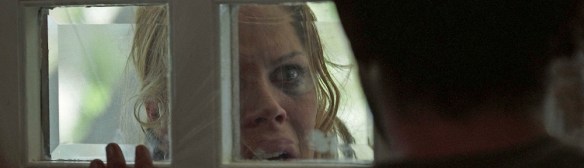
Verity in VerityBefore I set off really critiquing the film, let’s just remember this: it’s a student effort. In that context, I’ve seen far worse — heck, I’ve been involved in the production of worse. Cowell and Guy have set themselves an almost Herculean task by choosing a period tale, which obviously necessitates all sorts of extra effort in terms of costumes, locations, dialogue… And to make it worse, they’ve chosen the ’60s, evoked so faultlessly in almost 40 hours (and counting) of Mad Men. Of course a low/no-budget student film can’t compete with an expensive, acclaimed US TV series; and actually, Verity does a fair job of recreating its era… visually.

The comparison with Mad Men comes up in more than just the visuals though, because that also deals extensively with gender politics in the ’60s. Here, Verity can’t compete. Dialogue is too on the nose — some of the language they use freely is implausible for the era; the way they often bluntly state their point is implausible for any time. “I’m making history” is an unlikely thing for anyone to say ever.

In terms of these specific events, it doesn’t fare much better. Accuracy to facts can occasionally be ignored if it makes for a good story, and Verity’s outright rebellion against Newman’s “no bug-eyed monsters” mandate might appear to be that, but its execution is left wanting. She storms into his office and informs him the Daleks will be in the series, Verity in Sydney's officewhich he accepts with merely a muttered “damn” when she leaves. Sorry, what? There’s nothing believable in that scene, never mind accurate.

After the ratings success of the Daleks’ first appearance, Newman can’t help but think of the “merchandising opportunities”. Really? A lot of stuff was indeed produced during Dalekmania in the mid-’60s, but this is still the state-funded BBC and 14 years before Star Wars — not to mention that Verity brandishes a Dalek toy, which wouldn’t be produced until 1965. (If you really want it rubbed in, the prop she’s holding is clearly a new series toy.)

Ten minutes isn’t much to play with, true, but I think it’s fine for a version of this story. Cowell and Guy have picked their scenes well, it’s just that the actions and words they’ve filled the scenes with don’t ring true. This is only partially the fault of the cast’s rampant overacting — though, in fairness, I think Rachel Watson is fighting against an affected southern/period accent as Verity, and Brian Clarke gives quite a good performance as Newman.
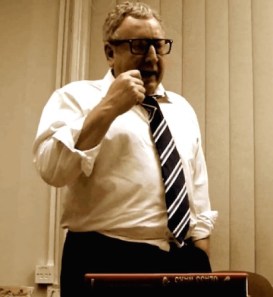
Sydney Newman in VerityTechnically, the piece is just as much a mixed bag. Stephen Cheung’s direction picks out some decent angles, avoiding the flat point-and-shoot trap some student filmmakers are apt to fall into, while the sepia-ish wash helps the period tone and adds a small amount of welcome gloss. The editing is a little rough around the edges, particularly at scene changes and toward the end. YouTube claims it’s viewable in 1080p — whether something went wrong in shooting, editing or at YouTube’s end I don’t know, but it isn’t that high quality. (This last point doesn’t impact on my score at all, it’s just an observation.)

I’d like to say Verity is a good effort, but though it has a few things going for it — and even allowing for the fact it’s a student film — it would clearly benefit from better research and greater subtlety in characters’ actions and dialogue. Must try harder.

2 out of 5

Verity is available on YouTube.

Three years later, the BBC told the same story in Mark Gatiss’ TV movie An Adventure in Space and Time, which is properly brilliant.

Wallander 2 (or 6) and 3 (or 13)

If you read my review of the first episode/film of the Swedish Wallander, Before the Frost, back in November, you may have some idea what that title’s on about. For the rest, I’ll try to explain it succinctly:

There are multiple TV/movie series based on Henning Mankell’s detective Kurt Wallander. This particular one, begun in 2005, features an adaptation of one novel (Before the Frost) followed by twelve original stories. Of these thirteen feature-length episodes, three were released theatrically — episodes one, six and thirteen (the rest went direct to DVD, and later TV) — and, because of their initial cinema release, I’ve reviewed those three as part of my objective. Having published the first last November, this pair of reviews covers the second film (or sixth episode) and the third film (or thirteenth episode).

I hope that makes some kind of sense…

2009 #88
Wallander: Mastermind

Mastermind works to earn its status as a theatrical release, everyone upping their game to provide something more filmic than the other direct-to-DVD entries in the series.” Read more…

2010 #12
Wallander: The Secret

The Secret‘s not quite as filmic as Mastermind. Making it personal for one of the team is always a good way to make A Bigger Story, and there are some particularly large revelations and twists involved here.” Read more…


A second series of the Swedish Wallander comes to BBC Four soon. This time, only the first episode — The Revenge (Hämnden) — has received a theatrical release, though to date only nine (of thirteen) episodes have been released at all (according to IMDb, the remainder are due for release in Sweden in March, April, June and July; I don’t know if BBC Four are screening all thirteen in one go regardless). I will, of course, continue to cover the series’ cinema-released episodes as I see them.

Hamlet (2009)

aka The Royal Shakespeare Company’s Hamlet

2009 #90
Gregory Doran | 183 mins | TV | 12

Hamlet (2009)It doesn’t seem like 18 months since the RSC brought Hamlet to the stage with British TV’s biggest star actor (probably) as the titular Dane, but it is (more or less). Thanks to sold-out performances and largely positive reviews (theatre critics seem even less keen to agree on anything than film ones), we’re now treated to this film adaptation, shown on BBC Two on Boxing Day and released on DVD (but not Blu-ray, boo*) earlier this week.

Hamlet hangs primarily on its central performance — so we’re constantly told, anyway; this being only the second production I’ve seen I can’t confidently assert so for myself, but I can certainly see where the consensus comes from. Equally, I can’t accurately compare David Tennant’s performance to any other, which often seems to be a central consideration in any review of the play. In near-isolation, however, it’s a thoroughly convincing performance. He glides seamlessly from withdrawn and grief-stricken in his first appearance, to intrigued and excited by the ghost of his father, to clever and wily as he plots, and finally to an alternation between assumed madness and serious introspection as he enacts his plans.

Any number of scenes show off Tennant’s abilities, particularly the way he treats other characters. He resolutely takes the piss out of both Polonius and Rosencrantz & Guildenstern, but plays each in subtly different ways: the former is like someone intelligent teasing with someone who doesn’t get it, which sounds distasteful but is enjoyable because of Polonius’ plotting and influence; while the latter is like a cat toying with a pair of treacherous mice, who are aware they’ve been caught out but struggle on regardless. Hamlet’s pair of ‘friends’ can be seen as insignificant characters by some — it’s part of what led Tom Stoppard to pen Rosencrantz and Guildenstern Are Dead, after all — but with a few silent additions around Shakespeare’s dialogue and the way Tennant, Sam Alexander and Tom Davey choose to play the original lines, their roles seem to have increased importance.

The other notable facet of Tennant’s interpretation of the character is humour. Hamlet’s madness here is almost unrelentingly funny — even in deadly serious situations, like capture following a murder, Tennant’s Hamlet can’t resist taunting the other characters, keeping the viewer onside by keeping his apparent insanity entertaining rather than scary or darkly intense. If anything, however, this screen version fails to capture just how funny Tennant was on stage. Perhaps it’s the loss of a bigger audience, or the energy of performing on stage, or perhaps Tennant has reined in, switching from Stage Acting to Screen Acting. He’s still funny, certainly, but its not as striking as it was live. In fact, more laughs are earnt by Oliver Ford Davies as Polonius. As his lines dither on like many a real forgetful old man, it’s difficult to imagine the part played any other way.

The other stand-out is an award-winning Patrick Stewart in the dual role of Claudius and the Ghost, though the fact he plays both feels relatively insignificant. His cool politician of a King makes a perfect contrast to the crazed energy of the Prince, the latter constantly bounding around while the former remains still and collected. In my view it’s a shame Stewart has a beard in the filmed version (a necessity forced by his concurrent appearance in Waiting for Godot, I believe) — on stage he was clean-shaven and therefore somehow more reminiscent of numerous other political villains, both real and fictional, whereas his bearded visage is more reminiscent of a traditional Kingly role. Still, it’s a minor aesthetic point that doesn’t hamper his wonderful performance.

Director of the original stage production, Greg Doran, also helms this version. It’s a convincing adaptation too, making good use of sets, locations and, vitally, camerawork, rather than employing static shots of the original theatrical blocking. A quick shoot (18 days for an over-three-hours film) and single location combine to reduce the number of on-screen locations, unfortunately, though the main set is fairly well rearranged to stand in for a number of rooms. It does branch out occasionally, but it’s a shame this couldn’t have been done more often, as consecutive scenes on the same slightly-redressed main set occasionally confuse whether we’ve changed location or not.

Doran’s main screen gimmick, however, is security cameras. Every so often our viewpoint switches to a grainy black & white high angle as we survey the scene via CCTV. It’s a neat idea to convey the concept of Elsinore as a place where everyone is under constant scrutiny, and it’s occasionally used very well indeed — during the Ghost’s appearance to Hamlet, for example, or when he rips a camera down to declare “now I am alone”. Unfortunately, it’s not as consistently thought-out as one might like. When Claudius and Polonius spy on Hamlet and Ophelia, for example, they do so from behind a two-way mirror (as in Branagh’s film, incidentally) rather than, say, from a control room with a bank of security monitors, an idea which seems to naturally flow from the presence of CCTV. Following this, when Polonius talks to Hamlet he delivers several asides to camera — not the security camera, mind, just to the audience. It would have been more effective to have him offer them to a security camera, knowing Claudius to be viewing in another room. It’s moments like these that turn the omnipresent video surveillance from a clever idea to little more than a gimmick. And by the time it’s cut to during the climactic sword fight, you just want it to go away.

It’s almost certain that this production will be remembered as “The Doctor Who Hamlet” thanks to its leading man. Whether that’s unfair or not is another debate, though it shouldn’t mean this version goes ignored. Tennant’s excellent performance reminds us that he was an accomplished performer with the RSC long before he gained televisual fame, and a strong supporting cast ensure this can’t just be dismissed as a popularity-seeking vanity venture by the RSC. Indeed, if there’s one good thing about the “Doctor Who Hamlet” label, it’s that the potential viewership is increased massively, bringing some to Shakespeare who never would have bothered otherwise. Surely no true theatre aficionado could argue with that.

4 out of 5

* A Blu-ray was eventually released in April 2010. ^

What makes a film a film?

What makes a film a film? I don’t mean “as opposed to a book”, or “as opposed to a pile of rubbish”; but rather, “as opposed to a TV special”, or different to a direct-to-DVD movie — indeed, is there a difference?

This is the sort of thing that’s bothered me for a while, mainly thanks to the Radio Times. The Radio Times’ film section frequently features reviews for things they label as “US TVM” — translation: an American TV Movie. Not everything falls into this category. The 1996 Doctor Who TV Movie (the clue’s in the title) was just listed as a TV special, as was the recent one-off episode of 24, Redemption. Why are these different to other feature-length made-for-TV one-off dramas? The former was a British co-production, perhaps, but the latter wasn’t. The latter is part of an on-going series, made between seasons, however. But then, one-off editions of other (older) series have been reviewed as “US TVM”s, so why are they different? It’s not even a hard rule in that instance, as some old series have their feature-length episodes screened as a matter of course among other repeats.

On a different tack, what about Paul Greengrass’ excellent Bloody Sunday, simultaneously screened on Channel 4 and released in cinemas? Or more recently, Ballet Shoes — just part of last year’s Christmas schedule in the UK, but it received a limited late-summer theatrical release in the US. So is that a film, or ‘just’ a TV special? Is a cinema release the key? Well, no — at least as far as the Radio Times are concerned — because Ballet Shoes wouldn’t now feature in their film review section were it repeated, while those other “US TVM”s will continue their circulation. [2015 note: A few years after I wrote this, Ballet Shoes was indeed repeated, and not listed as a film. Whenever Bloody Sunday is on, the Radio Times list it as a film.]

Is length the issue? Clearly not — look at the Basil Rathbone Sherlock Holmeses, some of which struggle to make the hour mark, a running time that Midsomer Murders or Poirot tops with every new episode.

And all this without even considering direct-to-DVD movies!

Perhaps it’s not a scientific rule-driven process, but just a “feel”? But that’s rubbish too — I’d wager 24: Redemption is at least twice as cinematic as most of the ’80s “US TVM”s awarded a proper film section review. Maybe it’s production method, then? But Redemption was produced as an individual piece, outside of the series’ production — much as a ‘proper’ 24 movie would’ve been, though surely with a smaller budget. So too was the Doctor Who TV movie, and obviously all one-off UK productions are made in a similar vein. And many of them, like Ballet Shoes, are surely just a theatrical release away from being a ‘film’ rather than a one-off TV drama, aren’t they? Perhaps it’s stylistic conventions — production company logos at the start, for example. But that seems a tad arbitrary to me, and plenty of independent films dispense with such.

Or perhaps, in this modern world, IMDb is the decider — whether it has that little “(TV)” after the title or not (it does for Ballet Shoes and 24, but not for Bloody Sunday). But then, why are the people at IMDb — and, we should remember, most of their content is user-generated anyway — any more qualified to decide than you or I?

It’s all down to the individual then, is it? Perhaps. If I declare 24: Redemption a film and review it as a numbered entry in 2008, would anyone care? But would it mean that, ‘morally’, I should go back and review Ballet Shoes as part of 2007? Or last month’s Einstein and Eddington as part of 2008? Or afford any of the countless other feature-length TV specials I’ve seen in the past two years the same treatment?

I don’t have any answers here, just more questions. I’m not going to go back and review Ballet Shoes though. Nor am I going to add Einstein and Eddington, or this Christmas’ The 39 Steps when it comes around. I may well count 24: Redemption, though [I did]. I don’t have Sky, so as far as I’m concerned it may as well be direct-to-DVD, especially in its extended DVD-exclusive form.

And direct-to-DVD movies definitely still count… don’t they?

2007 | Weeks 29-30

Another two week stretch on my quest to see 100 new films by the end of the year. I’m just not seeing enough films per week to warrant entries that often, it would seem.

This time round I blame TV — so many new things have started, as well as continuing shows, that I spend most of my time keeping up! During these two weeks I’ve been watching Boomtown, British Film Forever, Cape Wrath, Dexter, Dirt, Dragons’ Den: Where Are They Now?, Eight Out of Ten Cats, Firefly, Heroes, House, Hyperdrive, Jekyll, Mock the Week, Shark, Studio 60 on the Sunset Strip, The Time of Your Life, Vanished, The Wire and Would I Lie To You, as well as a variety of one-off things. Quite a bit, I’m sure you’ll agree!

Nonetheless, I’ve managed to get a few things watched (half of them right at the end of the second week!) — and they’ve all turned out to be of good quality too, as you will surely see when you read my reviews…

#66 Mystic River

#67 Right at Your Door

#68 Heat

#69 Mean Creek