
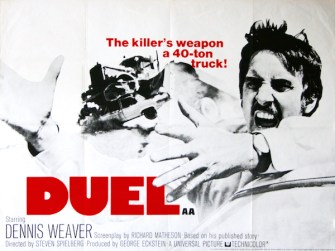
 As far as Americans are concerned, Steven Spielberg’s debut feature film was The Sugarland Express (which I reviewed just last year). For the rest of us, it was Duel. Originally produced as a TV movie for ABC, it was a ratings and critical success, which led Universal to have Spielberg shoot extra footage so they could release it theatrically in the rest of the world. It merits it, too, because Duel is a brilliant work.
Adapted by renowned Twilight Zone writer Richard Matheson from his own short story, the film sees ordinary family guy David Mann (Dennis Weaver) driving across the back of beyond to a business meeting, when he comes up behind a massive slow-moving truck. Perfectly reasonably, he overtakes and continues on his way… but a few seconds later, the truck thunders past him. “Whatever,” thinks Mann (in modern parlance)… until the truck slows down again. When he tries to overtake, the truck speeds up, or blocks his way. So begins a game of cat and mouse between the two vehicles, which mild-mannered Mann finds impossible to escape, as it becomes clear the mysterious truck driver is definitely trying to kill him.
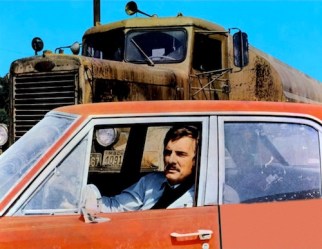
It’s an incredibly simple, straightforward premise; so simple that initially one struggles to see how Matheson and Spielberg intend to ring half-an-hour out of it, never mind a whole feature. That is to underestimate them, however; and to underestimate the truck driver, who has many ways of messing with Mann’s head — all without revealing himself (the one time he disembarks from his cab, we only see his boots as he paces on the far side of his vehicle). Never revealing the trucker’s face was Matheson’s idea, but Spielberg leapt on it wholeheartedly, because the scariest monsters are the ones you never see. Couple that with a specially-chosen truck (of the seven Spielberg ‘auditioned’, it was the one whose front most resembled a face) and you have a genuinely threatening presence.
Although Duel has been analysed as a horror movie, or a Western, or a commentary on class war in America, Spielberg didn’t see it that way, regarding it as a pure Hitchcockian suspense thriller. He’s bang on the money. It’s not scary in the way a horror movie would be, and I think calling it a Western is a bit of a reach, though I can kind of see where the class war thing is coming from; but you can absolutely see the ingredients for a Hitchcock movie here. Mann is an everyman (I’m sure his name can be no coincidence), a completely nondescript ordinary Joe, who gets caught up in extraordinary events against his will, and winds up the only person in a position to do anything about them. The truck is akin to the eponymous avians of The Birds, an everyday thing that seems to be acquiring almost supernatural powers; that you can never predict its next action, or where it will next appear, other than to know it will always be there, waiting for you. It’s a situation any driver — or, indeed, any passenger — can conceive of finding themselves in, which adds a “what would I do?” frisson to proceedings.
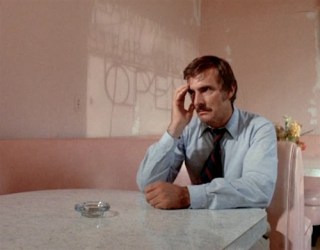 Weaver is excellent, plausibly charting a course from bland normality to apologetic paranoia, on to hopeless despair, ending in desperate lunacy. At one point he pauses at a roadside cafe to get a breather, but has reason to suspect one of his fellow patrons is his tormenter. As he tries to subtly surveil them, attempting to figure out what he can do to defuse the situation, Mann’s thoughts are narrated on the soundtrack; but we barely need it, because Weaver physically conveys all of his uncertainty, his fear, his wannabe-bravado. Sequences like this also demonstrate how Spielberg was already a master of camerawork and editing, guiding us as to where Mann is looking, shifting angles high and low, the constant changes in perspective not disorientating our sense of space but nonetheless keeping it off kilter.
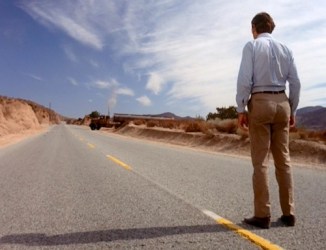
This applies tenfold to the road sequences. Spielberg was originally urged to shoot the film on a soundstage using rear projection, the only way to shoot a feature-length piece of this complexity in the time they had available; but he knew that wouldn’t be effective, so despite the insanely tight schedule he took the production out on the road and shot it all for real. Although he did run over in the end, the original TV movie was still shot in less than a fortnight, and edited in ten days to boot. (The additional photography for the movie version amounted to just two more days.) You wouldn’t know it. The array of complex setups on display is extraordinary if you’re looking out for that kind of thing; even if you’re not, there’s some fairly detailed road choreography in play at times, including dynamic moving material that can only have been achieved with a separate camera car. It’s no wonder this work brought Spielberg a lot of attention, and finally facilitated his long-desired move from TV into movies.
 Speaking of which, why has no one ever done a “TV work of Steven Spielberg” box set? There’s a short featurette on the Duel DVD (and Blu-ray) about the other TV productions he directed, and while I’m sure it can’t be his greatest work, he’s clearly not totally ashamed of it, and the clips shown suggest it’d be worth a watch. For one thing, being able to see the original TV edit of Duel would be interesting, for two reasons. First, it would solve the aspect ratio dilemma. The DVD is presented in 4:3, as it was originally shot for TV, even though it’s the movie cut. The more recent Blu-ray follows the cinematic framing of 1.85:1; however, it’s not just cropped and it’s not just widened: when they reviewed the footage to create the movie version, Spielberg discovered he could see himself sat in the back seat giving direction — so the final print is both widened slightly and cropped slightly. I guess which is ‘right’ is now a matter of personal preference, though the Blu-ray undoubtedly looks tonnes better in every other respect.
Secondly, it would be interesting to see Duel without the material that was added to pad the length. Specifically, that includes: the opening credits, where Mann backs out of the garage and drives through the city; when he phones his wife from the gas station; the scene at the railroad crossing; and the school bus. With the exception of the railway crossing, which is in-keeping with the focus of most of the rest of the movie, these are exactly the kind of scenes that feel added. That’s not to say they’re badly done, and if you didn’t know there’d been footage added they possibly wouldn’t stick out at all; but it would be interesting to see a version that less dilutes the otherwise near-unwavering concentration on Mann vs. Truck.
 Nitpicks and “what if”s aside, Duel is a fantastic calling card from a director who has gone on to become arguably the most significant and influential filmmaker of the ensuing 45 years. To say it stands in contention to still be regarded among his finest films does no disservice to the body of work he’s produced since, but rather indicates just how assuredly he hit the ground running.

Duel is on The Horror Channel today at 6:40pm and tomorrow at 8am.
* Duel’s initial rating under the modern system was PG in 1987, which stood until 2015 when it was resubmitted (presumably for the Blu-ray) and inexplicably given a 12 — “inexplicably” because even the BBFCinsight information doesn’t make the reasoning clear. It appears to be because of “threat”, which is a ridiculously vague non-justification. ^
 The BBC’s long-running spy thriller series
  Early seasons focused at least as much on things like the mundanity of spycraft, or how one went about having a personal life while also being a sometimes-undercover agent, as they did on the exciting action of counterespionage — as evoked in the memorable tagline “MI5 not 9 to 5”, of course. As the years rolled on, things got increasingly outlandish and grandiose, just as almost every spy series that starts out “grounded” is wont to do. In season three, an entire episode was spent on the moral dilemma of whether it was acceptable to assassinate someone; a couple of years later, assassinations would just be a halfway-through-an-episode plot development. The one constant through all this was section chief Harry Pearce (Peter Firth), the M figure to a rotating roster of “James Bond”s, including Matthew “
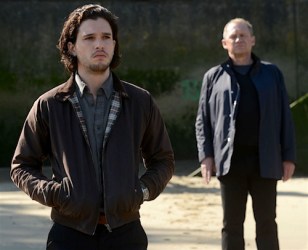
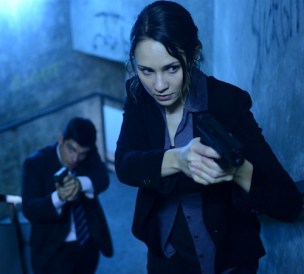 But I’m getting ahead of myself. The story begins with Harry running an op that goes wrong, during which terrorist Adam Qasim (Elyes Gabel) is sprung from custody just before being handed over to the CIA. Cue international incident. Naturally the blame is pinned on Harry, who consequently throws himself off a bridge. Except no one buys that, so they drag in Will Holloway (Kit Harington), a disenchanted one-time protégé of Harry’s (i.e. the series’ latest “younger man who can do the running around”). He knows nothing about it (
 The trailers attempt to promise some of that kind of action, but they’re a bit of a cheat: what adrenaline the film has is mostly released in tiny bursts, scattered throughout. That strategy is fine if you’ve got the money to make each little burst a solid sequence, but when the entirety of some sequences is “jumping through a window” or “climbing a wall to get into a flat”, well… Sure, it looks good in the trailer — it promises lots of action in different places at different times — but that’s also a promise the movie can’t fulfil. The Greater Good certainly isn’t just a low-rent action movie — it’s driven by its plot — but if they’d saved up the filmmaking time, effort, and expense afforded to those single-dose action moments and poured it all into one sequence (in addition to the two or three fully-realised action sequences that the film does have), it might’ve paid dividends.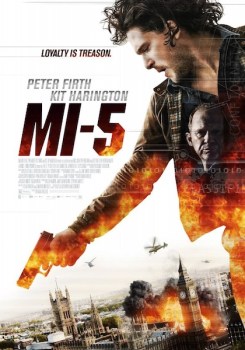

 100Films.co.uk