
Armando Iannucci | 119 mins | cinema | 2.35:1 | UK & USA / English | PG / PG

A fresh perspective on Charles Dickens’s favourite of his own novels, from co-writer/director Armando Iannucci, best known for sitcom The Thick of It, its spinoff movie In the Loop, and The Death of Stalin.
Those are all political satires, of course, whereas David Copperfield is more of a shaggy dog story; though its attracted some degree of ‘political’ commentary thanks to its colourblind casting. So let’s get that out of the way first. Not every character here is played by a white actor. Is every character in Dickens’s novel white? I dunno, probably. Is it unrealistic to have people of colour in a story set in Victorian England? Well, considering England was at the heart of a worldwide empire with global trade links and had been through the slave trade, I would guess not everyone in the country was white by that point. I’m no expert on this, but I’ve certainly seen comments by experts that would agree with that.
Now, all of that said, David Copperfield’s attitude to casting is the most genuinely colourblind I’ve ever seen — it’s not concerned that related characters have ‘plausible’ similar skin tones, even. It seems Iannucci has just cast whichever actor he felt was right for the role. I guess that’s going to prove an insurmountable barrier to some people; too great an ask to accept the ‘reality’ of the story. Whereas a giant hand crashing through a ceiling to pluck little David from comfort, well, that’s just dandy. Anyway, I’m already getting bored with this debate and I’ve barely written about it. If it bothers you, I don’t think it should, but hey, you do you. For the rest of us, we can just get on with enjoying everything else the film has to offer.

And that’s quite a bit. Dickens’s novel is a thick tome (768 pages, as per the film tie-in edition), and here it’s been condensed briskly into just under two hours, so there’s a lot more going on than the colour of people’s skin. It’s a semi-autobiographical tale, and Iannucci emphasises that side of it by framing it as David telling his own story at a staged reading. Such a framing device also allows for some flights of whimsy in the film’s treatment of certain things, especially scene transitions, but to say too much of those would destroy some delightful surprises. Trust that Iannucci is doing more than just showing off or messing around, however, instead establishing a style that allows for a neat twist or two later on.
I don’t know how thoroughly the film adapts those 768 pages, but it feels like it’s trying to cram in as much as possible. It rattles by at a whipcrack pace, which is both one of its greatest assets, because it moves like the clappers, and its biggest drawbacks, because it winds up feeling a bit too long. Every time you think it’s getting to the end, there’s another bit. (Maybe this is less of a problem if you’re familiar with the whole story, which I was not.) This is a minor complaint, though, because while those 119 minutes may be a few more than seems strictly necessary, what’s within them is frequently riotously funny. I saw the film with an almost-full house, and it was clear everyone was having a whale of a time.
The same appears to be true of the cast. I suppose Dev Patel is best known for heavier stuff, like Slumdog Millionaire (though that was 12 years ago now (jeez)) and Lion, but here reminds us he’s adept at lighter material too (which shouldn’t surprise anyone who’s seen the Marigold Hotel films). Elsewise, the extensive and sublime supporting cast vie for attention in an array of standout performances. For my money the winner (if we must pick one) is Hugh Laurie as the flighty but unfailingly kind Mr Dick. Plus it’s quite nice (or you could say “nostalgic”) to see him back in bumbling toff mode after years of things like House and The Night Manager.
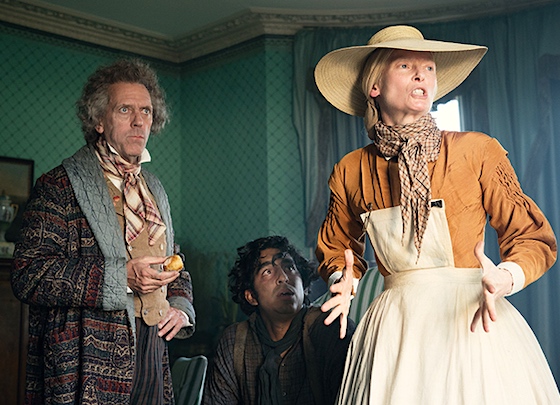
Not that the others don’t get their moments to shine — when you’ve got the likes of Tilda Swinton, Peter Capaldi, and Ben Whishaw involved, you’d expect nothing less. I could go on listing recognisable names, for there are plenty here, but you can always just read the cast list for yourself. One of the most noteworthy is Morfydd Clark in a dual role, one of which likes to mainly talk through her dog. I suspect this may be another stop on her path to stardom — she was recently seen in the BBC’s Dracula and a small-but-memorable role in His Dark Materials, and has been cast as Galadriel in Amazon’s Lord of the Rings series.
So there’s a lot of talent on screen, but it takes that degree of skill to negotiate the tone Iannucci has set: a narrative full with comedy, but that doesn’t lose sight of an underlying heart. Indeed, the degree of humour is a welcome counterpoint to the machinations of the plot, which contain an array of miseries when looked at objectively — death, loss of home, betrayal, and so on. This is again perhaps where that framing device comes into play, setting the story as a man finding the (sometimes dark) humour in the list of tragedies that have befallen him, as well as his friends and family. David’s predilection for storytelling is an important throughline, and the film’s affection for the emotional power of the act of writing is sure to make it a favourite for many authors (and wannabes).

The Personal History of David Copperfield is in UK cinemas now. It’s released in the US on May 8th.


 Score:



 The latest from Marvel (or Marvel Studios, as they’re now branded, presumably in a bid to differentiate themselves from the properties owned by other studios that have been only too keen to use the Marvel logo and blur the line for the casual moviegoer) opens the door on a new facet of their shared cinematic universe, though does so in a movie whose plot follows the familiar “superhero origin story” rulebook. On the bright side, Doctor Strange has several other qualities to recommend it.
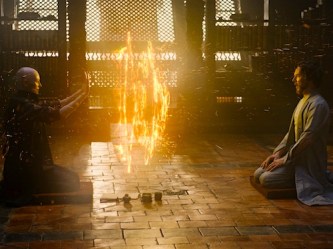 where the incredible effects are half the point — seemed dead in an era where every movie has CGI and every blockbuster has its share of once-impossible visuals. Strange demonstrates the form can be alive and well. The way the effects are created — with green screen and pixels — is the same as any other movie, but the designs and the visual imagination are exciting.
 Then there’s the cast. Obviously keen to avoid being typecast after playing an arrogant British genius in both
 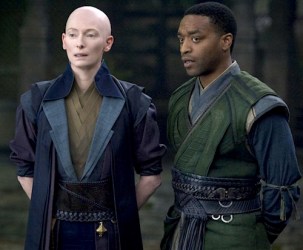 Besides, one of the film’s best characters is of Asian ethnicity, so it kinda balances out. That’s Benedict Wong as the sorcerers’ librarian, who’s likely to emerge as the film’s most popular character. It helps that viewers aren’t likely to expect much of him. Conversely, Chiwetel Ejiofor and Rachel McAdams are seriously underserved, perhaps hoping for more meat in the no-doubt-intended sequel(s).
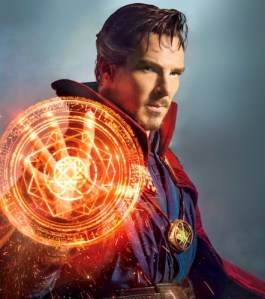 a teaser for another Marvel film, the other relates to the plot of the movie we’ve just seen. The former is first (and about 10% of my screening walked out before it came on) and the latter is, obviously, second (by which time about 90% had left). Those percentages ‘matter’ because, a) how do people not know Marvel’s rep for these scenes by this point?, and b) I think the scene related to the film you’ve just watched is the one that should be more attached to it, with the ‘teaser trailer’ being a fun bonus for those dedicated to stick around to the bitter end. But maybe that’s just me.
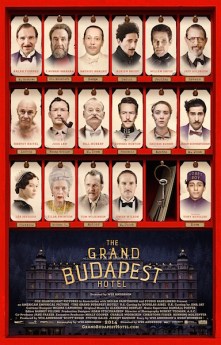 The latest from cult auteur Wes Anderson, which managed that rare feat of enduring from a March release to being an awards season contender, sees the peerless concierge of a magnificent mid-European hotel (Ralph Fiennes) accused of murdering a rich elderly guest (Tilda Swinton, caked in Oscar-winning prosthetics) and attempting to flee across the country to clear his name. More or less, anyway, because this is a Wes Anderson film and so it takes in all kinds of amusing asides, tangents, and recognisable cameos.
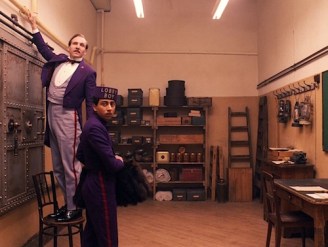 I suppose the kooky idiosyncrasies of Anderson’s brand of storytelling and filmmaking will rub some viewers up the wrong way, looking on it all as vacuous affectations signifying nothing. To each their own, but, whatever the merits (or not) of Anderson’s style as a kind of one-man genre played out across his oeuvre, The Grand Budapest Hotel displays a synthesis of contributing elements that creates a movie that’s ceaselessly inventive, surprising, amusing, and entirely entertaining.
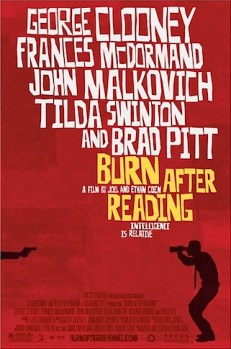 Ah, the Coen Brothers! Those indie-mainstream praise-magnets that I’ve never particularly got on with. But then, perhaps I was just too young and under-read (or, rather, under-viewed) to get
  For the characters in the film, it’s a confusing mess of a situation they find themselves embroiled in — no one has the full picture, and most don’t properly comprehend the bit they do see. For the viewer, it’s a fun bit of nothing. Things have changed by the end, certainly — most notably, several people are dead — but the events that got us there are pretty quickly forgotten.
 100Films.co.uk