
Peter Jackson | 187 mins | Blu-ray | 2.40:1 | USA & New Zealand / English | 12 / PG-13
 At the start of their audio commentary on The Desolation of Smaug, co-screenwriters Peter Jackson and Philippa Boyens note that, when the decision was made to extend the already-shot Hobbit duology to a trilogy, it wasn’t a third movie that need to be created but a second. That is to say, it was the middle instalment that required the most extra material, including a new prologue and climax. The theatrical version rather felt like that had happened, too, and now we have a cut with 16% more again.
Fortunately for new-stuff spotters, most of these additions come in the form of whole scenes, rather than tiny extensions here and there. In total, there’s almost 27 minutes of new material, plus a little over 90 seconds removed (all of it moments that seem to have been added to the theatrical edition to cover for now-reinserted scenes). That’s a pretty significant amount, and it does impact on some facets of the story, but not enough to change the overall feel. That said, I did like the film a little better, but I’d attribute that as much to simply watching it again: things that bugged me last time felt less irksome, like how long was spent on Legolas fighting orcs at the end, for instance.
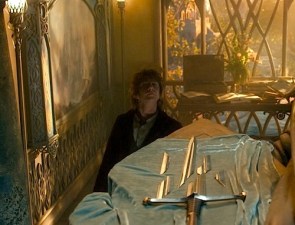
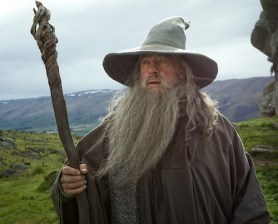
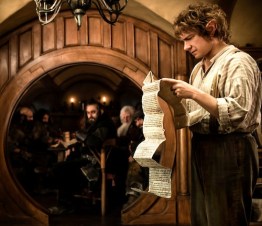
One thing I never had a problem with, unlike some others, is the film’s proportion of Bilbo: some say the titular hero is sidelined, with too much focus on Thorin and Gandalf as a result. Two things: one, despite the title, this is clearly structured as an ensemble movie — of course other characters are going to get some of the focus. Second, there’s actually loads of Bilbo! He saves everyone from spiders in Mirkwood, he saves everyone from imprisonment by the wood elves, he’s the one who finds the keyhole at Erebor, he goes into the mountain and has a long confrontation with Smaug, he’s the first face we see after the prologue and the last we see before the credits. And those are just the highlights. 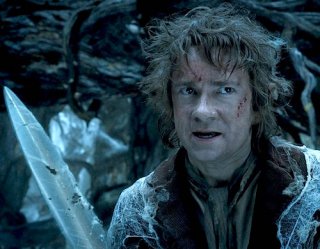 The extended cut amps him up even more, with an extra part in Mirkwood and a moment where he stands up for Thorin in Laketown. In fairness, he doesn’t have as much character development in this film as the first, while Thorin is on a definite arc and Gandalf is off on his own side-plot, but he’s undoubtedly a key character. I really don’t understand that complaint.
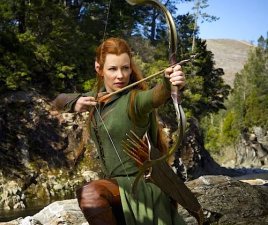
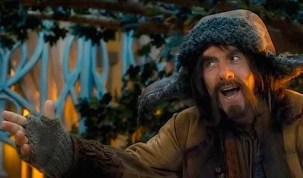
Of the new stuff, however, the best addition is more Beorn, authoritatively played by Mikael Persbrandt. He felt underused and half-arsed in the theatrical version, like they’d cut out a book character to make way for more film-added stuff later on. I have no idea how big his role is in the novel, but Tauriel and her dwarven love triangle aren’t in there at all, so I can well imagine some would rather have more of the skin-changer (whether from the novel or not) than the interspecies romance. Here, we get more of a sense of him as a character, with two whole worthwhile scenes supplementing his sole one from the other cut.
Other notable additions include an extended bit in Mirkwood, where the party have to cross a river; some more of Stephen Fry as the Master of Laketown; and a whole additional character encountered by Gandalf at Dol Guldur, played by renowned actor Sir Antony Sher, under so much make-up you’d never even know. There are more bits and bobs, including additional lines that set up some of the aforementioned new scenes, but nothing as significant as these. Some build on storylines first included in the extended cut of An Unexpected Journey, others are just on the level of “we shot this so here it is”.
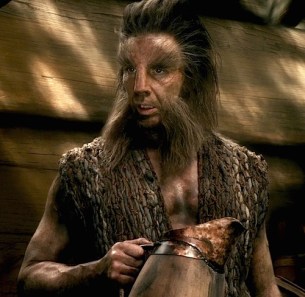 Even if some of the additions are worthless, on balance this is a better version of the film: more Beorn, more of the atmospheric Mirkwood, an additional character whose appearance will hopefully pay off in the extended Battle of the Five Armies (presuming it can’t have done in the theatrical version); plus simply watching the film for a second time helps iron out some of the pacing and emphasis problems I had on my first viewing. It’s still the weakest of Jackson’s Middle-earth films, and there are many issues with splitting one film in two (which I expect to rear their head again in the third film, with how some of the decisions pan out), but it isn’t all bad.

In case you missed it, my review of the theatrical cut can be read here.
The concluding part of the trilogy, The Battle of the Five Armies, is 2015’s #36. It’s released on DVD and Blu-ray in the US tomorrow and in the UK on 20th April. I’ll have a review nearer that time.
 The Desolation of Smowg-not-Smorg begins in the same way
  It’s my understanding that the originally-planned (and shot) two-part version of Jackson’s Hobbit adaptation was transformed into a trilogy by, essentially, taking what was to be film #2 and splitting it in half. That might explain why individual sections are allowed to go on so long here: to bulk up the running time to the kind of epic proportions audiences expect from a Middle-earth movie. Anything less than two-and-a-half hours isn’t going to cut it. But when your climax is a battle between a giant dragon (cool!) and a small army of dwarves (kick ass!) around a deserted underground city (hell yeah!), but my main thought afterwards is, “God that went on a bit”, then you’ve failed at something.
 Meanwhile, Luke Evans’ Bard is as Welsh as the actor’s name suggests, which is a little bit of a surprise. But then the dwarves’ accents have all the rest of the UK covered, so why not. Benedict Cumberbatch sounds like Benedict Cumberbatch playing ‘big’ as Smowg-not-Smorg. It feels like this should be an iconic villain performance but, while good, I found it somehow lacking. Expectation may be scuppering him; maybe I’ll warm to it on future viewings.
 I haven’t picked apart everything that’s wrong with the film (what purpose is there switching from one made-up-for-the-film orc general to another?!), but then nor have I praised everything that works (there are some quality actors in amongst all that crashing and banging). It seems a fair few people liked this Hobbit instalment more than the first; the best explanation I can find is, “because it’s got more action”. Far be it from me to accuse other film viewers of being shallow, but… really? I genuinely enjoyed An Unexpected Journey as a return to the beloved realms and peoples of Middle-earth. The Desolation of Smowg-not-Smaug has some of that, and the charm of introducing us to new parts of the world too, but it’s drowned out by so much aimless noise. Here’s hoping it improves with repeat viewings and/or the inevitable extended edition, because this time I nearly slipped down to a lowly 3 stars.
 Few would deny that Peter Jackson’s extended versions of
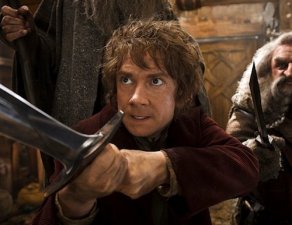
  There’s not as much extra time with the dwarves as I expected, though, with most of the character time still going to Bilbo.
 having to work alone on a green screen for many of his scenes with the smaller characters), but newcomers Martin Freeman, Richard Armitage and James Nesbitt shine too. This is Freeman’s film to be the centre of attention, but Armitage and Nesbitt will have much more to do in the follow-ups, and the groundwork is nicely laid here.
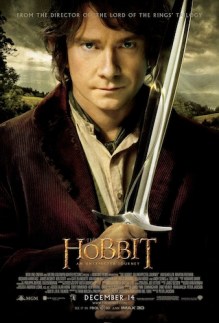 So here we are: nine years after his last tour of duty in Middle-earth, and after a Guillermo del Toro-shaped attempt at not having to serve again, Peter Jackson returns to the world of hobbits, dwarves, elves, orcs, and the rest, to tell the tale some have been clamouring for him to make since
  And, I have to say, as someone who hasn’t read the novel since primary school, I couldn’t spot the joins. I could take some guesses, but not many, and considering how long the film is I’m sure there must be quite a lot added.
 but I could have, and knowing you can do something makes all the difference. There’s also the little timer on the Blu-ray player, which means I can know that it took forty minutes to get out of Bag End rather than just thinking it feels like it. Does that somehow make it more palatable? Would I have been as bothered as others by the film’s length and pacing had I seen it in a cinema initially? It’s tough — nay, impossible — to say, because while there are those other subliminal factors, I also felt like I flat out enjoyed the film for itself, not just for my potential ability to escape it. But it is long and it is episodic, so maybe the association of watching individualistic episodes of TV back to back feeds into the acceptance of that? It’s a circular argument, so we’ll leave it there.
 Howard Shore returns to deliver another fantastic score. After he composed the iconic Fellowship theme for, um, Fellowship, I thought he could never muster anything else as monumental. And, in fairness, that theme is still the defining aspect of the series’ score (its absence here is at times felt, by me at least); but he produced another excellent motif for
  Without the breadth and world-changing story of The Lord of the Rings, The Hobbit was always going to be a somewhat smaller experience. By emphasising the backstory of the dwarves’ stolen homeland and the hints of war-to-come that will ultimately lead in to Rings’ story, Jackson has made it considerably more epic — for good or ill. For me, the whole experience clicked. I don’t think it’s as good as Lord of the Rings, but it is the next best thing.
 So many consumers hold off for the DVD these days, especially with the added quality offered by Blu-ray, that the old answer of “what was released in the cinema” doesn’t necessarily hold true any more. Filmmakers know some will be waiting for the DVD, so are less concerned with releasing a studio-mandated, shorter, mass audience friendly cut into cinemas when their fuller vision can be found on DVD. Equally, the PR people know that “longer cut!” and “not seen in cinemas!” and other such slogans can help sell DVDs, and so may be forcing needless and unwelcome extensions onto filmmakers. Then there’s all those older directors who think they’re doing a good thing finally getting to tamper with their film 30 years on, who may well be misguided.
 There remains one argument for clarity, I think. How does one guarantee that, in the future, the ‘correct’ version remains accessible? With new formats always coming along, there’s no assurance that every cut of a film will be released; with TV showings, there’s no assurance the preferred version will always be the one shown (though there’s another argument for how much the latter matters considering they already mess around with aspect ratios and edits for violence/swearing/sex/etc.) But then, even if a filmmaker makes it clear that their preferred version is the one that only came out on DVD/Blu-ray, what chance is there that unscrupulous disc / download / unknown-future-format producers or TV schedulers won’t just revert to the theatrical version by default?
 Made by the people behind the large
 100Films.co.uk