
We begin this month with a vision of the future — the future being… erm, yesterday? Timelines get confusing when you’re writing about February in early March, but you’re also doing that writing before the post is posting… Anyway, what I’m getting at is, I went to see Dune: Part Two yesterday, which is a March release, but has a bearing on February’s failures insofar as it means this could be the last month of 2024 where I begin this column with a comprehensive(ish) overview of major UK cinema releases. (Do I really think I’ll make it to the cinema every month for the rest of the year? No. But do you have any idea how tough it is to find a broadly-interesting and/or fresh way into this column every month?)
So, what films did I miss in February? Well, there was Sony’s latest attempt at crashing the rep of the MCU by playing on the general public’s lack of awareness about the difference between a Marvel Studios movie and a movie based on a Marvel comic, Madame Web, which is reportedly at least as terrible as the trailers promised. Once upon a time this would be a definite “catch it later”, but I’ve still not seen Venom 2 or Morbius (fellow Sony Spider-Man-derived films), nor a whole bunch of actual MCU films, so… More likely to get a play as soon as it’s available at home (in this case, when it becomes part of an Apple TV+ subscription) is the latest from director Matthew Vaughn, Argylle. That also attracted much derision on social media, but, well, I actually liked the trailer, and I’ve enjoyed most of Vaughn’s films (even the maligned ones like Kingsman 2), so I’m still cautiously looking forward to it.
Elsewhere, there were alphabetically-opposed Oscar nominees American Fiction and The Zone of Interest; a belated UK release for The Iron Claw, and an even more belated theatrical bow for Pixar’s Turning Red; filthy-mouthed Britcom Wicked Little Letters (another I look forward to streaming eventually); and some other stuff that, frankly, I don’t even care to bother mentioning. There’s always a bunch of “other stuff” in cinemas, but if it’s not actually screening near me or I don’t have a strong compulsion to catch it eventually, is it really a “failure”?
So, on to the streamers. The only true new release there that I’ve noted this month is Orion and the Dark, a kids’ animation on Netflix from Charlie Kaufman. Wait, what? Am I sure it’s for kids? Well, it looked like it, but his last animated film certainly wasn’t, so maybe I’m mistaken. Not that I’m not interested, but you can tell my level of interest from the fact I’m not sure. Actually, of more interest to me on Netflix this month was 12th Fail, an Indian film that jumped high onto the IMDb Top 250 late last year, and thus is eligible — nay, should be a key objective for — this year’s WDYMYHS challenge. Just need Poor Things on subscription streaming and Godzilla Minus One to get some kind of home release, and I’ll have the full complement available to me again. Other notable Netflix newcomers included another 2024 Oscar nominee, Past Lives; Ken Loach’s latest, The Old Oak; Mark Rylance gangster thriller The Outfit; and tennis biopic King Richard.
Other recent films making their subscription streaming debuts included The Marvels on Disney+ (I’ll wait until I can pirate the Japanese 3D Blu-ray, thanks… then add it to my pile of MCU flicks I’ve not seen) and Wes Anderson’s Asteroid City on Sky Cinema / NOW, who also had a few other bits and bobs I won’t watch for years, if ever, so why list them? Not a streaming debut (it’s already been on MUBI), but new for a wide audience, Aftersun aired on the BBC this month, and so was on iPlayer afterwards. Does that change how likely I am to get round to watching it? Well, I had access to MUBI the whole time it was on there, so…
Talking of MUBI, their big add this month (at least in terms of actually seeing it promoted) was La Antena — the first movie they ever streamed, apparently, making its return after… however long. I saw it 15 years ago on TV and enjoyed it a lot. I’d like a decent and accessible disc release, but failing that, I ought to take the opportunity to catch it while it’s streaming. Other films of note on the arthouse streamer this month were François Truffaut’s Jules et Jim and Roberto Rossellini’s War Trilogy — Rome Open City, Paisan, and Germany Year Zero — all of which are acclaimed to one degree or another, so I ought to watch them all.
Amazon Prime are conspicuous by their absence so far, considering they often rival (or attempt to) Netflix for splashy premieres or big streaming debuts. Maybe they were focused on launching a series or something instead, I don’t know. Even their back catalogue additions that caught my eye this month were deep, old cuts, like Images, the 1972 British psychological horror film written and directed by Robert Altman; or It Happened Tomorrow, a sci-fi fantasy film from 1944; or The Long Night, a noir starring Henry Fonda and Vincent Price; or Lured, a British serial killer thriller starring Boris Karloff, George Sanders, and… Lucille Ball? And directed by Douglas Sirk? You what? I really should watch some of this stuff… Well, that’s the whole point of this entire column, isn’t it?
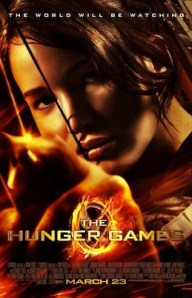
But what I really should watch more of are all those Blu-rays I keep buying. Yes, there was another plentiful pile this month. Let’s start at the top end, i.e. 4K Ultra HD, with prequel The Hunger Games: The Ballad of Songbirds & Snakes — the only brand-new film I bought this month, actually, with everything else being catalogue titles. Sticking to 4K, those included Arrow’s box set of The Conan Chronicles (aka Conan the Barbarian, which I have seen before, and Conan the Destroyer, which I haven’t), StudioCanal’s remaster of Michael Powell’s Peeping Tom, and the Masters of Cinema edition of Stanley Kubrick’s Paths of Glory. Also from Eureka was a double-bill of Japanese gangster thrillers in Yakuza Wolf 1&2 (the film’s subtitles — I Perform Murder and Extend My Condolences — sound almost like Spaghetti Westerns or poliziotteschi, which feels promising). Talking of poliziotteschi, 88 Films returned to the genre with Street Law, while Radiance offered their typically eclectic stylistic spread with a bundle of releases that included historical drama Allonsanfàn, ’60s spy-fi adventure Black Tight Killers, and an “ambitious revision of the yakuza movie”, By a Man’s Face Shall You Know Him.
Aside from new releases, pickups of older titles (thanks to various multibuys and offers) included Warner Archive’s release of noir Angel Face, Criterion’s edition of Häxan, Flicker Alley’s collection of Georges Méliès Fairy Tales in Colo[u]r, and a couple of multi-film releases of independent utlra-low-budget genre exercises via 101 Films: Wakaliwood Supa Action Vol.1 (including cult favourite and former Letterboxd Top 250er Who Killed Captain Alex, which I’ve seen and will happily revisit, and the director’s later Bad Black), and Treasure of the Ninja, which also includes several other works by director and martial artist William Lee, chiefly Dragon vs. Ninja. Some people say physical media is dead, but you’re not likely to find wonders as diverse and obscure as this on any streamer.






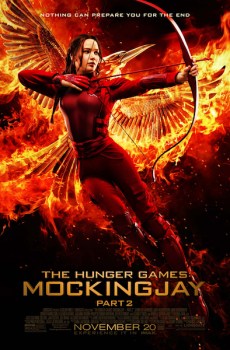 The artificially-extended Hunger Games trilogy-turned-tetralogy climaxes here. Presumably you’ve seen the first three and so know what you’re into by this point — either you’re invested or you’ve given up. Unless you want to know “does it end well?” before embarking on the whole thing, of course. While Mockingjay Part 2 is not the series’ finest instalment, it brings things to a decent head… eventually.
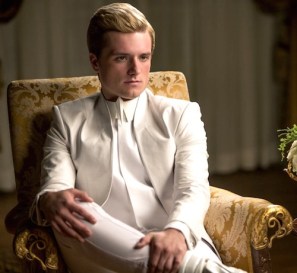
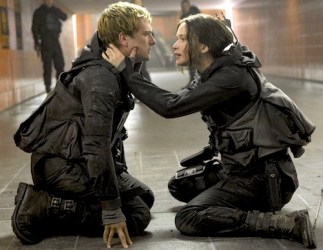 What follows isn’t perfect — in particular, the storyline could’ve done with tightening up — but it does have a lot going for it. There’s strong characterisation: Katniss is as confused, conflicted, and incapable of engaging with her emotions as ever, while Peeta’s PTSD is well-handled, with an effective device where he repeatedly makes a statement before asking, “real or not real?” There are other nicely developed thematic points too, like expanding further on the rebels not being perfect good guys (as initiated in Part 1), which plays a central role in the denouement. The action sequences are well staged and occasionally inventive, but best of all is that the climax doesn’t lean on being the biggest fight scene yet — it’s driven by the story, and the characters and their decisions, rather than being a ginormous shoot-out.
 Mockingjay Part 2 is not the best instalment of the Hunger Games, a series whose second half didn’t quite live up to the developed potential of the excellent
 If you’re not au fait with the
  as both sides attempt to rally ordinary people to their cause through the power of the media. It’s a tale that’s as timely as ever, surely.
 I must say that (as someone who hasn’t read the book) it didn’t feel overly like the first half of something longer to me. Of course there’s a cliffhanger and stuff, but there was at the end of the last film as well. This is no worse than that. If anything, I felt Mockingjay Part 1 built to its ending more successfully — I was quite surprised when
  it may be your favourite instalment so far (and you wouldn’t be alone in that view). For me, Catching Fire is the best of the three because it crystallises both of those constituent elements; and if the first film was purely the action side (with a bit of the politics), then here we find its mirror image: purely politics (with a bit of action). Either way, perhaps the ultimate fate of all these films rests on how well
 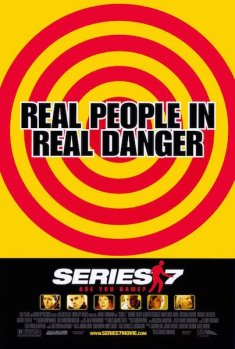 The debut of director Daniel Minahan — who’s since helmed episodes of over a dozen TV shows, including HBO hits
 25 years before Jennifer Lawrence had to
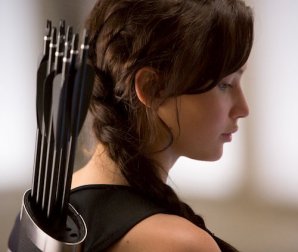
  Jennifer Lawrence (who, depending on your mileage, is either “the most charming young movie star in, like, forever” or “actually kind of a little bit irritating”) returns as the totally-plausibly-named Katniss Everdeen in this super-successful follow-up to the super-successful
  Tonally, however, it’s more similar to
  Of course, to an extent the tone of this ending comes from it being an adaptation: the filmmakers haven’t looked at the history of movie cliffhangers and chosen which to emulate, but instead brought someone else’s ending to the screen. Adapting doesn’t mean you have to take the original work faithfully, mind — you could go the
  which seems richer, more detailed, despite no genuine increase in resolution. I guess it’s true what they say: if you start with a higher quality source, it filters all the way down. The “bigger screen” effect probably wouldn’t work for a film entirely shot on IMAX — it’d just fill your TV from the start — but, after an hour-or-so of black bars, it really feels like the screen has grown.
 Seen by some as a
  100Films.co.uk